“There is no spoon” is a classic line from The Matrix. Reality is a construct. I agree, but I’m not sure I believe that we can get under this reality to experience it differently. And this might hinge on a distinction between experience and perception.
Losing Ourselves is a book just published in the US and forthcoming (July 2022) in the UK promoting the Buddhist notion of no-self or selflessness. I’ve been partial to Buddhism since, when I lived outside of Tokyo, I was exposed to it in 1980.
Book Cover: Losing Ourselves
For me, this intersects with my anti-Agency endeavour. If the Self is a construct, there is no Agent, and without an agent, there is no Agency. I realise that this is a meta-position and not uncontroversial, but I do like to collect ideas and perspectives in my quiver.
Obviously, there seems to be a strong drive (at least in the West) to construct selves, not the least of which serves the purpose of an object to confer praise or blame. Interestingly, I’ve heard much about objectification, but not many seem to care about this form. It’s more about sub-objectification.
It’s OK to parse the person from the fabric of the universe, but don’t further disintegrate that person.
Caruso: [Dan,] you have famously argued that freedom evolves and that humans, alone among the animals, have evolved minds that give us free will and moral responsibility. I, on the other hand, have argued that what we do and the way we are is ultimately the result of factors beyond our control, and that because of this we are never morally responsible for our actions, in a particular but pervasive sense – the sense that would make us truly deserving of blame and praise, punishment and reward. While these two views appear to be at odds with each other, one of the things I would like to explore in this conversation is how far apart we actually are. I suspect that we may have more in common than some think – but I could be wrong. To begin, can you explain what you mean by ‘free will’ and why you think humans alone have it?
Gregg Caruso
Dennett: A key word in understanding our differences is ‘control’. [Gregg,] you say ‘the way we are is ultimately the result of factors beyond our control’ and that is true of only those unfortunates who have not been able to become autonomous agents during their childhood upbringing. There really are people, with mental disabilities, who are not able to control themselves, but normal people can manage under all but the most extreme circumstances, and this difference is both morally important and obvious, once you divorce the idea of controlfrom the idea of causation. Your past does not control you; for it to control you, it would have to be able to monitor feedback about your behaviour and adjust its interventions – which is nonsense.
In fact, if your past is roughly normal, it contains the causal chains that turned you into an autonomous, self-controlling agent. Lucky you. You weren’t responsible for becoming an autonomous agent, but since you are one, it is entirely appropriate for the rest of us to hold you responsible for your deeds under all but the most dire circumstances.
Daniel Dennett
if your past is roughly normal, it contains the causal chains that turned you into an autonomous, self-controlling agent
Dan Dennett
So commences this debate. The argument unfolds largely on semantic grounds. Even here, one can see the debate over the distinction between control and causation. I understand what Dennett is attempting to parse here, but I object on the grounds of causa sui.
I recommend reading the Aeon article as there is much more than this distinction, but it does remain a semantic issue. I started a post on backwards- and forward-looking perspectives, that better articulate Caruso’s perspective, but I am also working on other things. This was quicker to post and I wanted to keep a bookmark anyway, so it’s a win-win.
Agency is going through the same fits as religion. When Nietzsche regarded society around him at the time, he declared that God is dead and asked now what? This is precisely the same challenge in different clothes.
Preserving “law and order” without a concept of real responsibility is a daunting task.
Dan Dennett
Without a God to use as a bully pulpit and mechanism of fear, how could we keep people in line in cohesive societies? Without the notion of human agency to allow for responsibility and blame, how can we keep people in line in cohesive societies? Only the predicate has changed, but the question remains, do we persist in lying for the so-called greater good? This is similar to the Santa Claus myth to keep young children in line.
If nobody is responsible, not really, then not only should the prisons be emptied, but no contract is valid, mortgages should be abolished, and we can never hold anybody to account for anything they do. Preserving “law and order” without a concept of real responsibility is a daunting task.
—Dan Dennett, “Reflections on Free Will” (naturalism.org)
One might like to think that lying is psychologically pathological, but it seems to be a significant part of the human condition. The fundamental question doesn’t appear to be ‘should I tell the truth’, but rather ‘Can I get away with lying?’ Despite all the talk of Truth and integrity, this seems to be the default state of humans. This renders integrity just another lie. But you knew that already, but let’s not fall into another Foucauldian rabbit hole.
We no longer have any sympathy today with the concept of ‘free will’: we know only too well what is is — the most infamous of all the arts of the theologian for making mankind ‘accountable’. . . Everywhere accountability is sought, it is usually the instinct for punishing and judging which seeks it… the doctrine of will has been invented essentially for the purpose of punishment, that is of finding guilty.
— Twilight of the Idols: ‘The Four Great Errors’, 7
Whenever I hear the phrase, ‘We don’t need to argue semantics’, two thoughts come immediately to mind.
We do need to argue semantics
Your position is shrouded in the ambiguity that you’d prefer remain intact—even if you are unaware of the ambiguity
This might be something less, but I find that many philosophical arguments are caused—at least in part—by a lack of a common foundation.
A common response to a ‘definition check’ is ‘you know what I mean’ or ‘everyone knows what X means’. My response is, respectively, ‘I might know what you mean, but I want to be sure’ or ‘great, so this should be easy for you to provide’.
I’ve spend some hours cobbling together another video that I labelled Free Will Scepticism: Would-Be Agency & Luck. I’ve embedded it here. The script is below.
Human agency does not exist. Free will is an illusion. Like the appearance that the sun rises in the east and sets and the west, we only appear to have free will.
There are some nuances and varying degrees of this belief, but if one believes in the scientific notion of cause and effect, that every effect is the result of a prior cause of causes, one inevitably ends up in this camp.
Video: Free Will Scepticism: Would-Be Agency & Luck
[REDACTED]
Without going into details because the focus of this segment is on luck, I’d still like to set the stage for the uninitiated.
Regarding the universe, we recognise a relationship between cause and effect. If we rewind to follow this logic back to the beginning of time and started again, we’d end up in exactly the same place. This is known as deterministic. What happens next is determined by what happened before.
And this is not just a scientific view. Those who believe that God caused the universe can arrive at this same place.
Owing to advancements in scientific thought, most philosophers today do not believe that the world is deterministic, per se. Given theories of quantum mechanics and probabilistic outcomes, they believe in so-called natural physical laws, but probability is also part of this model.
One may strike a billiard ball with a cue stick to cause it to strike another ball, knocking it into a pocket. In our knowledge of the universe, this is unsurprising. If one set this up mechanically, leaving no room for variation, we could run this scenario over and over again forever, and the ball would go into the pocket every time. The outcome is established by the laws of physics.
Billards Animated GIF
Actually, this is just another illusion. The laws of physics cause nothing. They are just a way of describing how things unfold in our universe. But just like saying that the sun rises in the east, we can employ idiomatic language and people know what we mean.
This was an illustration of determinism. Indeterminism accepts these same laws, but it adds an element of probability. In our mechanised billiards example, perhaps a ball is randomly rolled across the table in such a way that it might interfere with the path of the balls.
If the random ball does not interfere with the path, its presence is irrelevant. If it does interfere, there are a few different outcomes.
One, it knocks a ball off course, so the final ball does not go into the pocket.
Two, its path is such that although it collides with a ball, this event does not interfere with the final ball ending up in the pocket, so a person fixated on the pocket might not notice anything more than a slight delay in the occurrence of the event.
The second scenario depicts indeterminism.
In both scenarios, the ball expected to go into the pocket is the would-be agent. As illustrated, the ball itself has no agency. None of them does. Its fate, to borrow a term steeped in metaphysics, is entirely subject to the actions before it. And then there’s chance, so let’s continue.
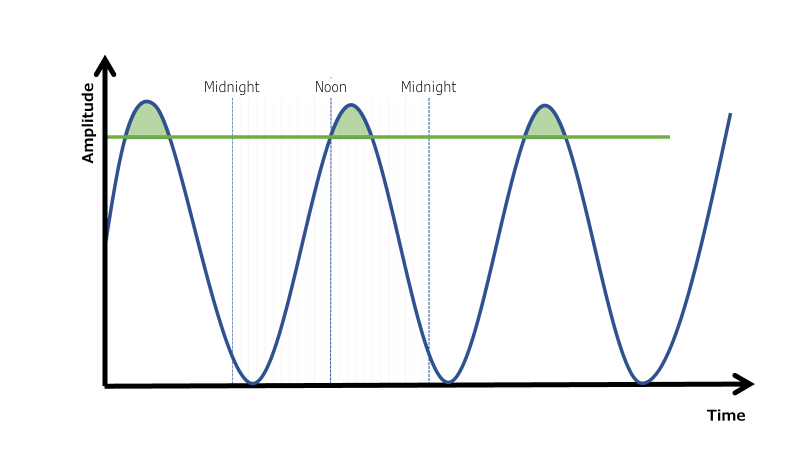
Humans are ostensibly automatons, subject to their genetic and environmental programming with no degree of free will. Let’s say that in a given context each person can be described by a certain wave function. For the sake of simplicity, let’s just pretend that it can be represented by a sine wave. As with any waveform, we can illustrate it by plotting it on a 2-dimensional plane, having amplitude on the Y-axis and time on the X-axis. Let’s consider this to be analogous to a person’s biorhythm, and let’s further consider that this represents the would-be agent’s mood or propensity to behave a certain way.
Arbitrary Disposition Cycle
Practically, there might be more functions, so let’s just say that this is the average of all of these other functions—perhaps the other functions being how much rest was had the night before, when and what the last meal was, traffic encountered on the way to work, and any number of other personal considerations.
For any stable wave, we can plot the period from peak to peak or trough to trough. Let’s use trough to trough to represent a period of a day but from 2:30 am to 2:30 am rather than from midnight to midnight. This is one complete cycle. The offset is just to more easily facilitate the scenario.
Given this frame, we’ll put noon in the centre between the midnights as expected.
For the purposes of illustration, we’ll draw a horizontal line to represent a threshold depicting a change in disposition. We’ll use this later.
Finally, let’s show time increments by hour, so we now see 24 hours in a day. And we can see that at noon the wave peak rises above the threshold and falls below the threshold again at 5 pm.
Let’s presume that this wave function represents that of a criminal trial judge. There is support for this notion as published in Daniel Kahneman’s 2021 book, Noise: A Flaw in Human Judgment, wherein he notes that trial judges are almost as predictable as a watch, that their sentences are more correlated with time of day and the aforementioned factors than anything related to law—save for the laws of time, I suppose.
Remembering that—like all people—this judge is an automaton. Let’s build some character—rather characteristics. Judge Judy believes that people are fundamentally bad and not to be trusted. She believes that they have free will and are accountable for their actions, though she does also allow for extenuating circumstances when considering sentencing, the usual suspects—bad childhood, chemical dependency, and whatnot. People who believe more strongly in free will are more likely to believe in harsher punishment. Judy is no exception.
Using this function as a guide, above the threshold represents her propensity for leniency. She tends to take lunch regularly before noon and is more lenient for a period after lunch. Data show that this effect is closer to a couple of hours after the midday meal, but we are simplifying.
Zooming in, let’s just consider a single day in the life of another would-be agent who as it happens will be interacting with our Judge Judy. I’ll take this opportunity to introduce the work of Neil Levy.
Neil is Head of Neuroethics at the Florey Neuroscience Institutes and Director of Research at the Oxford Centre for Neuroethics.
He is the author of Hard Luck, five previous books, and many articles, on a wide range of topics including applied ethics, free will and moral responsibility, philosophical psychology, and philosophy of mind.
Levy’s book promotes the concept that even if we allow for human agency, much of this supposed agency is undermined by luck. This will not only become evident in the scenario we are working through, but as a human, you may come upon a decision-point, where probability and luck come into play. You have no control over what ideas pop into your head—or don’t—and in what order. The choice you ultimately make is limited to what these ideas are and how they do or don’t manifest. Without going too far astray, perhaps you’ve constructed a false dichotomy.
Dark Alley
Perhaps you are confronted by a stranger in a dark alley. You observe that it’s a dead end. The stranger, asking for money, approaches you in a manner you interpret as menacing. As he reaches into his coat, you pull out your concealed weapon and fatally shoot him.
He was unarmed. No longer in panic, you realise that you are not in a dead-end alley.
When the police arrive, they inform you that the person you killed is known` by law enforcement and social services, who have been keeping an eye on him because he had limited cognitive capacity and resided in a group home. Not only was he not armed, but the detective on the scene noted that what he was reaching for were pens with inspirational inscriptions that he routinely sold to earn money.
Whilst you may not have been able to determine that he was otherwise harmless, it was your ‘luck’—bad luck—that you didn’t happen to see that you were never cornered in the first place.
Nevertheless, you are arrested.
In another scenario, perhaps there are two judges. Judge Judy and Justice Joe. As it happens, Justice Joe has a cycle reverse to Judy. Where Judy’s mood is better after lunch, Joe is fasting, and his mood gets worse. This means that your fate now is not only tied to the time of day but it’s also linked to the luck of which judge will hand down your sentence.
If you are a strict determinist, then the “universe” has already determined which judge will sentence you.
If you are an indeterminist, then the universe will flip a coin. And the probability of a case running long or short might determine the time of day.
In the end, as are you, the judges are slaves to their programming, and any alteration of inputs will just be processed through whatever they’ve become until that point. They have no more free will than you do. The die has already been cast.
Do you believe you have free will? If so, why. Are you a determinist or an indeterminist? Or are you a compatibilist who believes that free will and determinism can coexist in the same universe?
The title of this post is admittedly pompous, but I promise it’s relevant. I was chatting with an online colleague about the travails of my anti-agency journey. I’ll lay it out here as well.
About a month or so ago, I embarked to research on my suspicion that human agency is ostensibly hogwash*. I went down many rabbit holes to find the skeletal remains of many rabbits who have embarked on this path before me. I thought I had some unique epiphany and I would just have to articulate my position, but it turns out not to be the case. In fact, it’s a crowded space—lots of skeletal Leporidae. Moreover, many of these blokes are still alive and kicking.
As it happens, we all fit under the large umbrella of free will scepticism, but there are several flavours mostly differentiated by where one prunes the branch. Scepticism of free will is the common bond, but the differences, as one might expect, lead to different implications. Some branches still allow for responsibility—even absent agency—, others even insist on responsibility despite not having agency—and still others, like me, claim responsibility is impossible.
All of these perspectives hinge on the validity and strength of determinism or indeterminism. Soft determinism (AKA compatibilism) allows for free will and determinism to coexist, so that’s not on my radar.
As I’ve cited elsewhere, there are not many non-religious determinists these days, as the state of science and quantum theory pretty much obsoleted the idea. But by my reckoning, from the perspective of the would-be agent, it doesn’t matter because in either case, this person (or other animate objects—no need to overspecify) is affected by the causal chain and does not affect it. This lack of affectation is precisely why we can’t attribute responsibility or desert.
This is not just some philosophical mental masturbation. It turns out that entire legal frameworks are designed on the prevailing held beliefs, and the more degrees of free will a culture assumes people have, the more punitive that society is—and vice versa. More on this in a future post where I intend to write about Gregg Caruso’s perspective and where and how our positions deviate.
Video: Why? – “What for?” or “How Come?” — Daniel Dennett
As a rule, I don’t have much faith in humans. It would be apparent if you read some of my posts. I find most people to be akin to vapid sports fans: Hooray for my team—whether that team is political party or persuasion, science, religion, and whatever. Not a lot of critical thinking or reasoning. I believe Geuss mentioned that most people are just trying to make it to the next day and acquire more stuff—at least more stuff than the neighbour. Social media is a turn for the worse. Luckily and thankfully, there are exceptions to this rule.
Engaging in a CS Peirce forum that I was invited to because of some interactions I had in a postmodern forum, I asked for the source of a Peirce claim made by another Lee Smolin.
When you explain a system by referencing the laws, that’s not the end of the explanation; you have to—we must explain how the laws came to be and why there are these laws and not other laws.
Lee Smolin on CS Peirce
At 8:43, Smolin cites Peirce by saying ‘that when you explain a system by referencing the laws, that’s not the end of the explanation; you have to—we must explain how the laws came to be and why there are these laws and not other laws—and he goes on to say this is 1893…’
Video: Are the laws of the universe immutable and unchanging?
Not being a direct quote, I was experiencing difficulty finding the source of the citation, so I asked in the Peirce group. As I am wont to do, I added that I didn’t buy into the assertion, but if I could find the source I could gather more context.
I don’t buy into the assertion that in describing a system one needs to provide an origin story, so I was hoping to discover context to determine whether it’s Smolin or Peirce to have an issue with.
I was given a citation that didn’t happen to be accurate,
A second member chimed in that of course one needs an ‘original state’, so I clarified that it was not the original state that I held issue with. It was the narrative behind it—the story of the origin, not the origin itself.
He responded, ‘That’s Deacon!’ More precisely, the response was as follows:
YES!!!!!!! That’s Deacon!!!!
I’m not even schooled in Peirce, and now I’m getting his classmates.
To my origin clarification, I also added this bit:
I feel that ‘reasons’ or ‘whys’ are less important than ‘how’. In fact, I feel that ‘why’ is often used in English as a synonym to ‘how’ in many contexts.
So when asks ‘Why are you late?’ they are really asking ‘How it is that you’ve arrived late?’ or ‘How come you’re late?’ Why feels like a metaphysical stand-in for how.
…to which he responds with the top clip by Dan Dennett making my same point a decade ago—or I suppose that I am making his same point a decade later.
It seems that I’m late to the party yet again. This is becoming a trend.
The CAUSA SUI is the best self-contradiction that has yet been conceived, it is a sort of logical violation and unnaturalness; but the extravagant pride of man has managed to entangle itself profoundly and frightfully with this very folly. The desire for “freedom of will” in the superlative, metaphysical sense, such as still holds sway, unfortunately, in the minds of the half-educated, the desire to bear the entire and ultimate responsibility for one’s actions oneself, and to absolve God, the world, ancestors, chance, and society therefrom, involves nothing less than to be precisely this CAUSA SUI, and, with more than Munchausen daring, to pull oneself up into existence by the hair, out of the slough of nothingness. If anyone should find out in this manner the crass stupidity of the celebrated conception of “free will” and put it out of his head altogether, I beg of him to carry his “enlightenment” a step further, and also put out of his head the contrary of this monstrous conception of “free will”: I mean “non-free will,” which is tantamount to a misuse of cause and effect. One should not wrongly MATERIALISE “cause” and “effect,” as the natural philosophers do (and whoever like them naturalise in thinking at present), according to the prevailing mechanical doltishness which makes the cause press and push until it “effects” its end; one should use “cause” and “effect” only as pure CONCEPTIONS, that is to say, as conventional fictions for the purpose of designation and mutual understanding,—NOT for explanation. In “being-in-itself” there is nothing of “casual- connection,” of “necessity,” or of “psychological non-freedom”; there the effect does NOT follow the cause, there “law” does not obtain. It is WE alone who have devised cause, sequence, reciprocity, relativity, constraint, number, law, freedom, motive, and purpose; and when we interpret and intermix this symbol-world, as “being-in-itself,” with things, we act once more as we have always acted—MYTHOLOGICALLY. The “non-free will” is mythology; in real life, it is only a question of STRONG and WEAK wills.—It is almost always a symptom of what is lacking in himself, when a thinker, in every “causal-connection” and “psychological necessity,” manifests something of compulsion, indigence, obsequiousness, oppression, and non-freedom; it is suspicious to have such feelings–the person betrays himself. And in general, if I have observed correctly, the “non-freedom of the will” is regarded as a problem from two entirely opposite standpoints, but always in a profoundly PERSONAL manner: some will not give up their “responsibility,” their belief in THEMSELVES, the personal right to THEIR merits, at any price (the vain races belong to this class); others on the contrary, do not wish to be answerable for anything, or blamed for anything, and owing to an inward self-contempt, seek to GET OUT OF THE BUSINESS, no matter how. The latter, when they write books, are in the habit at present of taking the side of criminals; a sort of socialistic sympathy is their favourite disguise. And as a matter of fact, the fatalism of the weak-willed embellishes itself surprisingly when it can pose as “la religion de la souffrance humaine“; that is ITS “good taste.”
Einstein was wrong. Time is not the relative factor in space-time. Space is. Time is constant. Here’s a lecture on the topic of the book.
Lee Smolin Public Lecture: Time Reborn
As a result of a discussion with a colleague, on the possibility of variability or mutability of so-called physical laws, he recommended Lee Smolin’s book Time Reborn: From the Crisis in Physics to the Future of the Universe. He mentioned that it would be suitable as an audiobook. Since I had a credit on Audible, I decided to use it so I could listen to this without deep scrutiny and a need for taking notes.
There is a nice review in the Guardian from 2013. I suppose I am a bit behind the times.
Whilst running errands, I listened to the Preface and Introduction. I stopped at the start of the first chapter, and am debating whether to continue. Given his setup, I don’t believe I am Smolin’s target audience. Many of the beliefs he is attempting to dispel, I already don’t hold. Yet I don’t feel that I need to hold time as a constant to hold them. He seems to feel otherwise.
Preface
For the record, Lee Smolin is a theoretical physicist, who has written several books in this space. Quickly, recapping some of his points:
He provides examples of various illusions humans tend to be swayed by:
Matter appears to be smooth but turns out to be made of atoms
Atoms seem indivisible but turn out to be built of protons, neutrons, and electrons
Protons and neutrons are further made of still more elementary particles called quarks
The sun appears to go around the Earth, but it’s the other way around
Smolin relates that the prevailing perspective today is that time is an illusion—name-dropping Plato and Einstein, who hold this view. He conveys that he used to share this belief, but now he disagrees—whence the book. He tells us:
Not only is time real, but nothing we know or experience gets closer to the heart of nature than the reality of time.
— Lee Smolin, Time Reborn
Next, he posits that some people believe in timeless events—events outside of time, eternal and not a function of time. Here’s where he goes off the rails in my book.
“We perceive ourselves as living in time, yet we often imagine that the better aspects of our world and ourselves transcend it. What makes something really true, we believe, is not that it is true now but that it always was and always will be true.”
Evidently, he feels or felt this way. I am sure many others. I am not among them.
“What makes a principle of morality absolute is that it holds in every time and every circumstance.”
My position is that all morality is a social construct, so this doesn’t resonate with me.
“We seem to have an ingrained idea that if something is valuable, it exists outside time.”
Again, I am not in his intended audience.
“We yearn for “eternal love.” We speak of “truth” and “justice” as timeless.”
Love, truth, and justice are all human constructs—weasel words.
“Whatever we most admire and look up to — God, the truths of mathematics, the laws of nature — is endowed with an existence that transcends time. We act inside time but judge our actions by timeless standards.”
Yet again, I am unburdened by these beliefs.
Nothing transcends time, not even the laws of nature. Laws are not timeless. Like everything else, they are features of the present, and they can evolve over time.
— Lee Smolin, Time Reborn
I think that this quote is a reason this book was recommended to me. I do believe that the properties that comprise laws can evolve over time. I’m not sure if this is by a probabilistic process or something else. There are a few possible implications. One is that the laws at the onset of the universe may have been different, making the understanding of that time more challenging if not impossible. I don’t know if I believe in multiverses, and I doubt I may ever live long enough to discover. However, even if there is only one universe, per the name, perhaps universes can exist sequentially and when one dies another appears with a different set of initial conditions and properties. Borrowing from evolution, perhaps these survive or perish based on the viability of this combination.
Smolin goes on to posit that, ‘thinking in time is not relativism but a form of relationalism‘.
He continues,
“Truth can be both time-bound and objective when it’s about objects that exist once they’ve been invented, either by evolution or human thought.”
— Lee Smolin, Time Reborn
I’m not sure he is going to define truth, but I believe he conflates moral truths with axiomatic or tautological truths. Perhaps it doesn’t matter because both are constructed.
Smolin makes it clear that he is not a determinist, but unless you take the view he is proposing, as a physicist, you almost have to be. As he says regarding Determinism, theoretically. a person could suss out a mathematical equation to predict every future event. He also considers this belief to be a metaphysical vestige of religion.
Introduction
According to [the] dominant view, everything that happens in the universe is determined by a law, which dictates precisely how the future evolves out of the present. The law is absolute and, once present conditions are specified, there is no freedom or uncertainty in how the future will evolve.
— Lee Smolin, Time Reborn
He continues to describe a deterministic system without mentioning indeterminism, which may be a more prominent belief given what we understand about quantum mechanics. He claims that this perspective diminishes time for several reasons. Inflating or at least elevating time is important for his thesis, and I am thinking that this is more an act of wishful thinking.
He takes a stab at the inherent reductionism of physics—it reduces everything to parts until there are no longer subparts, at which point the process fails—and explains that by adopting this approach, one needs to get outside of the universe to make some evaluations, but this is impossible. And this might be a true statement, but so what? The answer is not to make up a story that creates an environment where that’s no longer necessary.
Smolin reiterates over and again about timeless laws in a time-bound universe, but I question his notion of timelessness. He admits that he has no grand theory—just an idea he hopes others can pursue and build upon. Emergent properties appear to be an emerging theme.
Leibniz is next up, in particular his principle of sufficient reason. Leibniz’ vision is a relational universe composed of a network of relationships—the space is simply the absence of things. He contrasts this with Newton’s view that space is absolute and serves as the container for things. He sets up a future chapter that he says establishes that Leibniz’ vantage precludes the possibility of absolute time, but I don’t see this as a challenge for those of us who believe that time is constructed in the first place.
The Newtonian view prevailed until Einstein resurrected Leibnitz with his general relativity theory of space and time. The trending vogue is about relationalism, whether biology or information science.
He cites the challenges of maintaining Locke’s views on autonomy and personal liberties in a deterministic world (again leaving indeterminism unmentioned).
And he’s back on the emergence of emergence. (I was in the midst of writing a post on emergence when this interrupted my flow. I suspect it should be forthcoming in time.)
Falling
As it turned out, I ran another errand and listened to the first chapter of part 1. It is about gravity and parabolas, but I shan’t recount it here, save to note that he seems to be of the opinion that many people have the desire to transcend the bounds of human life. He may be right. I am not one of these people.
Harvard’s Bob Doyle submits that people have free will in an indeterministic universe (read: agency) because if in the face of some random event an agent can make a choice, then s/he is responsible for that choice. I believe he is mischaracterising or misinterpreting the situation. I’ve composited an illustration to show where he and I interpret the random event differently. I’ve linked and cued the video to where he makes the statement I am reacting to.
The illustration depicts three event chains. My interpretation of Bob’s case is at the top followed by that of a Deterministic universe, followed by that of an indeterministic universe. At the bottom of the illustration is an index running from t-2 to t2, representing time, where t0 represents now, a decision point.
Determinism
Let’s set the table with the simplest narrative—Determinism. Here, every event that occurs was known since the beginning of time. Every state is the result of past events in a causal chain. Nothing can happen that isn’t caused by a prior event. This is the motion picture we just haven’t seen yet. But anyone who has already seen it can spoil the ending because it’s already known without a doubt.
Regarding the illustration, event t-2 causes t-1 that causes t0 all the way to t2 and beyond.
No Escape from Moral Responsibiliy Chart
Bob Doyle, an Interpretation
Although Bob’s case is an interpretation of Indeterminism, let’s consider his position first. Then I’ll suggest where he’s gone astray.
As with the other cases, Bob’s transition from t-2 to t-1 is Deterministic and uncontested. The difference starts where t-1 transitions to t0. In Bob’s world, a random or perhaps a probabilistic event occurs given the agent to make a choice not having been previously determined. Referring to the illustration, because of this event, the agent chooses yes and embarks on the top chosen path, even if the subsequent path is again determined. Bob argues that at t0, the agent has free will, or if we focus our language, is responsible for the decision. By definition, this means that whatever path might be embarked had our agent chosen the lower path will never be known. And that has made all the difference.
Indeterminism
Herein lies the rub. As with the prior two event chains, we arrive at t0, as with Bob’s scenario, we encounter a probabilistic (random, stochastic, aleatory, indeterministic) event. It does not follow that this event confers agential responsibility.
For example—not a moral consideration—, the random event involves the outcome of a match by their favourite sports team—or perhaps s/he’s won at Lotto—, our agent had no say in the outcome of the event. From the agent’s perspective—considering the illustration—s/he remains on a path. S/he can wish s/he rooted for the other team or had chosen a different number or ticket, but she had no choice.
To anticipate Bob’s response, perhaps she had won and now chooses to quit her job or take holiday. This should have been predictable knowing our agent’s disposition, character, and propensities. At no point did the agent actually possess even a modicum of agency.
Freedom & Creativity
I don’t know much about Bob or his work, but earlier in the video clip he discusses freedom and creativity. My sense is that he interprets creativity as a sort of emergent property that manifests at the moment. I fundamentally disagree with this assertion. The notion reminds me of Hume’s position that unicorns are simply the mental merger of horses and horns. This is not creation so much as a remix.
Later in the video, Bob clarifies that if something randomly pops into our heads and we make a different decision because of it, this is free will. My counterargument is that he is misusing the term random. An unknown origin does not necessarily mean randomly manifest.










 Philosophics