Language Primacy: Cognition or Communication

As I am busy researching, this will likely be short. It would be even shorter without this preamble.

In researching the literature for my insufficiciency of language hypothesis, I am reading Fodor and Reboul to try to better grasp the evolutionary function of language. Both rely on the Theory of Mind. It seems that the more accepted theory is the language primarily evolved for communication as a survival mechanism. However, Fodor defends that cognition was the primary function and communicated was exapted. Carruthers contributes to the Language of Thought domain.

As I’ve presented here in dribs and drabs, my insufficiency theory of language argues that language is ill-suited for the communication of abstract concepts. It is fine for expression; communication of situational objects, inventions, and motion, description; and argumentation. But imagined concepts such as fairness, justive, and freedom don’t hold water. As I’ve discussed this hertofore in detail, I’ll not repeat myself.

Confirmation bias notwithstanding, the primacy of cognition better explains why abstract conceptual communication so often fails. Language has been stretched beyond its boundary constraints, and the air is thin past that.

I’m not sure I am willing to choose a side quite yet. Rather, I’ll note the different perspectives and move on. The underlying mechanism is less important to me than the empirical deductions that follow.

Lacan or Not

Here I am yet again writing about something I am not particularly equiped to do. In other fora, I’ve been directed again to Lacan vis-à-vis a thread about Lacan’s perspective on the real. I’ve commented on Lacan before, usually in the context of eschewing any philosophy founded on psychology—especially psychoanalysis. Explaining that I have a reading backlog extending beyond my likely lifespan, it was recommended that I read Jacques Lacan by Sean Homer, so I am sharing the recommendation. Anything by Bruce Fink was another reco. Noam Chomsky takes an ad hominem swipe at Lacan here.

I decided to watch a few videos (including this, this, and this) to survey some of Lacan’s ideas, knowing that something could be lost in the translation. Let’s just say that I was underwhelmed.

In a nutshell, my biggest contention is the notion of the unconscious as an active agent.

According to my understanding, Lacan posits that there is a ‘real’ out there, but it is obscured by language and subject to interpretation. To him the real is a Void.

⁠Psychoanalysis presumes being able to get closer to the ‘truth’ of reality. Like astrologers and fortune-tellers, Psychoanalyst primary defence is that not all knowledge is evidence-based or falsifyable. My problem is that I am not open to another way of experiencing the world, but they somehow have privileged access to this truth. Of course, this is a similar to religious claims of some special spiritual access that opens when you believe.

To me, the Void is as apt a metaphor as any. And while we both agree that the real is inaccessible, I don’t accept the impostition of the how and the why. What Lacan does—and Freud before him and psychoanalysts more generally—is to inject hows and whys into the story. In this narrative, the unconscious has active powers, (as opposed to negative space), where memories (in whatever form) may be repressed and actions may be triggered (or activated) by unconscious urges or desires. I consider this last train of thought wholly imagined and fabricated. This void and the unconscious has no purpose.

Along the way, I do agree with Lacan’s poststructuralist position. I have no issues with symbolic or metaphoric concepts and speech. The contention arrises when one attempts to claim the metaphoric to be concrete. This is the same contention I have with people who take the metaphoric text of the bible and cencretise it. There are other problems there, but I’ll quit now.


​⁠

Projected Reality

This article suggests an interesting twist on the notion of peception and facts. In this instance, the human sensory organs don’t capture what’s there like a camera. It takes cues from the environs and fills in details heuristically. This mirror an effect I recall reading in a book, Drawing on the Right Side of the Brain*, where most people can’t draw what they see because their heuristic perception kicks in. This is essentially Kahneman and Tversky’s System I outlined in Kahneman’s Thinking, Fast and Slow.

This may come with a heavy dose of confirmation bias, but it fits my belief that reality is generally unaccessible with huamn sensory perception organs. it adds another layer or dimention to consider.


* I am aware that the simplistic right and left side distinction is an oversimplification, but this is the way of categorisation.

Maps and Terrain

To portray meaningful relationships for a complex, three-­dimensional world on a flat sheet of paper or a video screen, a map must distort reality … [A] single map is but one of an indefinitely large number of maps that might be produced for the same situation or from the same data …” 

Mark Monmonier, How to Lie with Maps 

The problem with perception and reality is that perception is so faulty as to be ostensibly unreliable.

Story here. No time to share.

Opiates of the Masses

No, really.

Memories are fallible. I’d thought I had written on this topic of opiates and public policy at length. And perhaps I have. Just not here. Perhaps that’s a good thing. Searching my blog for my take on opiates, I find that I cite Marx’s ‘Religion is the opiate of the masses‘, four times—make that five. But nothing more.

Carl Hart recently published a book on his heroin use—Drug Use for Grown-Ups: Chasing Liberty in the Land of Fear. By some accounts, Carl might appear to be the stereotypical heroin addict in the United States. Well, he’s black, so there’s that. But that’s where the stereotype ends.

Carl Hart is a professor of neuroscience in the psychology department of Ivy League, Columbia University—at least before he published his book. I’ve not read his book, but at my blog I’ve provided a link to the Guardian article, which prompted this post.

The gist I get from having read the Atlantic article is that the public health narrative surrounding heroin and other illicit drugs is akin to the hype of the days when Reefer Madness was all the moral outrage. And make no mistake—this outrage has everything to do with moral one-upmanship and nothing to do with health outcomes. This is pure and simple cultural performativism signalling the higher ground one occupies. As is common enough, many people have actually internalised their misinformation and disinformation to the point they truly believe there is a medical basis to their belief systems. If they are at all introspective, they would see that morals and Calvinism have nothing to do with this purported health care policy. It’s a seemingly reasonable, logical place to arrive. No emotional element is necessary.

But allow me to step back for a moment. Am I saying that there are no possible harmful effect for consuming drugs and other chemicals? No. Am I claiming that no one has ever died as a result of chemical intoxication or overdose? No, again. Am I saying that drug abuse does not incapacitate some people? Nope. I am saying none of the above. I am claiming that hyperbole abounds, the causal connection is overattributed, and cofactors are ignored in favour of an orthodox etiology.

For the record, I am a teetotaler. I do not abuse or even use chemicals referred to as drugs—illicit or otherwise. I don’t drink alcohol, don’t smoke cigarettes. I don’t even drink coffee or covfefe. I do drink Coca Cola, so my big vice in this regard is caffeine. Even rarely do I take ibuprofen or acetaminophen.

As I note in my Defence of Capitalism post, it’s difficult to get good second-hand information of illicit drugs. The medical-industrial complex and the official police state peddle fear and disinformation. Whether they believe the information they dispense is true or not is irrelevant. What is important is the low truth content. It makes one wonder what to trust and what not to when these agencies routinely propagate falsehoods and misrepresent truth.

This misrepresentation isn’t limited to opiates. I found it interesting when Michael Phelps won gold at the Olympics, only to announce that he was the consummate pothead, and smoking weed was part of his daily routine. Here’s what the official Olympics website says about him, by the time he retired at Rio 2016 at the age of 31, Michael Phelps had collected a total of 23 golds, three silvers and two bronzes at the Olympics, a record-breaking haul that looks unlikely to be bettered for many years to come. So much for the lazy stoner stereotype. As marijuana becomes more accepted by mainstream culture, we come to notice that many of the so-called mental health issues were just fabricated. The purpose was to shroud a moral argument in medical legitimacy. Whether the healthcare industry was complicit or it was the law enforcement regime gone rogue is a separate question. Yet again, it undermines the legitimacy of any claims.

In 2020, the world encountered the Coronavirus, COVID-19. And medical expertise, particularly around immunology and the spread of pathogens, came into question. In the United States and United Kingdom, their misinformation was further exacerbated by administrations hostile to science. But given the history of misinformation for political purposes, it may be premature to blame the general public for being reluctant to trust the alarms. They’ve created the classic Boy Who Cried Wolf scenario. And so the question becomes what health information can one trust? And who is the authoritative source?

Listen to this as a podcast on Spotify

Conceptual Abstraction

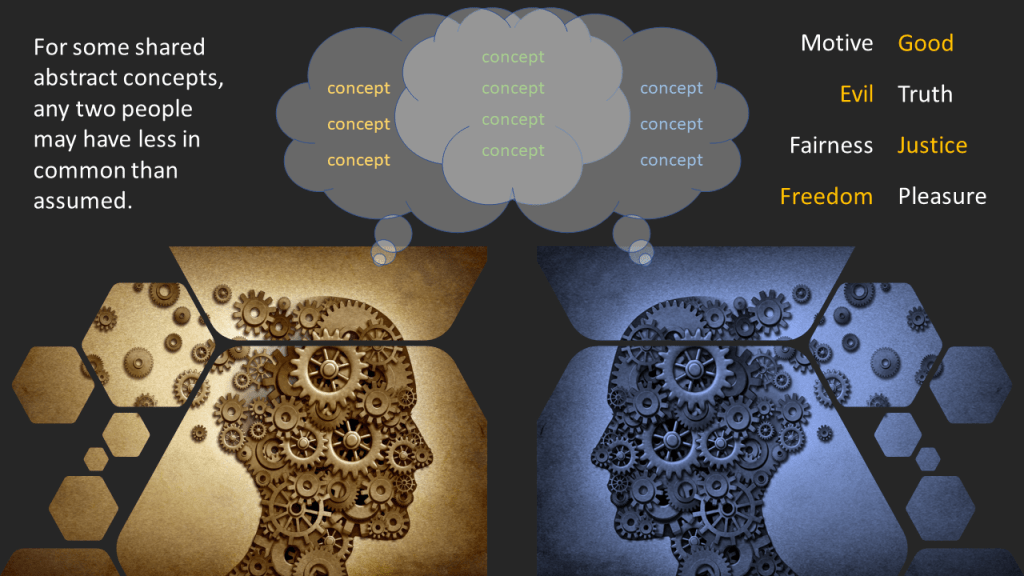
Shared Concept Image

I tend to go on about weasel words and the insufficiency of language, but I tend to get a lot of resistance by people who insist the chasm isn’t as expansive as I make it out to be. This makes me wonder how one might create a test to determine how much is similar and how much doesn’t.

To summarise my position, abstract concepts of this type are specious archetypes that cannot exist in the real world: truth, justice, freedom, fairness, and so on. The common thread here is almost always that they exist in the realm of morality, another false concept.

It seems to me that one could construct a sort of word cloud intersecting with a Venn diagramme. I’d assume that more articulate people would have more descriptors, thereby creating landscape with more details and nuance for any given concept.

Additionally, I could see a third dimension which would capture diametric meanings. There is also the issue of diverse contexts, e.g. in the case of justice, we have distributive, retributive, restorative, and procedural flavours, so one would need to be taken into account.

In everyday existence, I notice that these terms are good enough and have enough substance to trick people into believing not only that it’s real but that the are operating with a shared concept. My point is that it’s more apples and oranges. We could employ dimensions that make these appear to be similar.

  • Approximate spheroids
  • Fruits
  • Contain fruits
  • Have skin

Additional scrutiny would illustrate the differences.

  • Colour
  • Taste
  • Consistency

This difference between this concrete case is that we can observe the objects to compare and contrast, but with abstractions, we have a sort of survivorship bias in play. We remember what we agree on and forget or diminish the parts we don’t agree on. And we don’t necessarily even know the complete inventory of descriptors of our counterparts.

The image at the top of the page is not to scale. I don’t know what the percent breakdowns are, but I wouldn’t be surprised if in a situation where there were 10 possible descriptors, that only 4 would be commonly shared—so 40 per cent—, leaving 6 not in common—60 per cent.

In any case, I wonder if anyone has attempted this sort of inventory comparison. I haven’t even looked, do there could be tome upon tome published, but I don’t suppose so.

All Claims Are Equal

One of the most prominent strawman attacks of postmodernism and of relativism more generally is the statement countering the claim that all claims are equal.

I know of no one outside those attacking the claim believe this. I’ll give a couple of examples to illustrate why the attack is preposterous — a culinary case and a socio-political case.

The Proof is in the Pudding

Visit a recipe site, and search for macaroni cheese recipes. You’ll get hundreds if not thousands of recipes. Are they all equal? No. It depends on your tastes and preferences…even your audience. There are variations in the type of pasta, the type or types of cheese, whether to add additional ingredients, whether to prepare on the range or baked in the oven, and so on.

For your children, a prêt-à-manger out of the box preparation as opposed to the Gruyère and truffles verion you’re reserving for your next soirée.

Is there a best recipe? No. There are only preferences.

Is there an objectively best recipe? No. There are only preferences.

Can I create any recipe? No. Read on.

And they called it macaroni…

To have a recipe qualify as mac & cheese, there are at least to requirements for inclusion into the domain: Macaroni (or any pasta product or substitute) and cheese (ditto but with cheese products). I’m only pretty sure that no one countering that relativists claim that everything is equal is also arguing that one can make mac & cheese with, say, tacks and bricks. So, one has to question either the intelligence or the integrity of someone assuming someone else would defend this argument. Context matters. And just the choice of a contextual boundary is subjective (and relative).

Good Enough for the Government?

This works for recipes, but what about for government? Obviously Democracy is the best possible form of government because reasons, duh. And people. And agency. And other words I can imagine and associate in my defence.

As with mac & cheese, we need a defined purpose. The problem is that there are not only different purposes, there are different actors, each with their own needs and desires.

At no time is anyone arguing that public policy created by a council of gerbils is the same as that of people or or some artificial intelligence, just as no one is proposing that we throw mac & cheese against a wall in the manner or reading entrails to arrive at a meaningful end. Though, to be fair, given some policy choices I’ve seen, I might have voted for the mac & cheese method.

So, what are you trying to say?

By now a reader should have disavowed the notion that relativists do not recognise domain boundaries. It could be very legitimate for a non-relativist (objectivist?) to call something out as having improper domain boundaries, whether over-specified, under-specified, or just mis-specified, but that’s not the same claim.

A person may justifiably make the claim that such a such is not valid because it does not account for some other absent cohort. Perhaps it leaves out the dead or the unborn, or the animals, or the broader biosphere, if only by proxy. This is not to say that this would be easy or convenient, but it is certainly rational.

Most implemented government systems not only privilege humans over everything else, it virtually excludes everything else. But this is not the main point, which is that if a place and people have a functioning form of government, whether it is better or worse is up to the participants to decide, and there is not likely to be a consensus view. It should always be expected that there will be detractors for any number of reasons. There may be large contingencies of detractors. It could easily be that a government is divided into two worldviews, as in the United States, Canada, and the UK — each side claiming that they’ve got the solution, each side denying relativism in order to defend their version of truth.

Insurrection Bandwagon

There was a recent insurrection at the United States Capitol building in Washington, DC. I won’t take any more time discussing whether this is hyperbole or real. In the end, it doesn’t matter. It’s not relevant to the solution.

From the perspective of propaganda, it’s been an effective message. It’s gotten Trump haters and supporters to view Trump as a common enemy—some of them anyway. Some people and entities can’t performatively distance themselves fast enough or scapegoat him loudly enough.

Whilst I do feel that much of the hullabaloo is performative, I’m not going to focus on the performative aspect. This serves to amplify, but it’s not the central message. Instead, I’d like to frame this through the lens of René Girard’s mimetic theory of conflict and resolution.

Adopting Girard’s vantage, we can see each of mimetic desire, scapegoating, mimetic crisis, ritual, sacrifice, and culture.

Mimetic Desire

In a social context, mimetic theory is about creating in-groups and out-groups—and intentionally so. Groups have rules, by which membership is governed. Symbols are employed to amplify belonging and compliance. At it’s core, mimetic desire employs mimesis—imitation. Monkey see, monkey do.

Here, society is the prevalent in-group. From their perspective, this is the us of the in-group versus the them of the out-group. Girard noted that us versus them is evident in many contexts—whether in the wild or otherwise—, and it can be exploited. It’s about creating a flag to rally around—in this case literally, figuratively speaking.

The mechanism of mimetic desire is to coalesce the focus on some object. From the positive dimension, the desire is to belong, but mimetic desire doesn’t have to be positive. As in this case, it can be negative. The masses have assembled for a common cause of vilifying one Donald J Trump.

Mimetic Crisis

The insurrection is the mimetic crisis. It broke the rules. It’s unclear how all of the many rules that were broken in the four preceding years were able to fly under the radar. To some extent, the US government is constructed of two nearly equal in-groups. They each belong to the institution of institutionalised government and so-called Republican ideal as an expression of modern Democracy. They share some common beliefs, but this sharing diverges dimensionally and methodologically. The telos are multi faceted, and each group prefers different facets—and the facets desired by the public are different still.

At first—to borrow from Kübler-Ross—, there was denial by the Trump-aligned party of sycophants. These Trump-aligned Republicans (read: Neoconservatives; UK: Tories) were also aligned with the outgroup, leaving them vulnerable to ostracism. Meanwhile, the Democrats (read: Liberal/Neoliberal; UK: Labour) secured the moral high-ground and control of the larger in-group. They painted themselves as the adults wearing big boy trousers (over their Pull-Ups).

Scapegoating

Scapegoating is instrumental in mimetic theory. It’s a mechanism to build solidarity and cohesion through exclusion. Narratively, it operates to distinguish acceptable behaviour versus unacceptable. In almost all instances, scapegoating is an object to project blame.1 The remaining members have received the signal.

Here, we have two entities to scapegoat 2: the insurrectionists and the Instigator in Chief, soon to be ex-president, Donald Trump.

Ritual

Ritualistically, scapegoats need to be bear the brunt of the anger of the in-group and associated friends and family. There are procedures to follow. These rituals play out in the House in the form of impeachment, and in the Senate in the form of conviction. For the uninvited guests, the traditional court system ritual

Part of the outrage is performative ritual. Certain entities are checking the boxes suggested by their PR teams. These same entities had nothing to say for the past four years as they’ve enriched themselves at the expense of the American public and world, but this was the last straw. They vowed to cut off support and funding —until they don’t, but by then no one will be any the wiser. People have both short attentions spans and memories.

There is no requirement whatsoever that rituals produce anything. As hard work is its own reward, ritual for the sake of ritual is all that’s necessary. Rituals needn’t be authentic or heartfelt. Simply mime the parts, and you’re all set. Plus, you get full credit—participation points just for playing.

Sacrifice

One ritual is to sacrifice the goats, but we need only exile the offending members. In Christian lore 3, there are actually two goats—a sacrificial goat and an emissary goat—the scapegoat. The sacrificial goat is, obviously, sacrificed—burnt offerings—, but the emissary goat was released into the wilderness, taking with it all sins and impurities. This is the excommunicated, the shunned.

Culture

Where performatism really comes in, is cultural signalling. People and other entities work overtime to signal they are on the winning side. This includes everything from Oscar-winning performances to cringeworthy Razzie-candidates. Those in the public eye tend to go overboard. It’s good to remember that an empty vessel makes the most noise.


  1. The notable exception to this scapegoat-blame relationship is the Christian Christ myth, where Jesus acted as a scapegoat but was without blame.
  2. Trump and the Scapegoat Effect, The American Conservative, David Gornoski, September 1, 2016.
    An interesting article discusses the Trump-scapegoating phenomenon that also mentions René Girard’s work.
  3. Leviticus 16:21–22

Diversity Frame

One if the biggest foci of postmodern philosophy is the metanarrative. Employment diversity is a place that the metanarratives go unquestioned by most. The most predominant aspect is the frame. Don’t accept it.

Inside this frame, some uncritically adopted narratives are as follows:

  • Work is good
  • Work builds character (proportionately to the effort exerted)
  • Work defines your value or worth as a human
  • Work signifies your place in society
  • Work is its own reward (except for monetary payment and recognition)
  • Value is defined by monetary achievement
  • Worth is defined by your place in an enterprise

And so on…

In this HBR article*, the frame has been established as a corporation and the diversity within this context. What this say by omission is that money and power is the measure of a meaningful existence. If only women were afforded a seat at this table—proportional to their population in society—, things will be even.

Women should start their own successful companies. Women should rise to the top of existing companies. Especially if they buy into the aforementioned narratives. Many women and men buy into this story lock, stock, and barrel (whatever that means), but only is you accept this as a frame is this relevant.

It’s easy to imagine a world where money is unnecessary, where labouring is unnecessary.

It’s easy to imagine a world where money is unnecessary, where labouring is unnecessary. Some have imagined a world without work, where people could instead pursue artistic endeavours, but this is just adopting a different set of narratives—like the person who exchanges drugs or alcohol for Jesus or some such. Out of the frying pan into the fire. This is the lie.

Interestingly, the HBR article makes these points:

  1. Quantify gender equity in terms of economic gains for the company.
  2. Hold leaders accountable for change by tying DEI metrics to performance reviews.
  3. Offer development opportunities to increase gender intelligence, empathy, and self-efficacy.
  4. Pull back the curtain on misperceived social norms.
  5. Establish cross-gender professional relationships.
  6. Frame, focus, and integrate interventions into core business outcomes and mission.

Notice that each of these operates from the perspective of the company. Granted, this is HBR, where the B is for Business, but still. Here’s the low down.

  1. Gender equity will at some point increase your bottom line.
  2. Create diversity metrics (and incentives) and tie them to performance review—presumably tied to the economic performance expected in bullet 1.
  3. Offer diversity training—notwithstanding the body of evidence and long history that diversity programmes are not only ineffective but sow seeds of discontent.
  4. Educate your executives and staff to the misconceptions—so long as you don’t question the deeper metanarratives.
  5. Essentially, the ask here is to establish male-female protégé-mentor relationships. Of course, this could be expanded to break binary gender stereotypes, too.
  6. Back to business, frame the frame. But to tell the truth, I don’t even know how to interpret and summarise the provided example. It seems this is an admixture of points 1 and 2, given metrics should ladder up to stated objectives and outcomes.

asking for this equity in diversity is a short-term fix

In any case, asking for this equity in diversity is a short-term fix, but it’s unimaginative and buys into the worldview of the patriarchy. There is no reason to accept this prima facie. As with the notion of Democracy, I’d be willing to argue that the system itself is the problem and that any tinkering within the system is limited by the system itself.


* Apologies in advance if HBR has a paywall. Typically, the first 3 articles are free, but if you are like me that exhausts on day one.

Not Just a Number

That perception and memory work hand in hand is mostly taken for granted, but this case reminds us that this sometimes breaks down. This is not the case of the neurotypical limitations to fallible sense organs and standard cognitive boundaries and biases. This subject can’t discern the arabic numerals from 2 through 9.

To recap the study, the man can perceive 0 and 1 as per usual, but numerals 2 through 9 are not recognisable. Not even in combination, so A4 or 442 are discernible.

In a neurotypical model, a person sees an object, a 3 or a tree, and perhaps learns its common symbolic identifier—’3′, ‘three’, or ‘tree’. The next time this person encounters the object—or in this case the symbol—, say, 3, it will be recognised as such, and the person may recite the name-label of the identifier: three.

It might look like this, focusing on the numerals:

Encounter 1: 3 = X₀ (initial)
Encounter 2: 3 = X₁ ≡ X₀ (remembered)
Encounter 3: 3 = X₂ ≡ X₀ (remembered)

In the anomalous case, the subject see something more like this:

Encounter 1: 3 = X₀ (initial)
Encounter 2: 3 = Y₀ = { } (no recollection)
Encounter 3: 3 = Z₀ = { } (no recollection)

For each observation, the impression of 3 is different.

Phenomenologically, this is different to the question of whether two subjects share the same perception of, say, the colour red. Even if you perceive red as red, and another perceives red as red, as long as this relative reference persists to the subject, you can still communicate within this space. When you see a red apple, you can remark that the apple is red—the name marker—, and the same is true for the other, who can also communicate to you that the apple is indeed red because the word ‘red’ become a common index marker.

But in the anomalous case, the name marker would have little utility because ‘red’ would be generated by some conceivably unbounded stochastic function:

Colourₓ = ƒ(x), where x is some random value at each observation

It would be impossible to communicate given this constraint.

This, as I’ve referenced, is anomalous, so most of us have a stronger coupling between perception and memory recall. Interesting to me in this instance is not how memory can be (and quite often is) corrupted, but that fundamental perception itself can be corrupted as well—and not simply through hallucination or optical illusion.