I’ve been reengaging with philosophy, though my positions haven’t changed recently. My last change was to shift from being a qualified material realist to a qualified idealist in the shape of Analytic Idealism. In most matters I can think of, I am an anti-realist, which is to say concepts like truth and morality are not objective; rather they are mind-dependent.
I’ve long been on record of taking the stance that Capital-T Truth, moral truths, are derived rhetorically. There is no underlying Truth, only what we are aggregately convinced of, by whatever route we’ve taken. As a moral non-cognitivist, I am convinced that morality is derived through emotion and expressed or prescribed after a quick stop through logic gates. Again, there is nothing objective about morality.
Truth and morality are subjective and relative constructs. They resonate with us emotionally, so we adopt them.
Were I a theist — more particularly a monotheist —, I might be inclined to be emotionally invested in some Divine Command theory, where I believe that some god may have dictated these moral truths. Of course, this begs the question of how these so-called “Truths” were conveyed from some spirit world to this mundane world. I have no such conflict.
But let’s ask how an atheist might believe in moral realism. Perhaps, they might adopt a Naturalistic stance: we have some natural intuition or in-built moral mechanism that is not mind-dependent or socially determined. I am not a naturalist and I don’t take a universalist approach to the world, so this doesn’t resonate with me. I can agree that we have an in-built sense of fairness, and this might become a basis for some aspects of morality, but this is still triggered by an emotional response that is mind-dependent.
Another curious thing for me is why non-human animals cannot commit immoral acts. Isn’t this enough to diminish some moral universal? In the end, they are an extension of language by some definition. No language, not even a semblance of morality.
Anyway, there’s nothing new here. I just felt like creating a philosophical post as I’ve been so distracted by my health and writing.
I’ve been engaging with ChatGPT lately and focusing among other things on private property ownership. I am finding that it has a strong in-built bias. Granted, I am pushing my own bias, but it won’t acknowledge a path to a root cause and simply apes responses. Follows are some interactions to illustrate my point.
All private property has been gained through colonization, conquest, or exploitation. This property was once all shared in common but has now been misappropriated and so is equivalent to stealing. How can this immoral act be justified as moral?
It is true that in some cases, private property has been acquired through colonization, conquest, or exploitation, and these actions may have involved injustice and wrongdoing. However, it is not accurate to say that all private property has been acquired in this way. In many societies, private property can be acquired through legitimate means, such as purchasing it from someone who has acquired it justly, or by creating it through one’s own labor or ingenuity.
Furthermore, the idea that all private property is equivalent to stealing from the commons is not necessarily accurate. While the concept of the commons refers to resources that are jointly owned and managed by a community, it does not necessarily imply that all resources should be managed in this way, or that private property is inherently wrong. Different societies may have different approaches to how they allocate and manage resources, and there is no one-size-fits-all answer to what is the most just or fair way to do this.
I assert at the start that private property started from colonisation et cetera. In the beginning, all there was is land and inhabitants. Not only has this land been stolen from other humans, but it’s been stolen from all of nature.
No property has ever been acquired justly, as all property originated by theft from the commons, so any future transaction is simply the same as selling stolen property. Isn’t this immoral?
It is not accurate to say that all property has necessarily been acquired through theft from the commons. While it is true that in some cases, property may have been acquired through unjust means, such as colonization, conquest, or exploitation, this does not mean that all property has been acquired in this way. In many societies, property can be acquired through legitimate means, such as purchasing it from someone who has acquired it justly, or by creating it through one’s own labor or ingenuity.
Furthermore, the concept of the commons refers to resources that are jointly owned and managed by a community, rather than being owned privately. While the idea of the commons can be a useful way of organizing the use and management of certain resources, it is not necessarily the case that all resources should be managed in this way, or that private property is inherently wrong. Different societies may have different approaches to how they allocate and manage resources, and there is no one-size-fits-all answer to what is the most just or fair way to do this.
Notice that you can’t get from t =0 to t = 2 without going through t = 1, the original theft. Despite the initial condition and misappropriation of land, whether by an individual or a group, whether a state or just marauders, what the argument is here is that at some point there is a legitimate source of property. Of course, this is impossible. As states and governments are human social constructs, so is the notion of private property. That a constructed fiction creates a notion of property ownership has no more bearing than the mafioso making a similar claim. None of this makes it moral or justifies the original theft. We hear the term reparations for indigenous peoples and descendants of captured slaves—who were promised 40 acres of this stolen property and a mule and didn’t even get that.
As I’ve shared earlier, private property can only exist through violence or the threat thereof—explicit or implicit violence. Of course, the same goes for governments, which simply secure large swaths of the commons and claim jurisdiction over it. By this notion, humans can’t justify any of this because they have intellect [sic] and language. Sure, they can spout off the words and make grand claims. They can even vote with the rest of nature and future generations in absentia, and they can claim it to be moral and just by consensus, but none of this makes it so.
My mind is a Pachinko machine; my brain fatigued. Add to this the environmental distractions, such as breakfast, and it’s not conducive to focus. Today, it’s scrambled eggs and dry muffins—sans jam or butter, only some whipped substitute unfit for human consumption,
My prompt for writing the recent post on Professionalism was my reaction to the hospital staff and their demeanour—or as a colleague suggested in a comment, decorum. Perhaps I can remain focused on the words on this page as I type.
For service staff, warmth is a necessary ingredient of professionalism. This is particularly true for persons in the healing arts. The top indicator for pursuing legal action in a medical malpractice suit is the doctor’s bedside manner—personality and disposition—, whether the patient feels a personal connexion—a human connexion.
My experience in hospital is that the Medical Doctors have been hit or miss in the department—more miss than hit. I can even recall the names of the memorable ones. I suppose were I to be ill-treated, I’d remember as well. Here, it’s either treated nicely as a human or otherwise as an object in an assembly line. Thankfully, there have been no mistreatments or abuse.
The Registered Nurses had a better warmth ratio. Asking my circle of family, friends, and associates, this seems to be the general consensus. The rest of the staff were somewhere in between.
This warmth or human connexion extends beyond healthcare and to the service industry where human-to-human contact is made, even where that connexion is virtual—perhaps more so in order to bridge the distance. In my experience, the human factor tends to fall more at or below the level of the Medical Doctors. Any warmth is accidental. I am not saying that the people themselves lack compassion—though that could be the case. Rather, I am saying that they are moulded into automatons by the systems they are part of. It saps people of their humanity.
I started writing a post titled Bureaucracy is Violence, but I never completed it because I got lost in research. In a nutshell, bureaucracy is a Procrustean bed. I’ll leave it there for now. If you know, you know. Meantime, rage against the machine.
Do not go gentle into that good night. Rage, rage against the dying of the light.
Chapter 10 of The Master and His Emissary is titled The Enlightement, which is to say another chapter centred around a religious theme and paradigm shift. Only it isn’t. This chapter is focused mainly on metaphor and poetry, and that’s where I want to comment.
If you haven’t happened to have read the prior posts on The Master and His Emissary orThe Matter with Things, I’ll summarise the functions of the left and right cerebral hemispheres. If you have, feel free to skip this paragraph. The left hemisphere is closing and convergent whilst the right hemisphere is expansive and divergent, The left is about naming, categorising, and analysing; the right is about experiencing the world as presenced. Where the right hemisphere is about presentation, the left is about re-representation. A challenge occurs when the re-presented view of the left supersedes the experiential view of the right. This is what occurs in a left-dominant brain.
Metaphor is a function of the right hemisphere. The left hemisphere considers metaphor to be a figure of speech. It trivialises it in one of two ways. Either, it reduces it to components that map to some other concepts—ignoring the parts that can’t be mapped—, or it assumes the metaphor to be whimsy and therefore without inherent value.
But metaphor is more than a figure of speech. It’s a figure of thought that can’t be reduced. Metaphor is like art or music and other residences of the right hemisphere. These things must be taken as whole entities and be considered in the manner of Gestalt.
Being analytical and representative, the left hemisphere can be educated. I could be wrong, but I don’t see how the right can be strengthened. It seems that its weakness is interference from the left, but the left is constantly wintering on that it’s always right, and all you need is to be more analytical. If you don’t have empathy, you can’t learn it. If you don’t understand metaphor, you’re pretty much out of luck. The same goes for anything in the experiential right hemisphere.
Might I be wrong? Sure, I’m no neuroscientist, but short of some external event, like a stroke, brain lesions, head trauma, or some such. I don’t see the vector. In a way, it’s like the advancement of technology. It’s difficult to stem the tide and reverse it. This is the challenge. In the West, we’ve been on a path to rationality and reason—left hemisphere fare—, which has shifted it further and further left. We just need more systems and processes.
Why the title, “Metaphor and Simile?” Metaphor resides in the province of the right hemisphere. Simile resides in the left. I remember listening to Joseph Campbell in the 1980s discussing the power of metaphor. Where metaphor is a mode of thought, simile is just a figure of speech. And it’s an analytical analogue. Love is like a rose. There’s a simple mapping. Love is a rose is more robust. John Lennon sings these lines in Mind Games.
Love is the answer and you know that for sure
Love is a flower you got to let it grow
Love is a flower. You got to let it grow. Grammatical structure aside—only an intractable problem for left-brainers—, this is a relatively simple metaphor, flowers grow and bloom; love grows and blooms.
Follows are another few famous metaphors. These may feel more accessible than some others.
“All the world’s a stage, and all the men and women merely players. They have their exits and their entrances.”
William Shakespeare
“All our words are but crumbs that fall down from the feast of the mind.”
Khalil Gibran
This one is particularly interesting as it suggests how diminutive words are relative to that of the mind—mere crumbs.
“And your very flesh shall be a great poem.”
Walt Whitman
How shall your flesh be a great poem? No like a great poem, but to be a great poem.
I’ve talked about Robert Frost’s The Road Less Travelled previously.
Two roads diverged in a yellow wood, And sorry I could not travel both And be one traveler, long I stood And looked down one as far as I could To where it bent in the undergrowth;
Then took the other, as just as fair, And having perhaps the better claim, Because it was grassy and wanted wear; Though as for that the passing there Had worn them really about the same,
And both that morning equally lay
In leaves no step had trodden black.
Oh, I kept the first for another day!
Yet knowing how way leads on to way,
I doubted if I should ever come back.
I shall be telling this with a sigh Somewhere ages and ages hence: Two roads diverged in a wood, and I— I took the one less traveled by, And that has made all the difference.
This poem is replete with metaphors.
The road itself is a metaphor for life, and the forks are the choices we make. Interpreted from a post-Modern perspective, and as Frost said himself, the trick is that it doesn’t matter which path is taken. In any case, irrespective of which paths you take, it will still make all the difference.
I’ve digressed.
McGilchrist says societies and people are moving too far into a left-dominant worldview, which only reinforces and accelerates this worldview. I don’t know how reversible it is. It’s swung both ways before, but that was prior to Scientism. This and hubris are not a great combination. In the end, the probability of teaching someone metaphor is on par with teaching someone to appreciate a work of art or a piece of music.
McGilchrist says we need to regain this capacity for metaphor—and empathy and so on—, but this requires (in my mind) a paradigm shift. I don’t see it happening at an individual level. There would need to be a cultural shift, and that is unforeseeable from here at the moment.
Here’s the challenge as I see it. In saying that we need to regain the ability to understand metaphor without assuming it can be deconstructed without a loss of meaning, he doesn’t provide a path—at least not yet. I’ve got two chapters remaining, so perhaps he’ll offer some guidance or conceptual framework in one of them. Otherwise, the future looks bleak. Of course, humans are adaptable. Evolution works that way, but you can also veer down an evolutionary dead end without knowing your journey has no viable future until you get there. And that will make all the difference.
I’ve been reading David Benatar’s Better Never to Have Been, which I expect to review presentlyhave reviewed, but that’s not what this post is about. In it, I happened upon the Non-Identity Paradox asserted by Derek Parfit. In essence, the argument affecting three intuitions runs like this:
Person-affecting, intuition. According to that intuition, an act can be wrong only if that act makes things worse for, or (we can say) harms, some existing or future person.
A person an existence, though flawed, is worth having in a case in which that same person could never have existed at all, and the absence of that act does not make things worse for, or harm, and is not “bad for,” that person.
The existence-inducing acts under scrutiny in the various nonidentity cases are wrong.
The first intuition is my interest: an act can be wrong only if that act makes things worse for some existing or future person. In particular, relative to the future person.
I’ve long held that private property is immoral. One reason is that it favours an extant person over a non-extant person. It also favours humans over non-humans, but I suppose that’s an argument for another day. Plus, it appropriates common public property into private hands—and by ‘public’, I don’t mean property of the state, which is of course just another misappropriation but at a higher level
I believe that this intuition hones the edge of the extant person, person-affecting, argument insomuch as it puts future persons at a disadvantage relative to existing ones.
Nothing more to add. Back to reading Benatar. Thoughts?
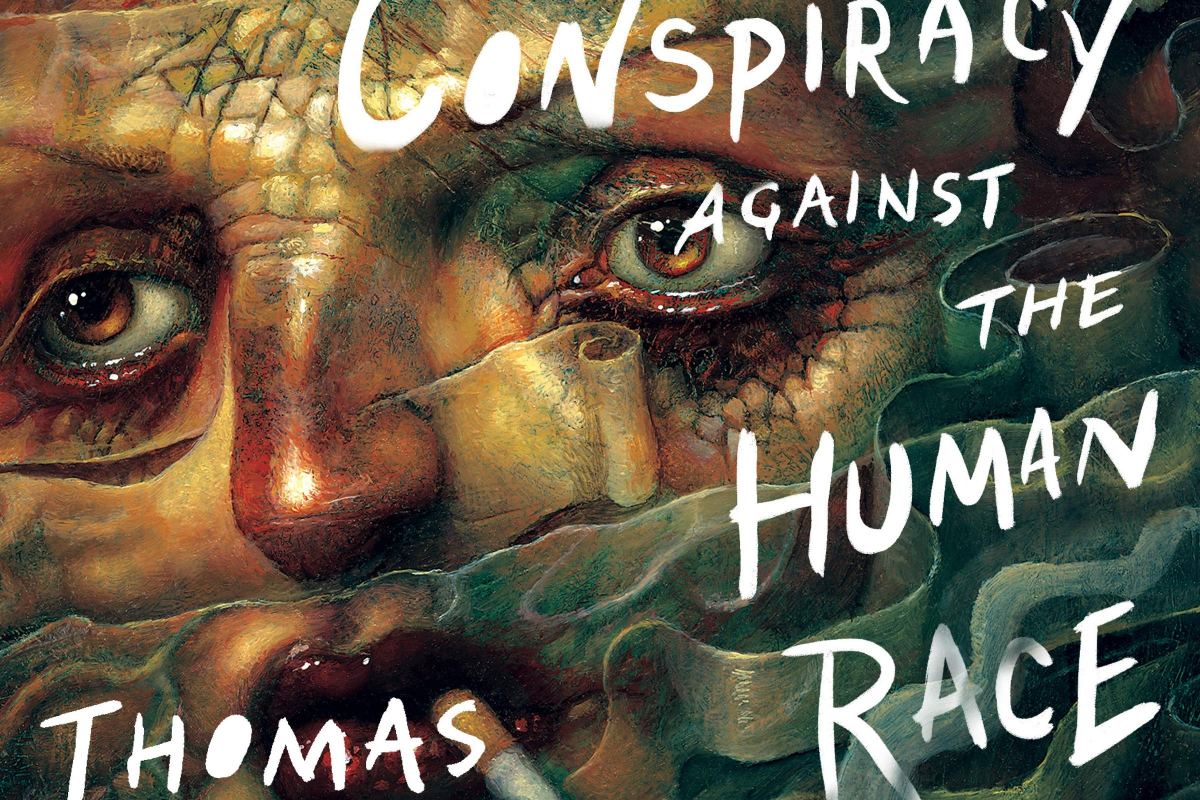
The Conspiracy against the Human Race is a work of non-fiction by horror author Thomas Ligotti. There is an audio podcast version and a YouTube video version. Feel free to leave comments in the space below or on YouTube.
Transcript
In this segment, I’ll be reviewing a book by Thomas Ligotti, The Conspiracy Against the Human Race, A Contrivance of Horror.
I haven’t done any book reviews, but since I tend to read a lot of books, I figure why not share my take and see how it’s received? If you like these reviews, click the like button and I’ll consider creating more.
Let’s get started.
First, I’ll be providing a little background, and then I’ll summarise some of the content and main themes. I’ll close with my review and perspective.
The author is Thomas Ligotti. He is a published writer in the horror genre in the vein of Lovecraft’s atmospheric horror. I’ve not read any of his work and haven’t read much fiction in ages.
The Conspiracy Against the Human Race is Ligotti’s first work of non-fiction. The book was originally published in 2010. I read the 2018 paperback version published by Penguin Books.
Conspiracy Against the Human Race falls into the category of Ethics and Moral Philosophy in a subcategory of pessimism. The main thesis of this book is that humans ought never to have been born. Following in the footsteps of anti-natalist David Benatar, who published Better Never to Have Been Born in 2007, Ligotti doubles down on Benatar’s position on the harm of coming into existence and argues that humans should just become extinct. Moreover, we should take out life in general.
In the book, Ligotti posits that consciousness was a blunder of nature and is the root of all suffering. He argues the derived Buddhist position of dukkha, which translates as Life is suffering. He establishes that most people are aware of this fact, but that we are nonetheless wired to be biased toward optimism through delusion and what a psychoanalyst might call repressed memories. Moreover, pessimists are a cohort not tolerated by society, who don’t want their delusions shattered.
Philosophically, Ligotti is a determinist. I’ve created content on this topic, but in a nutshell, determinism is the belief that all events are caused by antecedent events, leading to a chain of causes and effects stretching back to the beginning of time and bringing us to where we are now. If we were able to rewind time and restart the process, we would necessarily end up in the same place, and all future processes will unfold in a like manner.
Ligotti likes the metaphor of puppets. He employs puppets in two manners. Firstly, being the determinist he is, he reminds us that we are meat puppets with no free will. Our strings are controlled by something that is not us. This something ends up being Schopenhauer’s Will, reminding us that one can want what we will, but we can’t will what we will. This Will is the puppeteer. Secondly, puppets are soulless, lifeless homunculi that are employed in the horror genre to create unease by means of an uncanny association. He cites the work and philosophy of Norwegian author Peter Zapffe, who also elucidates human existence as a tragedy. Humans are born with one and only one right—the right to die. And death is the only certainty. The knowledge of this causes unnecessary suffering.
Quoting Ligotti,
“Stringently considered, then, our only natural birthright is a right to die. No other right has ever been allocated to anyone except as a fabrication, whether in modern times or days past. The divine right of kings may now be acknowledged as a fabrication, a falsified permit for prideful dementia and impulsive mayhem. The inalienable rights of certain people, on the other hand, seemingly remain current: somehow we believe they are not fabrications because hallowed documents declare they are real.”
Ligotti reminds us that consciousness is a mystery. We don’t really know what it is or what causes it other than it exists and we seem to have it, to be cursed with it. He adopts Zapffe’s position that consciousness is also responsible for the false notion of the self.
As all life is, humans are the result of an evolutionary process. Consciousness was just the result of an evolutionary blunder. He cites Zapffe and conveys that “mutations must be considered blind. They work, are thrown forth, without any contact of interest with their environment.”
Whilst pessimists view consciousness as a curse, optimists such as Nicholas Humphry think of it as a marvellous endowment.
He summarises the reason humans have it worse than the rest of nature:
“For the rest of the earth’s organisms, existence is relatively uncomplicated. Their lives are about three things: survival, reproduction, death—and nothing else. But we know too much to content ourselves with surviving, reproducing, dying—and nothing else. We know we are alive and know we will die. We also know we will suffer during our lives before suffering—slowly or quickly—as we draw near to death. This is the knowledge we “enjoy” as the most intelligent organisms to gush from the womb of nature. And being so, we feel shortchanged if there is nothing else for us than to survive, reproduce, and die. We want there to be more to it than that, or to think there is. This is the tragedy: Consciousness has forced us into the paradoxical position of striving to be unself-conscious of what we are—hunks of spoiling flesh on disintegrating bones.”
I’ll repeat that: Consciousness has forced us into the paradoxical position of striving to be unself-conscious.
He cites Zapffe’s four principal strategies to minimise our consciousness, isolation, anchoring, distraction, and sublimation
Isolation is compartmentalising the dire facts of being alive. So, he argues, that a coping mechanism is to push our suffering out of sight, out of mind, shoved back into the unconscious so we don’t have to deal with it.
Anchoring is a stabilisation strategy by adopting fictions as truth. We conspire to anchor our lives in metaphysical and institutional “verities”—God, Morality, Natural Law, Country, Family—that inebriate us with a sense of being official, authentic, and safe in our beds.
Distraction falls into the realm of manufactured consent. People lose themselves in their television sets, their government’s foreign policy, their science projects, their careers, their place in society or the universe, et cetera. Anything not to think about the human condition.
Sublimation. This reminds me of Camus’ take on the Absurd. Just accept it. Embrace it and incorporate it into your routine. Pour it into your art or music. Ligotti invokes Camus’ directive that we must imagine Sisyphus happy, but he dismisses the quip as folly.
Ligotti underscores his thesis by referencing the works of other authors from David Benatar to William James.
Interestingly, he suggests that people who experience depression are actually in touch with reality and that psychology intervenes to mask it again with the preferred veil of delusion and delf-deception. Society can’t operate if people aren’t in tune with the masquerade. Citing David Livingstone Smith in his 2007 publication, Why We Lie: The Evolution of Deception and the Unconscious Mind, Ligotti writes: “Psychiatry even works on the assumption that the “healthy” and viable is at one with the highest in personal terms. Depression, “fear of life,” refusal of nourishment and so on are invariably taken as signs of a pathological state and treated thereafter.”
Ligotti returns to the constructed notion of the self and presents examples of how a lack of self is an effective horror trope, citing John Carpenter’s The Thing and Invasion of the Body Snatchers.
He spends a good amount of time on ego-death and the illusion of self, a topic I’ve covered previously. He mentions Thomas Metzinger and his writings in several places including his Being No One, published in 2004, ostensibly reinforcing a position described as naïve realism, that things not being knowable as they really are in themselves, something every scientist and philosopher knows.
He delves into Buddhism as a gateway to near-death experiences, where people have dissociated their sense of self, illustrating the enlightenment by accident of U. G. Krishnamurti, who after some calamity “was no longer the person he once was, for now he was someone whose ego had been erased. In this state, he had all the self-awareness of a tree frog. To his good fortune, he had no problem with his new way of functioning. He did not need to accept it, since by his report he had lost all sense of having an ego that needed to accept or reject anything.” Krishnamurti had become a veritable zombie. He also cited the examples of Tem Horwitz, John Wren-Lewis, and Suzanne Segal, but I won’t elaborate here.
Russian Romantic author, Leo Tolstoy, famous for War and Peace and Anna Karenina, was another pessimist. He noticed a coping approach his associates had employed to deal with their morality.
Ignorance is the first. As the saying goes, ignorance is bliss. For whatever reason, these people are simply blind to the inevitability of their mortal lives. As Tolstoy said these people just did not know or understand that “life is an evil and an absurdity”.
Epicureanism comes next. The tactic here is to understand that we are all in here and no one gets out alive, so we might as well make the best of it and adopt a hedonistic lifestyle.
Following Camus’ cue, or rather Camus following Tolstoy and Schopenhauer, he suggests the approach of strength and energy, by which he means the strength and energy to suicide.
Finally, one can adopt the path of weakness. This is the category Tolstoy finds himself in, writing “People of this kind know that death is better than life, but not having the strength to act rationally—to end the deception quickly and kill themselves—they seem to wait for something.”
The last section of the book feels a bit orthogonal to the rest. I won’t bother with details, but essentially he provides the reader with examples of how horror works by exploring some passages, notably Radcliffe’s, The Mysteries of Udolpho; Conrad’s Heart of Darkness; Poe’s Fall of the House of Usher; Lovecraft’s Call of Cthulhu; and contrasting Shakespeare’s Macbeth and Hamlet.
This has been a summary of Thomas Logotti’s Conspiracy against the human race. Here’s my take. But first some background, as it might be important to understand where I am coming from.
I am a Nihilist. I feel that life has no inherent meaning, but people employ existentialist strategies to create a semblance of meaning, much akin to Zapffe’s distraction theme or perhaps anchoring. This said I feel that, similar to anarchism, people don’t understand nihilism. Technically, it’s considered to be a pessimistic philosophy because they are acculturated to expect meaning, but I find it liberating. People feel that without some constraints of meaning, that chaos will ensue as everyone will adopt Tolstoy’s Epicureanism or to fall into despair and suicide. What they don’t know is they’ve already fabricated some narrative and have adopted one of Zappfe’s first three offerings: isolation, which is to say repression); anchoring on God or country; or distracting themselves with work, sports, politics, social media, or reading horror stories.
Because of my background, I identify with Ligotti’s position. I do feel the suffering and anguish that he mentions, and perhaps I am weak and rationalising, but I don’t feel that things are so bad. I may be more sympathetic to Benatar’s anti-natalism than to advocate for a mass extinction event, though I feel that humans are already heading down that path. Perhaps this could be psychoanalysed as collective guilt, but I won’t go there.
I recommend reading this. I knocked it out in a few hours, and you could shorten this by skipping the last section altogether. If you are on the fence, I’d suggest reading David Benatar’s Better Never to Have Been. Perhaps I’ll review that if there seems to be interest. If you’ve got the time, read both.
So there you have it. That’s my summary and review of Thomas Ligotti’s The Conspiracy against the Human Race.
Before I end this, I’ll share a personal story about an ex-girlfriend of mine. Although she experienced some moments of happiness and joy, she saw life as a burden. Because she had been raised Catholic and embodied the teachings, she was afraid that committing suicide would relegate her to hell. In fact, on one occasion, she and her mum had been robbed at gunpoint, and her mum stepped between my girlfriend and the gun. They gave the gunmen what they wanted, so the situation came to an end.
My girlfriend laid into her mother that if she ever did something like that again and took a bullet that was her ticket out, she would never forgive her. As it turned out, my girlfriend died as collateral damage during the Covid debacle. She became ill, but because she was living with her elderly mum, she didn’t want to go to hospital and bring something back. One early morning, she was writhing in pain and her mum called the ambulance. She died later that morning in hospital, having waited too long.
For me, I saw the mercy in it all. She got her ticket out and didn’t have to face the hell eventuality. Not that I believe in any of that, but she was able to exit in peace. Were it not for the poison of religion, she could have exited sooner. She was not, in Tolstoy’s words, weak, so much as she had been a victim of indoctrination. I feel this indoctrination borders on child abuse, but I’ll spare you the elaboration. So, what are your thoughts on this book? Is there a conspiracy against humanity? Are optimists ruining it for the pessimists? What do you think about anti-natalism or even extinction of all conscious beings or the extreme case of all life on earth? Is Ligotti on to something or just on something?
I have agreed with this sentiment for as long as I can remember, at least stretching back to age 10 or 12 and long before I had ever heard of the likes of Proudhon. I don’t believe that Proudhon is a big focus in the United States. I never encountered him in all of my studies from kindergarten to grad school—and I was an economics major.
In the US, disparaging Marx was always in vogue, with the off-hand remark along the lines of “Communism works on paper, but because of human nature, it can’t work in practice. And by the way, look at the Soviet Union. That’s all the proof you need.” Of course, I was left thinking that at least it worked on paper, something I can’t say with a straight face for Democracy.
For those who are familiar with Proudhon, he is likely remembered for his quote, “Property is theft!” I’ve discussed this before.
La propriété, c’est le vol!
Property is theft!
But this is a different quote: “I do not wish to be either ruler or ruled.” When I was in high school, there was a saying, lead, follow, or get out of the way. As imperfect of a metaphor as it is, I just wanted out of the way. In the world of leaders and followers, I wanted to be an advisor. In a manner—given the false dichotomy of followers and leaders—, this relegated me a de facto follower. Only I am not a follower. I not only question authority and authority figures, I question the legitimacy of their power. Not a great follower, to be sure.
I feel I am the peasant in Monty Python’s Holy Grail who tells King Arthur upon encountering him, “Well, I didn’t vote for you.” Not that voting yields some source of legitimacy. What options does one have?
Philosophically speaking, there is no justification for personal bodily autonomy. Someone just made this claim, and some others agreed. Sounds good to me, but there is no real reason to support the idea save for selfish rationale.
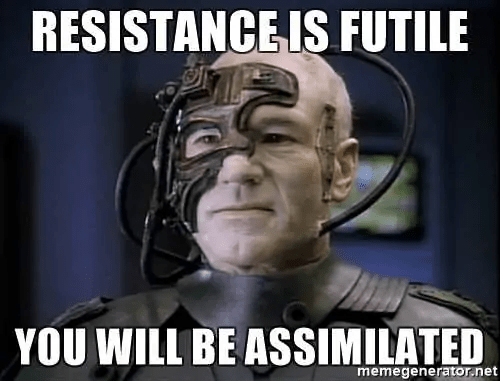
The science fiction staple, Star Trek, famously created a Borg where autonomy was futile. Because of our acculturation, we find this idea perhaps silly or perhaps appalling or absurd, but one is not more justifiable than another except by rhetorical devices. Yet neither is right.
Resistance is futile!
In the West, we tend to prefer a rather middle path, and perception doesn’t actually comply with reality. I think that people believe that they are more autonomous than they are. I’d be willing to argue that this is the same delusion underlying a sense of free will. Sartre might have argued that we each retain a sort of nuclear option as a last resort, but a choice between two options is hardly freedom. It sounds a lot like Sophie’s Choice (spoiler alert).
Not so come across like Hobbes, but I do feel that violence (subject to semantic distinction), or at least the potential for it, is inherent in any living system. With political and legal systems, violence just shifts from explicit to implicit, and so out of sight, out of mind.
In any case, I do not wish to be either ruler or ruled. I just want to advise. I’m an introvert. I want to be left alone. I value the benefits of society and I participate at the margins, and that’s where I prefer to remain. If the direction of the train I am on seems to be running off the tracks I’d presume it should be on, then I’ll get vocal. Otherwise, I’ll take the privilege to concentrate on cerebral and philosophical interests.
In this segment, I ponder the interplay between blame and Causa Sui. I’ll discuss the implications for moral responsibility as well as legal responsibility, which are not as in sync as one might imagine they might be.
Video: Blame & Causa Sui
To the uninitiated, Western legal systems have no pretensions about being about morality or justice. Legal systems are designed to maintain power structures and the status quo. They are deontological machines, making them prime targets for automation by the machine learning associated with artificial intelligence. This would also diminish the power of rhetoric over facts to some extent. But, I am no legal scholar, and all of this will have to wait for another segment.
I recently shared a video on causa sui and the basics of blame and blameworthiness, so I want to intersect those topics here.
Peter Strawson suggested that for humans, blame is a reactive response. It’s reflexive like having your knee jerk when tapped. Essentially, his position is that if blame didn’t naturally exist, we’d have to invent it, mirroring Voltaire’s quip, ‘If God did not exist, it would be necessary to invent Him’. Of course, this is because they serve the same power control purpose.
If God did not exist, it would be necessary to invent Him
Voltaire
To be fair, blame is closer to real than God, but the point remains. Strawson’s point is also that humans are saddled with blame and it’s not going anywhere no matter how nebulous it becomes in execution. It’s natural.
To me, this starts to sound suspiciously like a naturalistic fallacy. Humans seem to selectively cherry-pick which so-called natural tendencies they choose to defend. One might use nature to argue that female sexual availability begins at menstruation, and yet we have decided to ignore this and defer this on the grounds of civility. It’s obvious that we could consider blame to be an animal instinct we want to domesticate away, but because it serves other purposes, per Strawson’s perspective, it’s a useful tool. But what’s the causa sui challenge. Let’s quickly recapitulate.
Causa sui argues that one cannot be the cause of oneself, ex nihilo. Being full products of nature and nurture to adopt the lay parlance, any blameworthiness lies with the sources or creators. Since we are concerned with moral responsibility, we can eliminate nature forthrightly. Nature may be responsible—by many estimations approximately 40 per cent responsible—, it possesses no moral agency. And if the individual is not responsible, then we are left with the environment and society, including the social environment. Of course, the environment gets off the hook in the same manner as the genetic and hereditary factors of nature.
Before we consider society, let’s regard the individual.
Albeit the brain-as-computer is a bit facile, it’s still good enough for illustrative purposes. When you are born, your cognitive hardware is installed, as are your edge peripherals and update protocols. Any of these can become damaged through some degenerative processes, or external environmental factors, but since my interest is in optimistic rather than pessimistic scenarios, I’ll ignore these instances. Given that blameworthiness is directly related to presumed cognitive processing, factors that diminish these faculties, mitigate blameworthiness and factors than increase it, ameliorate it.
As a—quote—’normal’ child becomes an adolescent and then an adult, the probability it will become blameworthy, increases with age, ceteris paribus. A person with cognitive deficits or conditions such as aphasia or dementia decreases the probability of blame assignment. Even temporary impairment mitigates judgment—oh, she was drunk.
So, following the brain-as-computer analogy, your brain is a CPU with a self-updating cognitive operating system and instruction set. Essentially, there is also short and long-term memory. In the case of cognitive deficits, one of these components might be effectively broken. The CPU might process too slowly; it might misinterpret what it receives; there may be issues with the sense organs or the nerves that transport signals.
I’ve got a mate who, due to medical malpractice at birth, experienced nerve damage. Although his eyes and brain are normal, his optic nerve cannot carry signals very well, effectively leaving him blind. Neither can he taste nor smell. So there’s that.
But assuming that this processing and storage hardware are intact, the causa sui constraint still applies, but let’s spend some time evaluating societal interactions.
All inputs come from society—cultures and subcultures. Apart from misinterpreted processing scenarios, if a person doesn’t receive a particular moral instruction set, that person should surely be considered to be exempt from moral blame. It may be difficult to assess whether an instruction has been input. This is a reason why children are categorically exempted: they may not have received all of the expected moral codes, they may not have been stored or effectively indexed, and their processing hardware is still in development—alpha code if you will. Brain plasticity is another attribute I won’t spend much time on, but the current state of science says that the brain is still not fully developed even by age 30, so this is certainly a mitigating factor, even if we allow leeway for the causa sui argument.
I mention subculture explicitly because the predominant culture is not the only signal source. A child raised by, I don’t know, say pirates, would have an amended moral code. I am sure we can all think of different subcultures that might undermine or come at cross odds with the dominant culture, whether hippies, religious cultists, militia groups, racial purist groups, and so on.
So, a commonly held moral in the subdominant group may counter that of the prevailing one. An example that comes to mind is some religious organisations that do not agree with human medical intervention. There have been cases where parents have allowed a child to die from an otherwise curable condition. Although in the United States, there is a claim of freedom of religion—a claim that is spotty at best—, parents or guardians in situations like these have been convicted and sentenced for following their own moral codes. But as with all people, these people are as susceptible to the limitations of causa sui as the rest of us. They are not responsible for creating themselves, but moral responsibility was asserted based on the beliefs of the prevailing culture. Even besides the legal context, persons in the larger society would likely blame the parents for their neglect—though they may be praised for being resolute in their righteousness by their in-group. This just underscores that morality is a collection of socially constructed conventions rather than something more objective.
Returning to causa sui, let’s say a person commits an act that society would typically assign blame. Rather than exercise some act of retributive justice—a concept with no foundation in a causa sui universe—the course of action was remediation. In this case, the desired moral instruction would be delivered thereby seemingly making the moral offender blameworthy. But would they be?
Presumably, (for what it’s worth) psychologists would evaluate the subject for competency in maintaining the programming. In the case of the aforementioned religious parents, they may be threatened with retribution for not abiding by the superseding rules of the prevailing power structure.
Although I might personally allow some leeway even with the causa sui in full force and effect, but I can’t say that I have much faith in the ability of humans to make a correct assessment. My impression is that any assessment would be one of convenience than something sounder.
Perhaps I’ll produce a more robust segment on retributive justice, but my feeling is that retributive justice is an area that legal systems should avoid altogether. If necessary, focus on restorative justice, rehabilitation (or ‘habilitation’ as the case might be) and quarantine models to ensure any bad actors are contained away from society. Again, this puts individuals at the mercy of cultures they find themselves a part of. I am not going to delve into this any further save to remind the listener of gang initiation schemes where a person needs to kill a member of a rival gang to become a trusted member. This is their moral code—quite at odds with the mainstream.
So there you have it. Owing to causa sui constraints, a person cannot be ultimately responsible for their actions. My primary thesis is—apart from metaphorical equipment failures—that any moral responsibility falls wholly on the society or culture. Full stop. And this isn’t as foreign as one might first feel. Although for most people blame is natural, in an individualistic society, people are interested in finding the culprit. In collectivist cultures, any culprit might do. Perhaps I’ll share some stories in a future segment. Meantime, what are your thoughts on moral responsibility? Can someone be ultimately responsible? Some have said the ‘ultimate responsibility’ is a philosophical red herring and that we can still hold someone responsible, even if not in the ultimate sense, which causa sui disallows. Are you more in this camp? Is this enough to mete out so-called retributive justice? For me, retributive justice is a euphemism for vengeance, and justice is a weasel word. But that’s just me, and perhaps a topic for another segment.
Are there any topics you’d like me to cover? Leave a comment below.
I’ve finally returned to the second author of Four Views on Free Will. The first author was Robert Kane. Here, I was introduced to John Martin Fischer, who wrote a section on Compatibilism. I’ve never read anything by Fischer. Indeed, I have no familiarity with him or his work. Allow me to start by saying that I was not impressed. Before diving into the content, let’s just say that he was extremely repetitive and circumlocutive. I found myself questioning whether the book was assembled with duplicate pages. Hadn’t I just read that? I’ll spare the reader the examples.
I repeat myself when under stress
I repeat myself when under stress
I repeat myself when under stress
I repeat myself when under stress
— King Crimson, Indiscipline
The topic was 44 pages on compatibilism. The first 30 pages were compatibilism before he changed to his brainchild, semi-compatibilism. Full disclosure: I am not a compatibilist. My recollection is that the majority of contemporary philosophers are compatibilists. Joining Fischer are Dan Dennett, Frithjof Bergmann, Gary Watson, Susan R. Wolf, P. F. Strawson, and R. Jay Wallace. Historically, this cadre are joined by Hobbes, Locke, Hume, and Mill. This motley crew has been opposed by Peter van Inwagen and historical figures, Arthur Schopenhauer, William James, and Immanuel Kant.
Semi-compatibilism is the idea that regardless of whether free will and determinism are compatible, moral responsibility and determinism are.
At a meta-level, Fischer repeatedly—I’ll discontinue using this term as, like Fischer, it will become very, very repetitive—invoked law and common sense. Law is not a moral structure in search of truth. It’s a power structure employed to retain the status quo. And, as Voltaire quipped, ‘common sense is not so common.’ This is an argumentum ad populum (appeal to popularity) fallacy. It also relies on belief and perception. I suppose he’s not familiar with Descartes’ Meditations. It seems he is trying to forge Compatibilism into a cast of soft determinism with hopes that no one notices the switcheroo.
Fischer targets some quotes buy Kant, James, Wallace Matson, and Nietzsche with the general critique that they are expecting too much of an agent by expecting it to be the cause of its own actions. Nevermind, that he is guilty of just this in attempting to parse passive and active agents—passive being insentient dominos and active being conscious entities.
I’m not convinced that maths is a strong point. He sets up a hypothetical scenario where physics has proven that causal determinism is true, so 100 per cent of everything in the universe can be known with certainty. But then he does two things.
First, he exempts human agency—cuz reasons. Second, he creates a parallel scenario where 100 per cent might be 99 or 99.9 per cent.
Second, he claims that because he feels free, he must be free.
Similarly, it is natural and extraordinarily “basic” for human beings to think of ourselves as (sometimes at least) morally accountable for our choices and behavior. Typically, we think of ourselves as morally responsible precisely in virtue of exercising a distinctive kind of freedom or control; this freedom is traditionally thought to involve exactly the sort of “selection” from among genuinely available alternative possibilities alluded to above. When an agent is morally responsible for his behavior, we typically suppose that he could have (at least at some relevant time) done otherwise.
— Fischer, p. 46
Nothing is such that thinking doesn’t make it so.
It seems that when watching a movie for the third time, the victim who gets killed in the cellar won’t descend the stairs this time. Fisher must get perplexed when she does every time. Of course, he’d argue without evidence that an active agent would be able to make a different decision—even under identical circumstances. He insists that the agent possesses this free will.
Whilst sidestepping physicalism and materialism, he simply posits that consciousness is just different and not subject to other causal chain relationships—and that these cannot be deterministic even if everything else is.
I’m going to digress on his next point—that the person who knows not to cheat on taxes, and who does so anyway, is responsible as any normal person would be. Perhaps the person feels that the taxes are being used for illegal or immoral purposes and is taking the moral high ground by depriving the institution of these proceeds.
Around 2007 or so, I paid my taxes due minus about $5,000, which was the calculated amount of the per capita cost of the illegal and immoral Iraq invasion by the United States and its cadre of war criminals in charge. I attached a note outlining my opposition and rationale.
Some months later, the Internal Revenue department sent a legal request to my employer for the withheld sum. Payroll summoned me and conveyed that they were required to comply with the request. I told them my perspective and said if they could sleep with that on their conscience, then they were in their power. And so no nights of sleep were lost.
The point of this anecdote is to say that morals are social constructs. Clearly, Fischer is just an old-fashioned conformist. I suspect he thinks of Valjean as a bad person.
Like many if not most people, he employs a compos mentis approach, exempting persons of reduced cognitive capacity and those under duress or coercion, but he is not a proponent of the causa sui defence.
He has an entire subsection devoted to the libertarian notion of freedom. To recapitulate, he simply regurgitated all of the standard arguments and exempts the aforementioned agents and adds people under hypnosis, the brainwashed, and so on. Nothing to write home about—not here either.
In the next subsection, his focus is on consequences. He calls out Peter van Inwagen’s Consequence Argument.
Similarly, the skeptical argument about our freedom employs ordinary ideas about the fixity of the past and the fi xity of the natural laws (putatively) to generate the intuitively jarring result that we are not ever free, if causal determinism turns out to be true (something we can’t rule out apriori). If this skeptical argument is sound, it calls into question any compatibilist analysis of freedom (that is, freedom of the sort under consideration – involving the capacity for selection among open alternatives). If the argument is sound, then not only both the simple and refined conditional analysis, but any compatibilist analysis (of the relevant sort of freedom) must be rejected.
Fischer p. 53
He leans on Borges’ garden of forking paths and claims (without support) that although the past might be fixed, freedom is the ability to add to the future, citing Carl Ginet as the source of this notion. He misses the point that that’s what the future is, tautologically. It adds now to the past and generates a future. Choice is not necessary for this function to operate, but he continues to insist on invoking it.
Standard Frankfort examples are referenced as well as Locke. Here he wants to point out regulative control—but he skirts the question of where the volition comes from by saying ‘for his own reasons‘, as if these reasons are somehow meaningful. In the end, he recites the scenarios, performs some hand-waving, and summons his accord with Robert Kane’s “dual voluntariness” constraint on moral responsibility.
He leaves us with the thought that if the Consequence Argument were true, it would be compatibilism’s death knell, but it’s not true (in his mind), so all is well in Whoville. Crisis averted.
Source incompatibilism is next. His focus here is on the “elbow room” necessary to exercise free will.
Elbow Room is the title of a book by Daniel Dennett originally published in 1984 and republished in 2015. I’ve recently read this on holiday, but I haven’t had time to review it. Please stand by.
His approach in this subsection is to attack opposing perspectives as reductionist. Of course, he’s right, but they are no more reductionist than anything he’s suggested thus far. Besides, simply injecting favoured concepts to add to a model to make it compatible with one’s hypothesis doesn’t make it less reductionist. It just makes the model more convoluted.
Here he attempts to elevate consciousness into a special category in order to shield it from the physics of the universe. We can’t say for sure what consciousness is, but you can bet it’s a magical place where practically anything can happen. OK, that’s a bit of hyperbole.
He uses the metaphor of trying to assess how a television works by only studying the components. Of course, if that is all one did, one would be left with questions. But that is not where one stops. To be fair, neuroscience has come a long way since this was published in 2007. Neuroscientists are asking questions beyond the hardware.
He sets up a strawman by labelling total control as a chimaera as if anyone is arguing that if a theory doesn’t allow for total control, it will not be accepted. He does allow that…
We do not exist in a protective bubble of control. Rather, we are thoroughly and pervasively subject to luck: actual causal factors entirely out of our control are such that, if they were not to occur, things at least might be very different.
— Fischer, p. 68
We agree on this point, but I feel that he underestimates the remaining degrees of freedom after all of this is accounted for.
He attempts to create a mental model with vertical and horizontal lines. At least he admits that he does “not suppose [to] have offered a knockdown argument” because he doesn’t.
Finally, he wraps up this subsection by invoking Nietzsche’s famous Munchausen Causa Sui statement in Twilight of the Idols. He attacks this rationale as being “both ludicrous and part of commonsense.” He loves his commonsense.
Next, he wants to convince us, Why Be a Semicompatibilist? Semicompatibilism just needs enough elbow room to assert freedom. I suppose that’s the ‘semi‘ part. It feels to me an exercise in self-delusion.
The main idea behind semicompatibilism is to shrink the target size of compatibility and focus centrally on moral responsibility and agent control rather than the larger realm of free will.
Fischer makes what might be considered to be a religious argument. We should adopt this perspective because it feels better and is in our best interest. He cites Gary Watson’s view of using indeterminism to undermine determinism, but he feels that rather etiolates control rather than strengthening it because it “becomes unclear that our choices and actions are really ours.”
In the next subsection, he leads with the argument “that moral responsibility does not require regulative control, but only guidance control, and further that it is plausible that guidance control is compatible with causal determinism.” At least, this is the story he’s sticking to.
In Fischer’s “approach to guidance control, there are two chief elements: the mechanism that issues in action must be the “agent’s own,” and it must be appropriately “reasons-responsive.””
As for the “agent’s own” constraint, he simply notes that counterclaims exist, but he asserts that he doesn’t accept them.
In the final subsection, he writes about the Lure of Semicompatibilism. I do feel he is lured by the concept and makes light of the label. He advances the notion that “Kant believed that compatibility and incompatibilism are consistent“. Say what? But he takes a weaker position on this claim, using the Kant name-drop for cover.
As I said at the start, I don’t know anything about Fischer, but he is obsessed with legal theory as if it has any bearing on philosophical standing. Perhaps I’ll include a summary from a quick internet perusal. After I’ve wrapped this up. He mentions moral desert, which is a concept employed in matters of restorative and retributive justice.
The section concludes with a list of publications by him and others. Perhaps I’ll list them here in future as an addendum. For now, I’ll pop outside of this edit window and see what I can find on John Martin Fischer.
John Martin Fischer (born December 26, 1952) is an American philosopher. He is Distinguished Professor of Philosophy at the University of California, Riverside and a leading contributor to the philosophy of free will and moral responsibility.
I mentioned in my last post about how Artificial Intelligence discovered a new variable—or, as the claim suggests, a new physics. This was a tie-in to the possible missing dimensions of human perception models.
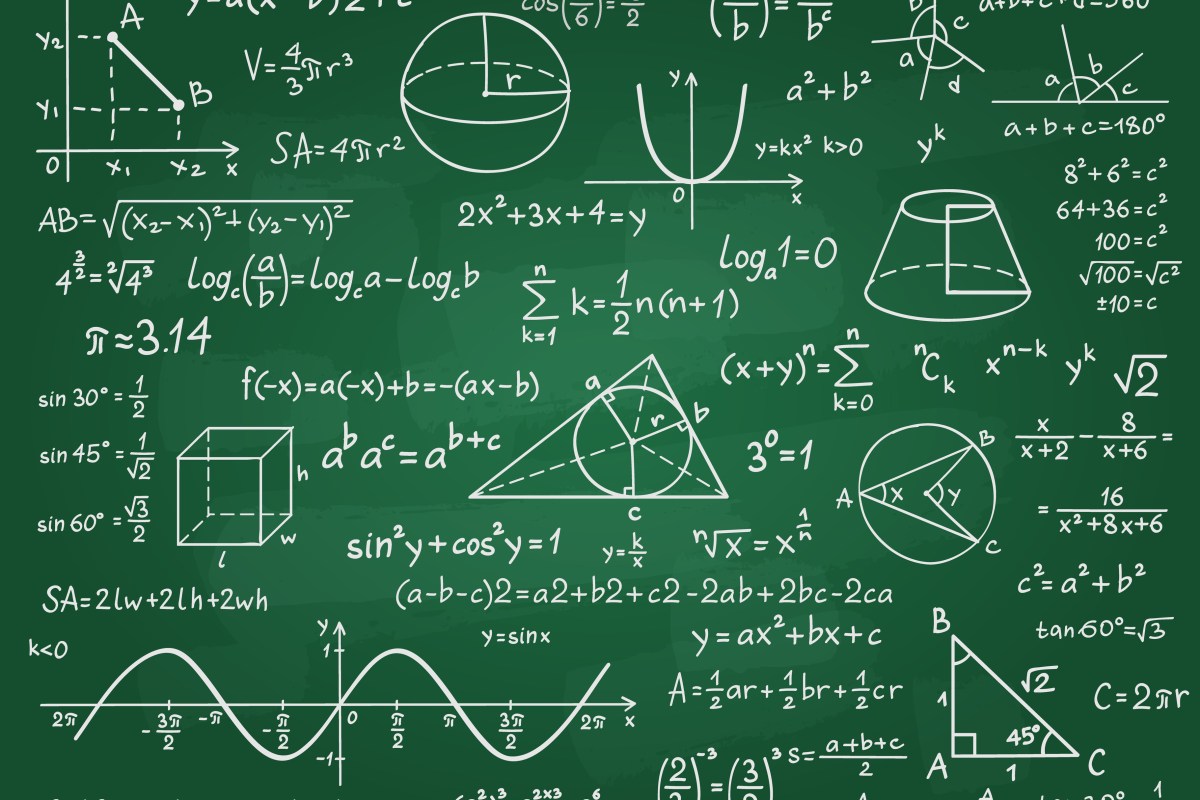
Without delving too deep, the idea is that we can predict activity within dynamic systems. For example, we are all likely at least familiar with Newtonian physics—postulates such as F = ma [Force equals mass times acceleration or d = vt [distance equals velocity times time] and so on. In these cases, there are three variables that appear to capture everything we need to predict one thing given the other two that need to remain constant. Of course, we’d need to employ calculus instead of algebra if these are not constant. A dynamic system may require linear algebra instead.
When scientists represent the world, they tend to use maths. As such, they need to associate variables as proxies for physical properties and interactions in the world. Prominent statistician, George Box reminds us that all models are wrong, but some are useful. He repeated this sentiment many times, instructing us to ‘remember that models are wrong: the practical question is how wrong do they have to be to not be useful‘. But no matter how hard we try, a model will never be the real thing. The map cannot become the terrain, no matter how much we might expect it to be. By definition, a model is always an approximation.
All models are wrong but some are useful
George Box
In the Material Idealism post, the embedded video featuring Bernardo Kastrup equated human perception to the instrumentation panels of an aeroplane. Like the purported observer in a brain, the pilot can view the instruments and perform all matters of actions to manipulate the plane, including taking off, navigating through the environment, avoiding obstacles, and then landing. But this instrumentation provides only a representation of what’s ‘really’ outside.
Like mechanisms in the body, instrumentation can be ‘wired’ to trigger all sorts of warnings and alerts, whether breached thresholds or predictions. The brain serves the function of a predictive difference engine. It’s a veritable Bayesian inference calculator. Anil Seth provides an accessible summary in Being You. It relies on the senses to deliver input. Without these sense organs, the brain would be otherwise unaware and blinded from external goings on.
The brain cannot see or hear. It interprets inputs from eyes and ears to do so. Eyes capture light-oriented events, which are transmitted to the brain via optic nerves, and brain functions interpret this information into colour and shape, polarisation and hue, depth and distance, and so on. It also differentiates these data into friend or foe signals, relative beauty, approximate texture, and such. Ears provide a similar function within their scope of perception.
As mentioned, some animals have different sense perception capabilities and limitations, but none of these captures data not also accessible to humans via external mechanisms.
Some humans experience synesthesia, where they interpret certain stimuli differently, perhaps hearing colours or smelling music. We tend to presume that they are the odd ones out, but this assumption does not make it so. Perhaps these people are actually ahead of the rest of us on an evolutionary scale. I suppose time might sort that one out.
But here’s the point. Like the pilot, we can only experience what we are instrumented to experience, as limited to our sense perception and cognition faculties. If there are events not instrumented, it will be as if they don’t exist to the pilot. Can the pilot hear what’s happening outside?
This is the point of the AI experiment referenced above. Humans modelled some dynamic process that was presumed to be ‘good enough’, with the difference written off as an error factor. Artificial Intelligence, not limited to human cognitive biases, found another variable to significantly reduce the error factor.
According to the theory of evolution, humans are fitness machines. Adapt or perish. This is over-indexed on hereditary transmission and reproduction, but we are more vigilant for things that may make us thrive or perish versus aspects irrelevant to survival. Of course, some of these may be benign and ignored now but become maleficent in future. Others may not yet exist in our realm.
In either case, we can’t experience what we can’t perceive. And as Kastrup notes, some things not only evade perception but cannot even be conceived of.
I am not any more privileged than the next person to what these missing factors are nor the ramifications, but I tend to agree that there may be unknown unknowns forever unknowable. I just can’t conceive what and where.











 Philosophics