Real music comes from the heart. Rather, it’s a right-hemisphere affair. Beethoven was such a true musical genius, he had to express himself even when you couldn’t hear himself.
Above, Rick Reato gives us a little appreciation for Daniel Barenboim’s rendition of Beethoven’s Op.110 Piano Sonata. I’ve included the entire opus below. The entire 31st sonata can also be found on YouTube.
To be a musician and continue to write when deaf is the same as continuing to write as a deaf author. Musical notation is just symbols as words are symbols in a different medium. The inspiration happens in the right hemisphere and the left hemisphere translates them into symbols.
Musically speaking, I am more left-hemisphere. I have ideas that spawn from the right, but without an instrument, I couldn’t articulate them. Not even relatively. Many of my own compositions are left-hemisphere fare. I either take a mathcore approach or perhaps something along the lines of Schoenberg, where I want to convey a pattern—an example that comes to mind is Tool’s Lateralis, wherein the lyrical melody is based on the Fibonacci sequence—, or I let the instrument do the talking and transcribe the music after the fact. I know just about enough music theory to be dangerous, but not enough to be self-sufficient. This is why I always tended to collaborate with music directors or someone competent in this along the way.
My point is that the ears are not necessary to produce music—at least after you’ve figured out how to articulate it. For the record, there are blind artists and sculptors.
The struggle is real. Last night, rather about 3 AM, I awakened with a thousand thoughts. This happens often enough. Some were creative ideas. Some were ideas for topics to write about here. Not just topics, but content as well. Then came the internal debate—whether to wake up and capture these ideas or to hope they’d remain in cache until the morning. All I can say it at least this one did. Well, the topic, at least.
The struggle is whether to lose sleep and risk not falling back to sleep to be able to awaken at a decent hour and not be dragging around the next day from lack of sleep. Or perhaps, at next notice, it would just be time to get up. All these scenarios have occurred at one time or another.
I tend to write a lot, whether for here, for work, for pleasure—whatever. I used to create visual art and certainly wrote a lot of songs or at least musical ideas that I hoped would develop into songs. The struggle was the same. The outcomes were as well.
Having read as much as I have of McGilchrist, it starts to make sense. The right cerebral hemisphere is the font of creativity. It’s also the place for intuition and empathy. The left hemisphere is for symbols and categories. It’s the quarter for intellect. It’s also a bad roommate.
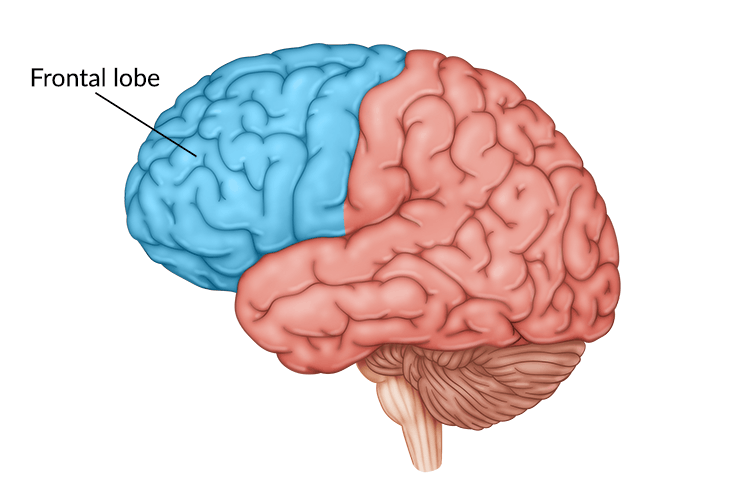
Whether or not one is creative does depend on the right hemisphere. Whether one can create depends on the left. Allow me to explain after laying out a relationship and three possibilities. For my purpose here, I can reduce the brain to three principal actors—the right hemisphere, the left hemisphere, and the frontal lobe.
As mentioned already, the right hemisphere generates creativity; the left hemisphere allows these ideas to be articulated symbolically, as in written and spoken words or art or music notation and so on; the frontal lobe acts as a mediator. Without getting too deep into neurology, a primary function of the frontal lobe is restrictive, which is to say it tells one or the other hemisphere to shut up and mind its business. Unfortunately, the hemispheres have this veto power of their own, so it’s difficult to fully understand the dynamics. This being said, let’s have a look at four scenarios that may illustrate why someone may or may not be able to create—in some cases even if they are otherwise creative.
I’ll start with the situation where the right hemisphere generates the creative ideas, and the other actors perform as expected. This is the brain of the creative person.
In the second scenario, the right hemisphere is simply weak. The person was just born with the bad luck of having a hemisphere that isn’t creative. In this case, there is nothing the left hemisphere or frontal lobe can do to compensate for this deficit. I’d like to think—like, perhaps being the wrong word—that this is where most non-creative people reside. They just don’t have that metaphorical creative gene.
In the third scenario, the right hemisphere generates plenty of creative thoughts, but the left hemisphere won’t “shut up”. If you’ve even had to think in a place with a lot of noise or distraction, you’ll get the gist. This is an imperfect analogy because creativity is precisely about not concentrating. Concentration is the enemy of creativity. So, in the case that the left hemisphere is interfering, it’s because it insists on concentrating, and that interrupts the creative process. In fact, it’s a misnomer to call something s creative process because creativity is precisely a lack of process. Like concentration, process kills creativity.
The right hemisphere is open and divergent. The left hemisphere is closed and convergent.
In the fourth and last scenario, the right and left hemispheres are each playing their parts swimmingly, but the frontal lobe as moderator is deficient. In this case, the left is being itself and disrupting. Like the parable of the scorpion and the frog, it can’t help itself, but the frontal lobe isn’t telling it to be quiet and wait its turn. That’s the job of the frontal lobe. If you’ve ever witnessed a debate or mediated discussion where the moderator just lets the participants run rampant, you’ll know what I mean. Or perhaps you’ve been in a classroom or a meeting where the teacher or leader has no control of the class or the audience. It’s difficult to get anything accomplished.
Moving on. So, the actors each have their roles, but timing matters. The right hemisphere not only needs to generate thoughts or ideas, but it also needs time for them to incubate. Once they are ripe, only then is it ready to encounter the scrutiny of the left hemisphere and seek moderation for the frontal lobe.
If during the incubation process, the left hemisphere is continually asking, “Are we there yet? Are we there yet?” it’s unlikely one will ever get there.
If you are wondering how this works in the world of business and commerce—or better yet, you have already put together that this can’t possibly work in the realm of business and commerce—, I talk about that next. And I’ve got another segment on cerebral challenges in business in the works.
Creativity cannot be time-boxed. It can’t be summoned on demand. As already mentioned, it is not a process, and it can’t be tamed. Aside from the fickle public, have you ever wondered why so many musical artists are one-hit-wonders—if they have even been that lucky? These people had one idea—that happened to be an idea that would resonate in that moment—, but being told by the label to go generate some more hits is asking for creativity on demand.
Depending on your age and generation, some of you might be asking yourselves, “What about Taylor Swift or Ed Sheeran or the Beatles or Beethoven?” These people are clearly the exceptions. We could as well look at the Vincent van Gough of the world who didn’t experience acceptance until after his death. Clearly, his creativity was unrecognised by his contemporaries. Even in some of these exceptional cases, these people have found a voice and are applying a pattern. An example I like is that of Stephen King, who in an interview admitted that he has only had one good idea in his entire life, and he’s exploited it into a large number of books. So, he’s kept reskinning the same skeleton but with different dressings.
And as far as commerce goes, yes, these people are commercially successful. Some would argue about the actual talent. I’ve seen philosophy classes compare the ‘high art’ of Shakespeare with the ‘low art’ of Matt Groening’s The Simpsons. Certainly, The Simpsons are culturally creative and commercially successful, but how creative is it really? How does one actually measure degrees of creativity?
My point is that these exceptional people are generating output once a year or every few years. In business, so-called creatives may be asked to generate new ‘creative’ content daily, weekly, or perhaps monthly. Creativity doesn’t work like this. Even if you asked Mozart to generate a new piece each week, this mechanical process might yield paydirt, but most would just be a formulaic rehash. In fact, if you talk to any top artist, they’ll tell you that what you see or hear is less than one per cent of their ideas. Most are either partially formed or, upon reflection, just bad. They felt good at the time, but they couldn’t develop into something better, or they turned out to be derivative, which is hardly creative.
So business is a death sentence for creativity. The creative people I know, don’t get their creative jollies from their day jobs. They get it from their side projects, from their passion projects, and whether or not these projects are commercially viable.
In fact, I can also look at someone like Nirvana’s Kurt Cobain who was creative at the start—when they were under the radar—, but once they rose into view, he lost it, and then we lost him.
I hope this gives you a better feeling of how creativity works from the perspective of the brain and why we see so little creativity in the real world and even less in the business world. Do you find this surprising, or are you thinking, “man, this bloke must be dense if he’s just catching on to this now”?
I was browsing YouTube, and I got captivated by reaction videos, where a younger audience listens to music some of us grew up with and reacts to it. Time is a song I grew up on. Pink Floyd were a major influence on my music and my worldview. I have to admit that I am partial to the David Gilmour years and stopped caring about anything released after Roger Waters left. I have spent hours listening to their back catalogue with Syd Barrett and early David Gilmour, but Meddle, released in 1971, is about as far back as I prefer to go—even that old gem, Seamus.
Roger Waters penned the deepest lyrics for Pink Floyd, and this was one of his best. He wrote this in his late twenties, though it feels like he would have been older and wiser. I suppose he’s an old soul. Here’s the first verse:
Ticking away the moments that make up a dull day
Fritter and waste the hours in an offhand way
Kicking around on a piece of ground in your hometown
Waiting for someone or something to show you the way
This speaks to how we tend to take time for granted. Sometimes, we just want the time to pass. We’re bored, and we want to get on to something meaningful, eventful, or perhaps exciting. We might be sat in work or school just waiting for quitting time. We aren’t living in the moment or enjoying the moment. And we might just be kicking around on a piece of ground in our hometowns rather aimlessly. And whilst I am aware that many people are looking for someone to guide them to the next level, whether a religion, a vocation, a guru, or a hero, that bit’s never really resonated with me. I suppose I’ve always been naturally insouciant and Zen. Some have said to a fault.
you missed the starting gun
Tired of lying in the sunshine, staying home to watch the rain
You are young and life is long, and there is time to kill today
And then one day you find ten years have got behind you
No one told you when to run, you missed the starting gun
The second verse picks up where the first one left off. Let’s not forget that this is Britain—London—plenty of rain. But some people do get tired of lying in the sunshine living their routine workaday lives. When we are younger, the days feel longer. Time is stretched. Einsteinian relativity. Again, we’ve got time to pad out and fill. Something’s happening at the weekend. Let’s just fast-forward, but we can’t, so let’s fill the time with mindless prattle and television or somesuch. Once you were 18 and now you’re 28. What happened? Tens years gone. Where’d the time go?
The last line in the second verse is telling. For me, it’s more an indictment of quote-modern-unquote society. It only applies to those who buy into this worldview. I never bought in. It’s’ always been a sham. But for some, they reach 28 and realise they’ve made the wrong decisions for their lives to end up the way they may have envisaged. I’ve never had this grand vision.
one day closer to death
And you run, and you run to catch up with the sun but it's sinking
Racing around to come up behind you again
The sun is the same in a relative way but you're older
Shorter of breath and one day closer to death
Resistance is futile. You can’t escape the movement of time as represented by the quotidian sun. It will always lap you. The sun ages on a different time scale to you. The sun doesn’t appear to age. It was here when we arrived. It will be here when we leave. It was here before any of us were born. It will be here after we’ve all left. Yet with every lap of the sun, we are each another day closer to death. That day may be tomorrow, next week, or in a hundred years, but as Twelve-Step programmes remind us, we live one day at a time. Perhaps even this is too large of a time slice, as we can only live moment to moment. Anything else is but a construction. Nothing else is real. Memento Mori.
thought I’d something more to say
Every year is getting shorter, never seem to find the time
Plans that either come to naught or half a page of scribbled lines
Hanging on in quiet desperation is the English way
The time is gone, the song is over, thought I'd something more to say
Again, time is relative. When we are young, we yearn for things: perhaps to graduate high school; get a driver’s license; graduate college; get the job we wanted; get some promotion or recognition; get signed to a big label; get a big break; the list goes on.
For those who are planners, the best-laid plans go awry. We dream of whatever and even journal these thoughts, but in the words of another song, “you can’t always get what you want”.
We want to do this or that, but life gets in the way. We can’t do everything. Economists capture this by the notion of opportunity costs. We can do this but not that. It doesn’t matter if we are Elon Musk, Jeff Bezos, Bill Gates, or whomever. Time is the ultimate leveller.
We can just keep a stiff upper lip and persevere. Just occupy some place on this third rock, Next thing you know, the time is gone. I recall my ninety-odd-year-old father-in-law after his wife of seventy-five years died. He just wanted to die. He was done. He was ready to quit, but the music was still playing. Any semblance of hope was exchanged for the hope to reach the ending peacefully.
home again
Home, home again
I like to be here when I can
And when I come home cold and tired
It's good to warm my bones beside the fire
In this verse, Roger becomes reflective. He’s nostalgic for home. Anyone with a home has a place to return to after work, after school, or a childhood memory, but to touring performers, home is an even more special place. It’s a place to return to after life on the road, perhaps for months or years. Consider Odysseus and the travellers of old. This home.
He wants to be in this comfortable, familiar place. And after a long day or excursion, it’s a place to rejuvenate and rekindle by the warmth of the fire.
softly spoken magic spells
Far away across the field
The tolling of the iron bell
Calls the faithful to their knees
To hear the softly spoken magic spells
The final verse is even more metaphorical than the others. There’s an allusion. Religious allegory. In the distance, we hear the peal of the church bell beckoning the parishioners to hear the palliative words of the vicars and priests and whatnot. Or perhaps these softly spoken magic spells are simply the prayers of the individuals.
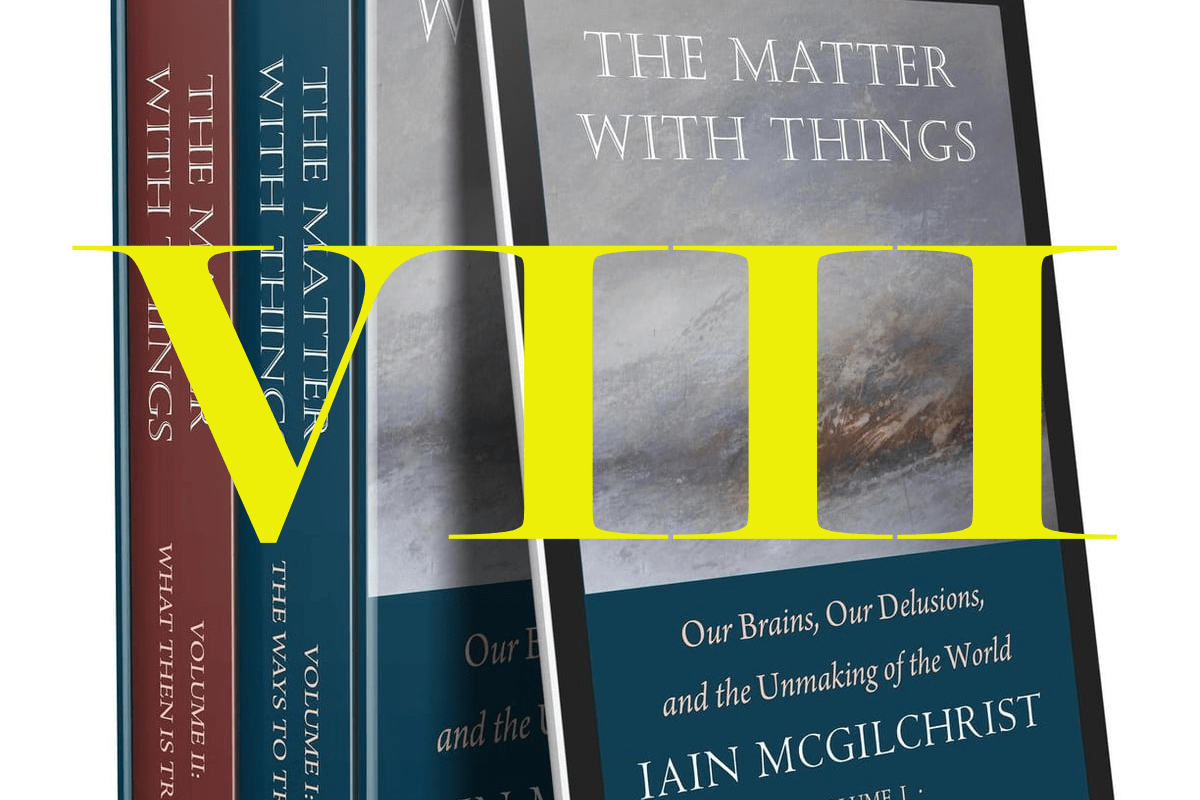
In deference to Barthes, the author is dead. But it doesn’t matter this is my interpretation—my meaning. Even more so, in deference to chapter eight of the Matter with Things, poetry and music are meant to be appreciated as a whole, not dissected. We can reflect on the words and phrases—even the melodies and rhythms—but the words are less than they sum to. Still, this piece moves me. It always has.
In the last chapters, the topics were about different intelligences. As we’ll see, intelligence is one of the factors for creativity, but there are more. Let’s crack on.
Podcast: Audio rendition of this page content
Content
Creativity is an elusive phenomenon that cannot only not be summoned at will, the very act of trying inhibits it. Unlike left-hemisphere-oriented intelligence, there are no simple tests for creativity because of their very nature. Assessing the left-hemisphere is relatively simple because it is systematic and any tests have definite known solutions—whether calculating some figure, solving a puzzle, choosing analogies, or recounting some trivia. There is no such test for creating something not yet created, but there are some proxies that most people categorically fail.
Psychologist, Colin Martindale, had this to say about the personal characteristics of creativity
“Creativity is a rare trait. This is presumably because it requires the simultaneous presence of a number of traits (e.g., intelligence, perseverance, unconventionality, the ability to think in a particular manner). None of these traits is especially rare. What is quite uncommon is to find them all present in the same person.”
— Colin Martindale
Whereas the left hemisphere is analytical, the right hemisphere (hence creativity) is a Gestalt. When given a difficult time-boxed challenge, the left hemisphere dominant individual who does not arrive at the expected response on time will commit to and defend an incorrect response (think escalating commitment), and the right hemisphere dominant individual will simply not commit to a response under the thought that there were still options to be explored.
Effectively, creativity can be broken down into three phases: preparation, incubation, and illumination.
In essence, for the creative individual, the best we can do is to leave well enough alone. Anything but space and permission will kill the creative impulse.
Preparation is simply the accumulation of a particular domain of knowledge. For an artist, it will be to understand, perhaps, colour, shape, texture, form, shadow, media, or so forth; for a musician, it might be to understand melody, harmony, tempo, timbre, dynamics, and so on; for a mathematician, it might be basic arithmetic, theories, proofs, and on and on. It’s also important to note that accumulated information in multiple domains also forms a foundation leveraged by many polymaths.
Incubation is simply waiting for something to grow in the prepared garden. Incubation is an unconscious activity and cannot be controlled or accessed by the conscious mind. In fact, conscious effort and introspection will serve only to impede cultivation. Digging up planted seeds to see how they are growing will only hinder the process.
Illumination is the final phase. Again, this is unwilled. Prepared and incubated flowers bloom. Of course, this is an imperfect metaphor because the ground must already have been fertile at the start. Tossing seeds on fallow ground still yields no blooms no matter how carefully attended.
In essence, for the creative individual, the best we can do is to leave well enough alone. Anything but space and permission will kill the creative impulse.
McGilchrist discusses generative, permissive, and translational requirements.
“The key element in generation seems to be the ability to think of many diverse ideas quickly, demanding breadth, flexibility and analogical thinking – seeing likeness within apparent dissimilarity.” This can be summed up as divergent thinking. This is the openness afforded by the right hemisphere as opposed to the convergent behaviour of the left. As it happens, this is where artificial intelligence falls flat as it is predicated on convergent activity.
The right hemisphere Gestalten surveys the environment and notes otherwise unperceived parallels. It is not a systematic approach. In the words of Oscar Wilde, “Education is an admirable thing. But it is well to remember from time to time that nothing that is worth knowing can be taught.”
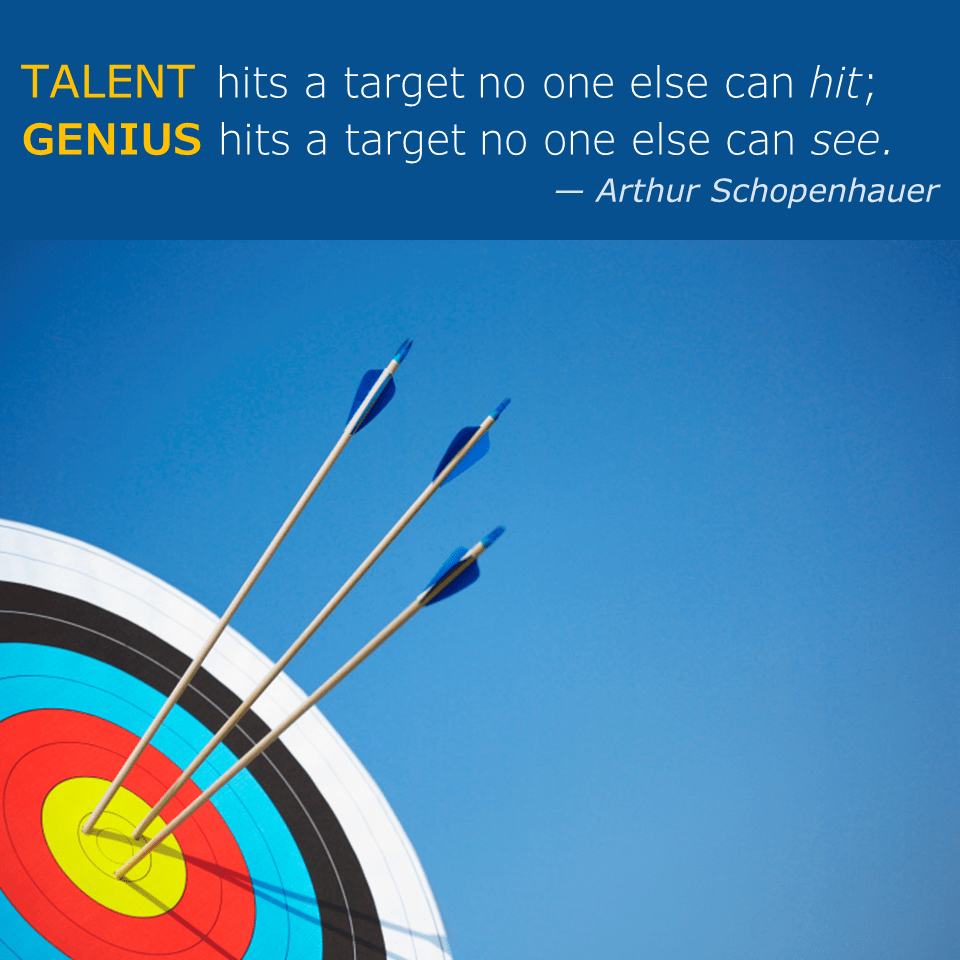
“Talent hits a target no-one else can hit; genius hits a target no-one else can see”.
Arthur Schopenhauer
Schopenhauer sums it up nicely, “Talent hits a target no-one else can hit; genius hits a target no-one else can see”.
Citing Isaac Asimov writing about Darwin’s insight, he notes that before Darwin, many people had read Malthus and studied species, but they lacked the creative spark that Darwin had.
Steve Jobs noted that
“Creativity is just connecting things. When you ask creative people how they did something, they feel a little guilty because they didn’t really do it, they just saw something. It seemed obvious to them after a while. That’s because they were able to connect experiences they’ve had and synthesize new things … A lot of people in our industry haven’t had very diverse experiences. So, they don’t have enough dots to connect, and they end up with very linear solutions without a broad perspective on the problem. The broader one’s understanding of the human experience, the better design we will have.”
— Steve Jobs
This is a failing of the business world and of specialisation more generally. McGilchrist writes, “Linear approaches and analytic thinking, characteristic of the left hemisphere, are fine in the right context, and may at a subsequent phase take part in creativity by narrowing things down and eliminating some of them, but on their own will not achieve creativity”.
There is a direct link between intelligence and creativity. Ego crushes creativity.
There is a direct link between intelligence and creativity. Ego crushes creativity.
He again cites Asimov:
“My feeling is that as far as creativity is concerned, isolation is required. The creative person is, in any case, continually working at it. His mind is shuffling his information at all times, even when he is not conscious of it …The presence of others can only inhibit this process, since creation is embarrassing.”
— Isaac Asimov
Some people excel at maths, but many are systematic and procedural left-hemisphere types; they apply logic and reason—insert tab A into slot B. The famous mathematicians understand the procedures, but their ideas come from intuition rather than reason. The left hemisphere doesn’t recognise this as a viable vector, and therein lies the rub. “Math is not about following directions; it’s about making new directions,” writes mathematician Paul Lockhart.
This is why we hear so many accounts of aha moments, something coming to one person in a dream or Isaac Newton’s falling apple anecdote.
“These thoughts did not come in any verbal formulation. I very rarely think in words at all. A thought comes, and I may try to express it in words afterward”
Albert Einstein
Einstein told Max Wertheimer, founder of Gestalt psychology, “These thoughts did not come in any verbal formulation. I very rarely think in words at all. A thought comes, and I may try to express it in words afterward”. Words are a left-hemisphere phenomenon.
Many accomplished musicians hear a piece whole. All they need to do is to compose it to staff paper or perform it. We hear this regularly: “I was driving from here to there and it just came to me. All I needed to do is to remember it long enough to get it down.”
I found McGilchrist’s inclusion of hemispheric damage quite interesting. He provides many examples of artists, composers, and poets, but I’ll only summarise them. For musicians and Artists with right hemisphere damage, those who even retained the urge to create did so at a lower quality level. However, those with left hemisphere damage operated at the same level and oftentimes at a higher level, without the inhibition and censorship of the left hemisphere.
It’s important to note that most people rely on both hemispheres. When I write left hemisphere dominant, I mean to say that either the right hemisphere simply underperforms or that the left hemisphere does not cede control back to the right hemisphere. Generally speaking, both hemispheres experience the world, and a strong right hemisphere will act as air traffic controller, or perhaps have the right of first refusal, but this is a loose metaphor because sometimes the left hemisphere just fields an experience and takes its best guess how to handle it even if it should have been fielded by the right hemisphere and even if the left hemisphere provides the wrong answer. The left hemisphere is the hemisphere of the ego and identity, so it is somewhat relentless and defensive even when it is wrong.
As a side note, I trust that political identity and escalating commitment are left-hemisphere activities and why modern Western politics feel so intractable.
After a strong argument for right hemisphere dominance and divergent thinking being hallmarks of creativity, he offers some counter-evidence and counters some of it.
A paper by Arne Dietrich and Riam Kanso co-authored a book citing instances of convergent thought processes that led to something innovative or creative. At the onset, McGilchrist calls them out for conflating problem-solving with creativity. In the end, the left hemisphere does play a role. He calls this the translational phase. Essentially, this is Mozart having heard his symphony and needing to put his thoughts to paper. Or the poet.
He goes off on a bit of a tangent noting how words pale concepts, and divergence and convergence are no exception. This fits in with my own insufficiency of language theory, but McGilchrist and I have different rationales for our arguments, so I’ll not side-track this summary.
He cites some statistics correlating creativity with mental health disorders and incidences of suicide. This will set the reader up perfectly for the next chapter about schizophrenia and autism.
Perspective
In summary, creativity has got me riled up more than in the previous chapters. This is partially due to how it comports with my own observations. I have always felt that humans are not very creative or innovative despite protests to the contrary. In fact, I’ve often commented when I’ve heard people say something like “artificial intelligence will never create the next…” Fill in the blank: Mozart, Picasso, Michelangelo, Nabokov, Wordsworth. Or Einstein. Of course, neither will a human be the next of these.
All these people are right cerebral hemisphere dominant. AI operates systematically, in the manner of the left hemisphere. None of these people built up systematically. Instead, their ideas were wholly formed, and their creations were reductive rather than additive. Famously, Michelangelo was to have said, “The sculpture is already complete within the marble block before I start my work. It is already there. I just have to chisel away the superfluous material.” He sees the solution first and then builds towards it.
In my professional life, I have been a strategist as a management consultant as well as a business analyst. In each case, I could quickly assess a situation and then spend weeks or months defending my intuition with words, diagrams, and numbers.
As a business analyst, I would offer a recommendation, and this would need to come with an estimate to deliver the recommendation. This figure would come to me in a matter of minutes. Then, per protocol, I would need to enter micro-level details into a pricing model so it could calculate from the ground up. First, this was time-consuming. Second, this would be circulated for review where different people would (almost invariably) reduce the number of hours estimated, typically due to pressure to reduce the cost. Ultimately, a number would be output and tendered to the client or the person footing the bill. Again (almost invariably), the number initially intuited was more accurate and reflective of what was ultimately invoiced. Unfortunately, business is a left-hemisphere endeavour, and that will be its Achilles’ heel and denouement.
This wraps up the chapter on Creativity. The next chapter is “what schizophrenia and autism can tell us”, and is the end of part one of The Matter with Things.
What are your thoughts and experiences with creativity now that you’ve heard McGilchrist’s take?
I’d been professionally involved in the music industry since the early 1980s, a career option from which I was greatly discouraged. Like many others, I was drawn to music early, but my family were not supportive. Accessing music beyond what I could hear on the radio was nearly impossible.
Podcast: Audio version of this page content
I had been asking for instruments, but I was directed to band instruments—a coronet to be precise. My dad had played the trumpet in his days and had suggested it. They bought me a coronet, and I enrolled in the school band. Let’s just say that this was not fulfilling. I didn’t find out until later that practically everyone else was also taking private lessons on the side. Many had an actual interest in what instruments they were playing.
I wanted a guitar. As I found out when I finally bought my own guitar at 14 that my mum didn’t want to encourage me to play rock music. My bio-dad had played the guitar and he was a heroin addict, so guitars equalled heroin in my mum’s mind. Might have as well been a gateway.
When I began working in high school, I was able to buy a turntable and records. And a guitar. That’s when I heard the rationale for not being given one. The guitar displaced books somewhat until I found a happy medium.
My ex-wife recounted, well countless times, how she had wanted to be a ballerina when she was a little girl, but she was never allowed to take lessons. As I recall, her mum didn’t like the local dance instructor on a personal level, though I don’t know anyone that her mum did like outside of her siblings. This pained her well into adulthood, and she still fancies the lost career option.
she admitted that she would have preferred violin
Her niece took piano lessons and was coerced into becoming a Medical Doctor as her sister with no artistic interests was pushed into becoming a lawyer. As she was in her residency, she admitted that she would have preferred violin and to have become a veterinarian. And so it goes.
Fast forward to my then-three-year-old son. I was still playing my guitar around the house, and he would engage with it. I’d place it on the floor, and he’d play with the strings. I’d tune it to an open or modal tuning and cycle through my effects pedals for tonal variety. Whenever I’d play, he’d come around, and I’d take a break to encourage his interaction.
Come Xmas, he was four, and I bought him a three-quarter scale Squire Affinity Strat with a practice amp and the general accoutrements. We took the requisite photos of him wielding the guitar as a memento for when he hit the big time.
we heard chorus after chorus of “Cat Scratch Fever…”
That was the last time he touched that guitar. Or mine. Somehow, this purchase was the kiss of death. When he was five or six, he evidently heard Ted Nugent’s Cat Scratch Fever on the radio. I didn’t listen to Classic Rock radio, so I’ll presume it was my wife. In any case, we heard chorus after chorus of “Cat Scratch Fever…” in pitch. Nothing more.
At six, he had a deep interest in Korn. This was retained as we migrated from Los Angeles to Chicago. In fact, he asked me if I would teach him how to play some Korn songs on the guitar. I informed him that I had sold my 7-string before we left LA, and Korn was a low-B 7-string band. I tried to show him some 6-string renditions, but they don’t quite sound the same an octave higher.
Around this time, we bought him a drum kit. He played it exactly never—though it came in handy some years later for me, so that worked out nicely. His mates would come by to visit, and they loved it. All of his friends would pound away on them whenever they had the chance. A month or so later, Korn were touring (during the time when Brian “Head” Welch had departed in favour of Christian values), but he had switched genres to Classical and Epic music.
I had a digital synthesiser that got moved into the living room (rather than the studio, which was downstairs), so it was more accessible when the inspiration struck. He was attracted to that in much the same manner as the three-year-old him was drawn to the guitar. He was more interested in the textures than the melodies or harmonies.
My wife enrolled him in piano lessons, as she herself had also done as a child. He took those for a few months, but he never really grew to like it much. We asked if there was anything he was interested in, but that was just listening. Eventually, he took a music appreciation course that he appreciated, but that was about it.
He’s twenty-five as I type this. He loves music and still favours instrumentals. Soundtracks and video game music are among his top genres.
she reacts to melody and beat
Now I have a toddler. She’ll soon be three. She is also drawn to my guitar. This time, I gave her an older ukulele for a while, and then I bought her her own. She responds to music when she hears it. She reacts to melody and beat, interpreting it with her own dance gestures. She’s not mastered the ukulele, but it’s hanging on her wall at about her shoulder height near her bedroom door. She strums or plucks the strings when she enters and exits her room. Often, she takes it off her wall hanger and noodles with it.
For Xmas, we bought her an assortment of kids’ instruments as did someone else, so she’s got two—xylophones, triangles, harmonica, blocks and shakers. I don’t recall what else, but she seems to love to engage with them. We’ll see where it ends up. One never knows.
Philosophy is not my only interest. Music has always been a part of my life, and I was a professional musician in the 1980s in Los Angeles, when LA was the veritable centre of the musical universe as hair bands ruled the airwaves.
I was into progressive jazz fusion at the time, but my primary income came from being a recording engineer and producer. I worked on commercials, film tracks, albums, and demsos—lots of demos. Because of the 1984 Olympics, commercials were a big thing.
Besides the hair metal thing, LA had a solid punk showing. It wasn’t quite like London or New York, but it gave us bands like Black Flag, Redd Cross, Minutemen, and Circle Jerks, with whom I had the pleasure of working. Keith Morris had come from Black Flag (replaced by the inimitable Henry Rollins) and Greg Hetson came from Redd Cross (and would go onto Bad Religion).
Unfortunately, I worked on the Wonderful album after their musical hiatus. During the six weeks of recording, I was hired and fired three times with a friend Jim McMahon finishing the record and taking the album credit. I can’t confirm or deny whether chemical substances may have been involved.
I had started with Karat Faye, with whom I had then recently worked on Mötley Crüe’s Theatre of Pain album. Circle Jerks were seeking a sound more in line with the other headbangers, but that sound was not for them, they couldn’t really write for that genre, and they didn’t really have the chops. They should have just leaned into their roots.
Anyhoo
What’s this got to do with Amyl and the Sniffers? These Aussi cats rock old-school punk without skipping a beat. Straight beats, nice bass riffs, and a guitarist with the playing competence of Greg Hetson, which is just what this band needs. Stay true to your roots.
Amy’s voice and delivery are perfect for the genre, and the lyrical content is personal. This clip is excerpted from a nice KEXP interview, which is also available on YouTube. Follows is the setlist:
Some Mutts (Can’t Be Muzzled)
Hertz
Guided By Angels
Security
Knifey
Capital
I Don’t Need A Cunt (Like You To Love Me)
Maggot
I am not going to review these tunes, but all of them are top-notch and punk-fun. If you are into old-school punk, I can almost guarantee you’ll dig it.
If you know Amyl and the Sniffers or want to share your thoughts after a listen, I’d love to read your comments below.
When I was seriously exploring music, I started from the artists I enjoyed and searched their roots and influences and cascaded back. In the 1970s, this was to look at the roots of Eric Clapton, Jimmy Page, and Keith Richards. I’d be brought back to James Burton or Elmore James; I’d find Robert Johnson, BB King, Muddy Waters and Hubert Sumlin (Howlin’ Wolf); and I’d find John Lee Hooker, and Chuck Berry. And then, I’d dg further to find Son House, T-Bone Walker, and Big Bill Broonzy. Although I grew to appreciate these originals, I still preferred the reinvigorated versions of my youth.
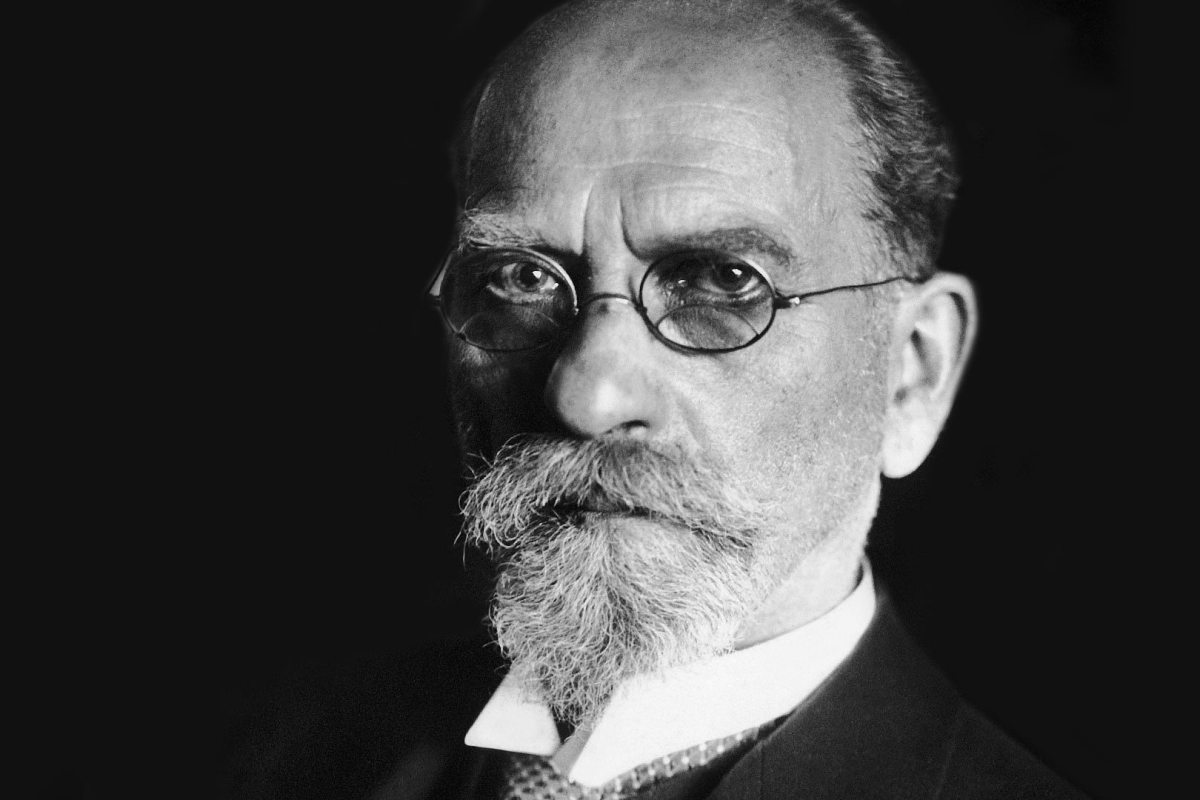
In philosophy, I seem to have taken a somewhat similar path. In particular, it’s a journey back to Husserl. I was exposed to essence and being most probably through Sartre. this brought me to Heidegger that brought me to Husserl. To be fair there was a large gap between Sartre and Heidegger and a fairly long gap from then until Husserl. I’ve come upon Husserl’s name time and again but I deprioritised him, He seemed always to be the AND of Heidegger, sort of like how Garfunkel was the AND of Simon.
But I thought that Heidegger was the root—the source, as Son House might have been to the Blues. Given the connection of Husserl and Heidegger, I’m not sure that Dasein‘s genesis is clear cut. Moreover, I believe it’s a pedestrian German world, that fancy pants academes wish to evermore preserve in amber as a stand-in to being there, though Heidegger insisted that the meaning was more nuanced and in some way I could consider that it prefigured Derrida’s privileged pairs highlighted in his Deconstruction.
I’ve commenced reading Husserl’s’ Ideas, and my takeaway at this point is his eidetic facts.
This post reflects on how memory operates and true and false memories. The video clip is about a minute long and shows Paul McCartney recounting how he decided to create the character of his eponymous song Eleanor Rigby.
He fancied the name Eleanor and was trying to think of a two-syllable word to follow when he spotted a sign that read Rigby & Evens, a wine and spirits shop in Bristol.
Rigby & Evens, Limited Sign
According to Paul, these were the components leading to the title character.
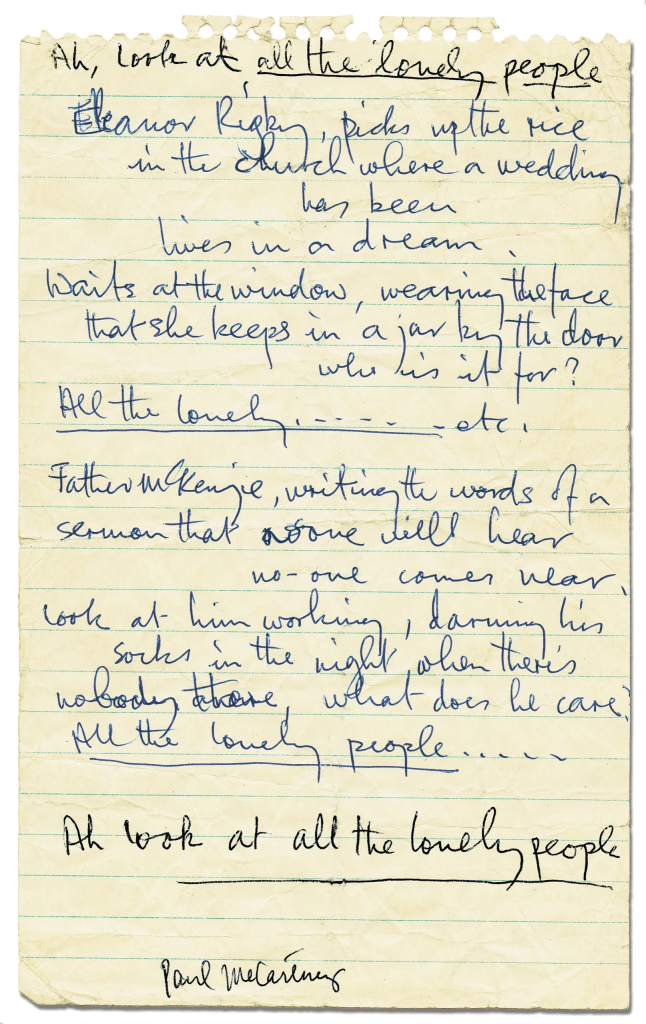
Eleanor Rigby Hand-written Lyrics by Pail McCartney
From the perspective of recency over primacy, Paul may be correct, but it could also be, as he admits, that he had seen the tombstone without it being consciously registered. He may have even been consciously aware but subsequently forgotten it. Perhaps this is why the name resonated with him, having been exposed previously. Memory is known to be reinforced through repetition. From the perspective of primacy over recency, he may have never settled on the name had he not seen the inscription on the gravestone.
Could it be that this was a coincidence and Paul never did see that grave marker, or is it more likely that he did? We’ll never know for sure, but it is an interesting turn of events.
A social connection posted a piece on Humberto Maturana’s idea of “aesthetic seduction”. I found it interesting, so I wanted to understand more. Performing a Google search, I landed on The Edge, where I found an interesting comment by Dan Dennett. I share it in its entirety.
Philosopher; Austin B. Fletcher Professor of Philosophy, Co-Director, Center for Cognitive Studies, Tufts University; Author, From Bacteria to Bach and Back
Post hoc ergo propter hoc! “After this, therefore because of this.” Francisco Varela is a very smart man who, out of a certain generosity of spirit, thinks he gets his ideas from Buddhism. I’d like him to delete the references to Buddhist epistemology in his writings. His scientific work is very important, and so are the conclusions we can draw from the work. Buddhist thinking has nothing to do with it, and bringing it in only clouds the real issues.
There are striking parallels between Francisco’s “Emergent Mind” and my “Joycean Machines.” Francisco and I have a lot in common. In fact, I spent three months at CREA, in Paris, with him in 1990, and during that time I wrote much of Consciousness Explained. Yet though Francisco and I are friends and colleagues, I’m in one sense his worst enemy, because he’s a revolutionary and I’m a reformer. He has the standard problem of any revolutionary: the establishment is — must be — nonreformable. All its thinking has to be discarded, and everything has to start from scratch.
We’re talking about the same issues, but I want to hold on to a great deal of what’s gone before and Francisco wants to discard it. He strains at making the traditional ways of looking at things too wrong.
Dennett’s response is a critique of Francisco Varela, which is not the part that interests me. What caught my eye is his distinction between revolutionary and reformer. And it dawned on me—perhaps re-dawned might be a better verb, or to illuminate or intensify, to shine a light.
I consider myself to be introspective, and times like these allow me to be self-critical. I view myself as a revolutionary as far as expectations go. This makes me impatient with little tolerance for the marginal changes that attendant with reformism.
Being a revolutionary doesn’t make one a Utopian—a common critique—, that one is seeking perfection. From my perspective, when things are so far off course or misaligned, incremental changes don’t seem to be enough.
Moreover, reform is a political misdirection tactic I am leery of. So, irrespective of core beliefs, I feel even a reformist should be wary of the tactic. In politics, sometimes new ideas arise that are not in concert with the prevailing orthodoxy but are building mass. The idea is to retain the status quo as much as possible. The tactic is to find the smallest least disruptive sliver and find a way to integrate it in a manner for the mass to diminish and to be able to claim concordance.
The first example that pops into my mind is the Affordable Care Act (AKA Obamacare) in the United States, which is not exactly affordable not all that caring, though it is a reformist act. Even the main alternative of Universal Single-Payer insurance wasn’t that revolutionary, making the delusion of the solution and the adopted approach all that much more disappointing.
Industrial and post-industrial countries have solved this problem, so it’s not revolutionary unless one considers being over a hundred years late to the party to be particularly impressive. Moreover, there are programmes in the United States, i.e. Medicare, that are ostensibly single-payer programmes. In fact, one approach suggested was to expand Medicare to include everyone. This was dubbed Medicare Part E.
What this exposes is that the Reform-Revolution debate is a sorites challenge. The reformers consider the Medicare Part E proposal to be radical or revolutionary whilst I viewed it as a couple more millimetres away from the original Obamacare promises. Since the status quo started from such a limited position, when they ended up with is a milquetoast implementation.
To me, the debate is about paradigm shift versus glacial change. As for me, when I regard the battle between the Democrats and Republicans in the United States, I am not satisfied with any solution that sees these parties still standing post-solution. As a revolutionary thinker, I don’t need to toss out the proverbial baby with the bathwater, but let’s lose the bathwater and at least the sieve of a tab. Of course, I argue that the direction the so-called Enlightenment has taken the Western world, which is different to the argument made by prior traditionalists, so I can see a lot of room for change—revolutionary change. In the case of implementing Enlightenment beliefs, they took the idea of revolution a bit more literally than was perhaps necessary, but since it was more about a power grab than some broader promise of freedom, I suppose it was necessary. Meet the new bosses, same as the old boss.
“Equality of rights under the law shall not be denied or abridged by the United States or by any state on account of sex.”
The United States doesn’t constitutionally protect women. This is where reformism gets you. Per Wikipedia,
The Equal Rights Amendment (ERA) is a proposed amendment to the United States Constitution designed to guarantee equal legal rights for all American citizens regardless of sex. Proponents assert it would end legal distinctions between men and women in matters of divorce, property, employment, and other matters. The first version of an ERA was written by Alice Paul and Crystal Eastman and introduced in Congress in December 1923.
Wikipedia — Equal Rights Amendment
If you read 1923 and wonder if that’s a typo, it’s not. It’s been almost 100 years and women still have no guarantee of equal rights. Women had only been granted voting rights with the ratification of the 19th Amendment to the Constitution on August 18, 1920.
For a country founded on the principle that all people are created equal, this feels like it should be considered to be a redundant act…
My bad, the US Declaration of Independence reads “We hold these truths to be self-evident, that all men are created equal, that they are endowed by their Creator with certain unalienable Rights, that among these are Life, Liberty and the pursuit of Happiness”. This is just men. And when this was written BIPOC did not fully qualify as men. Reformists have almost got that sorted out by now right? 1776 seems like almost yesterday. Change comes slowly.
By now, I’m rambling semi-coherently, so I’ll close this down. Keep in mind the foundation of your interlocutor. Is s/he a reformist or a revolutionary? Determine where on the scale s/he falls. You might save yourself a lot of time. Time Is on My Side is only a song not a recipe for living.
Being in a band is hard. It’s like being married to a bunch of partners, and if you are a band and not just some cat with some supporting characters, you’ve got artistic differences to consider. This is where I soured on direct democracy.
Slotrocket is the name of one of the bands I performed with. We played under this name exactly once, but let’s rewind to the democracy bits.
Skipping a lot of the details, I played bass in this line-up. It was a 3-piece with a focus on alt-post-grunge-nu-metal, but we all came from different places musically. The drummer came from speed metal, death metal, and maths rock. The guitarist-vocalist came from Classic Rock, Grunge and Nu-Metal. I came from all sorts of places, but I wanted to focus this project on the post-grunge thing. For the uninitiated, this is the likes of Seether, Three Days Grace, Breaking Benjamin and so on.
We didn’t have a name. Since we only played with friends and at parties and sometimes provided the backing for live karaoke, it was just us. We did arrive at the name of Breached, but it turned out that a Canadian band was already calling dibs on that, so we just let it slide—especially when they released an EP in the vein of early Incubus.
But then the guitarist-vocalist didn’t want to hold both roles. Too much effort. He didn’t care which. In the end, they found a female singer who was interested. It seems that there was a mixup in communication. They asked if I minded if she joined us during our next rehearsal. I figured it was just another live karaoke session, so when I said yes, it turns out that she was now a member of the band. Truth be told, I didn’t think a female would cop the vibe I was seeking. She was no Lacy Sturm or Amy Lee. She didn’t know any grunge material as she was more of a Country gal. But that’s not the story.
The story is the name. We deliberated for well over a month to settle on a name. We decided to create a spreadsheet. We’d all force rank the entries. And each of us had infinite veto votes to kill an offending entry from the list.
Skipping ahead a few chapters, I liked Rapeseed. It was a benign word that sounded edgy. The boys were fine with it. Notsomuch, the girl. There was no particular rush until we booked a gig—the gig. We’d need a name to promote.
I came up with Slotrocket. Again the boys were fine with it; her notsomuch. However, she didn’t veto—later claiming that she didn’t think we could possibly be serious. Since I booked the date and created the adverts, everything seemed to go under the radar—or under the rug.
A bit before the show, I was distributing material and advertising on our media outlets (as it were) and she caught a glimpse of the promo mats. Let’s just say that she was not amused. Still, when the time came, we performed.
OK, so I skipped over some stuff—the months of pouring over a spreadsheet. Our goal was unanimity. The name didn’t have to be everyone’s top pick, but we did need to attain a consensus view. As it happened, two of the biggest decisions came about by accident, and they both resulted in hard feelings.
It’s not that the 3 or 4 of us couldn’t have eventually come to a unanimous decision amounting to all of our first choices, but this would have taken time—and who knows how much.
One may feel justified accusing me of allowing perfection to be the enemy of the good, but that’s just something apologists tend to say, as they defend their preference for democracy.







 Philosophics