Find your self. What is this self you are searching for, and who is you in the first place?
You and self are taxonomical references—conveniences—, yet they don’t actually exist.
πάντα ῥεῖ : The only constant is change
Heraclitus of Ephesus
The Second Law of Thermodynamics states that entropy rules. Things decay. We can see this in the great structures of our ancient past. Try as we may, without energy, everything falls apart.
There is no you. The you that was born is not the same you that attended kindergarten, that graduated high school, dated, worked, or died. Even in a short span of time, you switch personae. Can you be multiple yous simultaneously? Are you only expressing some instance or another? I’m not buying it.
No one ever steps in the same river twice, for it’s not the same river and he’s not the same person
Plato, attributed to Heraclitus
When Heraclitus said that no man ever steps into the same river twice, it’s not only the river that has changed; the person has changed, too. It’s not the same person.
Woman in River
For the sake of convenience, we create this sense of identity, whether for ourselves or for others we want to categorise in some form or fashion. But they aren’t the same either.
It’s like the physical object that appears to be solid and yet is more space than material. It’s a matter of convenience, but it’s a trompe l’oeil. Yet again, your senses have deceived you.
Does this impact survival or some evolutionary progression? Apparently not. Not if you are here to read this. But that doesn’t make it real. Perception is reality.
But what about identity politics? Can’t a person choose their own identity? Sure. Choose away. It doesn’t it real.
I’ve written about the difference between sex and gender. Both are taxonomical creations. Whether a society accepts the distinction between sexes, genders, or even of the distinction of sex and gender is up to that society.
One is not born, but rather becomes, a woman.
Simone de Beauvoir, Second Sex
As with sex and gender, identity is a social construct. As such, its acceptance into a society is yet again a rhetorical effort.
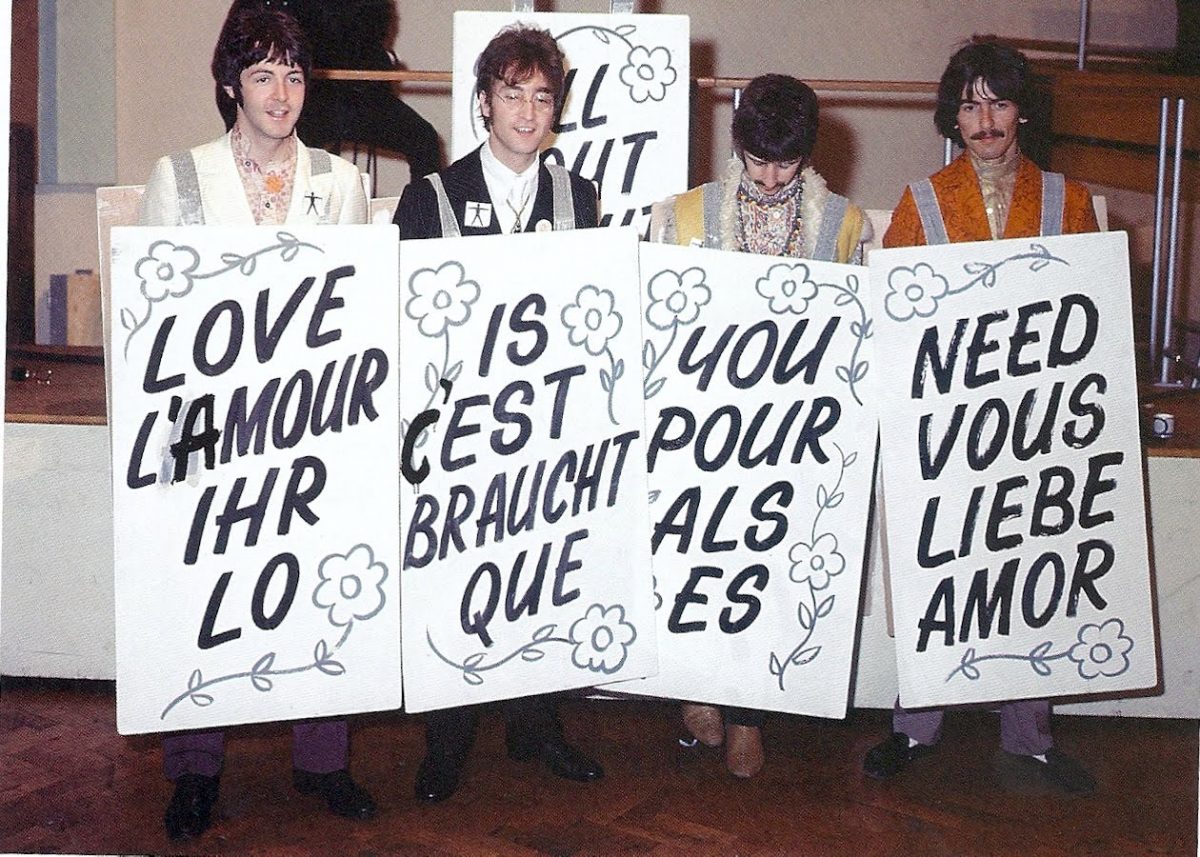
Love is an archetype. It’s a word we’ve created to express the notion of caring off the charts, on steroids. We throw it around and over-use it for many purposes. Generally, love is amorphic and expansive. In the typical scenario, a mother with a loved-child who bears another loves them both equally, but it’s not part of some arithmetic function where each child gets half an equal dose each. Love defies any notion of conservation of energy. Both children receive equal shares of the same quantity of love that the first received.
The Beatles – All You Need Is Love
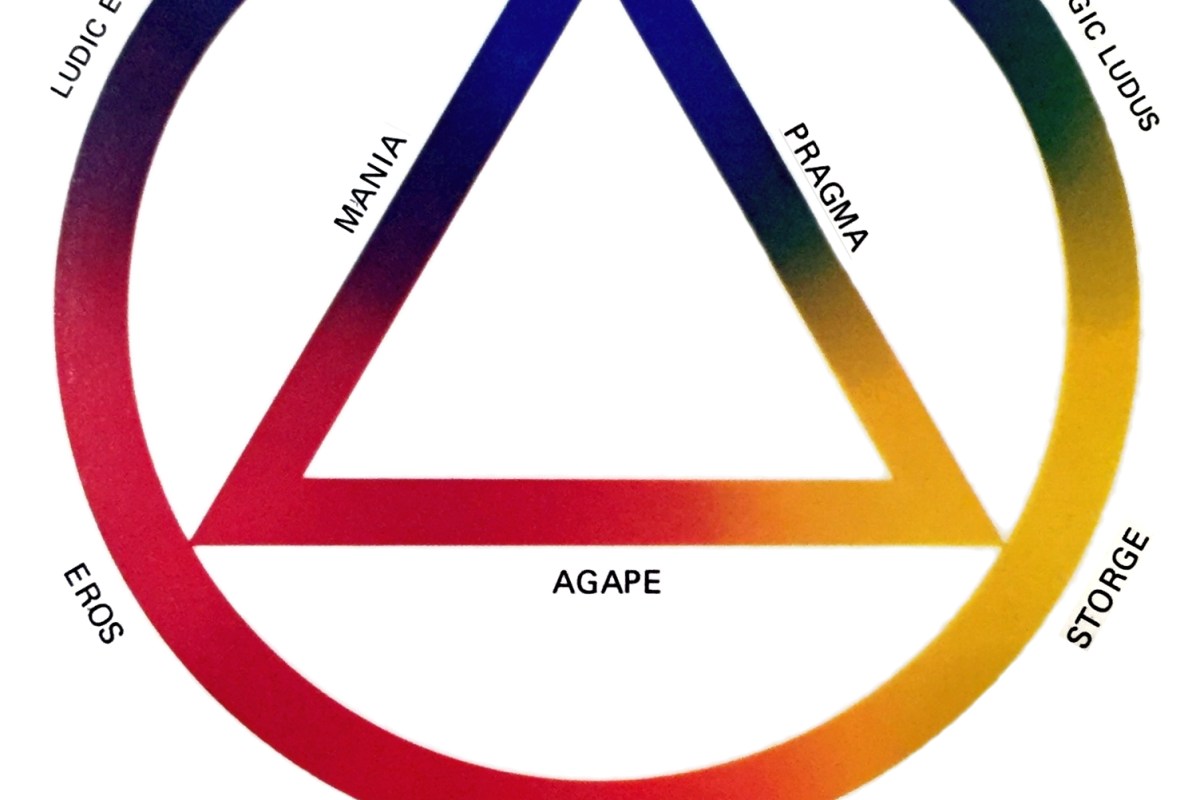
The ancient Greeks had several words to express love.
Storge (στοργή)
Storge is the love we have for community, for family, for our children and spouses. Storge is not romantic love. It is more a love of affection and tenderness. It may be the basis for the urge toward tribalism and nationalism, and it may have a sort of analogue to gravity, wherein the proximity of the source, the greater the attraction. This is where ‘blood is thicker than water’ and why I like my sports team better than yours.
Storge – love of family
Agape (ἀγάπη)
Agape is a sort of universal love, the selfless love of biblical reference of God and all of his children. Neither is agape a romantic notion. It is akin to charity, and the connection of transcending storge to include all of the world and ignoring the silos of tribalism. There appears to be a tension between agape and storge because one cannot have an equal love for all whilst retaining a greater love for one’s own tribe. Perhaps the notion is more aspirational than practicable.
Agape – Universal love
Philia (φιλία)
Philia is fraternal (to be more inclusive, perhaps also sororal) love, the brotherly love hoped to be inspired by the city of Philadelphia in Pennsylvania. This is an affectionate love, typically between equals. Again, philia has no romantic basis.
Philia – Sororal love
Eros (ἔρως)
Eros is notably erotic love; sexual love; intimate, passionate love; lust. Eros is ephemeral. Returning to physics, eros requires a lot of energy to maintain. In a typical setting, eros moderates to storge or pragma.
Plato believed that this love was transcendent of the body—and so could exist independently of body—, but I’ll not give heed to this metaphysical notion. Perhaps, this is where the notion of soulmates derives. This is a romantic love.
Ludus
Ludus is a lightweight version or precursor to erotic love. It is the playful, flirtatious nature expressed by young proto-lovers. Viewed teleologically, ludus may be seen as a stepping stone to eros, but not everyone makes it successfully to the final level.
Full disclosure: Ludus is Latin and not of Greek original.
Pragma (πράγμα)
Obviously, pragma is a pragmatic love. This is the love that remains to bond a pair who have remained together for years, say, an old married couple. This form either requires a lot of energy and compromise or a lot of apathy or indifference.
Older couple demonstrate pragma
Philautia
Philautia is a love of one’s self. It’s a portmanteau of philia + auto. As the saying goes, if you can’t love yourself, you can’t love anyone. As with most adages, they is as often true as not and require additional context to assess. Philautia should not be confused with narcissism, which may more properly be classified as a mania. It should also not be confused by onanism.
Philautia – Love of one’s self
Love will tear us apart… again.
Joy Division
Mania (μανία)
Some people include mania in their love collection. Mania is simply an unbalanced sort of love; obsessive love; eros gone wild.
Love has many meanings, but they are all about connecting. Perhaps, I am being hasty to dismiss the term, but it is overused and perhaps more phatic than genuine. In the parlance of Foucault, it’s a power phrase—especially in the erotic arena—, a means to manipulate.
Am I alone in this? Are there others who also cringe when they hear period-piece reenacters pronounce the word ye as ‘yee’, or is it just me? Be honest now.
Those as pedantic as I, know that ye was a solution to a technological limitation of early European printing. Prior to the printing press, Old English had a þ character pronounced thorn. Phonetically, it sounded like the modern English voiced dental fricative expression of the th digraph— IPA: /ð/.
Given this, ye would have been spelt þe and should be pronounced the (IPA: /ði/—not necessarily /ðə/) and not yee (IPA: /ji/). I am not sure if a hand-printed (or painted) sign of the day would have conformed to the pre-press spelling or the post-press variant. I wonder how long it took for thorn to pass by the wayside.
I am aware that language is a human construct and even that language is like a living organism. But in this case—as with Latin—, thorn is dead. It seems we should not revise the pronunciation of a fossil of a word. It seems to me it should be frozen in the amber of time.
Bonus Round 1
Back in the day, not only was the abbreviated as ye in printing, but this was abbreviated as ys and that was shortened to yt, as in the Mayflower Compact. Don’t ask why someone felt that it was important to abridge 3- and 4-letter words to 2 characters.
Herbert Manuscripts (excerpt)
Bonus Round 2
It’s may be important to note that the ye of Ye Olde Shoppe fame, which is simply a shortened form of the, is not the same ye of biblical fame, ‘Judge not, that ye be not judged‘, which was the plural form of thou, which is now rendered as you—the plural form.
And now you know…
As for the pronunciation of the ye of hear ye (hear ye), I am not sure which concept is being captured. If you know, then let me know.
I’ve been having a side debate with a Christian mate of mine who made these claims:
Whom do you serve?
Chrétien de Troyes — Perceval
‘[Non-religious people may] not define themselves as particularly “religious”, but…everyone is’, as he references lyrics from a Rush song, ‘even if you choose NOT to decide, you still have made a choice’.
‘One can choose to believe in nothing but themselves, but if they’re honest, “self” IS their religion. Everyone is religious.
We all yearn for some meaning and we end up pursuing something or someone to fill that inward desire. Whether we organise that something and call it “religion” is beside the point, as he references Bob Dylan’s lyric, “Ya gotta serve somebody; it may be the devil, or it may be the Lord, but ya gotta serve somebody.”
This had been the fluid exchange of ideas, but I’ll reply in turn.
even if you choose not to decide, you still have made a choice
Rush — Freewill
I’ve won’t repeat my position on free will, but one can choose to be religious or not. To choose not to be religious is not also a choice to be religious. I can agree that some people substitute superstitious, metaphysical believe for, say, scientism, and this is just as ridiculous, but some people remain unconvinced in these metanarratives.
“Self” is their religion
Some Guy
Again, not everyone even ascribes to the notion of self, and there is little reason to believe that there is some element of religious worship involved.
We all yearn for some meaning
Some Guy
Again, this is fundamental attribution error, the assumption that because he believes there is some underlying meaning and yearns to find it that everyone else does. I understand that he surrounds himself with people who share this belief system, and they convince themselves that someone who says otherwise is mistaken.
Ya gotta serve somebody; it may be the devil, or it may be the Lord, but ya gotta serve somebody
Bob Dylan — GottA Serve Somebody
This is clearly dualistic thinking incarnate; a false ‘you’re either with me or against me’ dichotomy.
I remember self-assessing myself when I was in high school. Nietzsche notwithstanding, I could never agree with the frame or the assertion that there are leaders and there are followers. I did not identify with either. I do feel that within the society I was born, that I need to comply just enough to not be subjected to the violence inherent in the system for non-conformance, but that’s not exactly following. I also don’t care to lead.
It turns out that this (perhaps not coincidentally) manifested in my career, as I am a consultant—an adviser.
Just a brief post today. I had forgotten about this Steven Pinker quote I shared elsewhere a few years back.
“Judges are not very good linguists. For better or worse, they try to find a way around the most natural interpretation of a sentence if it would stand in the way of the outcome they feel is just.”
The fact is that they do not care about the lack of specificity of language. Politicos revel in the fact that they can torture language into submission to meet their own objectives. This is the power of rhetoric.
As I have reviewed my posts over the past couple of years, it seems I repeat myself, repeat myself, repeat myself, repeat… I get a sudden urge to capture a notion, and it turns out that I had already written about it before. I’d just forgotten.
What I need to do is to formulate a cogent distilled version, but I can’t quite seem to get there. For now, I’ll just share this.
Experience is more important than material wealth because you can’t take it with you.
This is silly on so many levels.
Firstly, you can’t take experiences with you any more than you can take material, so the entire logic is faulty.
Secondly, although unsaid, this is typically uttered by those who equate experience with travel to other places, and so one needs some notion of material wealth to do so.
Thirdly, just being alive and somewhat aware is an experience, but I understand the notion implies a diversity of experience.
Fourthly, you still can’t take it with you.
Personally, I love aphorisms, those near-phatic quips that no one really thinks about, yet they feel that these are somehow guiding principles.
Opposites attract.
versus
Like attracts like.
Which of these is correct?
In fact, each of these statements may be correct; it simply depends on context. The issue is that people spout these off to make a point.
Opposites attract is how we justify when two unexpected people, for example, are together. It is also the basis behind the Jungian anima-animus concept.
Like attracts like may be either to justify why person A is with person B, but it sometimes further is meant to imply a sort of guilt by association.
The other issue is one of dimension. When applied to people, they are multidimensional. So which dimension is opposite and which is like. Of course, we’ll choose the dimension that fits our purposes.
Perhaps a 172 cm brunette woman is a police officer has a life partner who is a 172 cm blonde man, who is a criminal, and who both enjoy art museums.
Without specifying what percentage the likeness needs to be to qualify, if like truly attracted like, wouldn’t the 172 cm brunette policewoman be attracted to another 172 cm brunette policewoman? Or would just another taller policewoman be good enough?
Anyway, nothing earth-shattering here. This is simply another example of the imprecision of language. That, and I couldn’t sleep.
Destiny or free will is a question only as old as religion, and it’s a silly question. In my opinion, this is one of the ways that religion and religious thought sullies the world. Some dead bloke way back when had some seeming epiphany, and it was entered into the doctrinal record.
The concept of destiny is the silliest part. This is a throwback to the teleological notion of progress. I wonder if the whole concept of progress isn’t an offshoot of religion.
I’ve written elsewhere about the folly of progress. Destiny fails on the same level. Moreover, destiny in this context is first about individual destiny—what is my personal fate—and then we devolve further into some group notion, whether by race or nationality or some other social construct. It’s the same logic that led to Manifest Destiny and the slaughter of millions upon millions of people worldwide over the course of history1.
Progress Sign
Neither is free will sensible. Humans—living beings, categorically—have some autonomy over themselves. This, of course, presumes self and identity to actually mean anything. But, they are subject to the influences of genetics and environmental factors—including social indoctrination—, so how would one extricate these from some notion of sovereign free will?
One does not even need to be a strict materialist to see that one does not have free will. Not even Sartre’s no excusesExistentialism fully accounts for this. An Existentialist might argue the despite whatever historical baggage yo carry with you to any given point, you can always decide on what your next point might be. But this misses the point that any decision one makes can only be made in context to the experiences you’ve already had.
One can’t one day decide to speak Russian if one had never before learnt the Russian language.
So, as I said at the start, the question of destiny and free will are for juveniles. There is no reason to adopt the religious frame that makes them appear to be more than the specious notions they happen to be.
In the end, you just are. Enjoy the moment or at least just live it. It may be your last.
1. Please note the I am using the course of history in the idiomatic sense as one might employ corners of the earth. There is no course; there are no corners.
One primary function of language is to convey stories. As Yuval Noah Harari notes in his Sapiens, one reason humans have evolved to be seemingly above other species is the ability to construct narratives—particularly narratives about some vision of the future as well as metanarratives about the past and how we got here. His other two factors were money and religion; rather, these are merely special instances of story-telling, and so it’s all about stories.
The human brain responds to narratives, but it does not seem
so concerned with the truth element. We are often deceived. In fact, there are
notions like cognitive dissonance and escalating commitment where we fabricate
rationale around some implausible story or we entrench our thinking when
counter-knowledge might otherwise alter our perspective.
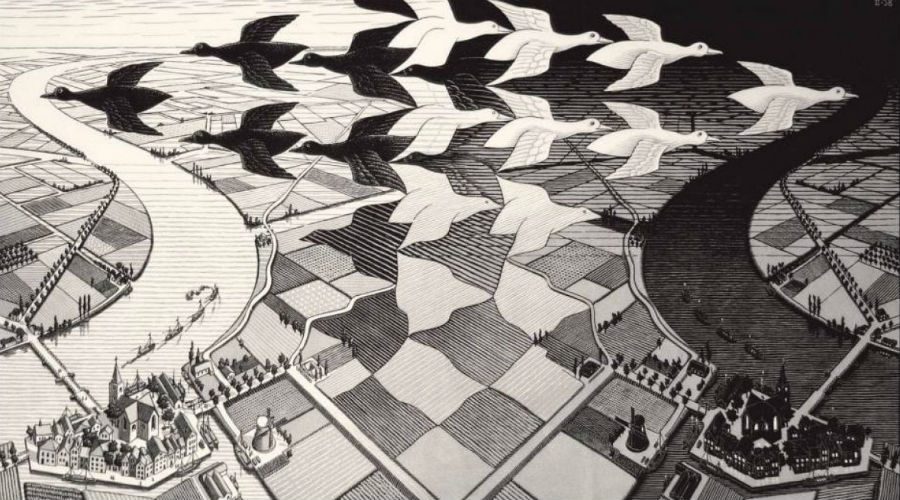
MC Escher
In fact, truth is merely another narrative we’ve been fed—rhetorical legerdemain. But it’s just a story: cognitive dissonance envelopes the notion and we build some heuristic defences around it; escalating commitment kicks in when someone attacks the notion.
The concept of Truth underlies entire societies, governments,
and legal systems. Idiomatically, we employ small-t truth to represent a sort
of relative proximity to match our senses to some observation. If I am asked if
a book is on a table when a book is on a table—ignoring semantics of what
constitutes a book, a table, or the concept of on—, and I say that it is, this is
considered to be a true statement. Of course, this statement is concerned with
the correspondence of observation and some shared reality. But this is
tautological or analytical. In the end, it’s petty.
Capital-T Truth is more universal (or multiversal), is so
much as it would be inviolable. Besides, the Truth of Truth, there are the
notions of Trust of Justice or Truth of Duty or Truth of Integrity. Truth of
any archetypes, really. Yet these are unobtainable—because there are imaginary
concepts.
Classically, archetypes are forms from which physical
objects sort of spawn. A table to an instantiation of some archetypal table.
Archetypes follow from Ancient Greek pathological notions of perfections—perfect
forms, shapes, harmonies, relationships, virtues, gods, and on and on. The
notion of perfect itself is an archetype in this sense.
But the causal relationship has been inverted. Empirical observations taken to imaginary extremes generate a notion of the archetype. Mother is an archetype—the perfect mother—, but it’s not that mothers are formed by some archetypical mould; it’s that the aggregation of mothers and how a perfect mother might be is the definitive. In Jungian psychology, all mothers are compared by their children against this archetypal form. In the Greek tradition, the virtuous mother would attempt to live up to this expectation.
Christian religion plays this up, too. Jesus and God are archetypes. Humans are fallible, but the virtuous strive to be like them; WWJD. Buddhists have their own archetypes of Buddha and Enlightenment, the realization of perfection in nirvana. Again, this is just a story.
Language itself is a human construct, and so anything within it is also constructed. It doesn’t matter whether language acquisition comes a priori or a posteriori. The language itself remains a fabrication.
Post Truth has been a popular topic recently. But what is post is the belief by many in the concept of truth. Although couched this way by detractors, no one is claiming that all truths are equally valid. The claim is rather that many truths are. To claim that women are equal to men and women are inferior to men cannot be evaluated because it would require a complete set of dimensions. Besides, even with this complete set of dimensions, a couple of dimensions are place and time, both of which are subject to change. Beauvoir pointed this out in Second Sex, where she noted that in hunter-gatherer societies physical size and strength may have made males ‘superior’ in matters of protection (a specific context), but that industrialization and automation have rendered this factor insignificant.
So why is any of this important? Well, it’s not. As I’ve
said, evidently truth was not necessary to become evolved to this point. And
since it’s a figment, there is little reason to believe that it will ever
become necessary. My point is merely to
point out that the emperor of truth is wearing no clothes.
This is a continuation of my previous post—with a touch of TMI…
I was divorced some time ago, and I was ‘accused’ of giving gifts to another woman—a woman a met after I was served papers for the divorce. After her attorney asked if I had ever given any gifts to anyone, the judge scoffed when I asked for a definition of gift so that I could respond honestly. The judge actually rolled her eyes and made a comment that my approach was not going to work. So without an established definition, I replied, ‘No. I never gave any gifts to anyone.’ She was fine with the response. In fact, she already had made up here mind in the same manner when a person pleading the Fifth in the US is automatically seen as having something to hide and therefore guilty of something. It’s a fanciful notion that taking the Fifth somehow eliminates the concern in question, but the entire jurisprudence system is arbitrary and virtually capricious—despite supposedly being a deontological endeavour. In practice, the goal of organised Law is to elevate process over justice so as to at least give the appearance that it is fair and otherwise meaningful.
Lady Justice
So, is it possible to give a gift? Is it possible to know this? Is it possible to know the intent of anything?
Gift (n): a thing given willingly to someone without payment
If gift is defined as a something given willingly and without payment, what is the scope of without payment, and what constitutes payment? Is altruism even possible? Is this possible to know? Again, can anyone know the intent of another? Can anyone truly know the intent of their own actions? Does the unconscious or past experience obviate intent?
In my case, I gave a woman some—what might colloquially be called—gifts. There were no strings explicitly attached? Does this mean there were no strings attached? I had a romantic interest in this woman. Clearly, this courting game involved gift-given in return for some expected payoff at some time in the future.
What if I had given one of these gifts to a stranger on the street—perhaps a homeless person? Would that now be a gift? What if I was in a foreign place with a nil probability of encountering this person ever again and nobody witnessed the transaction and I would never tell another soul about it? Would this be a gift?
I suppose if I had no notion of karma, whether the Eastern variety or the Western Heaven-oriented variety, and it gave me no hormonal benefits relative to dopamine, serotonin, and oxytocin, I’d buy it.
So, accuse me of being pedantic, and you’ve made my point. We only want to employ language until the point it complies with our notion of our sense of truth. But it’s nothing more than this.
Whether in English or in French, I don’t believe Foucault ever uttered the words, ‘It is meaningless to speak in the name of – or against – Reason, Truth, or Knowledge‘*, but I don’t think he’d disagree with the sentiment.
“All my analyses are against the idea of universal necessities in human existence.”
Michel Foucault
Foucault was a postmodernist, and on balance, political Conservatives (Rightists?) dislike the notion of postmodernism. Evidently, a lot of Postmodernists are also Leftists (Progressives or Liberals in the US), so somehow critics such as Jordan Peterson conflate the two clearly distinct concepts.
A basis for Conservatism is the notion of an objective truth, and despite recent sociopolitical trends, they at least say they are guardians or truth and purveyors of knowledge. Conservatives (OK, so I am broad-brushing here) are staunch individualists who believe strongly in possession and property, of material, of an objective reality. Fundamentally, the are aligned to a monotheistic god or at least some discernible (and objective) moral compass.
On the Left, especially post-Enlightenment, they’ve substituted God with some anthropomorphic Nature. In fact, they find comfort in natural laws and human nature. Science is often their respite because science is objective. Isn’t it? Leftists are friends or Reason, and one can’t acquire enough knowledge. Moderation need not apply here; the more the merrier.
This being said, evidently, many on the Left seem to have abandoned this comfort zone. Of course, this may be because the Left-Right dichotomy doesn’t capture the inherent nuance, and so they were miscategorised—perhaps, much in the same manner as persons are miscategorised in a binary gender system. No. It must be something else.
In any case, both side claim to the parties of knowledge, reason, and truth because the opposing parties are clearly abject morons. There is no hint of irony in the situation where each side claims some objective notion of truth—whether divinely granted or self-evidently reasoned—, yet they can’t resolve what the true truth is. If only the other side were more rational.
By now, we are well aware of the demise of homo economicus, the hyper-rational actor foundational to modern economic theory. In reality, humans are only rational given the loosest definitions, say, to (in most cases) know enough to get in the shade on a 37.2°C day. However, as behavioural economist Dan Ariely noted by the title of his book, people are Predictably Irrational. Ariely is just standing on the shoulders of Kahneman and Tversky and Richard Thaler. My point is that humans are only marginally rational.
As I’ve written elsewhere, truth is nothing more than a rhetorical endpoint. It is hardly objective. It’s a matter of opinion. Unfortunately, systems of government and jurisprudence require this objective truth. In truth—see what I did there?—, social fabric requires a shared notion of truth.
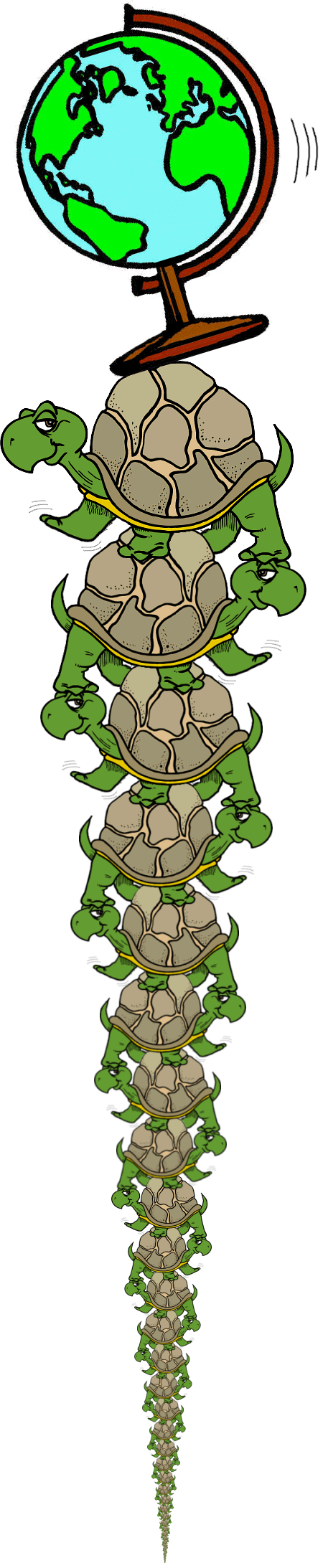
A shared notion doesn’t imply that this notion is objective, but if it’s not objective, how does one resolve differences of opinion as to which is the better truth. Without establishing a frame and a lens, this is impossible. The problem is that frames and lenses are also relative. Whether the members accept a given frame or lens is also a matter of rhetoric. It’s turtles all the way down.
Turtles all the way down
Even if all members agree on all parameters of truth at day 0, there is nothing to prevent opinion changes or from new members not to share these parameters. Such is always the problem with social contract theory. [How does one commit to a contract s/he is born into with little recourse to rescind the contract, renegotiate terms, or choose a different contract option. The world is already carved up, and the best one can do is to jump from the frying pan into the fire.]
In the end, the notion of truth is necessary, but it doesn’t exist. Playing Devil’s advocate, let’s say that there is a single purveyor of Truth; let’s just say that it’s the monotheistic Abrahamic God of Judeo-Christian beliefs. There is no (known) way to ascertain that a human would have the privilege to know such a truth nor, if s/he were to encounter, say, a burning bush of some sort, that this entity would be conveying truth; so, we aren’t really in a better place. Of course, we could exercise faith and just believe, but this is a subjective action. We could also take Descarte’s line of logic and declare that a good God would not deceive us—sidestepping that this ethereal being was good, as advertised. I’m afraid it’s all dead ends here, too.
And so, we are back to where we started: no objective truth, limited ability to reason, and some fleeting notion of knowledge. We are still left with nothing.
Enter the likes of Jordan Peterson, he with his fanciful notion of metaphysics and morality—a channeller of Carl Jung. His tactic is to loud dog the listener and outshout them indignantly. His followers, already primed with a shared worldview, are adept (or inept) cheerleaders ready to uncritically echo his refrain. To them, his virtue-ethical base, steeped in consequentialism awash in deontology, Peterson speaks the truth.
He also potentiates the selfish anti-collective germ and rage of the declining white man. He’s sort of a less entertaining Howard Stern for the cleverer by half crowd. He gives a voice to the voiceless—or perhaps the thoughtless. He uses ‘reason’ to back his emotional pleas. He finds a voice in the wilderness where white Western males are the oppressed. If only they hadn’t been born centuries earlier—albeit with iPhones and microwaves.
Those would be the days.
* I believe this phrase attributed to Foucault was a paraphrase by philosopher Todd May.
















 Philosophics