Markus Gabriel was brought to my attention, and I immediately thought of Lance at The Dog Walks.
In essence, part of his argument touches on the insufficiency of language, but his key rationale for this claim is anchored arount Kant and set theory. He published a book by the same name on this topic in 2015. This TedX talk is from 2013. I haven’t read it and am unlikely to do so in the near term, but it might be interesting if it expands upon the notion presented here.
As I am busy researching, this will likely be short. It would be even shorter without this preamble.
In researching the literature for my insufficiciency of language hypothesis, I am reading Fodor and Reboul to try to better grasp the evolutionary function of language. Both rely on the Theory of Mind. It seems that the more accepted theory is the language primarily evolved for communication as a survival mechanism. However, Fodor defends that cognition was the primary function and communicated was exapted. Carruthers contributes to the Language of Thought domain.
As I’ve presented here in dribs and drabs, my insufficiency theory of language argues that language is ill-suited for the communication of abstract concepts. It is fine for expression; communication of situational objects, inventions, and motion, description; and argumentation. But imagined concepts such as fairness, justive, and freedom don’t hold water. As I’ve discussed this hertofore in detail, I’ll not repeat myself.
Confirmation bias notwithstanding, the primacy of cognition better explains why abstract conceptual communication so often fails. Language has been stretched beyond its boundary constraints, and the air is thin past that.
I’m not sure I am willing to choose a side quite yet. Rather, I’ll note the different perspectives and move on. The underlying mechanism is less important to me than the empirical deductions that follow.
I’ve been following Philosophy Tube since Abigail was Ollie. Always top-notch material. Their content has gotten longer over time, so I’ve found myself skipping over in favour of shorter presentations. I am so glad to have decided to watch this one.
As anyone who follows me knows, I am a big advocate of social construct theory, yet I learned so much in this vid, which is proper well-cited AF. Lot’s of new content to add to my backlog, so I’ve got more than enough reading material for my next few incarnations at least.
The biggest takeaway for me is the notion that not only is gender a social construct, but so is sex itself. Previously, I have defended the sex-gender distinction, but in fact, scientific taxonomies are still social constructs—only in the scientific community rather than the greater community at large.
Abigail’s platypus drives home the point. Not that it’s some big reveal. Another less poignient analogy is fruit and vegetable classification. Tomatoes are fruits. Mellons—watermellons, pumpkins, and so on—are fruits. Say it ain’t so.
Give it a viewing and like or comment here and/or there.
It’s only happenstance that I’ve got consecutive gender posts. Derrida spoke about prioritisation in binary pair, and the inherent symbolic connotation. Sex and gender are two examples.
At the risk of overstating the obvious, masculinity holds the priority in this pair bond. Masculinity traditionally conveys hardness, strength and logic, whilst femininity conveys softness and weakness and emotion. This is what Beauvoir intends by her use of the other sex—male and other. Even in a non-binary frame, maleness still prevails over everythying else. Of course, in this broader world, male may trump female, but in an appeal to nature fashion, female trumps intersex in the same way the light-skinned people of colour trump their darker-skinned counterparts.
English even has derivative terms such as hysterical, an emotional state rooted in the Greek hystera, the uterus or womb. Etymologically, the word was invented by the Greek under the impression that this behaviour was a deviation from male normaly.
In the physical world, this male-female terminology generailises to penetrator and penetrated—penetratrix, anyone? We routinely refer to plugs and connectors with prongs as male and recepticals are female. At first glance, it might be tempting to assume that penis is somehow related to penetration, but it’s not so, as penis derives from tail.
In music there is the notion of cadence, the beats of a rhythm. Classically speaking, there are masculine and feminine cadences. And if you guessed that masculine cadences involve strong beats and feminine cadences invlove weak beats, you’d be correct.
Feminine Cadence a musical cadence in which the final chord or melody note falls on a weak beat
The reason I am writing this is as a reminder to the predjudice langage embeds and perpetuates. Even if we have lost the connection to the original intent, the sense remains. We should actively seek other terms that don’t promote this anachronistic belief system.
It’s also easy to get carried away and over-specify the domain. So, terms like manhole, manuscript, manipulate, and such are, let’s say, false cognates, in a manner of speaking. There are no counterpart womanholes—sophomoric humour notwithstanding—, womanuscripts, and womanipulation, though it might be fun to write some exposition with the intention of satarising these and words with a similar structure. I’m not sure I could womanage to carve out the time to get there.
Last Word
In a different space, we’ve got master-slave word pairs. In computers, there may be master and slave drives. I’ve heard people point out the insensitivity of this notion without grasping that projecting American (or wider-world) human slavery on this rather than understanding this pairing existed well before the New World was even ‘discovered’. This is where hysterical political correctness needs to step down and give way to education.
This wall of words was posted in a Facebook that the AI thought I would be interested in. I’m not, save for the rhetorical and grammatical structure. I am not interested in the veracity of the claim or the sentiment it is meant to provoke.
The author purportedly had a conversation with a former student, who identified as being a member of another race—black, I suppose; African-American in the current vogue; negro and coloured in bygone days.
Notice the head-fake. A conversation with an individual person quickly morphs into a generalisation. This individual, in the mind of the author—or at least the conveyance—was now the representative mouthpiece for this so-called race. But that’s not what I question.
They and them are now considered to be acceptible singular forms if a person identifies as such. I’m not sure I am equiped to comment on identification to a grammatical element, so I’ll side-step that and focus on the outcome.
Perusing this or something similar, there is a sense of undeserved weight—an inclusion from the perspective of a single person. Some people actively promote themselves as spokespeople for a group, whether race or something else. But this person did not necessarily claim to speak for anyone beyond him or herself—perhaps some small, immediate group of collegues who shared this perspective.
I am wondering how this will play out as a device to intentionally deceive the reader.
Another thing…
I was in Philadelphia yesterday, and a black associate of mine was commenting on what he deemed to be 150 neo-Nazi skinheads parading in the rain, a point eliciting more pleasure than perhaps it deserved. His assessment is that race was not a problem, that he held no illwill toward any race. His contention was with ‘motherfucking racists’. Unfortunately, there is no scientific racist litmus. There are only actions and perceptions. This is where Popper’s paradox of tolerance pops into mind. And so it goes…
Here I am yet again writing about something I am not particularly equiped to do. In other fora, I’ve been directed again to Lacan vis-à-vis a thread about Lacan’s perspective on the real. I’ve commented on Lacan before, usually in the context of eschewing any philosophy founded on psychology—especially psychoanalysis. Explaining that I have a reading backlog extending beyond my likely lifespan, it was recommended that I read Jacques Lacan by Sean Homer, so I am sharing the recommendation. Anything by Bruce Fink was another reco. Noam Chomsky takes an ad hominem swipe at Lacan here.
I decided to watch a few videos (including this, this, and this) to survey some of Lacan’s ideas, knowing that something could be lost in the translation. Let’s just say that I was underwhelmed.
In a nutshell, my biggest contention is the notion of the unconscious as an active agent.
According to my understanding, Lacan posits that there is a ‘real’ out there, but it is obscured by language and subject to interpretation. To him the real is a Void.
Psychoanalysis presumes being able to get closer to the ‘truth’ of reality. Like astrologers and fortune-tellers, Psychoanalyst primary defence is that not all knowledge is evidence-based or falsifyable. My problem is that I am not open to another way of experiencing the world, but they somehow have privileged access to this truth. Of course, this is a similar to religious claims of some special spiritual access that opens when you believe.
To me, the Void is as apt a metaphor as any. And while we both agree that the real is inaccessible, I don’t accept the impostition of the how and the why. What Lacan does—and Freud before him and psychoanalysts more generally—is to inject hows and whys into the story. In this narrative, the unconscious has active powers, (as opposed to negative space), where memories (in whatever form) may be repressed and actions may be triggered (or activated) by unconscious urges or desires. I consider this last train of thought wholly imagined and fabricated. This void and the unconscious has no purpose.
Along the way, I do agree with Lacan’s poststructuralist position. I have no issues with symbolic or metaphoric concepts and speech. The contention arrises when one attempts to claim the metaphoric to be concrete. This is the same contention I have with people who take the metaphoric text of the bible and cencretise it. There are other problems there, but I’ll quit now.
A Facebook friend is pushing for the adoption of a new phrase: red washing, where it indicates a false sense of ownership and control. This friend has collectivist leanings, so perhaps that’s where the red comes from. It doesn’t make logical sense to me, but rather than focus on the phrase itself, I want to discuss the sentiment and intent. Essentially, his contention is that some forms of ownership don’t offer the same sense of control as others. If I own a car, or a pencil, it’s mine to do with it what I please. But if I only own a piece of something, my control diminishes. This is especially true where my ownership is a minority share.
The first mistake my friend makes is to presume that ownership and control are one in the same. I don’t feel we need to discuss the case where the State controls the limits of any ownership. You can own property, but what you can construct on it is limited by zoning laws and perhaps community guidelines. You can own a car, but you can’t drive it on public roads at 200 MPH, or paint it like a police car affixed with blue and red lights. You can’t stab your neighbour with the pencil you own. And you can’t own or even possess heroin under normal circumstances. I feel that these ownership restrictions are obvious. These are aspects of control ceded to the State. Some Libertarians may baulk, but for the most part, these are generally accepted limitations.
My interest here is the notion of diluted ownership. This really underscores the difference between ownership and control. A simple illustrative example is a publicly traded company. One can own a share in that company, but ostensibly, this gives you no control. If one holds a million shares, maybe they have a voice. If one has a majority share or can create a coalition to compose a majority share, one ostensibly has control. Otherwise, although your ownership may grant you other advantages, control is not one of them. One can benefit by price increases in the marketplace, perhaps collect dividends, and you can cast your proxy vote, but these don’t represent control.
Likewise, this is how democracy operates in practice. One has a vote. Theoretically, it’s one person, one vote—one vote per person. Though in the United States this is the system de jure, not de facto system, where it’s closer to one vote per dollar.
Consider the United States. In 2020, there were 239,000,000 eligible voters. Each eligible voter is an owner of this democracy or republic. Pick your poison. Effectively, this means that one’s ownership share affords them 1/239,000,000 control. This wouldn’t even qualify as homoeopathic, and that’s a pretty low bar.
Dehydrated Water
I’ve commented elsewhere on how democracy is a specious proposition. That it only provides an ‘illusion of control‘. This is fine for the power structure. All they need to operate is to maintain this illusion and for the people to defend their voiceless voices.
Of course, the Republican flavour of Democracy is even worse. Not the Republican party. The sense of representative democracy over direct democracy or even anarchy. Republicanism adds a principle-agency challenge to it’s already weak-tea proposition.
I want to write about this Quanta Magazine article: What Is Life? Its Vast Diversity Defies Easy Definition. but I’ve not got enough spare time. Too many irons in the fire or plates spinning or which ever metaphor you favour.
My interest in the insufficiency of language is what attracted me to the article, and is probably how it ended up in my feed. To highlight some aspects, in 2011, Russian geneticist Edward Trifonov reviewed 123 definitions of life and found as many definitions as authors. Although he discovered some core shared features. His version distilled to self‐reproduction with variations.
The article mentions Wittgenstein’s language games—and rightfully so. But it underscores the point that language is an approximation of reality. My working position was that naming objects is simple—in fact trivial—, but naming abstract concepts presents challenges. Now, I find that the challenge sets in earlier than even I expected. Language is truly insufficient.
The first step to recovery is to admit there’s a problem.
Riffing on my recent post, I wanted to provide a tab more perspective on my claim that postmodernism serves a purely disintegrative function. Anyone can disintegrate a narrative into constituent parts, but postmodernism provides no grounds for privileged reintegration, as this too can be disintegrated. So, whilst one is free to disintegrate and even to reassemble the parts, one is never in a position to claim that this is how it should be put together because this privileges the subject and another subject can always come along and privilege another perspective. Also, there is no PoMo toolkit available to reassemble the parts that I am aware of.
When I was a child, a neighbour owned and operating a demolition company. He disintegrated buildings. He kept some of the materials and sold some other for scrap. Whilst these materials could be repurposed and used in the construction of another building—or a picnic table—, this was not the function of the demolition company. It’s safe to say that no one was ringing him up under the premise that he had tools, so why won’t he build them a house. He knows houses, right?
This is the same problem we face when deconstructing a narrative with postmodern tools. If we want to construct something, we can, but we should expect that no matter what we do, the next wave can readily knock it down. And though we can rebuild more castles made of sand, they are all subject to the same forces.
* I admit that this title was lent from The Cure’s Fascination Street, which does happen to be on their album Disintegration.
I tend to go on about weasel words and the insufficiency of language, but I tend to get a lot of resistance by people who insist the chasm isn’t as expansive as I make it out to be. This makes me wonder how one might create a test to determine how much is similar and how much doesn’t.
To summarise my position, abstract concepts of this type are specious archetypes that cannot exist in the real world: truth, justice, freedom, fairness, and so on. The common thread here is almost always that they exist in the realm of morality, another false concept.
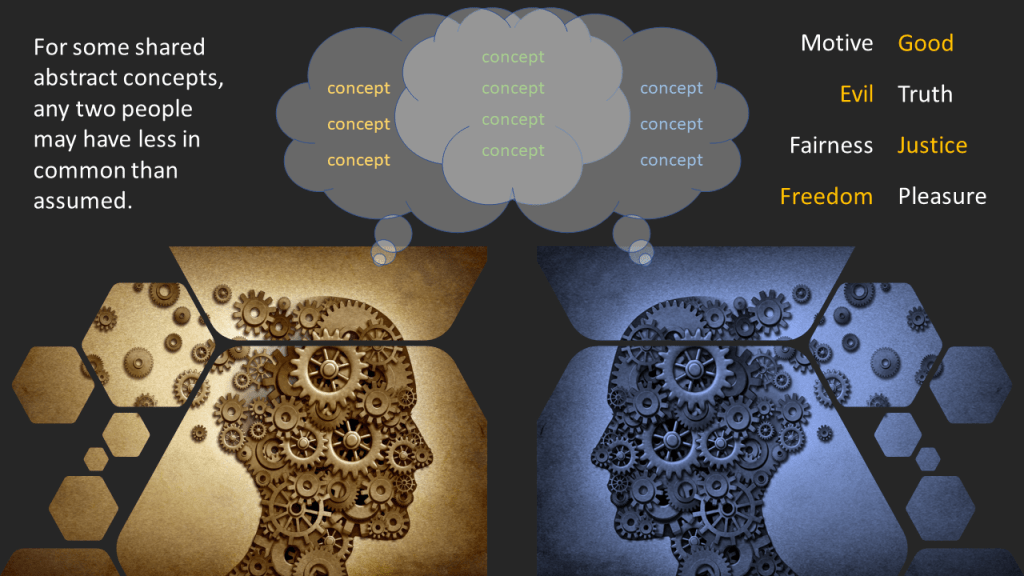
It seems to me that one could construct a sort of word cloud intersecting with a Venn diagramme. I’d assume that more articulate people would have more descriptors, thereby creating landscape with more details and nuance for any given concept.
Additionally, I could see a third dimension which would capture diametric meanings. There is also the issue of diverse contexts, e.g. in the case of justice, we have distributive, retributive, restorative, and procedural flavours, so one would need to be taken into account.
In everyday existence, I notice that these terms are good enough and have enough substance to trick people into believing not only that it’s real but that the are operating with a shared concept. My point is that it’s more apples and oranges. We could employ dimensions that make these appear to be similar.
Approximate spheroids
Fruits
Contain fruits
Have skin
Additional scrutiny would illustrate the differences.
Colour
Taste
Consistency
This difference between this concrete case is that we can observe the objects to compare and contrast, but with abstractions, we have a sort of survivorship bias in play. We remember what we agree on and forget or diminish the parts we don’t agree on. And we don’t necessarily even know the complete inventory of descriptors of our counterparts.
The image at the top of the page is not to scale. I don’t know what the percent breakdowns are, but I wouldn’t be surprised if in a situation where there were 10 possible descriptors, that only 4 would be commonly shared—so 40 per cent—, leaving 6 not in common—60 per cent.
In any case, I wonder if anyone has attempted this sort of inventory comparison. I haven’t even looked, do there could be tome upon tome published, but I don’t suppose so.










 Philosophics