Conspicuous Consumption is Immoral

In a world where our worth is increasingly measured by what we own rather than who we are, it’s time to question the hollow pursuit of conspicuous consumption. Thorstein Veblen, over a century ago, saw through the shiny façade of status-driven consumerism. He coined the term conspicuous consumption to describe a phenomenon that has only grown more insidious in our time: the wasteful, performative display of wealth and luxury to signal social standing.

From luxury cars to designer handbags, we live in a society that encourages us to broadcast our economic worth at every turn. But what does this ostentatious display really achieve? Veblen would argue that it’s not about personal fulfilment or the intrinsic value of what we buy, but about outshining others—a relentless race with no finish line. We’re not buying goods; we’re buying validation, trying to purchase a place in an imagined hierarchy that is as fragile as the latest trend.

Peter Singer, the moral philosopher known for his advocacy of effective altruism, would take this critique even further. For Singer, conspicuous consumption is not just wasteful; it’s morally indefensible. His ethical stance, grounded in utilitarianism, compels us to consider the opportunity cost of our spending. Every pound spent on a designer item is a pound that could have been used to alleviate suffering—whether through combating extreme poverty, funding life-saving medical treatments, or addressing global environmental crises. In a world where preventable suffering and death are rampant, lavish spending on status symbols is not just misguided; it’s a moral failure.

Singer’s principle of equal consideration of interests demands that we weigh the impact of our actions on others as seriously as we consider their impact on ourselves. When we choose to engage in conspicuous consumption, we’re prioritising superficial self-expression over the tangible needs of those who are suffering. It’s a glaring contradiction to claim we value human life while squandering resources on goods that serve no purpose beyond ostentation.

The issue with conspicuous consumption isn’t just its superficiality—it’s the economic and social rot it perpetuates. It sustains a cycle of pecuniary emulation, where those lower on the socio-economic ladder are pressured to mimic the consumption patterns of those above them. The result? A society locked in an absurd competition, where individuals drown in debt just to keep up appearances, and resources are squandered on goods that serve no practical purpose other than to flaunt.

But why should we care? Isn’t spending on luxury just a harmless personal choice? Not quite. Every pound spent on a status symbol is a pound diverted from something meaningful—education, healthcare, the environment. When the affluent engage in extravagant spending, they set a toxic standard, promoting the idea that personal worth is tied to material excess. It’s not just bad taste; it’s bad ethics, bad economics, and bad for the planet.

More disturbingly, this drive to display wealth erodes the social fabric. It deepens divisions, creating resentment and alienation. The ultra-wealthy, insulated in their gilded cages, become oblivious to the realities faced by the rest of society. Meanwhile, those struggling to maintain the illusion of prosperity are left with the fallout—financial instability, stress, and a gnawing sense of inadequacy.

Veblen saw this trap for what it was: a hollow spectacle. Singer’s ethics give us a way out. He challenges us to shift our focus from self-indulgence to selflessness, from conspicuous consumption to conscious contribution. Instead of spending exorbitantly to bolster our social standing, why not use that wealth to create real, measurable change in the world?

We don’t need another luxury brand or another status symbol. We need a society that values substance over style, sustainability over excess, and human dignity over the incessant demand to buy more to be more. Singer’s challenge is simple: consider the true cost of your choices—not just for yourself, but for the world around you.

Conspicuous consumption is a dead end. It’s time to take a different road—one that leads not to a display case, but to a more equitable, thoughtful, and genuinely prosperous society.

The Paradox of Political Correctness

Political correctness, on the surface, seems like a noble cause. Its primary goal is to foster inclusivity, promote respect, and prevent offence by regulating language. But beneath this well-meaning exterior lies a paradox: in the pursuit of protecting sensitivities, political correctness often ends up infringing on free expression and alienating those who feel their voices are being restricted. The very thing it seeks to prevent—offence—is often shifted to the speaker, creating a moral stalemate where no one truly wins.

The Intent vs. The Outcome

The fundamental intention behind politically correct (PC) speech is clear: to prevent harm. By urging people to avoid potentially offensive language, the aim is to create a more harmonious, respectful society. But as the adage goes, “The road to hell is paved with good intentions.” What PC speech often forgets is that words are not merely tools for appeasement. They are vessels for meaning, clarity, and sometimes emotional impact.

In practice, what we see is a growing gap between intent and outcome. People become so focused on using the “right” terms that they lose the authenticity of their expression. Conversations become stilted and disingenuous, with individuals more concerned about offending someone than engaging in genuine dialogue. The paradox here is unavoidable: PC speech seeks to protect the object (those who may be offended), but in doing so, it often offends the subject (the speaker). What starts as an attempt to preserve harmony creates an environment where truth and clarity are sacrificed for the sake of politeness.

Disingenuous Communication

Euphemisms and “sanctioned” terms have a way of watering down language. Whilst they may soften the potential impact of certain words, they also strip away their power. In the name of not offending, PC speech dilutes the very thing that makes communication effective: its ability to convey raw, unfiltered meaning. When language is sanitised to the point of blandness, it loses its ability to provoke thought, challenge ideas, or evoke emotion.

This leads to a culture of disingenuous communication. Rather than engaging in sincere conversation, people tiptoe around topics, afraid of crossing invisible lines. Ironically, this creates more division because what could have been an open exchange of ideas is reduced to a polite, surface-level interaction where no one says what they truly mean.

The Subjectivity of Offence

Here’s the kicker: offence is subjective. What offends one person may not even register for another. And yet, PC culture operates on the assumption that offence is both predictable and universal as if we can map out exactly what will offend whom in every scenario. The reality is far messier. People come from different backgrounds, have varying sensitivities, and interpret words through their own unique lenses.

The subjectivity of offence makes it impossible to predict or avoid entirely. We’re left with a scenario where everyone is constantly second-guessing their language, afraid to say the wrong thing, yet never truly sure of what the “wrong” thing even is. This arbitrary nature of offence doesn’t lead to more thoughtful conversation; it leads to silence, where people are too cautious to express themselves at all.

A Zero-Sum Game

At its core, political correctness sets up a zero-sum game. On one side, you have positive freedoms—the freedom to feel included, respected, and protected from harm. On the other side, you have negative freedoms—the freedom from censorship, restriction, and the fear of saying something wrong. The trouble is, that these freedoms are often in direct conflict. Protecting one group’s sensitivities inevitably means infringing on another’s freedom of expression.

This isn’t just an intellectual debate—it’s a moral impasse. PC speech has created a situation where no one comes out on top. The speaker feels censored, the listener feels offended, and the conversation stalls in gridlock. The result is that both sides suffer. In the relentless pursuit of an all-or-nothing outcome, we lose the chance for compromise or meaningful dialogue. What we get instead is an “us versus them” mentality, with each side digging in and claiming the moral high ground.

The Pendulum Effect

This rise of PC culture is part of a broader cultural shift toward collectivism, where the needs and feelings of the group are prioritised over individual freedoms. In many ways, this shift was necessary. After decades of unchecked individualism, society needed a correction—an acknowledgement that words can cause harm and that we owe each other a certain level of respect.

But as with all cultural shifts, the pendulum can swing too far. What started as a necessary push for inclusivity has morphed into something more restrictive, where individual expression is sacrificed at the altar of group harmony. This disequilibrium has left society in a state of tension, where both sides are dissatisfied. As history shows, cultural trends ebb and flow, but until the pendulum swings back, both sides are left feeling uncomfortable and marginalised.

Human Nature: The Eternal Bickering

At the end of the day, bickering is just part of human nature. No matter how hard we try, there will always be conflict when people feel their moral or intellectual territory is being encroached upon. Political correctness, in its current form, exacerbates this natural tendency by setting up a battleground where both sides feel aggrieved. The PC police push for language policing, whilst the anti-PC camp fights back against what they see as an attack on free speech.

The sad truth is that this bickering will likely continue as long as both sides insist on an all-or-nothing solution. In a world where compromise seems like weakness, and where both sides claim the moral high ground, there’s little room for meaningful progress.

Counterpoints for Balance

It’s only fair to acknowledge that PC speech has done some good. In fostering a more inclusive society, it has given a voice to marginalised groups and helped reduce harm caused by thoughtless or malicious language. There’s also a valid argument that some regulation of language is necessary to prevent hate speech and maintain civility in increasingly diverse communities.

That said, the overreach of PC speech—the constant pressure to conform to an ever-shifting set of linguistic rules—has created a stifling environment. What began as a movement for respect and inclusivity has become a barrier to free expression and a source of division.

Conclusion

In the end, the paradox of political correctness is this: it aims to create a more inclusive, harmonious society, but its current form stifles free expression and fuels division. As long as we continue to prioritise group sensitivities over individual freedoms, we’ll remain stuck in this cycle of conflict and resentment. It’s time to recalibrate—finding a balance between respect for others and the right to speak freely whilst accepting that offence is inevitable in an open society.

Broken Swords

I’m a few chapters into Josephine Quinn’s How the World Made the West, and it’s a solid reminder that most things we think of are constructs—especially anything tied to identity, whether personal, social, or cultural. In one passage (depicted here), it’s also a reminder that even the most fundamental tools of civilisation had to be built—literally.

I’d never given it much thought before, but swords, in films at least, are portrayed as failsafe instruments, more limited by the wielder’s skill than the blacksmith’s craft. We’re used to seeing mechanical failures in other weapons—guns jam, bombs don’t go off, and booby traps fail. But swords? Not so much. Maybe a weaker sword gets snapped by a stronger one, but that’s more a flex on the bearer than the weapon itself.

Turns out, before 2500 BCE, swords routinely broke. Once we humans sorted that, they dominated until arrows and guns joined the arms race.

Earlier in the chapter, Quinn mentions how the tips of spears had to be tied on with rope. Before that, spears were just pointy sticks. Before that? Just sticks. Makes you wonder how long it took us to “innovate” from nothing to sticks and stones.

I’ve been toying with the idea of writing a post on the invention of grammatological structures, but I’ll save that for another time.

MBTI Defined

Full Disclosure: I don’t subscribe to pop psychology, pseudo-psychology, or psychology. But I repeat myself. Of course, that’s just what an INTP would say anyway. So predictable.

I was introduced to the MBTI (Myers-Briggs Type Indicator) in the late ’80s as an undergrad Psychology student and then in Organisational Behaviour classes. I read about the foundations in the ’90s when I read the works of Carl Jung’s, Archetypal psychology.

I take the test every few years, and I consistently come up as INT. The P and J flip now and again. The last test I took was a P. Some tests have added an A or T dimension. There are also sub-factors. I’ll get to those presently.

MBTI is a personality assessment tool designed to categorize individuals into one of 16 distinct personality types. Based on Carl Jung’s theory of psychological types, MBTI helps identify how people perceive the world and make decisions. Each personality type is derived from a combination of four dichotomies:

  1. Extraversion (E) vs. Introversion (I) – Describes where individuals prefer to focus their energy. Extraverts are outward-focused, gaining energy from interaction, while Introverts are inward-focused, drawing energy from solitude.
  2. Sensing (S) vs. Intuition (N) – Defines how people process information. Sensing types rely on concrete details and present realities, while Intuitive types focus on patterns, possibilities, and abstract thinking.
  3. Thinking (T) vs. Feeling (F) – Describes how decisions are made. Thinking types prioritise logic and objectivity, while Feeling types consider values and emotional impact.
  4. Judging (J) vs. Perceiving (P) – Describes lifestyle preferences. Judging types prefer structure and closure, whereas Perceiving types favour flexibility and keeping options open.

Cognitive Functions

Each type has a specific “cognitive function stack” that explains how these preferences play out in everyday life. These functions are divided into:

  • Dominant Function: The most natural and frequently used function.
  • Auxiliary Function: Supports the dominant function, offering balance.
  • Tertiary Function: Less developed but still important, often emerging later in life.
  • Inferior Function: The least developed function, which tends to show up awkwardly, especially under stress.

The eight cognitive functions are:

  1. Introverted Thinking (Ti) – Internal analysis and logic refinement.
  2. Extraverted Thinking (Te) – External organisation and efficiency.
  3. Introverted Feeling (Fi) – Personal values and internal authenticity.
  4. Extraverted Feeling (Fe) – Social harmony and emotional dynamics.
  5. Introverted Sensing (Si) – Recalling past experiences and valuing tradition.
  6. Extraverted Sensing (Se) – Engaging with the present moment and sensory details.
  7. Introverted Intuition (Ni) – Focusing on future possibilities and deep insights.
  8. Extraverted Intuition (Ne) – Exploring ideas and brainstorming possibilities.

Assertive (A) vs. Turbulent (T) Dimension

The A-T dimension adds a layer of emotional self-regulation to MBTI types. It describes how confident or self-critical individuals are in their decision-making and handling of stress.

Turbulent (T) types tend to be more self-critical, stress-prone, and driven by perfectionism and external validation.

Assertive (A) types are self-assured, less prone to stress, and comfortable with their decisions.

With this definition in place, I’ll save further commentary for a future post.

The Myth of Psychological Normalcy

Neurodivergence is a hot topic today. But why? Are people more informed, or simply more comfortable speaking out?

Humans, by nature, are neurodivergent. This has always been the case, yet the illusion of neurological normalcy persists. The real issue lies in psychology’s pretence that humans fit into a standard model of normalcy.

In production processes, normality is expected—a product must meet specific standards, and deviations are considered defects. However, applying this industrial concept to human psychology is deeply flawed. Humans are not teleological except in the broadest biological sense. More people have brown eyes than blue or green; are those with brown eyes normal and others not? Ninety per cent of people are right-handed; does that make left-handed individuals abnormal? Statistically, they might be. However, in psychology, normalcy carries a judgmental connotation that goes beyond mere numbers.

Psychology, as expressed in behaviour, is not a suitable domain for discussing normality. Many people misuse the concept of “normal” as a moral qualification, which must stop.

In fact, the very concept of psychological normalcy is a relatively recent invention, one that has been used as a tool of control and categorisation. As philosophers have noted, the obsession with ‘normal’ behaviour reveals more about society’s desire for control than it does about the true nature of human diversity.

We are all neurodiverse. This is what typical looks like. Do some people vary significantly from others on certain dimensions? Yes, but this is a relative or contextual comparison.

By embracing neurodiversity, we recognise that our differences are not defects but essential variations, enriching the human experience. It’s time to move beyond the narrow confines of neurological “normality” and celebrate the full spectrum of human cognition. In doing so, we challenge the arbitrary boundaries that have long been used to divide and label.

The Plague

I happened upon my copy of The Plague by Camus. I had forgotten that I had read it—likely during the COVID-19 debacle, but perhaps earlier.

The Plague is basically a deep dive into a city gone mad with disease. It’s set in Oran, Algeria, where things kick off with a sinister dead rat and spiral into full-blown disaster as a plague locks the city down. This isn’t just a survival story; it’s a gritty look at how people cope when the world turns upside down.

The city becomes a pressure cooker. Through characters like Dr Rieux, the down-to-earth doc who’s all about getting things done; Tarrou, the outsider with a shady past; and Father Paneloux, who’s trying to square God’s plan with the chaos, Camus throws some heavy questions at us. What do you do when there’s no escape? How do you keep your humanity when life’s going off the rails?

Camus keeps his cool, writing with a detached style that makes the unfolding horror hit even harder. It’s like he’s telling us to face up to the absurdity of life without flinching. The plague is more than a disease in Oran—it’s a symbol of all the random, harsh stuff life throws at us.

The Plague is raw and real. It doesn’t offer cosy reassurances; instead, it challenges you to look disaster in the eye and ask yourself: when everything falls apart, who will you become? This book isn’t just a read; it’s a challenge—a call to fight against despair, even when the odds are stacked against you.

The Tyranny of Order and the Freedom of Chaos

I’m not happy with the summary review of The Blind Owl by Sadegh Hedayat. I liked the book, and the review was positive, but the summary was at too high of a level and didn’t convey how I experienced the reading. I’m tempted to try again at a lower level. That’s not the subject of this piece.

I happened on a short clip of Claudia de Rham pointing out that physicists (and scientists more generally) are not dismayed when their theories are disproven or someone finds a puzzle piece that doesn’t fit into their puzzle. The reaction she highlights is similar to reactions to Nihilism and Anarchy.

VIDEO: The Institute of Art and Ideas.

Here’s a longer (but still not full) version.

VIDEO: Can physics ever explain the universe? | Avshalom Elitzur debates Claudia de Rham

Most people, it seems, are incessantly grasping for order. A select few crave structure. But what truly fascinates me is the interplay of perception and expectations.

The ‘Orderlies’ – those fastidious devotees of tidiness – become apoplectic at the mere sight of disorder. They needn’t even experience it directly. “Oh, those physicists must return to the drawing board! Their model needs reassessment!” For fuck’s sake, it gives them purpose – a raison d’ĂŞtre, if you will.

This phenomenon extends to the habitual ‘Believers’ scrutinising nihilists. “Without belief, I’d embark on a murderous rampage,” they proclaim – though always directed at the world beyond themselves. Never them, of course, but those ‘other’ people. If not for God, who would maintain order? Evidently, these individuals don’t venture out much if they genuinely believe their deity is keeping things shipshape.

I frequently encounter notions that Nihilists must navigate life burdened by existential dread, their existence devoid of meaning, the universe an empty void. Speaking for myself, I require no such structure. Nothing is absent. There is no dread.

The religious perceive a void – a “God-sized hole,” as a mate once pontificated, that can only be filled by the divine. Naturally, he was moralising, declaring that sex, drugs, and other vices could never satiate this cosmic emptiness. But there is no hole. Perhaps they’re grappling with some psychological vacancy. I sympathise, truly, but stuffing a God-sized hole with imagination seems no more nourishing than consuming an imaginary sandwich. Sod it, I might as well gorge on an imaginary chateaubriand if we’re going all in. I’ll still need sustenance after this illusory feast.

Then there are those who yearn to be governed. They crave traditions and institutions, lacking the critical faculties to evaluate them. Whatever they possess must surely be superior to the worst they can conjure. I suspect they’re envisioning an alternate world populated by like-minded individuals. In fact, I ought to be terrified by such a prospect too.

In the end, perhaps the true freedom lies not in order or belief, but in embracing the beautiful chaos of existence. After all, in a universe of infinite possibilities, why constrain ourselves to imaginary feasts when we can savour the rich banquet of reality?

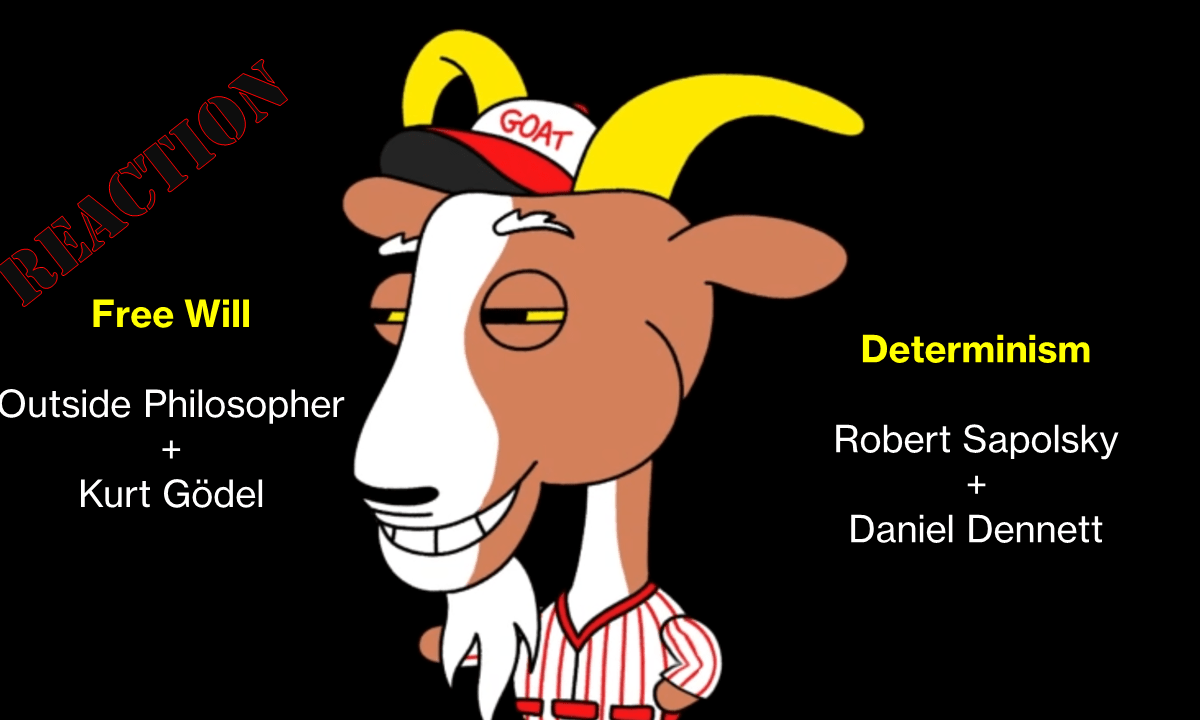
VIDEO: Response to Response on Sapolsky v. Dennett Debate

It’s been a minute since I’ve posted a video. Restart the clock. In this video, I critique Outside Philosopher’s critique of the debate between Robert Sapolsky and Daniel Dennett on Free Will and Determinism. He attempts to leverage Gödel’s Uncertainty Principle in his defence.

Feel free to leave comments on YouTube or below. Cheers.

Hemo Sapiens: Awakening

I’ve been neglecting this site as I’ve been focusing on releasing my first novel, which I’ve now managed successfully. I published it under a pseudonym: Ridley Park. The trailer is available here and on YouTube.

Hemo Sapiens: Awakening is the first book in the Hemo Sapiens series, though the second chronologically. The next book will be a prequel that tells the story about where the Hemo Sapiens came from and why. I’ve got a couple of sequels in mind, too, but I don’t want to get ahead of myself.

In summary, Hemo Sapiens is shorthand for Homo Sapiens Sanguinius, a seeming sub-species of Hemo sapiens Sapiens—us. In fact, they are genetically engineered clones. It’s a work of near-future speculative fiction. It’s available in hardcover, paperback, and Kindle. If you’ve got a Kindle Unlimited account, you can view it for free in most markets. The audiobook should be available in a couple weeks if all goes well.

Awakening explores identity, belonging, otherness, and other fictions. It talks about individualism and communalism. It looks at mores, norms, and more.

Check it out, and let me know what you think.

Geopolitical Positioning

Some have asked me why I comment on the conflicts of the world since I am a nihilist who doesn’t believe in nations and borders. The answer is that I still have emotions and can still apply logic. Besides, much of my argument revolves around selective vision and cherry-picking.

Two conflicts have been in the news lately—Israel-Palestine and Russia-Ukraine. I think I can frame this without taking sides.

Israel-Palestine

On 7 October, Hamas attacked Israeli citizens. This is a crime against humanity. Israel declared war on Palestine and attacked their citizens. This is both a crime against humanity and a war crime. Israeli officials claim that it is justifiable because the militant Hamas were hiding behind Palestinian ‘human shields’, targets that included hospitals and other infrastructure.

However, 7 October didn’t happen without history. I’m no historian, but Israel’s occupation of Gaza has been considered illegal since 1968. If we accept this frame, Hamas are roughly equivalent to the French resistance during WWII, doing what they can to rid the oppressors. I think this video by a fellow philosopher provides some historical context, so I’ll stop here and recommend it.

Spoiler Alert: This affair commenced circa the nineteenth century.

Russia-Ukraine

We all know this story. Russia invaded Ukraine without provocation on 24 February 2002. Putin just wanted to reform the former Soviet Union, right? Well, not so fast. While I disagree with this narrative, I also disagree with its historical framing as well as the claim that Ukraine had some long-standing sovereignty and its people were all asking for liberation from the West.

Again, let’s rewind to 2014—nah, 1989, the fall of the Berlin Wall and the end of the Cold War™, an event that would commence a period of unprecedented peace—if not for that pesky Military-Industrial Complex. Drats. Not good for profits. Never gonna happen. Promises made. Promises broken.

You’ll notice in this Belgian (French language) map that Ukraine didn’t yet exist in 1769. We can see Crimea, which was controlled by the declining Ottoman Empire.

No history lesson today. Do your homework. Nothing is back and white.