Covid Casualties

I’ve got several things on my mind, but they are ostensibly unrelated. I’ll post separately as time allows, but this is a personal story.

My sister has been visiting a dialysis centre three times a week for the past 5 years awaiting a matching kidney donor. She rang me the other day to tell me she was en route to hospital as they had found a donor. Found is probably a poor word choice. Some person had died, rendering the kidney superfluous for all intents and purposes.

My sister was excited to regain some control over her life. She was told that the host of this kidney had been diagnosed with Hepatitis C and was informed of the risks. The official cause of death was Covid—perhaps owing to a compromised immune system. No matter. My sister accepted the risk. It was evening, and the transplant was scheduled for the morning after running some test panels.

That morning, she was devastated by the news that she had tested positive for Covid, so she was no longer a candidate for a transplant. This is a reminder that Covid is not just about the effects of having caught it. She’d go back on the list and wait. Perhaps it wouldn’t take 5 years this next time, though there are no guarantees.

This is not my first experience with Covid. My 20-something-year-old daughter was hospitalised for over a week due to Covid. I’ve had friends and acquaintances get it, but they all survive–long-Covid effects notwithstanding.

I thought I’d written about the death of my last girlfriend who was another Covid casualty of the indirect variety. She died in June 2020. Her plight was sealed by deferring treatment of an infection for fear that hospitalisation would increase the probability of her contracting Coronavirus. This decision turned out to be fatal.

To be fair, there is a lot of information, misinformation, and disinformation abound, and it’s a challenge to sift out the relevant material. And neither is the ambient fear helpful. And so it goes…

Memento Mori

Some art just catches my eye and resonates. Here is an image of a robotic arm. Nothing quite captures the Modern human condition quite so poignantly. This is the plight of Sisyphus but not so pedestrian as Camus’ version. One can’t imagine this one happy. This robot was built intentionally to bleed the hydraulic fluid that is its lifeblood, as it toils to retain that sanguineous fluid. But as with life and humans, the task is futile.

In this shot, we see human spectators watching its eventual demise. Memento Mori. No one gets out alive.

The Instagram copy captures my sentiments pretty well, so I’ll end this here.

Still a Slave

“Wage slavery is not the same as slavery, and this diminishes the experience of plantation slaves in the antebellum Southern US states” is a sentiment I’ve heard repeated over the years.

I’ll argue that it is the same. Saying wage slavery is like when the then-president of the United States, Bill Clinton, denied that oral sex was sex despite it being an obvious part of the name. When one says wage slavery is still slavery, s/he is making a commentary on the lack of agency, a lack of personal control. That the worker has a choice over which master to slave under is hardly a consolation. That a plantation slave has a choice of picking cotton or tobacco is of no consequence.

To disqualify wage slavery as slavery is to disqualify a 3-month pregnant woman as being not as pregnant as a 6-month pregnant woman. One might be closer to term, but they are equally pregnant.

That a plantation slave may have had less freedom and run the risk of physical beatings, torture, or even death is a sad commentary. That they may have separated from their families and have no autonomy is a matter of degree.

The slavery connexion occurs where the human needs to comply. Sure, a wage slave can opt out and live as a transient—ostensibly homeless; perhaps s/he can home-surf. Perhaps s/he can beg or live off the land.

Wage slavery is not the same as slavery

To me, the common missing element is to be able to operate as a functioning society, that as communities, we might contribute however we see fit. Of course, that narrative will quickly provoke an appeal to Tragedy of the Commons. People are selfish and act only in their own self-interests. And this is accepted uncritically as fact rather than evaluating whether this worldview is a consequence of Modernity or Capitalism, whichever nomenclature one has opted to adopt.

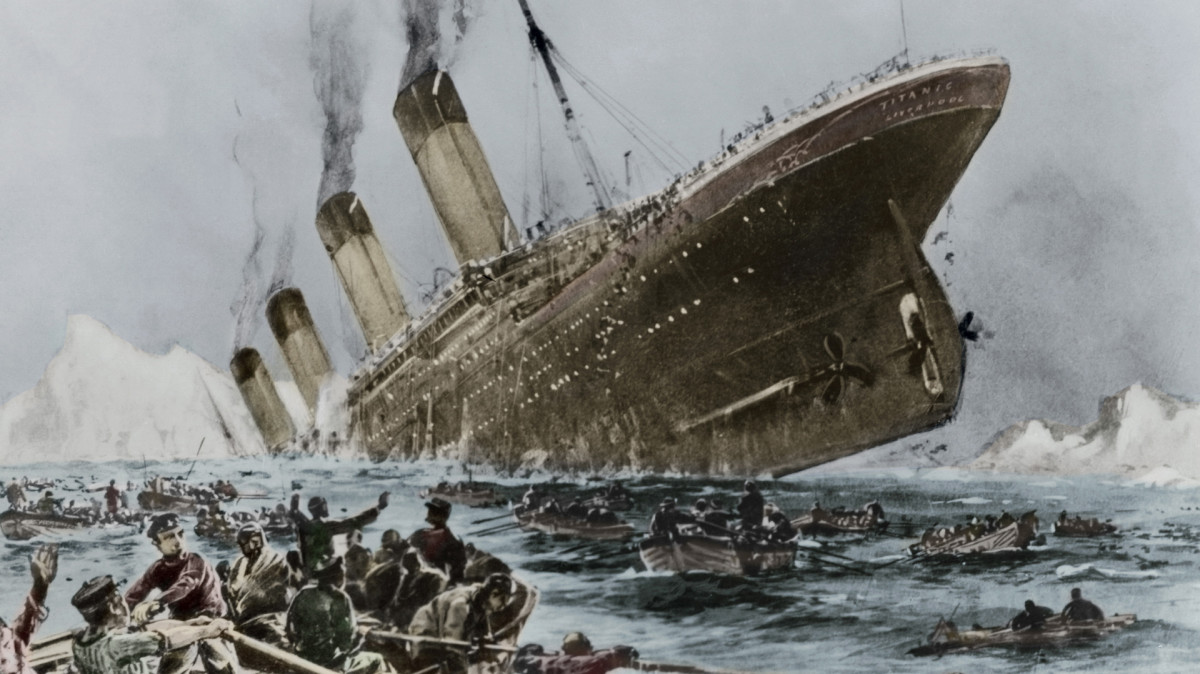
Wage slavery is slavery. Depending on the information source bout 50 per cent of Americans are a paycheque away from needing to deplete savings to survive; some have assessed a single paycheque from homelessness without intervention. One paycheque from poverty. Over two-thirds of Americans have been living paycheque-to-paycheque since the Covid-19 pandemic hit. If this describes you, it likely provides little solace that you are not alone. Who on the Titanic was relieved to know that other people shared their plight? Is there a silver lining for those who are paid fortnightly or monthly? And God forbid the ones whose paycheque arrive daily—perhaps in cash from the till.

Research from the Federal Reserve found that 4 in 10 Americans couldn’t afford a $400 emergency, and 22 per cent say they expect to forgo payments on some of their bills. It’s not much better in the UK, where the runway appears to end at 2.5 months rather than 1, although about two-thirds of renters would expect to make it more than a month.

Slavery, like turtles, all the way down. Just be thankful the worst that can happen is that one starves to death or pursues the life of Valjean. Dissociating wage slavery from plantation slavery is like separating the abbatoire from the butcher’s shop. When you’re the chattel it makes little difference.

Class Desire

Sometimes I feel the need to focus. This is a desire of mine. I’ve got so many irons in the fire that I (1) don’t finish thoughts in a ‘timely’ manner and/or (2) don’t articulate and expound as much as I might have otherwise been able to.

In another forum, Deleuze’s concept of desire—humans being desiring machines (production dĂ©sirante*)—came into the conversation, emergent desire generators versus Lacan’s version of free-floating desire—desire like æther. Through this course, I came upon a YouTube video, Desire and Class Interest: Insights from Gilles Deleuze| Literary Theory, by Masood Raja, and I want to relate his position here.

Ostensibly, Masood’s response is to the question, ‘Why do working-class people so often vote against their own self and class interests’. The answer is desire.

As a commonly misattributed reads,

“Socialism never took root in America because the poor see themselves not as an exploited proletariat, but as temporarily embarrassed millionaires.”

— Not John Steinbeck

Ultimately, these voters do not identify themselves with the working class. They’ve likely bought into the myth of upward mobility and want to preemptively protect themselves from the horrors of taxation and such. Money is their object of desire. Interestingly, except for the most pious, religious belief and views toward idolatry don’t alter the calculus here. I’d blame Calvinism again, but why bother?

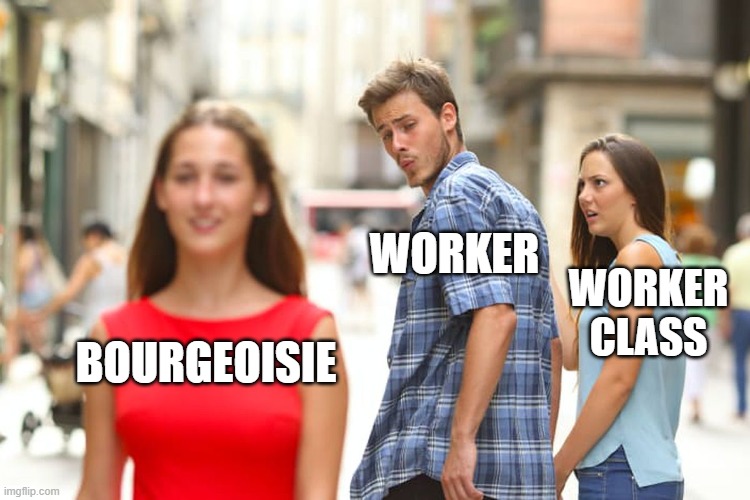
Boyfriend distracted by desire of millionaire class

These workers, whose probability of being the next Elon Musk, Jeff Bezos, or Bill Gates, are nil to none, nonetheless are blinded by their desire to be the next millionaire, billionaire, or trillionaire—or perhaps just better off than a hundredaire. In the end, they become class traitors, undercutting their own livelihoods to protect a future that’s unlikely ever to manifest.

They may (or may not) participate in other dimensions of social justice, but acquisitiveness trumps class consciousness.

* la production désirante est multiplicité pure, c’est-à-dire affirmation irréductible à l’unité

Identifying Identity

“Si Dieu n’existait pas, il faudrait l’inventer.”

— Voltaire

God knows that I am not interested in God, but in the quoted sentence, ‘If God did not exist, it would be necessary to invent him‘, Voltaire has established a pattern: If X did not exist, it would be necessary to invent X. Identity is a possible X. Time and now are other possible Xs.

I’ll focus on identity. That identity is a social construct may be technically correct, but so what? My position is that identity doesn’t exist, yet people–including me–identify. We search for identities that don’t exist. What I was when I looked is no longer there. And if someone invents a new attribute of identity, we tend to evaluate how we relate to it. Among other things, cognition is a difference engine.

“The mirror is a worthless invention. The only way to truly see yourself is in the reflection of someone else’s eyes.”

— Voltaire

When the concept of race is brought up—as invalid of a concept as it may be—, we assess how we relate to it. Sex, gender, self—it’s all the same pattern.

I’ve written on race identity in the past. Given it’s a fiction for the human species, it’s a moving target even within the realm of identity, a moving target in its own right. In my estimation, race is a conflation of colour, class, and culture—evidently, the 3Cs. So, although I don’t believe the concept of race is valid for homo sapiens sapiens, I still have a sense of what the users of this term mean. Besides colour, which I feel is the primary attribute, couched in this notion is cultural affinity as proxied by national original, another nonsensical notion.

In my case, I was raised as a WASP. My family background is white, Anglo-Saxon (Norwegian), and Protestant (Northern Baptist), so in the US I am afforded privilege. Were I to play it up, I should be able to parlay this into better jobs, better housing in better neighbourhoods, with access to better networks, and on and on. And even though I don’t play that game, I still accrue some of these benefits. Others I eschew. But I have options. This is the nature of privilege.

I don’t identify as white, nor do I identify as black or brown. This mantle is cast upon me. I can deny the notion, but I am helpless. Just as the black person can’t escape being identified as being black, the white person is similarly chained to their whiteness. In the United States, historically, a white person can deny the attribute of white, but simpletons will still consider them as white. But this is not a disadvantage to overcome. Some might argue that with a shifting colour landscape these days are coming to an end, but they haven’t ended yet, to the chagrin of the white folk who want to continue to ride the wave of privilege. People of colour, on the other hand, likely want to see this wave crash (and burn, if that’s possible).

But I’ve gone off the plantation—or is that reservation? No matter. Identity is nothing more than a connected locus of stateless states. It’s an n-dimensional snapshot of everchanging moments. The relationship between identity and identification might be viewed by analogy as the relationship between sex and gender, both social constructions in their own right. As with sex, identity is assigned. Except in rare cases, one doesn’t have the option of denying their biological sex. As with gender, identification is a space where you can self-assess. It’s just as pointless, but it somehow makes us feel better.

As with Voltaire’s quip, if the Self did not exist, it would be necessary to invent it. And invent, we do. As with objects in physical space, there is more absent than there, but that doesn’t prevent us from imagining it as real and present. In the end, identification is a heuristic that has survived as an evolutionary fitness trait. For what it’s worth, it affords us the capacity to differentiate between friends and enemies, us and them. But it also can be over-indexed and lead to unwanted or at least unexpected results. The question is how much energy should one expend on identity formation and assessment?

God and State

Despite my formidable reading backlog, I went out of queue and grabbed Mikhail Bakunin’s God and State—Dieu et l’Ă©tat. This book has been on my bookshelf since the ’90s—perhaps the 1890s. I’ve long lost interest in reading arguments that support atheism, but my interest was threefold: first, is the notion of state; second, is Bakunin’s position on anarchism; third, to peer directly into a work of Bakunin.

I’ve gotten about two-thirds through. It’s a relatively short book, which is why I decided to give it a go. I can sense some common ground with Weber and Locke. He goes on about the necessarily corrupting power of the state—of the State. He supports science, but is leery of scientists as administrators, feeling that administrations corrupt people and disengage critical thinking that is trumped by a sort of fealty—my word, not his. Not to discredit his integrity, but Dr Fauci comes to mind in this Age of the Pandemic. (In an admission of a Freudian slip, I spelt Dr Fauci as Dr Fausti in my first go-around. Know you know.)

His arguments seem pedestrian by now, but I am glad I am spending the time to put this one under my belt. There are some memorable quotes.

The idea of God implies the abdication of human reason and justice; it is the most decisive negation of human liberty and necessarily ends in the enslavement of mankind both in theory and practice.

— Mikhail Bakunin

I realised that I was an atheist in about fifth grade—at least this is my first memory. Attending elementary school in the United States, we are expected each morning to pledge allegiance to an American flag. I’ll spare the reader any commentary on Baudrillard. Aside from the nonsensical aspect of obsequiousness, there is a passage in the recital, ‘one nation under God‘. As tasteless is the pledge—and for children, no less; O! the humanity—, this God insertion breaks the proverbial camel’s back—it may have been a dromedary, but I digress.

I refused to utter these words, place my right hand over my ‘heart’ (read: left lung), or even stand, which I was still coerced into doing. I remember being grilled by my grade-five teacher and telling him (in fifth-grader parlance) that I thought the entire affair was quintessential bullshit and that there was obviously no God. He defended that of course there was. This is the world I was raised in.

A little more backstory: I was raised in a fairly affluent suburb south of Boston that was 70 per cent Roman Catholic Italians. My unnamed teacher was part of this cohort, as were my peers, some of whom were second-generation. A few were even first-generation. In any case, this was not a discussion. I was chastised for my position, and the teachers advocated peer pressure. Am I digressing again?

Until I read Dawkins’ The God Delusion, I was on the fence between agnosticism and atheism. In the end, I adopted his scale, leaving open the options that there is a 0.000000000000000000000000000001% chance that I might be mistaken in this belief, thereby being a weak-form flavour—and I may have omitted some zeros between the decimal and the one.

To end this stream of consciousness, where I diverge from Bakunin and most post-Enlightenment thinkers are with the archetypal notions of freedom and liberty. When I get to these passages, my eyes start to glaze over, and I need to grind through in the same manner as one might do in some video games, just to get to the end.

Anyone familiar with my thoughts might even guess that I’d interpret the quote I’ve chosen for this post to be nonsensical. Few humans are capable of reason beyond the most facile definition, and justice is another weasel word. I agree with his take on enslavement…

Roland Barthes on Rereading

Roland Barthes explains that rereading is difficult because when you reread, you are performing a deeply counter-cultural act. He writes that « the commercial imperatives of our society, oblige us to squander the book, to throw it away on the pretext that it is deflowered, so that we may buy another. »

Barthes writes that « rereading is no longer consumption, but play », and that probably says it best.

The new book you’re looking for is probably already on the shelf – right where you left the old one. « Rereading, an operation contrary to the commercial and ideological habits of our society, which would have us “throw away” the story once it has been consumed (“devoured”), so that we can then move on to another story, buy another book, and which is tolerated only in certain marginal categories of readers (children, old people, and professors), rereading is here suggested at the outset, for it alone saves the text from repetition (those who fail to reread are obliged to read the same story everywhere), multiplies it in its variety and its plurality: rereading draws the text out of its internal chronology (“this happens before or after that”) and recaptures a mythic time (without before or after); it contests the claim which would have us believe that the first reading is a primary, naĂŻve, phenomenal reading which we will only, afterwards, have to “explicate,” to intellectualize (as if there were a beginning of reading, as if everything were not already read: there is no first reading, even if the text is concerned to give us that illusion by several operations of suspense, artifices more spectacular than persuasive); rereading is no longer consumption, but play (that play which is the return of the different) ».
— Roland Barthes, SZ : An Essay, Translated by Richard Miller, Hill and Wang 1974

With few exceptions, I don’t reread entire books. I do refer to complex and favourite passages. My justification is that there is so much I haven’t even touched, so is it better to master once-experienced material over the expansion of material? In defence of rereading, sometimes perspective has changed and additional experiences provide different facets for reflection—and this has happened to me—, but how does one determine the value of retrod paths?

No Better Time Than Now

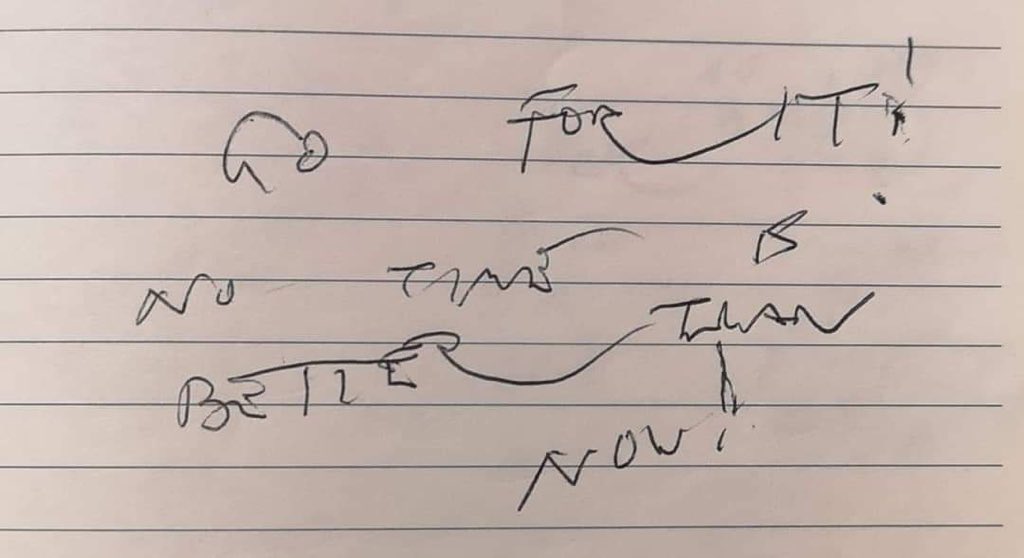
I saw this first on LinkedIn—that Instagram for personal promotion in a sea of vanity and hubris of all flavours—and had been sourced from Twitter, a more free-form universe.

Image

As the narrative went, this was written by a Parkinson’s-afflicted father to his daughter. There are many ways to interpret this. Ostensibly, it’s in line with Nike’s Just Do It tagline of a few decades back or perhaps Joseph Campbell’s advice to follow your bliss, but what is it?

To me, the it involves socially sanctioned activities, whether in commerce or the arts. If the it is robbing banks or shooting fentanyl, perhaps the drive should rather be suppressed. So the do it or go for it operates within boundaries. Nothing new here.

Then there’s the ‘no time is better than now’—exclamation—bit. Why privilege now? Why wouldn’t it have been a better yesterday or last week or tomorrow?

I love quotes—or they pique my interest—if they interest me. But vapid platitudes annoy me to no end. They are beyond being trite. I suppose I can forgive the person who finds solace in this note, but these almost always preach to the choir. They resonate with the daughter—first on an emotional level owing to the familial connection and next to a connection in worldview. I don’t need to point out the connection between worldview and upbringing. Let’s pretend there is no covariance.

Meantime, whatever you’re doing go for it. Just do it. Or not. Take the path on the left. Or the right. Or just sit and meditate. Or turnaround and try something else. But whatever you do, just do it. There’s no better time than now.

Note to Self #2

Hopefully, I get past these self-notes, but for now, I’m busy…

I don’t know if this is a good thing or not, but as I was structuring my thoughts critical to democracy, I discovered (recovered?) a structure I created several years ago. The structure was centred on the premise that democracy is a specious concept that retains life through the illusion of control. My latest concept is that people are just too dumb for democracy—not that it would matter if they weren’t.

I still question why I expend the effort. Who wants to read a piece whose premise is that the reader is likely too stupid to merit participating in a democratic process? Even worse, who wants to read a piece that claims the weakest link in any political process is people. I’m a sad panda.

On the upside, there’s some content crossover. And now I need to settle on a new centre. Please stand by.

Note to Self #1

Humans are much less rational than commonly assumed and the presumed ability to reason is either hubris or wishful thinking. Dan Ariely has brought attention to being predictably irrational, but that’s just the tip of the iceberg. Basing societies and legal systems on the premise of rational actors is a massive structural error.

— Bry Willis

I’ve got too much distraction to make progress on this, but I’ll save thoughts now and again so I don’t lose them…unless it’s deliberate.