The English language employs a lot of otherwise unnecessary filler words. Particularly words relating to orientation.
“I fell down.”
“I’m driving up to New York.”
In the case of ‘fall down’, there are some cases where as a phrasal verb it might add clarity. One might use ‘He fell down‘ versus ‘She fell over‘. There is some nuance of meaning to be rendered here. But if one says, ‘She fell down the stairs’, few people are will interpret that as ‘She fell over the stairs’, so the inclusion is superfluous. One might also qualify that, ‘The monkey fell off the bicycle’.
Another clarification might involve the object relationship. For example, ‘I fell the tree’ is different to ‘I fell over the tree’ or ‘I fell off the tree’, which might be taken as analogous to ‘I fell down the tree’ or ‘I fell out of the tree’. ‘I fell the tree’ communicates that you chopped the tree down; ‘I fell over the tree’, might communicate that you tripped over the tree. I’m not sure many would say ‘I fell off the tree’. ‘I fell off the branch’ might be more apt. I feel that it would be more common for a native adult English speaker to say, ‘I fell out of the tree’ over ‘I fell down the tree’, which might be something a child would say. Of course, if the object of the tree were known, as in the following dialogue, the orientation might be foregone.
Having dropped from a tree, Abdul asks Paco what happened.
‘I fell.’
Of course, the falling may also be obvious and the question revolves around the cause. Perhaps, it’s just a step into the so-called ‘five whys‘.
Why did you fall? Because I lost my grip.
Why did you lose your grip? Because I was distracted.
Why were you distracted?
And so on. But this is a horse of a different colour.
So what about New York? Why do we tend to add orientation to these types of directions? If I live south of New York, it feels that I am adding something, but is there another New York I could drive down to? If not, what is the up conveying? Also, I’ve heard people refer to up in a reference that would not correspond to up in a map, say, to be travelling to New York from Toronto. Again, just saying, ‘I’m going to New York’ would suffice.
Another odd construct is to wake up, which is to say to awaken. ‘When did you wake?’ or ‘When did you awaken?’ ask the same question as ‘When did you wake up?’ I could even ask ‘Did I wake you?’ or ‘Did I wake you up?’ What is the purpose of up? One can’t actually awaken in another orientation. You can’t wake down or wake over or even wake off, so what’s with the up inclusion?
This works for stand, too, but at least there is a distinct meaning between ‘stand up‘, ‘stand down‘, and ‘stand off‘, though contextually it would be unlikely to confuse the three. If one said, ‘stand’, the meaning should be interpreted the same as ‘stand up‘. ‘Stand down‘ means to relax or withdraw, and ‘stand off‘ is a deadlock, but this is idiomatic language.
I had more examples in mind, but between the original idea and the time I got to the keyboard some hours had elapsed. If you speak a language other than English, does that language have similar filler words?
In French, if I say ‘j’ai tombé‘, it means ‘I fell’, but if I say ‘je suis tombé‘, it is akin to saying ‘I fell down‘ or ‘I fell off‘ without the explicit orientation.
Chapter eleven is the first of three chapters discussing truth from the perspective of science. These chapters are followed by truth as seen from other perspectives, namely, reason and intuition.
Check out the table of contents for this series of summaries. I continue to render interstitial commentaries in grey boxes with red text, so the reader can skip over and just focus on the chapter summary.
The author posits that in the West, most of us trust science to deliver the truth of the matter, as “science alone holds out the promise of stable knowledge on which we can rely to build our picture of the world“. He admits that it does have value, but it has inherent limitations and yet draws us in like moths to a flame. Here, he distinguishes between the discipline and practice of science and Scientism as it is practised by laypeople. Science understands its place and domain boundaries. Scientism is omnipotent with delusions of grandeur that will never be realised.
Some philosophically naïve individuals become very exercised if they sense that the status of science as sole purveyor of truth is challenged
— Iain McGilchrist, The Matter with Things, chapter 10
Politicians who promote science as a bully pulpit prey on the public in a manner similar to bludgeoning them with religious notions.
Science is heavily dependent on the exercise of what the left hemisphere offers.
ibid.
The point the book makes is that like the turtles that go all the way down, science doesn’t have a grasp on what’s beyond the last turtle. Like trying to answer the toddler who can ask an infinite number of ‘why‘ questions, the scientist gets to a point of replying ‘that’s just the way things are’, or the equivalent of ‘it’s bedtime’.
Scientific models are simply extended metaphors. A challenge arises when a model seems to be a good fit and we forget about alternative possibilities getting locked into Maslow’s law of the instrument problem, where ‘to a man with a hammer, everything begins to look like a nail’. Moreover, the left hemisphere is fixated on instrumentation, so it’s always trying to presume a purpose behind everything. Nothing can just be.
This is likely where Scientism begins to trump science.
He quotes:
Dogmatism inevitably obscures the nature of truth.
— Alfred Whitehead
McGilchrist points out that a goal or promise of science is to be objective and take the subject out of the picture. Unfortunately, this is not possible as the necessity for metaphor ensures we cannot be extricated. Objectivity is legerdemain. We create a scenario and claim it to be objective, but there is always some subject even if unstated. He goes into length illuminating with historical characters.
The sciences do not try to explain, they hardly even try to interpret, they mainly make models … The justification of such a mathematical construct is solely and precisely that it is expected to work.
— John von Neumann
In fact, science itself is predicated on assumptions that have not and can not be validated through science.
In conclusion, McGilchrists wants to emphasise ‘that just because what we rightly take to be scientific truths are not ‘objective’ in the sense that nothing human, contingent and fallible enters into them, this does not mean they have no legitimate claim to be called true.’ ‘The scientific process cannot be free from assumptions, or values.’
Following this chapter are several pages containing dozens of plates of images.
George Harrison asked What Is Life? in a song, but he had a spiritual bent. The question is actually even more fundamental. Science has no settled meaning of what life is. Some posit that a virus is not life, and there is a multicellular organism discovered here on earth that requires no oxygen to survive. So when we are looking for signs of life on other planets, what is it that we are looking for exactly?
I spend a lot of time calling out weasel words, but we can’t even reliably define something we fundamentally are, which is alive. What is life? Forget about truth, justice, love, and freedom. These are abstract concepts, but not life. We live. We see life—experience life. We are a subset of it, but how do we know we’ve accounted for the full domain? Could something non-living be intelligent?—have intelligence?
It’s late and I am heading into a new year, AD 2023 BCE. And I was just thinking. If I am to believe Descartes, at least I’m alive parce que je donc, but I’ve got no answers in this realm.
In this first chapter of the second section of The Matter with Things, Iain McGilchrist asks, What is Truth? Section two has a different focus than the first, which was focused on foundation building. From here on in, he wants to build on this foundation.
Check out the table of contents for this series of summaries. Note that I have rendered my interstitial commentaries in grey boxes with red text, so the reader can skip over and just focus on the chapter summary.
At first, he establishes that each hemisphere ‘thinks’ it knows the true truth and has the best vantage on reality. He makes it clear that a short chapter will not do the topic of truth the justice he feels it deserves and notes that others have written books on the matter. He just wants to make a few points and clarify his position.
As we discovered in the first section, the left and right hemispheres perceive the world differently. The right hemisphere experiences the world as it is presented in a Gestalt manner. This is contrasted by the left hemisphere which views the world as a symbolic re-presentation. It’s not unfair to say that the right hemisphere experiences the world directly whilst the left hemisphere views a cache of the world.
In this chapter, McGilchrist (Iain) attempts to convince the reader that one side is more correct or correct more often than the other and so is more veridical. As he says, the left hemisphere ‘is a good servant but a poor master’. Of course, if we had a third hemisphere [sic], we might think it could mediate the other two, but then we’d need a fourth and a fifth, ad infinitum to act as the new arbiter.
Spoiler Alert: The right hemisphere wins the battle on truth pretty much hands down.
He wants to make it clear to the reader that he is no strict idealist. There is a reality ‘out there’ apart from mental processes that objectively exists even in the absence of a subject. Reality is not exclusively a projection of the brain.
His choice rather relies on the correspondence theory of truth, which is to say that the hemisphere that conveys perceptions more correspondent to our perceived reality would be more veridical.
Here, I challenge his reasoning on two accounts. In the first place,each hemisphere may operate better in one context versus another. In the second case, there may be a consequential factor, which again distils down to context. In risk management, there are notions of probability of failure and consequence of failure. For example, a failure to recognise the truth of a matter (we’ll use truth as a proxy for ‘fact’), may be inconsequential. If I am assessing the probability of a pipe bursting in a nuclear facility and the pipe is connected to a sink to deliver tap water, the consequence of this failure is practically insignificant. But if I am assessing the probability of a pipe containing radioactive materials, even if the probability of failure is low, the consequence of failure may be catastrophic.
Evolutionarily speaking, if you mistake a garden hose for a venomous snake, the consequence of failure is trivial. Turn the tables, and mistake a snake for a garden hose, the consequence may be fatal. I am not attempting to claim that one hemisphere interprets the low consequence scenario and the other interprets the high. I simply want to raise this nuance.
He makes the point that if we compare some known authentic object to a recollection, we want to retain the one that is more accurate.
I see a similar challenge. Hypothetically, let’s say I present a red disc and manipulate the hemispheres to activate only one at a time, asking to recall the object. If the left says it’s red and the right says it’s a disc, which is more correct? Again, I am not claiming that this is a real scenario, but if one side possesses facts unavailable to the other side, we’ve got a problem in making a truth claim.
To reiterate, the left hemisphere is more analogous to a photograph or a video account whereas the right hemisphere is to be in the place that is being photographed. The right hemisphere is duratively presenced whilst the left is re-presented. We move from a nominative form to a verbial form of representing reality. This leads him to ask if ‘truth’ is a thing or a process.
He shifts to a linguistic argument. When people view ‘truth’ as a noun, as a thing, the expectation is that it is static. Moreover, the descriptors of truth are rendered mainly in the past tense—representation, fact, perfect, precise, certain, and concluded. He provides definitions. When viewed duratively, ‘truth’ becomes a process. It is an active relationship. It flows. It’s an intercourse.
We may not ever get to an agreed truth, but neither is every position valid. Interpreting a text, for example, may have several conflicting meanings, but the possible meanings are relatively finite.
Take a simple sentence such as, “The dog bit the hand that feeds him.” This could be meant literally or figuratively. We might imagine different dogs, hands and person to whom the hand is attached. Perhaps the hand is attached to a bonobo. Perhaps, it’s a robotic hand. These are among various possible interpretations, and we may not ever agree on the truth of the matter. However, we can rule out that a giraffe or a watermelon were central to this narrative for what it’s worth.
The bookgoes on to discuss the etymology of the word ‘truth’ and of its relationship to the word ‘true’ (faithful) which is further related to ‘trust’. I won’t exhaust his explanation.
He does discuss correspondence and coherence theories of truth and discounts others such as consensus theory and social constructivism. He cautions not to equate truth with correctness. This is a left hemisphere game insisting on dichotomising things.
The book declares the despite a general agreement on the source or nature of truth, there is something there, so don’t give up un it. In the end, he seems to settle for a Pragmatistic version à la William James.
Personally, I feel he and others are over-invested in the nature of truth. And inflate its meaning over ‘fact’. To me, Capital-T Truth is an archetype, but it doesn’t otherwise exist. We have facts, and truth is sort of a perfect version of a fact. Love is in the same category, though I know Iain would disagree with this assertion. Of course, James dismissed semantic argument as petty and insisted that people simply know the truth of something. I’ve always found this take to be dismissive. I also feel that Pragmatism is too steeped in Empiricism and loses hold of the notion that what happened yesterday may not in fact manifest today or not in the same way.
I’ll also argue as others have before me that (besides being archetypal) the term is a redundant filler word. On a minuscule level, if I say ‘The cup is red’, saying ,’It’s true that the cup is red adds nothing’. The equation was already asserted. This leaves one to wonder what the purpose of it is.
Returnng to the asymmetry of the hemispheres he cautions up not to take a position that one of the other side is correct. Rather, even though there is an asymmetry in value, there is still a synthesis.
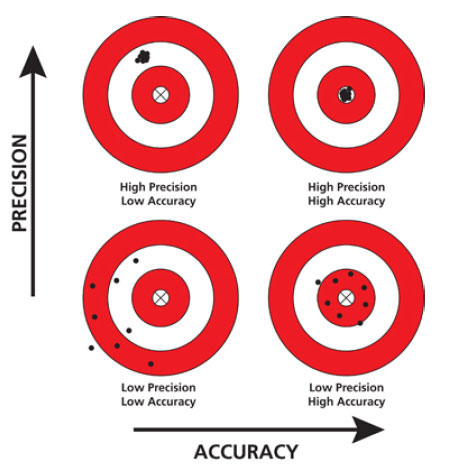
Iain uses the example of Newtonian and Einsteinian physics. At one point, they are practically synonymous and interchangeable. Only as we reach the speed of light does Newtonian physic exceed the bounds of its scope. He also educated the reader on the difference between precision and accuracy.
I like to view this in a musical context. If I play two notes together, say a B over an E, neither is more correct than the other. Notionally, I am playing an E5/B. This is neither an E or a B. The chord is the result of the two playing simultaneously. In this case E and B are both true and not true because the E5 is a synthesis. If I add a G# I get an E-major chord, subsequently adding a D renders an E7. In each of these cases, the truth of the notes, B, D, E, and G# remain true to their identity, but the fact is that the individuality is subsumed by the collective. This is the prevailing truth even though a person with perfect pitch can still individually identify the constituents of the chord. I don’t know if this is more confusion than necessary, but it helps me.
I’ve always like this illustration with target grouping, but this was not referenced by the book.
Image: Precision and Accuracy Chart
Interestingly, he cites Jay Zwicky’s definition: “Truth is the asymptotic limit of sensitive attempts to be responsible to our actual experience of the world … ‘sensitive attempts to be responsible’ means truth is the result of attention. (As opposed to inspection.) Of looking informed by love. Of really looking.” He accedes that there are degrees of truth.
Truth is the asymptotic limit of sensitive attempts to be responsible to our actual experience of the world
As the chapter comes to a close, he leaves us with a twisted categorical syllogism,
[p1] All monkeys climb trees
[p2] The porcupine in a monkey
[ c ] The porcupine climes trees
This structure presents a valid argument. However, it is not sound. It follows the Socratic logical syntax:
[p1] M a P
[p2] S a M
[ c [ S a P
Because of our exposure to and experience with the external world, we can assess this argument to be unsound, which is to say untrue by observation. Without this context, we could not render this assessment. He discusses the way right- and left-hemisphere occluded subjects respond to this discrepancy. In summary, an isolated left hemisphere with defend the logical syntax over the lived experience.
In conclusion, the hemispheres take different paths to assess truth and often end up at different destinations. The left hemisphere sees truth as a thing whilst the right views it as a process.
Children are ethically indisposed to think it’s wrong to eat animals. This article from the Journal of Environmental Psychology published a year ago looks into the schism and cognitive dissonance assuaging mechanisms in play.
This study relied on a small sample size (n=176), between the ages of 4 and 7 years living in a metropolitan area located in the southeastern region of the United States. The sample was otherwise diverse.
As this study was limited in geographic scope (see WIERD on a tangential note), it noted that eating habits vary by culture. For example, eating horse (or dog) meat is not condoned in the United States, but it is acceptable in many other places.
In summary, the childer were shown cards each with a picture of an item, whether a French fry, a horse, a cat, a fish, a tomato, and so on. At the start, they were asked to identify the item represented on the card. Next, they were asked to put the card into one of two bins, each decorated to approximate an animal or vegetation. Finally, they were asked to sort the cards into two areas, one represented by false teeth indicating edible products and a rubbish bin representing inedible items.
The subjects did a fair job of identifying the card items. They had very high image recognition of these particular animals. On the lower end of recognition were hamburger (ground beef patty), almonds, and shrimp. There was a difference between the older children and the younger children, but this may relate to the added acculturation their age would bring.
Without delving deeply into details, in this study, most 6- and 7-year-olds classified chicken, cows, and pigs as not OK to eat. The interesting cognitive trick is that these children also classified these derivative food items as non-animals thus removing the cognitive dissonance. No longer classified as an animal, their ethical framework remained internally coherent.
In discussing the results, many children were ill-informed about the source of various food products. Language games obscured the source. No one should eat a cow, but beef is fine—a hamburger is fine. Hot dogs grow on trees, don’t they?
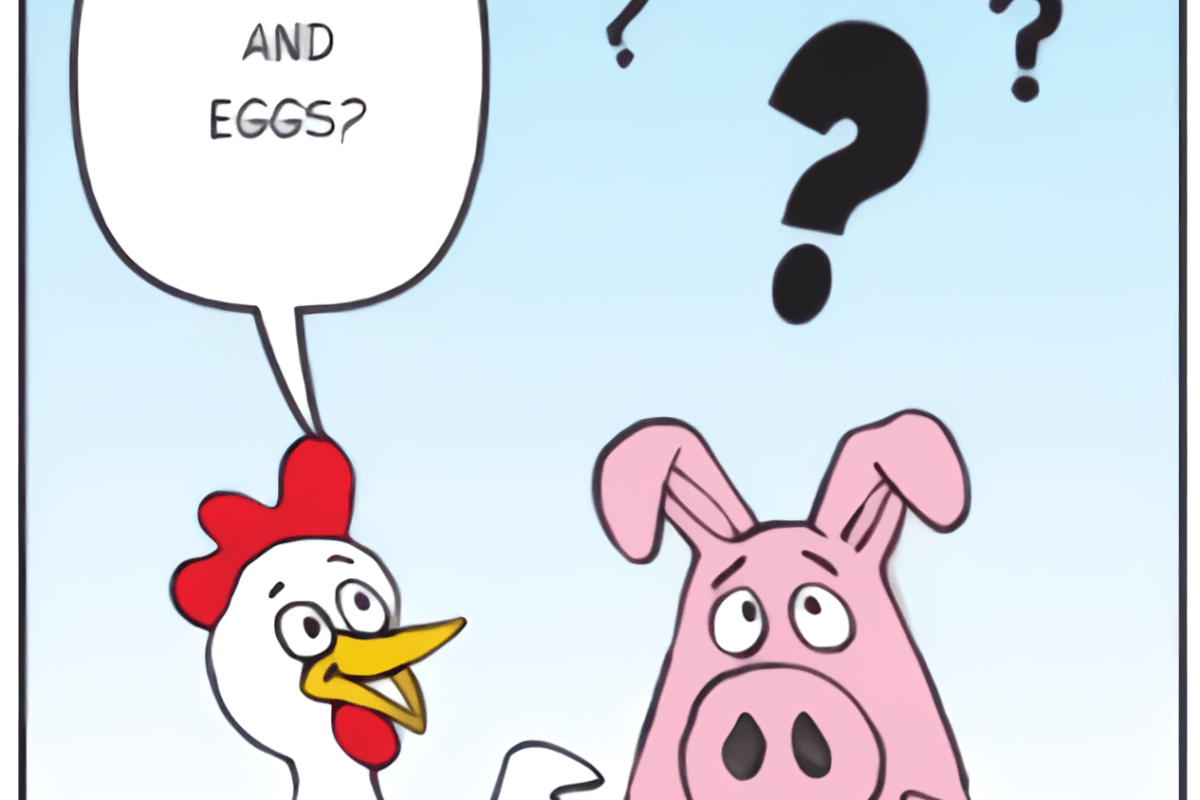
This reminds me of the story wherein a chicken and a pig are conversing, and the chicken suggests that it and the pig go into the restaurant business. The pig considers the proposition and declines by the rationale that it would be committed but the chicken would only be involved. Children may believe that hot dogs are a by-product like eggs, fur, or feathers—don’t get me started on the down used in pillows, jackets, and comforters—rather than grasping that the animals yield these products at the expense of their lives.
Some people grow up and realise the inconsistency of their ethics and actions, but they find any number of ways to reconcile their actions, noting that the activity is normal and natural.
FULL: DISCLOSURE: For the record, I eat chicken, turkey (on festive holidays in lieu of chicken), and I eat beef (that’s cows, for the uninformed). I also consume some animal byproducts, i.e., chicken eggs and cheese. I also wear leather. I was a vegetarian for about three years until I opted to become a chickenatarian. My life partners goaded me into eating beef, and so I’ve since added that. In all cases, I feel bad for eating defenceless, sentient beings. I’m not sure it serves as any consolation that I limit my consumption to these three animals—or even if it were only one. For the record, I don’t particularly like the taste of turkey or beef, but it’s not offensive like pork, coffee, or alcohol. Chicken, I like. Sorry chickens.
Video: Homer Simpson’s (not so) ethical dilemma
For the record, this is post number 500 on Philosophics. Perhaps I should write a post about it.
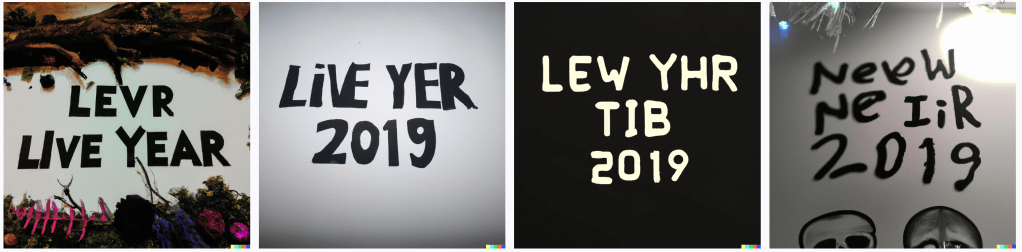
I was writing a post for another forum to acknowledge the changeover of the years, and I decided to lean on Dall-E to assist with some image rendering. It appears that Dall-E’s concept of New Year is 2019—BC, before Covid.
IMAGE: 4 Dall-E Renders
Honestly, I am not sure what to say.
Levr Live year? Wot?
Live Yer 2019? Huh?
Lew Yhr Tib 2019? I’d like to buy a vowel.
Neew Ne IiR 2019? Hmmm… 🤔
I think we know when their training data ended. There is no future past 2019. Little did they suspect.
Know thyself
Oracle at Delphi Inscription
As this was just a reactionary post, I don’t have much to add. To paraphrase the Delphic ‘Know thyself’ inscription, know thy data.
jimoeba mentioned that he enjoyed an interview with Vervake and Fridman in a comment, so I thought I’d give it a listen. It turns out there are several including a 3-plus-hour version. Arbitrarily, I chose this one. Even if it’s not the particular interview on the meaning crisis, it gives me a sense of the two and their dynamics. I’m glad I listened to it. I like Vervaeke. I can’t say I’m much of a Fridman fan on first listen.
John Vervaeke and Lex Fridman interview: Human civilisation is facing a meaning crisis
This interview content provides an orientation of where Vervaeke is coming from. It helps to clarify his position. His claim seems to be that many people today identify as having no religion but being spiritual. By extension, he posits that this cohort is searching for meaning. I can’t disagree. What it tells me is that I am not in his target demographic. I have no religion, as I am an atheist. I have no spiritual void to fill. This is Vervaeke’s goal—to find something to perform the function of the religion without the, perhaps, baggage and dogma.
I sympathise with his goal. He brings up Nietzsche’s “God is dead” quote, famous or infamous depending on your worldview. Essentially, he wants to answer Nietzsche’s query of what to do now that it’s been revealed that humans created God, not the other way around. His aim is to replace the font of wisdom for this generation.
For me, wisdom is a heuristic, part of the Gestalt McGilchrist mentions. McGilchrist’s work is even referenced here. Of course, I interpret McGilchrist’s references in this space to be metaphorical. It seems that he views it as ‘real’. I’m not sure where Vervaeke places it. Somehow, I feel that if there is a spectrum, Vervaeke leans closer to McGilchrist than me, and that’s OK. They just happen to be wrong.
I still don’t get the need for meaning. I don’t feel despondent that there is no inherent meaning in anything, but we are free to invite or adopt one or many. I remember a Christian mate of mine who explained that people have a God-sized hole that can only be filled by God. Essentially, Vervaeke is making a similar claim, but his void is filled by wisdom. I suppose that I don’t feel I have a void doesn’t mean there isn’t one.
I’m not a fan of psychology as a discipline, so this WEIRD phenomenon comes as no surprise. In fact, it’s not even that new. If memory serves, I think I first stumbled upon the notion from Jonathan Haidt.
WEIRD—Western, Educated, Industrialised, Rich, and Democratic.
WEIRD is the bias underpinning most university psychology studies—the ones that make the best memes and we tend to recite. The problem is that a vast majority of psych subjects are WEIRD—Western, Educated, Industrialised, Rich, and Democratic. There is a marked selection bias, so the composition tends to be gullible first-year psych students. As even a neophyte in statistical methods will tell you that random samples are a key ingredient of a decent social study, and a broad demographic base is another.
But, “So what?”, you say. The problem is that these students are not only not a good representational cross-section, they’re actually outliers, which is to say statistically nothing like the average world citizen. So whilst these studies do reveal certain psychological propensities, they are of this subgroup.
Common sense is not so common
— Voltaire
By extension, this means, as per Voltaire’s quip about common sense, if you have been taught that a person behaves like this, you should immediately flip that on its head and presume that the ordination non-WEIRDo would behave contrariwise.
The bigger problem is that the US having only five per cent of the global population has the tendency to be jingoistic and wants to impose its worldview on the rest, but it often if not almost always doesn’t realise that the world is not like them and doesn’t necessarily want to be like them. Moreover, Americans tend to believe they are better and better off than the rest of the world. of course, through their own lens, perhaps they are, but this is a minority lens with a minority view. People in the US don’t tend to get out much, and when they do it’s as tourists like visiting a zoo rather than trying to acculturate, so most world travelling doesn’t realise the opportunity it otherwise might have.
Deconstructing WIERD, the Western portion is beyond obvious. This would remain a factor even if studies weren’t restricted to undergrads. Educated is a bit of an odd one. Who knows how many student progress beyond their first year? But they are industrialised. I’d argue perhaps postindustralised. Rich is an interesting notion I’ll come back to in a moment, and their democracy is in name only, though I know where they are coming from.
Returning to Rich, the mean income of a family in the US in 2021 was $97,962. The median was $69,717. Statistically, what this indicates is that there are a few high wage-earners skewing the figure from the median. This phenomenon is known all too well. Somehow, I feel this has a sort of halo or affiliation effect, similar to the feeling a city has when its sports team wins a championship. Even the poor people feel they are part of the prosperity that by and large spits on them and holds them down. These people are indoctrinated with this WEIRD pseudoscience.
I don’t have much more to say. I’ve been distracted and have been writing this since yesterday. Weird, that.
Ever since encountering Viktor Frankl’s Man’s Search for Meaning in my youth, I’ve pondered why people search for and indeed invent meaning. By meaning, I am speaking in terms of finding a higher purpose or some spiritual affinity rather than the meaning of why bad things happen, though there are undoubtedly some intersections of the concepts.
This lecture, Ep. 39 – Awakening from the Meaning Crisis – The Religion of No Religion, from a series by John Vervaeke was recommended to an associate in my social network by another trusted associate, and it’s got me going. I’ve long been a nihilist and existentialist. I am even partial to aspects of the philosophic framework of Zen Buddhism. But I’ve never felt there was some higher meaning or raison d’être that isn’t self-imposed. How else would it be imposed? A person may be indoctrinated, but in the end, ignorance is no excuse from self-imposition.
I guess I can’t quite understand what drives this search for meaning. As Vervaeke notes, even some noted atheists like Richard Dawkins have suggested that we should find a secular proxy for the religion—or the namesake religion of no religion. I understand the social function of religion as well as some psychological functions, but the disconnect for me is that I have no such drive. I am admittedly an introvert, so whilst I admit the need for social cohesion and coöperation, I don’t understand the fabrication of religions or the personal, not only belief in meaning, but a yearning for it and even a belief that one has found it.
some people don’t search for meaning so much as they feel they have discovered meaning, but when their discovered meaning doesn’t jibe with another’s discovered meaning, the result is a search to justify or reconcile this conflict
I am empathetic to people like Iain McGilchrist who asserts that there is exogenous meaning out there to be had. He’d probably also assert that asking for proof is a left-hemisphere cerebral request but that absent the imposition by the left hemisphere, one would just feel it and know it. I just can’t abide.
Vervaeke does touch on the postmodern critique of religion as a power play, which is how I feel about it, but this is about the social aspect and doesn’t touch on the personal search for meaning. What I can’t say is whether a person would have this drive to search for meaning if they were either absent socialisation or exposed only to people who are not going to suggest meaning. I understand that previous generations have shown this propensity, but are there cultures that don’t? And is there a common thread to those who do?
In the past, many cultures have asserted gods and higher powers (whether or not as a power play), but could this simply prompt the people to search for alternative meanings, perhaps having noticed the dissonance between certain dogma and their lived lives?
Interestingly, some people don’t search for meaning so much as they feel they have discovered meaning, but when their discovered meaning doesn’t jibe with another’s discovered meaning, the result is a search to justify or reconcile this conflict.
It’s late. Time to retire for the evening. I have none of these answers, but I will jot the questions down on my to-do list just above the search for meaning.
I’ve been a longstanding fan of science. I’ve never been a fan of Scientism™, which is the dogmatic belief that science is the gate to all knowledge and that the discipline is incorruptible. I’ve even complained in the past about the self-correcting aspect that has sometimes taken centuries and millennia.
In the case of the article that spawned this post, peer review has always felt a bit specious to me. Just getting picked to get into the review queue is political at the start, and few people are actually equipped to perform the review with any material degree of diligence.
Science being peer-reviewed was like a knee-jerk credibility play. Of course, this also reeked of the police department or CIA reviewing their own misdeeds. On the other hand, who else is going to review it? The problem is there is no downside for the shoddy reviewer. There might be three referees who review your work and provide commentary—and so what if they miss some things?
As shoddy as soft sciences are, even hard sciences had reproducibility challenges—and that’s if the domain is reproducible. Models about climate change are not exactly suitable for laboratory reproduction.
Science is getting less and less credible these days. Besides being coopted by moneyed interests, you’ve got the politicos subverting it for their own purposes. Of course, the mismanagement and propagandising of the Covid debacle is still a fresh wound. And as we watch many of the conspiracy claims being shown to be correct and the official message shown to be wrong and intentionally disinformative, it’s hard not to become a jaded cynic. What’s a sceptic to do?








 Philosophics