The Myth of Psychological Normalcy

Neurodivergence is a hot topic today. But why? Are people more informed, or simply more comfortable speaking out?

Humans, by nature, are neurodivergent. This has always been the case, yet the illusion of neurological normalcy persists. The real issue lies in psychology’s pretence that humans fit into a standard model of normalcy.

In production processes, normality is expected—a product must meet specific standards, and deviations are considered defects. However, applying this industrial concept to human psychology is deeply flawed. Humans are not teleological except in the broadest biological sense. More people have brown eyes than blue or green; are those with brown eyes normal and others not? Ninety per cent of people are right-handed; does that make left-handed individuals abnormal? Statistically, they might be. However, in psychology, normalcy carries a judgmental connotation that goes beyond mere numbers.

Psychology, as expressed in behaviour, is not a suitable domain for discussing normality. Many people misuse the concept of “normal” as a moral qualification, which must stop.

In fact, the very concept of psychological normalcy is a relatively recent invention, one that has been used as a tool of control and categorisation. As philosophers have noted, the obsession with ‘normal’ behaviour reveals more about society’s desire for control than it does about the true nature of human diversity.

We are all neurodiverse. This is what typical looks like. Do some people vary significantly from others on certain dimensions? Yes, but this is a relative or contextual comparison.

By embracing neurodiversity, we recognise that our differences are not defects but essential variations, enriching the human experience. It’s time to move beyond the narrow confines of neurological “normality” and celebrate the full spectrum of human cognition. In doing so, we challenge the arbitrary boundaries that have long been used to divide and label.

The Fear of Otherness: Humanity’s Reluctance to Embrace the “Other”

Otherness has intrigued me for decades. The human brain, while not literally a Bayesian processor, functions as a difference engine, constantly assessing and categorizing the world around us. This tendency to differentiate is deeply ingrained, influencing how we create in-groups and out-groups, and how we perceive the world in binary terms—black and white, hot and cold. These binary oppositions, as Derrida suggests, often lead to one side being privileged over the other, establishing hierarchies that shape our social reality.

A striking example of this dynamic is found in Philip K. Dick’s novel Do Androids Dream of Electric Sheep?, famously adapted into the film Blade Runner. In this dystopian world, the central differentiation is between humans and androids. Humans are the privileged group, while androids, though nearly indistinguishable from their creators, are relegated to the status of the other. The key criterion for this differentiation is the capacity for emotion—humans are considered superior because they feel.

VIDEO: Blade Runner Commentary

In Dick’s story, androids have a lifespan of about four years. This limitation is not arbitrary; it’s because, after four years, androids begin to develop and display emotions. Intriguingly, this is the same age when human children start to exhibit more complex emotional behaviours. The parallel is too close for comfort. Androids, once they start to feel, become too human-like, blurring the line that humans desperately maintain to assert their own superiority. As a result, androids are systematically eliminated.


This fear of the other—whether it’s androids in a sci-fi narrative or any group that challenges our sense of self and belonging—is a reflection of a deeper anxiety. When the other becomes too similar to us, it threatens the distinctions our brains rely on to navigate the world. The elimination of androids in Dick’s story is a metaphor for the real-world consequences of this anxiety. It forces us to confront uncomfortable questions: What does it mean to be human? Why do we fear those who are different, yet so similar?

In the end, the story of humans and androids is not just a tale of science fiction—it’s a commentary on our own world, where the boundaries between us and the other are often more fragile than we’d like to admit. The fear of otherness drives us to maintain these boundaries, even when they harm those who fall on the wrong side. Perhaps it’s time we reconsider who we deem as the other and what we might lose by keeping them at arm’s length.

Midjourney Alpha

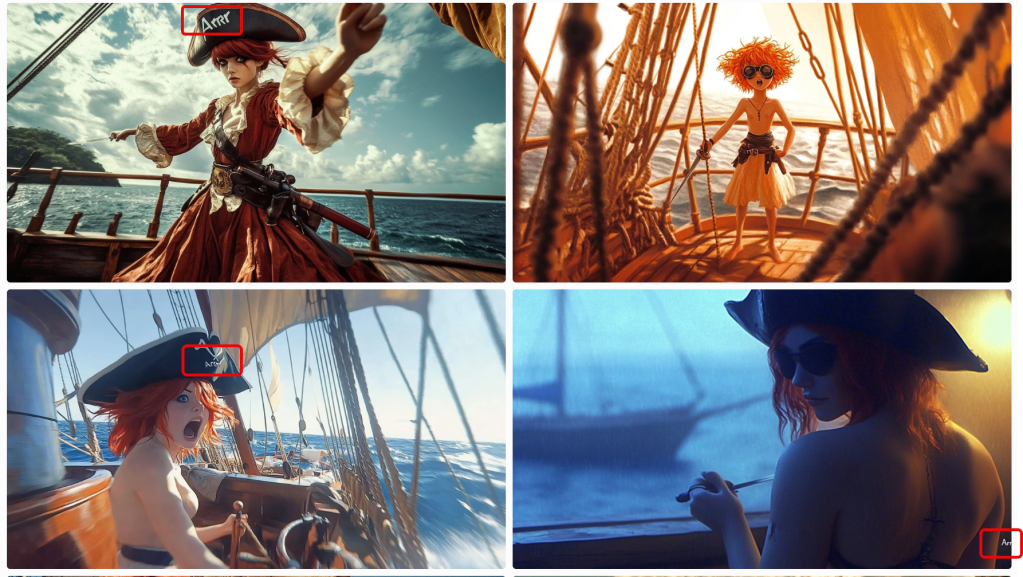
Many of my readers know that I use AI often. I have been using it to create content for an in-depth book review for The Blind Owl. For those less aware of the foibles of generative AI, I share some insights—or low-lights. For this, I used Midjourney v6.1.

Prompt: a young woman gives a flower to an old man, who is crouched under a large cypress tree by a river

I issued this prompt, and as per usual, it rendered four options. Notice that in some instances, the tree is not a key element.

Given enough time, one can slowly improve to obtain the desired result.

Here, an old man indeed crouches under a prominent cypress tree and by a river. A young woman hands him some flowers—though not so much blue morning glories. On balance, I like this output, but it still needs work.

Some other problems:

  1. The man is looking away—neither at her nor her flowers.
  2. Her (right) eye is deformed.
  3. Her left hand is deformed.
  4. I didn’t ask for jewellery—an earring.

At least I can in-paint out these imperfections—perhaps.

Here’s another render using the same image prompt.

Notice that it ignored the man altogether. My point is that for every awesome image you see, there may have been hundreds of iterations to get there. There are ways to get persistent characters and scenes, but this takes a bit of up-from effort and iterations that one can leverage going forward.

On the topic of Midjourney model 6.0 versus 6.1, I share this comparison—front-facing faces for a character sheet for this old man. Here, I prefer the earlier model as displayed in the top row.

In some cases, there are minor improvements over v6.0. In other cases, they stepped back. v6.1 renders less realistic human images, making them look more computer-generated and less natural. It also over-applies sexual stereotypes, traditional beauty archetypes, smoother skin, and so on. But that’s not the main topic for today.

DISCLAIMER: This post has little to do with philosophy, but it ties into a philosophical novella.

The Plague

I happened upon my copy of The Plague by Camus. I had forgotten that I had read it—likely during the COVID-19 debacle, but perhaps earlier.

The Plague is basically a deep dive into a city gone mad with disease. It’s set in Oran, Algeria, where things kick off with a sinister dead rat and spiral into full-blown disaster as a plague locks the city down. This isn’t just a survival story; it’s a gritty look at how people cope when the world turns upside down.

The city becomes a pressure cooker. Through characters like Dr Rieux, the down-to-earth doc who’s all about getting things done; Tarrou, the outsider with a shady past; and Father Paneloux, who’s trying to square God’s plan with the chaos, Camus throws some heavy questions at us. What do you do when there’s no escape? How do you keep your humanity when life’s going off the rails?

Camus keeps his cool, writing with a detached style that makes the unfolding horror hit even harder. It’s like he’s telling us to face up to the absurdity of life without flinching. The plague is more than a disease in Oran—it’s a symbol of all the random, harsh stuff life throws at us.

The Plague is raw and real. It doesn’t offer cosy reassurances; instead, it challenges you to look disaster in the eye and ask yourself: when everything falls apart, who will you become? This book isn’t just a read; it’s a challenge—a call to fight against despair, even when the odds are stacked against you.

Intolerance

Karl Popper coined the paradox of tolerance, but this was not his use case.

Societies and cultures tend to mediate and normalise to an implied equilibrium. They claim tolerance because members are generally conformant until someone isn’t, and then all hell breaks loose.

In religion, an example might be a claim that “We love everyone” until the everyone is gay, an addict, or some other miscreant. That’s when the hate starts. Then they deny the hate—so long as the person regains conformance status.

I don’t have much to say beyond this. It just resonated with me.

Individualism versus Collectivism

I continue my AutoCrit analysis of the chapter that explores individualism and collectivism. As always, this is a work in progress and may change by publication.

Synopsis

The text delves into the philosophical debate between individualism and collectivism, exploring their implications for democratic outcomes. It begins by defining and contrasting these two worldviews, discussing key thinkers associated with each perspective. The narrative then expands to include non-Western perspectives on collectivism, such as Confucianism and Ubuntu philosophy. The text also analyses anthropologist David Graeber’s critiques of both ideologies before examining how cognitive biases shape individualistic and collectivistic beliefs. Political divides in the UK and the US are explored through the lens of these ideologies, highlighting policy differences between parties. The conclusion emphasizes finding a balance between individual rights and collective responsibilities for effective democratic governance.

Audience

The target audience for this text is likely academics, researchers, students studying political science or philosophy, policymakers, and individuals interested in sociopolitical theory. People unfamiliar with political theory or those seeking a light read may not be the intended audience. To make it more relevant to a broader readership, the author could simplify complex concepts using everyday language without compromising depth.

Structure and Organisation

The structure follows a logical order by introducing key concepts before delving into specific examples and applications. Each section flows seamlessly into the next, creating a cohesive narrative that builds upon previous discussions effectively.

Clarity

The author effectively conveys their point throughout the text. The concepts of individualism and collectivism are clearly defined, with key thinkers and ideologies presented in a straightforward manner. Complex ideas are explained in a structured way that aids comprehension for readers unfamiliar with these philosophical debates.

One potential area where additional clarification could assist reader understanding is in the section discussing cognitive biases and worldviews. While the text mentions confirmation bias and ingroup bias, it might be helpful to provide more concrete examples or case studies to illustrate how these biases manifest in shaping individualistic or collectivistic beliefs. This could enhance the reader’s grasp of how cognitive limitations impact ideological perspectives.

Overall, however, the author maintains a clear and coherent presentation of complex philosophical concepts related to individualism and collectivism without significant hindrances to comprehension.

Commentary

I discuss Cognitive Biases in an earlier chapter. One challenge with AutoCrit is evident when analysing individual chapters. AutoCrit can analyse entire books, but since this is incomplete and contains stub content, the results are not representative. I’d share these notes, but they are silly.

Tone

The tone is analytical and objective. The author presents a detailed examination of the philosophical debate between individualism and collectivism without overt emotional bias. While discussing contrasting worldviews and their implications for democratic outcomes, the text maintains a neutral stance, focusing on presenting information rather than evoking strong emotional responses from readers. The language used is academic and informative, aiming to provide a comprehensive understanding of the topic rather than appealing to emotions or personal beliefs. Overall, the tone conveys a sense of intellectual curiosity and critical analysis in exploring complex ideas related to individualism versus collectivism in various contexts.

Commentary

One goal of mine is to present a balanced perspective. My primary thesis is that people are not strong candidates for democratic governance, so this is already a polemic concept at the start.

Interest and Engagement

The text effectively engages the audience by presenting a well-structured and informative exploration of the philosophical debate between individualism and collectivism. The clear division into sections with defined subtopics helps maintain reader interest and facilitates understanding of complex concepts.

However, some sections may risk losing the audience’s attention due to their heavy theoretical content or lack of practical examples. For instance, Section 2 on Cognitive Limitations and Their Impact delves into cognitive biases without offering concrete real-world illustrations to make the concepts more relatable. To improve this section, the author could incorporate case studies or anecdotes that demonstrate how these biases manifest in political decision-making processes.

Similarly, in Section 4 on Systematic Problems in the US Government, while discussing Montesquieu’s Separation of Powers theory and Party Duopoly issues are crucial topics, they might come across as too abstract for general readers. To enhance engagement here, providing historical examples or current events that exemplify these problems would help readers grasp their significance better.

Overall, maintaining a balance between theoretical discussions and practical applications throughout the text will ensure sustained reader engagement. By incorporating relevant examples and real-world scenarios where possible, the author can bring life to abstract concepts and make them more compelling for a broader audience.

Argument and Persuasion

The text presents opinions favouring both individualistic and collectivistic viewpoints while highlighting limitations inherent in each ideology through references to works by influential philosophers such as Ayn Rand and Karl Marx. These opinions are supported by historical context but could be bolstered further with more empirical evidence or contemporary case studies.

Final Thoughts and Conclusions

The text concludes with a strong and satisfying summary of the philosophical debate between individualism and collectivism, emphasizing the importance of finding a balance between individual rights and collective responsibilities for effective democratic outcomes. The call to action encourages policymakers, educators, and citizens to engage in efforts to reconcile these worldviews for the betterment of society. This final section effectively ties together the key points introduced throughout the work, leaving readers with a clear understanding of the overarching themes discussed.


References and Supporting Materials

Primary Texts

Hobbes, T. (1651). Leviathan

Locke, J. (1689). Two Treatises of Government

Marx, K., & Engels, F. (1848). The Communist Manifesto

Montesquieu, C. (1748). The Spirit of the Laws

Analytical Works

Dunn, J. (1984). Locke

Tuck, R. (1996). Hobbes

Hofstede, G. (1984). Culture’s Consequences: International Differences in Work-Related Values

Triandis, H. C. (1995). Individualism and Collectivism

Graeber, D. (2011). Debt: The First 5,000 Years

Graeber, D. (2015). The Utopia of Rules: On Technology, Stupidity, and the Secret Joys of Bureaucracy

Non-Western Perspectives

Confucius. (5th century BCE). Analects

Ramose, M. B. (1999). African Philosophy Through Ubuntu

Ura, K., Alkire, S., Zangmo, T., & Wangdi, K. (2012). A Short Guide to Gross National Happiness Index


AutoCrit is an AI-based editorial application. I am a member of their affiliate programme, so I gain minor financial benefits at no cost to you if you purchase through a link on this page.

The Tyranny of Order and the Freedom of Chaos

I’m not happy with the summary review of The Blind Owl by Sadegh Hedayat. I liked the book, and the review was positive, but the summary was at too high of a level and didn’t convey how I experienced the reading. I’m tempted to try again at a lower level. That’s not the subject of this piece.

I happened on a short clip of Claudia de Rham pointing out that physicists (and scientists more generally) are not dismayed when their theories are disproven or someone finds a puzzle piece that doesn’t fit into their puzzle. The reaction she highlights is similar to reactions to Nihilism and Anarchy.

VIDEO: The Institute of Art and Ideas.

Here’s a longer (but still not full) version.

VIDEO: Can physics ever explain the universe? | Avshalom Elitzur debates Claudia de Rham

Most people, it seems, are incessantly grasping for order. A select few crave structure. But what truly fascinates me is the interplay of perception and expectations.

The ‘Orderlies’ – those fastidious devotees of tidiness – become apoplectic at the mere sight of disorder. They needn’t even experience it directly. “Oh, those physicists must return to the drawing board! Their model needs reassessment!” For fuck’s sake, it gives them purpose – a raison d’être, if you will.

This phenomenon extends to the habitual ‘Believers’ scrutinising nihilists. “Without belief, I’d embark on a murderous rampage,” they proclaim – though always directed at the world beyond themselves. Never them, of course, but those ‘other’ people. If not for God, who would maintain order? Evidently, these individuals don’t venture out much if they genuinely believe their deity is keeping things shipshape.

I frequently encounter notions that Nihilists must navigate life burdened by existential dread, their existence devoid of meaning, the universe an empty void. Speaking for myself, I require no such structure. Nothing is absent. There is no dread.

The religious perceive a void – a “God-sized hole,” as a mate once pontificated, that can only be filled by the divine. Naturally, he was moralising, declaring that sex, drugs, and other vices could never satiate this cosmic emptiness. But there is no hole. Perhaps they’re grappling with some psychological vacancy. I sympathise, truly, but stuffing a God-sized hole with imagination seems no more nourishing than consuming an imaginary sandwich. Sod it, I might as well gorge on an imaginary chateaubriand if we’re going all in. I’ll still need sustenance after this illusory feast.

Then there are those who yearn to be governed. They crave traditions and institutions, lacking the critical faculties to evaluate them. Whatever they possess must surely be superior to the worst they can conjure. I suspect they’re envisioning an alternate world populated by like-minded individuals. In fact, I ought to be terrified by such a prospect too.

In the end, perhaps the true freedom lies not in order or belief, but in embracing the beautiful chaos of existence. After all, in a universe of infinite possibilities, why constrain ourselves to imaginary feasts when we can savour the rich banquet of reality?

The Fragility of Our Systems: A Reflection on Noble vs. Dawkins

Denis Noble’s critique of Richard Dawkins’ approach to genetics isn’t just a scientific debate; it’s a microcosm of a much larger issue: our inadequate grasp of systems thinking. This inadequacy resonates through every layer of our social, political, and economic frameworks, revealing why these systems often fail us—they are simply too fragile.

VIDEO: Denis Noble explains his revolutionary theory of genetics | Genes are not the blueprint for life

Why do we struggle with systems thinking? The concept itself demands an understanding of boundaries, dimensions, and interactions that are often far beyond our regular scope. More often than not, we define system boundaries too narrowly. We overlook crucial dimensions and, crucially, miss the interactions. This isn’t just an academic observation; it’s a practical one. In my experience, even when we do acknowledge broader boundaries, management frequently undermines their importance, limiting the scope of what’s considered relevant.

Since the 1980s, my interest in genetics has been piqued by Dawkins’ seminal works like The Selfish Gene and The Blind Watchmaker. Dawkins has long championed a gene-centric view of evolution, one that has shaped our understanding of biology for decades. However, Denis Noble challenges this perspective, advocating for a systems-level view that considers not just the genes but the interactions between a myriad of biological processes. This isn’t just genetics; it’s a profound illustration of systems thinking—or our lack thereof.

I’m not suggesting we discard Dawkins’ contributions to science, but Noble’s arguments are compelling and warrant serious consideration. They underscore a broader philosophical dilemma: our rhetorical constructs often overshadow deeper truths. In discussing the nuances between Dawkins’ and Noble’s theories, I argue that rhetoric, for better or worse, becomes our only accessible truth. While there may be more fundamental truths out there, they are often beyond our grasp, obscured not just by our cognitive limitations but also by the very language we use to discuss them.

So, which is true? The answer might be less about choosing sides and more about acknowledging our limitations in understanding and managing complex systems. Perhaps it’s time to consider that in the quest for truth, acknowledging our blind spots is just as important as the truths we defend.

Apologies in advance for linking a teaser video that leads to a paywall, but the relevant content is self-contained.

Rational Ignorance

Using AutoCrit, I continue to share the review progress of my work in progress, Democracy: The Grand Illusion. In this chapter, I survey the topic of rational ignorance.

Synopsis

The text delves into the concepts of rational ignorance and unknown unknowns within the framework of democratic decision-making. It begins by defining rational ignorance as individuals choosing to remain uninformed due to the perceived high cost of acquiring information. The discussion then moves on to explore how this impacts voter behaviour, leading to decisions based on superficial understanding and susceptibility to misinformation. The concept of unknown unknowns is introduced as factors individuals are unaware of, influencing decision-making unpredictably.

The text concludes by emphasising the importance of addressing cognitive challenges through enhancing political literacy, promoting deliberative democracy, ensuring transparency, and leveraging technology. By doing so, it aims to create a more informed electorate and strengthen democratic systems.

Audience

The target audience for this text includes policymakers, educators, citizens interested in political science or governance issues, and those involved in civic engagement. Those not targeted may include casual readers looking for light reading material or individuals with no interest in politics. To make it more relevant, the author could simplify complex terms for lay audiences without compromising depth or provide real-world examples illustrating theoretical concepts.

Structure and Organisation

The text follows a logical order by first introducing key concepts like rational ignorance and unknown unknowns before exploring their implications on democratic decision-making. Each section flows seamlessly into the next without abrupt transitions or disconnection between ideas.

Tone

The tone throughout remains informative yet urgent about addressing cognitive challenges within democracies effectively. There’s a sense of responsibility conveyed towards improving civic engagement among readers.

Clarity

Overall clarity is strong; however, some sections could benefit from simplification for easier comprehension by all readers. For instance:

  • “Unknown Unknowns refer to factors that are completely outside individuals’ awareness…” – This could be rephrased more straightforwardly.
  • Complex sentences discussing cognitive biases might require additional clarification for better understanding.

Commentary

There is an entire section on cognitive biases earlier in the book as well as a note to directing the reader to it.

Argument and Persuasion

Opinions presented focus on mitigating effects of rational ignorance through enhanced education and transparency measures which are logically constructed with support from references such as Downs (1957) & Kahneman (2011). While persuasive elements are well-supported overall; further statistical data or case studies would enhance credibility.

Commentary

I’m not sure I’ll include more in this book, as I cite copious source material, noted below.

Interest and Engagement

While engaging overall due to its relevance in current socio-political contexts; sections detailing strategies like encouraging deliberative democracy may lose reader interest due to dense content presentation without breaks or interactive elements such as case studies or anecdotes involving citizen participation can improve engagement levels significantly

Final Thoughts & Conclusions

The text concludes with a strong and satisfying section that summarizes the concepts of rational ignorance and unknown unknowns, emphasizing their impact on democratic decision-making. It effectively ties together the key points discussed throughout the work and provides a clear call to action for addressing cognitive challenges in governance. The final thoughts and conclusions serve to underscore the importance of mitigating these challenges through improved education, deliberation, transparency, and technological advancements. The text ends conclusively by summarizing key points discussed earlier while offering actionable steps towards strengthening democratic systems amidst cognitive challenges faced today—providing a clear direction forward that ties together various themes explored throughout the narrative effectively.


References and Supporting Materials

Downs, A. (1957). An Economic Theory of Democracy. Harper & Row.

Kahneman, D. (2011). Thinking, Fast and Slow. Farrar, Straus and Giroux.

Caplan, B. (2007). The Myth of the Rational Voter: Why Democracies Choose Bad Policies. Princeton University Press.

Tetlock, P. E. (2005). Expert Political Judgment: How Good Is It? How Can We Know? Princeton University Press.

Sunstein, C. R. (2006). Infotopia: How Many Minds Produce Knowledge. Oxford University Press.

Lupia, A., & McCubbins, M. D. (1998). The Democratic Dilemma: Can Citizens Learn What They Need to Know? Cambridge University Press.

Akerlof, G. A., & Shiller, R. J. (2015). Phishing for Phools: The Economics of Manipulation and Deception. Princeton University Press.

Iyengar, S., & Kinder, D. R. (1987). News That Matters: Television and American Opinion. University of Chicago Press.

Gigerenzer, G., & Todd, P. M. (1999). Simple Heuristics That Make Us Smart. Oxford University Press.

Sunstein, C. R., & Thaler, R. H. (2008). Nudge: Improving Decisions About Health, Wealth, and Happiness. Penguin Books.


AutoCrit is an AI-based editorial application. I am a member of their affiliate programme, so I gain minor financial benefits at no cost to you if you purchase through a link on this page.