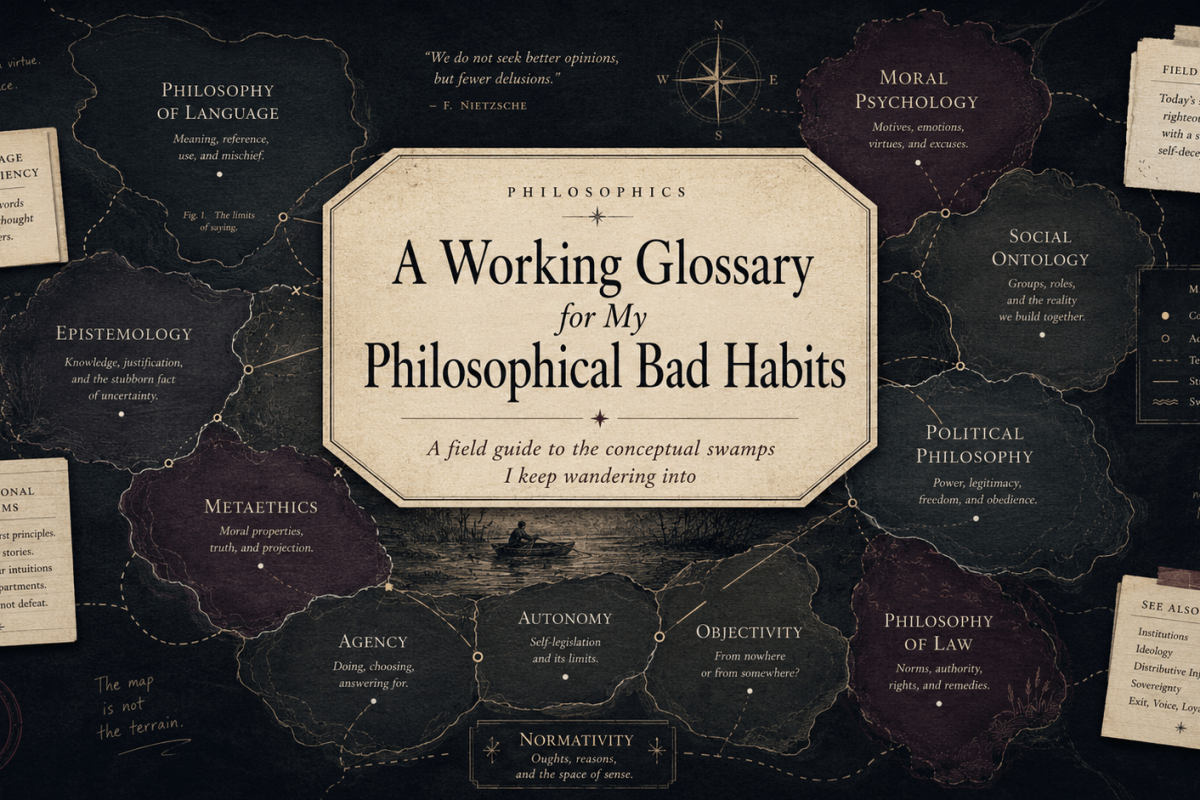
Or: a brief field guide to the conceptual swamps I keep wandering into, despite civilisation’s repeated attempts to pave them over.
As I was updating my PhilPapers profile, I decided to ask (prompt?) my digital colleague, ChatGPT to create a glossary of terms relevant to my work and interests. Perhaps this has SEO value. It doesn’t appear to be in any particular order – just like life – and so it will remain that way. Please leave comments about em dashes and notable LLMisms below.
Philosophy has the irritating habit of naming territories after the people who built fences around them. One begins by asking a fairly ordinary question — why do people keep disagreeing after the facts are settled? — and, sooner or later, someone informs you that you have wandered into metaethics, social ontology, philosophy of language, moral psychology, hermeneutics, political philosophy, or some other administratively sanctioned paddock of the great conceptual livestock farm.
This glossary is therefore not a syllabus, confession, or attempt to claim honorary residence in every department whose windows I have peered through. It is a map of the terms, fields, and adjacent concerns that recur across my work: the Language Insufficiency Hypothesis, the Architecture of Encounter, and my current project, The Architecture of Will. It is also a useful reminder that disciplines are often less like natural kinds than airport signage: helpful, directional, and faintly embarrassing when mistaken for geography.
Philosophy of Language
The study of how language means, fails, points, slips, distorts, coordinates, and occasionally performs the intellectual equivalent of falling down a staircase with a clipboard.
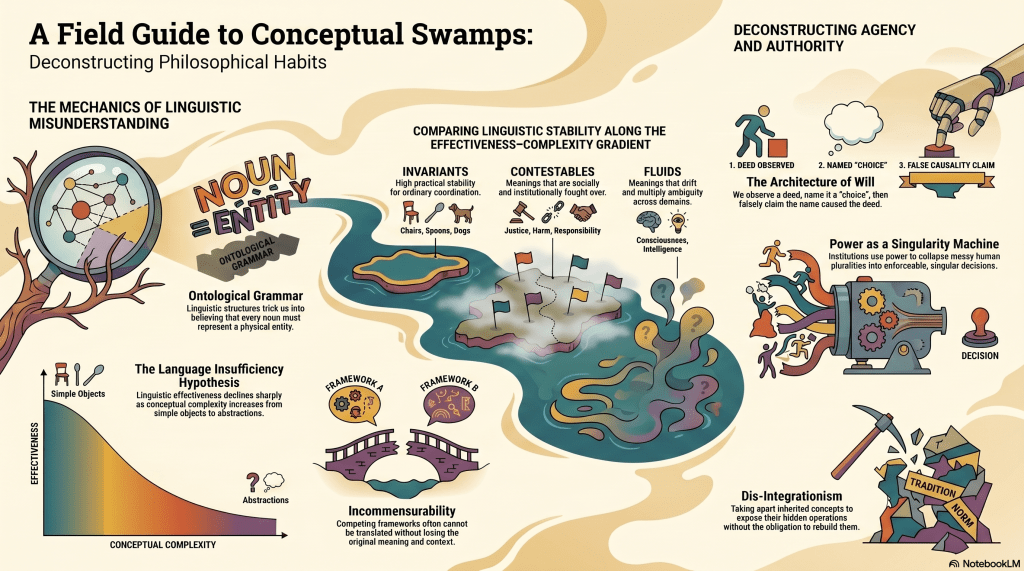
My interest is not chiefly in language as a transparent medium for thought, but in language as a structurally biased encoding system. Words do not simply carry meanings from one mind to another like well-behaved parcels. They compress, frame, prioritise, obscure, and smuggle in assumptions. Many philosophical problems begin when we treat grammar as though it were ontology: because a noun exists, we assume there must be a thing answering to it.
In my work, philosophy of language becomes the diagnostic centre from which many other disputes are reinterpreted. Moral language, political language, legal language, psychological language, and metaphysical language all depend on terms that remain useful long after their referential stability has expired.
Epistemology
Epistemology asks what knowledge is, how it is justified, and what distinguishes knowing from merely believing with good posture.
My concern is with mediated access: the fact that whatever we call knowledge is routed through perception, cognition, language, culture, inherited categories, institutional practices, and power. This does not mean truth is imaginary or that anything goes. That tedious little slogan should be retired and buried under a car park. It means that access to reality is always structured, filtered, and constrained.
Knowledge, on this view, is less a pristine correspondence between mind and world than a stabilised achievement under conditions of mediation. We know enough to function, to build bridges, to poison ourselves predictably, to disagree meaningfully, and to sustain institutions. But we do not know from nowhere.
Metaethics
Metaethics asks what moral claims are doing before everyone starts shouting about which ones are correct.
Are moral claims true or false? Do they express facts, attitudes, prescriptions, social commitments, emotional reactions, or something more inconvenient? My own orientation is non-cognitivist: I am sceptical that moral utterances report mind-independent moral furniture. Moral language looks less like description and more like action-authorising expression, salience-marking, coordination, condemnation, alignment, and pressure.
This does not make morality trivial. Quite the opposite. It makes moral discourse socially potent precisely because it is not merely descriptive. Moral language does things. It binds, excludes, licenses, condemns, absolves, and mobilises. The mistake is treating this performative force as though it were evidence of metaphysical depth.
Moral Psychology
Moral psychology studies how human beings actually make moral judgments, which is already impolite, since most humans prefer to imagine they reason first and rationalise never.
My interest lies in the pre-verbal and affective structure of moral salience. People do not simply encounter neutral facts and then calmly apply moral principles. They register threat, harm, impurity, authority, betrayal, autonomy, dignity, and violation through inherited orientations before reasons are narrated. The reasons matter, but they often arrive after the salience has already fired.
This is why many moral disputes persist even after factual clarification. The problem is not always ignorance. Sometimes the parties inhabit different moral architectures, and language is dragged in afterwards to pretend that one more definition might save the day.
Philosophy of Action
Philosophy of action asks what it means to act, intend, choose, decide, deliberate, and be responsible for what follows. It is where verbs go to be embalmed as nouns.
My current project, The Architecture of Will, belongs here, though it approaches the field diagnostically. I am interested in the will-family: will, volition, intent, motive, choice, and decision. These terms appear to name inward sources of action, but often function as compressed summaries of downstream patterns: conduct, hesitation, avowal, retrospective narration, institutional interpretation, and practical uptake.
The core suspicion is that these terms begin as practical handles and are later misrecognised as hidden authoring sources. The deed is observed, interpreted, compressed into a noun, and then that noun is treated as though it caused the deed. Human beings, naturally, decided this was a solid foundation for punishment. The species continues to be ambitious.
Free Will
Free will is the grand ancestral muddle in which metaphysics, theology, law, blame, self-flattery, and administrative convenience hold hands in a burning building.
My work does not primarily try to solve the traditional free-will debate. I am less interested in proving determinism, libertarianism, compatibilism, or hard incompatibilism than in asking why the vocabulary of will acquired such institutional authority in the first place. The question is not simply whether the will is free. It is whether the term will names anything stable enough to bear the moral and juridical burdens placed upon it.
The suspicion is that the will survives not because it has been discovered, but because too many practices require something like it to be presumed.
Responsibility
Responsibility is one of the great Contestables: indispensable, unstable, and always wearing shoes too polished for the terrain.
It can mean causal involvement, role obligation, answerability, accountability, liability, blameworthiness, reparative duty, or desert. These senses are routinely collapsed into one another, allowing institutions and moral cultures to slide from you were involved to you must answer to you deserve suffering with suspicious fluency.
My interest is in prising these apart. A person may be involved in an event, answerable within a relationship, subject to constraint, or appropriate for treatment without thereby becoming the metaphysical author required by retributive desert. Responsibility may remain useful, but only if we stop pretending it is one thing.
Philosophy of Law
Philosophy of law examines law’s concepts, justifications, authority, and interpretive machinery. It is where society dresses power in Latin and asks everyone to admire the tailoring.
My concern is with legal language as institutional compression. Law cannot wait for perfect concepts. It must decide. Terms such as intent, reasonableness, harm, consent, obscenity, negligence, culpability, and responsibility are not stable objects discovered in the world. They are administrable handles used to convert messy human reality into determinate outcomes.
This does not mean law is useless. It means law is a singularity machine: it collapses plural meanings into enforceable decisions. Procedure may dampen variance; it does not eliminate ontological plurality.
Political Philosophy
Political philosophy asks how power should be organised, justified, constrained, distributed, disguised, or ritualistically congratulated for existing.
My work approaches political philosophy through legitimacy, authority, autonomy, co-authorship, institutional maintenance, and the failures of liberal proceduralism. I am especially interested in the point at which Enlightenment political vocabulary begins to wobble: freedom, equality, autonomy, rights, justice, consent, representation, progress.
These terms are not meaningless, but neither are they stable invariants. They coordinate action because people can gather around them, but they fracture because people do not gather around the same thing. Political conflict is often not a disagreement inside shared concepts, but a collision between different ontological grammars using the same words.
Social Ontology
Social ontology asks what social things are: institutions, roles, money, borders, laws, offices, marriages, identities, statuses, and other collective hallucinations with enforcement budgets.
My interest is in institutions as second-order constraint systems. They stabilise behaviour by imposing categories, procedures, incentives, sanctions, and recognisable pathways of action. They are not merely ideas, and they are not simply physical objects. They are structured practices that persist because people, documents, buildings, technologies, habits, and power keep reproducing them.
Social reality is therefore neither imaginary nor naturally given. It is maintained. This matters because the maintenance work often disappears beneath the language of objectivity, neutrality, or inevitability.
Ontological Pluralism
Ontological pluralism is the view that people do not merely disagree about facts or values; they may inhabit different structures of salience, relevance, legitimacy, harm, authority, and reality itself.
This is central to my work. Many conflicts persist because participants are not simply making different claims within the same world-picture. They are operating from different ontological orientations. One person sees state violence where another sees order. One sees autonomy where another sees abandonment. One sees justice where another sees humiliation. The shared word conceals an unshared world.
Ontological pluralism does not mean every orientation is equally good, harmless, or coherent. It means disagreement often begins deeper than argument admits.
Incommensurability
Incommensurability names the condition in which competing frameworks cannot be fully translated into one another without loss.
This matters because modern discourse is addicted to the fantasy that enough dialogue will eventually produce convergence. Sometimes it will. Sometimes people are merely confused, misinformed, or performing stupidity for tribal applause. But in harder cases, the translation itself fails. The concepts do not line up. The saliences do not register. The terms arrive carrying incompatible worlds.
Incommensurability is not silence. It is structured misregistration. People may speak fluently and still fail to meet.
Hermeneutics
Hermeneutics concerns interpretation: how meanings are formed, inherited, transmitted, distorted, and revised.
I use hermeneutic concerns less as a reverent tradition than as a reminder that nobody interprets from a vacuum. We inherit prejudices in Gadamer’s sense: prior orientations that make understanding possible before they make it questionable. Interpretation is not the secondary act of a detached subject. It is the condition under which anything becomes intelligible at all.
This connects directly to ontological grammar. We do not first encounter raw reality and then interpret it. Interpretation is already in the encounter. The world arrives pre-sorted by histories we did not author and categories we rarely inspect.
Conceptual Engineering
Conceptual engineering asks whether we should revise, replace, improve, or abandon the concepts we use.
I am sympathetic to its diagnostic impulse but wary of its repair fantasy. Not every broken concept needs a shinier successor. Some concepts should be dis-integrated: taken apart so that their hidden operations become visible, without immediately pretending we can rebuild them better. Philosophy has enough contractors. Occasionally, what one needs is demolition with a conscience.
This is where my own term Dis-Integrationism enters. It is not destruction for sport. It is the refusal to treat conceptual breakdown as an automatic invitation to reconstruction. Sometimes the most honest intellectual act is to leave the rubble labelled.
Critique of Enlightenment Rationalism
By Enlightenment rationalism I mean the broad confidence that reason, clarity, classification, procedure, and progress can discipline human life into increasingly coherent order.
My work is not anti-reason in the toddler-with-a-matchstick sense. Reason is useful. So are maps, knives, antibiotics, and chairs. The problem begins when reason imagines itself unconditioned, neutral, universal, and sufficient. Enlightenment vocabularies often mistake procedural clarity for conceptual adequacy and institutional legibility for truth.
The critique is not that modernity failed because it was too rational. It is that it repeatedly overestimated what rationalisation could stabilise.
Autonomy
Autonomy is usually treated as self-rule, independence, or the capacity to author one’s own life. It is also one of modernity’s favourite decorative masks.
My interest is in autonomy as a fiction with consequences. Persons are never self-originating. They are formed through dependence, language, institutions, bodies, histories, injuries, affordances, and constraints. Yet liberal moral and political orders often require autonomy to function as though individuals were cleanly bounded authors of preference, choice, consent, and responsibility.
Autonomy may remain useful as a political safeguard or ethical aspiration. It becomes dangerous when treated as a metaphysical description of the human animal.
Agency
Agency names the capacity to act, intervene, respond, initiate, or alter a field of possibilities.
My approach is deflationary. Agency need not be imagined as a mysterious inner power belonging to a sovereign subject. It can be understood as patterned responsiveness within constraints. Agents do not float above the world, issuing commands from an immaculate interior chamber. They are situated, mediated, scaffolded, interrupted, trained, and compelled.
This does not make agency unreal. It makes it less theatrical. An agent is not a tiny monarch inside the skull. The sooner philosophy stops smuggling monarchy into psychology, the better for everyone, skulls included.
Objectivity
Objectivity is often imagined as the view from nowhere: reality scrubbed clean of position, interest, embodiment, and history.
I prefer a more modest account. Objectivity is not the absence of position, because there is no such absence available to finite creatures. It is a disciplined relation between positions, constraints, methods, and convergences. What matters is not whether one has escaped mediation, but whether one has accounted for it well enough to produce stable, corrigible, cross-perspectival claims.
Objectivity is therefore not magic neutrality. It is an achievement under constraint. The view from nowhere is a lovely phrase, but the actual creature saying it is still standing somewhere, usually on a grant application.
Normativity
Normativity concerns oughts, reasons, rules, obligations, permissions, ideals, and standards: the whole bustling marketplace of what should be the case, according to creatures who cannot agree what case they are in.
My work treats normativity as real in practice but not necessarily as metaphysically deep in the realist sense. Normative claims organise conduct. They express commitments, mark salience, stabilise expectations, and authorise responses. They are not reducible to mere noise, preference, or mood, but neither must they be inflated into eternal furniture.
The question is not whether normativity matters. It plainly does. The question is what kind of thing it is, and whether the grammar of moral seriousness has tricked us into mistaking social force for ontological depth.
Power and Institutions
Power is not merely corruption, domination, or the villain entering in a black cape after pure reason has done its best. Power is constitutive. It stabilises meanings, enforces categories, selects outcomes, and keeps institutions from dissolving into interpretive vapour.
Institutions depend on power because language underdetermines action. When terms such as justice, responsibility, harm, reasonableness, and freedom fail to secure convergence, institutions must still act. They select, enforce, punish, recognise, exclude, and maintain. Power does not resolve the underlying conceptual instability. It pauses it, contains it, and makes social coordination possible for another day.
This is why I often prefer maintenance to resolution. Resolution promises final settlement. Maintenance admits that some conflicts cannot be solved without pretending the plurality has vanished. A mature institution does not abolish fracture. It learns how not to let the fracture become catastrophic.
The Language Insufficiency Hypothesis
The Language Insufficiency Hypothesis is the claim that language’s effectiveness declines as conceptual complexity increases.
At one end of the gradient are relatively stable terms: chairs, spoons, dogs, measurable objects, operationally fixed references. At the other are terms that collapse into metaphor, silence, paradox, or awe. Between them sit the terms that cause most of the trouble: justice, freedom, consciousness, responsibility, harm, autonomy, will. These are usable enough to organise life and unstable enough to generate permanent dispute.
The point is not that language never works. That would be stupid, and there is already enough competition in that market. The point is that language works unevenly, and we do immense damage by pretending its success in simple cases transfers automatically to moral, political, legal, and metaphysical abstraction.
Invariants, Contestables, Fluids, and Ineffables
These are the regions of the Effectiveness–Complexity Gradient.
Invariants are terms with high practical stability. They are not metaphysically perfect, because nothing fun is ever that easy, but they function reliably enough for ordinary coordination.
Contestables are terms whose meanings are socially and institutionally fought over: justice, legitimacy, reasonableness, harm, responsibility. They support disagreement precisely because they are shared enough to matter and unstable enough to resist closure.
Fluids are terms whose meanings drift across domains: consciousness, intelligence, agency, identity. Clarification often multiplies ambiguity rather than reducing it.
Ineffables are where language reaches its limit: grief, awe, mystical experience, radical alterity, some forms of pain, and perhaps the felt interiority of another life. Here language does not stop being useful, but it stops pretending to be adequate.
Ontological Grammar
Ontological grammar is the tendency of linguistic structure to install metaphysical assumptions before argument begins.
A noun invites us to imagine a thing. A subject-predicate structure invites us to imagine a bearer with properties. A verb can be converted into a nominalised object. A process becomes an entity. A relation becomes a possession. A practical summary becomes an inner faculty. This is not mere rhetoric. It is the machinery by which philosophy repeatedly mistakes grammatical convenience for ontological discovery.
Ontological grammar is one of the central irritants running through my work. It explains why so many philosophical problems seem profound only because the sentence structure has already rigged the room.
The Architecture of Encounter
The Architecture of Encounter is my broader metaphysical framework. Its central move is to treat encounter-events, rather than substances, subjects, or objects, as primitive.
On this view, mind and world are not two separate domains that later require a bridge. They are abstractions drawn from structured encounter. Mediation is not a veil blocking access to reality; it is the condition under which reality is encountered at all. Constraint, resistance, salience, affordance, perception, and language all belong inside the architecture of encounter rather than outside it.
This framework is realist, but not naïvely so. Reality pushes back. But it never arrives unmediated, unstructured, or free from the conditions under which it can be encountered.
The Architecture of Will
The Architecture of Will is my current project: a diagnostic genealogy of the will-family.
It examines will, volition, intent, motive, choice, and decision as terms that appear to name inward authoring sources but often function as compressed summaries of downstream action-patterns. The central concept is authoring displacement: the two-stage process by which a practical summary is converted into an apparent source.
First, a pattern of conduct, hesitation, avowal, interpretation, and uptake is compressed into a noun. Second, that noun is grammatically inverted and treated as though it caused the very pattern from which it was abstracted. This matters most in retributive contexts, where institutions need inward authors in order to make punishment appear deserved rather than merely useful.
The project does not deny deliberation, regret, or practical responsibility. It denies that the nouns we use for these phenomena have earned the metaphysical authority required to ground deserved suffering.
Dis-Integrationism
Dis-Integrationism is my name for a method of taking apart inherited conceptual machinery without the pious obligation to rebuild it immediately.
It is adjacent to deconstruction, but less enchanted by textual mystique and more willing to leave the broken mechanism on the table with a label attached. Its point is diagnostic exposure: to show where a concept derives its authority, what it hides, what institutional labour it performs, and why its apparent coherence may depend on suppressing its own conditions of operation.
Dis-Integrationism is not nihilism. It is maintenance against false repair. Some structures should be rebuilt. Some should be abandoned. Some should be kept only with warning signs bolted to them.
Closing: Why This Glossary Exists
This glossary is not a complete taxonomy. It is a working map of recurring concerns: language and its insufficiencies; knowledge under mediation; moral judgment without metaphysical inflation; institutions as systems of compression and power; autonomy and agency as useful fictions; objectivity without the fantasy of nowhere; and the will-family as the latest site where grammar, law, and moral appetite have mistaken a noun for a hidden source.
The common thread is simple enough, though simple things are often the first victims of professional vocabulary. Human beings inherit terms, build institutions around them, forget their contingency, and then call the result reality. My work tries to interrupt that sequence before the noun becomes a shrine.
Not to abolish language. Not to end moral life. Not to sneer from outside the ruins. There is no outside, and sneering is already over-subscribed.
The aim is more modest and more corrosive: to notice where our words still work, where they fail, where power has been recruited to hide the failure, and where the demand for resolution has become part of the damage.

