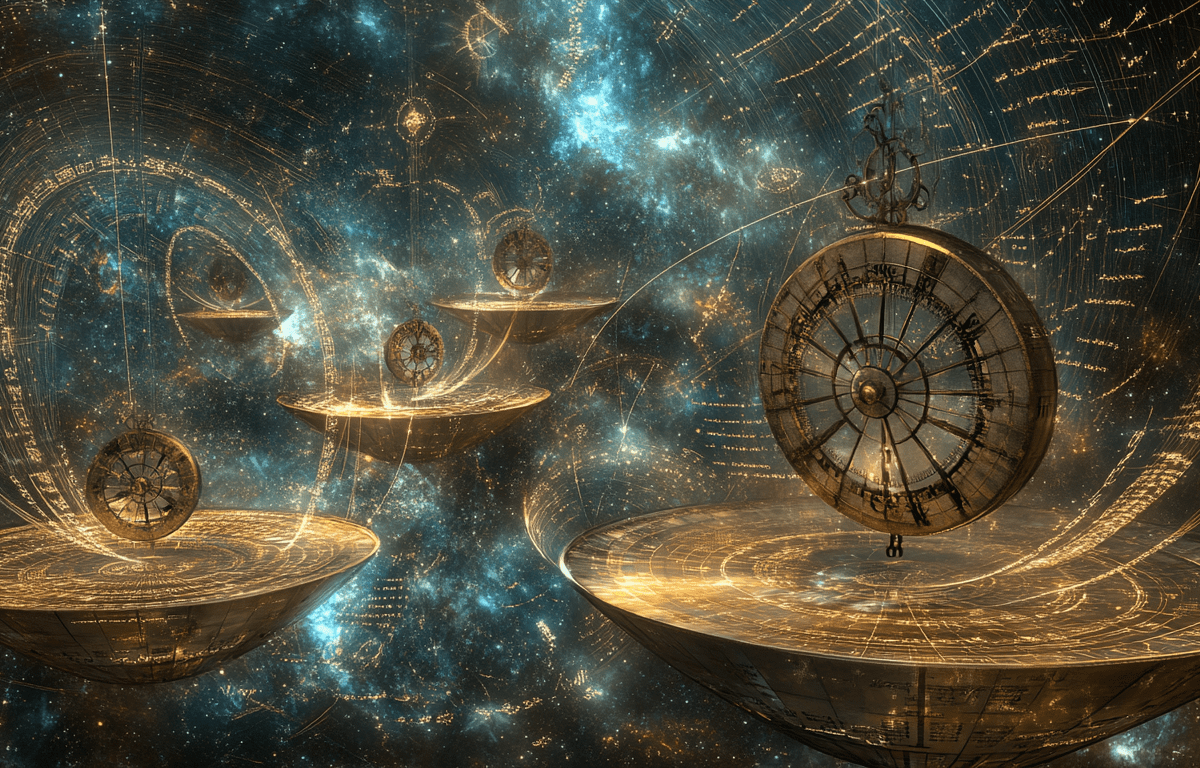
Time is not fundamental. It is not lurking behind the curtains of reality, counting down the universe like some cosmic metronome. Time is a human construct, a clumsy accounting trick invented so that hunter-gatherers could remember when to plant seeds, priests could know when to fleece the flock, and later, managers could know when to dock your wages.
Yes, our ancestors tracked cycles: the swing of day and night, the waxing of the moon, the slouch of the seasons. But this is proto-time at best. Call it rhythm, call it recurrence, call it the universe refusing to sit still. It was not time. It was change, and we anthropomorphised it.
Then along came Newton with his stopwatch. He baptised “absolute time,” a divine river that flowed “equably without relation to anything external.” In other words, he built the cosmic grandfather clock and declared it law. This fantasy held just long enough for Einstein to make mischief, weaving time into space with duct tape and calling it spacetime. Romantic, yes, but hardly fundamental. Time, in Einstein’s cosmos, bends and dilates depending on who’s doing the bending. Not exactly the firm bedrock you’d expect of a “dimension.”
Meanwhile, in the quantum world, time is the awkward dinner guest: not an observable, not dynamic, just an external parameter scribbled into the equations because no one knew where else to put it. Like a bad houseplant, it sits in the corner – unmeasurable, unaccountable, but impossible to get rid of.
And yet, not everyone has given up the ghost. One camp – think Julian Barbour and Carlo Rovelli – insists time is an illusion, something emergent from relations, clocks, and counters. Others, like Lee Smolin, flip the script and claim that time is more fundamental than space itself, the real stage upon which the cosmic drama plays out. Philosophical infighting aside, what this tells you is that physics doesn’t actually know what time is. They’re as clueless as Aristotle, who called it “the number of motion”, a definition so circular it should’ve been printed on a sundial.
Enter Constructor Theory (Deutsch & Marletto), which simply does away with time entirely in the fundamental laws. No ticking clocks, no background river. Just possible and impossible transformations, with time emerging only when we strap timers onto systems and start counting. Which, of course, makes perfect sense: time is what we measure with clocks – and clocks are just things that change.
The dirty secret is this: every culture, every cosmology, every physics textbook has tried to smuggle “time” in as if it were self-evident, while quietly redefining it to suit the mood. We can’t agree on whether it’s an illusion, a dimension, or the last shred of fundamentality left to cling to. And if that isn’t the mark of a human construct, I don’t know what is.
 Philosophics