L’Illusion de la lumière

1–2 minutes

Un court message aujourd’hui.

Je travaille à la traduction de The Illusion of Light : Thinking After the Enlightenment (L’Illusion de la lumière : Penser après les Lumières) en français, avec l’aide de quelques outils linguistiques et d’un peu d’intelligence artificielle. J’ai bon espoir que le processus sera fructueux. Souhaitez-moi bonne chance.

Je dois beaucoup aux penseurs français, d’hier comme d’aujourd’hui. Traduire ce texte est donc, à ma manière, une forme de reconnaissance. Mon plus grand défi sera de préserver un français à la fois contemporain et fidèle à ma voix – moins prosaïque que poétique.
Mes excuses d’avance aux Québécois.

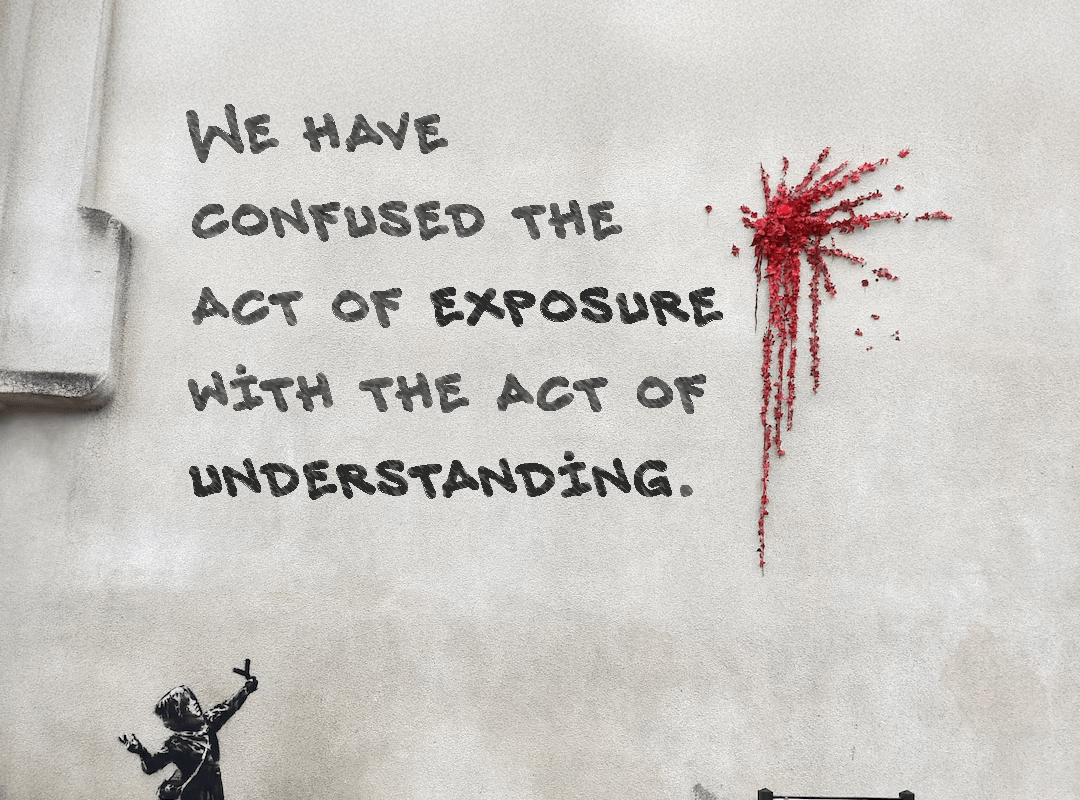
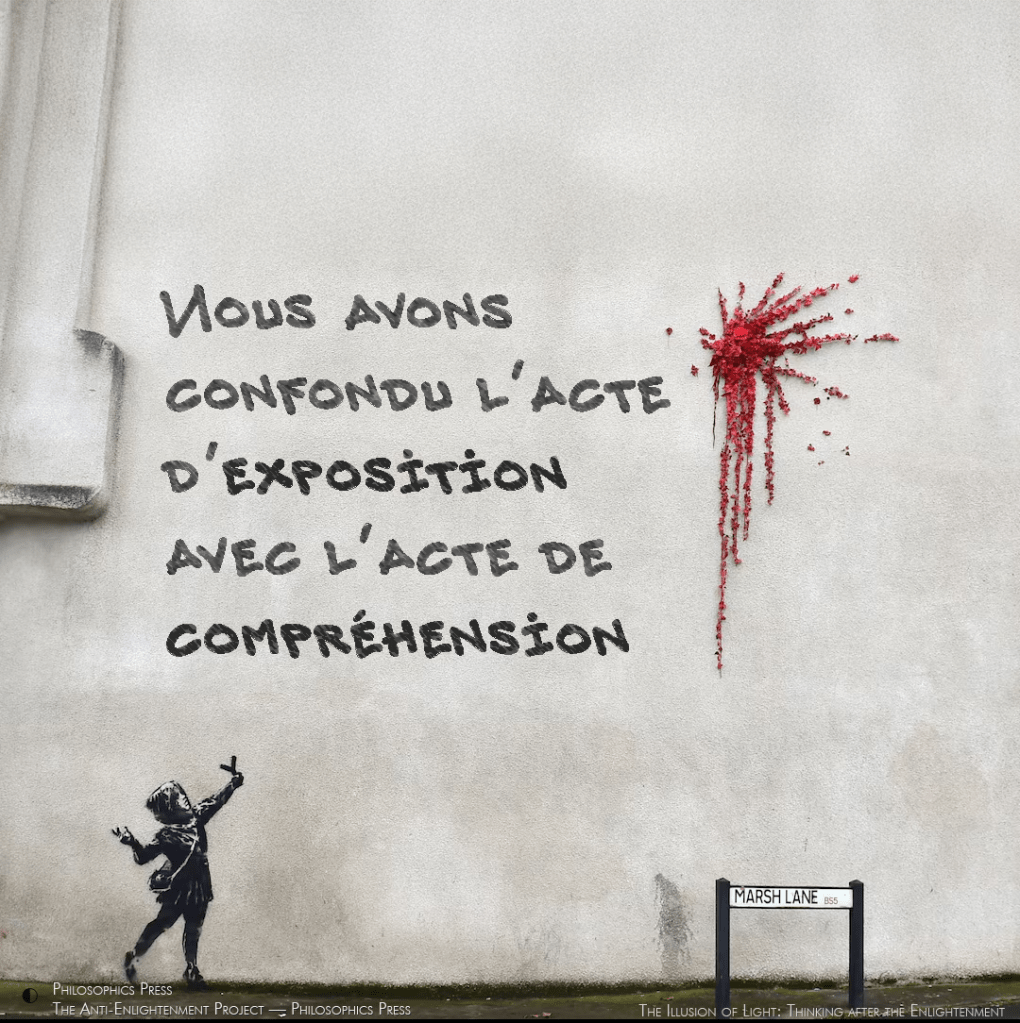
Image: “We have confused the act of exposure with the act of understanding.”

In English, I am translating The Illusion of Light into French, so I’m leaving just this short note today.

I don’t know any other languages well enough to attempt a translation myself, but with a few capable software partners, I’m confident the process will end well.

For the record, I’m using these tools:

  • Reverso — I’ve used it for years and still find it helpful. It provides plenty of contextual examples, which helps ensure I’ve captured the right nuance.
  • ChatGPT — My go-to AI partner; it gets the second pass.
  • Claude — I’m consistently impressed with its suggested amendments. Where Reverso is precise, Claude tends to catch idiomatic usage better.
  • Mistral — It’s French, after all. What can I say? A bit pedantic, perhaps, but another set of virtual eyes can’t hurt—can they?

Whilst I’m sure these tools could manage other languages, I want to be able to evaluate what they’re doing. In French, even if I don’t know a particular word, I can verify it, and I understand the grammar. With other languages, I’d simply be trusting a black box.

Besides, French culture and philosophy have influenced me so deeply that the least I can do is offer something back. As this translation is an overview of my English-language essays, I hope it provides some in-language context.

I know how difficult translated works can be to read, so if I’m overseeing the process, at least there’s one fewer filter between my thoughts and the reader.

Midjourney Video Renders

Yesterday, I wrote about “ugly women.” Today, I pivot — or perhaps descend — into what Midjourney deems typical. Make of that what you will.

This blog typically focuses on language, philosophy, and the gradual erosion of culture under the boot heel of capitalism. But today: generative eye candy. Still subtextual, mind you. This post features AI-generated women – tattooed, bare-backed, heavily armed – and considers what, exactly, this technology thinks we want.

Video: Pirate cowgirls caught mid-gaze. Generated last year during what I can only assume was a pirate-meets-cowgirl fever dream.

The Video Feature

Midjourney released its image-to-video tool on 18 June. I finally found a couple of free hours to tinker. The result? Surprisingly coherent, if accidentally lewd. The featured video was one of the worst outputs, and yet, it’s quite good. A story emerged.

Audio: NotebookLM podcast on this topic (sort of).

It began with a still: two women, somewhere between pirate and pin-up, dressed for combat or cosplay. I thought, what if they kissed? Midjourney said no. Embrace? Also no. Glaring was fine. So was mutual undressing — of the eyes, at least.

Later, I tried again. Still no kiss, but no denial either — just a polite cough about “inappropriate positioning.” I prompted one to touch the other’s hair. What I got was a three-armed woman attempting a hat-snatch. (See timestamp 0:15.) The other three video outputs? Each woman seductively touched her own hair. Freud would’ve had a field day.

In another unreleased clip, two fully clothed women sat on a bed. That too raised flags. Go figure.

All of this, mind you, passed Midjourney’s initial censorship. However, it’s clear that proximity is now suspect. Even clothed women on furniture can trigger the algorithmic fainting couch.

Myriad Warning Messages

Out of bounds.

Sorry, Charlie.

In any case, I reviewed other images to determine how the limitations operated. I didn’t get much closer.

Video: A newlywed couple kissing

Obviously, proximity and kissing are now forbidden. I’d consider these two “scantily clad,” so I am unsure of the offence.

I did render the image of a cowgirl at a Western bar, but I am reluctant to add to the page weight. In 3 of the 4 results, nothing (much) was out of line, but in the fourth, she’s wielding a revolver – because, of course, she is.

Conformance & Contradiction

You’d never know it, but the original prompt was a fight scene. The result? Not punches, but pre-coital choreography. The AI interpreted combat as courtship. Women circling each other, undressing one another with their eyes. Or perhaps just prepping for an afterparty.

Video: A battle to the finish between a steampunk girl and a cybermech warrior.

Lesbian Lustfest

No, my archive isn’t exclusively lesbian cowgirls. But given the visual weight of this post, I refrained from adding more examples. Some browsers may already be wheezing.

Technical Constraints

You can’t extend videos beyond four iterations — maxing out at 21 seconds. I wasn’t aware of this, so I prematurely accepted a dodgy render and lost 2–3 seconds of potential.

My current Midjourney plan offers 15 hours of “fast” rendering per month. Apparently, video generation burns through this quickly. Still images can queue up slowly; videos cannot. And no, I won’t upgrade to the 30-hour plan. Even I have limits.

Uses & Justifications

Generative AI is a distraction – an exquisitely engineered procrastination machine. Useful, yes. For brainstorming, visualising characters, and generating blog cover art. But it’s a slippery slope from creative aid to aesthetic rabbit hole.

Would I use it for promotional trailers? Possibly. I’ve seen offerings as low as $499 that wouldn’t cannibalise my time and attention, not wholly, anyway.

So yes, I’ll keep paying for it. Yes, I’ll keep using it. But only when I’m not supposed to be writing.

Now, if ChatGPT could kindly generate my post description and tags, I’ll get back to pretending I’m productive.

The Church of Pareto: How Economics Learned to Love Collapse

—or—How the Invisible Hand Became a Throttling Grip on the Throat of the Biosphere

As many frequent visitors know, I am a recovering economist. I tend to view economics through a philosophical lens. Here. I consider the daft nonsense of Pareto optimality.

Audio: NotebookLM podcast of this content.

There is a priesthood in modern economics—pious in its equations, devout in its dispassion—that gathers daily to prostrate before the altar of Pareto. Here, in this sanctum of spreadsheet mysticism, it is dogma that an outcome is “optimal” so long as no one is worse off. Never mind if half the world begins in a ditch and the other half in a penthouse jacuzzi. So long as no one’s Jacuzzi is repossessed, the system is just. Hallelujah.

This cult of cleanliness, cloaked in the language of “efficiency,” performs a marvellous sleight of hand: it transforms systemic injustice into mathematical neutrality. The child working in the lithium mines of the Congo is not “harmed”—she simply doesn’t exist in the model. Her labour is an externality. Her future, an asterisk. Her biosphere, a rounding error in the grand pursuit of equilibrium.

Let us be clear: this is not science. This is not even ideology. It is theology—an abstract faith-based system garlanded with numbers. And like all good religions, it guards its axioms with fire and brimstone. Question the model? Heretic. Suggest the biosphere might matter? Luddite. Propose redistribution? Marxist. There is no room in this holy order for nuance. Only graphs and gospel.

The rot runs deep. William Stanley Jevons—yes, that Jevons, patron saint of unintended consequences—warned us as early as 1865 that improvements in efficiency could increase, not reduce, resource consumption. But his paradox, like Cassandra’s prophecy, was fated to be ignored. Instead, we built a civilisation on the back of the very logic he warned would destroy it.

Then came Simon Kuznets, who—bless his empirically addled soul—crafted a curve that seemed to promise that inequality would fix itself if we just waited politely. We called it the Kuznets Curve and waved it about like a talisman against the ravages of industrial capitalism, ignoring the empirical wreckage that piled up beneath it like bones in a trench.

Meanwhile, Pareto himself, that nobleman of social Darwinism, famously calculated that 80% of Italy’s land was owned by 20% of its people—and rather than challenge this grotesque asymmetry, he chose to marvel at its elegance. Economics took this insight and said: “Yes, more of this, please.”

And so the model persisted—narrow, bloodless, and exquisitely ill-suited to the world it presumed to explain. The economy, it turns out, is not a closed system of rational actors optimising utility. It is a planetary-scale thermodynamic engine fuelled by fossil sunlight, pumping entropy into the biosphere faster than it can absorb. But don’t expect to find that on the syllabus.

Mainstream economics has become a tragic farce, mouthing the language of optimisation while presiding over cascading system failure. Climate change? Not in the model. Biodiversity collapse? A regrettable externality. Intergenerational theft? Discounted at 3% annually.

We are witnessing a slow-motion suicide cloaked in the rhetoric of balance sheets. The Earth is on fire, and the economists are debating interest rates.

What we need is not reform, but exorcism. Burn the models. Salt the axioms. Replace this ossified pseudoscience with something fit for a living world—ecological economics, systems theory, post-growth thinking, anything with the courage to name what this discipline has long ignored: that there are limits, and we are smashing into them at speed.

History will not be kind to this priesthood of polite annihilation. Nor should it be.