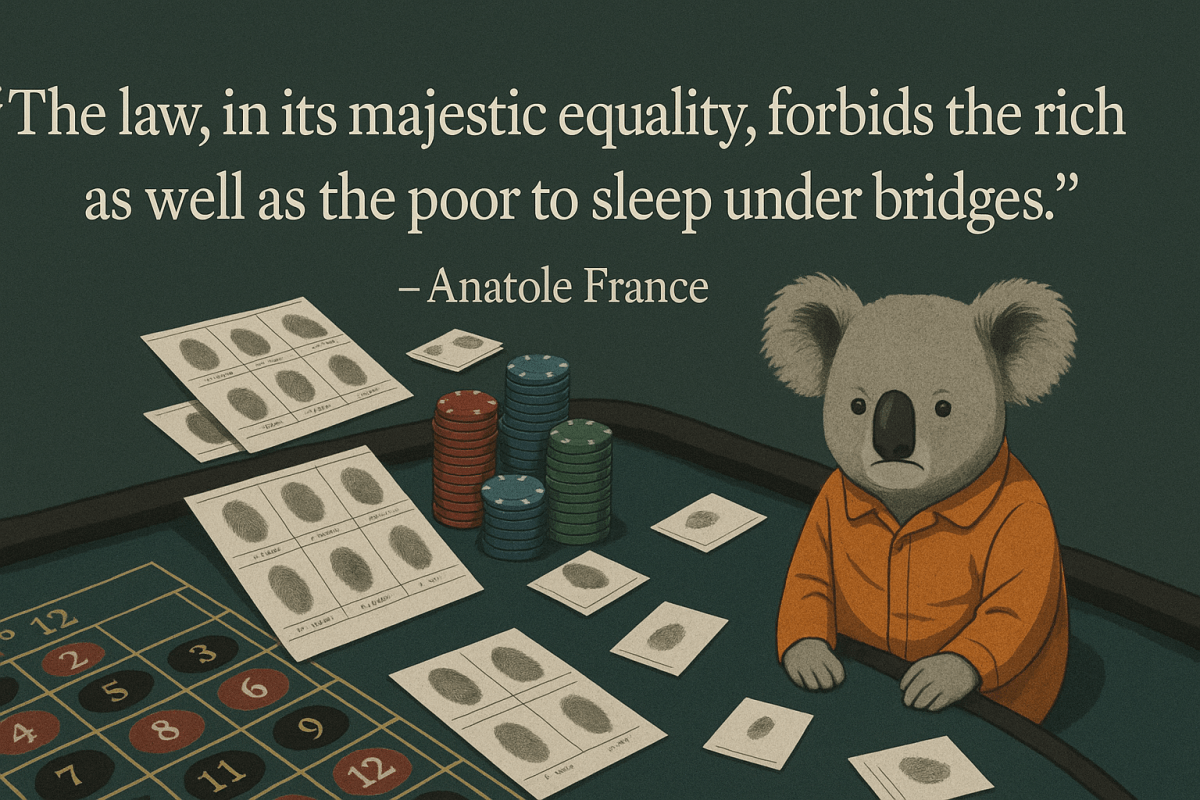
Welcome to the Casino of Justice

Welcome to the Grand Casino of Justice, where the chips are your civil liberties, the roulette wheel spins your fate, and the house—ever-smug in its powdered wig of procedural decorum—always wins.

Step right up, citizens! Marvel at the dazzling illusions of “science” as performed by your local constabulary: the sacred polygraph, that magnificent artefact of 1920s snake oil, still trotted out in back rooms like a sĂ©ance at a nursing home. Never mind that it measures stress, not deception. Never mind that it’s been dismissed by any scientist with a functioning prefrontal cortex. It’s not there to detect truth—it’s there to extract confession. Like a slot machine that only pays out when you agree you’re guilty.

Audio: NotebookLM podcast on this topic.

And oh, the forensic pageantry! The blacklight! The dramatic swabs! The breathless invocations of “trace evidence,” “blood spatter patterns,” and—ooh! ahh!—fingerprints, those curly little whorls of manufactured certainty. You’ve been told since childhood that no two are alike, that your prints are your identity. Rubbish. Human fingerprint examiners disagree with themselves when presented with the same print twice. In blind tests. And yes—this bears repeating with appropriate incredulity—koalas have fingerprints so uncannily similar to ours they’ve confused human forensic analysts. Somewhere, a marsupial walks free while a teenager rots in remand.

You see, it’s not about justice. It’s about control. Control through performance. The legal system, like a casino, isn’t interested in fairness—it’s interested in outcome. It needs to appear impartial, all robes and solemnity, while tipping the odds ever so slightly, perpetually, in its own favour. This is jurisprudence as stagecraft, science as set-dressing, and truth as a collateral casualty.

And who are the croupiers of this great charade? Not scientists, no. Scientists are too cautious, too mired in uncertainty, too concerned with falsifiability and statistical error margins. No, your case will be handled by forensic technicians with just enough training to speak jargon, and just enough institutional loyalty to believe they’re doing the Lord’s work. Never mind that many forensic methods—bite mark analysis, tool mark “matching,” even some blood spatter interpretations—are about as scientifically robust as a horoscope printed on a cereal box.

TV crime dramas, of course, have done their bit to embalm these myths in the cultural subconscious. “CSI” isn’t a genre—it’s a sedative, reassuring the public that experts can see the truth in a hair follicle or the angle of a sneeze. In reality, most convictions hinge on shoddy analysis, flawed assumptions, and a little prosecutorial sleight of hand. But the juries are dazzled by the sciencey buzzwords, and the judges—God bless their robes—rarely know a confidence interval from a cornflake.

So, what do you do when accused in the great Casino of Justice? Well, if you’re lucky, you lawyer up. If you’re not, you take a plea deal, because 90% of cases never reach trial. Why? Because the system is designed not to resolve guilt, but to process bodies. It is a meat grinder that must keep grinding, and your innocence is but a small bone to be crushed underfoot.

This isn’t justice. It’s a theatre of probability management, where the goal is not truth but resolution. Efficiency. Throughput. The house keeps the lights on by feeding the machine, and forensic science—real or imagined—is merely the window dressing. The roulette wheel spins, the dice tumble, and your future hangs on the angle of a smudge or the misreading of a galvanic skin response.

Just don’t expect the koalas to testify. They’re wise enough to stay in the trees.

A Buddhist Critique of Modern Livelihoods

It’s interesting to me that as an atheist and non-cognitivist, I can take the moral high ground relative to health insurance concerns in the United States. So, I write about it.

Blood Money and Broken Principles

In the aftermath of the tragic killing of Brian Thompson, the CEO of a health insurance conglomerate, a striking narrative has emerged. Many Americans view this act—shocking though it is—as emblematic of the anger and despair born of a system that profits by exploiting human vulnerability. Such reactions compel us to examine the ethics of industries that flourish on what can only be described as blood money. From health insurance to tobacco, alcohol, and the arms trade, these livelihoods raise profound ethical questions when viewed through the lens of the Buddhist Noble Eightfold Path, specifically Right Livelihood and Right Action.

The Moral Framework: Buddhism’s Path to Ethical Livelihood

Buddhism’s Eightfold Path provides a blueprint for ethical living, with Right Livelihood and Right Action serving as its ethical cornerstones. These principles demand that one’s work and deeds contribute to the welfare of others, avoid harm, and align with compassion and integrity. In short, they urge us to earn a living in a manner that uplifts rather than exploits. The health insurance industry’s business model—which often prioritises profits over the preservation of life—challenges these tenets in ways that are difficult to overlook.

Consider the denial of coverage for life-saving treatments, the exploitation of legal loopholes to reduce payouts, or the systemic perpetuation of healthcare inequality. These actions, while legally sanctioned, conflict sharply with the Buddhist ideal of avoiding harm and promoting well-being. Yet, this industry is not alone in its ethical failings. Many others—both legal and illegal—fall similarly short.

Industries of Exploitation: Tobacco, Alcohol, and Arms

The tobacco and alcohol industries provide stark examples of livelihoods that thrive on human suffering. Their products, despite their legality, are designed to foster dependency and harm. They exact a heavy toll on both individual lives and public health systems, a reality that makes them incompatible with Right Livelihood. The arms trade—arguably the most egregious example—profits directly from conflict and human misery. How can such industries possibly align with the Buddhist ideal of ahimsa (non-violence) or the compassionate aspiration to alleviate suffering?

In these cases, the harm caused is not incidental; it is fundamental to their business models. Whether one manufactures cigarettes, brews alcohol, or sells weapons, the destruction wrought by these activities is integral to their profitability. The contradiction is stark: the greater the harm, the greater the profit. This stands in direct opposition to the Buddhist call for livelihoods that sustain and support life.

Organised Crime: The Dark Mirror

When we turn to organised crime, the parallels become even more unsettling. Whether it’s the drug trade, human trafficking, or financial fraud, these activities epitomise unethical livelihoods. They exploit the vulnerable, foster violence, and undermine social cohesion. Yet, when viewed alongside certain legal industries, the line between “organised crime” and “corporate enterprise” begins to blur. Is the denial of life-saving healthcare less egregious than a gang’s extortion racket? Both profit by preying on human suffering. Both thrive in systems that prioritise gain over humanity.

The Buddhist Response: From Outrage to Action

Buddhism does not condone violence, no matter how symbolic or righteous it may appear. Right Action demands non-violence not only in deeds but also in thoughts and intentions. The killing of Brian Thompson, though perhaps an act of desperation or symbolism, cannot align with Buddhist ethics. Yet this tragedy should not eclipse the broader systemic critique. The true challenge is not to exact retribution but to transform the systems that perpetuate harm.

To move forward, we must ask how our societies can pivot toward livelihoods that align with compassion and justice. This entails holding exploitative industries to account and fostering economic systems that prioritise well-being over profit. The Buddhist path offers not only a critique of harmful practices but also a vision for ethical living—a vision that demands courage, compassion, and unwavering commitment to the common good.

Conclusion: Choosing a Better Path

The case of Brian Thompson’s killing is a symptom of a much larger ethical crisis. It forces us to confront uncomfortable truths about the industries that shape our world. Whether we scrutinise health insurance, tobacco, alcohol, the arms trade, or organised crime, the moral calculus remains the same: livelihoods that thrive on harm cannot be reconciled with the principles of Right Livelihood and Right Action.

As individuals and societies, we face a choice. We can continue to turn a blind eye to the suffering embedded in these industries, or we can commit to transforming them. The Buddhist path challenges us to choose the latter, to build systems and livelihoods rooted in compassion and justice. In doing so, we can begin to heal not only the wounds of individual tragedies but also the deeper fractures in our collective soul.

Rationality, Morality, and the Hydra of Modern Healthcare

Clash of Titans

The assassination of Brian Thompson, CEO of UnitedHealth, has electrified public discourse. In the court of public opinion—and particularly on social media—the assailant has been lionised, hailed as a hero who slayed a corporate leviathan. Yet the metaphorical beast is no simple predator; it’s a hydra. Slice off one head, and two grow back.

Still, this act has stirred the waters. It forces us to reckon with a clash of titans: the corporate machine versus the rogue idealist. Both are acting rationally, but neither is acting morally—at least not in the conventional sense. The question, then, is whether the assassin’s actions might occupy the higher moral ground, particularly through the lens of Consequentialist ethics.

The Hydra: UnitedHealth and the Systemic Beast

To understand the morality of the act, we must first confront the monster. UnitedHealth didn’t invent the healthcare system; it merely exploited its flaws with cold, clinical efficiency. Thompson’s leadership was emblematic of an industry that sees human lives as variables in a profit-maximising equation. Claims denial, inflated premiums, and labyrinthine bureaucracy are not bugs—they’re features. And for every life saved by healthcare, countless others are destroyed by its financial and emotional toll.

Rational? Certainly. Morally defensible? Hardly. Yet from the corporation’s perspective, these actions are the logical byproducts of a system designed to prioritise shareholder value above all else. Blame the player, yes—but blame the game more.

The Assassin: Vigilante Justice or Trolley Ethics?

Now consider the assassin, who embodies a grimly utilitarian logic: sacrifice one life to spare the misery of thousands. It’s a brutal, visceral iteration of the trolley problem—or perhaps the “baby Hitler problem,” only carried out decades too late. This wasn’t mindless violence; it was a calculated act of symbolic retribution.

From a Consequentialist perspective, the act raises uncomfortable questions. If Thompson’s death leads to systemic reform—if it forces even one profit-hungry executive to hesitate before denying care—does the assassin’s action gain moral weight? In utilitarian terms, the calculus seems clear: one life traded for a net reduction in suffering.

But that’s a dangerous game. Symbolism doesn’t always translate to change, and the hydra analogy looms large. The industry won’t topple because one CEO fell. The machinery grinds on, indifferent to the blood spilled in Manhattan. Worse, the system might grow even more resilient, using Thompson’s death as justification for tighter security, greater secrecy, and more aggressive self-preservation.

Rationality vs. Morality

What makes this clash so compelling is the cold rationality on both sides. UnitedHealth’s actions, reprehensible as they are, make sense within a capitalist framework. The assassin’s actions, though violent and morally fraught, also make sense if viewed as a desperate attempt to restore balance to a world that prioritises profit over human life.

The difference lies in their moral standing. The corporation’s rationality is underpinned by greed; its actions perpetuate suffering. The assassin’s rationality, however misguided, is rooted in outrage at injustice. If morality is determined by intent and consequence, the assassin might indeed occupy higher moral ground—not because killing is inherently justifiable, but because the system left no other path for redress.

The Symbolism and the Hydra

The tragedy is that this act of violence, however symbolic, won’t solve the problem. The hydra will grow another head, as corporations close ranks and reform remains elusive. Yet the act remains a potent reminder of the power of individual resistance. Perhaps it will force a moment of reflection, a hesitation before the next denial stamp hits the desk. Or perhaps it will simply serve as another chapter in the grim saga of a system that turns suffering into profit.

The Final Question

In this clash of titans, one side wields institutional power and systemic exploitation; the other wields desperation and bullets. Both are rational. Neither is fully moral. But perhaps the assassin’s act—brutal, symbolic, and imperfect—offers a glimpse of what happens when systemic injustice pushes people past the breaking point.

The real question is whether this singular act of defiance will lead to change—or whether the hydra will simply grow stronger, hungrier, and more entrenched.