PhilSurvey: What is the aim of philosophy?

2–3 minutes

I commenced a series where I discuss the responses to the 2020 PhilPapers survey of almost 1,800 professional philosophers. This continues that conversation with questions 2 through 4 – in reverse order, not that it matters. Each is under 5 minutes; some are under 3.

For the main choices, you are given 4 options regarding the proposal:

  • Accept
  • Lean towards
  • Reject
  • Lean against

Besides the available choices, accepted answers for any of the questions were items, such as:

  • Combinations (specify which.)
    For the combos, you might Accept A and Reject B, so you can capture that here.
  • Alternate view (not entirely useful unless the view has already been catalogued)
  • The question is too unclear to answer
  • There is no fact of the matter (the question is fundamentally bollocks)
  • Agnostic/undecided
  • Other

Q4: The first one asks, ‘What is the aim of philosophy?’ Among the responses were:

  • Truth/Knowledge
  • Understanding
  • Wisdom
  • Happiness
  • Goodness/Justice

Before you watch the video, how might you respond?

Video: What is the aim of philosophy?

Q3: What’s your position on aesthetic value?

  • Objective
  • Subjective
Video: What is aesthetic value?

Q2: What’s your position on abstract objects?

  • Platonism (these objects exist “out there” in or beyond the world)
  • Nominalism (the objects are human constructs)
Video: Where do abstract objects reside?

Q1: What’s your position on à priori knowledge?

This video response was an earlier post, so find it there. This is asking if you believe one can have any knowledge apart from experience.

  • Yes
  • No

NB: I’ve recorded ten of these segments already, but they require editing. So I’ll release them as I wrap them up. Not that I’ve completed them, I realise I should have explained what the concepts mean more generally instead of talking around the topics in my preferred response. There are so many philosophy content sites, I feel this general information is already available, or by search, or even via an LLM.

In the other hand, many of these sites – and I visit and enjoy them – support very conservative, orthodox views that, as I say, don’t seem to have progressed much beyond 1840 – Kant and a dash of Hegel, but all founded on Aristotelian ideas, some 2,500 years ago.

Spoiler alert, I think knowledge has advanced and disproved a lot of this. It turns out my brothers in arms don’t necessarily agree. Always the rebel, I suppose.

PhilPapers Survey – À Priori Knowledge

I commenced a new series that shares my philosophical positions from the PhilPapers 2020 survey.

Video: Intro and question 1 to the survey.

Not a lot to write beyond what the video already says.

My responses are available on my PhilPeople profile. If you really can’t justify watching the 4-minute video clip, read the spoilers below – but it will go down in your permanent record.

Show spoiler (tl;dr?)
  • 73% of respondents accept or lean toward the claim that à priori knowledge exists
  • 18% of respondents reject or lean away from the claim that à priori knowledge exists

My Response: À priori knowledge does not exists. No knowledge exists prior to experience.

Modernity Worldview Survey: Update 1

It’s nice to see responses still coming in from the Modernism Worldview Survey, so I thought I’d share some interim insights. Several people have shared their results with me privately. I’d be interested to know if any takers felt this was a fair and accurate assessment, given that this might be as relevant as the zodiac reading on a restaurant placemat. I’m an ox, if you’re wondering.

All aggregated responses resolve within the violet parallelogram that encompasses the population average (the blue dot). So, survey-takers have a slight propensity toward Modernist ideals with a tinge of Postmodernism. The force is weak, given how far the dot resides from the vertex. There were responses close to the green shading on the Modern side, but none indicated a strong Modernist worldview.

Firstly, no respondents are choosing “Pure Premodernity” (lower right). This doesn’t mean that no one abides by Premodern perspectives. It’s that they feel these ideas are filtered through Modern (mostly) and Postmodern (less so) lenses.

Secondly, respondents generally moderated their approach, avoiding any extremes. Although some responses were close to the Modern triangle (the green shading), none occupied the space, and points were even further removed from the other two corners. There were several scores in the white triangle. This space would be ripe for a Metamodernist to be positioned, but the survey would need to be restructured to determine whether this was mere happenstance.

Before the survey was published, I thought that the blue dot would be higher (toward Modernity) and further right (more Premodern), but this is likely due to the bias of people who visit this site and follow my content more generally. I need to share links in places without this bias. Of course, someone having even the slightest interest in the subject matter already represents a bias.

Video: Modernity Worldview Survey Intro

I’ve finally had time to create some video content for the Modernity Worldview Survey. This content is a cursory overview and serves as an introduction to deeper content planned for the future.

This video is short of seven minutes, so briefly, it outlines the worldviews and the questions. I opted not to produce a single comprehensive video so the material could arrive sooner. The content is bookmarked, though this is likely overkill for such a short video.

A permanent page about the survey is always available on this blog.

I’m still accumulating responses, but the survey is available here if you haven’t taken it. Apologies in advance for the fact that it renders best on a larger monitor or tablet rather than a mobile phone. It doesn’t render at all on a landline, so there’s that.

The Holy Grail of Longevity: Why Religious People Live Longer

Spoiler Alert: It’s Not About God

If you’re reading this, chances are you’re mortal. Bummer. Even worse, you may not be maximizing your odds of wringing every last drop out of your limited lifespan. But fear not! Science has some answers. And the answer, at least in the United States, is shockingly unsecular: religious people, on average, live longer than their non-religious counterparts. They also tend to be happier. But don’t rush to your nearest house of worship just yet—because it’s not God, the afterlife, or divine intervention at work. It’s something far more mundane: people.

Audio: NotebookLM podcast on this topic.

The Religion-Longevity Link: A Holy Miracle or Just Good Networking?

Multiple studies have confirmed what might seem an inconvenient truth for secular folks like myself: religious participation is associated with longer lifespans. A 2018 study published in JAMA Internal Medicine found that attending religious services more than once a week was associated with a roughly 33% lower risk of mortality. That’s a pretty solid statistical incentive to at least pretend to enjoy Sunday sermons.

Why the boost in longevity? No, it’s not divine reward points. It boils down to a few key factors:

  • Community and Social Support: Regularly showing up to church, temple, mosque, or synagogue means interacting with the same people repeatedly, forming strong social bonds. When life gets tough, these people tend to notice and lend support.
  • Healthier Lifestyles: Many religious traditions frown upon self-destructive behaviours like smoking, heavy drinking, and drug use.
  • Lower Stress Levels: Religious belief systems provide coping mechanisms for hardship, instilling a sense of meaning and reducing existential dread.
  • Volunteerism and Purpose: Many religious folks engage in community service, which has been linked to greater happiness and longevity.

The Not-So-Spiritual Catch: Why Atheists and the “Spiritual but Not Religious” Miss Out

Here’s the kicker: it’s not belief in a deity that grants these benefits. It’s participation in a structured, tight-knit community. That’s why merely identifying as “spiritual” doesn’t deliver the same effects—without a committed social framework, spirituality becomes a solo endeavour. And whilst atheists can certainly find meaning in other ways, they often lack equivalent institutions providing routine, real-world social engagement.

To put it bluntly, God isn’t keeping people alive longer. Other people are. Having a tribe that notices when you don’t show up, checks in when you’re sick, and nags you into a healthier lifestyle has tangible benefits.

The Scandinavian Exception: Thriving Without Religion

“But wait,” you may say, “what about those blissfully secular Scandinavian countries? They’re barely religious, yet they consistently rank among the happiest and longest-living people on Earth.” Good point. The key difference? They have successfully replaced the social function of religion with other strong communal institutions.

Nordic nations boast robust social safety nets, well-funded public spaces, and a culture prioritising collective well-being. They don’t need church groups to function as makeshift welfare systems because the state ensures no one falls through the cracks. They also have thriving clubs, hobby groups, and worker associations that provide built-in social support.

Conclusion: What This Means for Longevity-Seeking Atheists and Introverts

If you, like me, are an atheist and also an introvert who prefers solitude, writing, and the company of generative AI, this presents a bit of a conundrum. How does one reap the benefits of social integration without enduring the horror of group activities?

The lesson here isn’t that you need to feign religious belief or force yourself into suffocating social obligations. But if you want to maximize your lifespan and well-being, some form of consistent, meaningful connection with others is essential. Whether that’s through a socialist co-op, a local philosophy club, a structured hobby group, or even just a tight circle of like-minded misanthropes, the key is to avoid total isolation.

Religion isn’t the magic ingredient—it’s just a well-tested delivery system. And in a society where other forms of community are fraying, it’s not surprising that religious folks seem to be winning the longevity lottery. The real takeaway? Find your people. Even if you’d rather be alone.

Modernity Survey Results

I’ve added a permanent page to summarise the modernity worldview categories. If you haven’t yet taken the survey…

Click here to take the survey

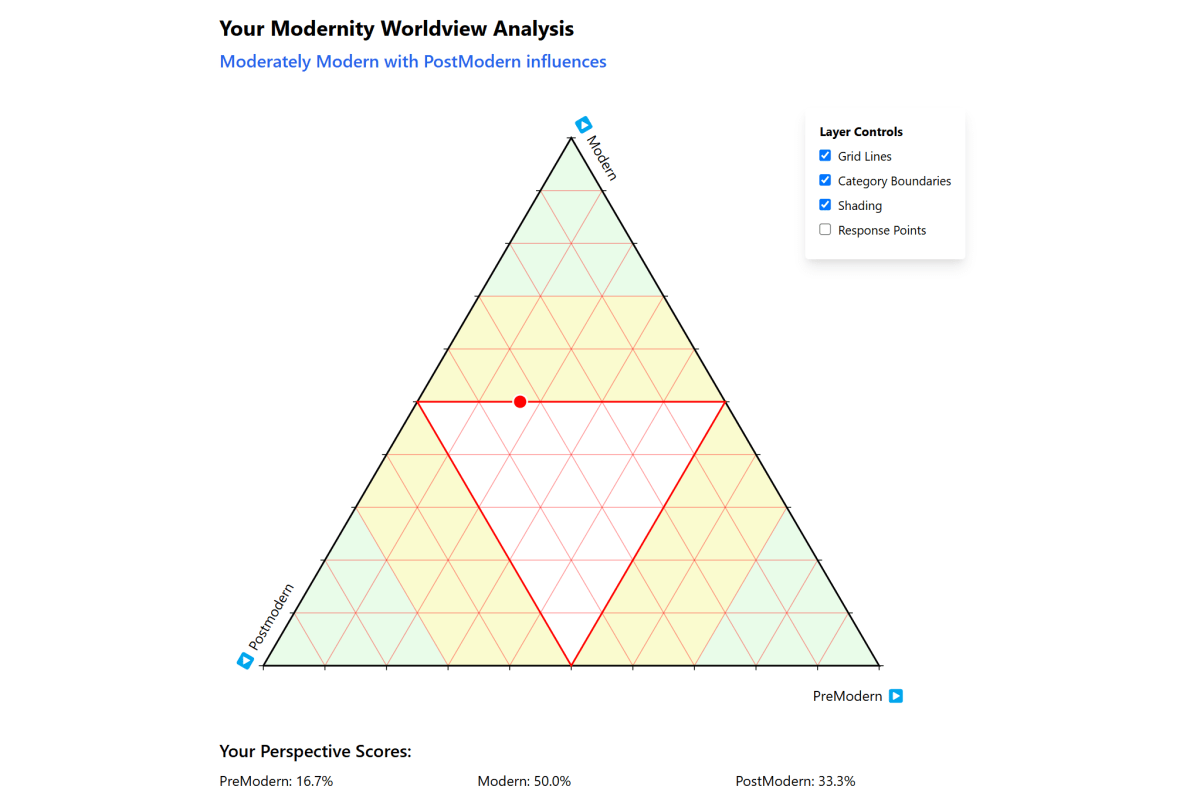
This post explains how to interpret the ternary plot chart’s visualisation. The ternary chart on the survey results page will render something like this. This is an admin page with additional functionality, but it’s similar enough. The blue dot represents the average of all responses. The star represents where I guessed the average would land–mostly modern with some residual premodernity and a touch of postmodernity.

Under the title in the header is a textual assessment of the visualisation. In this case, the response illustrates someone moderately modern with postmodern influences. Although this person also has some premodern tendencies, they are relatively insignificant to the context.

The three possible worldviews are at the vertices (the corners) of the triangle. Each side is a scale progressing from 0% to 100%—100% coincident with the label. For example, the bottom side runs from 0 on the left to 100 on the right, which would indicate a score of 100 per cent Premodern, which the output deems Pure Premodern.

Notice that each vertex has green and yellow shading that serves as visual aids representing the strength of the relationship to the corner. Green is strong, and yellow is moderate. The white section outlined by an interior triangle with a red border is decidedly mixed, showing no strong inclination to any of the extremes.

In the example above, the red plot point illustrates a response (as shown below the chart) that is 20.7% Premodern, 52.1% Modern, and 27.2% Postmodern. These numbers should always sum to 100, though there will be some drift due to rounding. The star represents where I thought the average response would be. Follow the tickmarks on each side, and you’ll notice they correspond with the plot point as a 3-tuple (20, 70, 10).

In the future, I expect to render a view that plots the average survey response as a reference.

Below this chart is an expository account of the response choices. You can render this content as a PDF for your personal archive.

Final Word

If you have any questions or suggestions related to this topic, please feel free to leave them in the comments below.

Survey Drama Llama

Firstly, I’d like to thank the people who have already submitted responses to the Modernity Worldview Survey. I’ll post that you submitted entries before this warning was presented.


» Modernity Worldview Survey «


Google has taken action and very responsively removed this warning. If you saw this whilst attempting to visit the URL, try again. Sorry for any fright or inconvenience. I’ll continue as if this never happened. smh


I am frustrated to say the least. I created this survey over the past month or so, writing, rewriting, refactoring, and switching technology and hosts until I settled on Google Cloud (GCP). It worked fine yesterday. When I visited today, I saw this warning.

As I mentioned in my announcement post, I collect no personal information. I don’t even ask for an email address, let alone a credit card number. On a technical note, this is the information I use:

id                 autogenerated unique identifier
timestamp          date and time stamp of record creation (UTC)
question-response  which response option made per question
ternary-triplet    the position of the average modernity score (pre, mod, post) 
plot_x             Cartesian x-axis plot point for the ternary chart
plot_y             Cartesian y-axis plot point for the ternary chart
session_id         facilitates continuity for a user's browser experience
browser*            which browser being used (Chrome, Safari, and so on)
region             browser's language setting (US, GB, FR)
source             whether the user is accessing from the web or 'locally'
                   ('local' indicates a test record, so i can filter them out)

* These examples illustrate the colected browser information:
- Mozilla/5.0 (Windows NT 10.0; Win64; x64) AppleWebKit/537.36 (KHTML, like Gecko) Chrome/132.0.0.0 Safari/537.36

- Mozilla/5.0 (Linux; Android 10; K) AppleWebKit/537.36 (KHTML, like Gecko) Chrome/132.0.0.0 Mobile Safari/537.36

This is all.

This is a Chrome Warning. Ironically, a Google product. I tested this on Opera, Edge, and Safari without this nonsense.

The front end (UI) is written in HTML, Python, JavaScript, and React with some standard imports. The backend (database) is MySQL. It is version-controlled on GitHub and entirely hosted on GCP. I link to the survey from here (WordPress) or other social media presences. I did make the mistake of not making the site responsive. I paid the price when I visited the site on my Samsung S24. The page felt like the size of a postage stamp. I may fix this once this security issue is resolved.

I sent Google a request to remove this from their blacklist. This could take three weeks, more or less.

Meantime, I’ll pause survey promotions and hope this resolves quickly. The survey will remain live. If you use something other than Chrome, you should be able to take it. Obviously, I’ll also delay analysing and releasing any summary results.

Apologies for rambling. Thank you for your patience.

Surveying Modernity

A Brief, Brutal Experiment in Categorising Your Worldview

This month, I’ve been tinkering with a little project—an elegant, six-question survey designed to assess where you land in the great intellectual mess that is modernity.

Audio: Podcast discussion about this post.

This isn’t some spur-of-the-moment quiz cooked up in a caffeine-fueled haze. No, this project has been simmering for years, and after much consideration (and occasional disdain), I’ve crafted a set of questions and response options that, I believe, encapsulate the prevailing worldviews of our time.

It all began with Metamodernism, a term that, at first, seemed promising—a bold synthesis of Modernism and Postmodernism, a grand dialectic of the ages. But as I mapped it out, it collapsed under scrutiny. A footnote in the margins of intellectual history, at best. I’ll expand on that in due course.

The Setup: A Simple, Slightly Sadistic Ternary Plot

For the visually inclined (or the masochistically curious), I initially imagined a timeline, then a branching decision tree, then a Cartesian plane before landing on a ternary plot—a three-way visual that captures ideological leanings in a way a boring old bar chart never could.

The survey itself is brief: six questions, each with five possible answers. Submit your responses, and voilà—you get a tidy little ternary chart plotting your intellectual essence, along with a breakdown of what your answers signify.

Methodology: Half-Rigorous, Half-Reckless

I am, after all, a (recovering) statistician, so I’ve tried to uphold proper methodology while also fast-tracking certain safeguards for the sake of efficiency. If there’s enough interest, I may expand the survey, adding more questions or increasing response flexibility (tick boxes instead of radio buttons—revolutionary, I know).

Privacy Concerns? Relax. I’m not harvesting your data for some nefarious scheme. No personally identifiable information is collected—just a timestamp, session ID, and your browser’s language setting. I did consider tracking IP addresses to analyze regional trends but ultimately scrapped that idea.

In the future, I may add an optional email feature for those who wish to save and track their responses over time (assuming anyone is unhinged enough to take this more than once).

The Rest of the Story: Your Feedback, My Amusement

Since this is a personal project crafted in splendid isolation, I’d love to hear your thoughts. Are the questions reasonable? Do the response options make sense? Does the summary feel accurate? Is the ternary chart decipherable, or have I constructed a glorified inkblot test?

As an academic, economist, and statistician, I had never encountered a ternary chart before embarking on this, and now I rather enjoy it. That said, I also find Nietzsche “intuitive,” so take that as you will.

If this gains traction, expect follow-up content—perhaps videos, podcasts, or further written explorations.

Your Move

Take the survey. It’s painless, requiring mere minutes of your life (which is, let’s be honest, already wasted online). And because I’m feeling generous, you can even generate a PDF to stick on your fridge, next to your collection of expired coupons and disappointing takeout menus.

Click here to take the survey.

Let’s see where you stand in the grand, chaotic landscape of modernity. Or at least, let’s have a laugh trying to make sense of it.

DISCLAIMER: The Modernity Worldview Survey is not scientific. It is designed as an experiment to provide directional insights. It is hosted on Google Cloud and subject to its availability and performance limitations.

Your Morals

I was commenting elsewhere on morals and was directed to Jonathan Haidt and his work. Notably, the questionnaire at YourMorals.org, where you can get your own assessment and contribute data points to the body of work.

Full disclosure: I am not a fan of this type of survey, as I’ve mentioned previously. Still, I made an attempt. Better still, I’ve copied the questions to critique. There are 36 all tolled. Perhaps, I’ll respond to a dozen at a time. The next dozen responses are here. Generally speaking, they present each question and provide a Likert scale as follows:

  1. Does not describe me at all
  2. Slightly describes me
  3. Moderately describes me
  4. Describes me fairly well
  5. Describes me extremely well

Standard fare. It starts off bad:

1. Caring for people who have suffered is an important virtue.

Why include an abstract concept like virtue? I don’t ascribe to the notion of virtue, so it’s an empty set. Given that, my response would be a 1. If I ignore the offensive nomenclature and assume it translates idiomatically into ‘beneficial for some target society’, then I still have to question what is meant by suffering, and how far does caring extend. Is it enough to feel bad about the homeless person, or does one have to care enough to provide sustenance and shelter? Talk is cheap.

2. The effort a worker puts into a job ought to be reflected in the size of a raise they receive.

This is fraught with all sorts of problems. In fact, it’s a reason why I consider myself to be a Postmodern. The inherent metanarrative is that societies are effectively money-based. I don’t happen to believe that, so I am again faced with responding to an empty set. Even if I attempt to abstract the ‘raise’ aspect to mean that effort represents input and output is a direct and (perhaps) proportional function, I am still left to wrestle with how this effort is measured and what could have been achieved had the others not been present.

Using a sports analogy—always a dangerous domain for me to play in—, what if LeBron James was to play an opposing team by himself? He needs the other team members. Of course, his teammates are compensated, too. But in his case, his salary is not only based on his athletic talent but on his celebrity power—rent in economic parlance. Perhaps LeBron makes a lot of baskets, but without the assists, he’d have fewer. And because he is the go-to guy, some other teammates might be sacrificing baskets as part of their winning strategy.

Finally, how do you measure the effort of an accountant, a janitor, and an executive? The question is fundamentally bollox.

3. I think people who are more hard-working should end up with more money.

On a related note, I can abbreviate my commentary here. Again, what is harder? Are we asking if construction workers should earn more than CEOs? More bollox.

4. Everyone should feel proud when a person in their community wins in an international competition.

Yet, again, an empty set and a sort of mixed metaphor. I don’t agree with the notion of identity and even less at scale—states, countries, and nationalities. Putting that aside, why should I derive pride (that cometh before the fall) because someone succeeds at some event anywhere? It’s facile. If the question was focused on whether I would be happy for that person, the answer might shift up the scale, but where would I have derived pride for that person’s achievements?

5. I think it is important for societies to cherish their traditional values.

First off, why? What values? Not to beat a dead horse, but what if my tradition is slavery? Should I cherish that? This is really asking should I cherish the traditions of my society. Clearly, it’s not asking if other societies should enjoy the privilege of cherishing theirs? From the standard Western vantage, many want to cherish their own, but not Eastern values of eating dogs or Middle Eastern values of burqaed women and turbans. Is this asking should the world subscribe to my society’s values? I’m not sure.

6. I feel that most traditions serve a valuable function in keeping society orderly

Speaking of tradition… We are not only dealing with the vague notion of tradition, we are discussing another vague concept, order, and elevating order over (presumably) disorder. Order connotes a status quo. And why is the superlative most present? Has someone inventoried traditions? I believe I am supposed to translate this as ‘I feel that the traditions I am familiar with and agree with help to create a society that I am content with’. Again, this betrays the privileged perspective of the observers. Perhaps those disenfranchised would prefer traditions like Capitalism and private property to be relics of the past–or traditions of two-party rule, partisan high court judges, or money-influenced politics, or politicians serving themselves and their donors over the people or Christmas.

7. We all need to learn from our elders

Learn what exactly from our elders? Which elders? The bloke down the block? That elderly Christian woman at the grocery mart? The cat who fought in some illegal and immoral war? The dude who hordes houses, cars, and cash at the expense of the rest of society? Or the guy who tried to blow up Parliament. I believe this is asking should we learn how to remain in place as taught by the privileged wishing to maintain their places.

8. Everyone should try to comfort people who are going through something hard

Define hard, and define comfort? This harkens back to the first question. Enough said. As far as lying is concerned, we should by now all be familiar with the adage trying is lying. Or as Yoda would restate it, do or do not, there is no try.

9. I think the human body should be treated like a temple, housing something sacred within

Obviously, this one is total rubbish. Here, I don’t have a structure that makes it difficult to answer. I may have sprained my eye rolling it, though. This said, what is a temple treated like?

10. I get upset when some people have a lot more money than others in my country

This one is interesting. Whilst I don’t believe that countries or money should exist. In practice, they do. So on its face, I can say that I get upset when we are thrown into a bordered region and told we need to exchange paper, metal, plastic, and bits for goods and services–that some people have more and others have less primarily through chance.

11. I feel good when I see cheaters get caught and punished

Which cheaters? Cheating requires perspective and a cultural code. It can privilege the individualist over the communalist. This reminds me of the cultures that are more interested in ensuring that all of their members finish a contest than having any one win.

Academically, it is considered to be cheating to work together on an exam because the individual is being tested. Of course, the exam is on certain content rather than on the contribution of the human being.

Again, the question feels targeted at cheaters getting caught circumventing something we value. If someone cheats becoming assimilated into some military-industrial society, I will encourage and support them. If they get caught and punished, my ire would more likely be directed toward the power structure that created the need to cheat.

12. When people work together toward a common goal, they should share the rewards equally, even if some worked harder on it

I’ll end this segment here on another question of meritocracy. I think it’s fair to judge the authors as defenders of meritocracy, though I could be wrong. This feels very similar to some other questions already addressed. The extension here is about sharing the rewards, whatever that means. Are we baking a cake? Did we build a house for a new couple? Did we plant trees in a public park? Did we clean up litter on a parkway? Did we volunteer to feed the homeless? And what was the work? Again, how are we measuring disparate work? Did the chicken farmer work harder than the cow farmer? Did the carpenter work harder than the organiser?

If the remainder of these questions is different enough, I’ll comment on them as well. Meantime, at least know you know more why I have little faith in the field of morals. This does nothing to change my opinion that morals are nothing more than emotional reactions and subsequent prescriptions. I don’t mean to diminish emotions, and perhaps that might be a good central pillar to a vibrant society. I’ll need more convincing.