NB: This is an idea I had kicking around, but it’s not really in my ballpark. Given my backlog, I don’t think I’ll pursue this. If anyone in the post-colonial space finds it interesting or adaptable, please pick it up as a kernel and run with it.
Thesis
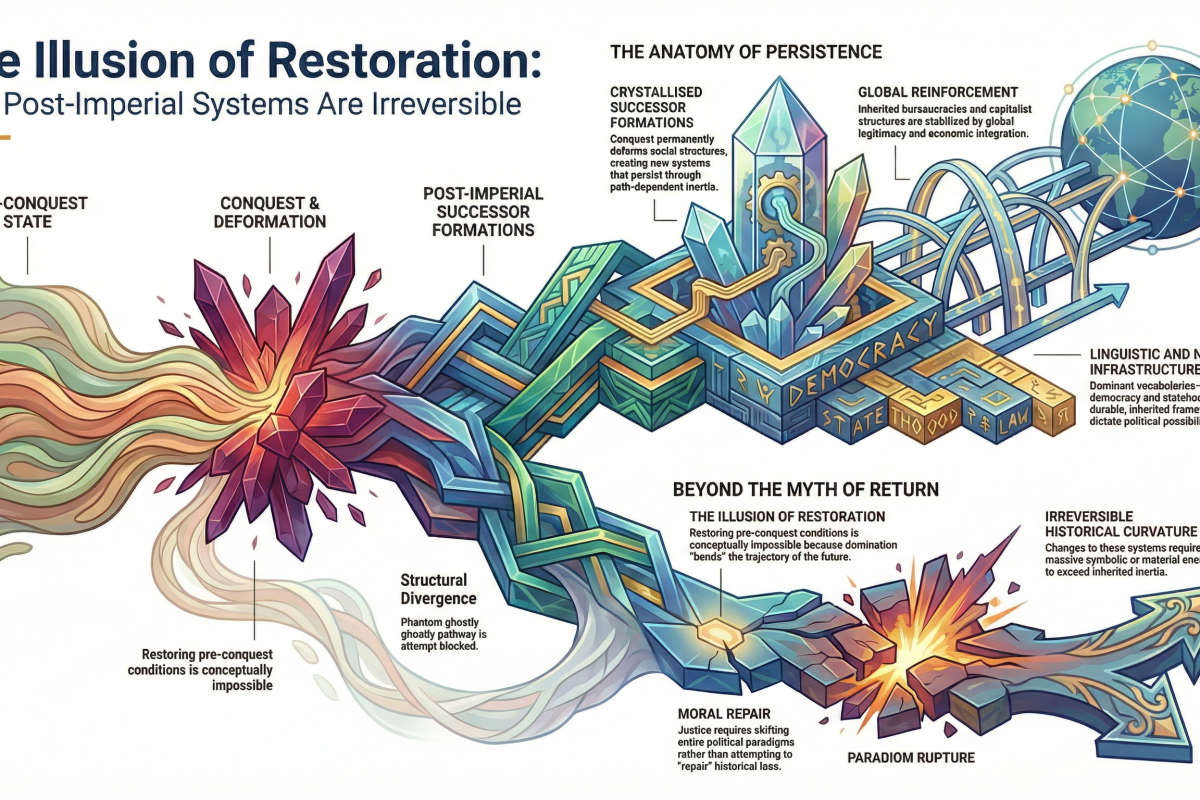
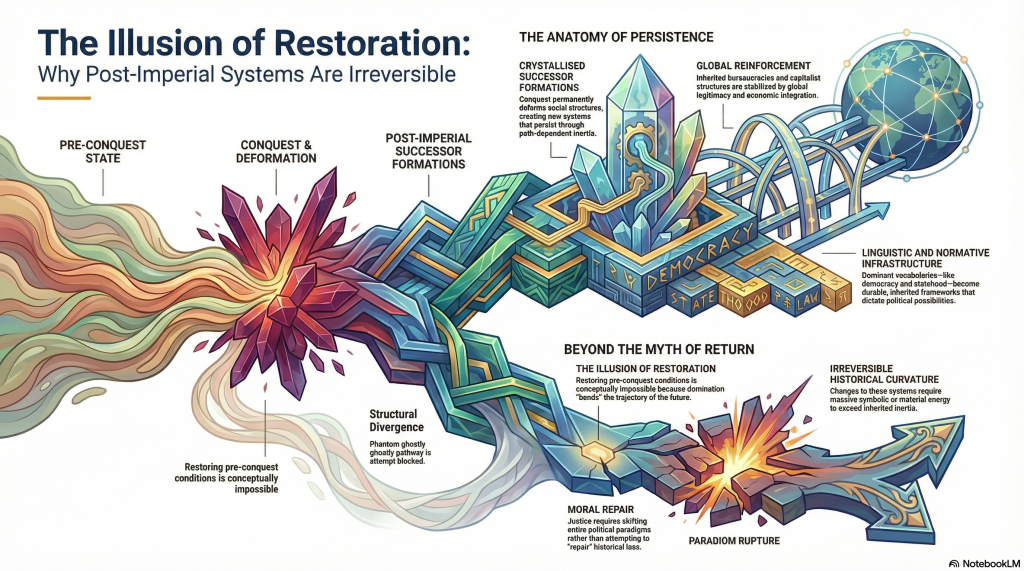
Post-imperial political orders do not restore pre-conquest social ontology but instead crystallise into historically irreversible successor formations whose institutional, linguistic, and normative structures persist through path-dependent inertia reinforced by global systems of legitimacy. Consequently, projects of restitution or decolonial restoration misrecognise the temporal dynamics of domination and must be reconceived as ethical and political negotiation within curved historical trajectories that can be altered only through paradigm-level rupture rather than moral repair.
Audio: NotebookLM summary podcast on this topic.
Abstract
This argues that post-imperial political transformation cannot be understood through narratives of restoration, restitution, or completed decolonisation. Conquest generates not only territorial dispossession but durable deformation of social ontology, producing successor formations structured by inherited administrative forms, linguistic infrastructures, and normative vocabularies – most prominently democracy, capitalism, and bureaucratic statehood – that persist through path-dependent institutional inertia. These structures endure not as static remnants but as dynamically stabilised systems reinforced by global regimes of legitimacy, economic integration, and mnemonic continuity.
Against both liberal accounts of reconciliation and radical imaginaries of full decolonial return, the analysis develops a framework of historical curvature and rupture. Domination bends the trajectory of possible futures, rendering restoration of a pre-conquest condition conceptually incoherent while leaving open the possibility of paradigm-level transformation when sufficient political, material, or symbolic energy accumulates to exceed inherited inertia. Justice after empire must therefore be reconceived not as repair of historical loss but as ethical and political negotiation within irreversibly transformed temporal horizons. This reframing clarifies persistent tensions surrounding sovereignty, restitution, and legitimacy in post-imperial orders and provides a diagnostic account of why decolonisation remains structurally incomplete despite formal independence.
We like to believe the world is governed by rules. By fairness. By international law, norms, institutions, treaties, and laminated charters written in earnest fonts. This belief survives not because it is true, but because it is psychologically necessary. Without it, we would have to admit something deeply unfashionable: power still runs the table.
Two and a half millennia ago, Thucydides recorded what remains the most honest conversation in political theory: the Melian Dialogue. No soaring ideals, no speeches about freedom. Just an empire explaining itself without makeup.
Audio: NotebookLM summary podcast of this topic.
Athens, the regional superpower of the ancient world, demanded that the small island of Melos surrender and pay tribute. Melos appealed to justice, neutrality, and divine favour. Athens replied with a line so indecently clear that political philosophy has been trying to forget it ever since: ‘The strong do what they can and the weak suffer what they must’.
That sentence is not an ethical claim. It is a descriptive one. It does not say what ought to happen. It says what does. The Athenians even went further, dismantling the very idea that justice could apply asymmetrically: ‘Justice, as the world goes, is only in question between equals in power’.
This is the part liberal internationalism prefers to skip, usually by changing the subject to institutions, norms, or aspirations. But the Athenians were being brutally honest. Appeals to fairness only work when neither side can impose its will outright. When there is a power imbalance, morality becomes theatre.
The Melians refused to submit. They chose honour, principle, and the hope that the gods would intervene. Athens killed every Melian man of fighting age and enslaved the women and children. End of dialogue. End of illusions. Fast-forward to now.
In early 2026, under Donald Trump, the United States launched a military operation against Venezuela, striking targets in Caracas and forcibly detaining Nicolás Maduro, who was transported to the United States to face federal charges. The justification was framed in familiar moral language: narco-terrorism, stability, regional security, democratic transition. The accompanying signals were less coy: temporary U.S. administration, resource access, and ‘order’. Cue outrage. Cue talk of illegality. Cue appeals to sovereignty, international law, and norms violated. All of which would have been very moving… to the Athenians.
Strip away the rhetoric and the structure is ancient. A dominant power identifies a weaker one. Moral language is deployed, not as constraint, but as narrative cover. When resistance appears, force answers. This is not a deviation from realism. It is realism functioning exactly as advertised.
Modern audiences often confuse realism with cynicism, as if acknowledging power dynamics somehow endorses them. It does not. It merely refuses to lie. The Melian Dialogue is not an argument for empire. It is an autopsy of how empire speaks when it stops pretending. And this is where the discomfort really lies.
We continue to educate citizens as if the world operates primarily on ‘shoulds’ and ‘oughts’, whilst structuring global power as if only ‘can’ and ‘must’ matter. We teach international law as though it binds the strong, then act shocked when it doesn’t. We pretend norms restrain power, when in reality power tolerates norms until they become inconvenient.
The Athenians did not deny justice. They reclassified it as a luxury good. Trump’s Venezuela operation does not abolish international law. It demonstrates its conditional application. That is the real continuity across 2,500 years. Not cruelty, not ambition, but the quiet consensus among the powerful that morality is optional when enforcement is absent.
The lesson of the Melian Dialogue is not despair. It is clarity. If we want a world governed by rules rather than force, we must stop pretending we already live in one. Appeals to fairness are not strategies. They are prayers. And history, as ever, is not listening.
Reparations, Sovereignty, and the Enduring Legacy of Colonialism
The story of Indigenous peoples in the United States is a story of profound loss—loss of land, culture, and sovereignty. But perhaps the most painful and enduring losses are the broken promises: the hundreds of treaties signed in good faith and then systematically violated. These broken promises have not only left Native nations impoverished and disenfranchised but have also created a debt so immense that, by some estimates, it could run into the trillions if fully accounted for.
The Weight of Broken Treaties
From the earliest days of European settlement, treaties were used as a tool of diplomacy between the United States government and Native nations. These treaties, over 370 in total, were meant to secure peace, land agreements, and coexistence. In exchange, Native peoples were promised sovereign rights, land, and, crucially, compensation in the form of resources, healthcare, education, and protection. Yet, these promises were almost universally broken, often within years of being signed.
The true cost of these broken promises is impossible to measure in simple monetary terms.
The true cost of these broken promises is impossible to measure in simple monetary terms. Land, culture, and sovereignty are not commodities that can be easily priced. However, if one were to quantify the economic and material loss incurred by Native peoples—through stolen land, expropriated resources, and missed opportunities—the total would be staggering. Some estimates suggest the cost could run into the hundreds of billions if not trillions when factoring in centuries of economic injustice, treble damages, and interest.
Calculating Reparations: Land, Wealth, and Justice
Any serious discussion of reparations must start with the land. Native nations once held over 2 billion acres of land in what is now the United States, a vast expanse rich with natural resources. Through a series of coercive treaties, legislation, and outright theft, much of this land was lost, culminating in the General Allotment Act (or Dawes Act) of 1887, which further fragmented Native lands and opened millions of acres for white settlers.
Reparations would need to account for the value of this land and the resources extracted from it—timber, minerals, oil, gas, and agricultural produce
Reparations would need to account for the value of this land and the resources extracted from it—timber, minerals, oil, gas, and agricultural produce—that have enriched generations of non-Native Americans. The land itself is invaluable, not just in terms of its market price but as the foundation of Indigenous identity, culture, and sovereignty. The land is not only an economic asset but a spiritual and cultural one. In this context, mere monetary compensation seems inadequate.
However, if we were to calculate reparations based on these lost lands and resources, the numbers quickly skyrocket. Consider the Black Hills of South Dakota, illegally seized from the Lakota after the discovery of gold, despite an 1868 treaty guaranteeing their sovereignty over the region. The Lakota have refused financial compensation for the Black Hills, insisting instead on the return of the land. The value of the Black Hills alone, when adjusted for inflation and interest, would be immense. And this is just one example. If treble damages were applied—tripling the original valuation to account for the egregiousness of the theft—the total would become astronomical.
Interest on Injustice
A crucial factor in calculating reparations is the interest accrued over time. The land was not just taken, but taken centuries ago, meaning that any fair compensation would need to account for the economic opportunities missed due to that loss. Compounded interest, a financial mechanism commonly applied in lawsuits to reflect the time value of money, would exponentially increase the debt owed. This debt is not just economic but cultural, as the loss of land also meant the loss of a way of life.
Reparations could…easily run into the trillions.
Reparations could, therefore, easily run into the trillions. This is not merely hypothetical. In 1980, the U.S. Supreme Court ruled in United States v. Sioux Nation of Indians that the U.S. government had illegally taken the Black Hills, and the Sioux were entitled to compensation. The sum awarded was $106 million—today, with interest, that figure exceeds $1 billion. Yet the Sioux have refused the payment, demanding the return of their land instead. Their stance underscores the inadequacy of financial compensation for the cultural and spiritual dimensions of the loss.
Beyond Dollars: The Moral and Ethical Case for Reparations
While the financial dimension of reparations is essential, the moral and ethical dimensions are equally important. Reparations are not simply about writing a cheque; they are about justice. The broken treaties were not merely legal failures but moral failures, reflecting a systemic disregard for Native sovereignty and human dignity. The U.S. government’s persistent violations of treaties reveal a deep-rooted pattern of exploitation and dishonour that continues to reverberate through Native communities today.
broken treaties were not merely legal failures but moral failures
Reparations, in this broader sense, must include the return of lands, the restoration of cultural and political autonomy, and a fundamental rethinking of the relationship between Native nations and the U.S. government. The return of land—such as in the Land Back movement—is a critical component of this. Land is not only a material asset but a living connection to identity, tradition, and the future. Restoring land to Native nations would not only right historical wrongs but also empower them to rebuild their communities on their own terms.
The Political Challenge of Justice
Despite the moral clarity of the case for reparations, political challenges remain immense. Many Americans are unaware of the extent of Native dispossession or may see reparations as impractical or divisive. Yet, as the fight for racial justice has shown, justice is often uncomfortable. The fact that reparations would be costly, complex, and difficult is not an excuse to avoid the issue. If anything, it highlights how deep and enduring the injustice is.
Reparations are not a “handout” but a payment of a debt long overdue.
Reparations are not a “handout” but a payment of a debt long overdue. Native nations were once economically, politically, and culturally self-sufficient. The disruption of their societies, through land theft and broken treaties, is the root cause of the poverty, health disparities, and political marginalisation they face today. Addressing this requires more than just policy tweaks; it demands a fundamental reckoning with the past.
Conclusion: Trillions Owed, Promises to Keep
The reparations owed for centuries of broken treaties, stolen land, and unfulfilled promises are not simply about money but about honouring the sovereignty and humanity of Indigenous peoples. The debt is vast—financially, morally, and ethically—but it must be addressed if there is to be any hope for genuine reconciliation. Justice, long delayed, can no longer be denied. This underscores the larger point that the United States rarely follow through on their commitments, but this is a story for another day. Meantime, they’ll continue running roughshod over their people and the world, bullying their way through it.
I’ve made several political posts in this space, but I was researching the backstory of the Ukraine-Russia conflict. Yet again, insufficiency of language is involved. It’s been said that the West promised not to expand NATO, ‘not one inch’, but it’s not clear whether NATO was the subject of that promise. Even Gorbachov said that NATO was not a topic of discussion, and that omission fell squarely on him. Even if this is the case, Putin made it clear in 2008 that this was his interpretation. Here’s a brief history for those interested. It’s decidedly not an academic affair, but I try to be neutral.
The Ukraine-Russia conflict is deeply rooted in the complex web of historical tensions and geopolitical dynamics that have shaped Eastern Europe from the Cold War to the present day. This article explores the critical developments and decisions from the end of World War II through to the events leading up to 2014, setting the stage for the current tensions.
From World War II to Cold War End
The geopolitical landscape of post-World War II Europe was significantly shaped at the Yalta Conference, where Allied leaders divided Europe into spheres of influence, leading to the establishment of a Soviet-dominated Eastern bloc. This division set the stage for the Cold War and the creation of NATO in 1949, a collective defence alliance that would come to play a central role in later tensions.
Collapse of the Soviet Union and Early Post-Cold War Hopes
The policies of glasnost and perestroika under Mikhail Gorbachev in the late 1980s, followed by the fall of the Berlin Wall, signalled a shift towards greater openness and potential integration. However, the dissolution of the Soviet Union in 1991 led to new states grappling with independence and the redefining of security and economic relations in the region. Initial hopes for a peaceful Europe were soon challenged by emerging security concerns.
NATO Expansion and Growing Tensions
NATO’s eastward expansion began in earnest in 1999 with the inclusion of the Czech Republic, Hungary, and Poland. This move, perceived by Russia as a strategic threat, reignited long-standing fears of encirclement and influenced Russia’s foreign policy. The expansion was justified by NATO as a way to stabilize Eastern Europe and integrate it into a democratic, peaceful Europe.
The 2008 Bucharest Summit
The 2008 NATO summit in Bucharest was a watershed moment. Although Ukraine and Georgia were not offered immediate membership, NATO’s declaration that they would eventually join the alliance was seen as provocative by Russia. The subsequent Russo-Georgian War in August 2008 underscored Russia’s willingness to use military force in response to perceived encroachments on its sphere of influence.
Deepening Crisis: 2010-2014
Relations continued to deteriorate with the EU’s Eastern Partnership program, which sought to deepen ties with former Soviet states, including Ukraine. The situation escalated dramatically in 2014 following the Euromaidan protests in Ukraine, the ousting of President Viktor Yanukovych, and Russia’s annexation of Crimea, a move widely condemned internationally but justified by Russia as a necessary defensive action.
Putin’s Defensive Stance
Throughout these developments, Vladimir Putin has maintained that NATO expansion represents a direct security threat to Russia. The narrative from the Russian perspective frames the expansion as a continuation of Cold War antagonism and a disregard for Russia’s security concerns, contrary to what they interpret as promises made during the 1990s.
Conclusion
This detailed narrative from the end of World War II through 2014 illuminates the complexities of Eastern European security dynamics and the challenges in reconciling the strategic interests of NATO and Russia. The ongoing conflict in Ukraine is deeply intertwined with these historical tensions, reflecting long-standing struggles for influence and security in post-Cold War Europe.
DISCLAIMER: Please note that the cover image is AI-generated—as if that isn’t immediately and obviously apparent.
Additional background and context.
If anything, perhaps this will help with SEO.
To provide a clearer picture of the discussions and statements made about NATO expansion during the early 1990s, particularly around the time of German reunification, here are some notable quotes and summaries from key figures involved:
James Baker (U.S. Secretary of State)
James Baker reportedly told Mikhail Gorbachev during a meeting in 1990:
“Not one inch eastward” was a phrase used by Baker to assure Gorbachev about NATO’s military posture not moving eastward, in the context of German reunification. This phrase has been widely cited but is subject to interpretation regarding its precise meaning and whether it referred to broader NATO expansion.
Mikhail Gorbachev (Soviet President)
Gorbachev’s response to these discussions has been a source of significant interest:
“The topic of ‘NATO expansion’ was not discussed at all, and it wasn’t brought up in those years. I say this with full responsibility. Not a single Eastern European country raised the issue, not even after the Warsaw Pact ceased to exist in 1991.” – Gorbachev, in later interviews, emphasized that the assurances were more about not deploying NATO troops to Eastern Germany than about preventing future NATO expansion.
Hans-Dietrich Genscher (German Foreign Minister)
Genscher’s position was similarly focused on reducing Soviet fears about NATO:
“NATO should rule out an ‘expansion of its territory towards the east, i.e. moving it closer to the Soviet borders.'” – Genscher said this in a speech in Tutzing, Germany, in 1990, which was aimed at assuaging Soviet concerns about German reunification and NATO.
Western and Soviet Interpretations
The assurances regarding NATO not expanding “one inch eastward” were primarily discussed in the context of German reunification and the integration of East Germany into NATO without expanding NATO’s military presence further east. The ambiguity lies in whether these assurances were understood to apply only temporarily or permanently, and specifically to Eastern Germany or more broadly to Eastern Europe.
Later Developments
After these discussions, in 1991 and beyond, the situation changed dramatically with the dissolution of the Soviet Union. The security landscape in Europe was fundamentally altered, leading to different priorities and decisions. By the mid-1990s, the question of broader NATO expansion became a topic of much debate, and in 1999, several former Eastern Bloc countries were admitted into NATO.
Conclusion
The quotes and the context they were spoken in reveal the complexities of diplomatic communications and the difficulties in interpreting what was meant and understood by different parties. These discussions were contingent on numerous factors, including the rapidly changing geopolitical landscape following the end of the Cold War.
I have agreed with this sentiment for as long as I can remember, at least stretching back to age 10 or 12 and long before I had ever heard of the likes of Proudhon. I don’t believe that Proudhon is a big focus in the United States. I never encountered him in all of my studies from kindergarten to grad school—and I was an economics major.
In the US, disparaging Marx was always in vogue, with the off-hand remark along the lines of “Communism works on paper, but because of human nature, it can’t work in practice. And by the way, look at the Soviet Union. That’s all the proof you need.” Of course, I was left thinking that at least it worked on paper, something I can’t say with a straight face for Democracy.
For those who are familiar with Proudhon, he is likely remembered for his quote, “Property is theft!” I’ve discussed this before.
La propriété, c’est le vol!
Property is theft!
But this is a different quote: “I do not wish to be either ruler or ruled.” When I was in high school, there was a saying, lead, follow, or get out of the way. As imperfect of a metaphor as it is, I just wanted out of the way. In the world of leaders and followers, I wanted to be an advisor. In a manner—given the false dichotomy of followers and leaders—, this relegated me a de facto follower. Only I am not a follower. I not only question authority and authority figures, I question the legitimacy of their power. Not a great follower, to be sure.
I feel I am the peasant in Monty Python’s Holy Grail who tells King Arthur upon encountering him, “Well, I didn’t vote for you.” Not that voting yields some source of legitimacy. What options does one have?
Philosophically speaking, there is no justification for personal bodily autonomy. Someone just made this claim, and some others agreed. Sounds good to me, but there is no real reason to support the idea save for selfish rationale.
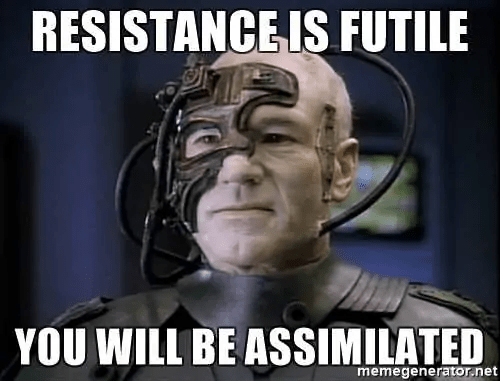
The science fiction staple, Star Trek, famously created a Borg where autonomy was futile. Because of our acculturation, we find this idea perhaps silly or perhaps appalling or absurd, but one is not more justifiable than another except by rhetorical devices. Yet neither is right.
Resistance is futile!
In the West, we tend to prefer a rather middle path, and perception doesn’t actually comply with reality. I think that people believe that they are more autonomous than they are. I’d be willing to argue that this is the same delusion underlying a sense of free will. Sartre might have argued that we each retain a sort of nuclear option as a last resort, but a choice between two options is hardly freedom. It sounds a lot like Sophie’s Choice (spoiler alert).
Not so come across like Hobbes, but I do feel that violence (subject to semantic distinction), or at least the potential for it, is inherent in any living system. With political and legal systems, violence just shifts from explicit to implicit, and so out of sight, out of mind.
In any case, I do not wish to be either ruler or ruled. I just want to advise. I’m an introvert. I want to be left alone. I value the benefits of society and I participate at the margins, and that’s where I prefer to remain. If the direction of the train I am on seems to be running off the tracks I’d presume it should be on, then I’ll get vocal. Otherwise, I’ll take the privilege to concentrate on cerebral and philosophical interests.
One topic I hear often, and most often from Libertarians, is that people ‘own’ their body. These people espouse body autonomy and self rule. In fact, this is a starting point and they extend it out to some imaginary boundary of limited government.
This sentiment is captured by pithy statements like
Your right to extend your fist ends at my nose.
Some guy
This all sounds well and good, yet there is no objective case that defends body self-ownership. Taking this position is simply latching onto normative, emotional rhetoric.
Personally, I like the idea that I should have some control over decisions leading to what happens to my body, but save for the idea content, I am under no delusion that this is self-evident or otherwise guaranteed. By extension, there is no reason in particular why sovereignty can be defended except through mutual contract and the tacit (and sometimes explicit) violence and the threat thereof, as I’ve commented on before.





 Philosophics