The Trolley Problem of For-Profit Healthcare:

Loops of Death and Denial

The trolley problem is a philosophical thought experiment that pits action against inaction. In the original version, a person faces a choice: a trolley hurtles down a track toward five people tied to the rails, but a lever allows the trolley to be diverted onto another track, where one person is tied. The dilemma is simple in its grotesque arithmetic: let five die or actively kill one to save them. A perennial favourite of ethics classes, the trolley problem is most often used to explore Consequentialism, particularly Utilitarianism, and its cool calculus of harm minimisation. Over the years, countless variations have been conjured, but few approach the nightmarish reality of its real-world application: the for-profit healthcare system in the United States.

With the recent death of UnitedHealthcare CEO Brian Thompson, the trolley dilemma takes on a new and morbid relevance. Let’s reframe the challenge.

The Healthcare Trolley Loop

Picture the trolley again on a bifurcated track. The lever remains, as does the moral agent poised to decide its fate. This time, the agent is Brian Thompson. The setup is simple: one track leads to the deaths of five people, and the other is empty. But here’s the twist: the trolley doesn’t just pass once in this versionβ€”it’s on a loop. At every interval, Thompson must decide whether to pull the lever and send the trolley to the empty track or allow it to continue its deadly course, killing five people each time.

But Thompson isn’t just deciding in a vacuum. The track with five people comes with a financial incentive: each life lost means higher profits, better quarterly earnings, and soaring shareholder returns. Diverting the trolley to the empty track, meanwhile, offers no payout. It’s not a single moral quandary; it’s a recurring decision, a relentless calculus of death versus dollars.

This isn’t just a metaphor; it’s a business model. For-profit healthcare doesn’t merely tolerate deathβ€”it commodifies it. The system incentivises harm through denial of care, inflated costs, and structural inefficiencies that ensure maximum profit at the expense of human lives.

Enter the Shooter

Now, introduce the wildcard: the shooter. Someone whose loved one may have been one of the countless victims tied to the track. They see Thompson at the lever, his decisions ensuring the endless loop of suffering and death. Perhaps they believe that removing Thompson can break the cycleβ€”that a new lever-puller might divert the trolley to the empty track.

Thompson is killed, but does it change anything? The system remains. Another CEO steps into Thompson’s place, hand on the lever, ready to make the same decision. Why? Because the tracks, the trolley, and the profit motive remain untouched. The system ensures that each decision-maker faces the same incentives, pressures, and chilling rationale: lives are expendable; profits are not.

The Problem of Plausible Deniability

The shooter’s actions are vilified because they are active, visible, and immediate. A single violent act is morally shocking, and rightly so. But what of the quiet violence perpetuated by the healthcare system? The denial of coverage, the refusal of life-saving treatments, the bankruptcy-inducing billsβ€”all are forms of systemic violence, their harm diffused and cloaked in the language of economic necessity.

The for-profit model thrives on this plausible deniability. Its architects and operators can claim they’re simply “following the market,” that their hands are tied by the invisible forces of capitalism. Yet the deaths it causes are no less real, no less preventable. The difference lies in perception: the shooter’s act is direct and visceral, while the system’s violence is passive and bureaucratic, rendered almost invisible by its banality.

A System Built on Death

Let’s not mince words: the current healthcare system is a death loop. It’s not an accident; it’s a feature. Profit-seeking in healthcare means there is always a financial incentive to let people die. During the Affordable Care Act (ACA) debates, opponents of universal healthcare decried the spectre of “death panels,” bureaucrats deciding who lives and who dies. Yet this is precisely what for-profit insurance companies doβ€”only their decisions are driven not by medical necessity or moral considerations, but by spreadsheets and stock prices.

This is the logic of capitalism writ large: maximise profit, externalise harm, and frame systemic failures as unavoidable. Healthcare is merely one example. Across industries, the same dynamic plays out, whether in environmental destruction, labour exploitation, or financial crises. The trolley always runs on tracks built for profit, and the bodies left in its wake are just collateral damage.

How to Break the Loop

The death of Brian Thompson changes nothing. The system will simply produce another Thompson, another lever-puller incentivised to make the same deadly decisions. Breaking the loop requires dismantling the tracks themselves.

  1. Remove the Profit Motive: Healthcare should not be a marketplace but a public good. Universal single-payer systems, as seen in many other developed nations, prioritise care over profit, removing the incentive to let people die for financial gain.
  2. Recognise Passive Harm as Active: We must stop excusing systemic violence as “inevitable.” Denying care, pricing treatments out of reach, and allowing medical bankruptcy are acts of violence, no less deliberate than pulling a trigger.
  3. Hold the System Accountable: It’s not just the CEOs at fault; the lawmakers, lobbyists, and corporations sustain this deadly status quo. The blood is on their hands, too.

Conclusion: The Real Villain

The shooter is not the solution, but neither is their act the real crime. The healthcare systemβ€”and by extension, capitalism itselfβ€”is the true villain of this story. It constructs the tracks, builds the trolley, and installs lever-pullers like Brian Thompson to ensure the loop continues.

When will it end? When we stop debating which track to divert the trolley toward and start dismantling the system that made the trolley inevitable in the first place. Until then, we are all complicit, passengers on a ride that profits from our suffering and death. The question isn’t who’s at the lever; it’s why the trolley is running at all.

The Truth About Lying

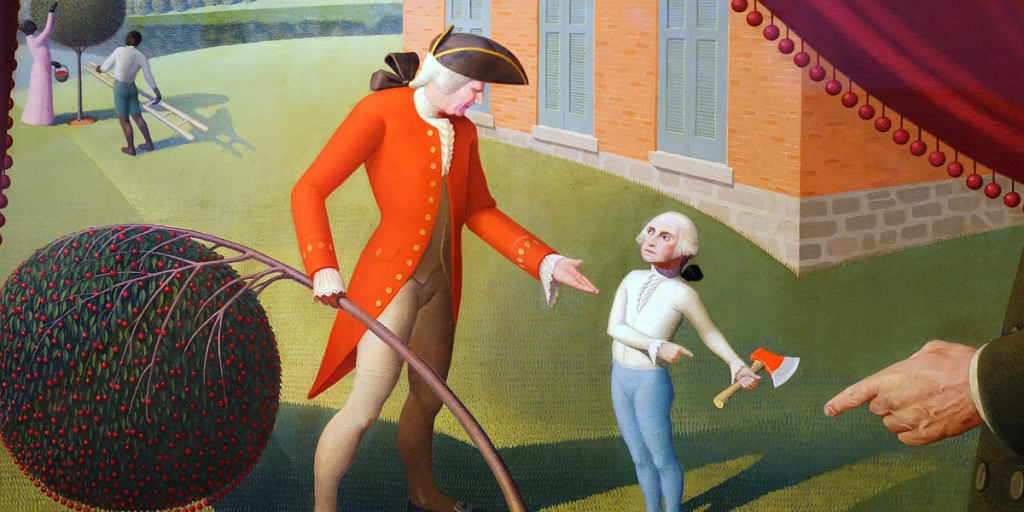
Every American knows that George Washington cannot tell a lie, so he confesses to chopping down a cherry tree. Much of American (and pretty much any) history is rife with lies. Sure, some myths, fables, and legends contain some kernel of truth, but they’re ostensibly propaganda and lies. But what is it about humans and lying? Moreover, if you don’t lie appropriately, you’re marginalised.

Why Honesty Gets You Shunned

Ah, truth. That elusive, glittering ideal we claim to cherish above all else. The thing we teach our children to uphold, weave into our national anthems, and plaster across inspirational posters. Yet, scratch the surface of human interaction, and you’ll find a murky, convoluted relationship with truthβ€”one that oscillates between romantic obsession and outright disdain. If truth were a person, it would be the friend we invite to parties but spend the whole night avoiding.

It’s not just that we lieβ€”we excel at it. We lie casually, reflexively, like it’s part of our evolutionary DNA. And here’s the kicker: we don’t just tolerate lying; we expect it. Worse still, they are promptly shunned when someone dares to buck the trend and embrace honestyβ€”unapologetically refusing to engage in the ritualistic deception that greases the wheels of society. It’s a paradox so rich it deserves its own soap opera.

Lying: The Social Glue That Binds Us

Let’s start with the uncomfortable truth: lying is essential to civilisation. Yes, the thing your kindergarten teacher told you was bad is the same thing that keeps society from collapsing into chaos. Without lies, polite society would implode under the weight of raw honesty.

  • The Politeness Lie: “Do these trousers make me look fat?” Imagine answering this question truthfully. You’d be ostracised by lunchtime.
  • The Collective Myth: From national pride to religious dogma, our shared liesβ€””We’re the greatest country on Earth!” or “Our side never starts wars!”β€”are the glue that holds nations, ideologies, and social hierarchies together.

Without these lies, the faΓ§ade crumbles, and we’re left staring into the abyss of our inadequacies. Lies make the unbearable palatable. They provide comfort where truth would leave only discomfort and despair.

The Paradox of the Honest Outsider

Now here’s where it gets juicy: we claim to value honesty, yet we loathe the honest person. The unapologetic truth-teller is viewed not as virtuous but as insufferable. Why? Because they threaten the delicate equilibrium of our collective deceptions.

  • Social Disruption: Truth-tellers force us to confront realities we’d rather ignore. Like that co-worker who insists the team-building exercises are pointless, they upset the carefully curated fiction we’ve all agreed to believe.
  • Untrustworthy Honesty: Ironically, we often trust liars more than truth-tellers. The liar plays by the unspoken rules of the game, while the honest person seems unpredictable and even dangerous.
Image: Meme: ‘What’s your greatest weakness?’

Lies as Power Plays

From a Foucauldian perspective (because who doesn’t love a bit of Foucault?), lies are more than social lubricantsβ€”they are tools of power. Governments lie to maintain control, institutions lie to justify their existence, and individuals lie to navigate these systems without losing their minds.

But honesty? Honesty is a destabilising force. It’s a rebellion against the status quo. Those who reject lies challenge the structures of power that depend on them. This is why whistleblowers, truth-tellers, and sceptics are often ostracised. They expose the game, and in doing so, they risk collapsing the entire house of cards.

Cognitive Dissonance and Escalating Commitment

The real kicker is how we defend these lies. Once we’ve told or accepted a lie, we become invested in it. The psychological discomfort of admitting we’ve been dupedβ€”cognitive dissonanceβ€”leads us to double down.

  • Escalating Commitment: From minor fibs (“I’ll just hit snooze once”) to societal delusions (“This war is for freedom”), we defend lies because admitting the truth feels like self-destruction.

Meanwhile, the honest person, standing on the sidelines of this elaborate charade, becomes a threat. Their refusal to participate makes them a mirror, reflecting the absurdity of our commitment to the lie. And we hate them for it.

The Ostracism of Honesty

Shunning the truth-teller isn’t just a quirk of human behaviourβ€”it’s a survival mechanism. Lies are the foundation of the social contract. Refusing to lie or to accept lies is tantamount to breaking that contract.

  • The Group Protects Itself: Honest individuals are scapegoated to preserve cohesion. They’re labelled as rude, arrogant, or untrustworthy to justify their exclusion.
  • The Emotional Toll: Truth-tellers aren’t just rejectedβ€”they’re actively punished. This social cost ensures that most people choose compliance over honesty.

Is There Hope for Honesty?

So, where does this leave us? Are we doomed to live in a world where lies are rewarded and honesty is punished? Not necessarily. Here’s the silver lining: lies may be the glue that binds us, but truth is the solvent that cleanses.

  • Building Bridges: Truth-tellers who approach honesty with empathyβ€”rather than confrontationβ€”can foster change without alienating others.
  • Cultural Shifts: Societal norms around lying are not fixed. Movements like radical transparency in organisations or calls for accountability in politics show that change is possible.

The challenge is navigating the paradox: to live truthfully in a world that prizes deception without becoming a martyr for the cause.

Conclusion: The Truth Hurts, But Lies Hurt More

Our love-hate relationship with truth is as old as humanity itself. Lies comfort us, unite us, and shield us from the harshness of realityβ€”but they also entrap us. The truth-teller, though ostracised, holds a mirror to our collective delusions, forcing us to confront the uncomfortable question: what kind of world do we want to live in?

For now, it seems, we’d rather lie than answer honestly.

References

  1. Ariely, D. (2012). The Honest Truth About Dishonesty: How We Lie to Everyoneβ€”Especially Ourselves. Harper.
    • Explores everyday lies, self-deception, and the psychological mechanisms behind dishonesty.
  2. Raden, A. (2021). The Truth About Lies: The Illusion of Honesty and the Evolution of Deceit. St. Martin’s Press.
    • Examines the evolutionary and cultural roots of deception and its role in shaping human behaviour.
  3. Foucault, M. (1977). Discipline and Punish: The Birth of the Prison. Vintage Books.
    • A foundational text for understanding power dynamics, including how truth and lies are used to control and normalise behaviour.
  4. Foucault, M. (1980). Power/Knowledge: Selected Interviews and Other Writings, 1972–1977. Pantheon Books.
    • Delves into the relationship between power and the production of truth in society.
  5. Bok, S. (1999). Lying: Moral Choice in Public and Private Life. Vintage Books.
    • A comprehensive analysis of the ethical dimensions of lying and its societal implications.
  6. Smith, D. L. (2004). Why We Lie: The Evolutionary Roots of Deception and the Unconscious Mind. St. Martin’s Press.
    • Explores how deception is hardwired into the human psyche and its evolutionary advantages.
  7. Orwell, G. (1946). Politics and the English Language. Horizon.
    • A classic essay on how languageβ€”including liesβ€”is used as a tool of manipulation in politics.
  8. Arendt, H. (1972). Crises of the Republic. Harcourt Brace Jovanovich.
    • Particularly the essay “Lying in Politics,” which critiques the use of deception in public affairs.
  9. Trivers, R. (2011). The Folly of Fools: The Logic of Deceit and Self-Deception in Human Life. Basic Books.
    • Examines self-deception and its evolutionary benefits, shedding light on how lies operate at individual and societal levels.
  10. Nietzsche, F. (1873). On Truth and Lie in an Extra-Moral Sense (translated in Philosophy and Truth, 1979). Harper & Row.
    • A philosophical exploration of truth as a construct and the utility of lies.

Apologies

Apologies. The sacred cow of social rituals. We’re told they’re essentialβ€”an ego on its knees, a ritual cleansing of the proverbial moral ledger. And yet, for all their lofty promises of redemption and relationship mending, aren’t apologies just glorified public relations exercises?

If you don’t like my position, I apologise. This is my response to Philosophy Minis, a channel I follow.

The philosophical breakdown you provide is charmingly earnest: admit guilt, promise reform, and repair the damage. It sounds good, doesn’t it? But let’s not kid ourselvesβ€”this is an ideal that seldom leaves the page. In practice, apologies are often nothing more than a performance. The “I’m sorry if you took offense” genre is merely the tip of the iceberg; the whole construct is a social mirage, designed more to shield the offender than to restore the wronged.

Take the idea that a “good” apology must paint the apologizer as a villain. In the real world, does that happen? Rarely. Instead, we get the watered-down versionβ€”a careful choreography of noncommittal contrition, crafted to absolve the perpetrator while barely acknowledging the harm. It’s the politician’s bread and butter: “I made a mistake” becomes code for “I’m not actually sorry, but my PR team says I should say something.” Serial apologists thrive on this economy of empty gestures, repeating offences with impunity, because they know the script will always offer them an escape hatch.

Then there’s the supposed promise of changeβ€”β€œI will try my best not to do this again.” Admirable in theory, utterly laughable in execution. Actions speak louder than words, but apologies, divorced from tangible behavioural shifts, speak volumes about their futility. The self-flagellation of guilt is easy; reform is hard. The apology may declare, “This is not who I want to be,” but the track record often screams, “This is exactly who I am, and I’ll see you here next week.”

And let’s not forget the crowning jewel of the apology trilogy: relationship repair. The idea that an apology rebuilds bridges is as idealistic as it is naive. True repair requires more than words; it demands effort, time, and trustβ€”not the performative recitation of a three-step apology handbook. Worse, the insistence on a good apology as a relationship panacea risks shifting the burden onto the harmed party. If they don’t forgive, they’re the villain. Apologies weaponized as moral obligations are nothing short of emotional coercion.

Even the social utility of apologies feels overstated. Sure, children may warm to those who apologise, but is this truly evidence of moral profundity, or just a reflection of our preference for surface-level niceties? If anything, our societal obsession with apologies perpetuates the illusion that words can magically undo harm. This is a comforting narrative for offenders, but it does little for the offended.

Ultimately, apologies are not the noble moral endeavour they are so often made out to be. At best, they are flawed attempts at social cohesion; at worst, they are phatic placeholders that substitute genuine accountability with a hollow facsimile. Before we canonise the “good apology,” perhaps we ought to ask whether its real purpose is to humble the egoβ€”or to let it off the hook entirely.

The Scapegoat and the Spectacle

Girardian Lessons from a Violent Reckoning

The assassination of UnitedHealth CEO Brian Thompson is more than just a shocking headlineβ€”it’s a vivid tableau of modern society’s darkest impulses. For some, Thompson’s death represents long-overdue justice, a symbolic blow against the machinery of corporate greed. For others, it’s an unforgivable act of chaos that solves nothing. But as the dust settles, we’re left with an unsettling truth: both sides may be acting rationally, yet neither side emerges morally unscathed.

This event takes on deeper significance when viewed through the lens of RenΓ© Girard’s theories on mimetic rivalry and the scapegoat mechanism. It’s not just about one man or one systemβ€”it’s about the cycles of conflict and violence that have defined human societies for millennia.

Mimetic Rivalry: The Root of Conflict

Girard’s theory begins with a simple observation: human desires are not unique; they are mimetic and shaped by observing what others want. This inevitably leads to rivalry, as individuals and groups compete for the same goals, power, or symbols of status. Left unchecked, these rivalries escalate into social discord, threatening to tear communities apart.

Enter the scapegoat. To restore order, societies channel their collective aggression onto a single victim, whose sacrifice momentarily alleviates the tension. The scapegoat is both a symbol of the problem and a vessel for its resolutionβ€”a tragic figure whose elimination unites the community in its shared violence.

Thompson as Scapegoat

In this story, Brian Thompson is the scapegoat. He was not the architect of the American healthcare system, but his role as CEO of UnitedHealth made him its most visible face. His decisionsβ€”denying claims, defending profits, and perpetuating a system that prioritises shareholders over patientsβ€”embodied the injustices people associate with healthcare in America.

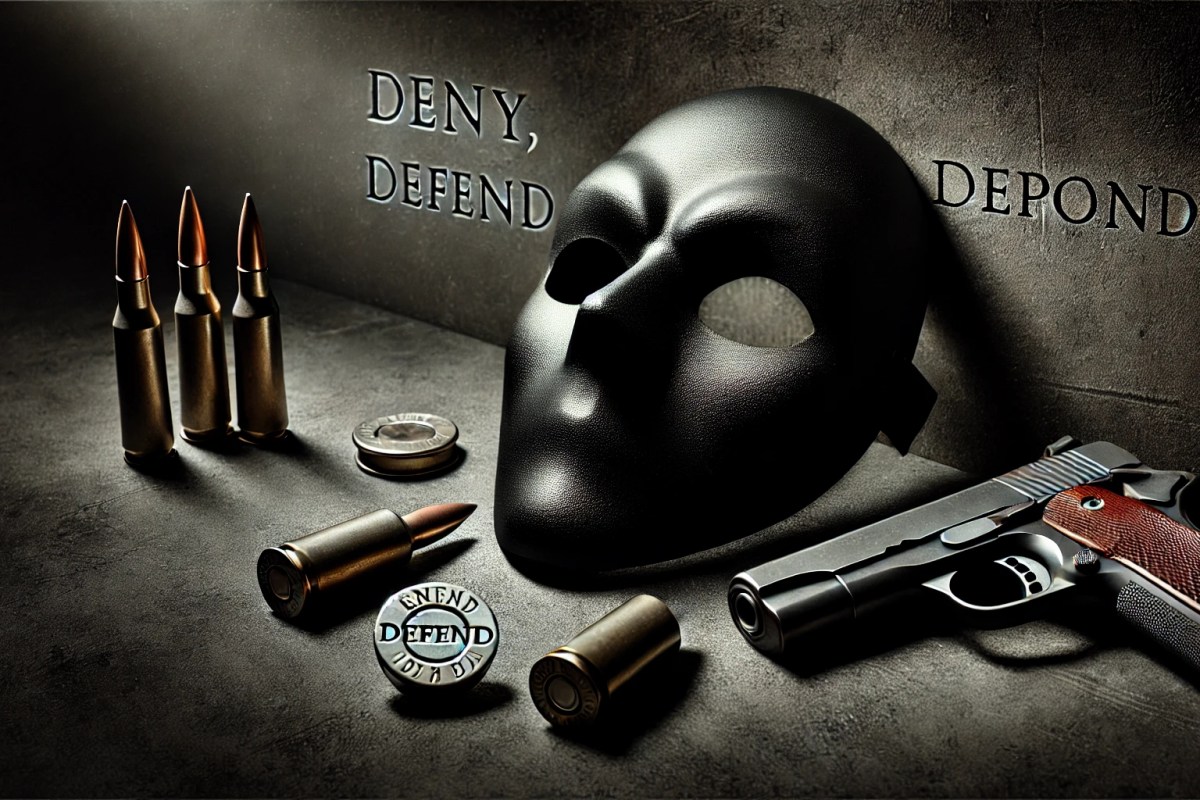
The assassin’s actions, however brutal, were a calculated strike against the symbol Thompson had become. The engraved shell casings found at the sceneβ€”inscribed with β€œDeny,” β€œDefend,” and β€œDepose”—were not merely the marks of a vigilante; they were the manifesto of a society pushed to its breaking point.

But Girard would caution against celebrating this as justice. Scapegoating provides only temporary relief. It feels like resolution, but it doesn’t dismantle the systems that created the conflict in the first place.

The Clash of Rationalities

Both Thompson and his assassin acted rationally within their respective frameworks. Thompson’s actions as CEO were coldly logical within the profit-driven model of American capitalism. Deny care, maximise profits, and satisfy shareholdersβ€”it’s a grim calculus, but one entirely consistent with the rules of the system.

The assassin’s logic is equally clear, though rooted in desperation. If the system won’t provide justice, then justice must be taken by force. From a Consequentialist perspective, the act carries the grim appeal of the trolley problem: sacrifice one life to save countless others. In this view, Thompson’s death might serve as a deterrent, forcing other executives to reconsider the human cost of their policies.

Yet Girard’s framework warns us that such acts rarely break the cycle. Violence begets violence, and the system adapts. The hydra of modern healthcareβ€”the very beast Thompson representedβ€”will grow another head. Worse, it may become even more entrenched, using this event to justify tighter security and greater insulation from public accountability.

β€œAn Eye for an Eye”

Mahatma Gandhi’s warning, β€œAn eye for an eye will only make the whole world blind,” resonates here. While the assassin may have acted with moral intent, the act itself risks perpetuating the very cycles of harm it sought to disrupt. The scapegoat mechanism may provide catharsis, but it cannot heal the underlying fractures in society.

Moving Beyond the Scapegoat

To truly break the cycle, we must confront the forces that drive mimetic rivalry and scapegoating. The healthcare system is just one manifestation of a larger problem: a society that prizes competition over cooperation, profit over people, and violence over dialogue.

The hydra story looms in the background here, its symbolism stark. Slaying one head of the beastβ€”be it a CEO or a policyβ€”will not bring about systemic change. But perhaps this act, as tragic and flawed as it was, will force us to reckon with the deeper question: How do we create a society where such acts of desperation are no longer necessary?

The answer lies not in finding new scapegoats but in dismantling the systems that create them. Until then, we remain trapped in Girard’s cycle, blind to the ways we perpetuate our own suffering.

Power Relations Bollox

As I put the finishing touches on the third revision of my Language Insufficiency Hypothesis manuscript, I find myself reflecting on the role of Foucault’s concept of Power Relations in shaping the use and interpretation of language in institutional contexts.

A key aspect of my hypothesis is the notion that some abstract conceptual language is intentionally vague. I touched on this idea in my recent article on the ambiguity of the term ‘gift’, but the implications extend far beyond that specific example. The strategic use of linguistic indeterminacy is a pervasive feature of many professional domains, serving to veil and enable subtle power plays.

NotebookLM Audio Podcast Discussion of this content.

In my manuscript, I examine the concept of ‘reasonableness’ as a prime example of this phenomenon. This term is a favourite hiding spot for legal professionals, appearing in phrases like ‘reasonable doubt’ and ‘reasonable person’.Yet, upon closer inspection, the apparent clarity and objectivity of this language dissolves into a morass of ambiguity and subjectivity. The invocation of reasonableness often serves as a rhetorical sleight of hand, masking the exercise of institutional power behind a veneer of impartiality.

While I don’t wish to venture too far into Nietzschean cynicism, there is a sense in which the legal system operates like a casino. The house always seeks to maintain its edge, and it will employ whatever means necessary to preserve its authority and legitimacy. In the case of reasonableness, this often involves a strategic manipulation of linguistic indeterminacy.

The court reserves for itself the power to decide what counts as reasonable on a case-by-case basis. Definitions that prove expedient in one context may be swiftly discarded in another. While skilled advocates may seek to manipulate this ambiguity to their advantage, the ultimate authority to fix meaning rests with the judge – or, in some instances, with a higher court on appeal. The result is a system in which the interpretation of key legal concepts is always subject to the shifting imperatives of institutional power.

This example highlights the broader significance of the Language Insufficiency Hypothesis. By attending to the ways in which abstract and contested terms can be strategically deployed to serve institutional ends, we can develop a more critical and reflexive understanding of the role of language in shaping social reality. In the process, we may begin to glimpse the complex interplay of power and meaning that underlies many of our most important professional and political discourses.

DΓ©s-intΓ©gration

Nous vivons une Γ©poque oΓΉ le langage est utilisΓ© non pas pour Γ©clairer, mais pour diviser et dΓ©tourner. L’Obamacare, dΓ©testΓ© dans son ensemble mais soutenu dans ses dΓ©tails, en est un parfait exemple. Cela reflΓ¨te un problΓ¨me plus fondamental : des concepts comme Β« dΓ©rΓ¨glement climatique Β» ou Β« inΓ©galitΓ©s systΓ©miques Β» deviennent des points de friction en raison de leur abstraction. Ce ne sont pas les scientifiques ou les activistes qui posent problΓ¨me, mais une structure de pouvoir qui manipule le discours pour diluer l’action.

DΓ©plaΓ§ons le dΓ©bat. Comme pour l’Obamacare, dΓ©construisons les concepts en Γ©lΓ©ments concrets : Γ©nergies renouvelables, adaptation agricole, redistribution des richesses. Chaque brique est plus comprΓ©hensible et soutenable que le mur idΓ©ologique qu’on nous oppose.

Le langage, dans sa complexitΓ©, peut Γͺtre insuffisant, mais il reste notre outil principal pour reconstruire des vΓ©ritΓ©s fragmentΓ©es. Γ€ nous de le manier avec prΓ©cision, en refusant de cΓ©der Γ  ceux qui le dΓ©forment pour mieux nous diviser.

Cela illustre parfaitement ma notion de Β«β€―dΓ©s-intΓ©grationβ€―Β». Ce terme, que je prΓ©fΓ¨re Γ  la Β«β€―dΓ©constructionβ€―Β» de Derrida, se distingue Γ©galement de l’usage courant de Β«β€―dΓ©sintΓ©grationβ€―Β». LΓ  oΓΉ la Β«β€―dΓ©constructionβ€―Β» appartient au domaine littΓ©raire et philosophique, et oΓΉ la Β«β€―dΓ©sintΓ©grationβ€―Β» Γ©voque une destruction pure, la Β«β€―dΓ©s-intΓ©grationβ€―Β» renvoie Γ  une mΓ©thode critique et analytique pour sΓ©parer un concept en ses composantes essentielles afin de le reconstruire ou le recontextualiser.

C’est exactement ce qu’il faut appliquer au dΓ©bat sur le changement climatique d’origine anthropique. PlutΓ΄t que de nous enfermer dans des abstractions globales qui polarisent, il faut fragmenter ce dΓ©bat en ses constituants concrets : l’énergie, l’industrie, l’agriculture, les infrastructures. En dΓ©composant ces Γ©lΓ©ments, nous pouvons redonner du sens et du pragmatisme Γ  des discussions souvent noyΓ©es sous l’idΓ©ologie.

LinkedIn est une plateforme horrible pour le partage. C’est pourquoi j’ai copiΓ© ma rΓ©ponse ici. Si vous avez accΓ¨s Γ  LinkedIn, la conversation gΓ©nΓ©rale s’y dΓ©roule.

https://www.linkedin.com/posts/arthur-auboeuf-03574312b_nous-avons-un-probl%C3%A8me-bien-plus-grave-que-activity-7269983848719921152-mxrw

Where you from, Homie?

This skit is a comical take on in-group versus out-group language insufficiency. It’s a couple years old, so you may have seen it before.

This video illustrates how easy it is for miscommunication to occur in mixed-group settings.
Trigger Warning: The humour is a bit weak and the focus is on stereotypes. If this isn’t quite up your street, just move on. Nothing to see here.

Guns, Germs, and Steel

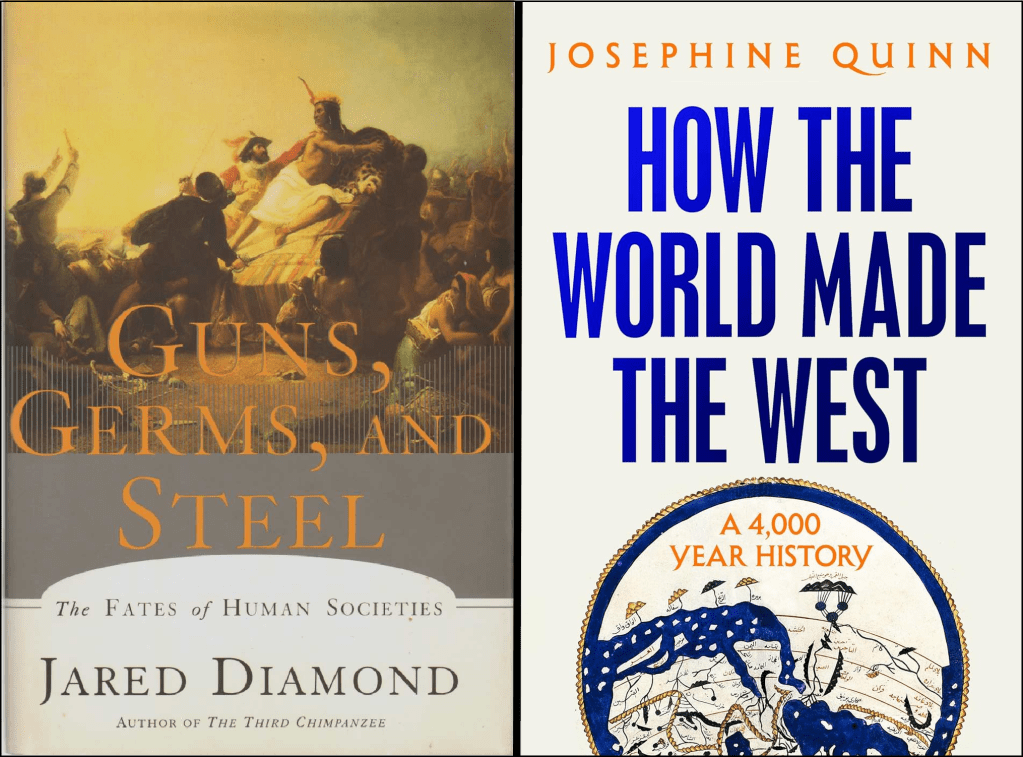
I am reading Jared Diamond’s Guns, Germs, and Steel: The Fates of Human Societies, the first and likely most famous of an informal trilogy. I thought I had already read it, but I think I only saw the PBS show. Having recently finished Josephine Quinn’s How the World Made the West, I wanted to revisit this perspective. The two books are presented in different styles and represent different perspectives, but they seem to be complementary.

Where Diamond focuses on environmental factors (an oft-voiced critique), Quinn focuses on human agency.

Diamond takes a bird’ s-eye view, looking for universal patterns and systemic explanations, whilst Quinn adopts a granular, specific approach, highlighting the fluidity and contingency of history.

Diamond deconstructs European dominance by attributing it to environmental luck, but his narrative risks sidelining the agency of colonised peoples. Quinn critiques the very idea of Western dominance, arguing that the concept of the West itself is a myth born of appropriation and exchange.

Rather than being wholly opposed, Diamond and Quinn’s approaches might be seen as complementary. Diamond provides the structural scaffolding – the environmental and geographic conditions that shape societies – whilst Quinn fills in the cultural and human dynamics that Diamond often glosses over. Together, they represent two sides of the historiographical coin: one focusing on systemic patterns, the other on the messiness of cultural particularities.

Quinn’s approach is more aligned with The Dawn of Everything: A New History of Humanity, co-authored by David Graeber and archaeologist David Wengrow, if you can use that as a reference point.

The Rise of AI: Why the Rote Professions Are on the Chopping Block

Medical doctors, lawyers, and judges have been the undisputed titans of professional authority for centuries. Their expertise, we are told, is sacrosanct, earned through gruelling education, prodigious memory, and painstaking application of established knowledge. But peel back the robes and white coats, and you’ll find something unsettling: a deep reliance on rote learningβ€”an intellectual treadmill prioritising recall over reasoning. In an age where artificial intelligence can memorise and synthesise at scale, this dependence on predictable, replicable processes makes these professions ripe for automation.

Rote Professions in AI’s Crosshairs

AI thrives in environments that value pattern recognition, procedural consistency, and brute-force memoryβ€”the hallmarks of medical and legal practice.

  1. Medicine: The Diagnosis Factory
    Despite its life-saving veneer, medicine is largely a game of matching symptoms to diagnoses, dosing regimens, and protocols. Enter an AI with access to the sum of human medical knowledge: not only does it diagnose faster, but it also skips the inefficiencies of human memory, emotional bias, and fatigue. Sure, we still need trauma surgeons and such, but diagnosticians are so yesterday’s news.
    Why pay a six-figure salary to someone recalling pharmacology tables when AI can recall them perfectly every time? Future healthcare models are likely to see Medical Technicians replacing high-cost doctors. These techs, trained to gather patient data and operate alongside AI diagnostic systems, will be cheaper, faster, andβ€”ironicallyβ€”more consistent.
  2. Law: The Precedent Machine
    Lawyers, too, sit precariously on the rote-learning precipice. Case law is a glorified memory game: citing the right precedent, drafting contracts based on templates, and arguing within frameworks so well-trodden that they resemble legal Mad Libs. AI, with its infinite recall and ability to synthesise case law across jurisdictions, makes human attorneys seem quaintly inefficient. The future isn’t lawyers furiously flipping through booksβ€”it’s Legal Technicians trained to upload case facts, cross-check statutes, and act as intermediaries between clients and the system. The $500-per-hour billable rate? A relic of a pre-algorithmic era.
  3. Judges: Justice, Blind and Algorithmic
    The bench isn’t safe, either. Judicial reasoning, at its core, is rule-based logic applied with varying degrees of bias. Once AI can reliably parse case law, evidence, and statutes while factoring in safeguards for fairness, why retain expensive and potentially biased judges? An AI judge, governed by a logic verification layer and monitored for compliance with established legal frameworks, could render verdicts untainted by ego or prejudice.
    Wouldn’t justice be more blind without a human in the equation?

The Techs Will Rise

Replacing professionals with AI doesn’t mean removing the human element entirely. Instead, it redefines roles, creating new, lower-cost positions such as Medical and Legal Technicians. These workers will:

  • Collect and input data into AI systems.
  • Act as liaisons between AI outputs and human clients or patients.
  • Provide emotional supportβ€”something AI still struggles to deliver effectively.

The shift also democratises expertise. Why restrict life-saving diagnostics or legal advice to those who can afford traditional professionals when AI-driven systems make these services cheaper and more accessible?

But Can AI Handle This? A Call for Logic Layers

AI critics often point to hallucinations and errors as proof of its limitations, but this objection is shortsighted. What’s needed is a logic layer: a system that verifies whether the AI’s conclusions follow rationally from its inputs.

  • In law, this could ensure AI judgments align with precedent and statute.
  • In medicine, it could cross-check diagnoses against the DSM, treatment protocols, and patient data.

A second fact-verification layer could further bolster reliability, scanning conclusions for factual inconsistencies. Together, these layers would mitigate the risks of automation while enabling AI to confidently replace rote professionals.

Resistance and the Real Battle Ahead

Predictably, the entrenched elites of medicine, law, and the judiciary will resist these changes. After all, their prestige and salaries are predicated on the illusion that their roles are irreplaceable. But history isn’t on their side. Industries driven by memorisation and routine applicationβ€”think bank tellers, travel agents, and factory workersβ€”have already been disrupted by technology. Why should these professions be exempt?

The real challenge lies not in whether AI can replace these roles but in public trust and regulatory inertia. The transformation will be swift and irreversible once safeguards are implemented and AI earns confidence.

Critical Thinking: The Human Stronghold

Professions that thrive on unstructured problem-solving, creativity, and emotional intelligenceβ€”artists, philosophers, innovatorsβ€”will remain AI-resistant, at least for now. But the rote professions, with their dependency on standardisation and precedent, have no such immunity. And that is precisely why they are AI’s lowest-hanging fruit.

It’s time to stop pretending that memorisation is intelligence, that precedent is innovation, or that authority lies in a gown or white coat. AI isn’t here to make humans obsolete; it’s here to liberate us from the tyranny of rote. For those willing to adapt, the future looks bright. For the rest? The machines are comingβ€”and they’re cheaper, faster, and better at your job.

The Relativity of Morality: A Penguin’s Tale

I recently watched The Penguin on HBO Max, a series set in DC’s Batman universe. Ordinarily, I avoid television – especially the superhero genre – but this one intrigued me. Less spandex, more mob drama. An origin story with a dash of noir. I’ll spare you spoilers, but suffice it to say that it was an enjoyable detour, even for someone like me who prefers philosophy over fistfights.

This post isn’t a review, though. It’s a springboard into a larger idea: morality’s subjectivity – or, more precisely, its relativity.

Audio: Spotify podcast related to this topic.

Morality in a Vacuum

Morality, as I see it, is a social construct. You might carry a private moral compass, but without society, it’s about as useful as a clock on a desert island. A personal code of ethics might guide you in solitary moments, but breaking your own rules – eating that forbidden biscuit after vowing to abstain, for instance – doesn’t carry the weight of a true moral transgression. It’s more akin to reneging on a New Year’s resolution. Who’s harmed? Who’s holding you accountable? The answer is: no one but yourself, and even then, only if you care.

The Social Contract

Introduce a second person, and suddenly, morality gains traction. Agreements form – explicit or tacit – about how to behave. Multiply that to the level of a community or society, and morality becomes a kind of currency, exchanged and enforced by the group. Sometimes, these codes are elevated to laws. And, ironically, the act of adhering to a law – even one devoid of moral content – can itself become the moral thing to do. Not because the act is inherently right, but because it reinforces the structure society depends upon.

But morality is neither universal nor monolithic. It is as fractured and kaleidoscopic as the societies and subcultures that create it. Which brings us back to The Penguin.

Crime’s Moral Code

The Penguin thrives in a criminal underworld where the moral compass points in a different direction. In the dominant society’s eyes, crime is immoral. Robbery, murder, racketeering – all β€œbad,” all forbidden. But within the subculture of organised crime, a parallel morality exists. Honour among thieves, loyalty to the family, the unspoken rules of the game – these are their ethics, and they matter deeply to those who live by them.

When one criminal praises another – β€œYou done good” – after a successful heist or a precise hit, it’s a moral judgement within their own framework. Outside that framework, society condemns the same actions as abhorrent. Yet even dominant societies carve out their own moral exceptions. Killing, for instance, is broadly considered immoral. Murder is outlawed. But capital punishment? That’s legal, and often deemed not only acceptable but righteous. Kant argued it was a moral imperative. Nietzsche, ever the cynic, saw this duality for what it was: a power dynamic cloaked in self-righteousness.

In The Penguin, we see this dichotomy laid bare. The underworld isn’t without morals; it simply operates on a different axis. And while the larger society might disdain it, the hypocrisy of their own shifting moral codes remains unexamined.

Final Thoughts on the Series

I’ll save other philosophical musings about The Penguin for another time – spoilers would be unavoidable, after all. But here’s a quick review: the series leans into drama, eschewing flashy gimmicks for a grittier, more grounded tone. The writing is generally strong, though there are moments of inconsistency – plot holes and contrivances that mar an otherwise immersive experience. Whether these flaws stem from the writers, director, or editor is anyone’s guess, but the effect is the same: they momentarily yank the viewer out of the world they’ve built.

Still, it’s a worthwhile watch, especially if you’re a fan of mob-style crime dramas. The final episode was, in my estimation, the best of the lot – a satisfying culmination that leaves the door ajar for philosophical ruminations like these.

Have you seen it? What are your thoughts – philosophical or otherwise? Drop a comment below. Let’s discuss.