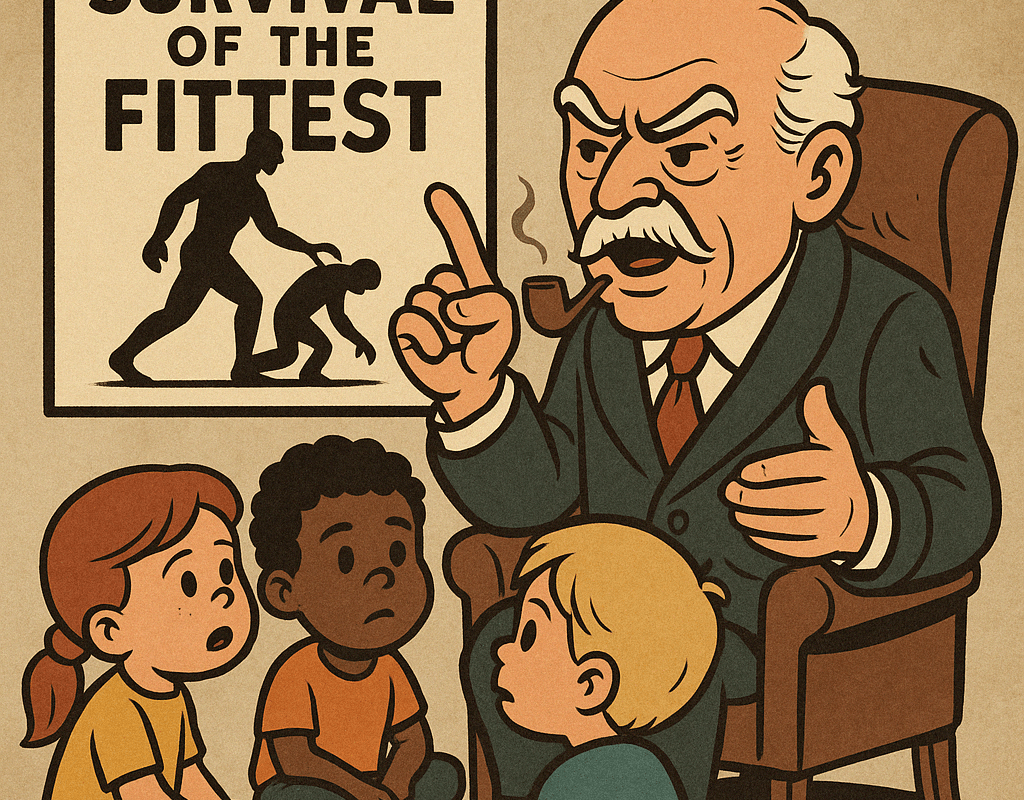
The Tyranny of “Human Nature”

There is a kind of political necromancy afoot in modern discourse—a dreary chant murmured by pundits, CEOs, and power-drunk bureaucrats alike: “It’s just human nature.” As if this incantation explains, excuses, and absolves all manner of violent absurdities. As if, by invoking the mystic forces of evolution or primal instinct, one can justify the grotesque state of things. Income inequality? Human nature. War? Human nature. Corporate psychopathy? Oh, sweetie, it’s just how we’re wired.

What a convenient mythology.

Audio: NotebookLM podcast on this topic.

If “human nature” is inherently brutish and selfish, then resistance is not only futile, it is unnatural. The doctrine of dominance gets sanctified, the lust to rule painted as destiny rather than deviance. Meanwhile, the quiet, unglamorous yearning of most people—to live undisturbed, to coöperate rather than conquer—is dismissed as naĂŻve, childish, and unrealistic. How curious that the preferences of the vast majority are always sacrificed at the altar of some aggressive minority’s ambitions.

Let us dispense with this dogma. The desire to dominate is not a feature of human nature writ large; it is a glitch exploited by systems that reward pathological ambition. Most of us would rather not be ruled, and certainly not managed by glorified algorithms in meat suits. The real human inclination, buried beneath centuries of conquest and control, is to live in peace, tend to our gardens, and perhaps be left the hell alone.

And yet, we are not. Because there exists a virulent cohort—call them oligarchs, executives, generals, kings—whose raison d’ĂŞtre is the acquisition and consolidation of power. Not content to build a life, they must build empires. Not content to share, they must extract. They regard the rest of us as livestock: occasionally troublesome, but ultimately manageable.

To pacify us, they offer the Social Contract™—a sort of ideological bribe that says, “Give us your freedom, and we promise not to let the wolves in.” But what if the wolves are already inside the gates, wearing suits and passing legislation? What if the protection racket is the threat itself?

So no, it is not “human nature” that is the problem. Cancer is natural, too, but we don’t celebrate its tenacity. We treat it, research it, and fight like hell to survive it. Likewise, we must treat pathological power-lust not as an inevitability to be managed but as a disease to be diagnosed and dismantled.

The real scandal isn’t that humans sometimes fail to coöperate. It’s that we’re constantly told we’re incapable of it by those whose power depends on keeping it that way.

Let the ruling classes peddle their myths. The rest of us might just choose to write new ones.

The Narcissist’s Playbook

I’ve lived in Los Angeles a couple of times for a sum total of perhaps 15 years. The first time, I loved it. The next time, I was running on fumes. The first time, I was in my twenties – the second time in my forties. What a difference perspective and ageing makes. In my twenties, I was a pretty-boy punk-ass who owned the club scene on the Strip. In my forties, I was a wage slave.

Audio: NotebookLM podcast on this topic.

This morning, I heard a country song on Insta with a line claiming ‘there are nines and dimes in all 50’, and it reminded me of a phrase we used when I lived in Los Angeles – ‘LA 7’. This is constructed on the egoist, sexist notion that if you were a 10, you’d have already moved to LA. If you still lived in, say, Iowa and were considered a 10, the exchange rate to LA would be a 7.

Then, I thought about the LA-NYC rivalry and wrote this article with some help from ChatGPT.

How L.A. and NYC Became the Centres of the Universe (According to Them)

It is a truth universally acknowledged that Los Angeles and New York City—those bickering siblings of American exceptionalism—believe themselves to be the sun around which the rest of us drearily orbit. Each is utterly convinced of its centrality to the human experience, and neither can fathom that people outside their borders might actually exist without yearning to be them. This is the essence of the ‘Centre of the Universe Complex,’ a condition in which self-importance metastasises into a full-blown cultural identity.

Let us begin with Los Angeles, the influencer of cities. L.A. doesn’t merely think it’s the centre of the universe; it believes it’s the universe, replete with its own atmosphere of smog-filtered sunlight and an economy powered entirely by dreams, green juice, and Botox. For L.A., beauty isn’t just a priority—it’s a moral imperative. Hence the concept of the ‘L.A. 10,’ a stunningly arrogant bit of mathematics whereby physical attractiveness is recalculated based on proximity to the Pacific Coast Highway.

Here’s how it works: a ’10’ in some picturesque-but-hopelessly-provincial state, say Nebraska, is automatically downgraded to a ‘7’ upon arrival in Los Angeles. Why? Because, according to L.A.’s warped ‘arithmetic, if she were a real 10, she’d already be there, lounging by an infinity pool in Malibu and ignoring your DMs. This isn’t just vanity—it’s top-tier delusion. L.A. sees itself as a black hole of good looks, sucking the beautiful people from every corner of the earth while leaving the ‘merely pretty’ to languish in flyover country. The Midwest, then, isn’t so much a place as it is an agricultural waiting room for future Angelenos.

But don’t be fooled—New York City is no better. Where L.A. is obsessed with beauty, NYC worships hustle. The city doesn’t just believe it’s important; it believes it’s the only place on earth where anything important happens. While L.A. is out perfecting its tan, NYC is busy perfecting its reputation as the cultural and intellectual capital of the world—or, at least, its part of the world, which conveniently ends somewhere in Connecticut.

This mindset is best summed up by that sanctimonious mantra, If you can make it here, you can make it anywhere. Translation: if you survive the daily humiliation of paying $4,000 a month for a shoebox apartment while dodging both rats and an existential crisis, you’ve unlocked the secret to life itself. New York isn’t about looking good; it’s about enduring bad conditions and then boasting about it as if suffering were an Olympic sport. In this worldview, the rest of the world is simply an unworthy understudy in NYC’s perpetual Broadway production.

And here’s the thing: neither city can resist taking cheap shots at the other. L.A. dismisses NYC as a grim, grey treadmill where fun goes to die, while NYC scoffs at L.A. as a vapid bubble of avocado toast and Instagram filters. It’s brains versus beauty, grit versus glamour, black turtlenecks versus Lululemon. And yet, in their relentless need to outshine one another, they reveal a shared truth: both are equally narcissistic.

This mutual self-obsession is as exhausting as it is entertaining. While L.A. and NYC bicker over who wears the crown, the rest of the world is quietly rolling its eyes and enjoying a life unencumbered by astronomical rent or the constant pressure to appear important. The people of Iowa, for example, couldn’t care less if they’re an ‘LA 7’ or if they’ve “made it” in New York. They’re too busy living comfortably, surrounded by affordable housing and neighbours who might actually help them move a sofa.

But let’s give credit where it’s due. For all their flaws, these two cities do keep the rest of us entertained. Their constant self-aggrandisement fuels the cultural zeitgeist: without L.A., we’d have no Kardashians; without NYC, no Broadway. Their rivalry is the stuff of legend, a never-ending soap opera in which both cities play the lead role.

So, let them have their delusions of grandeur. After all, the world needs a little drama—and nobody does it better than the cities that think they’re the centre of it.