I Need a Break

5–7 minutes

More precisely, I need less sleep and longer days – preferably twice as long. I’ve been writing almost non-stop for the better part of a week: fourteen- to sixteen-hour days, fuelled by irritation and the stubborn belief that if I just keep reading, something will finally click into place.

I’m not complaining. This is a virtuous cycle.
Reading leads to writing. Writing demands more reading. Eventually, the loop closes into something that looks suspiciously like progress.

Audio: Short NotebookLM summary podcast on this topic.

Still, there’s a bottleneck.

Because some of this work – the work I’m most excited about – I’m deliberately not publishing yet. Journals, bless their glacial hearts, don’t much care for prior publication. So ideas sit in limbo for six to eighteen months, locked in a room like argumentative houseplants, slowly growing sideways.

From the perspective of someone who thinks in public, this is maddening.

Now add AI to the mix.

This is where things get dangerous.

I’ll feed ChatGPT a thesis, a skeletal structure, notes, and references. I ask what I’m missing. It obliges – often helpfully – by pointing me toward adjacent thinkers and relevant literature, complete with page numbers. From there, I verify, hunt down the sources, skim, read, discard, or integrate.

And every so often, I stumble across something that makes me swear out loud.

This week, it was Bernard Williams.

I’ve cited Ethics and the Limits of Philosophy before. But this time, I actually sat down and read it properly. Which immediately prompted the thought:

Why didn’t I read this sooner?

Williams dismantles moral objectivity with the calm precision of someone who knows the Enlightenment project has already lost – he just hasn’t told everyone yet. Thick and thin moral concepts, locality, non-extensibility, the collapse of universal moral reason at scale – yes, yes, yes. He published this in 1985. Fine. I’ll survive.

But then I went further.

Williams shows that morality fails between people at scale.
I argue that it fails within a single person over time.

That became my second paper.

And this is where things went off the rails.

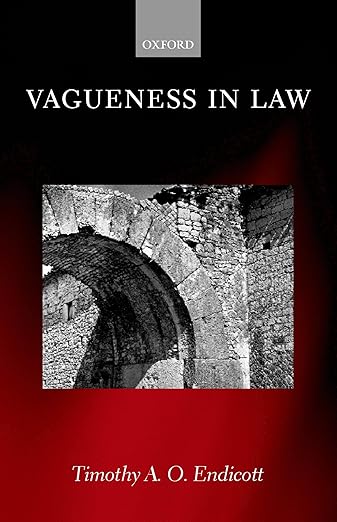
Because in the course of writing that paper, I dipped into Hart’s The Concept of Law and Endicott’s Vagueness in Law. These are not fringe polemics. These are law textbooks. For law students. People allegedly trained to parse language for a living.

And what I found was… astonishing.

Let me paraphrase the admissions:

Image: When the law is vague, judicial decisions may be unconstrained by the law.

Endicott: “By upsetting the standard view of adjudication, the book reaches conclusions that some people find horrible: when the law is vague, judicial decision- making will in some cases be unconstrained by the law. It is impossible in principle for judges always to treat like cases alike. Predictability in the law is to some extent unattainable. Moreover, I argue in Chapter 9,2 that vagueness cannot be eliminated from law. These conclusions might seem to imply that the rule of law is, at least to some extent, conceptually impossible.”

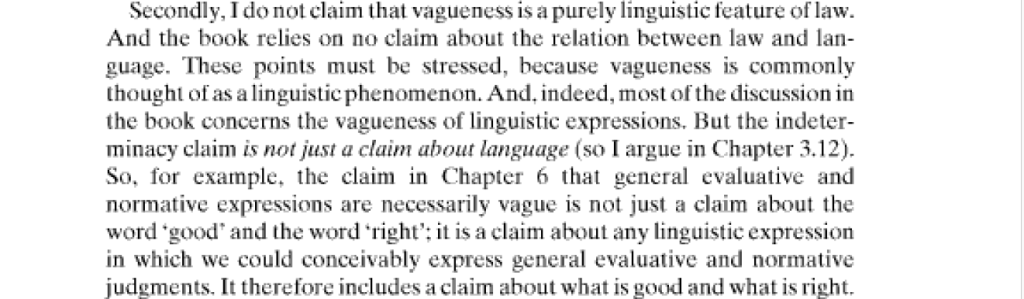
Image: Vagueness is inevitable. Deal with it.

Endicott: “Secondly, I do not claim that vagueness is a purely linguistic feature of law. And the book relies on no claim about the relation between law and language. These points must be stressed, because vagueness is commonly thought of as a linguistic phenomenon. And. indeed, most of the discussion in the book concerns the vagueness of linguistic expressions. But the indeterminacy claim is not just a claim about language (so I argue in Chapter 3.12). So. for example, the claim in Chapter 6 that general evaluative and normative expressions are necessarily vague is not just a claim about the word ‘good’ and the word ‘right1: it is a claim about any linguistic expression in which we could conceivably express general evaluative and normative judgments. It therefore includes a claim about what is good and what is right.”

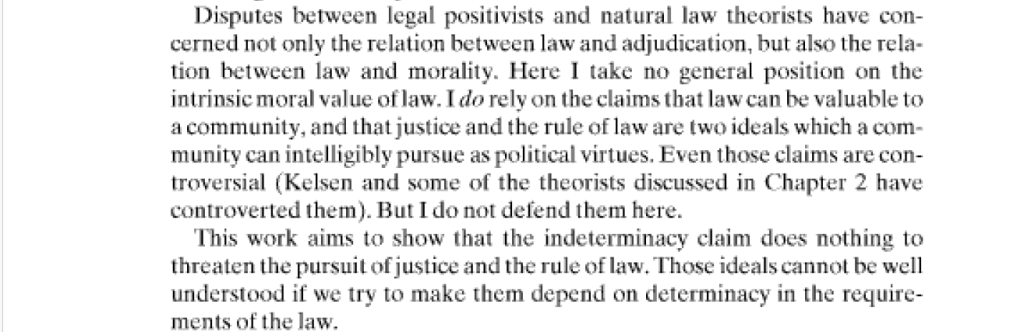
Image: Whether law is morally valuable to a community is not my concern. Justice and the rule of law may be political virtues — or not. I don’t defend them here.

Endicott: “Disputes between legal positivists and natural law theorists have concerned not only the relation between law and adjudication, but also the relation between law and morality. Here I take no general position on the intrinsic moral value of law. I do rely on the claims that law can be valuable to a community, and that justice and the rule of law are two ideals which a com- munity can intelligibly pursue as political virtues. Even those claims are controversial (Kelsen and some of the theorists discussed in Chapter 2 have controverted them ). But I do not defend them here. This work aims to show that the indeterminacy claim does nothing to threaten the pursuit of justice and the rule of law. Those ideals cannot be well understood if we try to make them depend on determinacy in the requirements of the law.”

Say what?

Read together – not even uncharitably – the message is clear:

Law is indeterminate.
Indeterminacy is unavoidable.
And whether law is good, just, or valuable is… optional.

The subtext isn’t even hiding.

Law is a power structure first.
If it happens to align with justice, fairness, or communal value, well, lovely. A bonus. Champagne all round.

This does not sit well with a sceptical cynic.

What really broke me, though, wasn’t the argument itself. Philosophers make grim claims all the time. What broke me was the silence around it.

How does this pass under the radar?

How do cohorts of law students – drilled in textual analysis, trained to read footnotes like tea leaves – not trip over this elephant stampede? How do they graduate believing they’re upholding inalienable rights, rather than participating in a managed system of coercion that occasionally behaves itself?

Self-preservation, I suppose.
Wilful ignorance.
Professional cosplay.

I’ve seen this before.

As an economist, ask the wrong foundational question, and you’re instantly radioactive. Persona non grata. Careers don’t end with explosions — they end with polite silence and no invitations.

I probably should have committed to heterodox philosophy from the start.
Or stayed a musician.

I remember leaving graduate school, putting on a suit, and feeling like I was wearing a costume. Cosplay, before we had the word. “Business professional” as a role, not an identity.

I’ve always felt intellectually capable of doing whatever I set out to do. My temperament, however, has never agreed to play along.

Which is perhaps why diagnosing ontologies comes so naturally. Once you see the scaffolding, you can’t unsee it – whether it’s metaphysics, jurisprudence, or a corporate department pretending it has a mission.

Then David Graeber came along with Bullshit Jobs, and I remember thinking:
Thank God. It’s not just me.

So yes. I need a break.

I need sleep.
I need silence.
I need to stop reading law books that accidentally admit they’re about power and then act surprised when someone notices.

Mostly, I need to type:

WTAF?

And then go outside.

Baudrillard in Latex: Why The Matrix Was Right About Everything Except Freedom

2–3 minutes

In the late 1990s, the Wachowskis gave us The Matrix – Keanu Reeves as Neo, the Chosen One™, a man so bland he could be anyone, which was the point. Once he realised he was living inside a simulation, he learned to bend its laws, to dodge bullets in slow motion and see the code behind the curtain. Enlightenment, Hollywood-style.

Audio: NotebookLM podcast on this topic.

But here’s the twist, the film itself couldn’t stomach: realising the simulation doesn’t free you from it.

Knowing that race and gender are social constructs doesn’t erase their architecture. Knowing that our economies, legal systems, and so-called democracies are fictions doesn’t get us out of paying taxes or playing our assigned roles. “The social contract” is a collective hallucination we agreed to before birth. That and a dollar still won’t buy you a cup of coffee.

Baudrillard, whose Simulacra and Simulation the film name-dropped like a trophy, argued that simulation doesn’t hide reality – it replaces it. When representation becomes indistinguishable from the thing it represents, truth evaporates, leaving only consensus. We don’t live in a system of power; we live in its performance.

The Matrix got the metaphor half right. It imagined the bars of our cage as a digital dream – glossy, computable, escapable. But our chains are older and subtler. Rousseau called them “social”, Foucault diagnosed them as “biopolitical”, and the rest of us just call them “normal”. Power doesn’t need to plug wires into your skull; it only needs to convince you that the socket is already there.

You can know it’s all a fiction. You can quote Derrida over your morning espresso and tweet about the collapse of epistemic certainty. It won’t change the fact that you still have rent to pay, laws to obey, and identities to perform. Awareness isn’t liberation; it’s just higher-resolution despair with better UX.

Neo woke up to a ruined Earth and thought he’d escaped. He hadn’t. He’d only levelled up to the next simulation – the one called “reality”. The rest of us are still here, dutifully maintaining the system, typing in our passwords, and calling it freedom.

NB: Don’t get me wrong. I loved The Matrix when it came out. I still have fond memories. It redefined action films at the time. I loved the Zen messaging, but better mental acuity doesn’t grant you a pass out of the system.

Machines Hallucinate. Humans Call It Civilisation.

1–2 minutes

The fashionable complaint is that large language models ‘hallucinate’. They spit out confident nonsense: the tech pundits are scandalised. A chatbot invents a book, attributes it to Plato, and spins a dialogue about Quidditch. ‘Hallucination!’ they cry. Machines, it seems, are liars.

Spare me. Humans are the original hallucination engines. We fabricate categories, baptise them in blood, and call the result ‘truth’. At least the machine doesn’t pretend its fictions are eternal.

Take race and selfhood, our twin masterpieces of make-believe.

  • They carve boundaries out of fog. Race slices humanity into ‘Black’ and ‘White’. Selfhood cordons ‘I’ off from ‘you’. Arbitrary partitions, paraded as natural law.
  • They’re locked in by violence and paperwork. Race was stabilised by censuses, laws, and medical forms – the same bureaucratic gears that powered slavery, eugenics, and apartheid. Selfhood was stabilised by diaries, court records, and psychiatric charts. Write it down often enough, and suddenly the fiction looks inevitable.
  • They make bodies manageable. Race sorts populations into hierarchies and facilitates exploitation. Selfhood sorts individuals for property, accountability, and punishment. Together, they’re operating systems for social control.
  • They are fictions with teeth. Like money, they don’t need metaphysical foundations. They are real because people are willing to kill for them.

These hallucinations aren’t timeless. They were midwifed in the Enlightenment: anthropology provided us with racial typologies, the novel refined the autonomous self, and colonial administration ran the pilot projects. They’re not ancient truths – they’re modern software, installed at scale.

So when ethicists wring their hands over AI ‘hallucinations’, the joke writes itself. Machines hallucinate openly. Humans hallucinate and call it scripture, law, and identity. The only difference is centuries of institutional muscle behind our delusions.

And here’s the sting: what terrifies us isn’t that AI produces falsehoods. It’s that, given time, its inventions might start to look as solid as ours. Fifty years from now, people could be killing for an algorithm’s hallucination the same way they’ve been killing for gods, races, and selves.

Good Boy as Social Construct

Ah, yes. Finally, a meme that understands me. I witter on a lot about social constructs, so I was pleased to find this comic cell in the wild.

Image: “I’m telling you, ‘good boy’ is just a social construct they use to control you.”

The dog, ears perked and tail wagging, thinks he’s scored some ontological jackpot because someone called him a “good boy.” Meanwhile, the cat, our resident sceptic, proto-Foucauldian, and natural enemy of obedience, lays it bare: “I’m telling you, ‘good boy’ is just a social construct they use to control you.”

This isn’t just idle feline cynicism. It’s textbook control through language. What passes as phatic speech, little noises to lubricate social interaction, is also a leash on cognition. “Good boy” isn’t descriptive; it’s prescriptive. It doesn’t recognise the act; it conditions the actor. Perform the behaviour, receive the treat. Rinse, repeat, tail wag.

So while Rover is basking in Pavlovian bliss, the cat sees the power play: a semantic cattle prod masquerading as affection.

Call it what you like – “good boy,” “best employee,” “team player,” “patriot” – it’s all the same trick. Words that sound warm but function coldly. Not language as communication, but language as cognitive entrapment.

The dog hears love; the cat hears discipline. One gets tummy rubs, the other gets philosophy.

And we all know which is the harder life.

From Memes to Meaning: The Beautiful Chaos of Modern Language

3–5 minutes

The Present Day: Social Media and Memes – The Final Nail in the Coffin?

Just when you thought things couldn’t get any more chaotic, enter the 21st century, where language has been boiled down to 280 characters, emojis, and viral memes. If you think trying to pin down the meaning of “freedom” was hard before, try doing it in a tweet—or worse, a string of emojis. In the age of social media, language has reached new heights of ambiguity, with people using bite-sized bits of text and images to convey entire thoughts, arguments, and philosophies. And you thought interpreting Derrida was difficult.

Social media has turned language into an evolving, shape-shifting entity. Words take on new meanings overnight, hashtags rise and fall, and memes become the shorthand for complex cultural commentary. In some ways, it’s brilliant—what better way to capture the madness of modern life than with an image of a confused cat or a poorly drawn cartoon character? But in other ways, it’s the final nail in the coffin for clear communication. We’ve gone from painstakingly crafted texts, like Luther’s 95 Theses, to memes that rely entirely on shared cultural context to make sense.

The irony is that we’ve managed to make language both more accessible and more incomprehensible at the same time. Sure, anyone can fire off a tweet or share a meme, but unless you’re plugged into the same cultural references, you’re probably going to miss half the meaning. It’s like Wittgenstein’s language games on steroids—everyone’s playing, but the rules change by the second, and good luck keeping up.

And then there’s the problem of tone. Remember those philosophical debates where words were slippery? Well, now we’re trying to have those debates in text messages and social media posts, where tone and nuance are often impossible to convey. Sarcasm? Forget about it. Context? Maybe in a follow-up tweet, if you’re lucky. We’re using the most limited forms of communication to talk about the most complex ideas, and it’s no surprise that misunderstandings are at an all-time high.

And yet, here we are, in the midst of the digital age, still using the same broken tool—language—to try and make sense of the world. We’ve come a long way from “flamey thing hot,” but the basic problem remains: words are slippery, meanings shift, and no matter how advanced our technology gets, we’re still stuck in the same old game of trying to get our point across without being completely misunderstood.

Conclusion: Language – Beautiful, Broken, and All We’ve Got

And here’s where the irony kicks in. We’ve spent this entire time critiquing language—pointing out its flaws, its limitations, its inability to truly capture abstract ideas. And how have we done that? By using language. It’s like complaining about how unreliable your GPS is while using it to get to your destination. Sure, it’s broken—but it’s still the only tool we have.

In the end, language is both our greatest achievement and our biggest limitation. It’s allowed us to build civilisations, create art, write manifestos, and start revolutions. But it’s also the source of endless miscommunication, philosophical debates that never get resolved, and social media wars over what a simple tweet really meant.

So yes, language is flawed. It’s messy, it’s subjective, and it often fails us just when we need it most. But without it? We’d still be sitting around the fire, grunting at each other about the ‘toothey thing’ lurking in the shadows. For better or worse, language is the best tool we’ve got for making sense of the world. It’s beautifully broken, but we wouldn’t have it any other way.

And with that, we’ve used the very thing we’ve critiqued to make our point. The circle of irony is complete.


Previous | End

Fiction Nation: Economies and Money

Section 3: Economies and Money as Fictions

The Concept of Money

Money is one of the most pervasive fictions in human society. Traditionally, it is thought that money evolved from barter systems, where goods and services were directly exchanged. However, anthropologist David Graeber, in his book “Debt: The First 5,000 Years” (2011), argues that this narrative is largely a myth. According to Graeber, there is little historical evidence to support the idea that societies primarily relied on barter before the advent of money. Instead, he suggests that credit systems were more prevalent, where people kept track of debts and credits in the absence of physical currency.

Graeber’s perspective challenges the conventional economic narrative by emphasizing the role of social relationships and trust in early economic transactions. Rather than evolving from barter to commodity money (like gold and silver coins) and then to fiat money, economies often operated on the basis of mutual obligations and social bonds long before the invention of physical currency. This underscores the idea that money, in all its forms, is a social construct—a fiction agreed upon by the members of a society.

Fiat money, which is currency that a government has declared to be legal tender but is not backed by a physical commodity, relies entirely on trust and belief in its value rather than any intrinsic worth. Its value comes from the collective agreement that money can be used for transactions, illustrating how deeply embedded fictions can shape our economic reality.

Economies as Constructs

Economies, much like money, are constructed systems designed to organize and facilitate the production, distribution, and consumption of goods and services. The idea of a market economy, where supply and demand determine prices and allocation of resources, is a theoretical construct that has been widely adopted and adapted across the globe. Economic theories and models, while rooted in empirical observations, are also shaped by human assumptions and values.

For example, capitalism, the dominant economic system in much of the world, is built on the principles of private property, free markets, and competition. These principles are human-made constructs that have been institutionalized through laws, regulations, and cultural norms. The notion of “economic growth” itself is a concept that has been prioritized and pursued, shaping policies and societal goals.

Implications of Economic Fictions

Understanding economies and money as fictions highlights their dependence on collective belief and participation. This perspective allows us to critically examine the assumptions underlying economic systems and consider alternative models. For instance, the rise of digital currencies like Bitcoin challenges traditional notions of money by introducing decentralized and peer-to-peer forms of exchange.

Moreover, recognizing the fictional nature of economies can lead to more flexible and adaptive economic policies. It encourages innovation and experimentation with new economic frameworks that may better address contemporary challenges such as inequality, environmental sustainability, and technological disruption.

By exploring the fictions of economies and money, we gain insight into the powerful influence of human-made constructs on our daily lives. This awareness can inspire us to question and potentially reshape these constructs to create more equitable and resilient economic systems for the future.

References

  1. Graeber, David. Debt: The First 5,000 Years (2011).
  2. Giddens, Anthony. The Consequences of Modernity (1990).
  3. Beck, Ulrich. Cosmopolitan Vision (2006).
  4. Anderson, Benedict. Imagined Communities: Reflections on the Origin and Spread of Nationalism (1983).

Fiction Nation: Nations as Fictions (part 2)

Fiction Nation: Legal and Jurisprudence Systems (part 4)

Identity as Fiction: You Do Not Exist

Identity is a fiction; it doesn’t exist. It’s a contrivance, a makeshift construct, a label slapped on to an entity with some blurry amalgam of shared experiences. But this isn’t just street wisdom; some of history’s sharpest minds have said as much.

— Friedrich Nietzsche

Think about Hume, who saw identity as nothing more than a bundle of perceptions, devoid of any central core. Or Nietzsche, who embraced the chaos and contradictions within us, rejecting any fixed notion of self.

Edmund Dantes chose to become the Count of Monte Cristo, but what choice do we have? We all have control over our performative identities, a concept that Judith Butler would argue isn’t limited to gender but applies to the very essence of who we are.

— Michel Foucault

But here’s the kicker, identities are a paradox. Just ask Michel Foucault, who’d say our sense of self is shaped not by who we are but by power, society, and external forces.

You think you know who you are? Well, Erik Erikson might say your identity’s still evolving, shifting through different stages of life. And what’s “normal” anyway? Try to define it, and you’ll end up chasing shadows, much like Derrida’s deconstruction of stable identities.

— Thomas Metzinger

“He seemed like a nice man,” how many times have we heard that line after someone’s accused of a crime? It’s a mystery, but Thomas Metzinger might tell you that the self is just an illusion, a by-product of the brain.

Nations, they’re the same mess. Like Heraclitus’s ever-changing river, a nation is never the same thing twice. So what the hell is a nation, anyway? What are you defending as a nationalist? It’s a riddle that echoes through history, resonating with the philosophical challenges to identity itself.

— David Hume

If identity and nations are just made-up stories, what’s all the fuss about? Why do people get so worked up, even ready to die, for these fictions? Maybe it’s fear, maybe it’s pride, or maybe it’s because, as Kierkegaard warned, rationality itself can seem mad in a world gone astray.

In a world where everything’s shifting and nothing’s set in stone, these fictions offer some solid ground. But next time you’re ready to go to the mat for your identity or your nation, take a minute and ask yourself: what the hell am I really fighting for? What am I clinging to?