EDIT: Since I first posted this, I’ve discovered that computer algorithms and maths are not playing well together in the sandbox. Those naughty computer geeks are running rogue from the maths geeks.
In grade school, we typically learn a form of PEMDAS as a mnemonic heuristic for mathematical order of operations. It’s a stand-in for Parentheses, Exponents, Multiplication, Division, Addition, and Subtraction. This may be interpreted in different ways, but I’ve got bigger fish to fry. It turns out that many (if not most) programming languages don’t implement around a PEMDAS schema. Instead, they opt for BODMAS, where the B and O represent Brackets and Orders—analogous to Parentheses and Exponents. The important thing to note is the inversion of MD to DM, as this creates discrepancies.
And it doesn’t end here. HP calculators interject a new factor, multiplication by juxtaposition, that mathematician and YouTuber, Jenni Gorham, notates as J resulting in PEJMDAS. This juxtaposition represents the implied multiplication as exemplified by another challenge;
1 ÷ 2✓3 =
In this instance, multiplication by juxtaposition instructs us to resolve 2✓3 before performing the division. Absent the J, the calculation results in ½✓3 rather than the intended 1/(2✓3). As with this next example, simply adding parentheses fixes the problem. Here’s a link to her video:
And now we return to our originally scheduled programming…
Simplifying concepts has its place. The question is where and when. This social media war brings this back to my attention.
As depicted in the meme, there is a difference of opinion as to what the answer is to this maths problem.
6 ÷ 2 ( 1 + 2 ) =
In grade school, children are taught some variation of PEMDAS, BOMDAS, BEDMAS, BIDMAS, or whatever. What they are not taught is that this is a regimented shortcut, but it doesn’t necessarily apply to real-world applications. The ones defending PEMDAS are those who have not taken maths beyond primary school and don’t use maths beyond some basic addition and subtraction. Luckily, the engineers and physicists who need to understand the difference, generally, do.
Mathematicians, scientists, and engineers have learned to transform the equation into the form on the left, yielding an answer of 1. If your answer is 9, you’ve been left behind.
Why is this such a big deal?
When I taught undergraduate economics, I, too, had to present simplifications of models. In practice, the approach was to tell the students that the simplification was like that in physics. At first, you assume factors like gravity and friction don’t exist—fewer variables, fewer complexities. The problem, as I discovered in my advanced studies, is that in economics you can’t actually relax the assumptions. And when you do, the models fail to function. So they only work under assumptions that cannot exist in the real world—things like infinite suppliers and demanders. Even moving from infinite to a lot, breaks the model. Economists know this, and yet they teach it anyway.
When I transitioned from undergrad to grad school, I was taken aback by the number of stated assumptions that were flat out wrong.
When I transitioned from undergrad to grad school, I was taken aback by the number of stated assumptions that were flat out wrong. Not only were these simplifications flat out wrong, but they also led to the wrong conclusion—the conclusion that aligned with the prevailing narratives.
This led me to wonder about a couple of things
Firstly, if I had graduated with an English degree and then became a PhD candidate in English, would I have also learnt it had mostly been a lie for the purpose of indoctrination?
Secondly, what other disciplines would have taught so much disinformation?
Thirdly, how many executives with degrees and finance and management only got the fake version?
Fourthly, how many executives hadn’t even gotten that? Perhaps they’d have had taken a class or two in each of finance and economics and nothing more. How many finance and economics courses does one need to take to get an MBA? This worries me greatly.
To be honest, I wonder how many other disciplines have this challenge. I’d almost expect it from so-called soft sciences, but from maths? Get outta here.
Half-life of knowledge
This also reminds me of the notion of the half-life of knowledge. What you knew as true may eventually no longer be. In this case, you were just taught a lie because it was easier to digest than the truth. In other cases, an Einstein comes along to change Newtonian physics into Oldtonian physics, or some wisenheimer like Copernicus determines that the cosmic model is heliocentric and not geocentric.
If you’ve been keeping up with my latest endeavour, you may be surprised that free will, human agency, identity, and the self are all human social constructs in need of remediation. Get ready to get out of your comfort zone or to entrench yourself in a fortress of escalating commitment.
Does digital technology make students stupid? That’s what a 2019 BigThink article asks. I like to read Big Think, but it seems like PopScience in a negative way—like Pop Psychology. It’s not necessarily directionally wrong. It’s just oversimplified and seeks the lowest common denominator.
On this topic, Plato quipped, voicing Socrates, in his Phædrus 14 dialogue except that his quip was relative to writing and memory. Some historians and Classicists have suggested that modern readers may be missing the satire. I’m no defender of human intelligence, but this is the demise of society because of change—whether due to writing, radio, television, computers, video games, mobile devices, and whatever comes up next.
For this invention will produce forgetfulness in the minds of those who learn to use it, because they will not practice their memory. Their trust in writing, produced by external characters which are no part of themselves, will discourage the use of their own memory within them. You have invented an elixir not of memory, but of reminding; and you offer your pupils the appearance of wisdom, not true wisdom, for they will read many things without instruction and will therefore seem to know many things, when they are for the most part ignorant and hard to get along with, since they are not wise, but only appear wise.
Plato – Dialogue Phædrus 14
Whether or not this claim has merit, my claim is that computers have trebled manufactured consent, so it allows people to be passively active, to have to specious notion of participation in the body politic, and yet are virtually tilting windmills.
It seems that some people have such nostalgia for their apparent way of life that any deviation is considered to be an affront and possible disruption. Perhaps, it’s because I feel there’s possibly as much to shed than to keep in my book, so for me, it’s more good riddance than oh heavens.
Some geezer, John Gray, wrote a book having this title. It was, let us say, ‘suggested’ that I watch it in video format—over an hour-long at that. I decided to search for a summary instead.
It’s not particularly up my street. The bloke who suggested the vid posted a statement:
Atheism is a narcissistic apostasy; the adoration of the things humans do & make; the worship of the golden calves of science & technology.
When I responded thusly « This quip reduced and conflates, almost creating a strawman. I suppose some atheists might be narcissists, though I don’t see that they would significantly differ from a sample of the general population. I’m guessing the second clause is intended to connect from the first, which is to claim that an atheist is a human who chooses STEM over gods as if there are no other alternatives, which creates a false dichotomy. But to treat atheism as some monolith is to treat all religions as ostensibly identical », his response was
What is atheism?.
To which I replied, « Atheism is the absence of belief in gods (or supernatural beings, if that’s a more generalisable concept). »
well, that is not enlightening at all. Explain atheism clearly.
That is all there is to it. There are different reasons why people are atheists, but that’s the definition. Etymologically, ‘theism’ is ‘belief in a deity or deities’. Atheism, applying the Greek prefix ‘a-‘, is the negative state of ‘theism, so the absence of ‘belief in a deity or deities’.
Atheism is not science. A large number of scientists believe in God. They see no contradiction between God and science, in fact they find the order behind everything reinforces their belief.
And so here the conversation, as it was, went off the rails. At no point did I invoke science. And then he promotes the John Gray video.
Interview with John Gray on Does God Exist
And we’ve been there before.
New Atheism: the debate between science and religion was a result of confusing myths with theories. Religion is no more a primitive type of science than is art or poetry; scientific inquiry answers a demand for an explanation; the practice of religion expresses a need for meaning.
Secular Humanism: a hollowed-out version of the Christian belief in salvation in history; the widespread belief that humans are gradually improving is the central article of faith of modern humanism
Science-Religion: Gray reflects on the twentieth century’s strange faith in science – a faith that produced the false equation of evolution with progress and the racist ideologies that infect our social arrangements and political institutions
Political Religion: Modern political ideologies are de facto religions; the belief that we live in a secular age is an illusion
God-hatred: absorbed by the problem of evil; suffering, if inevitable, is at least infused with moral significance
The Unsentimental Atheisms of George Santayana and Joseph Conrad: Santayana dismisses any idea that civilization is improving; everything in this world is a progress towards death. Conrad wrote that man is a wicked animal; his wickedness has to be organized; society is essentially criminal – otherwise, it would not exist
Mystical Atheism: Schopenhauer was deeply and articulately antagonistic to religion in general; he rejects the notion that history has any metaphysical meaning, or that human beings are somehow advancing
Disclaimer 1: This summary list is copy-pasted from the linked source and edited ever so slightly to fit here.
Disclaimer 2: Neither did I watch the video nor read his book, so the summary might be off-kilter.
Still, I offer my reaction/reflection.
Firstly, this comes off not as an attack on atheism; rather, it’s an attack more particularly on Enlightenment and post-Enlightenment thinkers, predominantly Scientists—as in those who practice Scientism religiously.
Secondly, this limited attack garners the same critique as I give Dawkins’ God Delusion. I liked this book, but whereas Gray limits his attack on a thin slice of atheists—despite offering up 7 flavours—, Dawkins limits his attack to Christians; perhaps, some Abrahamic denominations. This is a particular God and particular disciples.
I address these in turn.
New Atheism: I agree that Scientism simply switched faith from God to Science or it deified Science, whichever vantage you prefer. This ilk simply swapped God for Naturalism. These are the same lot who offer up ‘Self-evident truths’ and Natural Law. Please. I agree with neither.
Secular Humanism: Whilst admittedly secular, I am not quite a Humanist and decidedly not a Secular Humanist™. Here, I disagree with the underlying teleological notion of both.
Science-Religion: The only nod I am willing to give to science is the evidence-based, falsifiability over faith, but much of science is still faith-based. It just operates from a different metanarrative. Again, Scientism is no one’s friend.
Political Religion: I agree that this is as much a scourge as organised religion. By now, one might notice a trend—a healthy does of whataboutism: We can’t suck because we’re no different to this other thing that you might be attached to. Except they are all bollox through and through. Political ideology is religion without the blatant metaphysical nod—though it is still there beneath the surface.
God-hatred: Even having not read the book, this makes no sense whatsoever. How can one hate what one doesn’t believe exists? I suppose I could hate unicorns, faeries, and Harry Potter, but I don’t think that’s the same thing. The summary suggests that it’s more about an obsession with evil, but I don’t have enough context to respond meaningfully. Do atheists actually believe in evil? I don’t. And, except idiomatically, I don’t personally know of others who do. Feels like a red herring.
Unsentimental Atheisms: Satayana refutes the Secular Humanists. I’m buying what he’s selling. Conrad is taking a spin on evil but opting to label it wicked—a bit of a drama llama. I’m not buying it.
Mystical Atheism: I like Schopenhauer—probably because he’s such an underdog. He did glean a bit from Buddhist philosophy. So have I. But Buddhism ranges from the secular to the sacred. I don’t tend to stray too far from the secular. I fully agree that history has no metaphysical meaning and human beings are not objectively advancing.
If anything, this is one of the longer posts I’ve made in a while. Thanks to the Copy-Paste Gods. Allahu Akbar, Oh Mighty. In the end, Santayana and Schopenhauer notwithstanding, I am still left with a why not neither.
I want to write about this Quanta Magazine article: What Is Life? Its Vast Diversity Defies Easy Definition. but I’ve not got enough spare time. Too many irons in the fire or plates spinning or which ever metaphor you favour.
My interest in the insufficiency of language is what attracted me to the article, and is probably how it ended up in my feed. To highlight some aspects, in 2011, Russian geneticist Edward Trifonov reviewed 123 definitions of life and found as many definitions as authors. Although he discovered some core shared features. His version distilled to self‐reproduction with variations.
The article mentions Wittgenstein’s language games—and rightfully so. But it underscores the point that language is an approximation of reality. My working position was that naming objects is simple—in fact trivial—, but naming abstract concepts presents challenges. Now, I find that the challenge sets in earlier than even I expected. Language is truly insufficient.
The first step to recovery is to admit there’s a problem.
My base belief is that what people believe is their truth, and rhetoric is a primary way to convince them. Part of the rhetorical mechanism is to introduce evidence, but this, too, is shrouded in rhetoric.
I’m not talking about the evidence that ‘standard’ water boils at 100°C at sea-level. This is tautological. Water is defined as H₂O. Literally, 100°C is the definition of where water boils under these conditions.
But things that cannot be repeated in controlled environment with the ability to alter parameters within the environment rely on rhetoric. This is why Newton’s laws seemed som compelling until a new narrative (somewhat) supplanted it. Still, this is not the point I want to make. I want to concentrate on the socio-poliotical domain.
I feel that given two equally viable explanations, the one offering more hope will prevail. Donald Trump knows this. This is why in the midst of the COVID-19 pandemic, he railed at a presser how he chastised a reporter for questioning his (false) narrative of hope. Politics relies on more than one rhetorical thread, and many already have the disposition of reviling Trump, so any messages from him are discounted at the start.* But, ceteris paribus, if a person assesses two equally probable outcomes—a typical door number 1 or door number 2 scenario—, and (for whatever exogenous reason) hope is associated to particular door.
In a survival scenario, perhaps you are one of three people lost in a cave and there are two possible paths forward. One person asserts that s/he feels that—without evidence—the left path is best way out but adds logically there is no way to tell, that you might as well flip a coin. The other person confidently conveys that s/he knows—without evidence—that the right path is the path to salvation. Being otherwise indifferent, you are likely to acquiesce to the second person, the one who offers hope over logic.
I fully admit that this is 100 per cent fabricated whole cloth from thin air, but the reason I come to this point is when you compare atheists to theists, anarchists to statists, nihilists to Existentialists, and any such analogic pair, the right side gets more traction and requires much more evidence to sway people to the left.
So when Occupy Wall Street (effectively anarchists) made demands, the status (read: the general population) asked ‘Who’s your leader?’ When the media-industrial complex broadcast this, the public was immediately sympathetic to the structured system. This is slightly different in that it’s not necessarily hope, rather a comfort zone—an endowment effect. It’s a benefit accruing to the incumbent.
My point is: hope floats. It acts to buoy otherwise rhetorically equivalent arguments. Or perhaps hope is simply an employed rhetorical device, so it’s unnecessary to call it out. Now, I’ve convinced myself to adopt this position.
* This is why ad hominem attacks can be effective, as persons swayed by the attack discount messages delivered by this person despite there not being a necessary connection between the grounds for debasement and the claim being asserted.
Without considering the veracity of this article or the underlying methodology employed, what if it were true that cancer is a random event?
Setting aside that it is only a co-factor and there are other dimensions such as the type and virulence, what does this inform us about research funding? Is this a veritable cash cow for researchers and ripe with charlatans?
After examining 32 different kinds, researchers determined that 66% of all cancers were driven by chance, 29% were due to environmental causes, and 5% inheriting a mutation.
Op. cit.
Sure, different cancers have different correlative percentages, whether 35% for lung cancer or 95% for prostate cancer, and there may be different covariant factors, but, as might be the case for prostate cancer, we only have about 5% to address systematically, and we don’t even know that tweaking within this 5% will have ant material benefits to the health outcome of the patient. At least we have 65% of leeway for lung cancer.
Is there an inverse relationship between the proportion of randomness and positive health outcomes?
I don’t know the answer to these questions. I am also aware that some randomness is probably due to methodology, approach, and simply not necessarily fully understanding the mechanisms behind cancer—or the cause of the seemingly random genetic mutation. I’m not sure how one selects a control group to limit other causes.
Please note that this content has been subsumed into the originating article: The Truth about Truth.
SECOND: We have no idea if any changes to our perception move us closer to or further from Reality.
Rather than being asymptotic, perhaps the relationship to is polynomial (or the result of some stochastic function). See the graph above. As we move into the future (in red) and look back, we may perceive that we’ve reversed against some notion of progress. Common wisdom is that progress is directly, positively related to time. But is it?
In my last post, I reference how Einstein progressed and refined Newtonian physics, but in the future, this could be shown to be wrong. In our minds, what had seemed like progress may in retrospect turn out to have been a false assertion.* Moreover, we’ll dutifully accept this updated notion of truth if the rhetoric is sufficient to fit our concept of evidence, especially given humans’ propensity for pareidolia.
Taking our understanding of gravity as the fabric of space-time, we still have no idea what’s going on or how it operates, but this doesn’t prevent us from accepting it as a black box and making pragmatic predictions from there. So, for all intents and purposes, the ‘truth’ mechanism is less important than the functional relationship, just as I can tell time on a watch I have no idea how it operates.
I am no true Sceptic, but neither do I accept the prevailing meta-narrative whole cloth. Unfortunately, I am in no better position than the next to discern proximity to the underlying structure of reality.
* I am not versed well enough in the history of science, but I’d be interested to know which, if any, scientific advances have been a step ‘backward’, that a belief had overtaken a prior belief only to have reverted to the former.
I am aware of the slow march of science and the ignorance of possibly valid assertions simply because the rhetoric was not strong enough or the PR just wasn’t adequate. An example might be the debate of theoretical Democracy versus Communism: which is better than the other. Of course, there are too many dimensions to consider, and the adoption or exclusion of one dimension over another might be enough to tilt the outcome.
In the real world—see what I did there—, the US spend billions upon billions of dollars to interfere with Communism—and I am not taking a position whether it would have succeeded or failed on its own terms—, just to be able to knock down the strawman some century later though propagandising and disinformation campaigns.
The notion of Truth is not as cut-and-dry as it might appear at first glance. As a non-cognitivist, I don’t believe in the notion of objective Truth, so I am not entirely sure why it matters enough to me to continue to talk about it. I suppose I’m an Emotivist and Prescriptivist, if these terms capture the essence of my feelings. The Emotivism is what attracts me to an issue whilst Prescriptivism is why I feel the urge to transmit my beliefs. I’ll also suppose, if I adopt an evolutionary survival framework, that people do this to enhance probability of survival by minimising otherness. It also identifies me to those with a similar perspective. The inherent risk is that this attempt at community-building also broadcasts my potential—and let’s be real here, actual—otherness.
In practice, I’d venture that most people simply take the notion of truth for granted, and given an inquiry would defend it with an ‘of course it’s true‘ response with no need for additional justification. But as with human language more generally, Truth is an approximation of a notion. I like to categorise it as Archetypal.
The issue with Truth and other virtues (and pretty much everything else not analytically tautological), is that people don’t seem to believe that they operate asymptotically. They believe there is a truth, it’s objective and accessible, with enough inquiry, can be discovered.
I am self-aware that employing the language of maths and science is a problem adopted for many in philosophy, as they attempt to legitimatise a position by explaining it relative to the currently adopted metanarrative framework. I also know that by adopting this frame, I (or anyone in a similar position) am (is) twisted into convoluted knots. This is how science had been forced into retrograde motion models to explain a geocentric model of the universe, but when the paradigm was shifted to a heliocentric model, these off behaviours fell by the wayside. I suppose a superior approach would be to redefine the language and deposition the frame, but that’s easier said than done.
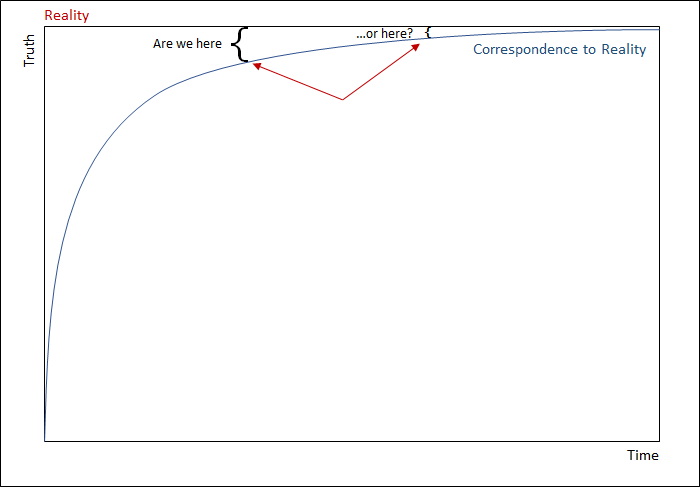
Graph: Correspondence of Truth to Reality (Asymptotic Curve)
The common assumption is that, over time, scientific inquiry will lead us closer to the truth. Correspondence theory supports the notion that more observations and perspectives will lead to a closer approximation, and eventually tools at our disposal will lead to more granular definitions, until we reach a point that and differences in the tangency to reality will be insignificant, a veritable rounding error. But there are several problems with these assumptions.
We have no idea how close or far we are from Reality on the Y-axis, representing Truth.
Graph: Correspondence of Truth to Reality (Asymptotic Curve)
Assuming for the time being that there is an approachable truth, we have no reference to understand how close to reality we might be. In practice, we seem to operate on a basis of always being within some level of statistical significance of where Truth = Reality, and when new information is introduced, we say, “Hooray for Science!” Aren’t we glad that science is self-correcting. Empiricism has its own issues.
Historically, we’ve had ‘wrong’ correspondence between Truth and Reality, but then we got it ‘right’—until we didn’t. Rinse and repeat.
We may all be familiar with the story of how Einstein progressed and refined Newtonian physics. What Einstein did is to create a new narrative—a synchronous shift of paradigm and rhetoric—, which has been accepted into a revised orthodoxy. In our mind, this feels like progress. But how close are we to the real truth?
Taking our understanding of gravity as the fabric of space-time, we still have no idea what’s going on or how it operates, but this doesn’t prevent us from accepting it as a black box and making pragmatic predictions from there. So, for all intents and purposes, the ‘truth’ mechanism is less important than the functional relationship, just as I can tell time on a watch I have no idea how it operates.
We have no idea if any changes to our perception move us closer to or further from Reality.
Rather than being asymptotic, perhaps the relationship to is polynomial (or the result of some stochastic function). See the graph above. As we move into the future (in red) and look back, we may perceive that we’ve reversed against some notion of progress. Common wisdom is that progress is directly, positively related to time. But is it?
In my first amendment, I reference how Einstein progressed and refined Newtonian physics, but in the future, this could be shown to be wrong. In our minds, what had seemed like progress may in retrospect turn out to have been a false assertion.* Moreover, we’ll dutifully accept this updated notion of truth if the rhetoric is sufficient to fit our concept of evidence, especially given humans’ propensity for pareidolia.
I am no true Sceptic, but neither do I accept the prevailing meta-narrative whole cloth. Unfortunately, I am in no better position than the next person to discern proximity to the underlying structure of reality.
Rhetoric is a primary driver to fashion our sense of how close or distant we are from reality. Rhetoric shapes and focuses the frame.
War Is Peace, Freedom Is Slavery, and Ignorance Is Strength
— 1984, George Orwell
I’ve already commented at length about the primacy of rhetoric. To recap for the purpose of this disquisition, the only meaningful arbiter of truth is rhetoric—the ability to persuade the larger populace to accept something as true.
Here, I’d expect someone to counter with, ‘Just because people are convinced that something is true doesn’t make it so’, and they’d be right. However, as we cannot access the underlying reality accept through our admittedly fallible senses, who’s to argue?
Moreover—departing on a tangent—, we know that other lifeforms—let’s stick with the animal kingdom—have different senses than humans, and some humans perceive things differently to the normie (if I may adopt a spectrum term) .
Sharks have electroreception (re: The Ampullae of Lorenzini), which allows them to perceive small changes in electrical fields as well as what’s termed a lateral line ( mechanoreceptor function), which allows them to recognise changes in environmental pressure. Other known sensory adaptations are echolocation in bats and dolphins and chemoreceptors (notably in insects and snails).
We are probably also aware that different animals have differing degrees of sense acuity compared to humans. Dogs hear frequencies above the human threshold and have better olfactory discrimination. Birds of prey have superior vision. Women typically have a broader colour vocabulary.
And then there’s synesthesia, a condition in which one sense is simultaneously perceived as if by one or more additional senses. A person with synesthesia may perceive sound as colour (chromesthesia) or perhaps taste.
Given concepts of normality, we presume we are synesthesia are normal and these other people are somehow not, but for all we know, we normies are evolutionary dead ends, soon to be displaced by synesthesiacs. (Is that even a word? It is now.)
But I digress.
Perception is reality. If one can convince you of something, e.g. Donald Trump is a good president, then it’s ostensibly true to you. If one can convince an entire population that something is true, e.g. the plot of Orwell’s 1984, or The Matrix, then who’s to say otherwise.
Intent in communicating perception does not get one closer to some corresponding reality. It merely converges perception.
This fourth entry is a response to this comment by Landzek from The Philosophical Hack regarding the notion of intended truth in communication.
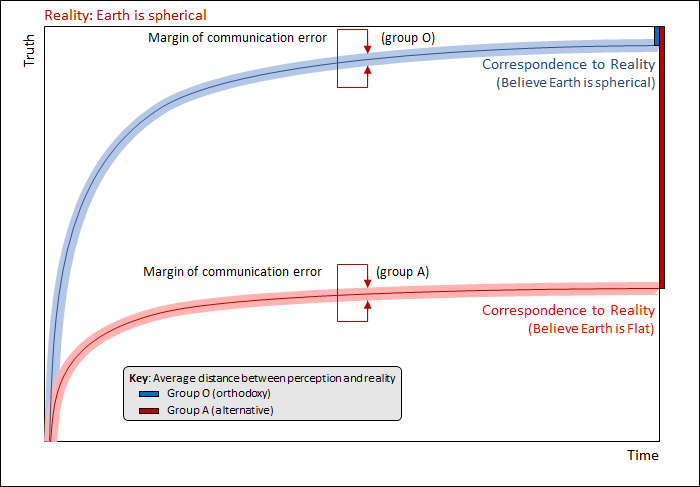
Extending the simple asymptotic function from the first section, we might see (in Graph 4a) a slight variation in interpretation due to the insufficiencies of language—providing us with a close enough for the government approximation to some shared perception. People in this group will tend to agree on some perception, say, that the earth is spherical.** The average distance from perception to reality is the same for all in-group members, give or take some small variance that I’ll dismiss as an insignificant rounding error.
Graph 4a: Correspondence of Truth to Reality (Simplified in-group concurrence)
Graph 4b, however, illustrates two opposing perceptions of reality. In this example, I show proponents of orthodoxy (group O), who claim the earth to be roughly spherical, arbitrarily closer to reality than proponents of an alternative theory (group A), who claim that the earth is flat.
Each in-group has some variance from the mean notion, but ex-group members are orders of magnitude apart, as measured by the blue and red bars to the right of the chart. If we assume some binary condition that the earth is either spherical or flat with no other options, one of these might be considered to be right whilst the other would be wrong. We can establish this situation relative to the ex-groups, but, still, neither of these is comparable to Reality™ .
Graph 4b: Correspondence of Truth to Reality (Simplified ex-group concurrence)
The intent of each group may be to promote the perspective of the group—each claiming to be closer to the truth than the other. It is easy to imagine a situation where both claimants are equally distant from the truth:
Imagine two groups, each making opposing claims:
Tarot is superior to Astrology in predicting the future.
Astrology is superior to Tarot in predicting the future.
I’ll go out on a limb here and create a reality where the future is not predictable by either measure, irrespective of what each in-group believes.
* I am not versed well enough in the history of science, but I’d be interested to know which, if any, scientific advances have been a step ‘backward’, that a belief had overtaken a prior belief only to have reverted to the former.
I am aware of the slow march of science and the ignorance of possibly valid assertions simply because the rhetoric was not strong enough or the PR just wasn’t adequate. An example might be the debate of theoretical Democracy versus Communism: which is better than the other. Of course, there are too many dimensions to consider, and the adoption or exclusion of one dimension over another might be enough to tilt the outcome.
In the real world—see what I did there—, the US spend billions upon billions of dollars to interfere with Communism—and I am not taking a position whether it would have succeeded or failed on its own terms—, just to be able to knock down the strawman some century later though propagandising and disinformation campaigns.
** I understand that the earth being an oblate spheroid is primarily an analytical distinction, so is tautologically true, but I am using a simplification of a commonly accepted fact.
DISCLAIMER: In order to keep generating new content (or even content) on this blog, I will occasionally adopt a new approach of publishing unfinished thoughts instead of waiting to complete the thought. This means, I may be editing pages in place to correct my position and alter narrative flow, of not the narrative itself.
EDIT: I’ve included my amendments in line above, though I’ve retained links to the original content.
As the article states, there is no one gene, and we can’t even predict ‘gayness’ based on some configuration of genes. That humans’ knowledge of genetics is so nascent is one reason, and over-imagining the impact of genes on behaviours may be a problem. Just because you want to find a relationship doesn’t mean one exists.
My take is that genetics establish a predisposition. Genes may limit your height to 180 cm, but environmental factors may not allow you to reach this limit, and anything short of genetic modification will not allow you to surpass this limit.
I don’t see a reason for sexual orientation to be different. One may have a propensity to same sex attraction, let’s say 70%, but if environmental factors fail to catalyse this predilection, it may never manifest. Even this is too simplistic.
Being ‘gay’ is an identity marker. Just because a person has same-sex relationships does not mean the person identifies as gay. Moreover, one can be ‘virginal’ or celibate and otherwise have had unexpressed same-sex tendencies. More-moreover, ‘gay’ is not about activity; it’s an emotional attraction. A ‘gay’ person might have sex outside of their identity orientation for myriad reasons, for example, access to a partner of the preferred orientation (say, prisoners) or for survival (say, prostitutes).
On balance, I’d argue that this is a quixotic venture into finding the underpinning of a human social construct. Once again, humans obsessed with categorisation, as if finding a category provides special meaning to the thing in it.
I’ve shared a new video on YouTube discussing the rhetorical nature of truth.
Before the Classical Hellenes, Mesopotamians recognised the power of rhetoric as the art of using language to convince or persuade. The term itself derives from the Greek ῥητορικός, rhētorikós.
As with any human construct such as language, truth and rhetoric are confined by limitations of the system and its logical structure.
In “Gorgias”, one of his Socratic Dialogues, Plato defines rhetoric as the persuasion of ignorant masses within the courts and assemblies.
Rhetoric, in Plato’s opinion, is merely a form of flattery and functions similarly to cookery, which masks the undesirability of unhealthy food by making it taste good.
Rhetoric typically provides heuristics for understanding, discovering, and developing arguments for particular situations, such as Aristotle’s three persuasive audience appeals: logos, pathos, and ethos.
But it’s more insidious than all of this. The notion of truth—or whatever we believe to be true—is nothing more than rhetoric.
If one is aptly convinced that something is true, it is. The physical world—the world of objects—contains facts—attributes of these objects, but these facts are tautological descriptors: a red car, une voiture rouge, ou quelque chose. In the conceptual domain of abstractions such as truth, justice, gods, and love, all bets are off.
As Geuss aptly suggests, most of society and civilisation don’t care about philosophical thought at this level. This is privileged activity. It’s not about level of intellect, per se; rather, it’s the privilege of free time to devote to abstract thinking.
Most people are more concerned with getting to the next day to earn a paycheque, and they accept sloganeering for any deeper meaning.
Humans are said to be rational beings. In fact, this predicates entire disciplines such as economics…
…and jurisprudence. Legal systems are founded on the concept that humans are at least rational enough to make fundamental decisions about right and wrong—and this, of course, presumes that the notions of right and wrong in and of themselves are meaningful.
For the sake of argument, let’s presume that humans are at least rational enough for our purposes, and whilst right and wrong may not be objectively validated, that within the context of a society—presuming that not to be mired in its own identity problem—, it can be defined in the manner of a social compact envisaged by the likes of Hobbes, Locke, Rousseau, et alii. As the saying goes, ‘if it’s good enough for the government… well.
Language is a human construct, yet it’s an apparition. Like a physical object, it appears solid, but there’s more space than not. What’s there is exiguous. Echoing Heisenberg’s observations at the atomic level, one cannot be fully certain of a particular meaning. This is what Derrida (via Barthes) meant by ‘the death of the author’, though there is nothing to guarantee that the author could fully articulate the meaning or intent even if they were present to defend it.
About the same time, Saussure was finding promise in the structure of language, Russell was creating a new language of logic to obviate its deficiencies. Structuralists and logical positivists were a natural extension of the scientism of the 20th Century, the prevailing wave since the Enlightenment, but as with the demise of gods, religious belief, and other things metaphysical, this faith in structure was also specious.
Historically speaking, there is progress (another illusion), and there are paradigm shifts. When a paradigm shifts, an old truth is replaced by a new one. This is typically credited to a progression of knowledge, but it’s actually just that, on balance, people have accepted a new frame, chalking it up to scientific method rather than some rhetorical sleight of hand.
Even so, scientific discovery is different to archetypal notions such as truth or justice. At least we can empirically test and verify a scientific notion, even if what we are observing is later revised because of some previously unknown factor or removed constraint. For example, until Einstein’s day, Newton would not have known that his theory of gravity would break down as it approached the speed of light. But truth is just an opinion—even if widely held. Enter the ‘appeal to tradition’ flavour of logical fallacy—I’ll not dwell on the fact that systems of government are based on this quaint notion of precedents. #JustSaying
“Truth is simply a culmination of the rhetorical power to persuade the ignorant masses.”
Plato
I’ve arrived at my philosophical position as an autodidact. I am not a conventional scholar, and my exposure to philosophy derives from books, videos, and online sources including Wikipedia, blogs, Reddit, and the such.
I consider myself to be a non-cognitivist in the realm of Ayers’ Emotivism, and I fully realise that society as we know it relies on some notion of ascertainable truth. Of course, Nietzsche was vilified for observing that ‘God is dead’ and unceremoniously subjected to the ad hominem attacks afforded to the likes of Marx.
I’ve got a certain amount of respect for Existentialists (and Absurdists), but I find the teleological component a bit at odds with the central tenet. To that extent, I am more of a Nihilist.
I am more comfortable with what’s been called ‘Post-Modernism’, despite admiring the effort of some Structuralists and Logical Positivists. Where this love affair ends is where the permeation of science fetishists begin. Scientific Method and Logic are the gods of the New Age.
As a post-Enlightenment child, I’ve been steeped in all of its unfound glory, and it’s harder still for me to escape the pull of my Western indoctrination. So, to argue, one is forced to comply with the rules of logic within the limitations of human language—even the limitations of Russell’s language of Logic. And like arguing with a proponent of religion who points out that you can’t disprove his Ethereal Unicorn, one is forced into positions of arguing against Quixotic figments introduced as metaphysical elements.








 Philosophics