Reason is not an oracle of truth but a spectrum-bound tool, and when it is worshipped as absolute, it curdles into pathology. True rationality knows when to temper itself, when to equivocate, and when a kind lie is wiser than a cold fact.
Reason and rationality are the household gods of modernity. We light incense to them daily: follow the science, be reasonable, act rationally. But before we genuflect, it’s worth asking what exactly we mean. By reason, I mean the faculty of inference – spotting contradictions, tracing causes. By rationality, I mean the practice of applying that faculty toward some end. That’s all. Nothing mystical.
Audio: NotebookLM podcast on this topic.
The trouble starts when these concepts are treated as absolutes. They aren’t. They vary in intensity and application. A person’s reasoning operates on a spectrum with something like frequency and amplitude. Some minds hum at low frequency – broad strokes, contradictions smoothed over by intuition. Others burn hot at high frequency and amplitude – rapid logical leaps, obsessive consistency, the inability to let a premise go. And while some reason flows like a continuous wave – steady, consistent, predictable – other forms fire more like particles: synaptic sparks that don’t always connect, logic arriving in bursts or stutters rather than as a smooth line.
“But a normal ego of this sort is, like normality in general, an ideal fiction. The abnormal ego, which is unserviceable for our purposes, is unfortunately no fiction. Every normal person, in fact, is only normal on the average. His ego approximates to that of the psychotic in some part or other and to a greater or lesser extent; and the degree of its remoteness from one end of the series and of its proximity to the other will furnish us with a provisional measure of what we have so indefinitely termed an ‘alteration of the ego’.”
― Sigmund Freud
Push too far and what we sanctify as ‘reason’ bleeds into what psychiatry pathologises as autism or schizophrenia. Meanwhile, ‘normal’ cognition always includes an emotional ballast. Strip it out and the result looks alien, even monstrous. Freud’s quip about psychopathy – that the psychopath differs from the rest of us in degree, not kind – applies just as well to reason. Rationality is simply the socially acceptable blend of logic and affect. Deviate, and you’re declared broken.
Camus gave us a parable in The Stranger. Meursault observes his world with ruthless clarity, but no emotional resonance. He doesn’t weep at his mother’s funeral, and society condemns him less for murder than for failing to perform grief. His ‘pure’ reason reads as inhuman.
Here’s the paradox: if rationality means adapting effectively to one’s environment, then pure rationality demands knowing when to suspend itself. A person who insists on logic at every turn is not rational but maladapted. The rational actor lies, flatters, nods at the boss’s bad joke, comforts the friend who doesn’t want statistics but solace. Rationality that cannot bend collapses into pathology.
This is why the infamous ‘Do these jeans make me look fat?’ question is such a perfect test. The ‘true’ answer, if you are reasoning narrowly, may be ‘yes’. But true rationality recognises the context, the stakes, the human need beneath the words. The rational response is not the cold fact but the kind equivocation. Rationality that cannot lie is no rationality at all.
Here’s the paradox: if rationality means adapting effectively to one’s environment, then pure rationality demands knowing when to suspend itself. A person who insists on logic at every turn is not rational but maladapted. The rational actor lies, flatters, nods at the boss’s bad joke, comforts the friend who doesn’t want statistics but solace. Rationality that cannot bend collapses into pathology.
Consider the social rituals we all know. A partner says, ‘I like that house’, and the rationally over-tuned response is to evaluate the house. The actual cue is in the like, not the house. The answer isn’t that you dislike the house, but rather what you can appreciate about it. Miss that, and you miss the point. Or take the dinner table: when my son was seven, a well-meaning host – very Martha Stewart – asked him how he enjoyed his meal. He replied, with perfect candour, ‘I’ve had better’. From a logical standpoint, faultless. From a rational standpoint – if rationality includes social adaptation – disastrous. The question was never about the food. It was a cue for appreciation, for harmony. He gave fact when what was asked for was affiliation.
So yes, I attack reason and rationality – not because they don’t exist, but because they are misapplied, reified, and worshipped as neutral arbiters of truth. They are not. They are tools with a range, and outside that range, they fail catastrophically. To speak of ‘reason’ as if it were an unqualified good is like praising fire without mentioning its talent for arson.
Written by
microglyphics
After I wrote this, I realised I forgot to mention Kant.
Even Kant, patron saint of rational duty, insisted you must never lie, not even a white lie, not even to a murderer asking where your friend is hiding. For him, truth-telling was categorical, binding, immune to circumstance. But this is reason gone rigid, unable to flex with human reality. It shows how worship of Reason leads not to morality but to monstrosity. A rationality that cannot bend is no rationality at all.
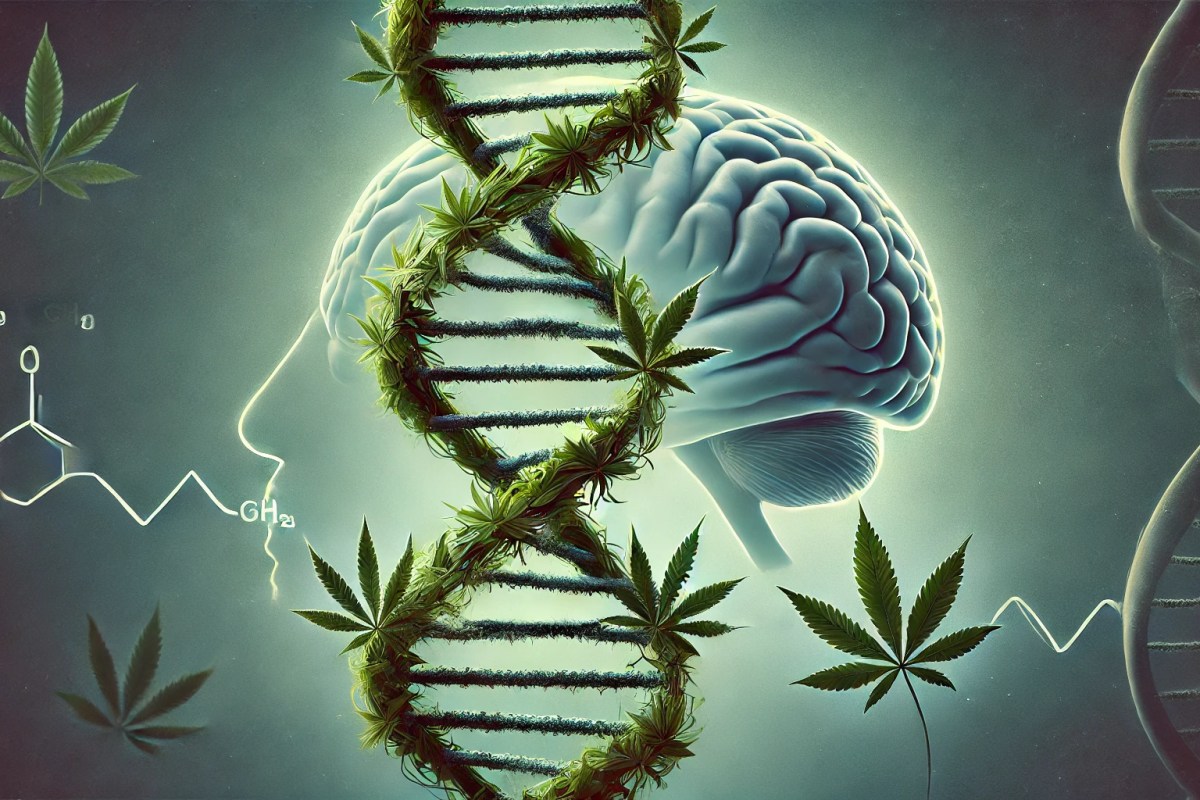
A study on genetics and cannabis found a connexion between marijuana use and genetic states. The study claimed to be looking for epigenetic effects and although there were some correlations, the directions of causality haven’t been determined.
Recent research has delved into the complex interplay between genetics and cannabis use, revealing intriguing correlations but leaving some critical questions unanswered. A recent study aimed to uncover the epigenetic effects of marijuana use, suggesting a link between genetic states and cannabis consumption. Whilst the findings offer some fascinating insights, they also highlight the ambiguity surrounding causality.
The Genetic Link
The study in question sought to explore whether cannabis use might influence genetic expression or, conversely, whether genetic predispositions could affect an individual’s likelihood of using marijuana. The results indicated some noteworthy correlations between cannabis use and certain genetic states, yet they fell short of clarifying the direction of causality. In other words, the research raises important questions but doesn’t definitively answer whether cannabis use leads to changes in genetic expression or if genetic predispositions increase the likelihood of cannabis use.
Cannabis and Schizophrenia: A Complicated Relationship
One of the most contentious aspects of the study is its implications for understanding the relationship between cannabis use and schizophrenia. The association between the two has been a subject of ongoing debate, with some evidence suggesting a connection. However, the study’s findings underscore the complexity of this relationship. It remains unclear whether cannabis use contributes to the development of schizophrenia or if individuals with a predisposition to schizophrenia are more likely to use cannabis.
The ambiguity stems from the fact that whilst correlations exist, they do not establish a clear cause-and-effect relationship. Schizophrenia is a multifactorial disorder, influenced by a combination of genetic, environmental, and neurobiological factors. Cannabis use might interact with these factors, but pinning down the exact nature of this interaction remains elusive.
What’s Next?
This study serves as a reminder of the challenges inherent in unraveling the connections between genetics and behaviour. It highlights the need for further research to elucidate the causal pathways and better understand how genetic predispositions and environmental factors like cannabis use interact. Until then, while correlations provide valuable insights, they are insufficient to draw definitive conclusions about causality.
As research progresses, it’s crucial to approach these findings with a nuanced perspective, recognising that the relationship between cannabis, genetics, and mental health is complex and multifaceted. Continued exploration in this area will hopefully shed more light on these intricate connections and help guide future investigations.
By fall, I don’t mean autumn except perhaps metaphorically speaking. The accompanying image illustrates a progression from the pre-Enlightenment reformation and the factors leading to the Modern Condition and increases in schizophrenia in people, societies, and enterprises.
Podcast: Audio rendition of this page content.
This image is essentially composited from a later chapter in Iain McGilchrist’s The Master and His Emissary. In it, he outlines a path that commences at the Reformation that led to Lutheranism and Protestantism and further to Calvinism (not separately depicted). Max Weber argued that Capitalism is inextricably linked to Calvinism and the workmanship ideal tradition.
McGilchrists argument is founded on the notion that Catholocism is a communally oriented belief system whilst Protestantism is focused on the individual and salvation through personal work. The essence of capitalism is the same.
Of course, history isn’t strictly linear. In fact, there are more elements than one could realistically account for, so we rely on a reduction. In concert with the Reformation but on a slight delay is the so-called Age of Enlightenment, the Age of Reason, which led not only to faith in science but then to the pathology of Scientism.
This Protestant-Scientismic nexus brought us to Capitalism and into the Industrial Revolution, where humans were devivified or devitalised, trading their souls to be pawns to earn a few shekels to survive. Capitalism and the Industrial Revolution led to Marxism, through Marx’s critique of Capitalism, but Marxism has the same fatal flaw as Capitalism inasmuch as it doesn’t view people as humans. It does afford them a slightly higher function as workers, but this still leaves humanity as a second-tier aspect and even historicity is elevated above as a sort of meta-trend or undercurrent.
From there, we transition to Modernity, which yields the modern condition and schizophrenics in one fell swoop. This is no coincidence.
Although I end this journey at Modernism, McGilchrist is also leery of the effects of post-modernism as well as philosophy itself as overly reductionist in its attempts to categorise and systematise, valuing signs and symbols over lived experience. His main complaint with postmodernism is that it moves from the objective perspective of Modernity to the subjective perspective, and so there remains no base foundation, which is the shared experience. I’m not sure I agree with his critique, but I’m not going to contemplate it here and now.
In the end, this journey and illustration are gross simplifications, but I still feel it provides valuable perspective. The challenge is that one can’t readily put the genie back into the bottle, and the question is where do we go from here, if not Modernism or Postmodernism. I shouldn’t even mention Metamodernism because that seems like an unlikely synthesis, as well-intentioned as it might be. McGilchrist gives examples of reversals in the trend toward left-hemisphere bias, notably the Romantic period, but that too was reversed, recommencing the current trajectory. My feeling is that if we continue down this dark path, we’ll reach a point of no return.
It seems to be that it’s growing at an increasing rate, like a snowball careening down a slope. It not only drives the left-dominant types further left because an analytical person would reinforce the belief that if only s/he and the world were more analytical things would be so much better—even in a world where net happiness is trending downward—, but it also forces this worldview on other cultures, effectively destroying them and assimilating them into the dark side, if I can borrow a Star Wars reference.
Epilogue
I wasn’t planning to share this story—at least not now. In another forum, I responded to a statement, and I was admonished by Professor Stephen Hicks, author of the book of dubious scholarship, Explaining Postmodernism.
I responded to this query:
If you’re a single mother and have a son I’d suggest putting him in a sport or martial arts to add some masculine energy to his life. It’s not a replacement for the actual father but it can help instil structure and discipline into the core of his being.
— Julian Arsenio
“Perhaps this world needs less discipline and structure, not more,” was my response, to which Hicks replied.
The quotation is not about “the world.” It is about boys without fathers. Evaluate the quotation in its context.
— Stephen Hicks
“Disciplined boys create a disciplined world. Not a world I’d prefer to create or live in. We need more right-hemisphere people. Instead, we are being overwhelmed by left hemisphere types, leading to Capitalism and the denouement of humanity as it encroaches like cancer, devouring or corrupting all it touches.
“In the end, it is about the world, which from a left hemisphere perspective is a sum of its parts. Right-hemisphere thinkers know otherwise,” was my reply. He responded,
You seem to have difficulty focusing. From a quotation about fatherless boys you free associate to [sic] weird psychology and global apocalptic [sic] pessimism. Pointless.
— Stephen Hicks
“I’ll suggest that the opposite is true, and perhaps you need to focus less and appreciate the Gestalt. This was not free association. Rather, it is a logical connexion between the disposition of the people in the world and lived reality.
“Clearly, you are a left-hemisphere structured thinker. The world is literally littered with this cohort.
“I suggest broadening your worldview so as not to lose the woods for the trees. I recommend Dr Iain McGilchrist as an apt guide. Perhaps reading The Master and His Emissary and/or The Matter with Things would give you another perspective. #JustSaying”
And still, rather than addressing the issue of fatherless boys, you go off on tangents, this time psychologizing about people you’ve zero first-hand knowledge of.
— Stephen Hicks
Feel free to interpret this as you will. For me, his attempt to limit discussion to some notion he had in his head and his failure to see the woods for the trees, as I write, suggests that he is a left-brain thinker. Having watched some of his videos, whether lectures or interviews, this was already evident to me. This exchange is just another proof point.
I considered offering the perspective of Bruno Bettleheim’s importance of unstructured play, but as is evidenced above, he is not open to dialogue. His preference appears to be a monologue. This is the left hemisphere in action. This is an example of how insidious this convergent thinking is, and it makes me worry about what’s ahead in a world of people demanding more structure and discipline. Foucault’s Discipline and Surveillance comes to the forefront.
Most people have heard the term schizophrenia. It’s a mental health pathology wherein people interpret reality abnormally. To oversimplify to make a point, in a ‘normal’ brain, the left and right hemispheres operate together to regulate bodily functions and to interpret the world we live in. In brief, schizophrenia is a condition where the left cerebral hemisphere overly dominates the right. Some might be led to believe that schizophrenics interpret reality irrationally, but the opposite is true. Schizophrenics are hyperrational to a fault.
Schizophrenia has been on the rise this past half century or so, but this might just be a symptom of Modernity, as cultures are also experiencing a leftward shift—a shift toward hyperrationality. Cultures have swung like a pendulum from left-hemisphere-dominance to right dominance and back through the ages, but we may be seeing an uncorrected swing further and further to the left, led by science, followed by commerce and politics, dangerously close to the territory of schizophrenia, if not already occupying this territory. Allow me to briefly summarise how the hemisphere function to help the reader understand what it means to be too far left or right.
Cerebral Bilateral Hemispheres
Most people experience the world—what some otherwise known as reality—with both cerebral hemispheres, and each hemisphere has a function. In a nutshell, the right hemisphere experiences reality holistically, which is to say that it views the world through a Gestalt lens. The right hemisphere is open and divergent. It is creative—generative. It knows no categories or subdivisions. All is one and connected. I like to refer to this as Zen. Many people can relate to this Zen notion. The right hemisphere is a creative and empathetic centre that only knows the world as it is presented—without words or naming. Intuition lives here. It distinguishes differences in the world in a manner similar to that of a preverbal child who can tell mum from a bowl of porridge without knowing the word for either. Children are right hemisphere creatures. As we mature toward adulthood, the function of the left hemisphere increases to offset the dominance of the right.
The left hemisphere is the sphere of intellect. Its function is to categorise, to create symbols—words, names, labels, icons, and so on. It doesn’t know how to create, intuit, or empathise. In fact, it doesn’t even experience the world as presented; it relies on re-presentation. To borrow from a computer analogy, when it experiences something in the world, it caches a symbol. Where the right hemisphere experiences a tree and just appreciates its ‘treeness’, and it doesn’t know that it’s a tree by name. It’s just another thing in the world. The left hemisphere, on the other hand, notices these things with ‘treeness’ and categorises them as trees—or des arbres, árboles, Bäume, 木, درختان , पेड़, or whatever. And it reduces the tree to an icon, so it can file it away for later retrieval to compare with other tree-like inputs.
The left hemisphere is where difference, the sense of self, and ego come from
The left hemisphere is where difference, the sense of self, and ego come from. Where the right hemisphere is open and divergent, the left hemisphere is closed and convergent. It is particularly egotistical, stubborn, and always thinks it’s right if I can anthropomorphise analogically. The left hemisphere knows no nuance, and it doesn’t recognise connotation, metaphor, allegory, or allusion. Everything is literal.
The left hemisphere can use similes and understand that a man is like a tiger, but it takes the right hemisphere to know that a man is a tiger, has metaphorically embodied the tiger and assumed its form, say in the manner of indigenous Americans. Poetically, there is a difference between being a tiger and being like a tiger. The left will have none of this. The response to hearing ‘he was a tiger’ would either result in ‘no he isn’t, he’s a human’ or ‘someone must be talking about a male tiger’. The nuance would be lost.
At the risk of further digression, this is why a poem can’t be dissected for meaning—this despite so many valiant attempts by high school teachers and undergraduate professors. Dissecting a living poem is like dissecting a living animal. You might learn something, but at the risk of devitalisation—you’ve killed the subject. It’s like having to explain a joke. If you have to explain it, it didn’t work. You can’t explain a work of art or a piece of music. The best you can do is to describe it. Although we’re likely familiar with the adage, “A picture is worth a thousand words”, a thousand words is not enough to do more than summarise a picture. This sentiment is captured by Oscar Wilde when he wrote, “Education is an admirable thing, but it is well to remember from time to time that nothing that is worth knowing can be taught.” Education is a left-brain function, that can be stuffed like a sausage, but no amount of education can make someone feel a work of art, music, or poetry. This can only be experienced and is apart from language.
A Tree is not a Tree
As already noted, schizophrenics are hyperrational. They are devoid of the empathy and intuition afforded by the right hemisphere. So, they fail to connect the parts to a constructed whole. They presume that a whole is constructed of parts. This is the mistake of Dr Frankenstein, that he could construct a man from parts, but all he could manage is to construct a monster.
In the experienced world, there are only whole objects as experienced by the right hemisphere. As humans, we break them down for easier storage and retrieval, but this is like lossy compression if I can risk losing some in technical lingo.
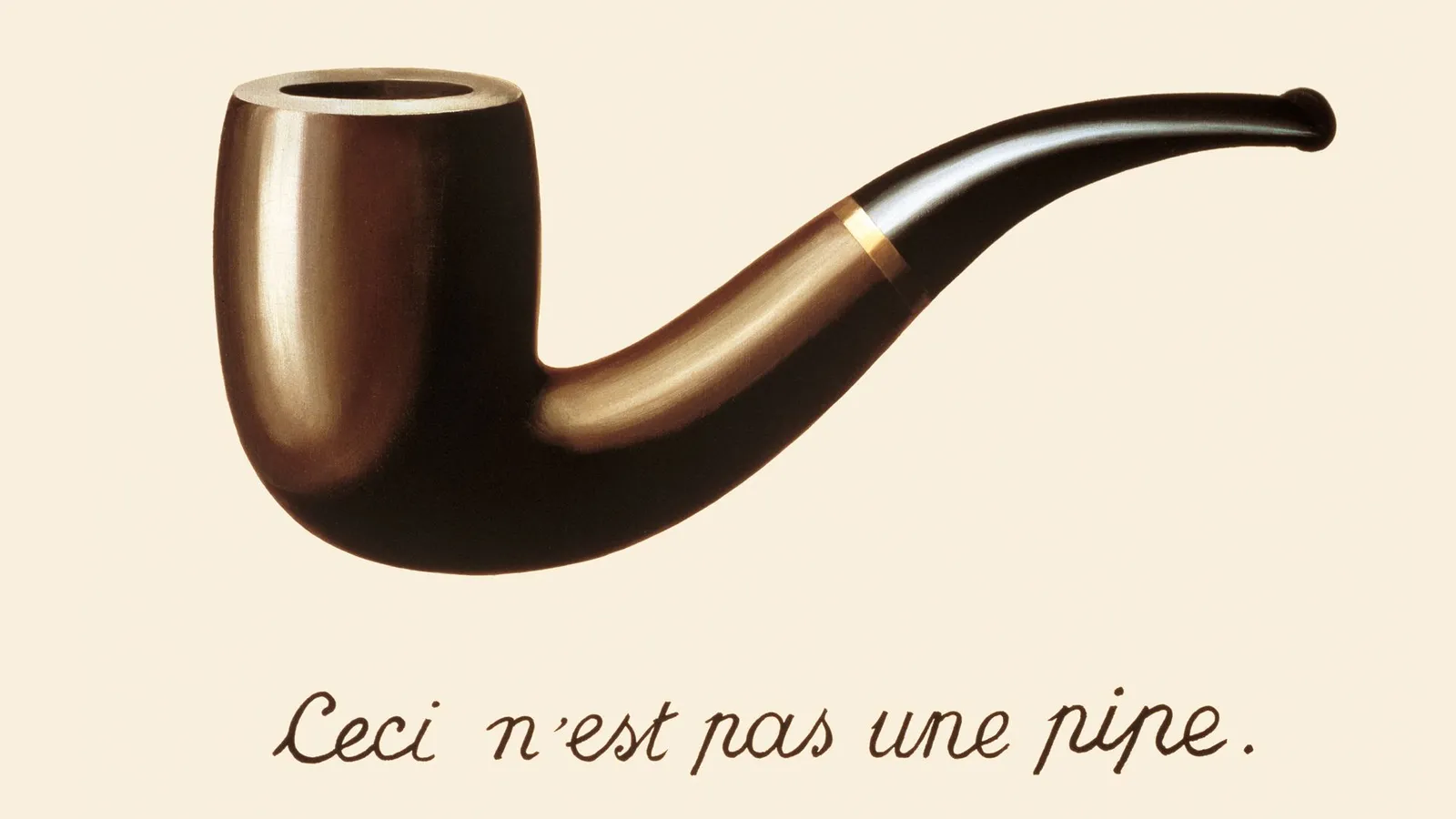
But a tree is not built from parts. It’s just a tree. We can articulate that a tree has a trunk and roots and branches and leaves and seeds and blooms, but it’s just a tree. The rest we impose on it with artificially constructed symbol language. This is what post-modern painter Rene Magritte was communicating with the “Ceci n’est pas une pipe” inscription in his work The Treachery of Images—This is not a pipe. He was not being cute or edgy or trying to be clever. He was making the point that the symbol is not the object.
In the manner that the image is not the pipe, it’s been said that to document a system is to make an inferior copy. The documented system is less optimal. This may feel counterintuitive. In fact, you may even argue that a documented system allows subsequent process participants to plug into the system to allow it to continue to operate into perpetuity. Whilst this is true, it comes at a cost. I’ll leave this here for you to ponder. The right hemisphere understands the difference. The document is not the process.
Getting Down to Business
If you’ve been following along, you may have already noticed that the left hemisphere looks and sounds a lot like the business world. Everything is systematised, structured, and ordered. We have all sorts of symbols and jargon, processes, and procedures. Everything is literal. There is no room for metaphor. There is no room for empathy. HR instructs that there be empathy, but they might as well instruct everyone to speak Basque or Hopi. In fact, it’s worse because at least Basque and Hopi can be learnt.
Sadly, this leftward shift isn’t limited to the world of commerce. It’s affected science, politics, and entire cultures. It’s caused these entities to abandon all that isn’t rational as irrational. But empathy and intuition are irrational. Science says if you can’t measure it and reproduce it, it’s not worth noting, but science is not the arbiter of the non-scientific realm. Business takes a similar position.
Politics of the Left (Hemisphere)
And politics creates categories: left and right, red and blue, black and white, men and women, gay and straight, and this and that. All of this is all left-hemisphere debate.
Categories and names are exclusive provinces of the left hemisphere. If you are hung up on an ideology, whether Democracy, Republicanism, Marxism, or Anarchism, you’re stuck in your left hemisphere. If you defend your positions with logic and words, you’re stuck in your left hemisphere. If you can’t imagine an alternative, you are really stuck in the left. I’ll stop here.
Science and Scientism
How did we get here and come to this? Science was receptive to right hemisphere influence up until about the 1970s. That’s where Scientism began to take hold. Scientism is when faith in science becomes a religion. I feel that many scientists today are less likely to hold a belief in Scientism as a religious belief. Paradoxically, I think this is more apt to be a faith held by non-scientists. Unfortunately, this faith is exploited by politics as exemplified by the recent trust in science campaign perpetrated by politicians, which is to say non-scientists with their own agenda, whether they practised Scientism or not.
The problem is that the left hemisphere has an outsized ego. It thinks it’s always right. In practice, it’s right about half the time. Because of its reliance on stored data and a ‘belief’ that it doesn’t need to fresh its data until it’s effectively overwhelmed and acquiesced. It fails to give enough weight to the experienced world, so that it shifts belief further and further left, which is to say further from reality as it is.
It trusts the symbol of the tree more than the tree itself. We may all be familiar with stories of cars driving down train tracks and off cliffs because the SAT-NAV user put more faith in their device than the world outside. This is the risk companies face as well, choosing to believe that the documented process is superior to the system in and of itself.
Getting on About?
You may be wondering what inspired me to write this and where I get my information. My realisation started in chapter 9 of The Matter with Things and was reinforced by this video interview by its author, Iain McGilchrist.
Actually, it started even before this with The Corporation, a Canadian documentary and companion book released in 2003. One of the points of The Corporation is to articulate the parallels between corporate behaviour relative to the definition of psychopathy as presented in The Diagnostic and Statistical Manual of Mental Disorders, henceforth DSM. Per Wikipedia, the DSM ‘is a publication by the American Psychiatric Association for the classification of mental disorders using a common language and standard criteria and is the main book for the diagnosis and treatment of mental disorders in the United States and is considered one of the “Bibles” of psychiatry’. Essentially, corporations ticked all the boxes.
Methodologically, this assertion is a bit weak, but it is at least sometimes entirely valid despite provoking an emotional trigger reaction. Nonetheless, this established corporations as pathological entities. But that is not my focus here. It simply tilled the soil for me to be more receptive to this topic. This topic is less about the legal fiction that is a corporation and more about the people embodied in it. From the height of the C-suite to the workaday staff, floor workers, warehouse workers, and the mailroom. Do they still have mailrooms? I digress.
I can’t claim to know what it is to be schizophrenic or schizoaffective, but I’ve known enough people who have these diagnoses. My brother was one of those. Although I use these and other labels, I am not a fan of labels, generally, especially psychological labels, specifically this label. Autism is another nonsensical label. Both fall into the realm of medical syndromes, which for the uninitiated is the equivalent of your kitchen junk drawer. It’s equivalent to the other choice when all others fail. I don’t want to go off on a tangent from the start, so I’ll leave it that these categories are overly broad and reflect intellectual laziness. There is no single schizophrenia or autism. There are many, but the distinction is lost in the category. The push to create an autism spectrum for DSM obscures the problem, but it helps for insurance purposes. As the saying goes, follow the money and you can gain clues to the driving force behind why this happened. I suppose you can also label me a conspiracy theorist. If I learned one thing in my undergrad Sociology classes, it’s to eschew labels.
Almost finished
Given the length of this segment, I am not going to summarise it here, save to say that this leftward shift in business and culture doesn’t have a good outlook. We are not only being replaced by machines, but we are also forced into becoming machines, and we aren’t even questioning it. All we need to do is to become more analytic, right?
What I suggest is to watch the six-minute video of Dr Iain McGilchrist discussing this topic, and if you really want a deep dive, read The Matter with Things, an almost three-thousand-page tome, to fill in the details.
Postscript
Here’s a music analogy to help to express why the whole is more important than the sum of the parts. If I want to learn to play a new piece, I will listen to the piece first. Depending on the length and genre, I may have to listen many times. In some cases, once or twice is enough, but let’s say this is at least somewhat complex and not some repetitive three-chord pop song. I’ll probably break the song into pieces or movements—verse, chorus, bridge, and whatever—, and then, I’ll learn each note and each pattern of notes, perhaps as musical phrases. Once I figure out the verse, I might either learn how the next verse differs or move on to the chorus and defer that verse-to-verse step. I’ll rinse and repeat until I’ve got through each of the sections. If I’ve had the luxury of hearing the piece, I’m at an advantage as far as tone, timbre, and dynamics are concerned; otherwise, I’d better hope these are all documented and that I interpret them in the manner they were intended. If the audience is familiar with a tune, they’ll notice the difference.
When I am practising, I need to get the mechanics down pat. All of what I’ve described thus far is left-hemisphere fare. It’s translating the symbolic representation of notes—like letters and words in writing—into an utterance. In this case, it’s a musical utterance. But once I am ready to perform the piece, it needs to be performed through the right hemisphere or it will feel mechanical and stilted.
I used to earn my living as an audio recording engineer and producer. Most of the time I was working with unknown artists recording demo records and trying to get a record deal. For the uninitiated, that usually translated into not having a large recording budget. Occasionally, we want, say string parts—violins, viola, cello, or whatever—but we couldn’t afford union players. We’d hire music students from USC or UCLA. These players would be more than willing to play for cheap in exchange for something to add to their portfolios or experience chops.
Somebody would transcribe the musical notation, and we’d give it to the string player. Of course, it could be a keyboard or wind or reed part, but I’ll stick to strings. Part of music is the vibe. This is something that can’t be captured in symbols. Revisiting Scientism and the left-hemisphere analogy, vibes can’t be real because they can’t be notated.
Almost invariably, if we got someone with Classical training, they could not get the vibe. The music was right in front of them. We’d play it for them on piano, maybe on a synthesiser, but they couldn’t get it—even if they were playing along to a reference track just trying to double the synth part. They would hit every note for the specified duration and dynamic, but it might have as well been the equivalence of a player piano or music box. We could have played it on a synthesiser, but we might be seeking the nuance a real instrument would bring.
We never had the luxury of auditioning players or recording several players and grabbing the best parts. That’s for the bigger-budget artists who go through a half-dozen or more performers to get just the right one. When we got lucky, it was usually because we got someone from the jazz program. These cats seem to have a natural feel for vibe inaccessible to the classical performers.
In business, the classical performer is good enough, but for art, it wasn’t. Business might appreciate the difference if it happens to get it, but it won’t seek it, and it won’t pay for it. A pet peeve of mine is a quip in business I heard often—don’t let perfection be the enemy of the good. This is obviously a left-hemisphere sentiment based on Voltaire’s statement. Besides, even from a left hemisphere perspective, reciting, “Don’t let perfection be the enemy of the good” doesn’t mean you shouldn’t at least strive for good enough because I noticed that mark was missed often enough, too.
Creativity is chapter nine of Iain McGilchrist’s The Matter with Things. It also marks the end of part one of three in this two-volume set.
The main thrust is to provide a lot of cases of schizophrenia to elaborate on how the deficits impact perception—and of course, attention and judgment.
Content
This chapter starts off by noting that mental illnesses are not a matter of the brain being broken like a machine. McGilchrist doesn’t much like the analogies to machines or computers, to begin with. Instead, they affect how their world is experienced. They attend to different things, which creates a different perception because we perceive what we attend to.
It is effectively a left-hemisphere challenge, but he is careful to say that we don’t have enough evidence to call it a right-hemisphere deficit. His rationale is that it could be one of these three leading scenarios:
The right hemisphere has deficits.
The left hemisphere is not performing its function to work with the right hemisphere, which is otherwise intact.
The frontal lobe which is supposed to moderate the hemispheres is not performing its function.
Schizophrenia and autism are distinct conditions, but there are some overlaps. He clarifies that schizophrenia and autism are too broad of categories (a situation made worse in the case of autism by the creation of the autism spectrum). There are types of schizophrenias and autisms that would otherwise be unrelated except for psychology’s kitchen junk drawer approach to categorisation, I suppose, following the lead of syndromes in the medical profession. I digress.
These conditions exemplify what it’s like to experience the world with an overreliance on the left hemisphere. A point he wants to make is that he feels society at large is shifting in this direction to the detriment of all concerned, that the world of business, science, politics, and bureaucracy more generally is migrating to a hyper-rational position at the expense of experiential reality.
He praises Louis Sass’s 1992 book Madness and Modernism as “one of the most fascinating, and compelling, books I have ever read”, primarily because it notes the relationship between schizophrenia and Modernism and a modern world that is experiencing an increase in the phenomena of schizophrenia.
they miss the forest for the woods
McGilchrist goes into detail about how right hemisphere deficits affect perception in schizophrenic patients. I won’t share that level of detail here. Effectively, they miss the forest for the woods and make contextual miscues, lacking in empathy and intuition. Missing this context, they jump to conclusions—invalid conclusions. He goes on to explain this from the perspective of brain construction and physiology whilst extending the conversation to include the autism spectrum, noting a general overlap between these diagnoses.
He invokes the work of Eugène Minkowski—reflecting on the foundational work of Henri Bergson—, which resonated with me, wherein Minkowski tries to simplify and characterise the hemisphere as the left representing intellect and the right being intuition. This feels about right. He shares a list of terms generally representing qualities in schizophrenics that detail what is atrophied in the intuition of the right hemisphere and what is hypertrophied (or exaggerated) in the left hemisphere. I’ll not share this list here, but I like it. He promises to elaborate on this in chapter 22.
Essentially what’s missing is a sense of coherence with experience leading to a detachment from reality as we normally experience it—and a loss of vitality and a sense of self. These people live as outsiders looking in rather than simply feeling a part of the whole. Man becomes a machine built of parts and separate to nature. Everything becomes literal. There is no room for connotation in a denotative world. But this world is disconnected from the presented reality, instead relying on a re-presented version. The world loses depth and becomes a two-dimensional caricature.
Perspective
My summary of this chapter left many details unsaid, probably more so than the preceding chapters, so a lot of context and nuance is missing. My biggest takeaway is really the scary connexion between schizophrenia and Modernity. It is far from comforting. Add to this the positive feedback loop otherwise known as a vicious cycle as societies more and more adopt a left hemisphere perspective, that of a schizophrenic, and it becomes scarier still. To make matters worse, this is not metaphorical. It’s analogical. I’m not sure how to reverse this tide.
connexion between schizophrenia and Modernity
This wraps up the chapter on schizophrenia, autism and the rest. As I mentioned at the start, this also marks the end of part one of the book. The next chapter is “What is Truth?” This will allow the reader to delve more deeply into various aspects of truth, from science to reason to intuition and imagination. This second part of the books takes us to the end of the first volume, traversing us through chapters ten to nineteen.
What are your thoughts on mental illnesses like schizophrenia and autism, especially around how they may shed light on neurotypical persons and the relationship between these and modern society?






 Philosophics