Surveying Modernity

A Brief, Brutal Experiment in Categorising Your Worldview

This month, I’ve been tinkering with a little project—an elegant, six-question survey designed to assess where you land in the great intellectual mess that is modernity.

Audio: Podcast discussion about this post.

This isn’t some spur-of-the-moment quiz cooked up in a caffeine-fueled haze. No, this project has been simmering for years, and after much consideration (and occasional disdain), I’ve crafted a set of questions and response options that, I believe, encapsulate the prevailing worldviews of our time.

It all began with Metamodernism, a term that, at first, seemed promising—a bold synthesis of Modernism and Postmodernism, a grand dialectic of the ages. But as I mapped it out, it collapsed under scrutiny. A footnote in the margins of intellectual history, at best. I’ll expand on that in due course.

The Setup: A Simple, Slightly Sadistic Ternary Plot

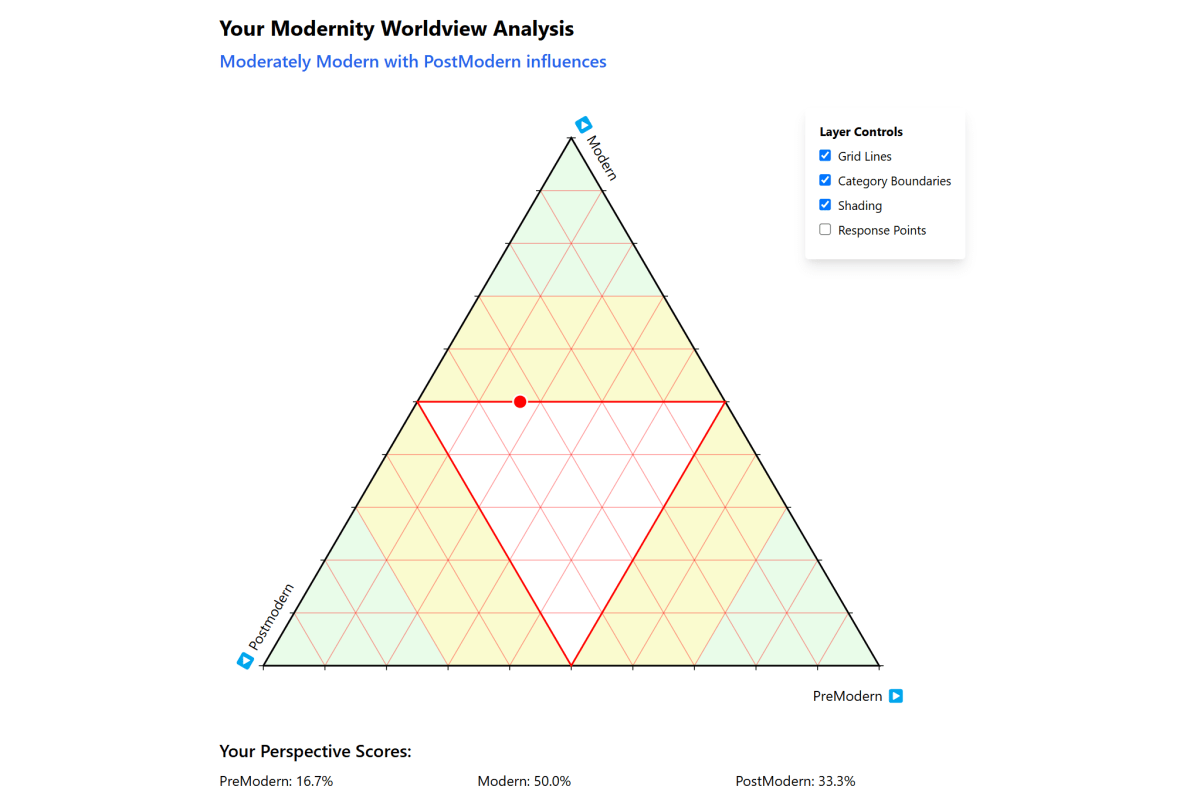
For the visually inclined (or the masochistically curious), I initially imagined a timeline, then a branching decision tree, then a Cartesian plane before landing on a ternary plot—a three-way visual that captures ideological leanings in a way a boring old bar chart never could.

The survey itself is brief: six questions, each with five possible answers. Submit your responses, and voilà—you get a tidy little ternary chart plotting your intellectual essence, along with a breakdown of what your answers signify.

Methodology: Half-Rigorous, Half-Reckless

I am, after all, a (recovering) statistician, so I’ve tried to uphold proper methodology while also fast-tracking certain safeguards for the sake of efficiency. If there’s enough interest, I may expand the survey, adding more questions or increasing response flexibility (tick boxes instead of radio buttons—revolutionary, I know).

Privacy Concerns? Relax. I’m not harvesting your data for some nefarious scheme. No personally identifiable information is collected—just a timestamp, session ID, and your browser’s language setting. I did consider tracking IP addresses to analyze regional trends but ultimately scrapped that idea.

In the future, I may add an optional email feature for those who wish to save and track their responses over time (assuming anyone is unhinged enough to take this more than once).

The Rest of the Story: Your Feedback, My Amusement

Since this is a personal project crafted in splendid isolation, I’d love to hear your thoughts. Are the questions reasonable? Do the response options make sense? Does the summary feel accurate? Is the ternary chart decipherable, or have I constructed a glorified inkblot test?

As an academic, economist, and statistician, I had never encountered a ternary chart before embarking on this, and now I rather enjoy it. That said, I also find Nietzsche “intuitive,” so take that as you will.

If this gains traction, expect follow-up content—perhaps videos, podcasts, or further written explorations.

Your Move

Take the survey. It’s painless, requiring mere minutes of your life (which is, let’s be honest, already wasted online). And because I’m feeling generous, you can even generate a PDF to stick on your fridge, next to your collection of expired coupons and disappointing takeout menus.

Click here to take the survey.

Let’s see where you stand in the grand, chaotic landscape of modernity. Or at least, let’s have a laugh trying to make sense of it.

DISCLAIMER: The Modernity Worldview Survey is not scientific. It is designed as an experiment to provide directional insights. It is hosted on Google Cloud and subject to its availability and performance limitations.

The Narcissist’s Playbook

I’ve lived in Los Angeles a couple of times for a sum total of perhaps 15 years. The first time, I loved it. The next time, I was running on fumes. The first time, I was in my twenties – the second time in my forties. What a difference perspective and ageing makes. In my twenties, I was a pretty-boy punk-ass who owned the club scene on the Strip. In my forties, I was a wage slave.

Audio: NotebookLM podcast on this topic.

This morning, I heard a country song on Insta with a line claiming ‘there are nines and dimes in all 50’, and it reminded me of a phrase we used when I lived in Los Angeles – ‘LA 7’. This is constructed on the egoist, sexist notion that if you were a 10, you’d have already moved to LA. If you still lived in, say, Iowa and were considered a 10, the exchange rate to LA would be a 7.

Then, I thought about the LA-NYC rivalry and wrote this article with some help from ChatGPT.

How L.A. and NYC Became the Centres of the Universe (According to Them)

It is a truth universally acknowledged that Los Angeles and New York City—those bickering siblings of American exceptionalism—believe themselves to be the sun around which the rest of us drearily orbit. Each is utterly convinced of its centrality to the human experience, and neither can fathom that people outside their borders might actually exist without yearning to be them. This is the essence of the ‘Centre of the Universe Complex,’ a condition in which self-importance metastasises into a full-blown cultural identity.

Let us begin with Los Angeles, the influencer of cities. L.A. doesn’t merely think it’s the centre of the universe; it believes it’s the universe, replete with its own atmosphere of smog-filtered sunlight and an economy powered entirely by dreams, green juice, and Botox. For L.A., beauty isn’t just a priority—it’s a moral imperative. Hence the concept of the ‘L.A. 10,’ a stunningly arrogant bit of mathematics whereby physical attractiveness is recalculated based on proximity to the Pacific Coast Highway.

Here’s how it works: a ’10’ in some picturesque-but-hopelessly-provincial state, say Nebraska, is automatically downgraded to a ‘7’ upon arrival in Los Angeles. Why? Because, according to L.A.’s warped ‘arithmetic, if she were a real 10, she’d already be there, lounging by an infinity pool in Malibu and ignoring your DMs. This isn’t just vanity—it’s top-tier delusion. L.A. sees itself as a black hole of good looks, sucking the beautiful people from every corner of the earth while leaving the ‘merely pretty’ to languish in flyover country. The Midwest, then, isn’t so much a place as it is an agricultural waiting room for future Angelenos.

But don’t be fooled—New York City is no better. Where L.A. is obsessed with beauty, NYC worships hustle. The city doesn’t just believe it’s important; it believes it’s the only place on earth where anything important happens. While L.A. is out perfecting its tan, NYC is busy perfecting its reputation as the cultural and intellectual capital of the world—or, at least, its part of the world, which conveniently ends somewhere in Connecticut.

This mindset is best summed up by that sanctimonious mantra, If you can make it here, you can make it anywhere. Translation: if you survive the daily humiliation of paying $4,000 a month for a shoebox apartment while dodging both rats and an existential crisis, you’ve unlocked the secret to life itself. New York isn’t about looking good; it’s about enduring bad conditions and then boasting about it as if suffering were an Olympic sport. In this worldview, the rest of the world is simply an unworthy understudy in NYC’s perpetual Broadway production.

And here’s the thing: neither city can resist taking cheap shots at the other. L.A. dismisses NYC as a grim, grey treadmill where fun goes to die, while NYC scoffs at L.A. as a vapid bubble of avocado toast and Instagram filters. It’s brains versus beauty, grit versus glamour, black turtlenecks versus Lululemon. And yet, in their relentless need to outshine one another, they reveal a shared truth: both are equally narcissistic.

This mutual self-obsession is as exhausting as it is entertaining. While L.A. and NYC bicker over who wears the crown, the rest of the world is quietly rolling its eyes and enjoying a life unencumbered by astronomical rent or the constant pressure to appear important. The people of Iowa, for example, couldn’t care less if they’re an ‘LA 7’ or if they’ve “made it” in New York. They’re too busy living comfortably, surrounded by affordable housing and neighbours who might actually help them move a sofa.

But let’s give credit where it’s due. For all their flaws, these two cities do keep the rest of us entertained. Their constant self-aggrandisement fuels the cultural zeitgeist: without L.A., we’d have no Kardashians; without NYC, no Broadway. Their rivalry is the stuff of legend, a never-ending soap opera in which both cities play the lead role.

So, let them have their delusions of grandeur. After all, the world needs a little drama—and nobody does it better than the cities that think they’re the centre of it.

America’s Team: A Losing Franchise with No Prospects

Let’s face it – the United States™ are the sporting world’s equivalent of an also-ran team. For decades now, they’ve been united in name only – USINO, if you will. No cohesion, no teamwork, and definitely no vision. Imagine the country as a sort of Premier League relegation-battler or a bottom-tier NFL team, clinging to nostalgia and the fumes of past glory. The problem? They’ve got no talent to speak of, no bench depth, and if they’ve got feeder prospects anywhere, they’re keeping it under wraps.

Let’s start with the fanbase. Every country has one, and every sporting team has its die-hards – the blind loyalists who defend their team no matter how appalling the statistics look. Take Sheffield United fans in the UK, or the eternally hopeful New England Patriots followers post-Brady. There’s always this romantic, ridiculous belief that “next year will be our year,” but let’s be honest: it never is. That’s precisely where we find the United States™ right now – stuck in a loop of misplaced optimism and declining influence, running out a roster that’s more washed up than a Boxing Day sale.

The Ageing Star

Then there’s Donaldo Trump, our once-all-star quarterback, whose glory days, such as they were, are long behind him. It’s like watching a faded reality TV star trying to make a comeback on the pitch. He’s not just past his prime; he’s sitting in the dugout, signing autographs and giving interviews about the good old days when he had the crowd eating out of his hand. But instead of giving him the gold watch and a retirement party, they’ve signed him on for another four-year contract with a no-trade clause.

If America were a halfway self-aware team, this is where they’d start thinking about rebuilding – shipping off the old guard, drafting fresh faces, and looking to the future. But instead, they’re clinging to this over-the-hill has-been with all the fervour of a fourth-division club hoping their star from 1987 will somehow lead them to the title in 2024. It’s not just embarrassing; it’s delusional.

No Depth, No Prospects

Let’s be clear: America doesn’t have any rising stars waiting in the wings, either. There’s no next generation being groomed for greatness, no wunderkind on the bench. This is a franchise that’s either too proud or too stubborn to think about succession. Look at other national squads – they’ve all got their academies, their training camps, their eye on the future. Meanwhile, the United States™ is playing with the same ragged roster, wheeling out worn-down veterans while the rest of the world shakes its head in bemusement.

And it’s not as if they’re out there scouting for talent, either. No, this team is closed to outside recruitment. No trades, no international transfers. The rules of the game are rigged to keep foreign talent out of the league entirely. It’s like they’re terrified that if they bring in anyone from abroad, the whole enterprise will collapse under the weight of actual competition. Meanwhile, the USINO brass keep shouting from the box seats, claiming they’re on the verge of a new era of dominance. They’re not. They’re on the verge of irrelevance, and everyone but their own die-hard fanbase knows it.

It’s not that America is wholly devoid of talent. Anyone with any integrity knows better than to be sullied by this broken system and wouldn’t want to be dragged into the dramatic clown show.

Lovable Losers?

Most people can find a soft spot for the underdogs – the Chicago White Sox, the Detroit Pistons, the San Jose Sharks – they’re lovable losers who at least seem to be trying. But America? Not even close. There’s no underdog charm here, no scrappy team spirit, just an unearned arrogance paired with the performance record of a pub team. They’re failing spectacularly, yet somehow, they seem entirely unaware of it. It’s like watching a player trip over their own shoelaces and then yell at the referee. Endearing, if only they weren’t so cluelessly convinced of their own superiority.

Where Does This Go Next?

So, where does this leave us? America’s in the league, but at this rate, they’re in a relegation battle. The question is, do they even know it? Are they ready to shake things up, bring in some new talent, maybe look beyond their own borders for a change? Or will they keep throwing their weight around, pretending they’re top-tier while everyone else just sighs and rolls their eyes?

Is there a chance for a real rebuild, or are we just waiting for them to pull their hamstring one last time before the inevitable? Because as it stands, the next seasons don’t look any better than the last ones.

Cyclists are Economic Disasters

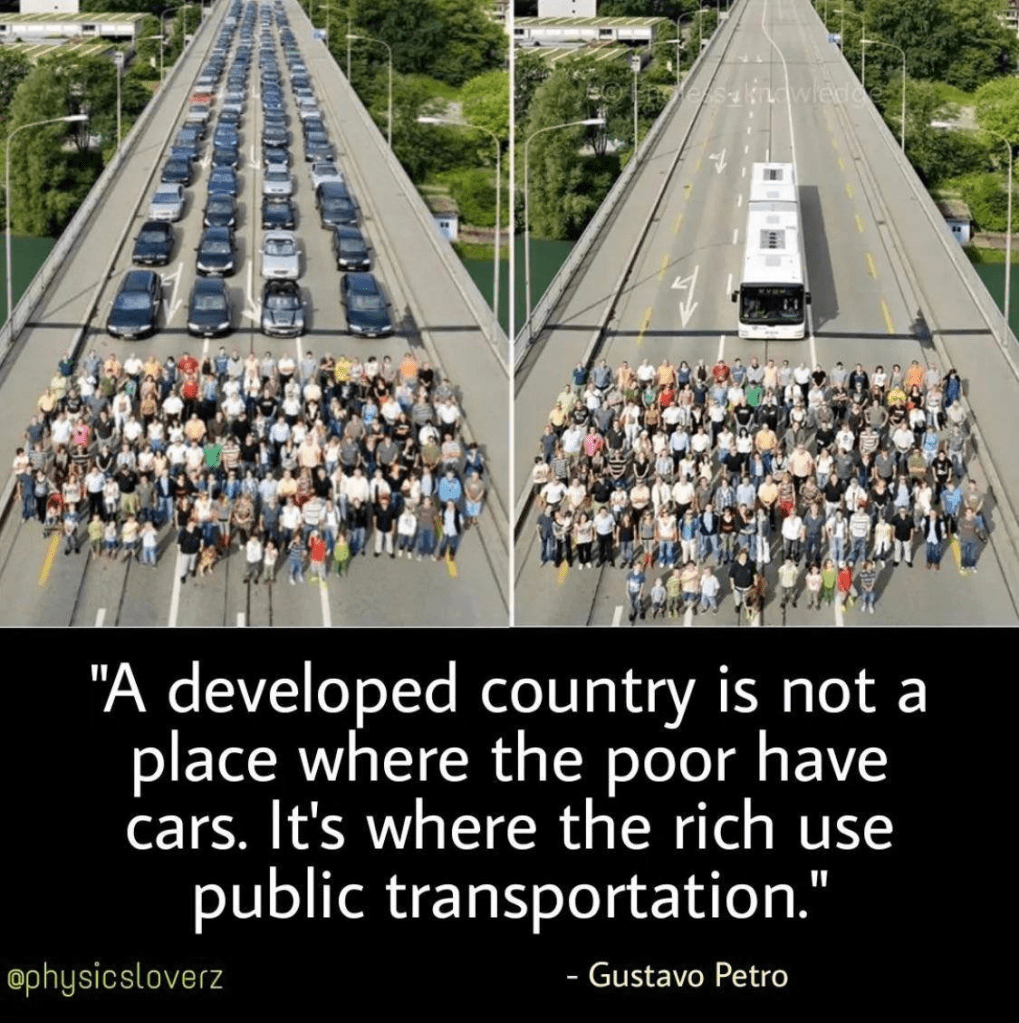
A colleague of mine posted this today. It was in quotations but was uncited. I attempted to discover the source, but the best I could do was to find a post from 2017 citing another author, Kaushik Patel on LinkedIn, but I do not know if this person originated this. It doesn’t really matter. In the spirit of full disclosure, my colleague is a fully indoctrinated, unapologetic Libertarian Capitalist. He also is an avid bicyclist, so reconciling the meta must be a challenge.

A Cyclist – is a disaster for the economy:

1. He does not buy the car and does not take a car loan.
2. Does not buy vehicle insurance.
3. Does not buy fuel.
4. Does not use the services of repair shops and car washes.
5. Does not use paid parking.
6. Does not become obese.
7. Yes, and well, dammit ! Healthy people are not needed for the economy. They do not buy drugs. They do not go to private doctors. They do not increase the country’s GDP ! On the contrary, every new McDonald’s outlet creates 30 jobs: 10 Dentists, 10 Cardiologists and 10 Weight Loss Experts.

So, what do you prefer- Cycling or fast food?

Like the Jackass parable, I recently shared, how one reacts to this is largely predictable if you know the worldview of the reactor.

This piece takes the perspective of the cyclist critiquing GDP economics satirically through the lens of an orthodox economist. Of course, there are also many internal contradictions and mistruths. I don’t intend to fully critique what I take to be a meme, but I’ll comment somewhat. To be fair, I get annoyed by bicycles intermingling with either automobiles or pedestrians. I’d prefer there be dedicated thoroughfares for bikes. When I am walking, I feel they’re like mosquitos or horseflies. When I’m driving, I see them as drunken toddlers. Who knows what they’re going to do next.

Meantime

Crossed my Facebook Feed

To be honest, I see them as anachronistic. They serve a purpose—many purposes, in fact—, but that doesn’t obviate the nuisance factors. I am not wholly anti-bicycle, but I feel they need a better implementation strategy. I rode bicycles until I was twelve years old or so. Not being the nineteenth century, I still view them as child’s toys. Regarding adults, there are generally two categories—the privileged (and self-righteous) and the underprivileged (and disenfranchised).

Privilege

The author of this quote is likely in this category. How dare someone try to undermine my god-given right to responsibly ride a bike for the greater good of humankind. These people not only own expensive bicycles. Some own several for on-road cycling, off-road cycling, and perhaps even performance cycling. Generally, they own the accoutrements and matching aerodynamic vestiments—padded bicycle shorts, a tight jersey, a sleek helmet, and proper cycling shoes, each contributing to the economy.

In the categories are the commuters, who cannot necessarily wear their gear on the commute, but trust me, they got it in the closet, and they’d wear it if they could.

Underprivilege

This category is for the poor who need to commute a relative distance but either can’t afford or justify an automobile or have had their licence revoked. These people are not a part of bike culture. They are bicyclists by necessity. This is not a play to the greater good. It’s just a way to not have to walk as much.

More Colour and Shape

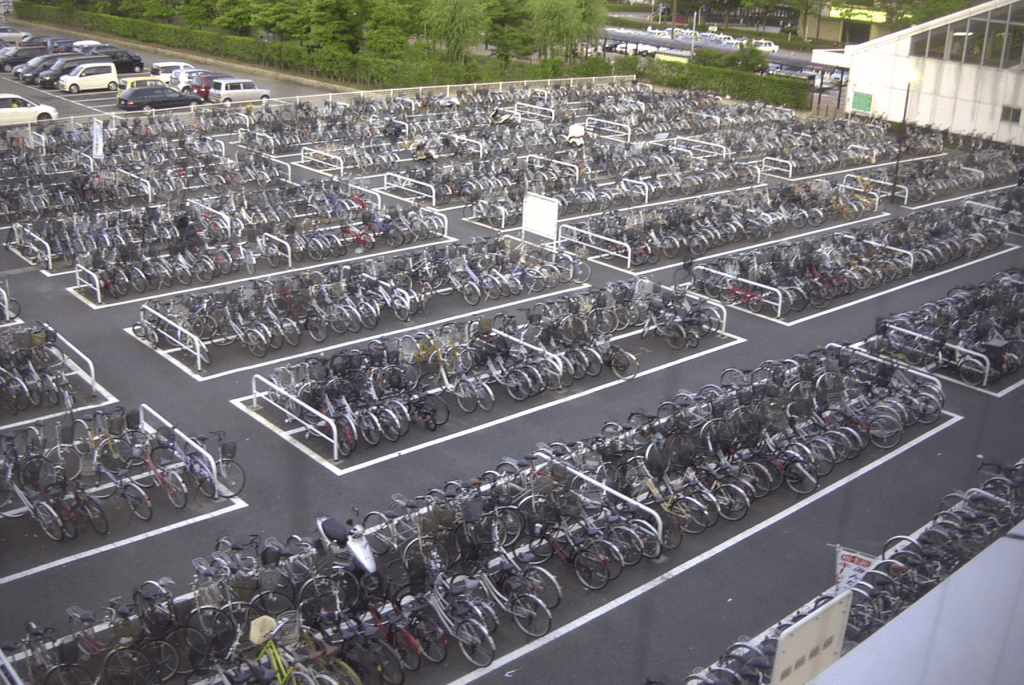
There is a large cultural component evident here. Japan has a bike culture. When I lived outside of Tokyo, I could drive past parking lots filled with thousands of bicycles. But that’s their culture.

A parking lot for bicycles in Niigata, NiigataJapan

I didn’t even own a car in Japan. I relied on their public transportation system and my feet. I drove friends’ cars and motorbikes. Japan also has favourable motorbike regulations, but that’s another topic.

What does it mean?

The meta of this satire is that from the perspective of the GDP, the cyclist does not contribute to the larger economy. I’ll not mention beyond this that the cyclist is a male.

He does not buy the car and does not take a car loan

This presumes that the bicycle is the sole means of transportation. Perhaps it is. Perhaps it isn’t. Perhaps he buys a car but pays cash. Why is he introducing financing into the equation? Of course, the bike needs to be purchased. Some are more expensive than a used car.

Does not buy vehicle insurance

This relies on the previous situation, but—and I hate to be the one to break it to you— not all people who own cars or drive buy automobile insurance. Do all jurisdictions actually require a person to purchase insurance?

Does not buy fuel

Ditto. Presuming this means petrol for the motorcar.

Does not use the services of repair shops and car washes

This is just silly. As with fuel, obviously, this is scoped to auto repair. And many people don’t use or rarely use car washes. Whilst one may bypass auto repair, you may not escape the need for bicycle repairs or tyres or frames and so on. Sure, these might be less expensive, but they are no zero-cost events.

Does not use paid parking

I am presuming this person either does not live in a congested city where one would have to pay for parking or his city subsidises parking, thus contributing to GDP.

Does not become obese

A bit of fat-shaming, perhaps? I guess he’s never seen a fat person on a bike. I’ll give him that the person on the bike might get some cardiovascular activity that wouldn’t have happened otherwise, and perhaps he’d avoid becoming morbidly obese, but I’m not accepting this one. Moreover, I’ll suggest that selection bias is more the factor.

Healthy people are not needed for the economy

Here’s the punchline. Healthy people don’t contribute to the Medical-Industrial Complex. Speaking from the perspective of the US, these people pay for preventative care, buy upscale food, eat in upscale restaurants—not to mention McDonald’s—, live in upscale housing in upscale neighbourhoods, shop in upscale stores, and so on. I’ve heard the sentiment that if you don’t spend money on Organic™ food and health supplements and treatment modalities, then you’ll spend it later in trying to recover your (inevitable) lost health.

How does McDonald’s generate dentists? Conveniently, he left out the medical personnel who get to treat knee injuries, injuries from falling and getting hit by cars (or maybe just car doors).

Closing

In the end, economics is not a good measure for much of anything, but it is a measure that can increase or decrease and, for what it’s worth, we can compare X to Y.

After all is said and done, I don’t care about the GDP, and I don’t care about cycling. Chalk it up to non-attachment or apathy—perhaps a little of each.