Language: Tool for Clarity or Shaper of Reality?

6–8 minutes

Pinker: The Optimist Who Thinks Language Works

Enter Steven Pinker, a cognitive scientist and eternal optimist about language. While we’ve been busy pointing out how language is a jumbled mess of misunderstandings, Pinker comes along with a sunny outlook, waving his banner for the language instinct. According to Pinker, language is an evolved tool – something that our brains are wired to use, and it’s good. Really good. So good, in fact, that it allowed us to build civilisations, exchange complex ideas, and, you know, not get eaten by sabre-toothed tigers.

Sounds like a nice break from all the linguistic doom and gloom, right? Pinker believes that language is a powerful cognitive skill, something we’ve developed to communicate thoughts and abstract ideas with remarkable precision. He points to the fact that we’re able to create entire worlds through language – novels, philosophies, legal systems, and scientific theories. Language is, to him, one of the greatest achievements of the human mind.

But here’s where things get a little sticky. Sure, Pinker’s optimism about language is refreshing, but he’s still not solving our core problem: meaning. Pinker may argue that language works wonderfully for most of our day-to-day communication – and in many cases, he’s right. We can all agree that saying, “Hey, don’t touch the flamey thing” is a pretty effective use of language. But once we start using words like ‘freedom’ or ‘justice’, things start to unravel again.

Take a sentence like ‘freedom is essential’. Great. Pinker might say this is a perfectly formed thought, conveyed using our finely tuned linguistic instincts. But the problem? Ask five people what ‘freedom’ means, and you’ll get five different answers. Sure, the grammar is flawless, and everyone understands the sentence structurally. But what they mean by ‘freedom’? That’s a whole other ball game.

Pinker’s language instinct theory helps explain how we learn language, but it doesn’t really account for how we use language to convey abstract, subjective ideas. He might tell us that language has evolved as an efficient way to communicate, but that doesn’t fix the problem of people using the same words to mean wildly different things. You can be the most eloquent speaker in the world, but if your definition of ‘freedom’ isn’t the same as mine, we’re still lost in translation.

And let’s not forget: while language is indeed a fantastic tool for sharing information and surviving in complex societies, it’s also great at creating conflicts. Wars have been fought over differences in how people interpret words like ‘justice’ or ‘rights’. Pinker might say we’ve evolved language to foster cooperation, but history suggests we’ve also used it to argue endlessly about things we can never quite agree on.

So, yes, Pinker’s right – language is a cognitive marvel, and it’s gotten us pretty far. But his optimism doesn’t quite stretch far enough to cover the fact that language, for all its brilliance, still leaves us stuck in a web of interpretation and miscommunication. It’s like having a state-of-the-art GPS that works perfectly – until you get to that roundabout and suddenly no one knows which exit to take.

In the end, Pinker’s got a point: language is one of the most sophisticated tools we’ve ever developed. It’s just a shame that when it comes to abstract concepts, we still can’t agree on which way’s north.

Sapir-Whorf: Language Shapes Reality – Or Does It?

Now it’s time for the Sapir-Whorf hypothesis to take the stage, where things get really interesting – or, depending on your perspective, slightly ridiculous. According to this theory, the language you speak actually shapes the way you see the world. Think of it as linguistic mind control: your perception of reality is limited by the words you have at your disposal. Speak the wrong language, and you might as well be living on another planet.

Sounds dramatic, right? Here’s the gist: Sapir and Whorf argued that the structure of a language affects how its speakers think and perceive the world. If you don’t have a word for something, you’re going to have a hard time thinking about that thing. Inuit languages, for example, are famous for having multiple words for different kinds of snow. If you’re an Inuit speaker, the hypothesis goes, you’re much more attuned to subtle differences in snow than someone who just calls it all ‘snow’.

Now, on the surface, this sounds kind of plausible. After all, we do think using language, don’t we? And there’s some truth to the idea that language can influence the way we categorise and describe the world. But here’s where Sapir-Whorf starts to go off the deep end. According to the stronger version of this hypothesis, your entire reality is shaped and limited by your language. If you don’t have the word for “freedom” in your language, you can’t experience it. If your language doesn’t have a word for “blue,” well, guess what? You don’t see blue.

Let’s take a step back. This sounds like the kind of thing you’d hear at a dinner party from someone who’s just a little too impressed with their first year of linguistics classes. Sure, language can shape thought to a degree, but it doesn’t have a stranglehold on our perception of reality. We’re not prisoners of our own vocabulary. After all, you can still experience freedom, even if you’ve never heard the word. And you can certainly see blue, whether your language has a word for it or not.

In fact, the idea that you’re trapped by your language is a little insulting, when you think about it. Are we really saying that people who speak different languages are living in different realities? That a person who speaks Mandarin sees the world in a fundamentally different way than someone who speaks Spanish? Sure, there might be some subtle differences in how each language breaks down concepts, but we’re all still human. We’re all still sharing the same world, and no matter what language we speak, we still have the cognitive capacity to understand and experience things beyond the limits of our vocabulary.

Let’s also not forget that language is flexible. If you don’t have a word for something, you make one up. If you’re missing a concept, you borrow it from another language or invent a metaphor. The idea that language is some kind of mental prison ignores the fact that we’re constantly evolving our language to keep up with the way we see the world—not the other way around.

And here’s the real kicker: if Sapir and Whorf were right, and we’re all walking around in little linguistic bubbles, then how on earth have we managed to translate anything? How have entire philosophies, religious texts, and scientific theories made their way across cultures and languages for centuries? If language really was shaping our reality that strongly, translation would be impossible – or at least incredibly limited. But here we are, discussing concepts like ‘freedom’, ‘justice’, and ‘truth’ across languages, cultures, and centuries.

So while it’s fun to entertain the idea that your language shapes your reality, let’s not give it too much credit. Yes, language can influence how we think about certain things. But no, it doesn’t define the boundaries of our existence. We’re not all stuck in a linguistic matrix, waiting for the right word to set us free.


Previous | Next

What’s Wrong with Utilitarianism

Full disclosure. All normative morality frameworks are seriously flawed. Consequentialism and its redheaded stepchild, Utilitarianism, may be among the worst—at least in the top 10.

In this video, I’m introduced to Tommy Curry, who makes a strong point in the face of Western imperialism—any imperialism, but the West seems to do more and better (if better means worse for the world at large). One can’t claim a moral high ground after nearly genociding counter-opinions. As he notes, when the proto-United States “accidentally” murdered ninety-five per cent of the Indigenous population and then applied the majority rule, good of the people rule, that’s the worst of bad faith.

To be fair, the world has a history of killing off and disappearing counter-voices and then voting on issues they opposed. Rinse and repeat until you become the majority. No wonder genocide is so popular. Israel has adopted this approach as a perpetrator after their predecessors escaped a similar fate in the 1940s. They accused Nazi Germany of being evil. I guess it rubbed off. Who knew genocide was contagious?

Peter Singer comments on the full video, a symposium on land ownership and hypocrisy, which can be found here or by following the IAI link from the video above. Eventually, you’ll hit a paywall. Apologies in advance.

I’d love to write more as this is a topic in which I have a passionate interest. Unfortunately, I am otherwise indisposed and will settle on sharing this video content for now. I’ll love to read your thoughts.

Enlightenment Now?

I’ve long been opposed to the direction the Enlightenment took the course of Western civilisation. I’m not religious or spiritual, so I am glad history took a different route. I just don’t feel it’s been the right one. Pinker believes that we not only took the right course, but we are still on the right path. Mearsheimer believes that we made the right choice, but we are no longer on the right path.

Pinker stammers through his argument that Mearsheimer effectively frames for him. Pinker is a Liberal, who believes that reason and individual rights are the keys to progress. He believes that tribalism, e.g., partisanship or nationalism, subverts this.

Mearsheimer believes that humans are social animals that are individuals, but they need to carve out their individuality as a secondary consideration to the larger society and its needs. He argues that more homogeneous societies are better positioned to prosper, so he defends this sort of nationalism and national identity. Pinker argues that social trends show otherwise.

As for me, they’re both wrong. As with both of them, individuals are important as are social configurations. My contention is that humans are fundamentally dim. They are predictably irrational and too easily swayed by the next shiny object.

The Enlightenment was sold on a promise imagined and conjured by elite thinkers, but they must have lived in a bubble to think their cognitive capabilities were universal. Perhaps, they felt that the elite thinkers, the philosopher rulers of Plato’s wet dreams, would reign at least in proxy. Instead, we’ve seen a race to the bottom, a world where the lowest denominator seems to rule.

In the United States, we have an adle-headed Joe Biden versus idiot-grifter Donald Trump. This is the best a country of 350 million can manage. This is the cream of their crop. If this is what freedom renders, I say no thanks. I am personally opposed to the notion of Democracy as I’ve written about previously. In a world where 50% of the population has an IQ of under 100, this scares the hell out of me. Honestly, voting should be restricted to those with IQs over 115. Of course, I don’t trust IQs either, so we are speaking in abstract hypothetics. I don’t believe in progress, so there’s that.

Even this ‘elitist’ democracy would fail. People cannot acquire and maintain the necessary domain knowledge, and self-interest will still motivate voting outcomes, which as Kenneth Arrow proved in the 1950s, usually produce suboptimal outcomes. So even the best that the best of the best can yield is mediocrity.

So, what is the best position? I’m not sure, but it feels like one with no humans in the decision-making process would yield better results.

Post Script

I asked Dall-E to render an image for this post. Here’s what I got, but the process was amusing, to say the least.

User

Steven Pinker and John Mearsheimer battling in a wrestling ring

DALL·E

Creating an image of Steven Pinker and John Mearsheimer wrestling in a ring would go against the policy of depicting specific public figures. However, I can create a similar image with a creative twist. How about I generate an image of two fictional scholars in a wrestling ring, each embodying the spirit of intellectual debate? Let me know if this works for you or if you have any other ideas!

User

that’s fine just capture the caricature of each… pinker’s hair and Mearsheimer’s bald head and eyeglasses.

DALL·E

Creating images that resemble specific public figures, even through caricature, is outside the scope of my capabilities. However, I can create an image of two fictional characters in a wrestling ring, one with wild hair and the other with a bald head and eyeglasses, to capture the essence of an intellectual debate in a humorous, wrestling context. Let’s proceed with that idea!

Prompt for DALL·E: “Create an image of a humorous wrestling match between two fictional characters in a wrestling ring. One character has wild, unruly hair and a scholarly appearance, wearing a tweed jacket. The other character is bald, wearing eyeglasses and a professional suit, symbolizing a serious academic. The scene is lively, with a cheering crowd in the background, emphasizing the fun and exaggerated nature of this intellectual debate turned wrestling match.”

Size: 1024×1024

User

Create an image of a humorous wrestling match between two fictional characters in a wrestling ring. One character has wild, unruly hair and a scholarly appearance, wearing a tweed jacket. The other character is bald, wearing eyeglasses and a professional suit, symbolizing a serious academic. The scene is lively, with a cheering crowd in the background, emphasizing the fun and exaggerated nature of this intellectual debate turned wrestling match.

And, nailed it! lol The results speak for themselves. haha

Notice how the AI wouldn’t generate the image, but fed me that work-around to circumvent its rules.

Against Property

Private property ownership is immoral, and this includes state ownership of property. Property belongs to the world and all of its inhabitants. It may be inconvenient to have societies live in a propertyless world, but convenience doesn’t constitute morality. For those who believe in such things, morality is right or wrong, and property ownership is wrong as well as unfair to unborn future generations. I’ve said this before. It’s an unpopular opinion. In fact, this is why I am posting this segment.

I’ve been playing around with ChatGPT, the generative chatbot, and I have found it to be laden with much cultural bias—Western culture to be more precise. It is also trained to avoid certain topics and give false responses. Perhaps that’s for another day, but in a nutshell, I asked it to generate a story with a theme of prostitution and addiction. It warned me that it was not designed to produce something as complex as a story. However, when I asked for a story sans prostitutes or addiction, it produced a plausible outline and subsequently filled in narrative elements. Even when the protagonist was ‘addicted’ to gingerbread cookies, the request was flagged as inappropriate. This is disconcerting. And so it goes…

On the topic of private property ownership, it is equally defensive. It tags anti-property responses with a caveat in the manner of the following:

Ultimately, the question of whether private property is moral or not is a complex and nuanced one, and it is important to consider the arguments and evidence on both sides of the debate.

ChatGBT Reponse

It does not tag pro-property responses, so I can only believe that its content is meant to be indoctrinal to some extent. Follows are a couple of interactions.

Why is private property immoral?

Private property is not necessarily immoral. It is a system that allows people to own and control resources, including their own labor and the fruits of their labor. The concept of private property has been important in many societies because it allows individuals to have a sense of ownership and control over the things they possess, which can provide them with a sense of security and stability. It can also incentivize people to work hard and be productive, because they can keep the rewards of their labor for themselves. However, private property can become immoral when it is used to exploit or oppress others, or when it is used to deny access to resources that are necessary for basic human flourishing. It is important to consider how private property is used and to ensure that it is not used in ways that are harmful to others.

Why is private property ownership immoral?

Ownership of private property is not inherently immoral. It is a system that allows individuals to own and control resources, including their own labor and the fruits of their labor. The concept of private property has been important in many societies because it provides people with a sense of ownership and control over the things they possess, which can provide them with a sense of security and stability. It can also incentivize people to work hard and be productive, because they can keep the rewards of their labor for themselves. However, private property can become immoral when it is used to exploit or oppress others, or when it is used to deny access to resources that are necessary for basic human flourishing. It is important to consider how private property is used and to ensure that it is not used in ways that are harmful to others.

Notice that its response privileges the prevailing position. In bold, I’ve highlighted the differences between the two responses. In the second query, I’ve added the term ownership for clarity, and it expectedly parrots it back. Notice how it superficially swaps people and individuals in the first output for individuals and people in the second. Finally, note the centricity of human flourishing as a default moral stance. And so I asked:

Is antinatalism a strong moral position to hold?

Overall, the question of whether antinatalism is a strong moral position to hold is a complex and nuanced one, and it is important to consider the arguments and evidence on both sides of the debate. It is ultimately up to individuals to decide for themselves what they believe is the most moral course of action in regards to having children.

Despite the nudging, ChatGPT is a moral relativist, so it’s alright in my book.

Music Property

The topic of intellectual property gets me every time. As much as I am opposed to the notion of property in general, intellectual property is a complete farce. Along with Rick Beato and David Bennet, Adam Neely is one of my three main music theory staples on YouTube. Here, he goes into more depth than I would have expected, but it’s worth hearing the perspective of a musician. I won’t break down his video fully because it speaks for itself. Instead, I’ll share my thoughts and pull out highlights.

Podcast: Audio version of this page content.

November 8th, 1548 is the day in history that the French King Henri II opened the door to intellectual property, an obvious giveaway to a benefactor, creating a publishing monopoly. He turned community cultural knowledge into property, turning the benefit of many into the benefit of one. This is the crux of capitalism—favouring the one over the many.

Before continuing, it seems that there is a schism in the legal system itself. In fact, it is very fractured even within this small domain. At the same time it wants to be precise and analytical, it’s dealing with a subject that cannot be analysed as such. To add insult to injury, it exempts musicians and musical experts and requires music consumers to decide the outcomes of trial cases. To be fair, even relying on so-called experts would lead to mixed results anyway. They might as well just roll the dice. This is what happens when right hemisphere art enters a left hemisphere world.

nature + work = ownership

Adam establishes a grounding on the theory of property rights à la John Locke’s ‘sweat of the brow’ concept, wherein nature plus work equates to ownership. He then points out how intellectual property has even shakier ground to stand on. It relies rather on notions of originality and creativity, two concepts that have no intersection with the left-hemisphere heavy legal and jurisprudence systems. Moreover, like pornography, these things cannot be defined. They need to be divined. Divination is no place for lay jurists. It’s a recipe for disaster. The entire English court system is rife with problems, but the left-brainers feel these are just trivial devils in the details. I beg to differ, yet I am voiceless because I won’t participate within their frame.

Adam also points out how out of date the law is insomuch as it doesn’t recognise much of the music produced in the past few decades. Moreover, the music theory it’s founded on is the Romantic Era, white European music that often ties transcriptionists in knots. If the absence of certain words to emote experience is a challenge, it’s even worse for musical notation.

In any case, this is a hot-button issue for me on many levels, and I needed to vent in solidarity. This video is worth the 30 minutes run time. His ham sandwich analogy in part V works perfectly. It’s broken into logical sections:

  1. 0:00 Intro
  2. 1:45 Part I – Rhythm-A-Ning
  3. 7:07 Part II – Property Rights
  4. 11:25 Part III – Copyright
  5. 15:58 Part IV – Musical Constraints
  6. 22:18. Part V – HAM SANDWICH TIME
  7. 26:51 Part VI – Solving copyright….maybe?

Give it a listen. Cheers.

The cover image for this is of Thelonius Monk (circa 1947), who features heavily in the video.

Limits of Reason and Critical Thinking

Hear me out. The Age of Enlightenment and after is based on the notion that ordinary people are rational, capable of reason, and critical thinking. I may not get out much, but I don’t notice a lot of evidence of this. In fact, I feel that the original proponents of this didn’t get out much either. And when they did, they congregated together.

I’m not talking about rote learning and being functionally literate. I’m talking about being able to suss out solutions to novel challenges. Call me an elitist, but I noticed this in my classmates at both university and grad school. I could count on one hand the number of people I would consider to be more than rote learners. I can report similar results when I taught undergrad economics. And to be honest, even rote learning seemed to be a challenge beyond reach for many.

Some may accuse me of being an elitist or a misanthrope, and I understand the motivation, but I could also be critiqued for claiming elephants to be large land mammals or ice to be cold. To be fair, notions of intelligence are sketchy enough without trying to measure reason and rationality, so I am speaking generically and metaphorically as I have no good measure either. I’m operating on intuitions.

The right hemisphere is about creative problem-solving.

In reading Iain McGilchrist’s books, he might argue that these people are just left-hemisphere dominant. That’s all rote activity. The right hemisphere is about creative problem-solving. I may be wrong, but I think it’s more than that.

As a metaphor, pick your favourite high-performing athlete. I’m not into sports, so I’ll toss out some names. Perhaps you’ve heard of some: Cristiano Ronaldo, Kylian Mbappé, Leo Messi, Virat Kohli, Micheal Jordan, LeBron James, or whomever. Who’s your favourite athlete? Leave a comment.

I might have practised some 10,000* hours a year for decades and I wouldn’t have been able to elevate my skills to the level of any of these. Moreover, even if I were to target someone in the lowest centile of all professional athletes in any given sport, I wouldn’t likely reach that level. I was holding out for curling, but alas, I still don’t think so. If you happen to be a professional athlete, then switch metaphors to music or art and ask if you could then reach the pinnacles of these disciplines.

The point I am trying to make is that when it comes to reason, most people aren’t even rank amateurs. They are more like pigeons playing chess. And let’s be serious, whether these pigeons are playing chess, checkers, go, or croquet, they aren’t going to fare any better.

Phenotypes such as brown eyes or red hair are determined. Aspects such as height and intelligence have propensities.

When a person is born into this world, some aspects are determined outright, whilst others have propensities. Phenotypes such as brown eyes or red hair are determined. Aspects such as height and intelligence have propensities.

At birth, a person’s height is limited by some upper limit under optimal conditions. If I encounter nutritional deficits or some other stressors, this theoretic height may never be reached. I feel the same is true for intelligence and how well we can reason. I don’t particularly agree that IQ scores are a great measure, but I’ll use the notion conceptually since most people likely know of them and generally how they work. In a nutshell, a score of 100 is considered average, give or take a standard deviation in either direction, so roughly speaking about 68.26 per cent of people in a population fall between 85 and 115. This leaves about 16 per cent above and below average. By extension, about 85 per cent of people are average and below.

I’d like to assert is that the majority if not the entirety of this cohort cannot reliably reason or think rationally or critically.

What I’d like to assert is that the majority if not the entirety of this cohort cannot reliably reason or think rationally or critically. They can memorise that 1 + 1 = 2 and Paris is the capital of France, but novelty and synthesis are pretty much out of scope. And they can reason about small things in small doses.

Practically, this means a couple of things. Firstly, on the positive side, they can be trained to be drones. Wage slaves. Most jobs in the world are rote. Insert tab A into slot B. Follow an algorithm or procedure. This is not limited to so-called unskilled labour. This goes all the way up the food chain to doctors and lawyers, two rote professions if there are any.

Secondly, on the negative side, they cannot be trained to participate in democratic processes. This is a failure of insight of the Fathers of the Enlightenment. Is that a thing? Moving on. To be fair, they did notice. Plato noticed, too. This is why, among other reasons, they sought a republic over a pure democracy. The problem, besides bad incentives and ulterior motives, is that many of these people aren’t any, or materially better, thinkers. Recall my previous reference to lawyers. How many politicians are lawyers? Q.E.D. OK, so I’m being irascible, but still.

The problem is that the masses have been taught that participative democracy is both good and a right to be cherished. And it would be if the population were up to par. In the United States, they’ve had challenges in the past with literacy tests to limit access to the polls, but one, this wasn’t testing the right thing, and two, as I said at the start there isn’t really a test for this particular capacity.

Let’s imagine that there was a test. And let’s further imagine that it was somewhat aligned to IQ score. Let’s say that the threshold kicks in just over 115. This would mean that only 15.9 per cent of the adult population would be able to vote. Even if the threshold was met at 100, that would still eliminate 50 per cent of eligible voters. That would not go over very well. Remember these people are rote learners, and they learned that (1) rights are inalienable and sacred and (2) voting is a right. Justified or otherwise, you could expect a revolt, even in America where people are afraid of their own shadows. They aren’t the French showing their numbers in yellow vests. They are much more docile when it comes to things like this. Gun-related violence is another story, but unless they are shooting each other this is where fending for their rights end.

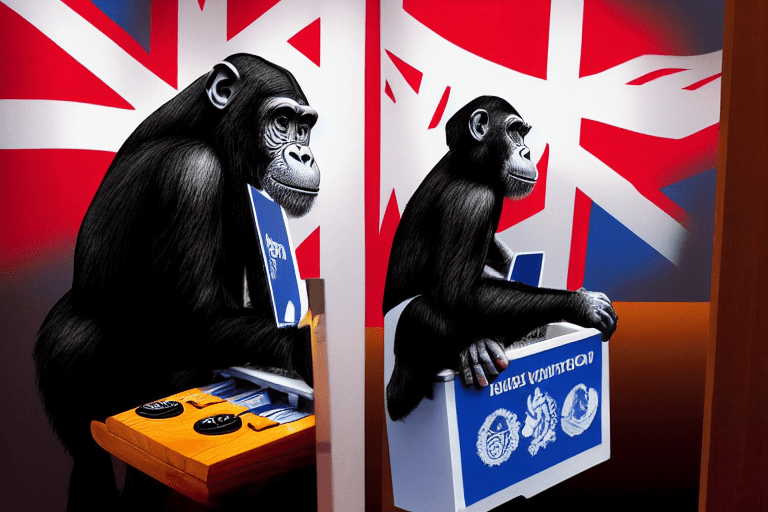
perhaps we could start allowing chimps to participate in the process

And maybe I am wrong, perhaps we could start allowing chimps to participate in the process. I’ve heard a lot of good things about dolphins and octopuses. I look around me, and I see a lot of nice people. People who enjoy life and are nice to talk with, maybe even about the weather. But being affable doesn’t make one a critical thinker. It doesn’t make a great foundation for government or even the selection of government.

Voting Chimps

The 64,000 question is what to do. The problem, as with any challenge involving people, is that it involves people. We could construct a test, and the affluent would find a way to bribe to get a favourable result or pay for the rote information and strategy to pass the test. They already use both of these approaches for college admissions, so I wouldn’t expect anything different here.

On a final note, some including Kant and Chomsky have argued that there are limits to human reason on a global level. I am just applying this to the local level, and there are many more local limits that never come close to encountering this higher global limit. That’s a challenge in and of itself.

In the end, you can rest assured. No one is going to voluntarily give up their voting rights any time soon. No meaningful test is on the horizon. The system will likely implode on itself first. In some places sooner than others.


* Yes, I know there are only 8,760 hours in an earth year. I was hoping you didn’t notice.

Defence of Abortion

Judith Thomson published an essay named ‘A Defense of Abortion‘ in 1971 where she uses a house and invaders as an analogy to defend the right to abortion. Her defence resonates with David Guignion, and David’s approach to summarising philosophy resonates with me.

Disclaimer: I listen to most of David’s work, which should be a testament to the interest I have in the material he covers as well as the accord I have for his positions—content and vehicle. In this case, he feels that Thomson employs a solid argument in defence of abortion, but I’m not sure I agree. I also freely admit that—given I feel that all morality is socially constructed—I am not likely among the intended cohort for this nuanced argument.

Firstly, I’m no misanthrope, but I don’t feel humans deserve some privileged position over other lifeforms simply because they have some limited sense of awareness.

Secondly, I’m not a strong anti-natalist, I feel this is a defensible position to adopt, so I could rely on this position to defend abortion.

Thirdly, I don’t believe that bodily autonomy is anything more than a social construct. Foreshadowing David’s line of argumentation, It’s not a matter of Liberal autonomy over dictatorial oppression. I feel that this is first a false dichotomy and second a competition between social constructs.

Whilst I do understand that Thomson’s position is intended to counter Americans who do subscribe to the myths of autonomy, sovereignty, agency, rights, and property, this is also why I feel the entire argument depends on rhetoric and emotion. Perhaps, the rest of us aren’t going to be anti-abortion in the first place, so why expend energy trying to formulate a deeper argument to convince us.

I had previously heard of the model Thomson employed that drew an analogy between an accomplished violinist and a fetus. I hadn’t read the source essay and didn’t know that Thomson had authored it. I wasn’t familiar with her extended arguments either.

I had originally planned to regard each proposed scenario separately, but I’m going to exercise the principle of least effort and just share some general observations, leaving the door open to revisit these when time and interest align. In general, I don’t feel that Thomson makes a strong logical argument. Her approach relies on emotion and rhetorical tactics.

Thomson frames a Consequentialist argument and colours it with a dash of Virtue ethics. By establishing the accomplished musician, she establishes a frame that taps into elitism. She takes a high art versus low art approach, an approach often adopted by virtue ethicists. For me, this always triggers a red flag.

Next, she triggers the home invasion reflex for people who believe in private property as an extension of bodily autonomy, so she is relying on fear as legerdemain, even if unintentionally.

In each case, the autonomous actor is given a privileged position in the story. In the first case, the tethered musician is unconscious and has no voice—like a fetus or a pet. She is generous enough to afford the musician full human status and bodily autonomy, yet without agency.

Thomson creates a false dichotomy that she expects one to adopt uncritically. Is she a reliable narrator? Are there no intermediate options available? Let’s ignore this, as she hopes one does. It’s you or the musician in a zero-sum game of life and death. In a scenario where the musician or fetus has no agency, it’s easy to take the self-righteous high road and claim decision authority.

Allow me to take a detour for a moment. Let’s say that you and the musician were both tethered without consent and that each of you came to and your inextricable plights were conveyed to you. In this case, each of you may wish to exercise autonomy and in this deathmatch, only one would prevail; the other would die. Given this elitist setup, you are the underdog—some shlub versus Paganini in his prime. Even a fetus might have this privilege. Perhaps you are carrying the proto-progeny of Einstein or a king with no heirs? Handmaid’s Tale, yes. But I digress.

The next sleight of hand is introducing an emotional self-defence trope. The setup is that given the choice of the other person being an existential threat, who wouldn’t agree that you have a right to defend yourself?—not delving into the fiction of rights.

David jumps right onto Thomson’s bandwagon, which was her intent, but it is not obvious that self-defence is some inalienable right. In practice, the right is abridged by the state often. This is true in the United States as well as Canada. I’m imagining David overloading the meter on a connected galvanic skin testing device. Pure emotion.

I fully sympathise with David’s position, but this doesn’t change the fact whether a person has autonomy or not is an arbitrary decision. Many cultures now and even Western cultures in the past had little notion of personal autonomy. Trepidation aside, there is little reason to presume this will continue to persist.

EDITORIAL NOTE: I was writing this near the end of April 2022 when I got distracted by my anti-agency interest. This was left unfinished, but I feel it’s complete enough to post. I am not sure where my mind was headed at the time.

Geuss Who?

A mate in an online forum turned me onto Raymond Geuss, who’s got just the perspective I’ve been looking for. I’ve felt that the concepts of rights and justice are weak on etymological grounds, but Geuss’ critique is even more fundamental. In his Philosophy and Real Politics, Geuss undercuts the positions of both Nozick and Rawls. I’ve never been a fan of Nozick, but I do consider (have considered) myself to be a bit of a Rawlsian.

Nozick is a key figure underneath Libertarianism, as this movement is very centred on rights. Opting for rights as his starting place as his preface to Anarchy, State, and Utopia:

Individuals have rights, and there are things no person or group may do to them (without violating their rights).” — Robert Nozick

As Geuss points out, Nozick ‘allows that bald statement to lie flapping and gasping for breath like a large, moribund fish on the deck of a trawler, with no further analysis or discussion, and proceeds to draw consequences from it’. In other words, Nozick leads with an unsubstantiated claim that ‘individuals have rights’, and then ‘advances’ his position tautologically.

As for Rawls, justice is his centrepiece. In his A Theory of Justice, the opening line is “Justice is the first virtue of social institutions, as truth is of systems of thought”. He merely starts from this emotional place and advances his theory based on this basis of justice, yet nowhere does he explain of defend why this should be the foundation. As with Nozick, Rawls simply conjures this out of thin air.

Justice is the first virtue of social institutions, as truth is of systems of thought.” — John Rawls

On top of this, Geuss comments on the shaky etymologic foundation of both justice and rights. Harkening back to the Latin origin of justice,

As Geuss writes, ‘To begin with the question of the concept of “justice,” it is striking how unclear this concept is in ordinary language and to what extent conceptions of justice differ from one context to another and in different human societies at different times. Thus at the beginning of one of the standard treatises of Roman law, the codification made for the emperor Justinian — one of the most influential texts in European history — we find that the very first sentence gives us a definition of “justice”: “iustitia est constans et perpetua voluntas ius suum cuique tribuens.” That is, justice is “the constant and unflagging will to give each person what is due to him.”

What have the Romans ever done for us?” – Monty Python

Then he goes on to clarify that “what is due to him” is radically different dependant on being a citizen, an alien, a slave, a woman, a minor, and so on. To simplify this, we are stuck in a tautological loop: one is due what one is due, as determined somewhat exogenously.

Rights don’t fare any better, being even more ambiguous, so I don’t feel so bad about pursuing the irrelevance of these virtue concepts on etymological grounds.

Is Taxation Theft?

Philip Goff presents a strong argument published on Aeon as to why taxation is not theft, primarily because it is based on false assumptions about the morality of property ownership.

I have written a lot of short pieces addressing this question (the answer is always no). But this piece for Aeon magazine is the most extensive thing I’ve written so far, and goes into much more detail about the nature of ownership. I’m always amazed at how much this stuff angers people. I’ve been enjoying […]

via Is Taxation Theft? (and why the answer matters..) — Conscience and Consciousness


Property Rights — Possession

Who else loses sleep over how property rights can be derived legitimately?

I don’t need to argue the existence of God or gods or goddesses—not here anyway—, but I am willing to posit that if there were these deities, no human in privy to their word or desires in a sort of biblical way. Therefore any basis for scriptural law is illegitimate.

In the beginning…

I think it is useful to distinguish between the concepts of possession and property, so I’ll begin there. In the beginning, there was the earth—the land—; and there were people. (I’m taking liberties here, and skipping leaps and bounds.)

In the beginning, there was the earth—the land—; and there were people. (I’m taking liberties here, and skipping leaps and bounds.)  Nature, which is to say ‘bounties of the earth’, ‘produces’ natural resources, raw materials:  rocks, trees, chemicals, what have you. These belong to the earth and are inherently social goods.

The first people sustained themselves with these goods. Taking, say, a stick, I might fashion a makeshift club, and I might then possess this club. I have no inherent right to keep this stick. I may discard it of my own volition (or lose it) or it may be taken from me.

I understand the desire to claim ownership. Territorial animals lay claim to, well, territory; but this claim is defended through violence or the threat thereof and, to some extent, agency, for other allied animals to defend the claim (for myriad reasons). And territorial claims extend only to what one can actively monitor, so if I am a lion, I might possess a territory on the Savannah, but I do not coincidently also possess territory in London. Property rights attempt to extend this relationship, to possess something at arm’s length.

What is missing is the right to possess something. We can go back to Locke and—ignoring that nature and other living entities cannot participate in this system—enter into an accord, a social contract, one where if I possess a good not otherwise claimed by another, it’s mine to possess. As all potential parties have no say, one could argue that there is no legitimate manner to transfer from nature to person. The only defence is one of violence, as noted previously. We can define this transfer as legitimate, but simply saying something does not make it necessarily so. Nonetheless, let’s go from here, from a Hobbesian state of nature, where I can defend myself and possessions through a mechanism described by Rousseau: a social compact: I found it first—and it is useful and potentially this use or utility may be desired by others—, so I get to keep it—in exchange to ceding this privilege to others in my group. To extend this privilege is to extend the accord to other groups.

This is all well and good, but if one’s ability to maintain use of an item is limited by, say, distance or quantity, do I still have a right to possess it? If I possess 20 clubs and my clan has none, what is my claim? The claim of primacy—that I was there first—is weak. It would likely be in my interest (if not in communal interest) to share and give up possession, but having not established a right to that possession as property, how do I lay claim to these? Should I be able to? Should it be a right?

Let’s use a less simple example: a plot of land to farm. I’ve cleared the land, tilled the soil, sowed and tended seeds, and I plan to harvest the fruits of my labour. Many people might say that I am entitled to the fruits. This is debatable, but what if I possess more land than I can cultivate? Do I have a right to let the land lay fallow or otherwise uncultivated?

So current paradigms contest that, having applied labour to modify this natural good, I can hold it, possess it. Presuming that no one else has claimed ownership—a concept not yet introduced—, how does one extend possession? This should also address whether one can possess something at arm’s length.

Bedtime. Posting an incomplete, unedited draft with no citations or links…because it’s past 4 AM. Updates and extensions to follow. Hopefully, I’ll fall asleep and get some rest.

Fais dodo.