The road to Hell is paved with good intentions. I wanted to post a fairly robust piece arguing against democracy, but it is proving to be a bit daunting of a task. There is a lot of data and information to support this position. Too much, in fact. I’ve decided to step back and approach supporting this position more academically (which is to say, less blog-like… citations, footnotes, counterpoints, and the rest).
“Democracy don’t rule the world, You’d better get that in your head; This world is ruled by violence, But I guess that’s better left unsaid.”
—Bob Dylan
As it happens, I’ve been spending a lot of prep time reading, reviewing, watching online content, and so on. To be honest—I know, right?—, I’ve been engaging in deliberate selection bias, seeking arguments and evidence to make my case. In fact, it’s not too difficult to locate. The reality is that most people, such as David Moscrop, who asks Are We Too Dumb for Democracy? are creating provocative titles to grab attention, but their punchline is always ‘of course not’ and let me tell you why not by peddling hope and optimism. There is a reason self-help books sell.
Where I am now as 2021 has bled into 2022 is to try to create a structure around my thoughts. So far, it looks like this—not necessarily in this order:
Position and setup
Prima facie arguments
essential strawman counter arguments
historical backdrop – pre-enlightenment until now (pro-dem args)
Think about it: The average person has an IQ of 100. Essentially, half of the people have lower and half have higher. Not a good hand to be dealt. I don’t particularly buy into the whole IQ thing, but it serves this line of logic. Adopting this framework and reflecting on normal or so-called Gaussian distributions, this means (pun initially unintended) that within one standard deviation of the mean, 68 per cent of the population falls, which is to say having an IQ between 85-115.*
Zut Alors!
An IQ score of 100 wouldn’t be that bad if it was calibrated to Einstein or Hawking, but it’s not. The average police officer in the US has an IQ of around 103. Think about it. This is who democracy is asking to be in charge; this is who we expect to make good voting decisions. Amor fati. Memento mori.
Continuing on my It’s People riff, I am further struggling with options. As a Disintigrationist, I don’t feel compelled to provide answers, but as a personal matter, it seems that I am stuck in the middle. Idiocracy was supposed to be satire, but it’s serious.
So, accuse me of being an elitist. Call me a misanthrope. But it’s more patho-anthropy. It’s pity. Dunning-Kruger, be damned. On the one hand, a hierarchical structure leaves us with self-interested opportunists, megalomaniacs and narcissists; on the other, we get to know the political opinions of the Paul Blart‘s and Homer Simpson‘s of the world. And there’s nothing in between.
The Devil You Know
Following Plato’s Republic, the current system presumes a sort of meritocracy that elevates those who excel at politics to rise to the top. Optimistically, this is precisely what happens; pessimistically, this is precisely what happens. This is as good as it gets—self-serving politicos doing all they can to maintain their positions.
But what about the other people? Surely some honourable people are attracted to the political calling, right? Some who make it into the system are spat out by it; some are marginalised; the remainder are corrupted by it.
Then there’s the other side of the coin. There’s something to consider with local democracy. At least you know the idiots you are dealing with, but that’s not really a consolation. Here, Plato noted the benefits of rhetoric.
Police break up an illegal poker match—doggy style
Given the limited prospects for even a third-tier suboptimal solution, we might be better off by adopting RNG as a ruling system. No boundaries. No parameters. Remove any interference by humans. They’ll only muck it up.
Where to Go from Here
Hyperbole aside, what is the solution? Nazi Germans took a stab at it, but of course, they were idiots, too. Plain and star-bellied Sneetches. Pots calling the kettles black. People have tried literacy testing, income and wealth testing, lots, and any other number of approaches. The challenge is to have a system with no human intervention. Sadly, even this system would necessarily be constructed by humans, so we’re pretty much doomed.
Sneetches
Finally, to silence those who might label me an elitist, no, I don’t think that a society comprised and governed by people only with IQs at and above, say, 160 would fare much better because the problem is broader than facile intelligence.
* If your reaction is ‘but my IQ is in this range’, you may now get my trepidation.
Surfing the Web, I happened upon a blog wherein Wintery Knight riffed on a conversation about morality with an atheist millennial man. My interest was piqued, so I scanned it and then read it. I scanned the About page, and it’s apparent that we hold diametrically opposed worldviews, and that’s OK.
As a result of the encounter with this millennial man, the post intends to answer the question: How could I show him that happy feelings are not a good basis for morality? But let’s step back a bit.
In the words of the author, ‘I asked him to define morality, and he said that morality was feeling good, and helping other people to feel good.’ Here’s the first problem: Although a conversation about morality may have occurred between the author and an atheist millennial man, the post is not in fact a reaction to Millennial morality. Rather, it’s of the respondent’s dim characterisation of what morality is (whether for a theist or an atheist). His reply that morality is ‘feeling good, and helping other people to feel good’ sounds more like hedonism and compassion. The author does pick up on the Utilitarian bent of the response but fails to disconnect this response from the question. The result is a strawman response to one person’s hamfisted rendition of morality. The author provides no additional context for the conversation nor whether an attempt to correct the foundational definition.
A quick Google search yields what should by now be a familiar definition of morality: principles concerning the distinction between right and wrong or good and bad behaviour.
morality (noun) : principles concerning the distinction between right and wrong or good and bad behaviour
Oxford Languages
Clearly, conflating utility with rightness and wrongness, with goodness and badness, is an obvious dead-end at the start. This said, I could just stop typing. Yet, I’ll continue—at least for a while longer.
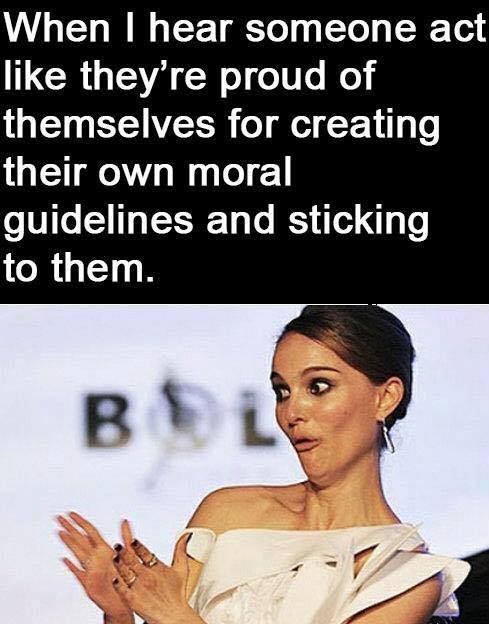
At the top of the article is a meme image that reads ‘When I hear someone act like they’re proud of themselves for creating their own moral guidelines and sticking to them’.
Natalie Portman sports an awkward facial expression and a sarcastic clap. Under the image is a line of copy: If you define morality as “whatever I want to do” then you’ll always be “moral”, which is tautological, but a bit of a non-sequitur to the rest, so I’ll leave it alone.
Let’s stop to regard this copy for a few moments but without going too deep. Let’s ignore the loose grammar and the concept of pride. I presume the focus of the author to be on the individually fabricated morals (read: ethical guidelines or rules) and that the fabricator follows through with them.
That this person follows through on their own rules is more impressive than the broken New Year’s resolutions of so many and is a certainly better track record than most people with supposed religious convictions.
New Years’ Resolutions
First, all morals are fabricated—his morals or your morals. And you can believe that these goods came from God or gods or nature or were just always present awaiting humans to embody them, but that doesn’t change the point.
Let’s presume that at least some of his morals don’t comport with the authors because they are borne out of compassion. Since we’ve already established precedence for cherry-picking, allow me to side-step the hedonistic aspects and instead focus on the compassionate aspects. Would this be offensive to the author? Isn’t, in fact, in Matthew 7:12 and Luke 6:31, the do unto others Golden Rule edict, is a call for compassion—at least sympathy if not empathy?
After a quick jab at abortion (tl; dr: abortion is bad) taking the scenic route to articulate the point that atheists typically don’t think of unborn children as people, apparently without fully grasping the concept of zygotes and gametes. The author then confuses the neutral notion of a probabilistic outcome with accidents, having negative connotations—as if I flip a coin, the result is an accident. Let’s ignore this passive-aggressive hostility and move on. Let’s also forgive the flippant—or at least facile—articulation of biological evolutionary processes as ‘the strong survive while the weak die’. We can let it slide since what is meant by strong in this context is wide open.
child (noun) : a young human being below the age of puberty or below the legal age of majority
Oxford Languages
The author continues with a claim that ‘you aren’t going to be able to generate a moral standard that includes compassion for weak unborn children on that scenario’. This feels like an unsubstantiated claim. Is this true? Who knows. Some people have compassion for all sorts of things from puppies to pandas without having some belief in rights. Some people like Peter Singer argues that rights should be extended to all species, and all humans should be vegans. I wonder if the author can live up to this moral high watermark. Maybe so. Probably doesn’t mix linen and wool because it’s the right thing to do.
“If the rule is “let’s do what makes us happy”, and the unborn child can’t voice her opinion, then the selfish grown-ups win.” This is our next stop. This is a true statement, so let’s tease it a bit. Animals are slaughtered and eaten, having no voice. Pet’s are kept captive, having no voice. Trees are felled, having no voice. Land is absconded from vegetation and Animalia—even other humans. Stolen from unborn humans for generations to come. Lots of people have no voice.
People are into countries and time and space. What about the converse situation? Where is the responsibility for having the child who gains a voice and doesn’t want this life? Does it matter that two consenting adults choose to have a child, so it’s OK? Doesn’t the world have enough people? What if two consenting adults choose to rob a bank? I know I don’t have to explicitly make the point that once the child is thrown into this world, the voice is told to shut up if it asks to exit or even tries to exit without permission. Unless circumstances arise to snuff out the little bugger as an adult.
Finally, the author is warmed up and decides to focus first on fatherhood. The question posed was whether the interlocutor thought that fatherlessness harmed children, to which the response was no.
Spoiler alert: The author is toting a lot of baggage on this fatherhood trip. Before we even get to the father, the child, or the family, there is a presumption of a Capitalist, income-based, market economy. Father means the adult male at the head of a nuclear family with a mum (or perhaps a mother; mum may be too informal), likely with 2 kids and half a pet. The child is expected to also participate in this constructed economy—the imagined ‘right’ social arrangement. It goes without saying that I feel this is a bum deal and shit arrangement, but I’ll defer to pieces already and yet to be written here. But if fathers are the cause of this ‘Modern’ society, fuck ’em and the horses they rode in on.
She asks him, if a system of sexual rules based on “me feeling good, and other people around me feeling good”, was likely to protect children. Evidently, he was silent, but here you can already determine that she unnecessarily links sex to procreation. And reflecting on a few paragraphs back, how is forcing a child (without asking) to be born and then told to become a wage slave or perish not violent and cruel?
(Self-guidance: Calm down, man. You can get through this.)
So the question is surreptitiously about procreative sex. By extension, if the couple can’t procreate for whatever myriad reasons, it’s OK? Sounds like it? Premenstrual, menopausal, oral, anal, same-sex coupling is all OK in this book. Perhaps, the author is more open-minded than I am given credit for. Not all humans are fertile, sex with plants and animals won’t result in procreation. A lot of folks would call this author kinky or freaky. Not my cup of tea, but I’m not judging. Besides, I’ve read that book—though shalt not judge. I’m gonna play it safe. And they couldn’t print it if it wasn’t true.
Spoiler Alert: Jesus dies at the end.
Seeking credibility, the author cites Bloomberg, as Centre to Centre-Left organisation as Far-Left. Clearly another red flag. Excuse me, your bias is showing. This piece is likely written for choir preaching, so we’ll take the penalty and move along.
A quick jab at the bête noire of ‘Big Government’ facilitating idle hands and, presumably genitals, to play. The idle rich as Croesus folks are idols to behold. At least I can presume she opposes military spending and armed aggression on the grounds of harm, so we’ve got common ground there. They’re probably an advocate of defunding the police, though by another name. so there’s another common platform. It just goes to show: all you need to do is talk to ameliorate differences. We’re making good headway. Let’s keep up the momentum.
Wait, what? We need to preserve a Western Way? I was shooting for something more Zen. Jesus was a Westerner—being from Bethlehem and all. (That’s in Israel—probably on the Westside.)
White Jesus from the Middle East
No worries. Just a minor setback—a speedbump. It’s just a flesh wound. But we’ve pretty much reached the end. A little banter about some other studies. There’s an impartial citation from the Institute for Family Studies on cohabitation they beg the question and employs circular logic. And another from the non-partisan Heritage Foundation finds that dads who live with their children spend more time with them. How profound. I’d fund that study.
And it’s over. What happened? In the end, all I got out of it is ‘I don’t like it when you make up morals’. You need to adopt the same moral code I’ve adopted.
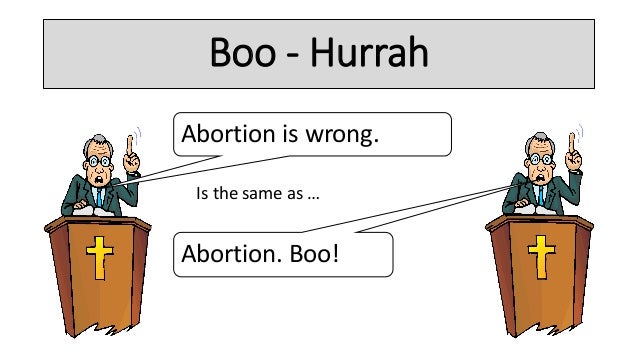
AJ Ayer – Emotivism
Where was I? Oh yeah. Fathers. So these people don’t mean generic fathers. They mean fathers who subscribe to their worldview. In their magical realm, these fathers are not abusive to their mothers or children; these fathers are not rip-roaring alcoholics; these fathers are the dads you see on the telly.
Suspiciously absent is the plotline where the fathers are ripped from their families through systematic racism and incarcerated as if they didn’t want to be there for their children. And this isn’t discussing whether it’s an issue of fathers or an issue of money. It isn’t discussing whether someone else might serve as a proxy for this role. Indeed, there is nothing magical about fathers unless you live in a fantasy world.
I watched the video, What Makes us Postmodern, and its predecesor, What Makes Us Modern, and I immediately discounted any attempts to synthesise Modernism and Postmodernism in some Hegelian manner, Hegel’s approach being somewhat Modern at the start. One can pair the essential dimensions and perhaps arrive at some moderate position, but, firstly, this is a Modern perspective; secondly, Moderns are not likey to abandon their position.
There may be a resolution, but it seems that it will require a paradigm shift—a different perspective still.
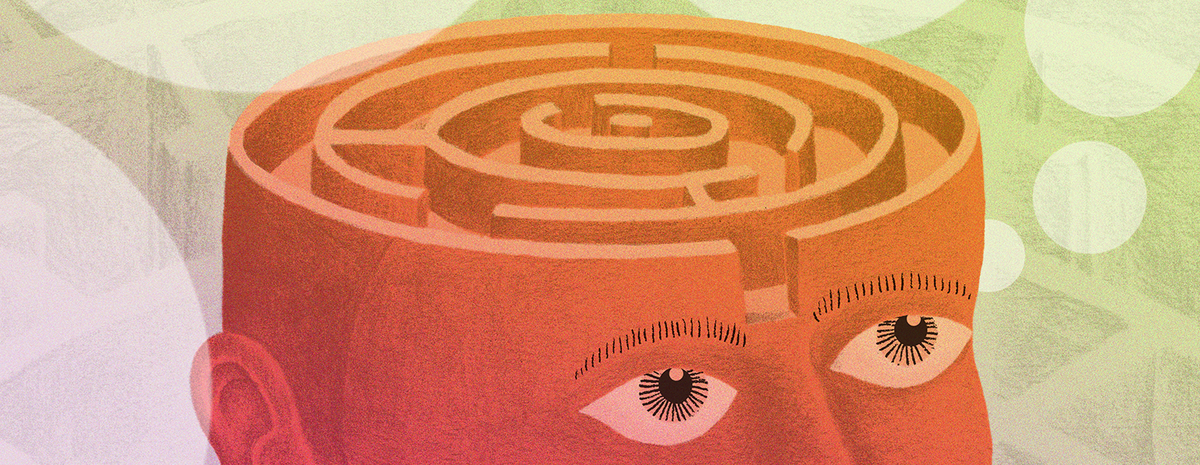
Ancient Greek mythology gives us the story of the Labyrinth. As I am not interested in analysing this from a Jungian perspective, we can safely ignore the Minotaur. The story of the labryrinth is a story for Moderns. It’s a teleological story based on the metanarrative that suggests that one can find order in disorder, if only they have the key.
As the story goes, the labyrinth is an unsolvable puzzle. However, at least one person knows how to solve it, or at least knows how to beat the system. Depending on the source version, Ariadne either assisted Theseus with a thread or jewels.
In a tl;dr version of the story, Theseus is tasked with killing the Minotaur. I’ve recently discussed his ship. Exposition informs us that the Minotaur is mortal, thus killable, but there is no escaping the maze—for reasons. However, Daedalus, the architect of the labyrinth, told Ariadne that there was one way out. If someone were to record their ingress, with say, a thread or jewels, they could then follow these to egress. Definitely not a plot device. Hansel and Gretel took this to heart and marked their ingress with breadcrumbs—or stones, depending upon which version you’re reading.
What Makes this Modern
Though the story of the labyrinth and the Minotaur comes from a pre-modern era, it remains an apt metaphor for modernity.
There is a deliberate underlying structure. In fact, it has been architected by Daedalus. This mirrors the Intelligent Design narrative favoured by Christians.
There is a definitive solution to the puzzle. The story is teleological. If one follows the plan, stays on the path, they will prevail. Go off-script, and perish.
This is a story about structure, about order, about adopting and conforming to the rules. Even though it’s also about gaming the system with cheat codes in more modern parlance. Nowadays, I’d turn off clipping and collision detection, but Ariadne didn’t know these codes. I digress.
Postmodern Reaction
This is not a story for Postmoderns because it starts with a design. For moderns, there is a design. It’s either a vestigial god or science. The belief is that everything has structure. Even if that structure is yet unknown to us. If only we had enough time, we could suss it out. Perhaps it’s past time to re-task Shakespeare’s infinite monkeys.
Reconciliation of this teleological belief is intractable. Rather, it can likely only be solved with rhetoric. Moderns love rhetoric, which explains why they have so much faith in Aristotle and classical philosophers, who still provide a foundation to much philosophy of the Moderns. It’s intractable in the same way that converting someone with some religious conviction to no longer have that conviction.
Modernism is about faith. It may have shifted from faith in gods to faith in logic and reason, science and technology, or organisation and progress. Postmodernism points out that whilst these are possible solutions, they are not the only solutions. Moreover, these have unintended consequences and create collateral damage. They also rely on a privileged perspective. Perhaps I’ll create a segment to illustrate this point using the disruption of COVID-19 as a backdrop.
In the end, Modernism relies on teleologies. The end may not be known, but we can divine a vision and lead people in that direction anyway by employing rhetorical devices. Postmodernism knows that any such narrative is fiction. A postmodern may emotionally buy into the narrative, but they never forget that it’s still fiction.
Modernism relies on order and control to maintain that order. This doesn’t mean that all Moderns are top-down authoritarians. But it does mean that they need crowd control and compliance. The United States are probably mostly Moderns. They like to claim they are individualists, but they are more typically either keeping up with the Joneses or competing with them. Most individuality is trivial at best. “I’m an individual because my BMW is purple.” Quite. And Moderns don’t like much non-compliance. They may want change, but if someone expresses this need for change through civil disobedience, the Modern may viscerally agree, but they will also rationalise that the civil disobedients should have used the admittedly broken system. Moderns like what they call progress, but they can only accept change in small doses at a slow pace, so there’s a friction.
Finally, there’s power. I am not going to rehash Nietzsche or Foucault, but this is a schism. Moderns want order and control. Power structures assist this, but then they don’t like the current actors. If only there were better actors. Nietzsche noted that the masters and the herd had different interests and moralities. Moderns know this on one level but think they can remediate this dichotomy. Because of course, they think they can bring order to everything—Second Law of Thermodynamics notwithstanding.
In the end, these schools will likely attempt to coexist. As for me, I’m a nihilist and somewhat of an existentialist. Yet, I am also a pragmatist as I still have to operate within the world I’ve been thrown into, as noted by Heidegger.
“The nine most terrifying words in the English language are: I’m from the Government, and I’m here to help.”
Ronald Reagan
This sentence just crossed my mind. People of a certain age may remember film actor Ronald Reagan’s quip: I’m from the Government, and I’m here to help. Libertarians seem to be enamoured by this. Perhaps smug captures it better. For them, this is about the ineptness of government, that bloated bureaucracy that couldn’t get it right if it tried, and certainly not efficiently. If the government comes a knocking, view it as you do with stranger danger: Don’t get in the van with the guy with the puppy and candy. I get it. But let’s shift perspective to see how it renders from a different perspective.
Let’s start from the start with a small disclaimer. I am not an apologist for government. In fact, I am not a fan of bureaucracy. One of the more successful propaganda-slash-marketing campaign in the sphere of public opinion is that private enterprise is somehow superior in all manners to the public version. Let’s be clear here. If one is making sweeping generalisations, then start here. All bureaucracies are created equal.
Echoing Tolstoy, “Bureaucracies are all alike; every bureaucracy is unhappy in its own way.” I may have misremembered how this opening line goes. Poor Anna. Let’s keep going. Government bureaucracy is no better or worse than corporate bureaucracy. There is no correlation. For every efficient corporation—not a thing, but bear with me—there is an efficient government agency—also not a thing, so, I think you’re realising my point. Bureaucracies are practically by definition recipes for mediocrity. They are meant to produce repeatable processes at scale. They aren’t designed to be innovative or nimble, although you can buy many books and training materials on how to achieve this if you’ve got nothing better to do with your money. Let’s return to the main concept: I’m from the Government, and I’m here to help.
I’m from the Government, and I’m here to help.
What’s the problem with this? We need to ask, why has the government shown up at our doorstep, to begin with. The answer, private markets have failed. There is a hole in the social fabric. Perhaps the private sector does provide the needed good or service, but it is clearly not affordable. Hence the hole. Clearly, the private sector has dropped the ball. So when the government attempts to intervene, the response is to cry foul. “Those people can’t afford to pay for a solution, so they shouldn’t get one. Perhaps those people should work harder or get more job training so they can afford to pay us.”
“What? Urgent medical care, you say? They should have thought ahead.”
“What’s that? She’s an infant? I suppose she should have picked different parents who thought ahead. Why do people reproduce when they can’t afford to raise a child in the first place. There ought to be a law.”
And so it goes.
Not only doesn’t the private sector not want to serve a population if it can’t profit. It’s decided that if it can’t profit from a person in a circumstance, then that person doesn’t deserve assistance. Even shoddy assistance as is suggested by the quote.
I recall another adage: something is better than nothing.
But there is more to this than meets the eye. The unstated objection is that government will provide the good or service, and it will be as good if not better than the private sector offering and it will cost less to provide. This would reveal the private sector apologists to be the charlatans they are. I am not claiming that this is some foregone conclusion. But it’s an eventuality the private sectorists don’t want exposed.
A prime example of this is the provision of healthcare and insurance. The world over provides these services cheaper and with superior health outcomes, and yet a common refrain by profit mongers is that you don’t want those other services with better health outcomes, not only provided for a lower cost, but also provided for a lower cost to you.
There is nothing inherent in this quote about the government being here to help that it is attempting to supplant some successful private sector business model.
“Why don’t we get into the yacht-building business?”
When government intervenes, it is usually due to market failure. So then why do we so often see the government trying to intervene? Availability bias aside, it’s because the market fails often, so the government has to play MacGyver time and time again. Markets are fragile. Capitalism is fragile.
The Second Law of Thermodynamics relates to entropy. Capitalism and market systems are not self-sustaining. Entropy consistently dissipates energy in these systems, hence economic busts. This isn’t even addressing the issue of misappropriation of resources from this system, which only serves to exacerbate and accelerate this natural decline. If external capital weren’t injected into this system, it would have collapsed under its own weight ages ago.
As a parting shot, it’s interesting to me that for a cohort loathing government assistance, these same blokes seem to have their hands out begging, or at least accepting, this same government assistance. The help the eschew on behalf of others is often welcomed with open arms. Where I come from, we call this hypocrisy. Hypocrisy Now. I’ve got an idea for a film.
This wall of words was posted in a Facebook that the AI thought I would be interested in. I’m not, save for the rhetorical and grammatical structure. I am not interested in the veracity of the claim or the sentiment it is meant to provoke.
The author purportedly had a conversation with a former student, who identified as being a member of another race—black, I suppose; African-American in the current vogue; negro and coloured in bygone days.
Notice the head-fake. A conversation with an individual person quickly morphs into a generalisation. This individual, in the mind of the author—or at least the conveyance—was now the representative mouthpiece for this so-called race. But that’s not what I question.
They and them are now considered to be acceptible singular forms if a person identifies as such. I’m not sure I am equiped to comment on identification to a grammatical element, so I’ll side-step that and focus on the outcome.
Perusing this or something similar, there is a sense of undeserved weight—an inclusion from the perspective of a single person. Some people actively promote themselves as spokespeople for a group, whether race or something else. But this person did not necessarily claim to speak for anyone beyond him or herself—perhaps some small, immediate group of collegues who shared this perspective.
I am wondering how this will play out as a device to intentionally deceive the reader.
Another thing…
I was in Philadelphia yesterday, and a black associate of mine was commenting on what he deemed to be 150 neo-Nazi skinheads parading in the rain, a point eliciting more pleasure than perhaps it deserved. His assessment is that race was not a problem, that he held no illwill toward any race. His contention was with ‘motherfucking racists’. Unfortunately, there is no scientific racist litmus. There are only actions and perceptions. This is where Popper’s paradox of tolerance pops into mind. And so it goes…
My base belief is that what people believe is their truth, and rhetoric is a primary way to convince them. Part of the rhetorical mechanism is to introduce evidence, but this, too, is shrouded in rhetoric.
I’m not talking about the evidence that ‘standard’ water boils at 100°C at sea-level. This is tautological. Water is defined as H₂O. Literally, 100°C is the definition of where water boils under these conditions.
But things that cannot be repeated in controlled environment with the ability to alter parameters within the environment rely on rhetoric. This is why Newton’s laws seemed som compelling until a new narrative (somewhat) supplanted it. Still, this is not the point I want to make. I want to concentrate on the socio-poliotical domain.
I feel that given two equally viable explanations, the one offering more hope will prevail. Donald Trump knows this. This is why in the midst of the COVID-19 pandemic, he railed at a presser how he chastised a reporter for questioning his (false) narrative of hope. Politics relies on more than one rhetorical thread, and many already have the disposition of reviling Trump, so any messages from him are discounted at the start.* But, ceteris paribus, if a person assesses two equally probable outcomes—a typical door number 1 or door number 2 scenario—, and (for whatever exogenous reason) hope is associated to particular door.
In a survival scenario, perhaps you are one of three people lost in a cave and there are two possible paths forward. One person asserts that s/he feels that—without evidence—the left path is best way out but adds logically there is no way to tell, that you might as well flip a coin. The other person confidently conveys that s/he knows—without evidence—that the right path is the path to salvation. Being otherwise indifferent, you are likely to acquiesce to the second person, the one who offers hope over logic.
I fully admit that this is 100 per cent fabricated whole cloth from thin air, but the reason I come to this point is when you compare atheists to theists, anarchists to statists, nihilists to Existentialists, and any such analogic pair, the right side gets more traction and requires much more evidence to sway people to the left.
So when Occupy Wall Street (effectively anarchists) made demands, the status (read: the general population) asked ‘Who’s your leader?’ When the media-industrial complex broadcast this, the public was immediately sympathetic to the structured system. This is slightly different in that it’s not necessarily hope, rather a comfort zone—an endowment effect. It’s a benefit accruing to the incumbent.
My point is: hope floats. It acts to buoy otherwise rhetorically equivalent arguments. Or perhaps hope is simply an employed rhetorical device, so it’s unnecessary to call it out. Now, I’ve convinced myself to adopt this position.
* This is why ad hominem attacks can be effective, as persons swayed by the attack discount messages delivered by this person despite there not being a necessary connection between the grounds for debasement and the claim being asserted.
Please note that this content has been subsumed into the originating article: The Truth about Truth.
THIRD: Rhetoric is a primary driver to fashion our sense of how close or distant we are from reality. Rhetoric shapes and focuses the frame.
War Is Peace, Freedom Is Slavery, and Ignorance Is Strength
— 1984, George Orwell
I’ve already commented at length about the primacy of rhetoric. To recap for the purpose of this disquisition, the only meaningful arbiter of truth is rhetoric—the ability to persuade the larger populace to accept something as true.
Here, I’d expect someone to counter with, ‘Just because people are convinced that something is true doesn’t make it so’, and they’d be right. However, as we cannot access the underlying reality accept through our admittedly fallible senses, who’s to argue?
Moreover—going off on a tangent—, we know that other lifeforms—let’s stick with the animal kingdom—have different senses than humans, and some humans perceive things differently to the normie (if I may adopt a spectrum term) .
Sharks have electroreception (re: The Ampullae of Lorenzini), which allows them to perceive small changes in electrical fields as well as what’s termed a lateral line ( mechanoreceptor function), which allows them to recognise changes in environmental pressure. Other known sensory adaptations are echolocation in bats and dolphins and chemoreceptors (notably in insects and snails).
We are probably also aware that different animals have differing degrees of sense acuity compared to humans. Dogs hear frequencies above the human threshold and have better olfactory discrimination. Birds of prey have superior vision. Women typically have a broader colour vocabulary.
And then there’s synesthesia, a condition in which one sense is simultaneously perceived as if by one or more additional senses. A person with synesthesia may perceive sound as colour (chromesthesia) or perhaps taste.
Given concepts of normality, we presume we are synesthesia are normal and these other people are somehow not, but for all we know, we normies are evolutionary dead ends, soon to be displaced by synesthesiacs. (Is that even a word? It is now.)
But I digress.
Perception is reality. If one can convince you of something, e.g. Donald Trump is a good president, then it’s ostensibly true to you. If one can convince an entire population that something is true, e.g. the plot of Orwell’s 1984, or The Matrix, then who’s to say otherwise.
The notion of Truth is not as cut-and-dry as it might appear at first glance. As a non-cognitivist, I don’t believe in the notion of objective Truth, so I am not entirely sure why it matters enough to me to continue to talk about it. I suppose I’m an Emotivist and Prescriptivist, if these terms capture the essence of my feelings. The Emotivism is what attracts me to an issue whilst Prescriptivism is why I feel the urge to transmit my beliefs. I’ll also suppose, if I adopt an evolutionary survival framework, that people do this to enhance probability of survival by minimising otherness. It also identifies me to those with a similar perspective. The inherent risk is that this attempt at community-building also broadcasts my potential—and let’s be real here, actual—otherness.
In practice, I’d venture that most people simply take the notion of truth for granted, and given an inquiry would defend it with an ‘of course it’s true‘ response with no need for additional justification. But as with human language more generally, Truth is an approximation of a notion. I like to categorise it as Archetypal.
The issue with Truth and other virtues (and pretty much everything else not analytically tautological), is that people don’t seem to believe that they operate asymptotically. They believe there is a truth, it’s objective and accessible, with enough inquiry, can be discovered.
I am self-aware that employing the language of maths and science is a problem adopted for many in philosophy, as they attempt to legitimatise a position by explaining it relative to the currently adopted metanarrative framework. I also know that by adopting this frame, I (or anyone in a similar position) am (is) twisted into convoluted knots. This is how science had been forced into retrograde motion models to explain a geocentric model of the universe, but when the paradigm was shifted to a heliocentric model, these off behaviours fell by the wayside. I suppose a superior approach would be to redefine the language and deposition the frame, but that’s easier said than done.
Graph: Correspondence of Truth to Reality (Asymptotic Curve)
The common assumption is that, over time, scientific inquiry will lead us closer to the truth. Correspondence theory supports the notion that more observations and perspectives will lead to a closer approximation, and eventually tools at our disposal will lead to more granular definitions, until we reach a point that and differences in the tangency to reality will be insignificant, a veritable rounding error. But there are several problems with these assumptions.
We have no idea how close or far we are from Reality on the Y-axis, representing Truth.
Graph: Correspondence of Truth to Reality (Asymptotic Curve)
Assuming for the time being that there is an approachable truth, we have no reference to understand how close to reality we might be. In practice, we seem to operate on a basis of always being within some level of statistical significance of where Truth = Reality, and when new information is introduced, we say, “Hooray for Science!” Aren’t we glad that science is self-correcting. Empiricism has its own issues.
Historically, we’ve had ‘wrong’ correspondence between Truth and Reality, but then we got it ‘right’—until we didn’t. Rinse and repeat.
We may all be familiar with the story of how Einstein progressed and refined Newtonian physics. What Einstein did is to create a new narrative—a synchronous shift of paradigm and rhetoric—, which has been accepted into a revised orthodoxy. In our mind, this feels like progress. But how close are we to the real truth?
Taking our understanding of gravity as the fabric of space-time, we still have no idea what’s going on or how it operates, but this doesn’t prevent us from accepting it as a black box and making pragmatic predictions from there. So, for all intents and purposes, the ‘truth’ mechanism is less important than the functional relationship, just as I can tell time on a watch I have no idea how it operates.
We have no idea if any changes to our perception move us closer to or further from Reality.
Rather than being asymptotic, perhaps the relationship to is polynomial (or the result of some stochastic function). See the graph above. As we move into the future (in red) and look back, we may perceive that we’ve reversed against some notion of progress. Common wisdom is that progress is directly, positively related to time. But is it?
In my first amendment, I reference how Einstein progressed and refined Newtonian physics, but in the future, this could be shown to be wrong. In our minds, what had seemed like progress may in retrospect turn out to have been a false assertion.* Moreover, we’ll dutifully accept this updated notion of truth if the rhetoric is sufficient to fit our concept of evidence, especially given humans’ propensity for pareidolia.
I am no true Sceptic, but neither do I accept the prevailing meta-narrative whole cloth. Unfortunately, I am in no better position than the next person to discern proximity to the underlying structure of reality.
Rhetoric is a primary driver to fashion our sense of how close or distant we are from reality. Rhetoric shapes and focuses the frame.
War Is Peace, Freedom Is Slavery, and Ignorance Is Strength
— 1984, George Orwell
I’ve already commented at length about the primacy of rhetoric. To recap for the purpose of this disquisition, the only meaningful arbiter of truth is rhetoric—the ability to persuade the larger populace to accept something as true.
Here, I’d expect someone to counter with, ‘Just because people are convinced that something is true doesn’t make it so’, and they’d be right. However, as we cannot access the underlying reality accept through our admittedly fallible senses, who’s to argue?
Moreover—departing on a tangent—, we know that other lifeforms—let’s stick with the animal kingdom—have different senses than humans, and some humans perceive things differently to the normie (if I may adopt a spectrum term) .
Sharks have electroreception (re: The Ampullae of Lorenzini), which allows them to perceive small changes in electrical fields as well as what’s termed a lateral line ( mechanoreceptor function), which allows them to recognise changes in environmental pressure. Other known sensory adaptations are echolocation in bats and dolphins and chemoreceptors (notably in insects and snails).
We are probably also aware that different animals have differing degrees of sense acuity compared to humans. Dogs hear frequencies above the human threshold and have better olfactory discrimination. Birds of prey have superior vision. Women typically have a broader colour vocabulary.
And then there’s synesthesia, a condition in which one sense is simultaneously perceived as if by one or more additional senses. A person with synesthesia may perceive sound as colour (chromesthesia) or perhaps taste.
Given concepts of normality, we presume we are synesthesia are normal and these other people are somehow not, but for all we know, we normies are evolutionary dead ends, soon to be displaced by synesthesiacs. (Is that even a word? It is now.)
But I digress.
Perception is reality. If one can convince you of something, e.g. Donald Trump is a good president, then it’s ostensibly true to you. If one can convince an entire population that something is true, e.g. the plot of Orwell’s 1984, or The Matrix, then who’s to say otherwise.
Intent in communicating perception does not get one closer to some corresponding reality. It merely converges perception.
This fourth entry is a response to this comment by Landzek from The Philosophical Hack regarding the notion of intended truth in communication.
Extending the simple asymptotic function from the first section, we might see (in Graph 4a) a slight variation in interpretation due to the insufficiencies of language—providing us with a close enough for the government approximation to some shared perception. People in this group will tend to agree on some perception, say, that the earth is spherical.** The average distance from perception to reality is the same for all in-group members, give or take some small variance that I’ll dismiss as an insignificant rounding error.
Graph 4a: Correspondence of Truth to Reality (Simplified in-group concurrence)
Graph 4b, however, illustrates two opposing perceptions of reality. In this example, I show proponents of orthodoxy (group O), who claim the earth to be roughly spherical, arbitrarily closer to reality than proponents of an alternative theory (group A), who claim that the earth is flat.
Each in-group has some variance from the mean notion, but ex-group members are orders of magnitude apart, as measured by the blue and red bars to the right of the chart. If we assume some binary condition that the earth is either spherical or flat with no other options, one of these might be considered to be right whilst the other would be wrong. We can establish this situation relative to the ex-groups, but, still, neither of these is comparable to Reality™ .
Graph 4b: Correspondence of Truth to Reality (Simplified ex-group concurrence)
The intent of each group may be to promote the perspective of the group—each claiming to be closer to the truth than the other. It is easy to imagine a situation where both claimants are equally distant from the truth:
Imagine two groups, each making opposing claims:
Tarot is superior to Astrology in predicting the future.
Astrology is superior to Tarot in predicting the future.
I’ll go out on a limb here and create a reality where the future is not predictable by either measure, irrespective of what each in-group believes.
* I am not versed well enough in the history of science, but I’d be interested to know which, if any, scientific advances have been a step ‘backward’, that a belief had overtaken a prior belief only to have reverted to the former.
I am aware of the slow march of science and the ignorance of possibly valid assertions simply because the rhetoric was not strong enough or the PR just wasn’t adequate. An example might be the debate of theoretical Democracy versus Communism: which is better than the other. Of course, there are too many dimensions to consider, and the adoption or exclusion of one dimension over another might be enough to tilt the outcome.
In the real world—see what I did there—, the US spend billions upon billions of dollars to interfere with Communism—and I am not taking a position whether it would have succeeded or failed on its own terms—, just to be able to knock down the strawman some century later though propagandising and disinformation campaigns.
** I understand that the earth being an oblate spheroid is primarily an analytical distinction, so is tautologically true, but I am using a simplification of a commonly accepted fact.
DISCLAIMER: In order to keep generating new content (or even content) on this blog, I will occasionally adopt a new approach of publishing unfinished thoughts instead of waiting to complete the thought. This means, I may be editing pages in place to correct my position and alter narrative flow, of not the narrative itself.
EDIT: I’ve included my amendments in line above, though I’ve retained links to the original content.
One topic I hear often, and most often from Libertarians, is that people ‘own’ their body. These people espouse body autonomy and self rule. In fact, this is a starting point and they extend it out to some imaginary boundary of limited government.
This sentiment is captured by pithy statements like
Your right to extend your fist ends at my nose.
Some guy
This all sounds well and good, yet there is no objective case that defends body self-ownership. Taking this position is simply latching onto normative, emotional rhetoric.
Personally, I like the idea that I should have some control over decisions leading to what happens to my body, but save for the idea content, I am under no delusion that this is self-evident or otherwise guaranteed. By extension, there is no reason in particular why sovereignty can be defended except through mutual contract and the tacit (and sometimes explicit) violence and the threat thereof, as I’ve commented on before.