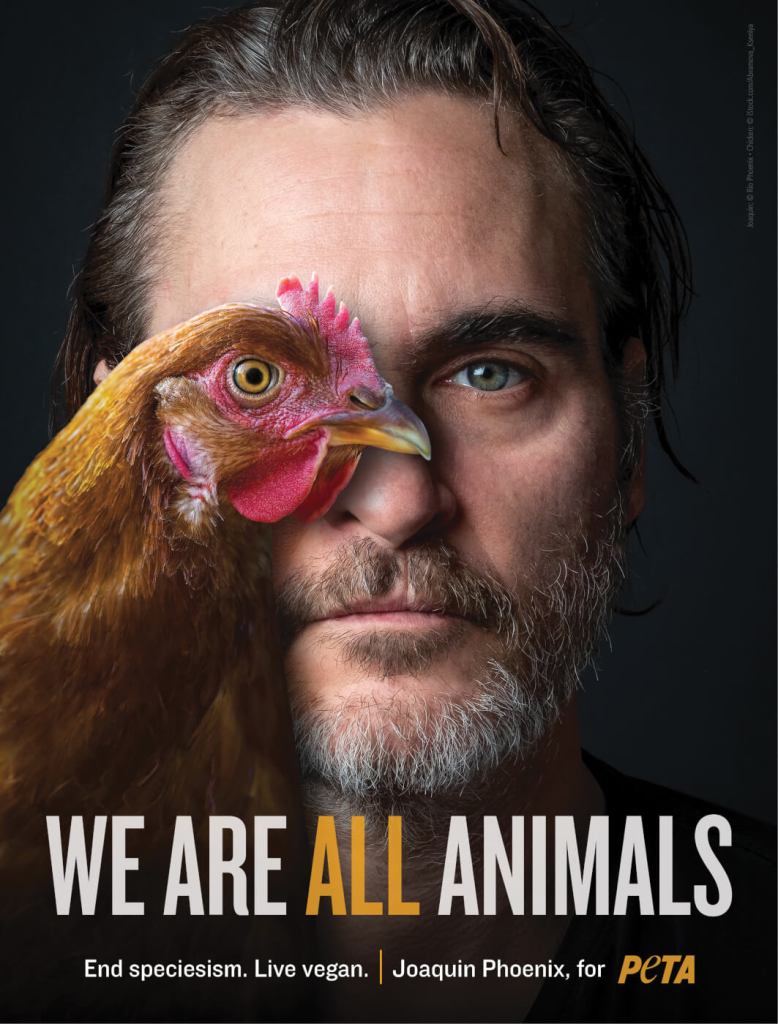
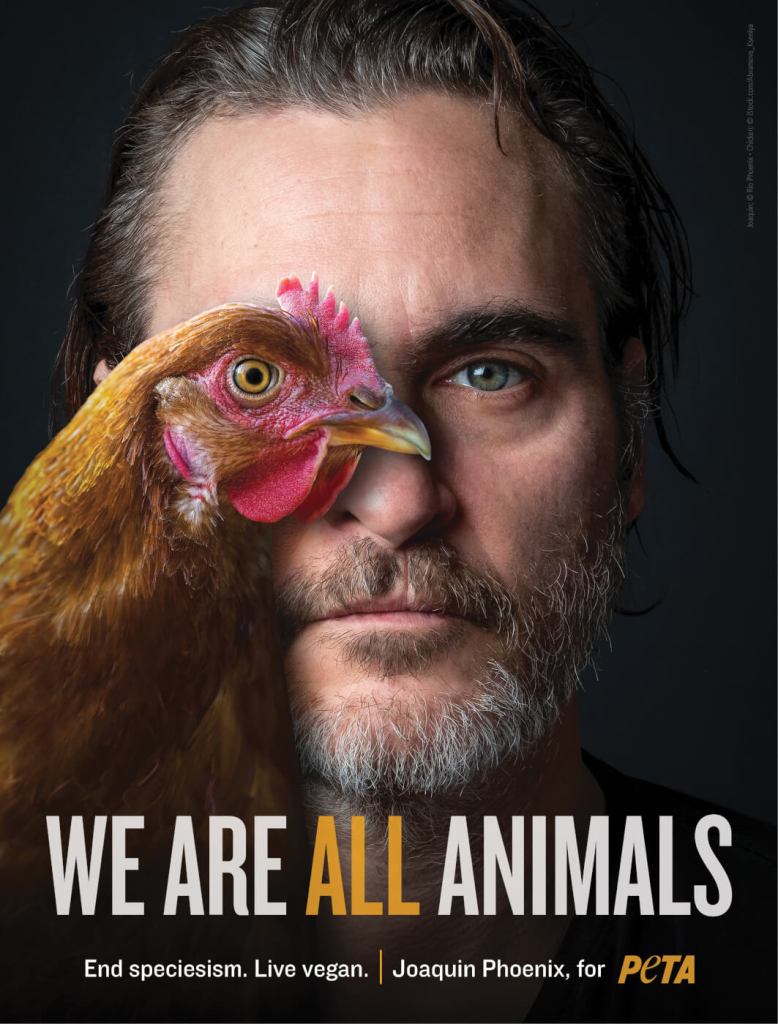
Why is racism wrong but speciesism OK? Primarily, other species have no voice, and to have no voice is to have no say. This advert got my attention.
Joaquin Phoenix Advert
Humanism is part and parcel specious Enlightenment tripe, where ‘coincidentally‘ humans put themselves at the forefront. Copernicus removed Earth from the centre — though to be fair, even Christians had elevated gender-non-specific-Man above other animals — , but Humanism makes it more poignant that it’s Man at centre not God. Gods be damned. In fact, it’s often an afterthought that humans are animals at all, despite only the slightest veneer of consciousness and, more to the point, language to separate us from them.
Otherness has proven itself to be an evolutionary survival aspect, one that has brought me to a point where I can write this, so one can call it natural, another term fraught with connotational baggage. To be able to differentiate and discriminate appear to be valuable attributes, but how much is enough, and how much is too much.
Buddhism teaches that we are all one with the cosmos and that any distinction is an illusion. Buddhist Enlightenment — not to be confused with Western Enlightenment — is to understand this, to not be bound to the illusion.
But, if racism is wrong, why is speciesism OK? Humans do give some animals some rights, and some places give different animals different rights, whilst others give animals categorically more and fewer rights. Some places ascribe divinity upon animals, elevating them above humans.
Racism seems to be more wrong because humans are more genetically homogeneous — at least phenotypically. Other mammals and herptiles don’t look so much like us. In observation, when they do, we have an additional layer of empathy, so chimps and canines with expressive eyes gain sympathy not afforded crustaceans and pinnipeds.
I don’t have an answer save to say that it’s just convenient and someday we may see a world as portrayed by science fiction where some — mostly bipedal species — live quasi-harmoniously with humans. But even there, humans are always the start, front and centre to provide to moral POV.
My girlfriend’s mother with whom we live was raised a Catholic. She asked me what my religious beliefs are, and I responded that I don’t believe in gods, angels, divine anything, a higher intelligence or power in the manner people ascribe to gods. She conveyed that she had been upset with her husband but got the last laugh after he died.
As she related it to me, the night after he dies, he came to her in a vision and told her that he was wrong and she was right, so now she knows that there is life after death. I’m not entirely sure if he was heaven-bound in this scenario.
So, as she finds comfort in this belief (and of the other spectres she’s seen, heard, and felt, I just nod and smile and say ‘that’s nice’). I try my best not to sprain anything as I roll my eyes on the inside.
At least Descartes admitted that his senses might be deceived. No such thing here. One of the issues I have with so-called religious tolerance is that it is not politically correct to call BS on nonsense like this. Of course, I am not about to jeopardise my relationship with my girlfriend by mocking her mother.
My girlfriend is a different story still. she was raised in a Catholic household but was not subjected to the church or parochial school like her mother, but she was still fed a diet of religious nonsense growing up. To her, hell is real. The fear of a hell actually influences some moral decisions. To the righteous, this is a fine consequentialist approach, the ends (of normalised behaviour) justify the means (of believing a lie).
To me, the lie is immoral, but to some, they actually believe it (or believe it enough) that they don’t see it as a fabrication. I suppose it’s easier for people like me who consider morality to be fabricated from whole cloth.
I’m an unabashed atheist, a position I’ve defended since 5th grade when I refused to pledge allegiance* in class—primarily on account of the God clause, but I’ve never been a fan of fealty. It was difficult as at the time I was being raised a WASP in a town comprised of 70-odd per cent of Roman Catholics.
I’d wrestled with the concept for years, even taking a middle-ground agnostic position until I decided to get off the fence and pick a side. Dawkin’s God Delusion made it easier when he published his 7-point spectrum, stretching between an absolute believer to an absolute atheist. Here I was able to remain agnostic but defend the atheist notion as, say, a 6 of 7 on the scale—or 6.9999 as the case might be.
Strong theist. 100% probability of God. In the words of C.G. Jung: “I do not believe, I know.”
De facto theist. Very high probability but short of 100%. “I don’t know for certain, but I strongly believe in God and live my life on the assumption that he is there.”
Leaning towards theism. Higher than 50% but not very high. “I am very uncertain, but I am inclined to believe in God.”
Completely impartial. Exactly 50%. “God’s existence and non-existence are exactly equiprobable.”
Leaning towards atheism. Lower than 50% but not very low. “I do not know whether God exists but I’m inclined to be sceptical.”
De facto atheist. Very low probability, but short of zero. “I don’t know for certain but I think God is very improbable, and I live my life on the assumption that he is not there.”
Strong atheist. “I know there is no God, with the same conviction as Jung knows there is one.”
I leave open there could be such a higher ‘energy’ or some such, but I feel the probability is pretty remote—something less than homoeopathic.
Unicorns are the new black
Allow me to sidestep the distinction between an atheist meaning not believing and an agnostic meaning not knowing. For the average person, this distinction is lost—sort of like the use of who versus whom or of fewer versus less at grocery checkout stations.
So why does an atheist care about religion enough to write about it? He doesn’t write about unicorns—except when discussing religion. Why can’t he just agree to individual religious freedom and leave it at that? And why does he refer to himself in third-person?
Religion…is the opiate of the masses
Karl Marx
Marx infamously wrote that religion is the opiate of the masses. He was correct, but religious belief is a cancer. It is not benign. Various people have exclaimed that ‘your right to swing your arm ends at my nose.’ Religion violates this sensibility and smacks you in the face.
Although moral sentiment a precedent to religion, religion is a crucible that codifies it. And like cancer, it spreads into the public sphere as law. I’ve written about the moral outrage of prostitution, and it seeps into legislation around abortion, adoption, and restroom usage. It’s not that one could not have developed these positions independently, but in the US these positions are highly correlated to religious beliefs.
It doesn’t much matter to me the causal direction of this relationship; the correlation is enough for me. I don’t want to say that all religious activity is harmful, but the basis of it is delusional. We consider psychiatric treatment for those with different delusions.
God is dead
Friedrich Nietzsche
And so my interest in religion is that I would prefer to pull it out by the roots. As Nietzsche notes, if God is dead, we don’t really have a suitable concept to keep society focused. The masses will go into withdrawal. Enlightenment Age Humanists tried to replace it with Natural Law and then some abstract notions that serve as philosophical mental masturbation, but society will not congeal around it, and so politicians prey on the delusional masses.
I’ve been engaging in a bit of friendly dialogue countering a claim citing the demise of atheism with a mate (Neal Mack) at a blog named The scientific case against evolution, but I’ve decided to pose some points here so I can leverage some of my expended energy on my own content.
Although I don’t believe in the supernatural or metaphysical, I’ve got no dog in the race as to how others believe. Where I draw the line, though, is where religious doctrine seeps into the realm of political philosophy, jurisprudence, and governance because then it’s not about a ‘personal relationship’ with God. It’s about imposing that God upon me.
Parent scolding child
As the sayings go, if you feel abortion is wrong, then don’t have one; if you don’t approve of gay marriage, then don’t marry a same-sex partner; if you don’t believe that two (or more) adults should be able to engage in safe, sane, and consentual sexual acts, then don’t participate; if you don’t believe that a woman should be able to earn money from sex, then don’t pay her any; and on and on and on and on…
if you don’t approve of gay marriage, then don’t marry a same-sex partner
But don’t impose your sense of morality on me. Keep it to yourself. If it were up to me, I would prefer that there be no religion and no superstition outside of the domain of fiction. But a key reason that these things even work in fiction is the sense that they could be or might be true. It fits into the evolutionary psychology the got humans to where we are instead of withering and dying on the evolutionary vine. But give us time. Homo sapiens sapiens is a relatively young species, and they appear on course to extinguish themselves relatively soon anyway, making all of this moot. Perhaps a more fitting name would have been Homo hubris.
I’ll keep this post short, as I’ve got nothing new to add, and it’s getting late. If you’ve read my other posts, you’ll know that I am a non-cognitivist, and I don’t believe in any objective truth. I also understand—and as Nietzsche pointed out—the difficulty in forming a cohesive society without this orientation and supporting meta-narrative. Yet, this is not my problem.
I’ve been having a side debate with a Christian mate of mine who made these claims:
Whom do you serve?
Chrétien de Troyes — Perceval
‘[Non-religious people may] not define themselves as particularly “religious”, but…everyone is’, as he references lyrics from a Rush song, ‘even if you choose NOT to decide, you still have made a choice’.
‘One can choose to believe in nothing but themselves, but if they’re honest, “self” IS their religion. Everyone is religious.
We all yearn for some meaning and we end up pursuing something or someone to fill that inward desire. Whether we organise that something and call it “religion” is beside the point, as he references Bob Dylan’s lyric, “Ya gotta serve somebody; it may be the devil, or it may be the Lord, but ya gotta serve somebody.”
This had been the fluid exchange of ideas, but I’ll reply in turn.
even if you choose not to decide, you still have made a choice
Rush — Freewill
I’ve won’t repeat my position on free will, but one can choose to be religious or not. To choose not to be religious is not also a choice to be religious. I can agree that some people substitute superstitious, metaphysical believe for, say, scientism, and this is just as ridiculous, but some people remain unconvinced in these metanarratives.
“Self” is their religion
Some Guy
Again, not everyone even ascribes to the notion of self, and there is little reason to believe that there is some element of religious worship involved.
We all yearn for some meaning
Some Guy
Again, this is fundamental attribution error, the assumption that because he believes there is some underlying meaning and yearns to find it that everyone else does. I understand that he surrounds himself with people who share this belief system, and they convince themselves that someone who says otherwise is mistaken.
Ya gotta serve somebody; it may be the devil, or it may be the Lord, but ya gotta serve somebody
Bob Dylan — GottA Serve Somebody
This is clearly dualistic thinking incarnate; a false ‘you’re either with me or against me’ dichotomy.
I remember self-assessing myself when I was in high school. Nietzsche notwithstanding, I could never agree with the frame or the assertion that there are leaders and there are followers. I did not identify with either. I do feel that within the society I was born, that I need to comply just enough to not be subjected to the violence inherent in the system for non-conformance, but that’s not exactly following. I also don’t care to lead.
It turns out that this (perhaps not coincidentally) manifested in my career, as I am a consultant—an adviser.
One primary function of language is to convey stories. As Yuval Noah Harari notes in his Sapiens, one reason humans have evolved to be seemingly above other species is the ability to construct narratives—particularly narratives about some vision of the future as well as metanarratives about the past and how we got here. His other two factors were money and religion; rather, these are merely special instances of story-telling, and so it’s all about stories.
The human brain responds to narratives, but it does not seem
so concerned with the truth element. We are often deceived. In fact, there are
notions like cognitive dissonance and escalating commitment where we fabricate
rationale around some implausible story or we entrench our thinking when
counter-knowledge might otherwise alter our perspective.
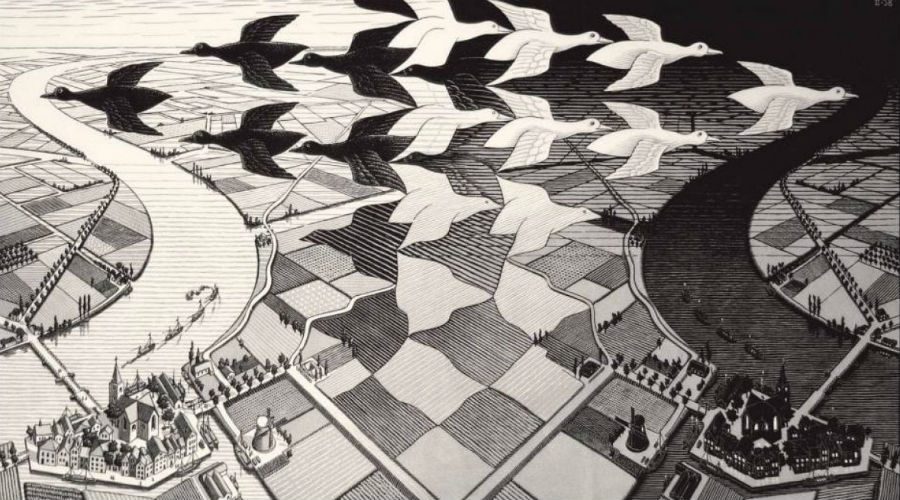
MC Escher
In fact, truth is merely another narrative we’ve been fed—rhetorical legerdemain. But it’s just a story: cognitive dissonance envelopes the notion and we build some heuristic defences around it; escalating commitment kicks in when someone attacks the notion.
The concept of Truth underlies entire societies, governments,
and legal systems. Idiomatically, we employ small-t truth to represent a sort
of relative proximity to match our senses to some observation. If I am asked if
a book is on a table when a book is on a table—ignoring semantics of what
constitutes a book, a table, or the concept of on—, and I say that it is, this is
considered to be a true statement. Of course, this statement is concerned with
the correspondence of observation and some shared reality. But this is
tautological or analytical. In the end, it’s petty.
Capital-T Truth is more universal (or multiversal), is so
much as it would be inviolable. Besides, the Truth of Truth, there are the
notions of Trust of Justice or Truth of Duty or Truth of Integrity. Truth of
any archetypes, really. Yet these are unobtainable—because there are imaginary
concepts.
Classically, archetypes are forms from which physical
objects sort of spawn. A table to an instantiation of some archetypal table.
Archetypes follow from Ancient Greek pathological notions of perfections—perfect
forms, shapes, harmonies, relationships, virtues, gods, and on and on. The
notion of perfect itself is an archetype in this sense.
But the causal relationship has been inverted. Empirical observations taken to imaginary extremes generate a notion of the archetype. Mother is an archetype—the perfect mother—, but it’s not that mothers are formed by some archetypical mould; it’s that the aggregation of mothers and how a perfect mother might be is the definitive. In Jungian psychology, all mothers are compared by their children against this archetypal form. In the Greek tradition, the virtuous mother would attempt to live up to this expectation.
Christian religion plays this up, too. Jesus and God are archetypes. Humans are fallible, but the virtuous strive to be like them; WWJD. Buddhists have their own archetypes of Buddha and Enlightenment, the realization of perfection in nirvana. Again, this is just a story.
Language itself is a human construct, and so anything within it is also constructed. It doesn’t matter whether language acquisition comes a priori or a posteriori. The language itself remains a fabrication.
Post Truth has been a popular topic recently. But what is post is the belief by many in the concept of truth. Although couched this way by detractors, no one is claiming that all truths are equally valid. The claim is rather that many truths are. To claim that women are equal to men and women are inferior to men cannot be evaluated because it would require a complete set of dimensions. Besides, even with this complete set of dimensions, a couple of dimensions are place and time, both of which are subject to change. Beauvoir pointed this out in Second Sex, where she noted that in hunter-gatherer societies physical size and strength may have made males ‘superior’ in matters of protection (a specific context), but that industrialization and automation have rendered this factor insignificant.
So why is any of this important? Well, it’s not. As I’ve
said, evidently truth was not necessary to become evolved to this point. And
since it’s a figment, there is little reason to believe that it will ever
become necessary. My point is merely to
point out that the emperor of truth is wearing no clothes.
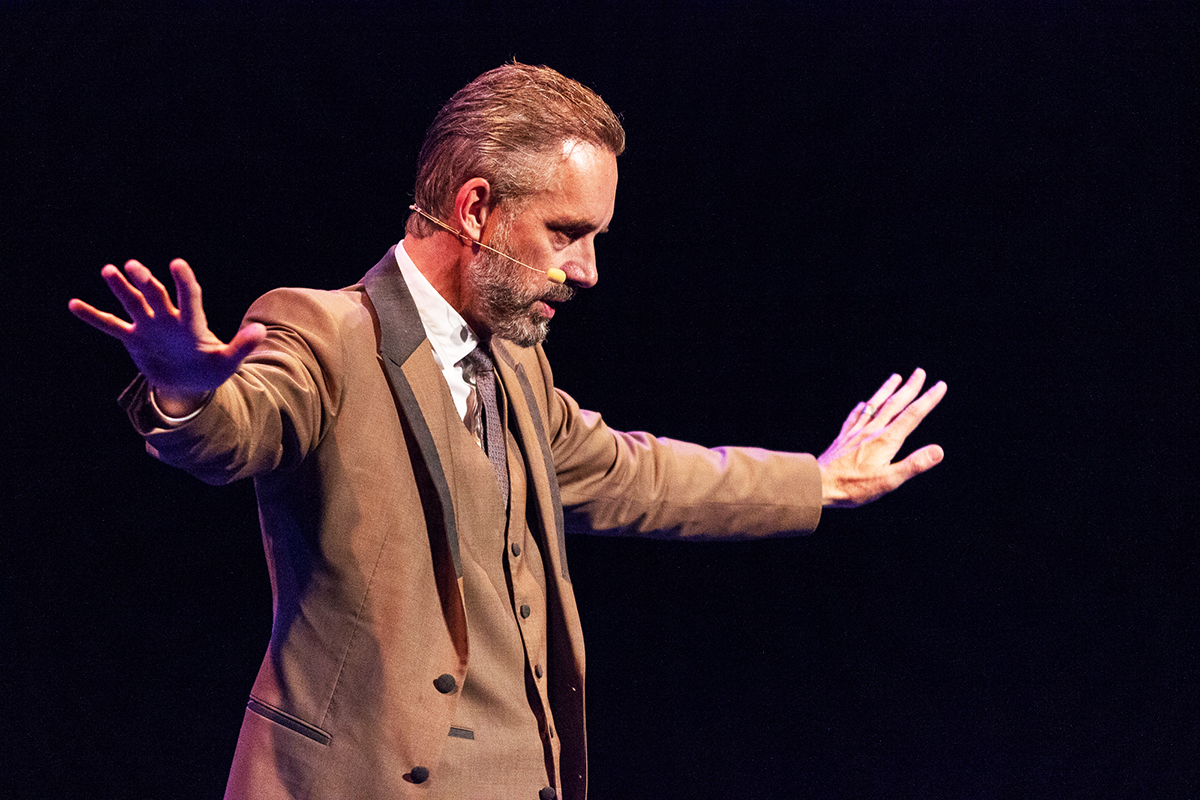
On the topic of social constructivism and cultural relativism, Jordan Peterson is both a vehement counter voice and a hypocritical adherent. This post calls out Peterson’s hypocrisy. To Peterson, the notion that people create their own reality and especially their own identity is heresy. Worse, he will not abide where someone wishes to be identified by some non-gender-performative pronoun.
In his world, it’s obvious that there are two each of singular, gendered subject pronouns and their correspondent object pronouns: he, she, him, and her. Betwixt the two shan’t ever meet. For people like Jordan Peterson, this arbitrary taxonomical classification is written in stone in a manner reflective of Moses encounter with God on the mount.
Peterson 23:13-15
There shalt be two and only two genders, male and female;
and all humans shall conform to these classifications;
and all humans shall dress and behave in compliance with these classifications
For people who view the world like Peterson, there is no distinction between sex and gender, so there is no CIS-this or CIS-that. They will accept for the minority of exceptions for hermaphrodites, but these people are freaks of nature and need to pick a path.
If you have were born with certain primary sexual traits, you must comply with gender stereotypes:
Male = Penis
Female = Vagina
And these are not cultural stereotypes, by the way; it’s obvious that this is Natural Law handed down from on high because identity is not an individual’s construct. If anything, you must accept with grace the identity society bestows upon you. If they perceive you as X, you had better conform to X or all hell will break loose, and your parents and friends will corral you into the X-mould, if you’ll only listen and comply. It’s for your own good.
Society knows best. If you can’t see it, that’s your problem. It our world, it’s majority rule, and if the masses perceive you as gender X, you had better comply. And don’t be a sissy about it. Purses are for women. Makeup is for women. Dresses are for women. Skirts are for women.
Image: Men wearing kiltsAs action figures are not dolls, kilts are not skirts; even so, don’t wear a kilt unless you are either Scottish or playing dress-up, but don’t play dress-up, and you’d better be toting a bagpipe or we’ll question your motives.
Where was I going with all of this?
At the same time, Peterson and his ilk defend universalism, they leave open the ability to envision their own deities as realities as they choose in a ‘it’s my personal god’ sort of way. They want to have their cake and eat it, too.
It’s fine to take a position of objectivism versus subjectivism. I mean you’d be wrong, but you don’t really get to cherry-pick from each where it is convenient. Actually, you do, but you’d be a hypocrite, so there’s that. Perhaps just logically inconsistent or disingenuous.
In the realm of philosophy, it’s no mystery to those who know me that I am a Subjectivist, but I still need to operate in this physical socio-political domain, which is what attracts me to political philosophy.
I like to make an analogy relative to religious belief. Philosophically, I consider myself to be an igtheist, which is to say that I don’t really care about god or gods or ‘the universe’ or some metaphysical superpower in the abstract, but practically speaking, I am an atheist. The reason being that the non-existence of gods is irrelevant in a world where people behave as if there is one and create moral positions and form legal systems based on this premise, thus infecting these systems, so one needs to be an active atheist in order to disinfect the systems and extricate religion from it. Without getting too far off track, I am not saying that religious belief has had no benefit to ‘human progress’, but the price we pay is too high. The cost-benefit calculus is not favourable.
Walzer and Anderson both understand the constructed nature of political identity, whether self, family, community, state, nation, all of humanity, or beyond. It’s all relative. Some modern political philosophers like Rawls and Nozick try to rise above the inherent relativity in this constructionist view, but after all the trying, their attempts are weak tea, as their solutions are also constructed.
In the end, politics and perhaps all of perceived reality are social constructs, whose major survival mechanism is rhetoric. The more convincing the argument, the better. In fact, the reason I have adopted this worldview is only that the rhetorical narrative resonates with me better than some other. Ditto if you concur, and ditto if another narrative resonates for you, whether Christianity, Pastafarian, a starchild, or a nihilist.
Given this, it makes me wonder how other people choose the rhetoric they have rather than my (obviously superior) version.
EDIT: After I wrote this, I happened upon a short(ish) video promoting veganism and commenting on the construction of culture, so I am adding it. James Wildman
I stumbled upon Professor Jordan Peterson and his defenders of virtue morality, like Dr Stephen Hicks, and I decided to watch some vids.
Full Disclaimer: Not a fan
I ended up on his lecture about Carl Jung.
I’d been interested in archetypal and depth psychology for ages, and I’ve read most of Jung’s work. I still own all of the volumes of his complete works. The difference between me and Professor Peterson is that I take it as metaphor and, by his words, I presume that he doesn’t.
The video clip is cued to the location where Jordan says, speaking of Nietzsche,
“…‘God is dead, and we have killed him’ led Nietzsche to pose another question, which was: What are we going to do to replace him? Because Nietzsche believed—and I think he was absolutely right about this. I can’t see how it could be otherwise—, he believed that the morality that had structured Western society was predicated on the fundamental axiom of divinity, and so, as far as Nietzsche was concerned, the whole purpose of morality was dependent on that axiom being true—or at least being accepted as true. And when that axiom was knocked out by, say, the conflict between science and religion—because in some sense that’s what did it—, then the whole system no longer had anything to stand on and could become entirely questionable…”
“The whole purpose of morality was dependent on [the existence of divinity] being true.”
As I’ve said time and again, this is the primary reason people—especially those defending or seeking some sense of status quo, conservative vanguards, and morality warriors—insist on the existence of a real, objective moral centre or a good-enough version of it—one that coincidentally conforms to their worldview.
I’m afraid that I am going to need to hear something well more convincing than that because I’m not buying what these guys are selling.
It seems to me that the largest or largest complaint people claiming a realist, objective moralist perspective is:
How would it work if morals were not objective?
This is also a common defence by Christians who claim:
If there were no God, then people would just be mindless hedonists.
This is the same line of defence used by statists of all stripes, whether Republican, Democratic, Libertarian, Monarchist, Oligarch, or otherwise.
Anarchy can’t work because everything would just be chaos.
It is also the same argument mounted, as Steven Pinker points out in The Blank Slate, against a strong genetic component to human behaviour.
If we believe that, then what will prevent the next Nazi Holocaust?
In the end, because these people cannot fathom how it might work, it is easy to assuage cognitive dissonance through self-delusion. It’s as if the people defending actually know that they are wrong, but that if they deny it loudly enough, then, like religion, others will believe it’s just so, that they’ll follow the deceiving confederate in a psychology experiment.
The problem is that there is no god, there is no objective morality, government is unnecessary, and much behaviour and temperament have significant genetic foundations unaffected by environmental factors.








![commandments-inline1[1]](https://philosophics.blog/wp-content/uploads/2018/07/commandments-inline11.jpg)
![9-_TfKGzN5RMaeAoFS7-SMlaQ2d5d1ZFBwRHnnkZtmw94pkdSsIUTFFT3WGHhpjGaUSjR30Ajjg2XAkPqhTaIEp2vnIv8I9nNhsZcANmL15h14s0XNBJCdsXXEzNWXOQU1[1]](https://philosophics.blog/wp-content/uploads/2018/07/9-_tfkgzn5rmaeaofs7-smlaq2d5d1zfbwrhnnkztmw94pkdssiutfft3wghhpjgausjr30ajjg2xakpqhtaiep2vniv8i9nnhszcanml15h14s0xnbjcdsxxeznwxoqu11.jpg)
![266257282_640[1]](https://philosophics.blog/wp-content/uploads/2018/07/266257282_6401.jpg)

![battleOfTheBean[1]](https://philosophics.blog/wp-content/uploads/2017/12/battleofthebean1.jpg)
![quote-i-am-by-far-your-superior-but-my-notorious-modesty-prevents-me-from-saying-so-erik-satie-49-63-66[1]](https://philosophics.blog/wp-content/uploads/2017/12/quote-i-am-by-far-your-superior-but-my-notorious-modesty-prevents-me-from-saying-so-erik-satie-49-63-661.jpg)

 Philosophics