Materialism and Measurement

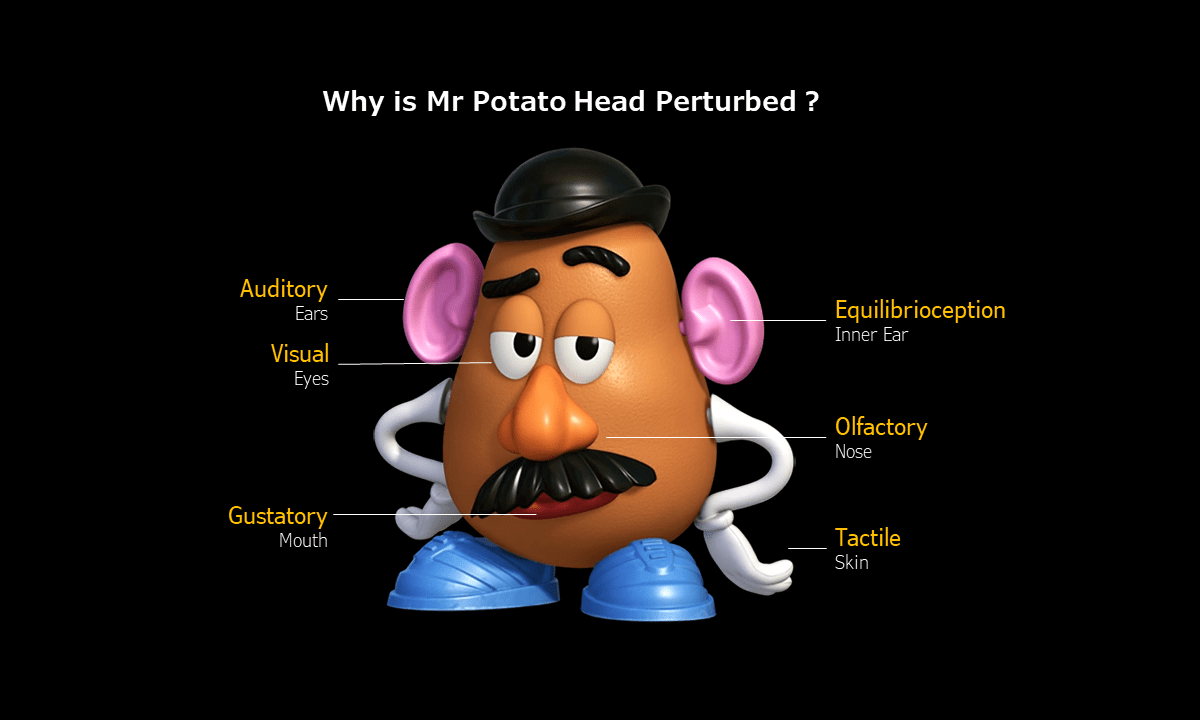
Why is Mr Potato Head perturbed?

Following up on recent posts about Unknown Dimensions and Material Idealism, I was pondering the implication of the spaces between. Fundamentally, I consider myself to be a materialist or physicalist depending on which nomenclature you prefer. I don’t believe in metaphysics, but I am perturbed like Mr Potato Head, because if there exists phenomena not accessible to our senses—and the other senses noted in a prior post—we simply have no way to experience them let alone measure them.

There could exist many other physical phenomena that we not only cannot register, but we can’t even imagine what they might be. These don’t need to be metaphysical or spiritual, but they can exist in theory. Perhaps we can reference them as paraphysical.

As humans, we can extend our senses with instruments such as lenses on telescopes, microscopes, and cameras, with which we can register ultraviolet and infrared light, and so on. But I am not talking about this.

I’m not going to lose any sleep over this notion, but as ridiculous as this might seem, it is fully within the realm of possibilities. It’s neither testable nor falsifiable.

So what’s the deal?

We can’t touch this because it has no mass, but neither do sights or sounds or smells or tastes. In fact, we wouldn’t even know what we are missing. But imagine one day, a person through some genetic quirk could suddenly sense this new aspect of reality.

I imagine it would be like Plato’s Allegory of the Cave, trying to convey the unconveyable to the masses. Synesthesia is odd enough for some people to wrap their brains around, but at least we can understand the concept as crossed wires or some such.

Now imagine a second and third person each aware of the others with this heightened ability. Could they exploit this to their advantage?

How might this work? What might it be? Although magnetoception, electroception, hygroreception, or echolocation might be interesting, we can already conceptualise and in some cases measure these phenomena. And we’ve already got infrared and ultraviolet covered.

The closest idea I can equate this to is that of Flatland, where higher-dimension objects interact with a lower-dimension world, but this doesn’t quite capture the essence.

Physics tells us there is no space for gods in current models, but do we need space? How much space do the molecules for ‘scent’ occupy? Could these same molecules carry the cargo for other missing sense perceptions? They may be already hiding among us.

Does anyone have any ideas—especially you storytellers and poets?

Unknown Dimensions

I mentioned in my last post about how Artificial Intelligence discovered a new variable—or, as the claim suggests, a new physics. This was a tie-in to the possible missing dimensions of human perception models.

Without delving too deep, the idea is that we can predict activity within dynamic systems. For example, we are all likely at least familiar with Newtonian physics—postulates such as F = ma [Force equals mass times acceleration or d = vt [distance equals velocity times time] and so on. In these cases, there are three variables that appear to capture everything we need to predict one thing given the other two that need to remain constant. Of course, we’d need to employ calculus instead of algebra if these are not constant. A dynamic system may require linear algebra instead.

When scientists represent the world, they tend to use maths. As such, they need to associate variables as proxies for physical properties and interactions in the world. Prominent statistician, George Box reminds us that all models are wrong, but some are useful. He repeated this sentiment many times, instructing us to ‘remember that models are wrong: the practical question is how wrong do they have to be to not be useful‘. But no matter how hard we try, a model will never be the real thing. The map cannot become the terrain, no matter how much we might expect it to be. By definition, a model is always an approximation.

All models are wrong but some are useful

George Box

In the Material Idealism post, the embedded video featuring Bernardo Kastrup equated human perception to the instrumentation panels of an aeroplane. Like the purported observer in a brain, the pilot can view the instruments and perform all matters of actions to manipulate the plane, including taking off, navigating through the environment, avoiding obstacles, and then landing. But this instrumentation provides only a representation of what’s ‘really’ outside.

Like mechanisms in the body, instrumentation can be ‘wired’ to trigger all sorts of warnings and alerts, whether breached thresholds or predictions. The brain serves the function of a predictive difference engine. It’s a veritable Bayesian inference calculator. Anil Seth provides an accessible summary in Being You. It relies on the senses to deliver input. Without these sense organs, the brain would be otherwise unaware and blinded from external goings on.

The brain cannot see or hear. It interprets inputs from eyes and ears to do so. Eyes capture light-oriented events, which are transmitted to the brain via optic nerves, and brain functions interpret this information into colour and shape, polarisation and hue, depth and distance, and so on. It also differentiates these data into friend or foe signals, relative beauty, approximate texture, and such. Ears provide a similar function within their scope of perception.

As mentioned, some animals have different sense perception capabilities and limitations, but none of these captures data not also accessible to humans via external mechanisms.

Some humans experience synesthesia, where they interpret certain stimuli differently, perhaps hearing colours or smelling music. We tend to presume that they are the odd ones out, but this assumption does not make it so. Perhaps these people are actually ahead of the rest of us on an evolutionary scale. I suppose time might sort that one out.

But here’s the point. Like the pilot, we can only experience what we are instrumented to experience, as limited to our sense perception and cognition faculties. If there are events not instrumented, it will be as if they don’t exist to the pilot. Can the pilot hear what’s happening outside?

This is the point of the AI experiment referenced above. Humans modelled some dynamic process that was presumed to be ‘good enough’, with the difference written off as an error factor. Artificial Intelligence, not limited to human cognitive biases, found another variable to significantly reduce the error factor.

According to the theory of evolution, humans are fitness machines. Adapt or perish. This is over-indexed on hereditary transmission and reproduction, but we are more vigilant for things that may make us thrive or perish versus aspects irrelevant to survival. Of course, some of these may be benign and ignored now but become maleficent in future. Others may not yet exist in our realm.

In either case, we can’t experience what we can’t perceive. And as Kastrup notes, some things not only evade perception but cannot even be conceived of.

I am not any more privileged than the next person to what these missing factors are nor the ramifications, but I tend to agree that there may be unknown unknowns forever unknowable. I just can’t conceive what and where.


I can’t wait to get back to my Agency focus.

Evolution of Free Will

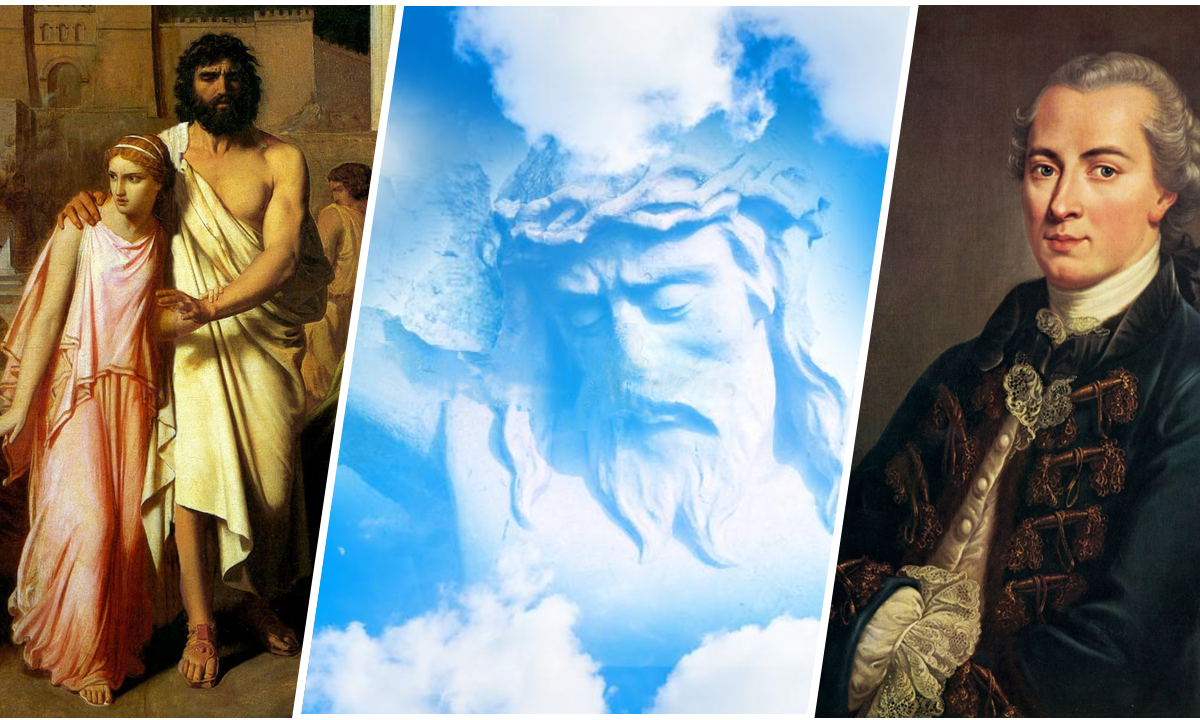
The more I read about free will the more I feel that it is a modern invention. I don’t mean to claim that this is cut and dry, but as the image accompanying this post suggests, Sophocles’ story of Œdipus Rex is precisely about a man attempting to escape his fate. Without getting mired in a discussion about the distinction between fate and determinism, we understand that the plight of Œdipus is set in stone.

As I said, I am simplifying as I know there are authors debating free will before this, but it is also known that many people simply believed that their lives were governed. I suspect that in certain slave societies this might be a source of comfort. If Buddhist thought that life is suffering holds true, what better consolation than it was just meant to be, I might as well just make the best of it.

Enter Christianity and Aquinus. Their god may have set things up, but there can be no notion of growth or responsibility without free will, so we’d better create a narrative around this. How an omniscient creator can not know every possible plotline and twist remains a question, though rationale akin to retrograde motion has been suggested to accommodate it. Now, it seems that we’ve got a little less determined and a little freer if I think of it as a zero-sum game.

Si Dieu n’existait pas, il faudrait l’inventer

Voltaire, Épître à l’Auteur du Livre des Trois Imposteurs (1769)

By the time Kant enters the picture, he rather spills the beans on the whole narrative. Perhaps riffing on Voltaire’s quip, ‘If God did not exist, it would be necessary to invent Him‘. Kant tells us that if we need to blame people and presume responsibility, then we need to assume free will. And so we did.

In this day and age, most people have been marinated in this worldview, so it’s difficult to see outside of this frame. The rhetoric of free will has been particularly effective. Though we have evidence of free will not being dominant in some cultural conversations, we have little idea in preliterate societies. I’d be interested to gain additional perspective from historians or anthropologists. Some may have already been published. I’ve already been so overwhelmed with the deluge of information and opinions to date. I’ve learned much and have been introduced to many new scholars. As I wrote the other day, this is somewhat daunting. I wish I were a grad student and could justify spending so much time trying to justify my position.

The Appointment in Samarra*

There was a merchant in Bagdad who sent his servant to market to buy provisions and in a little while the servant came back, white and trembling, and said, Master, just now when I was in the marketplace I was jostled by a woman in the crowd and when I turned I saw it was Death that jostled me. She looked at me and made a threatening gesture, now, lend me your horse, and I will ride away from this city and avoid my fate. I will go to Samarra and there Death will not find me. The merchant lent him his horse, and the servant mounted it, and he dug his spurs in its flanks and as fast as the horse could gallop he went. Then the merchant went down to the marketplace and he saw me standing in the crowd and he came to me and said, why did you make a threatening gesture to my servant when you saw him this morning? That was not a threatening gesture, I said, it was only a start of surprise. I was astonished to see him in Bagdad, for I had an appointment with him tonight in Samarra.

I was astonished to see him in Bagdad,
for I had an appointment with him tonight in Samarra.

Death

I love this story of fatalism. Originally from the Babylonian Talmud, Sukkah 53a, it’s a story about one attempting to alter their determined fate. An interesting side-comment on the original version. The last line attributes fate to the servant’s feet.

A man’s feet are responsible for him; they lead him to the place where he is wanted

Babylonian Talmud, Sukkah 53a

This interpretation would allow for the feet to be determined but in conflict with the intellect and reason of the head, much as is said about the conflict between the head and the heart. It could be argued that the only fate this accounts for is that of death, but that’s well beyond my scope of inquiry.

Final Note

Some people seem to not quite grasp the distinction between constructed and unreal. Many things are human social constructs, from money to states and countries, to nations, to governments, to ethnicities, and to gender. Even sex. All of my favourite weasel words are constructs.

But there’s a difference between money and unicorns. No amount of money can buy you a unicorn. This is the difference between fiction and figment. We can say that money is ‘real’ insomuch as it affects our everyday lives. We transact. We buy things. We sell things. It’s an agreed-upon medium of exchange. Without going into details, long before cryptocurrency, most money is in the form of computer bits and bytes—rather it has no form. The currency and coins we can touch are a small fraction of the money that exists. The money behind your credit card or debit card is not banknotes—and it’s not gold. When a central bank wants to create money, it simply has to type a number in a computer register and press enter, and it exists.

So whilst each of these is pretend, some things are manifest in our ‘real’ world and have real-world implications. Not so much for unicorns and fairies.


* The Appointment in Samarra as retold by W Somerset Maugham (1933)

Is human consciousness creating reality?

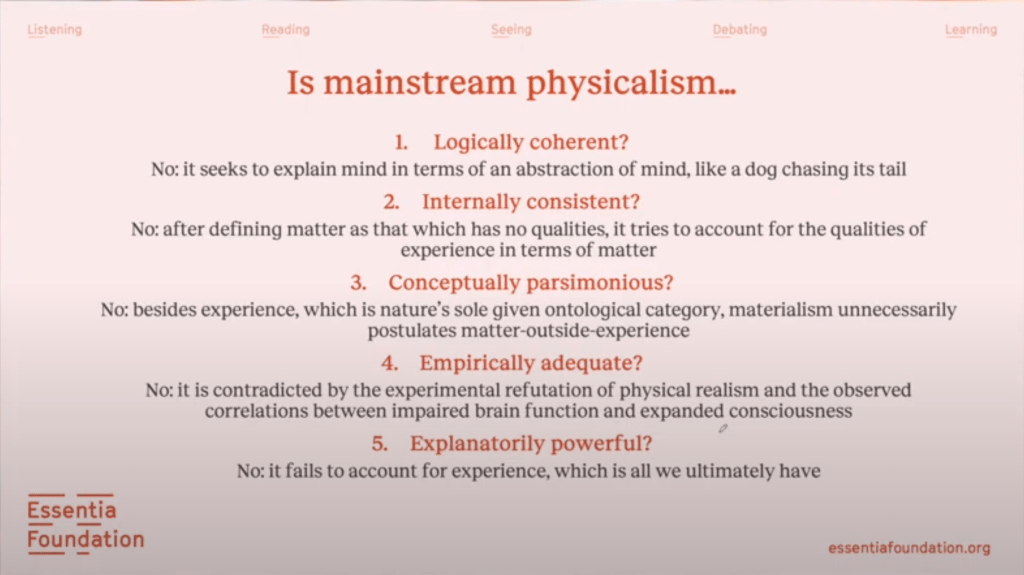
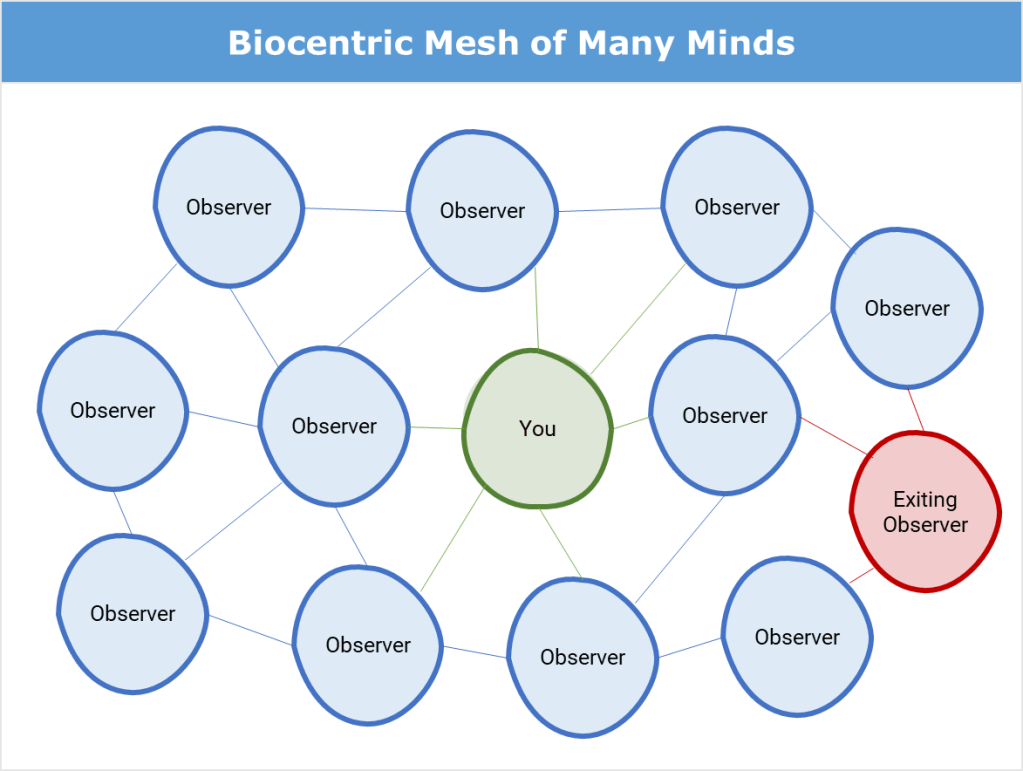
Perhaps, and as much as I see social aspects as constructed, I wouldn’t count on reality being constructed whole cloth from a web of observers. This is ostensibly what  Robert Lanza’s biocentric view attempts to say. I’m not buying it.

Biocentric Mesh of Many Minds

As I understand it—admittedly from a single BigThink article, so there’s that—Lanza is trying to one-up Descartes and jump into the domain of Wittgenstein’s many minds conundrum. I suppose that this is another dualistic theory, but I am not likely to spend many cycles on it in the near term.

My question is that if at Time0, a reality is projected—my word—by the many minds, and at Time1, You enter the picture, and at Time2, the Exiting Observer is leaving the picture. how is reality shaped by these events? And are they events, or are they merely imagined? Is this an entirely solipsistic endeavour? Is this like Star Trek’s Borg? You will be assimilated. Resistance is futile.

Borg: You will be assimilated. Resistance is futile.

This also feels a lot like Jung’s Collective Unconscious on steroids. I’ll stop commenting here for now and consider this nothing more than a distraction. And I am not ready to jump on a panpsychism bandwagon any time soon.

Pizza Tracker Reality

Three years late, but a mate of mine shared this with me and it got me to thinking — sort of. No synapses were harmed (or likely even engaged) in the construction of this post.

No synapses were harmed in the construction of this post.

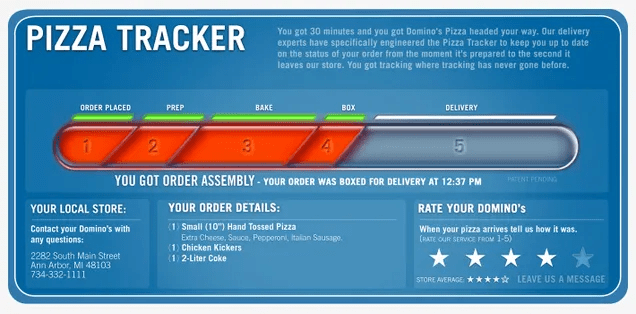
Domino’s has a pizza tracker app, where a person can track their order from intake to delivery. Only the tracker does not reflect what’s actually occurring. It’s merely a facade built on historical timing. The pizza-making process is very well regimented, so at a macro-level, it may appear to work. If on average, a pizza takes 30 minutes from order to the time it shows up at your door, and your delivery conforms to this average, you’ll be none the wiser that the details didn’t otherwise happen to comport.

Pizza Tracker Concept

I feel that it’s almost fair to consider this app analogous to our cognitive processes. The details don’t really matter, so long as the stimulus-response corresponds to our expectations. Unlike the actual process underlying the manufacture and delivery process, we don’t have direct access to reveal the ‘reality’.

Around the same time as Domino’s fakery was being revealed, they did make progress by at least relaying GPS details via the app. Given that this probably accounts for most of the variability in their process, it would make sense to address this earlier than later.

My point is not to take a deep dive into the technology or remark on the integrity of this approach. I only wanted to point out that most customers might not have even questioned the progress meter. Others may have their own questions.

Meme Blowback

In the end, the state of the process could be transmitted, but it could actually slow the process by introducing additional steps, so the cost of conveying reality may outweigh the benefits. I’m not the one to make that call. Meantime, pizza’s up.

Lacan or Not

Here I am yet again writing about something I am not particularly equiped to do. In other fora, I’ve been directed again to Lacan vis-à-vis a thread about Lacan’s perspective on the real. I’ve commented on Lacan before, usually in the context of eschewing any philosophy founded on psychology—especially psychoanalysis. Explaining that I have a reading backlog extending beyond my likely lifespan, it was recommended that I read Jacques Lacan by Sean Homer, so I am sharing the recommendation. Anything by Bruce Fink was another reco. Noam Chomsky takes an ad hominem swipe at Lacan here.

I decided to watch a few videos (including this, this, and this) to survey some of Lacan’s ideas, knowing that something could be lost in the translation. Let’s just say that I was underwhelmed.

In a nutshell, my biggest contention is the notion of the unconscious as an active agent.

According to my understanding, Lacan posits that there is a ‘real’ out there, but it is obscured by language and subject to interpretation. To him the real is a Void.

⁠Psychoanalysis presumes being able to get closer to the ‘truth’ of reality. Like astrologers and fortune-tellers, Psychoanalyst primary defence is that not all knowledge is evidence-based or falsifyable. My problem is that I am not open to another way of experiencing the world, but they somehow have privileged access to this truth. Of course, this is a similar to religious claims of some special spiritual access that opens when you believe.

To me, the Void is as apt a metaphor as any. And while we both agree that the real is inaccessible, I don’t accept the impostition of the how and the why. What Lacan does—and Freud before him and psychoanalysts more generally—is to inject hows and whys into the story. In this narrative, the unconscious has active powers, (as opposed to negative space), where memories (in whatever form) may be repressed and actions may be triggered (or activated) by unconscious urges or desires. I consider this last train of thought wholly imagined and fabricated. This void and the unconscious has no purpose.

Along the way, I do agree with Lacan’s poststructuralist position. I have no issues with symbolic or metaphoric concepts and speech. The contention arrises when one attempts to claim the metaphoric to be concrete. This is the same contention I have with people who take the metaphoric text of the bible and cencretise it. There are other problems there, but I’ll quit now.


​⁠

Projected Reality

This article suggests an interesting twist on the notion of peception and facts. In this instance, the human sensory organs don’t capture what’s there like a camera. It takes cues from the environs and fills in details heuristically. This mirror an effect I recall reading in a book, Drawing on the Right Side of the Brain*, where most people can’t draw what they see because their heuristic perception kicks in. This is essentially Kahneman and Tversky’s System I outlined in Kahneman’s Thinking, Fast and Slow.

This may come with a heavy dose of confirmation bias, but it fits my belief that reality is generally unaccessible with huamn sensory perception organs. it adds another layer or dimention to consider.


* I am aware that the simplistic right and left side distinction is an oversimplification, but this is the way of categorisation.

The Truth about Truth (Fourth Amend)

Please note that this content has been subsumed into the originating article: The Truth about Truth.

This is a response to this comment by Landzek from The Philosophical Hack regarding the notion of intended truth in communication, the fourth amendment in a series of posts extending the concept commenced in The Truth about Truth.

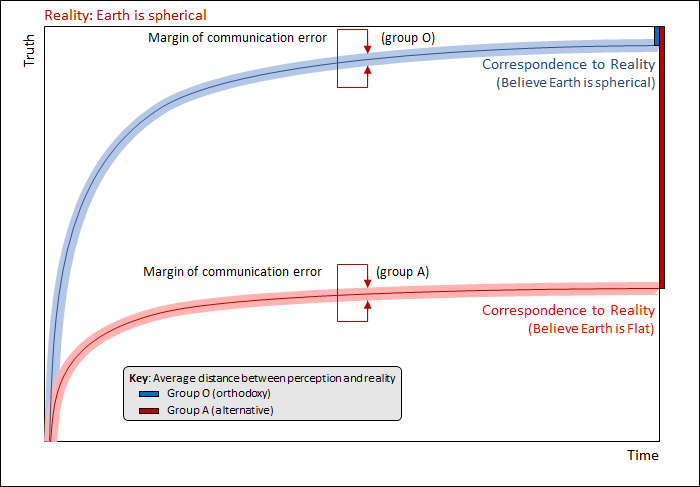
Extending the simple asymptotic function from the first amend, we might see (in Graph 4a) a slight variation in interpretation due to the insufficiencies of language—providing us with a close enough for the government approximation to some shared perception. People in this group will tend to agree on some perception, say, that the earth is spherical.* The average distance from perception to reality is the same for all in-group members, give or take some small variance that I’ll dismiss as an insignificant rounding error.

Graph 4a: Correspondence of Truth to Reality (Simplified in-group concurrence)

Graph 4b, however, illustrates two opposing perceptions of reality. In this example, I show proponents of orthodoxy (group O), who claim the earth to be roughly spherical, arbitrarily closer to reality than proponents of an alternative theory (group A), who claim that the earth is flat.

Each in-group has some variance from the mean notion, but ex-group members are orders of magnitude apart, as measured by the blue and red bars to the right of the chart. If we assume some binary condition that the earth is either spherical or flat with no other options, one of these might be considered to be right whilst the other would be wrong. We can establish this situation relative to the ex-groups, but, still, neither of these is comparable to Reality™ .


Graph 4b: Correspondence of Truth to Reality (Simplified ex-group concurrence)

The intent of each group may be to promote the perspective of the group—each claiming to be closer to the truth than the other. It is easy to imagine a situation where both claimants are equally distant from the truth:

Imagine two groups, each making opposing claims:

  • Tarot is superior to Astrology in predicting the future.
  • Astrology is superior to Tarot in predicting the future.

I’ll go out on a limb here and create a reality where the future is not predictable by either measure, irrespective of what each in-group believes.


* I understand that the earth being an oblate spheroid is primarily an analytical distinction, so is tautologically true, but I am using a simplification of a commonly accepted fact.

The Truth about Truth (Third Amend)

Please note that this content has been subsumed into the originating article: The Truth about Truth.

THIRDRhetoric is a primary driver to fashion our sense of how close or distant we are from reality. Rhetoric shapes and focuses the frame.

War Is Peace, Freedom Is Slavery, and Ignorance Is Strength

1984, George Orwell

I’ve already commented at length about the primacy of rhetoric. To recap for the purpose of this disquisition, the only meaningful arbiter of truth is rhetoric—the ability to persuade the larger populace to accept something as true.

Here, I’d expect someone to counter with, ‘Just because people are convinced that something is true doesn’t make it so’, and they’d be right. However, as we cannot access the underlying reality accept through our admittedly fallible senses, who’s to argue?

Moreover—going off on a tangent—, we know that other lifeforms—let’s stick with the animal kingdom—have different senses than humans, and some humans perceive things differently to the normie (if I may adopt a spectrum term) .

Sharks have electroreception (re: The Ampullae of Lorenzini), which allows them to perceive small changes in electrical fields as well as what’s termed a lateral line ( mechanoreceptor function), which allows them to recognise changes in environmental pressure. Other known sensory adaptations are echolocation in bats and dolphins and chemoreceptors (notably in insects and snails).

We are probably also aware that different animals have differing degrees of sense acuity compared to humans. Dogs hear frequencies above the human threshold and have better olfactory discrimination. Birds of prey have superior vision. Women typically have a broader colour vocabulary.

Bees see in ultraviolet; snakes can ‘see’ in infrared; owls have night-vision.

And then there’s synesthesia, a condition in which one sense is simultaneously perceived as if by one or more additional senses. A person with synesthesia may perceive sound as colour (chromesthesia) or perhaps taste.

Given concepts of normality, we presume we are synesthesia are normal and these other people are somehow not, but for all we know, we normies are evolutionary dead ends, soon to be displaced by synesthesiacs. (Is that even a word? It is now.)

But I digress.

Perception is reality. If one can convince you of something, e.g. Donald Trump is a good president, then it’s ostensibly true to you. If one can convince an entire population that something is true, e.g. the plot of Orwell’s 1984, or The Matrix, then who’s to say otherwise.

The Truth about Truth (Second Amend)

Please note that this content has been subsumed into the originating article: The Truth about Truth.

SECOND: We have no idea if any changes to our perception move us closer to or further from Reality.

Rather than being asymptotic, perhaps the relationship to is polynomial (or the result of some stochastic function). See the graph above. As we move into the future (in red) and look back, we may perceive that we’ve reversed against some notion of progress. Common wisdom is that progress is directly, positively related to time. But is it?

In my last post, I reference how Einstein progressed and refined Newtonian physics, but in the future, this could be shown to be wrong. In our minds, what had seemed like progress may in retrospect turn out to have been a false assertion.* Moreover, we’ll dutifully accept this updated notion of truth if the rhetoric is sufficient to fit our concept of evidence, especially given humans’ propensity for pareidolia.

Taking our understanding of gravity as the fabric of space-time, we still have no idea what’s going on or how it operates, but this doesn’t prevent us from accepting it as a black box and making pragmatic predictions from there. So, for all intents and purposes, the ‘truth’ mechanism is less important than the functional relationship, just as I can tell time on a watch I have no idea how it operates.

I am no true Sceptic, but neither do I accept the prevailing meta-narrative whole cloth. Unfortunately, I am in no better position than the next to discern proximity to the underlying structure of reality.


* I am not versed well enough in the history of science, but I’d be interested to know which, if any, scientific advances have been a step ‘backward’, that a belief had overtaken a prior belief only to have reverted to the former.

I am aware of the slow march of science and the ignorance of possibly valid assertions simply because the rhetoric was not strong enough or the PR just wasn’t adequate. An example might be the debate of theoretical Democracy versus Communism: which is better than the other. Of course, there are too many dimensions to consider, and the adoption or exclusion of one dimension over another might be enough to tilt the outcome.

In the real world—see what I did there—, the US spend billions upon billions of dollars to interfere with Communism—and I am not taking a position whether it would have succeeded or failed on its own terms—, just to be able to knock down the strawman some century later though propagandising and disinformation campaigns.