Editing Is Hard and Propensity

2–3 minutes

Well, not so much hard as not particularly or inherently enjoyable.
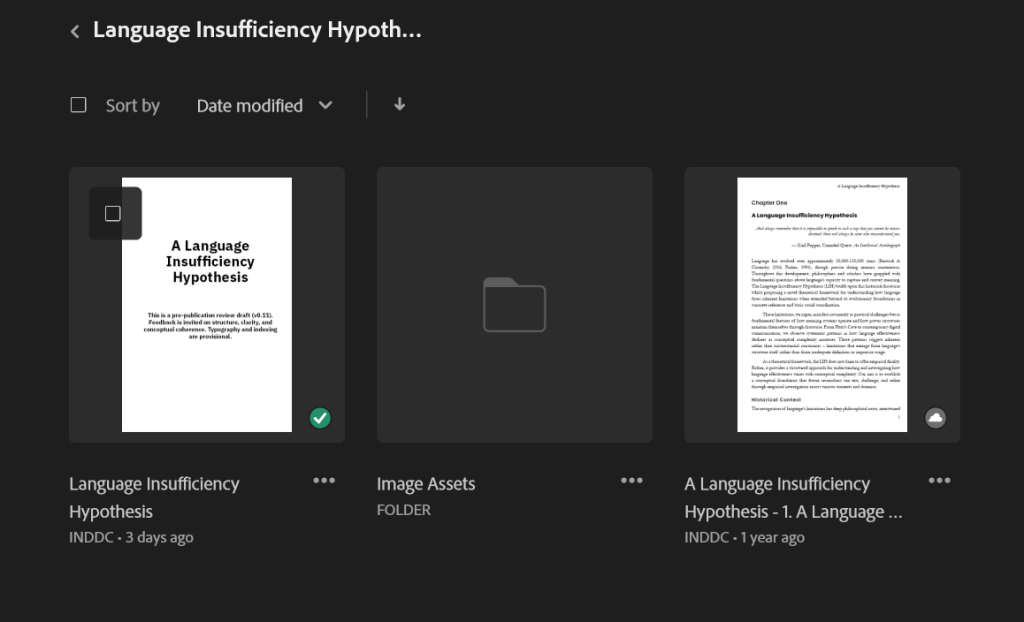
I estimate I’ve got about a day left to complete this manuscript – ‘done’ done. When I open InDesign, it shames me – 3 days ago, I last touched this document. It doesn’t feel like 3 days have passed, but time flies.

On the right is an older version. I began reworking it into this new version over the summer, and here I am come autumn. It’s even worse if I use the Chinese calendar. Evidently, 7th November is the first day of winter. They can’t wait until soltace.

Anyway, just a brief update. This isn’t going to edit itself, and I can’t afford to pay an editor for a passion project. Besides – and let’s be honest – I can’t afford an editor in general – or at least can’t cost-justify it – and all my writing is a passion project.

Of course, editors (and cover artists) insist that one would sell more book if only they were edited or professionally rendered. There is an element of truth to this, but I’ve read some gawdawful books that were professionally edited and published through a traditional publisher, because publishers publish.

Me, I operate on razor-thin margins. Most of my publications haven’t even broken even – even if I ignore opportunity costs, which I can’t because I’m an economist. Accountants get to play that trick.

This said, I do hire reviewers, editors, and artists in small doses – homoeopathic as they might be – and I’ve had mixed results.

I’m rambling

Must really be avoiding the editing process…

Recently, I wanted to redesign the cover of one of my Ridley Park fiction books.
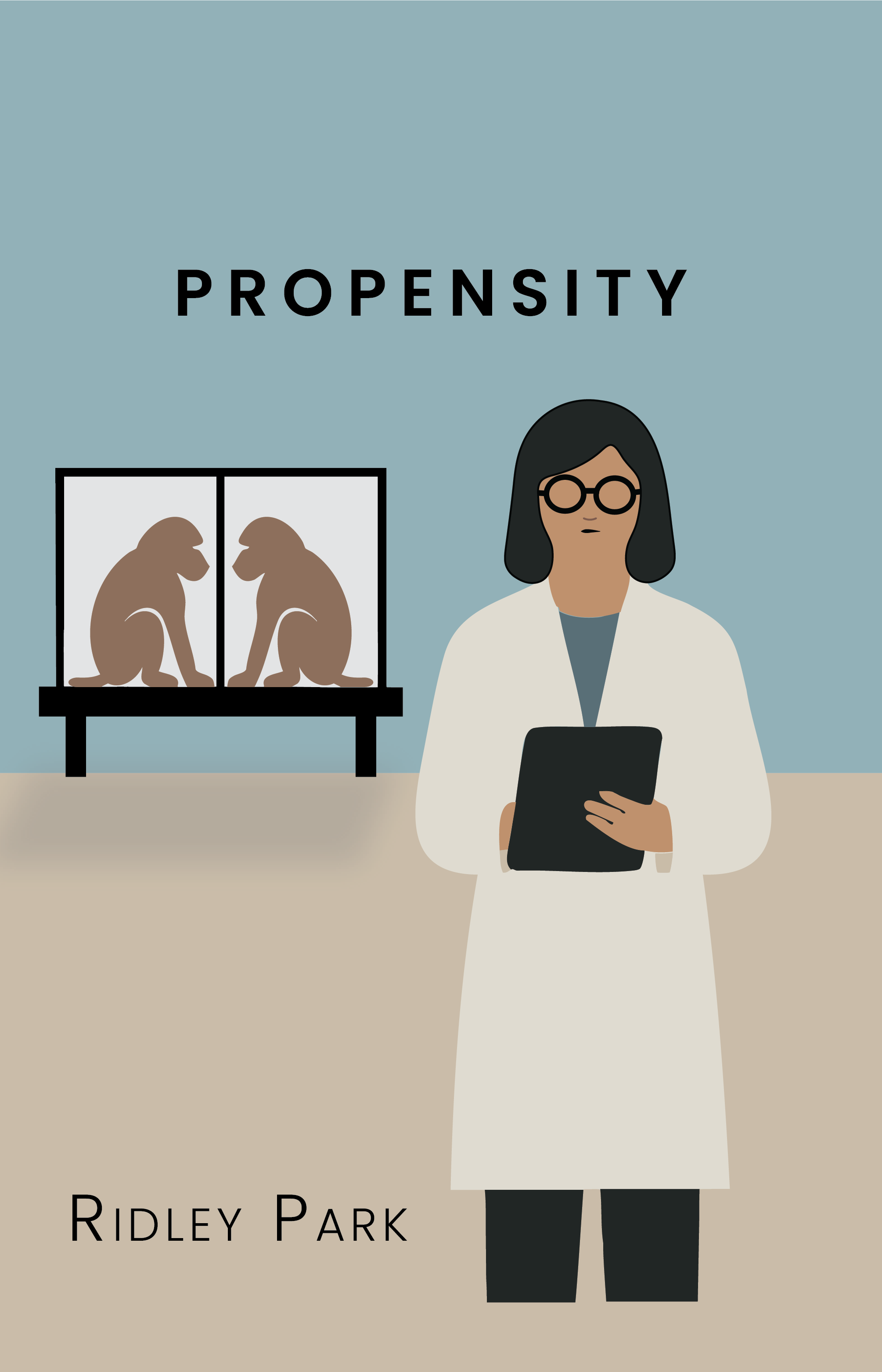
Image Comparison: A Tale of Two Propensities

The cover on the left is the original. It is intentionally a minimal 2-D construction – a representation of the first section of the book, the first 15 chapters.

The cover on the right is the update. It is also minimalist, representing the second section of Propensity. I’m not sure how I would depict the third section. If it comes to me, I may render a third version.

There’s a story to this. I reached out to some cover artists and told them I was unhappy with my original design but had no visual ideas. I’d leave this to the artist. It turns out that some artists don’t want full control over the design process. I can understand the hesitation.

They asked for covers that I might like, so I researched some covers and saved them to a Pinterest board.

As it turned out, after some inspiration, I decided to render this one myself, too. Hey, I tried.

What happened to the rest of the time?

OK, so there’s more. I also created a video book trailer in the evening.

It was fun enough. Give it a watch. It also represents part one of Propensity.

OK, this time for real. Let me know what you think…about anything in particular.

Trustwise

The lamb spends all its time worrying about the wolf and ends up being eaten by the shepherd.

— Unknown

I think one could look at this from several perspectives or through different lenses.

We worry about the wrong things.

At some level, this is about trust.

We trust the wrong people. Those whom we most entrust do us in. But I feel this is contextual.

One might feel this shepherd is Capitalism or the State or organised religion. Perhaps it’s culture or identity cohorts. Or all or these or none of these.

On another level, it recalls the inevitability of death. This shepherd reaper is always waiting in the wings whether or not one worries.

In the words of RATM, Know Your Enemy.

Consciousness Is Religion

I expect that consciousness is a human nominative concept. Like religion, it will become smaller as science encroaches. In 1994, David Chalmers presented his idea of the hard problem of consciousness in a lecture, Toward a Scientific Basis of Consciousness, but I feel this is more due to the insufficiency of language than anything else. To me, consciousness isn’t well defined. It’s like a medical syndrome. It’s just a grouping of seemingly related conditions that haven’t yet been parsed. In time, it may be determined that they weren’t even related in the first place. Apophenia and cognitive dissonance are two significant human biases that affect perception.

At core, consciousness might be functionally reduced to that of an interpreter. Some have posited that the only thing that exists is ‘information’, whatever that means, so there only needs to be an interpreter—a translater. If that interpreter is defined as consciousness, then so be it. This appears to lead us to a Cartesian place—though it doesn’t follow that the self or ego exists. This would be a second-order event.

Anyway, just rambling. As seems to be the case lately, I’ve got little time to develop my thoughts. At least I’ve captured them for now.

Dear diary…

Mimetic Desire

People influence one another and, when they’re together, they have a tendency to desire the same things, primarily not because those things are rare but because, contrary to what most philosophers think, imitation also bears on desire. Humans essentially try to base their being, their profound nature and essence, on the desire of their peers.

“Mimetic Desire: Shakespeare Rather than Plato.” When These Things Begin: Conversations with Michel Treguer, by René Girard and Trevor Cribben Merrill

Although I have some reservations—or at least reserve some latitude—, I tend to agree with Girard. Desire is a social construct. Desire is separate to needs. Desires are wants. As accomodated in Economics, we don’t need what we want, but we want what we need. We desire what we need.

we don’t need what we want, but we want what we need

What Girard is essentially saying is that I want what I want because you want it. This is independent of value in an economic sense. Memetically, the value of an object increases relative to the perceiver simply because another person wants it. In my reckoning, I’d separate want from desire or at least elevate desire to a higher degree of wanting.

Girard termed this triangular relationship between subject (you), object (the thing), and the mediator (the influencer) mimetic, to mimic. I suppose some of this might be considered to be memetic, but I also suppose that memes serve to simplify rather than serve as a distinct transmission vector.

circa 2016

My question is—exacerbated during this pandemic—how does this operate in isolation? I consider myself. I am not an ascetic by most definitions, but I am somewhat of a minimalist. My only ‘vices’ are my computer and my guitars. I used to be a professional musician—though most of that was spent on the other side of the console—and I was a Gibson snob. From the perspective of emotional desire, I still am. There is a certain nostalgia, but I don’t play out anymore, and I’m not seriously recording, so I don’t need the same perceived quality of an old Gibson.

Guitarists know that different guitars give different sounds. I’ve owned as many as 10 guitars at a time, and each had its purpose. Some was feel. This guitar was for Blues, this was other for Grunge, and that was for Jazz…and that for Fusion and that for a retro sound. This one had a fast neck, and this one sustained for days. This one was tuned Ă  la Keith Richards, sans a string, to an Open G, and the was set up for Drop C, and of course there was the Standard-tuned one for good measure

Jason & Me circa 2012

Did I need 10 guitars? No. Did I need 1? Not really—not unless I wanted to be a musician, desired to be a musician, so the degree of freedom was l, given this other desire. Having 1 guitar for a guitar player is not the same as a painter with only one colour of paint, but it almost feels like it. It’s certainly a convenience, and it allows players to express themselves artistically.

The question isn’t why I desired a guitar, but why I wanted to be a musician, and of all the instruments, why the guitar—and why did I prefer this genre over that. I’ll admit that my tastes are rather eclectic, but all that says is that I mimic eclecticism or eccentrism. My parents are not eclectic. Most of my friends are mainstream whitebread people—none I’d deem eclectic.

I’m rambling. Just because I don’t remember the source of my desire doesn’t mean there is no source. Perhaps it’s a composite source. I can’t say. Perhaps the outcome I’m naming, say eclecticism, is incorrect, so I am seeking the wrong source.

circa 2004

My point was that I don’t need a Gibson to be satisfied. First, I’ve already owed them, and I don’t have the same performative needs. But I still want to play, and I still want to exercise some artistic freedom, so I still have a few guitars.

To wrap this up, I’ll leave with an unpaid mimitec endorsement of Harley Benton guitars. The last guitar I purchased was this Harley Benton Black Paisley TE70. It’s very fit, and I picked it up for about €200, which included shipping and handling. They are German-built. When I was a kid, a guitar at this price range would have be borderline unplayable and won’t sound shite-like. These aren’t €1,000 instruments, but you’d be hard pressed to find a 5x value differential. They are build solid and have been given extra care not previously seen in down-market instruments. If I wanted to spend another €200, I could upgrade the pickups and for a bit more swap out the electronics to bigger potentiometers—but I won’t. I was planning to splurge and spend €50 on locking machine heads. Nope. Good enough. At €200 a pop, I could afford all sorts of configurations, but even that desire has waned—at least a bit, at least for a while.

circa 1984

Sans Raison

How does one justify reason without reason? Isn’t this just circular reasoning— circular logic? Can one justify reason without employing reason? Can there be logic without reason?

The Age of Enlightenment is simultaneously the Age of Reason. Reason is the best path forward, and yet one can’t even board the train without a predisposition toward reason at the start.

This reminds me of the troubles the logical positivists encountered by claiming that everything need to be falsifiable, and yet this claim could not be falsified. It’s Hume’s ought problem.

One could employ empiricism, but can one arrive there alogically?

Is there a term for ‘not logical’ without the same baggage as illogical?

  • Alogical
  • Antilogical
  • Contralogical
  • Counterlogical
  • Delogical
  • Dislogical
  • Inlogical
  • Mislogical
  • Nonlogical
  • Oblogical
  • Unlogical

For example, a work of art is not (necessarily) logical, but neither is it illogical; this feels like improper usage. So, what prefix modifier would one employ to communicate ‘not within the sphere of logic’ in shorthand? Or is it just ‘not logical‘. That doesn’t seem quite right either.

Clearly, shambling down some rabbit hole…