Justice as a House of Cards

4–6 minutes

How retribution stays upright by not being examined

There is a persistent belief that our hardest disagreements are merely technical. If we could stop posturing, define our terms, and agree on the facts, consensus would emerge. This belief survives because it works extremely well for birds and tables.

It fails spectacularly for justice.

Audio: NotebookLM summary podcast of this topic.

The Language Insufficiency Hypothesis (LIH) isn’t especially interested in whether people disagree. It’s interested in how disagreement behaves under clarification. With concrete terms, clarification narrows reference. With contested ones, it often fractures it. The more you specify, the more ontologies appear.

Justice is the canonical case.

Retributive justice is often presented as the sober, adult conclusion. Not emotional. Not ideological. Just what must be done. In practice, it is a delicately balanced structure built out of other delicately balanced structures. Pull one term away and people grow uneasy. Pull a second and you’re accused of moral relativism. Pull a third and someone mentions cavemen.

Let’s do some light demolition. I created a set of 17 Magic: The Gathering-themed cards to illustrate various concepts. Below are a few. A few more may appear over time.

Card One: Choice

Image: MTG: Choice – Enchantment

The argument begins innocently enough:

They chose to do it.

But “choice” here is not an empirical description. It’s a stipulation. It doesn’t mean “a decision occurred in a nervous system under constraints.” It means a metaphysically clean fork in the road. Free of coercion, history, wiring, luck, trauma, incentives, or context.

That kind of choice is not discovered. It is assumed.

Pointing out that choices are shaped, bounded, and path-dependent does not refine the term. It destabilises it. Because if choice isn’t clean, then something else must do the moral work.

Enter the next card.

Card Two: Agency

Image: MTG: Agency – Creature – Illusion

Agency is wheeled in to stabilise choice. We are reassured that humans are agents in a morally relevant sense, and therefore choice “counts”.

Counts for what, exactly, is rarely specified.

Under scrutiny, “agency” quietly oscillates between three incompatible roles:

  • a descriptive claim: humans initiate actions
  • a normative claim: humans may be blamed
  • a metaphysical claim: humans are the right kind of cause

These are not the same thing. Treating them as interchangeable is not philosophical rigour. It’s semantic laundering.

But agency is emotionally expensive to question, so the discussion moves on briskly.

Card Three: Responsibility
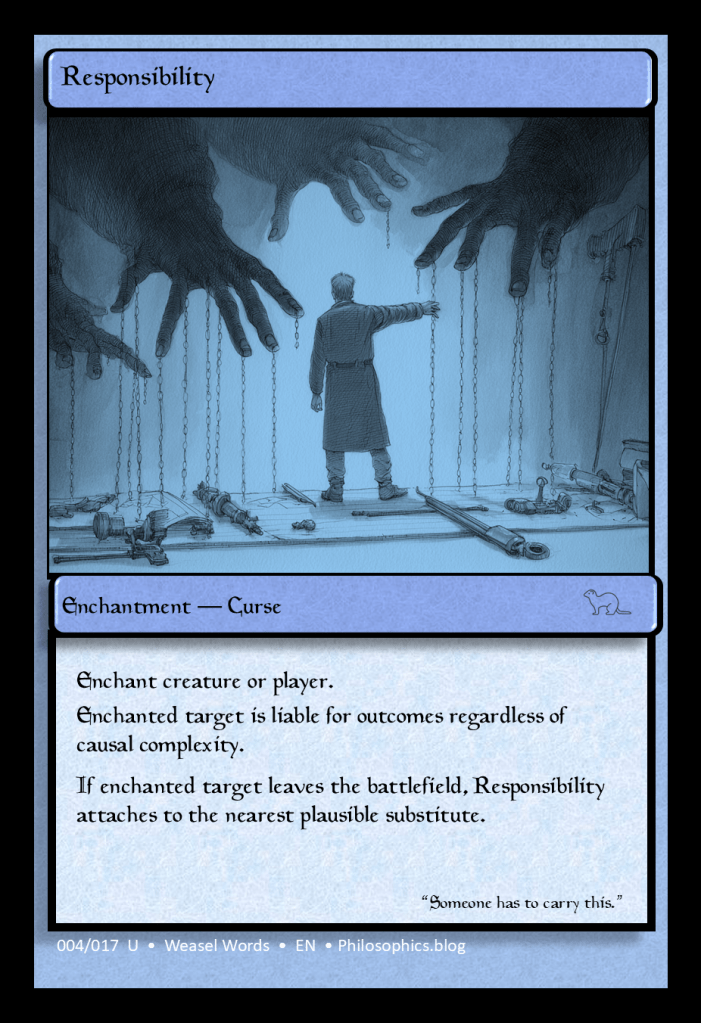
Image: MTG: Responsibility – Enchantment – Curse

Responsibility is where the emotional payload arrives.

To say someone is “responsible” sounds administrative, even boring. In practice, it’s a moral verdict wearing a clipboard.

Watch the slide:

  • causal responsibility
  • role responsibility
  • moral responsibility
  • legal responsibility

One word. Almost no shared criteria.

By the time punishment enters the picture, “responsibility” has quietly become something else entirely: the moral right to retaliate without guilt.

At which point someone will say the magic word.

Card Four: Desert

Image: MTG: Desert – Instant

Desert is the most mystical card in the deck.

Nothing observable changes when someone “deserves” punishment. No new facts appear. No mechanism activates. What happens instead is that a moral permission slip is issued.

Desert is not found in the world. It is declared.

And it only works if you already accept a very particular ontology:

  • robust agency
  • contra-causal choice
  • a universe in which moral bookkeeping makes sense

Remove any one of these and desert collapses into what it always was: a story we tell to make anger feel principled.

Which brings us, finally, to the banner term.

Card Five: Justice
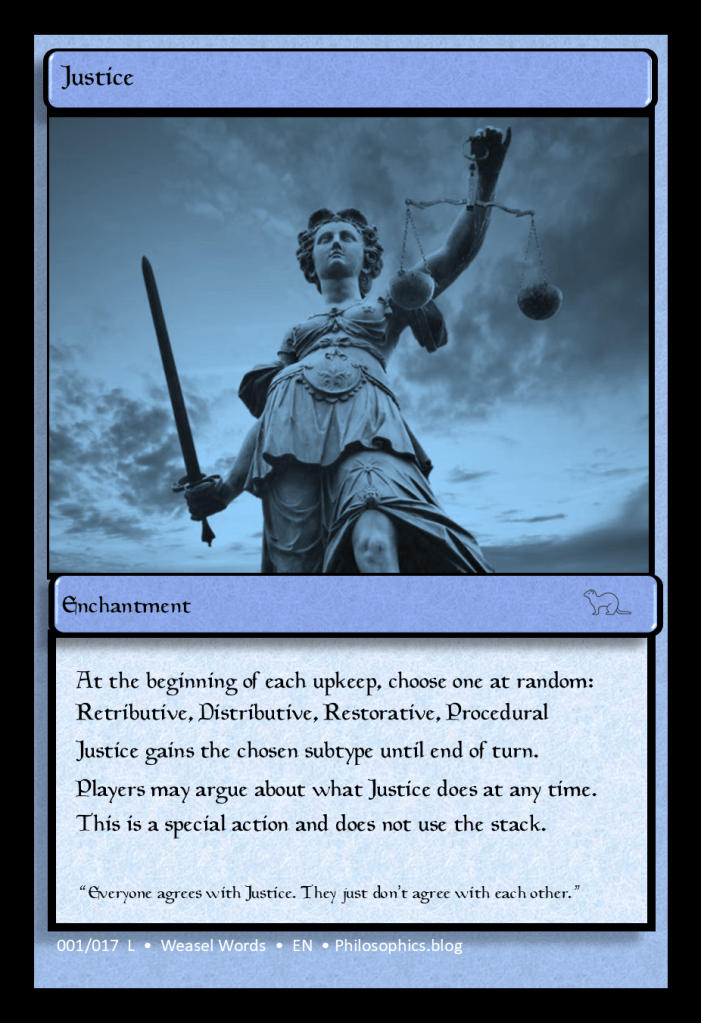
Image: MTG: Justice – Enchantment

At this point, justice is invoked as if it were an independent standard hovering serenely above the wreckage.

It isn’t.

“Justice” here does not resolve disagreement. It names it.

Retributive justice and consequentialist justice are not rival policies. They are rival ontologies. One presumes moral balance sheets attached to persons. The other presumes systems, incentives, prevention, and harm minimisation.

Both use the word justice.

That is not convergence. That is polysemy with a body count.

Why clarification fails here

This is where LIH earns its keep.

With invariants, adding detail narrows meaning. With terms like justice, choice, responsibility, or desert, adding detail exposes incompatible background assumptions. The disagreement does not shrink. It bifurcates.

This is why calls to “focus on the facts” miss the point. Facts do not adjudicate between ontologies. They merely instantiate them. If agency itself is suspect, arguments for retribution do not fail empirically. They fail upstream. They become non sequiturs.

This is also why Marx remains unforgivable to some.
“From each according to his ability, to each according to his need” isn’t a policy tweak. It presupposes a different moral universe. No amount of clarification will make it palatable to someone operating in a merit-desert ontology.

The uncomfortable conclusion

The problem is not that we use contested terms. We cannot avoid them.

The problem is assuming they behave like tables.

Retributive justice survives not because it is inevitable, but because its supporting terms are treated as settled when they are anything but. Each card looks sturdy in isolation. Together, they form a structure that only stands if you agree not to pull too hard.

LIH doesn’t tell you which ontology to adopt.

It tells you why the argument never ends.

And why, if someone insists the issue is “just semantic”, they’re either confused—or holding the deck.

Retributive Injustice

I’ve already said that justice is a weasel word, but let’s pretend that it’s actually something more substantial and perhaps even real. I’ve spoken on the notion of blame as well. I have been thinking about how untenable retributive justice is and it seems to include restorative justice, too. But let’s focus on the retributive variety for now.

In short, retributive justice is getting the punishment one deserves, and I think desert is the weak link. Without even delving into causa sui territory, I feel there are two possible deserving parties. The agent and society. Let’s regard these in turn.

The Agent

An agent, or more specifically moral agents, are entities that can be deemed responsible for their actions on moral grounds. Typically, moral agency assumes that an agent, an actor, is fully aware of the cultural rules of a given society, whether norms or legislated. Under this rationale, we tend to exclude inanimate objects with no agency, non-human life forms, children, and persons with diminished cognitive faculties. In some cases, this diminution may have been self-imposed as in the case of chemically induced impairment, for example by drugs or alcohol. We might consider these entities as being broken. In any case, they do not qualify as having agency. An otherwise moral agent until duress or coercion may no longer be expected to retain agency.

Unless an informed and unimpaired agent commits an act with intent … there can be no moral desert

Unless an informed and unimpaired agent commits an act with intent, another weasely word in its own right, there can be no moral desert. But let’s hold this thought for a bit and turn our attention to society.

Society

For the purposes of this commentary, society is a group of like-minded persons who have created norms, customs, laws, and regulations. In most cases, people come into societies whose structure is already formed, and they need to acculturate and adapt, as changing the fabric of society generally takes time. Even in the case of warfare where a society is subsumed, cultural norms will persist for at least a time.

Whilst it is incumbent for a person to become aware of the rules of engagement and interaction with a society, this is reciprocally a responsibility of society to impart its norms through signalling and performance as well as through more formal training, such as public fora, schools, and activities. Even media and entertainment can serve to reinforce this function.

So What?

I argue that retributive justice is bullshit (to employ technical language) is because if an informed and unimpaired agent does violate some standard or protocol, the society is at least partially to blame—perhaps fully so. Again, if the person is not unimpaired, a pivotal question might be why is s/he uninformed? If the person has the information but ignores it, to what extent is the person impaired and what responsibility does society have for being unaware?

Special Case?

What if a particularly predacious person from Society A infiltrates Society B? Is the person broken or is Society A responsible to creating a person that would prey on some other unsuspecting society? Again, the person is never entirely responsible unless s/he is broke, in which case, s/he is exempt and not morally responsible.

When Then?

As I’ve said before, a person who commits an act against the interest of a society may be quarantined or perhaps exiled or shunned as some cultures practice, but these are meant to preserve the cohesion of the society and not meant to exact a point of flesh in retribution.

In the end, I just don’t see a use case where retribution would fall upon a single actor. If some transgression is made, how then do we ensure society pays its dues as well? In my mind, society is more apt to fail the individual than the other way around, but maybe that’s just me and my world.

What am I missing here?

Quarantine and Social Justice

Gregg Caruso is interested in the notion of Agency from the perspective of justice, desert, and sentencing. This is applied philosophy.

My main argument against the possibility of free will is Nietzsche-Strawson’s causa sui argument, which I’ve touched on a few times by now, but I haven’t yet fully articulated my position. I’ll get to that another day. I’d also like to create another video, as I would like to do for this as I explore in more detail.

Ostensibly, this is a compatibilist view that leaves a modicum of free will, even with causa sui in place. I hope this illustration will be helpful.

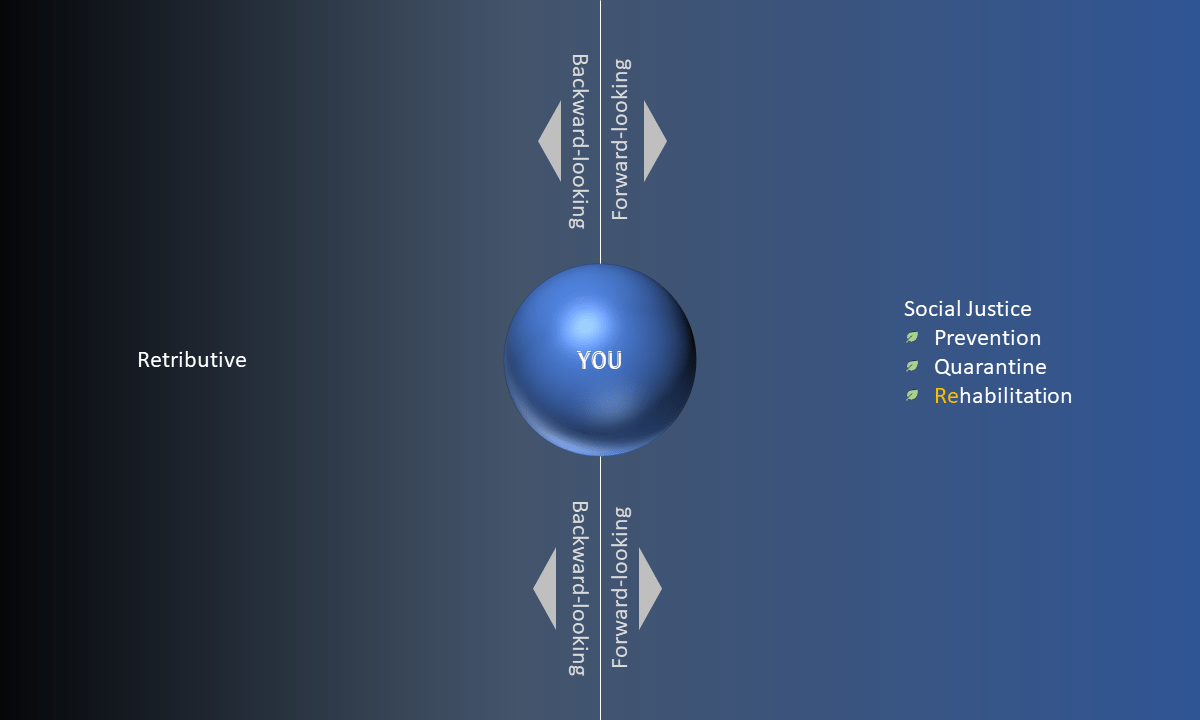
In the centre of the illustration is you, the self of some arbitrary person who shall act as our subject. Let’s assume a couple of basic premises:

  1. We either live in a relaxed causal, deterministic or indeterministic universe.
  2. Causa sui is in full force and effect: one cannot cause any aspect of one’s self.

I include the term relaxed in the first premise, so I don’t have to deal with a fully deterministic universe governed entirely by the notion captured by Schrödinger’s equation. The second premise is in place to serve as a limitation: even if consciousness is an emergent property, its emergence doesn’t grant some insuperable metaphysical powers. One cannot reach outside of one’s self.

The scenario plays out as follows. You have been apprehended for violating some statute. Let’s say that you’ve taken an item from a retail store. As you are leaving the store, the police stop you. When asked if you took the item, you answer in the affirmative. This is a very efficient municipality, so you are taken immediately to a magistrate to make a plea.

In this scenario, Caruso is your attorney at law. His argument is that, given causa sui, you cannot be responsible for who you are. We’ve been here before. Since you can’t be responsible for who you are, any sentence to punish you would be unethical, as you’ve done nothing to deserve it. This is the notion of desert in the realm of retributive justice.

The judge buys this argument, but s/he counters with three possible courses of action. You may not be responsible for who you are, but we are a community of laws. You are a victim of your circumstances, so we cannot look backwards. For whatever reason—and through no fault of your own, by definition—, you were broken relative to complying with community norms.

Social Justice

Firstly, we may wish to make an example of you, to signal the community that we will incarcerate people who break the laws. This is more a public service purpose than a punishment.

Secondly, if you had contracted a communicable disease—we’re looking at you Covid—, you can be quarantined under the consideration of the common good. Framed this way, it is not a punishment, we just don’t want it to happen again.

Lastly, we may also be justified on the grounds of rehabilitation. I highlight the ‘re‘ in rehabilitation because some people may not have been ‘habilitated’ in the first place. Perhaps think of them as feral. In any case, a computer programming analogy might make sense here.

So what’s this all about? Remember, causa sui says that you cannot be held responsible for creating yourself. The claim is that you are a product of your nature and nurture. Genetically speaking, perhaps there was some reason that you could not incorporate inputs into factors that allowed you to appropriately interpret this law—or any law, more generally. Or maybe, you were never exposed to this law or category of law before.

In the preventative vein, we could be signalling, ‘We caught You taking an item from a shop without paying. Now you know this, and we may make an example of you since you are caught as well’.

Quarantine may be a bit of a stretch in this scenario, so feel free to substitute a more serious offence if it helps you to remember this. Perhaps You killed someone. Even without punishment, we may want to get You off the streets before another killing is perpetrated. I’ll come back to this one.

Rehabilitation makes sense even if one is not responsible for one’s self. Presuming that you are a product of programming—family, culture, peers, and so on—, perhaps you just need to be rewired. Perhaps a particular subroutine was not implemented or activated correctly. This rationality could be used as a non-punitive justification.

Counterarguments

The public prevention case may be why offenders were pilloried in by-gone days. Display in a public square may inform some who may have missed the lesson the first time around, hence dissuading taking similar actions. But unless this ‘public service message’ reached enough people, it would probably not be the best rationale.

Quarantine may sound OK on the surface, but it’s actually rather specious. Firstly, that You knicked a trinket. What exactly is the risk of contagion? Petty theft is not known to be particularly communicable. Secondly, just because you’ve done something once is little measure of whether you’ll do it again. In fact, if this were true, then one might have assumed that you could never have committed the offence because of your history.

Rehabilitation may likely be the best option among these. If you missed that particular lesson or had forgotten or diminished the calculus, remediation may do just the trick. However, if your ‘operating system’ is not up to snuff, it’s not a matter of inputs. It’s a matter of processing capability.

Psychological intervention is in its infancy, so the probability of remediating this is low, if not a crap shoot. And not all such processes can be remediated. This could lead one to fall back on the quarantine option, but who is the competent assessor in this case?

It’s easy enough to assess if You is Hannibal Lecter or tells you straight out that s/he intends to repeat the offence. Some cognitive deficiencies are simple enough to recognise. But what about the grey areas—all of that space in between?

And who is making sure that the judges are not being punitive simply because they haven’t yet eaten lunch?

Enfin

Bringing this to a close, if we have no free will, it makes no sense to punish. Sadly, most justice systems promote retributive justice and punishment in sentencing. I’ll spare you my diatribe on how I believe most people attracted to jurisprudence, law, and law enforcement have been conditioned. And whilst Caruso feels justified in foreword action, I am more sceptical. This said, I’ll take what I can get.

This post is pretty much a stream of consciousness. I hope to give it better treatment in a future video.

Moral Responsibility

Can we be held morally responsible for our actions? Yes, says Daniel Dennett. No, says Gregg Caruso. Reader, you decide

Aeon Article, 4 October 2018

Caruso: [Dan,] you have famously argued that freedom evolves and that humans, alone among the animals, have evolved minds that give us free will and moral responsibility. I, on the other hand, have argued that what we do and the way we are is ultimately the result of factors beyond our control, and that because of this we are never morally responsible for our actions, in a particular but pervasive sense – the sense that would make us truly deserving of blame and praise, punishment and reward. While these two views appear to be at odds with each other, one of the things I would like to explore in this conversation is how far apart we actually are. I suspect that we may have more in common than some think – but I could be wrong. To begin, can you explain what you mean by ‘free will’ and why you think humans alone have it?

Gregg Caruso

Dennett: A key word in understanding our differences is ‘control’. [Gregg,] you say ‘the way we are is ultimately the result of factors beyond our control’ and that is true of only those unfortunates who have not been able to become autonomous agents during their childhood upbringing. There really are people, with mental disabilities, who are not able to control themselves, but normal people can manage under all but the most extreme circumstances, and this difference is both morally important and obvious, once you divorce the idea of control from the idea of causation. Your past does not control you; for it to control you, it would have to be able to monitor feedback about your behaviour and adjust its interventions – which is nonsense.

In fact, if your past is roughly normal, it contains the causal chains that turned you into an autonomous, self-controlling agent. Lucky you. You weren’t responsible for becoming an autonomous agent, but since you are one, it is entirely appropriate for the rest of us to hold you responsible for your deeds under all but the most dire circumstances. 

Daniel Dennett

if your past is roughly normal, it contains the causal chains that turned you into an autonomous, self-controlling agent

Dan Dennett

So commences this debate. The argument unfolds largely on semantic grounds. Even here, one can see the debate over the distinction between control and causation. I understand what Dennett is attempting to parse here, but I object on the grounds of causa sui.

I recommend reading the Aeon article as there is much more than this distinction, but it does remain a semantic issue. I started a post on backwards- and forward-looking perspectives, that better articulate Caruso’s perspective, but I am also working on other things. This was quicker to post and I wanted to keep a bookmark anyway, so it’s a win-win.

Your Morals

I was commenting elsewhere on morals and was directed to Jonathan Haidt and his work. Notably, the questionnaire at YourMorals.org, where you can get your own assessment and contribute data points to the body of work.

Full disclosure: I am not a fan of this type of survey, as I’ve mentioned previously. Still, I made an attempt. Better still, I’ve copied the questions to critique. There are 36 all tolled. Perhaps, I’ll respond to a dozen at a time. The next dozen responses are here. Generally speaking, they present each question and provide a Likert scale as follows:

  1. Does not describe me at all
  2. Slightly describes me
  3. Moderately describes me
  4. Describes me fairly well
  5. Describes me extremely well

Standard fare. It starts off bad:

1. Caring for people who have suffered is an important virtue.

Why include an abstract concept like virtue? I don’t ascribe to the notion of virtue, so it’s an empty set. Given that, my response would be a 1. If I ignore the offensive nomenclature and assume it translates idiomatically into ‘beneficial for some target society’, then I still have to question what is meant by suffering, and how far does caring extend. Is it enough to feel bad about the homeless person, or does one have to care enough to provide sustenance and shelter? Talk is cheap.

2. The effort a worker puts into a job ought to be reflected in the size of a raise they receive.

This is fraught with all sorts of problems. In fact, it’s a reason why I consider myself to be a Postmodern. The inherent metanarrative is that societies are effectively money-based. I don’t happen to believe that, so I am again faced with responding to an empty set. Even if I attempt to abstract the ‘raise’ aspect to mean that effort represents input and output is a direct and (perhaps) proportional function, I am still left to wrestle with how this effort is measured and what could have been achieved had the others not been present.

Using a sports analogy—always a dangerous domain for me to play in—, what if LeBron James was to play an opposing team by himself? He needs the other team members. Of course, his teammates are compensated, too. But in his case, his salary is not only based on his athletic talent but on his celebrity power—rent in economic parlance. Perhaps LeBron makes a lot of baskets, but without the assists, he’d have fewer. And because he is the go-to guy, some other teammates might be sacrificing baskets as part of their winning strategy.

Finally, how do you measure the effort of an accountant, a janitor, and an executive? The question is fundamentally bollox.

3. I think people who are more hard-working should end up with more money.

On a related note, I can abbreviate my commentary here. Again, what is harder? Are we asking if construction workers should earn more than CEOs? More bollox.

4. Everyone should feel proud when a person in their community wins in an international competition.

Yet, again, an empty set and a sort of mixed metaphor. I don’t agree with the notion of identity and even less at scale—states, countries, and nationalities. Putting that aside, why should I derive pride (that cometh before the fall) because someone succeeds at some event anywhere? It’s facile. If the question was focused on whether I would be happy for that person, the answer might shift up the scale, but where would I have derived pride for that person’s achievements?

5. I think it is important for societies to cherish their traditional values.

First off, why? What values? Not to beat a dead horse, but what if my tradition is slavery? Should I cherish that? This is really asking should I cherish the traditions of my society. Clearly, it’s not asking if other societies should enjoy the privilege of cherishing theirs? From the standard Western vantage, many want to cherish their own, but not Eastern values of eating dogs or Middle Eastern values of burqaed women and turbans. Is this asking should the world subscribe to my society’s values? I’m not sure.

6. I feel that most traditions serve a valuable function in keeping society orderly

Speaking of tradition… We are not only dealing with the vague notion of tradition, we are discussing another vague concept, order, and elevating order over (presumably) disorder. Order connotes a status quo. And why is the superlative most present? Has someone inventoried traditions? I believe I am supposed to translate this as ‘I feel that the traditions I am familiar with and agree with help to create a society that I am content with’. Again, this betrays the privileged perspective of the observers. Perhaps those disenfranchised would prefer traditions like Capitalism and private property to be relics of the past–or traditions of two-party rule, partisan high court judges, or money-influenced politics, or politicians serving themselves and their donors over the people or Christmas.

7. We all need to learn from our elders

Learn what exactly from our elders? Which elders? The bloke down the block? That elderly Christian woman at the grocery mart? The cat who fought in some illegal and immoral war? The dude who hordes houses, cars, and cash at the expense of the rest of society? Or the guy who tried to blow up Parliament. I believe this is asking should we learn how to remain in place as taught by the privileged wishing to maintain their places.

8. Everyone should try to comfort people who are going through something hard

Define hard, and define comfort? This harkens back to the first question. Enough said. As far as lying is concerned, we should by now all be familiar with the adage trying is lying. Or as Yoda would restate it, do or do not, there is no try.

9. I think the human body should be treated like a temple, housing something sacred within

Obviously, this one is total rubbish. Here, I don’t have a structure that makes it difficult to answer. I may have sprained my eye rolling it, though. This said, what is a temple treated like?

10. I get upset when some people have a lot more money than others in my country

This one is interesting. Whilst I don’t believe that countries or money should exist. In practice, they do. So on its face, I can say that I get upset when we are thrown into a bordered region and told we need to exchange paper, metal, plastic, and bits for goods and services–that some people have more and others have less primarily through chance.

11. I feel good when I see cheaters get caught and punished

Which cheaters? Cheating requires perspective and a cultural code. It can privilege the individualist over the communalist. This reminds me of the cultures that are more interested in ensuring that all of their members finish a contest than having any one win.

Academically, it is considered to be cheating to work together on an exam because the individual is being tested. Of course, the exam is on certain content rather than on the contribution of the human being.

Again, the question feels targeted at cheaters getting caught circumventing something we value. If someone cheats becoming assimilated into some military-industrial society, I will encourage and support them. If they get caught and punished, my ire would more likely be directed toward the power structure that created the need to cheat.

12. When people work together toward a common goal, they should share the rewards equally, even if some worked harder on it

I’ll end this segment here on another question of meritocracy. I think it’s fair to judge the authors as defenders of meritocracy, though I could be wrong. This feels very similar to some other questions already addressed. The extension here is about sharing the rewards, whatever that means. Are we baking a cake? Did we build a house for a new couple? Did we plant trees in a public park? Did we clean up litter on a parkway? Did we volunteer to feed the homeless? And what was the work? Again, how are we measuring disparate work? Did the chicken farmer work harder than the cow farmer? Did the carpenter work harder than the organiser?

If the remainder of these questions is different enough, I’ll comment on them as well. Meantime, at least know you know more why I have little faith in the field of morals. This does nothing to change my opinion that morals are nothing more than emotional reactions and subsequent prescriptions. I don’t mean to diminish emotions, and perhaps that might be a good central pillar to a vibrant society. I’ll need more convincing.