Checkmate Stalemate

Capitalism and apathy in the United States are leading factors in driving homelessness. Employing Capitalism and apathy is somewhat redundant as a major component of Capitalism is apathy and creating otherness—us and them; haves and have nots. People reaching retirement age—Boomers in the parlance—are finding themselves homeless—or as the sage, George Carlin reminds us, houseless.

An article titled America’s homeless ranks graying as more retire on streets was posted elsewhere with a comment, If they voted for Reagan, fuck ’em!

If they voted for Reagan, fuck ’em!

Facebook Poster

The feeling behind this sentiment is that this cohort did this to themselves. They shot themselves in the foot—or the face, as the case might be. They bought into the Darwinist mythos and envisaged themselves as coming out on top—except they didn’t and the music stopped and someone else had all the chairs. In fact, a few people had many more chairs than a person could ever need, leaving more people out of the game than strictly necessary. Illusory superiority is a cognitive fallacy that keeps things like Capitalism alive. And cognitive dissonance masquing mechanisms assuage the delta between perception and reality. And like lottery players, they convince themselves that one day their ship will come in. Yet at some point during the backside of midlife—however one defines that—, comes the foreboding that this is probably not in the cards. You’d gone all in and there was no payoff.

Whilst viscerally, I agree with the sentiment—as I sometimes feel schadenfreude for the people who vote for any major party candidates in election after election and are surprised that their candidate doesn’t move the needle because of [insert excuses here]. When the other party wins, nothing material happens because they don’t understand or don’t have it right. When their party wins and nothing material happens it’s because of entrenched opposition—perhaps, rather, controlled opposition.

Controlled Opposition

But what’s entrenched is not the other party. As I’ve noted before, there is no other party. There are no material choices. I don’t believe the image below is to scale because it makes it appear that they are less alike than they actually are. The image illustrates how the Democratic and Republican parties share the same foundation. I am fairly certain one could swap our Democrats and Republicans for Labour and Conservative, but I won’t speak out of school.

Twin Peaks

Almost nothing anyone can do in the near term can have any effect. In the long run, any real threat will be eliminated, neutralised, or assimilated. They may even allow an independent voice remain, but that is only for the sake of performance. It’s more like improv than scripted, but the impact will be negligible, in the manner of throwing a pillow at an aircraft carrier—even a firm foam pillow.

The most obvious connexion is that both parties—in practice all participating factions—are constitutionalists. Interestingly enough, my spellchecker autocorrected ‘institutionalist’ as ‘constitutionalist’, and that’s another commonality. As for foreign policy, the two are virtually indistinguishable. On domestic affairs, aside from vapid rhetorical and stylistic differences that might amount to some inconsequential veneer of a different tint, but their biggest differences above the water are hot-button items that spawn more words than action—especially from the Democrats.

In the US, there’s a notion of two Santa Clauses. Ostensibly, Republicans run roughshod and spend like drunken sailors when they are in power, but when Democrats are in power, Republican messaging accuses timid Democrats—and let’s be honest here; that’s most of them—of being free-spending liberals. Both parties are unrepentant spendaholics. The only difference is which people get the leftovers. I say ‘leftovers’, because their sponsors are first on queue to get paid.

The meter’s about to run out, so I’ll end my rant here. This is just one of two topics I wanted to get off of my chest. The other relates to racism—and otherness more generally, but that will have to wait for another day.

Tilting Bodies Politic

Does digital technology make students stupid? That’s what a 2019 BigThink article asks. I like to read Big Think, but it seems like PopScience in a negative way—like Pop Psychology. It’s not necessarily directionally wrong. It’s just oversimplified and seeks the lowest common denominator.

On this topic, Plato quipped, voicing Socrates, in his Phædrus 14 dialogue except that his quip was relative to writing and memory. Some historians and Classicists have suggested that modern readers may be missing the satire. I’m no defender of human intelligence, but this is the demise of society because of change—whether due to writing, radio, television, computers, video games, mobile devices, and whatever comes up next.

For this invention will produce forgetfulness in the minds of those who learn to use it, because they will not practice their memory. Their trust in writing, produced by external characters which are no part of themselves, will discourage the use of their own memory within them. You have invented an elixir not of memory, but of reminding; and you offer your pupils the appearance of wisdom, not true wisdom, for they will read many things without instruction and will therefore seem to know many things, when they are for the most part ignorant and hard to get along with, since they are not wise, but only appear wise.

Plato – Dialogue Phædrus 14

Whether or not this claim has merit, my claim is that computers have trebled manufactured consent, so it allows people to be passively active, to have to specious notion of participation in the body politic, and yet are virtually tilting windmills.

It seems that some people have such nostalgia for their apparent way of life that any deviation is considered to be an affront and possible disruption. Perhaps, it’s because I feel there’s possibly as much to shed than to keep in my book, so for me, it’s more good riddance than oh heavens.

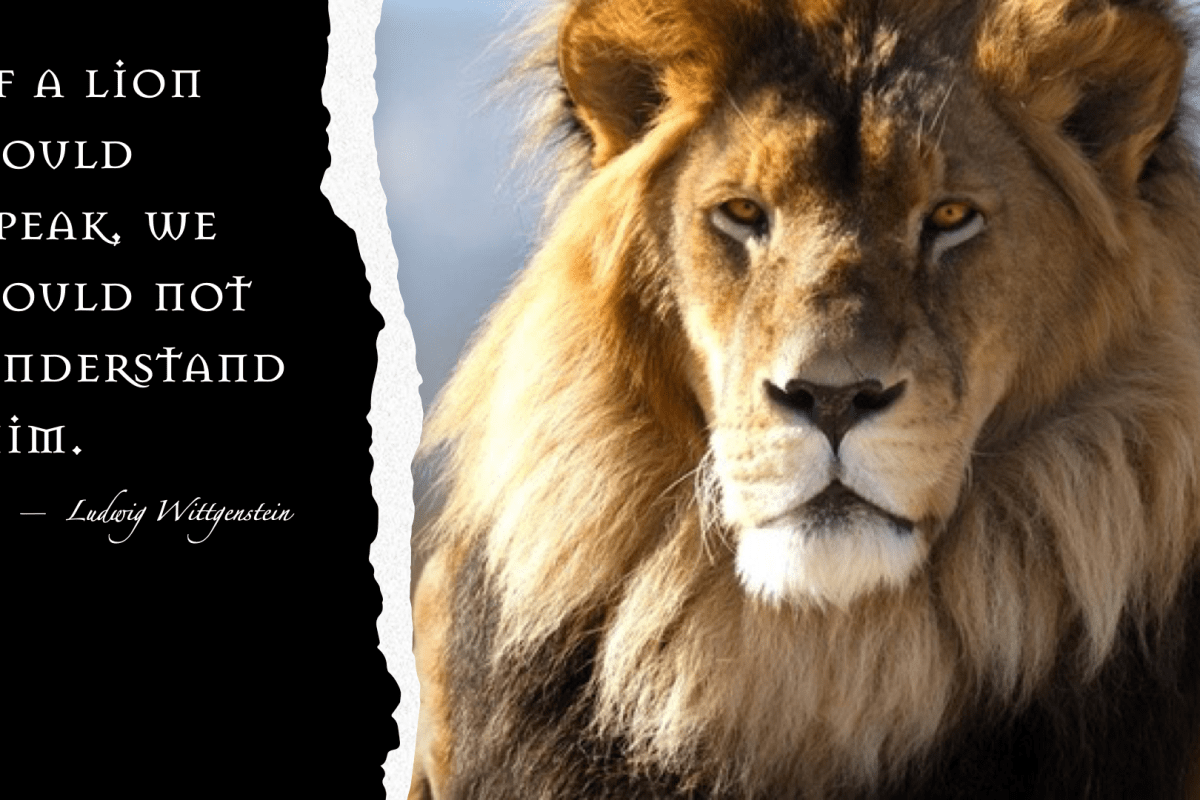
If a lion could speak

If a lion could speak, we could not understand him.

— Ludwig Wittgenstein

As much as I love Wittgenstein’s quote on language, I find it vastly more amusing aside the lion of Gripsholm Castle in Sweden. Because as talking lions come, this one is certainly more unintelligible than most.

If a lion could speak (Gripsholm Remix)

I also appreciate Daniel Dennett’s retort that if we could manage to communicate with this one talking lion—not, of course, this lion in particular—that it could not speak for the rest of lionity. (Just what is the equivalent of humanity for lions?)

If a lion could speak (traditional)

Ludwig Wittgenstein famously said, “If a lion could talk, we could not understand him.” ( [Philosophical Investigations] 1958, p. 223) That’s one possibility, no doubt, but it diverts our attention from another possibility: if a lion could talk, we could understand him just fine—with the usual sorts of effort required for translation between different languages—but our conversations with him would tell us next to nothing about the minds of ordinary lions, since his language-equipped mind would be so different. It might be that adding language to a lion’s “mind” would be giving him a mind for the first time! Or it might not. In either case, we should investigate the prospect and not just assume, with tradition, that the minds of nonspeaking animals are really rather like ours.

Daniel Dennet — Kinds of Minds: Toward an Understanding of Consciousness (p.18)

Superinstitutional Heros

I’ve never been a comic book guy or into heroes or superheroes. In fact, I have always had a thing for the underdog. This article points out The Batman’s Privilege Problem. I’ve skimmed a few comic books and graphic novels, and I’ve seen a few movies, but I am not really steeped in this space to speak to the nuance—and there is probably a difference between comics and graphic novels, but like I said: not inters. I just don’t identify with most of it. Not the violence. Not the Truth, Justice, and the American way of legacy Superman. But I do sense a privilege problem. Defenders of the status quo. I wonder if comic book aficionados tend to be more politically Conservative.

A quick Google search, and I’m mostly correct. Evidently, Marvel authors trend toward the Right. This article ranks some figures Conservative, Centrist, and Left, although the Left feel more Liberal than Left, and they are all constitutionalists. Apparently, X-Men were born of the Civil Rights movement in America in the 1960s. Still not my bag. Where are the Anarchists? At this rate, I’d settle for a Marxist.

One last mention: this piece points out that even where there are prominent social justice issues raised in one or another comic, the subtext (or overarching meta) is Conservative. This likely creates tension in a manner of speaking, but it creates dissonance for me.

I don’t have much more to add, but the article caught my fancy. It resonated for me, and having not posted for a while, I figured what the hell.

Consciousness Is Religion

I expect that consciousness is a human nominative concept. Like religion, it will become smaller as science encroaches. In 1994, David Chalmers presented his idea of the hard problem of consciousness in a lecture, Toward a Scientific Basis of Consciousness, but I feel this is more due to the insufficiency of language than anything else. To me, consciousness isn’t well defined. It’s like a medical syndrome. It’s just a grouping of seemingly related conditions that haven’t yet been parsed. In time, it may be determined that they weren’t even related in the first place. Apophenia and cognitive dissonance are two significant human biases that affect perception.

At core, consciousness might be functionally reduced to that of an interpreter. Some have posited that the only thing that exists is ‘information’, whatever that means, so there only needs to be an interpreter—a translater. If that interpreter is defined as consciousness, then so be it. This appears to lead us to a Cartesian place—though it doesn’t follow that the self or ego exists. This would be a second-order event.

Anyway, just rambling. As seems to be the case lately, I’ve got little time to develop my thoughts. At least I’ve captured them for now.

Dear diary…

Nontonomy

Being critical of freedom, liberty, and autonomy is likely to make one the subject of scorn and derision. Most people tend to feel these things are self-evident attributes and goals, but they are all simply rhetorical functions. I was reading a passage in Mills’ On Liberty, where he posits

That the only purpose for which power can be rightfully exercised over any member of a civilized community, against his will, is to prevent harm to others. His own good, either physical or moral, is not a sufficient warrant … Over himself, over his body and mind, the individual is sovereign.

On Liberty, John Stuart Mill

It should come as no surprise that I question a position adopted by the Enlightenment Age. These geezers posited that many things were self-evident, but all of this is self-serving magical thinking, and there is no reason to have truck with any of it. These are all normative claims being dressed as positive, non-normative, ones, hoping to skirt scrutiny by employing a position of self-evidence.

I am generally critical of any notions of identity and self from the start, so affixing some attribute of power to it seems just silly.

It seems that I again am distilling this notion to a power equation. As a person, I want to claim power, if anything, over my self however that might be defined. And though, I would like this, too, it is nothing more than some emotional reaction.

Without delving into the depths of autonomy quite yet, on a proverbial desert island—as necessarily the case with any social constructs, where these notions are meaningless without a social context—adding a second person creates friction. Person A seemed to have full autonomy on this island—notwithstanding the other life forms on this island that are somehow never granted autonomy—now has had this autonomy reduced by the presence of Person B.

Firstly, Person A may have claimed this island to be their own. Given this, Person B is infringing on this autonomous decision, having arrived sequentially. Is Person B tresspassing? Does their presence harm Person B, be limiting their autonomy however slightly?

Mills’ concept is one of no harm: one is free to do what one chooses as so long as it doesn’t harm another. Accordingly, it says one is free to harm one’s self—essentially treating the self, the corpus, as personal property. Just as one could damage a piece of personal furniture, one could damage themself. I am not sure if Mills intend this to extend to suicide, but that’s not an important distinction here, so I’ll move on.

Let’s return to Person A on the island—only Person A is a woman and Person B is a fetus. What rights and autonomy does Person B now possess? For some, it has full autonomy; full personhood. Still, Person B is ostensibly trespassing, so does this autonomy even matter if it exists?

If you are Person X and own a house, and I, as Person Y, enter into it, how does this differ from A and B? Can you justify disallowing Person Y from exercising autonomy whilst supporting Person B? I don’t want to make this about abortion, so I’ll keep stop here.

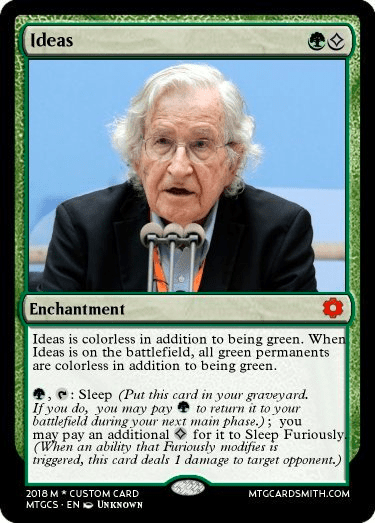
Colourless Green Ideas Sleep Furiously

I was thinking about a story idea, but it seems too daunting to attempt. Call it a mind experiment tethered to solipsism. The conceptual framework is this:

The premise is that ‘reality’ is generated in real-time—except there is no time; there is no space. All of this is constructed. Think of the sort of dream you may have experienced where physics-defying events occur. These dreams don’t care about the continuity of time or space. You can instantly be here and then there irrespective or where here and there are. One may even be in both places at once or nowhere at all. One can transform from one state to another or even be stateless. One doesn’t require an ego or a sense of I; rather, the I may shift without effort or it might dissolve. We are not encumbered by bodies. Vonnegut’s short story Unready to Wear—that for some reason indexed in my recollection as Pas prêts à porter.

In this world, perception is loaded into memory. But unlike a typical video game, the rest of the world is not a telos. It’s rather procedurally generated. In fact, even this is a poor analogy because the generation could be some stochastic process with no need to connect event 0 to event 1.

Empirically, events rely on preceding events. This is the world of cause and effect—a snooker ball collides with another and causes it to fall into a pocket; a stock price rises or falls, but these are not random events as they are inexorably linked to the past. As no one expects an unperturbed ball to jump into a pocket any sooner than one would expect a stock price to be truly random–to jump from 100 to 2 to 999 to 42. But with dreaming, all of this is possible.

Returning to the video game metaphor, what you see in the moment is all that is real. If you look in a particular direction, a table with a lamp and book on it might appear to be situated next to a chair; that registers as reality. But if you look away and then back, none of this needs to remain there. There needn’t be a table or a chair. Or there could be, but they don’t have to be the same table and chair; and there needn’t be a book.

In this reality, the mind—label it as you will—continually reconstructs whatever it wants to, simultaneously—apologies for the temporal terminology, but communication is restricted to the convention of shared meaning—and whatever it generates arrives with a plausible backstory. Given this, any history or relationships are always part of this fiction. Cognitive devices would be active to ensure this backstory appears to have continuity with our sense of the past; rather, it generates this plausible past. This past only has to be plausible in the moment—enough to hold the illusion together.

Consider a nebulous dream. These dreams don’t need to conform to conventions of time and space. But when we occasion to convey these dreams to a journal, a mate, or a therapist, we are forced to fit into a conventional spatiotemporal structure–first, this happened and I was here, and then that happened and I was there. But this was not the reality of the dream. This is subjectively experiential and so cannot be conveyed. In these dreams, there are no rules, but we apply structure that wasn’t really there in the first place; but we interpret time and space linearly and contiguously—even where no such structure exists. I think it would tedious to write and difficult to follow….. Perhaps better suited for an AI author.

To put a finer point on it, I’ll leave with a snippet. Let’s begin with the chair next to a table with a lamp and a book set upon it. You are a nuclear scientist on your way to a job interview at 3:30pm because why not?


A scheduled alarm awakens you. A clock on a bedside table reads 8 a.m. Your focus is on an interview this afternoon at 3:30, so you don the suit you’d set out the night before.

In the kitchen, you decline your partner’s offer of the soup he’s heated for lunch. He routinely eats soup for lunch on Thursdays.

The engine is still making a ticking sound, but you are distracted by the woman fussing with her makeup on the commuter train.

You’ve always preferred to take notes by hand with a fountain pen, having found the mass of the implement to add weight to your ideas.

Your wife, sipping café au lait on the sofa, smiles adoringly at you as you walk through the living room. She’s wearing that azure sweater she bought in Anchorage—or was it Chicago? The telephone rings.

“The captain has asked all passengers to fasten their seatbelts and prepare for a landing. We’ll be arriving at London Heathrow in about 20 minutes.” You close your laptop and acknowledge the flight attendant as she walks past.

You hang up the phone and tell your girlfriend it was a wrong number. You’re not sure that she believes you, but the barking dog distracts you. You don’t prefer to take lunch in public parks. You prefer the beach.

You pay for the trousers and accept the recommendation to purchase a leather belt. You’ve got to get back to your office. There’s not usually traffic at this hour. That’s why you left before 11.

Out of the corner of your eye, you catch a glimpse of your husband. What’s he doing in Sydney? You tell yourself that you must be mistaken and eat the last morsel on your plate, the waiter hovering with the check.

Ten more minutes you tell yourself as you glance at the clock on the wall. Don’t go off you plead with the alarm clock, but the cat walking across the bed tells you that this ten minutes will not be used catching up on sleep.

“Four. Seven minus three is four,” you offer.

“Very good. And what is seven plus three?”

This is your favourite part of Phantom, but you wonder what became of your date. On one hand, he seemed like a nice guy.

“There are only eleven. It says a dozen.”

You continue to read the same paragraph over and again but it doesn’t seem to make sense.

Why is that guy looking at you? He must know that you know that he’s staring.

You are trying to find the heat of the stage light so you can get into the shot. “Line?” you ask.

You lock the door of your hotel room behind you as imagine crashing on the bed in front of you, but you’ve just noticed that you’d forgotten your luggage.


As I just took a stream of consciousness approach save for actively quashing any semblance of contiguity. To be honest, I seriously considered entering snippets into a spreadsheet and then randomising the concepts. Another thought was to approach it like Mad Libs, but I opted for a more organic approach.

In the end, my goal was to dissolve concepts of sex or gender of time and place and of context in general. Looking back, it seems one could create continuity differently. In dreams I’ve experienced, I’ve awakened to discover an element in the environment likely inspired the events in a dream, so perhaps the ticking of the engine could have derived from the ticking of the alarm clock.

My initial goal was not one of continuity, but reading ex post facto, it might need something to keep attention—rather a string to follow out of the labyrinth. On the other hand, that is more of a testament to a need for some narrative.

And so it goes…

Shout out to Nick Bostrom’s essay Are You Living In a Computer Simulation?

Covid Casualties

I’ve got several things on my mind, but they are ostensibly unrelated. I’ll post separately as time allows, but this is a personal story.

My sister has been visiting a dialysis centre three times a week for the past 5 years awaiting a matching kidney donor. She rang me the other day to tell me she was en route to hospital as they had found a donor. Found is probably a poor word choice. Some person had died, rendering the kidney superfluous for all intents and purposes.

My sister was excited to regain some control over her life. She was told that the host of this kidney had been diagnosed with Hepatitis C and was informed of the risks. The official cause of death was Covid—perhaps owing to a compromised immune system. No matter. My sister accepted the risk. It was evening, and the transplant was scheduled for the morning after running some test panels.

That morning, she was devastated by the news that she had tested positive for Covid, so she was no longer a candidate for a transplant. This is a reminder that Covid is not just about the effects of having caught it. She’d go back on the list and wait. Perhaps it wouldn’t take 5 years this next time, though there are no guarantees.

This is not my first experience with Covid. My 20-something-year-old daughter was hospitalised for over a week due to Covid. I’ve had friends and acquaintances get it, but they all survive–long-Covid effects notwithstanding.

I thought I’d written about the death of my last girlfriend who was another Covid casualty of the indirect variety. She died in June 2020. Her plight was sealed by deferring treatment of an infection for fear that hospitalisation would increase the probability of her contracting Coronavirus. This decision turned out to be fatal.

To be fair, there is a lot of information, misinformation, and disinformation abound, and it’s a challenge to sift out the relevant material. And neither is the ambient fear helpful. And so it goes…

Memento Mori

Some art just catches my eye and resonates. Here is an image of a robotic arm. Nothing quite captures the Modern human condition quite so poignantly. This is the plight of Sisyphus but not so pedestrian as Camus’ version. One can’t imagine this one happy. This robot was built intentionally to bleed the hydraulic fluid that is its lifeblood, as it toils to retain that sanguineous fluid. But as with life and humans, the task is futile.

In this shot, we see human spectators watching its eventual demise. Memento Mori. No one gets out alive.

The Instagram copy captures my sentiments pretty well, so I’ll end this here.