The Insufficiency of Language in an Agile World

I wrote and published this article on LinkedIn. I even recycled the cover image. Although it is about the particular topic of Agile, it relates to the Language Insufficiency Hypothesis, so I felt it would be apt here as well. It demonstrates how to think about language insufficiency through the framework.

Agile in Name Only

For over two decades, I’ve been immersed in Agile and its myriad interpretations. One refrain has persisted throughout: Agile™ is “just about agility,” a term that anyone can define as they see fit. The ambiguity begs the question: What does it really mean?

On its face, this sounds inclusive, but it never passed my intuitive sniff test. I carried on, but as I reflected on my broader work concerning the insufficiency of language, this persistent fuzziness started to make sense. Agile’s conceptual murkiness can be understood through the lens of language and identity—particularly through in-group and out-group dynamics.

Otherness and the Myth of Universality

To those who truly understand agility, no elaborate definition is required. It’s instinctive, embedded in their DNA. They don’t need to label it; they simply are agile. Yet, for the out-group—the ones who aspire to the status without the substance—Agile™ becomes a muddy abstraction. Unable to grasp the core, they question its very existence, claiming, “Who really knows what Agile means?”

The answer is simple: Everyone but those asking this question.

The Agility Crisis

This disconnect creates a power shift. The in-group, small and focused, operates with quiet competence. Meanwhile, the out-group, larger and louder, hijacks the conversation. What follows is an inevitable dilution: “Agile is dead,” “Agile doesn’t work,” they declare. But these proclamations often reflect their own failures to execute or evolve, not flaws inherent to agility itself.

This pattern follows a familiar playbook: create a strawman—define Agile™ as something it’s not—then decry its inability to deliver. The result? Performative agility, a theatre of motion without progress, where the players confuse activity for achievement and rely on brittle, inextensible infrastructures.

Agile Beyond the Label

Ironically, the true practitioners of agility remain unbothered by these debates. They adapt, innovate, and thrive—with or without the label. Agile™ has become a victim of its own success, co-opted by those who misunderstand it, leading to a paradox: the louder the chorus claiming “Agile doesn’t work,” the more it underscores the gap between those who do agility and those who merely wear its name.

The lesson here is not just about Agile™ but about language itself. Words, when untethered from their essence, fail. They cease to communicate, becoming tools of obfuscation rather than clarity. In this, Agile™ mirrors a broader phenomenon: the insufficiency of language in the face of complexity and its misuse by those unwilling or unable to engage with its deeper truths.

The Matter with Project Managers

Index and table of contents

Several of my esteemed colleagues prompted me to become familiar with Iain McGilchrist. I had viewed hours upon hours of his lectures before I decided to commit to his latest book and likely magnum opus, though I don’t want to sell him short. The Matter with Things is an approximately 3,000-page, two-volume tome. To be fair, it’s about 1,600 pages of narrative content with the remainder being appendices, a bibliography, an index, and other such back matter.

Podcast: Audio rendition of the content on this page.

I’ve mentioned much of this before, but I am writing this post with a particular LinkedIn audience in mind, whom I don’t expect to be familiar with my prior commentary, though they are invited to explore more. McGilchrist’s thesis is that the human brain operates with asymmetrical hemispherical differences. These differences are not the facile “left-brain analytical, right-brain creative” distinction of yore, rather the differences are more nuanced. If you are interested in the minutiae of this, stick around and read past and future posts when they arrive, as I’ll be documenting my journey through these volumes presently.

So, what’s the matter with project managers? And why bring up project managers? In my workaday life, I’ve often been asked to perform project management functions, something decidedly not my forte. I could be reading into and am guilty of reductionism, but in reading The Matter with Things, I may have stumbled onto something with explanatory power. So let’s pause for a quick reflection.

Pistachio in hand

In a very small nutshell. I’m talking, perhaps, pistachio-sized here. The right brain hemisphere is the part that experiences the world as it is. The right brain is not about making judgments and categorising. Rather, it’s about just absorbing without interpreting, per se. On the other hand, the left brain hemisphere interprets, codifies, and maps this world for later access. Again, forgive the over-simplification, but this is the information pertinent to the matter at hand—a very left-hemisphere control function, I might add.

It turns out that the left brain is not so much concerned with the outside world at large. Once it has its map, it is rather content to reference it from there on in unless the right brain nudges it to pass along more information. Whereas the right hemisphere opens possibilities, the left hemisphere shuts them down. If you’ve read Daniel Kahneman’s work, Thinking Fast and Slow, you may notice certain parallels. I’d be interested to know if McGilchrist comments on this. Perhaps a later topic.

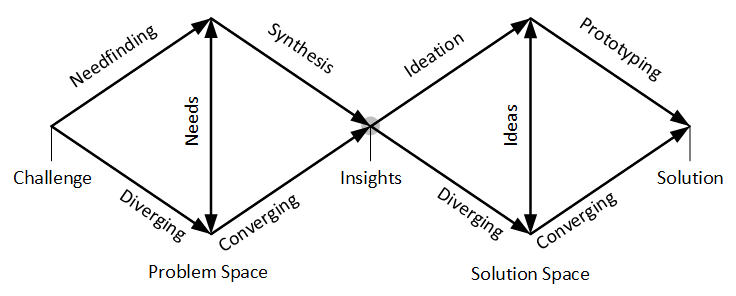
Borrowing from some aspects of Design Thinking, there is a double diamond design process model. I purloined one from the internet that will work for my purposes.

Double Diamond Design Process Model

I feel that I can simplify and assume that the diverging activity represents a right hemisphere strength whilst the converging is more apt to be a left hemisphere activity.

The right brain is not only always open to seeing options and opportunities, it actively seeks them. The left brain just wants to close any discussion and settle on a decision or an answer.

From an evolutionary perspective, the “raison d’être [of the right hemisphere] is to enable us to be on the lookout for potential predators, to form bonds with mates, and to understand, and interpret the living world around us” whilst the left hemisphere’s purpose “is to enable us to be effective predators.”

A right-hemisphere dominant person will likely continue to play what-if until the cows come home. A left-brain dominant person will take the first semi-viable solution and want to run on it. No need for deliberation. In a balanced scenario, the left and right hemispheres will battle for dominance, but they will arrive at a good-enough solution.

And this is where project managers enter the picture, and where I exit. I am decidedly over-indexed on the right brain. Among other things, I see options and possibilities. And, sure, I have enough balance to resolve to take action, but I don’t lose track of the possibilities and I am always ready to change course at a moment’s notice—what we call pivot in the business—or perish as the case might be.

The project manager, on the other hand, sees the map. This represents practically inviolable marching orders.

Disney Sorceror’s Apprentice Brooms-Flood Scene

One aspect of a good project manager is the ability to filter out the noise. Rather, this is what a right-brain person would surmise. Instead, the left-brain person doesn’t even register the noise. Where a right-brain person has to expend energy continually filtering out options and possibilities, the left-brain person never registers these options from the start. So, where I as a right-brain person may find it exhausting to actively and continuously limit this noise, this threshold is never triggered for the left-brainer.

In closing, I want to remind you again and again and again, that this is a gross oversimplification and rather metaphorical in nature. Nonetheless, I feel the that it is germane and offers insights into why some people are more apt at certain tasks than others.

I want to emphasise that one side is not better than the other. A right-dominant person is not superior to e left-dominant person, and vice versa. As with the brain itself, these can be complementary. Some people are very capable of tasking whichever hemisphere is necessary, but this is rarer than one might at first assume. McGilchrist provides many examples, so you can read them for yourself firsthand, or you can follow along as I call out key highlights in The Matter with Things.

If you have any comments or suggestions, feel free to leave them in the space provided.