American Exceptionalism

It’s sometimes difficult living in such a narcissistic place. I’ve lived in and out of the US, but I seemed to have settled here for now. I’ve lived on each coast, the Southwest, and the Midwest. I’ve visited all but four states—notably, Wyoming, Montana, and North & South Dakota, so you might recognise the trend.

Currently, I reside in Delaware, but my office is in Manhatten. As a consultant, I am most often wherever my client is. Combined, I’ve lived in LA for well over a decade, my earliest youth was spent in and around Boston. In my 20s in the 1980s, I spent my formative years in Los Angeles, the centre of the music industry at the time, where I was a recording engineer and musician. I had left my roots in Boston with various pitstops along the way to settle in LA, but I returned to Boston in the late ’80s to attend university and grad school. In Boston, I was married and then divorced, an event that gave me leave to return to Los Angeles, where I got married again and relocated to Chicago, where I spent over a decade as well. Divorced again, I relocated near Philadelphia for work and settled into rural northern, Delaware.

To the uninitiated, the US have two cosmopolitan cities, NYC and LA. By population, the third largest city, Chicago, is an oversized farm town. It qualifies as a city on the basis of population, and it’s not a bad place to be, but it lacks the cultural diversity and buzz of a NY or LA. There is none of that in Philadelphia and even less in Delaware.

Donut

The United States are like Australia. It’s ostensibly like a doughnut—empty in the middle, except to say the top and bottom don’t offer much either. So this is not to say that there aren’t valuable things, lessons, and people in these other areas, but by and large, even with the Internet and social media, they are still a decade and more behind.

When I lived in Japan—and I realise that I am coming off as some sort of culture snob—, I was taken aback at how far they seemed behind my frame of reference, having come from an affluent, white, East Coast, family. On one hand, their technology was off the charts and, owing to the exchange rate, it was cheap. Besides the exchange rate, the mark-up was enormous. Americans have no sense of value, and so as much as they exploit other countries, the last laugh is on them.

Americans are not some monolithic entity. There are many dimensions and divisions. To say Americans [fill in the blank] would be disingenuous. To listen to the politicians—especially the ones on the Right, and not just the fringe—you might be left thinking that American are all narcissistic assholes. In fact, this is the same cohort that leaves you feeling that the US have never left the Dark Ages with their religious superstitions.

Much of the country is actually in the 21st Century, but when you try to assess some average sentiment, this vocal minority makes it seem we live in perhaps the fifteenth century.

Roman General Lucius (John Cusack) — Dragon Blade Film

Even behind these anachronisms, there is still a sense of American exceptionalism—or perhaps there was a time that they were exceptional in some bout of nostalgia. You can cherry-pick some dimensions and claim to rank high on the scale but any exceptionalism only happens by adopting a frame. Many who come to the conclusion that the US are or were exceptional tend to fetishise Ancient Greece and Rome as well. In my opinion, it’s indoctrination, but there has to be more than this. There needs to be a certain gullibility gene that creates the propensity to believe these narratives. Without going off the rails, it might be fair to say that this genetic predisposition might have been the reason humans have evolved this far. I’d like to think it’s merely vestigial, but I’ll presume that this is only wishful thinking.

Americans, like most people, have a sense of identity, whether personal or to groups. And like the personae we project as individuals, we have myriad group personae as well. Perhaps there is already a term for this. If not, I’m not going to coin a term now.

Like individual identity, people defend their notion of group identity, and they tend to over-estimate. More than half of people consider themselves to be average or better than average in looks or intelligence and so on. Clearly, this defies statistics, but it is not merely an attempt to assuage some cognitive dissonance; you can come to a defensible position by picking some attributes that might excel (on some subjective aesthetic scale) and then overvaluing these attributes relative to the entire domain. Perhaps a person is taller than average and has been told s/he has beautiful eyes. It would be easy to discount other factors and place oneself in a higher rank due to these two factors. It works like this for national identity.

In the US, they will focus on some economic indicator, argue that it is important and captures broader coverage than it does, and then reference it as proof of exceptionalism. Meantime, the population is being indoctrinated into accepting this narrative, and much effort is spent trying to convince the larger world that this attribute is important.

In this MAGA Age of Make America Great Again, it’s helpful to remember that it never was and never will be great. And that’s OK. It’s also helpful to remember that the ‘good ole days’ are rarely as we remember them in the rearview mirror.
Fables of the Deconstruction

To some extent or another, humans appear to need order—some more than others. Societies are a manifestation of order, and we’ve got subcultures for those who don’t fit in with the mainstream. Humans are also a story-telling lot, which helps to provide a sense of order. Metanarratives are a sort of origin story with a scintilla of aspiration toward some imagined semblance of progress.

Some people appear to be more predisposed to need to ride this metanarrative as a lifeboat. These people are typically Conservative, authority-bound traditionalists, but even the so-called Progressives need this thread of identity. The problem seems to come down to a sort of tolerance versus intolerance split, a split along the same divide as created by monotheism in the presence of polytheism.

Meet the new boss, same as the old boss.

Won’t Get Fooled Again — The Who

In a polytheistic world, when two cultures collided, their religious pantheons were simply merged. In a blink, a society might go from 70 gods to 130. On this basis, there was a certain tolerance. Monotheism, on the other hand, is intolerant—a winner takes all death match. The tolerant polytheists might say, sure, you’ve got a god? Great. He can sit over there by the elephant dude. Being intolerant like a petulant schoolboy, the monotheists would throw a tantrum at the thought that there might be other gods on the block. Monotheists won’t even allow demigods, though there is the odd saint or two.

This is a battle between absolutism and relativism. The relativist is always in a weaker arguing position because intolerant absolutists are convinced that their way is the only way, yet the tolerant relativists are always at risk of being marginalised. This is what Karl Popper was addressing with the Paradox of Tolerance.

In a functioning society, a majority of the metanarratives are adopted by the majority of its constituent. On balance, these metanarratives are somewhat inviolable and more so by the inclined authoritarians.

A problem is created when a person or group disagrees with the held views. The ones espousing these views—especially the Traditionals—become indignant. What do you mean there are more than two genders? You are either male or female. Can’t you tell by the penis?

I happened to read a tweet by the GOP declaring their stupidity:

America the Stupid

The Vice President, a living anachronism and proxy for the American Midwest Rust Belt superimposed on the Bible Belt, he tells his sheep that “The moment America becomes a socialist country is the moment that America ceases to be America…” Americans as a whole are pretty dim, and it seems to get dimmer the higher one ascends their government. Pence seems very firm in affirming a notion of American identity, but not accepting that identities change. He may become upset if he finds out that George Washington is dead—in fact, there are very few remnants of the original United States aside from some dirt, trees, and a few edifices—and the country is still the county. Some people have a difficult time grasping identity. It makes me wonder if he fails to recognise himself in the mirror after he gets his hair cut.

The idea behind deconstruction is to deconstruct the workings of strong nation-states with powerful immigration policies, to deconstruct the rhetoric of nationalism, the politics of place, the metaphysics of native land and native tongue… The idea is to disarm the bombs… of identity that nation-states build to defend themselves against the stranger, against Jews and Arabs and immigrants…

Jacques Derrida

Interesting to me is how people complain about this and that politically. Most of this is somewhat reflexive and as phatic as a ‘how are you?’, but some is more intentional and actioned. Occasionally, the energy is kinetic instead of potential, but the result is always the same: One power structure is replaced by another.

What you aspire to as revolutionaries is a new master. You will get one

Jacques Lacan

As Lacan noted, as people, we believe ourselves to be democratic, but most of us appear to be finding and then worshipping some authority figures who will promise us what we desire. We desire to have someone else in charge, who can make everything OK, someone who is in a sense an ideal parent. I don’t believe this to be categorical, but I do believe that there is a large contingent of people who require this.

As an aside, I’ve spent a lot of time (let’s call it a social experiment) in the company of social reprobates. What never ceases to amaze me is how these social outcasts seem to have a strong sense of right and wrong and how things should be. Conveniently, they exempt themselves from this scope, so if they steel to buy drugs, it’s OK, but if someone else gets caught, they should get what’s coming to them.

About a year ago I was chatting with a mate, and I shared an observation that the biggest substance abusers in high school—”the Man’s not going hold me down” cohort—are the biggest conservatives. A girl a few houses down from me became a stripper, but her political views are very Conservative, an avid Trump supporter.

One woman I know is a herion-addicted prostitute. In her eyes, she’s fine (sort of—without getting into psychoanalytics); other women are junkie whores. A heavy dose of assuaged cognitive dissonance is the prescription for this, but it confounds me.

Getting back to the original topic, people who need this order are resistant to deconstruction and other hallmark notions of poststructuralism. They need closure. This translates into a need for metanarratives. When confronted with the prospect of no Truth, they immediately need to find a substitute—speculatively, anyway, as denial and escalating commitment will kick into overdrive.

The same problem mentioned above comes into play here. A few years ago, there was an Occupy Wall Street group, and like atheists, there are myriad reasons why people participated. One of the commonest complaints by the power structure and the public at large is if you don’t like the status quo, what status should replace it. None of the above was never an acceptable response.

It doesn’t matter that in this universe we occupy there is more disorder than order, and entropy rules, pareidolia is the palliative. And religion remains an opiate of the masses.


Please ignore my clear misappropriate of the classic R.E.M. album.

True Believer

I’m an unabashed atheist, a position I’ve defended since 5th grade when I refused to pledge allegiance* in class—primarily on account of the God clause, but I’ve never been a fan of fealty. It was difficult as at the time I was being raised a WASP in a town comprised of 70-odd per cent of Roman Catholics.

I’d wrestled with the concept for years, even taking a middle-ground agnostic position until I decided to get off the fence and pick a side. Dawkin’s God Delusion made it easier when he published his 7-point spectrum, stretching between an absolute believer to an absolute atheist. Here I was able to remain agnostic but defend the atheist notion as, say, a 6 of 7 on the scale—or 6.9999 as the case might be.

The spectrum of theistic probability is published on Wikipedia:

  1. Strong theist. 100% probability of God. In the words of C.G. Jung: “I do not believe, I know.”
  2. De facto theist. Very high probability but short of 100%. “I don’t know for certain, but I strongly believe in God and live my life on the assumption that he is there.”
  3. Leaning towards theism. Higher than 50% but not very high. “I am very uncertain, but I am inclined to believe in God.”
  4. Completely impartial. Exactly 50%. “God’s existence and non-existence are exactly equiprobable.”
  5. Leaning towards atheism. Lower than 50% but not very low. “I do not know whether God exists but I’m inclined to be sceptical.”
  6. De facto atheist. Very low probability, but short of zero. “I don’t know for certain but I think God is very improbable, and I live my life on the assumption that he is not there.”
  7. Strong atheist. “I know there is no God, with the same conviction as Jung knows there is one.”

I leave open there could be such a higher ‘energy’ or some such, but I feel the probability is pretty remote—something less than homoeopathic.

Unicorns are the new black

Allow me to sidestep the distinction between an atheist meaning not believing and an agnostic meaning not knowing. For the average person, this distinction is lost—sort of like the use of who versus whom or of fewer versus less at grocery checkout stations.

So why does an atheist care about religion enough to write about it? He doesn’t write about unicorns—except when discussing religion. Why can’t he just agree to individual religious freedom and leave it at that? And why does he refer to himself in third-person?

Religion…is the opiate of the masses

Karl Marx

Marx infamously wrote that religion is the opiate of the masses. He was correct, but religious belief is a cancer. It is not benign. Various people have exclaimed that ‘your right to swing your arm ends at my nose.’ Religion violates this sensibility and smacks you in the face.

Although moral sentiment a precedent to religion, religion is a crucible that codifies it. And like cancer, it spreads into the public sphere as law. I’ve written about the moral outrage of prostitution, and it seeps into legislation around abortion, adoption, and restroom usage. It’s not that one could not have developed these positions independently, but in the US these positions are highly correlated to religious beliefs.

It doesn’t much matter to me the causal direction of this relationship; the correlation is enough for me. I don’t want to say that all religious activity is harmful, but the basis of it is delusional. We consider psychiatric treatment for those with different delusions.

God is dead

Friedrich Nietzsche

And so my interest in religion is that I would prefer to pull it out by the roots. As Nietzsche notes, if God is dead, we don’t really have a suitable concept to keep society focused. The masses will go into withdrawal. Enlightenment Age Humanists tried to replace it with Natural Law and then some abstract notions that serve as philosophical mental masturbation, but society will not congeal around it, and so politicians prey on the delusional masses.

*The history of the US Pledge of Allegiance is fairly insidious.

Defending Democracy

2–3 minutes

Indeed, it has been said that democracy is the worst form of Government except for all those other forms that have been tried from time to time. 

Sir Winston Chirchill

I am not a defender of or apologist for Democracy. Any system is only as strong as its weakest link, but save for the rhetorical promises Democracy is nothing but weak links. Turtles all the way down. It’s another failed Enlightenment experiment. Sure, you can argue that the Ancient Greeks invented democracy—or at least implemented it at any scale—, but specious Enlightenment ideals pushed it forward into the mainstream.

The Achilles’ heel of Democracy is the principle-agent problem, the same one that separates management (CEOs) from owners (shareholders). Incentives are different.

Achilles’ Heel

Plato published his solution is Republic, but this proposal was naive at best. The notion that meritocracy is something real or that we can appropriately understand dimensions and measures in order to create the right incentives is another weak link.

Plato’s Republic

We see the same problem controlling elected officials. Time and again, we elect them, and time and again, they disappoint. We, the People, are the principles, and the elected are our agents. People in the US (and in so-called ‘democratic’ societies) have the vote, and yet—per the oft-cited definition of insanity—, they perform the same action and continue to expect different results; in fact; they are always surprised). At its core, it’s an incentive and accountability problem.

Kenneth Arrow wrote about the Impossibility Theorem, where he proved mathematically that no voting system would yield optimal results. Democracy is cursed with mediocrity. We like to soft-pedal the notion of mediocrity with the euphemism of compromise, another Ancient Greek legacy of moderation. If this makes you feel better, who am I to break the delusion? Cognitive dissonance is a powerful palliative.

μηδέν άγαν

Do Nothing in Excess, Delphic Oracle Inscription

Interestingly enough, many people clamour for term limits (a subversion of democracy) because they can’t help themselves from voting for the same shit politicians over and again. They rationalise it and say it is to defend against the other guy’s vote because they’d have never voted for shit representation.

This is often couched as ‘save me from myself’, but it is just as aptly cast as ‘save me from democracy’. I suppose a heroin addict might have the same thoughts.

Homo Hubris

2–3 minutes

I’ve been engaging in a bit of friendly dialogue countering a claim citing the demise of atheism with a mate (Neal Mack) at a blog named The scientific case against evolution, but I’ve decided to pose some points here so I can leverage some of my expended energy on my own content.

Although I don’t believe in the supernatural or metaphysical, I’ve got no dog in the race as to how others believe. Where I draw the line, though, is where religious doctrine seeps into the realm of political philosophy, jurisprudence, and governance because then it’s not about a ‘personal relationship’ with God. It’s about imposing that God upon me.

Parent scolding child

As the sayings go, if you feel abortion is wrong, then don’t have one; if you don’t approve of gay marriage, then don’t marry a same-sex partner; if you don’t believe that two (or more) adults should be able to engage in safe, sane, and consentual sexual acts, then don’t participate; if you don’t believe that a woman should be able to earn money from sex, then don’t pay her any; and on and on and on and on…


if you don’t approve of gay marriage, then don’t marry a same-sex partner

But don’t impose your sense of morality on me. Keep it to yourself. If it were up to me, I would prefer that there be no religion and no superstition outside of the domain of fiction. But a key reason that these things even work in fiction is the sense that they could be or might be true. It fits into the evolutionary psychology the got humans to where we are instead of withering and dying on the evolutionary vine. But give us time. Homo sapiens sapiens is a relatively young species, and they appear on course to extinguish themselves relatively soon anyway, making all of this moot. Perhaps a more fitting name would have been Homo hubris.

I’ll keep this post short, as I’ve got nothing new to add, and it’s getting late. If you’ve read my other posts, you’ll know that I am a non-cognitivist, and I don’t believe in any objective truth. I also understand—and as Nietzsche pointed out—the difficulty in forming a cohesive society without this orientation and supporting meta-narrative. Yet, this is not my problem.

Penetration Politics

Foucault (or Dworkin or Butler) may have had something to say about penetration politics—not the measure of electability in the professional political arena, rather the type that occurs in interpersonal sexual (or protosexual) relationships. 

Although different cultures treat this differently, at least in the West, there is a certain polarity between the penetrator and the penetrated, with the penetrator presumed to be dominant and the penetrated to be passive or submissive. I’ve not done any deep research—especially cross-culturally—but I’ll guess that this is more prevalent in patriarchal settings. Religion adds the element of shame and fetishises sex in the first place.

Before Greece

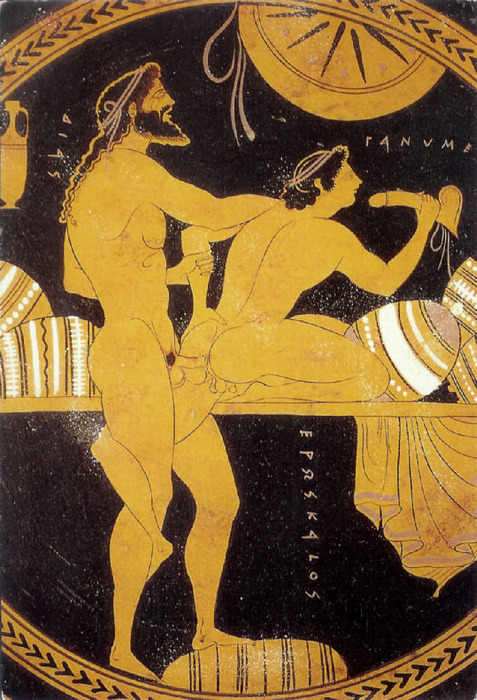
Even in Ancient Greece and some African cultures, same-sex penetration is allowed, but only when the penetrated is of a lower station, whether by age or class standing.

Greek Art

Anecdotally, female same-sex interaction is less of an issue than the male counterpart. I suggest that this is because of the penetration involved. It is also statistically speaking, the least risky. In BDSM parlance, there is a top and a bottom. The choice of these terms is not merely coincidental. And whilst they could represent the actors in physical space, they also relate to the power hierarchy.

Greek Pottery

We can also visit idiomatic speech—at least in English. Penetrative notions are most typically negative. I can’t think of any that are positive, so correct me if I am wrong.

‘I got fucked’ and ‘He fucked me’ are both terms of being taken advantage of. ‘I got screwed’ is the lighter version. ‘I got fucked in the ass’ ratchets it up a notch, perhaps. ‘Fuck you’ is not a term of endearment. I suppose I’ve heard people exclaim ‘fuck me’, but I don’t think one is supposed to reconcile that literally.

Boys will be boys

People we don’t like are cocksuckers. This one has always been a bit curious to me. It represents cocksuckers as some negative actor, but—as a fairly typical male—who doesn’t like a cock-sucker? How could this possibly be a negative? It’s because of the penetration. It’s yet another double standard. Most guys I know want to get their cock sucked and even enjoy it, but the sucker—that person is of a lower order; clearly a loathed order. Myself, I can’t use the term—at least not as a pejorative.

Sex seems to be a power play. Some people use sex as a weapon, either through teasing or withholding, which as I think about it are one and the same. If the receptor (allow me to stay with a heterosexual model for a while) gives in, the penetrator; if she doesn’t, she’s got the upper hand.

Greek Pederasty

Don’t get me wrong. In a functioning relationship, this is an activity of equals, but many relationships are dysfunctional on one level or another, and so it becomes a power struggle. He or she wants it less. One or the other party ‘gives in’ in order to remain in the relationship for some other reason, and so we are back to politics.

In the spirit of TMI (but hopefully not too too much ‘I’), my first wife hated doing dishes. Though I would have preferred not to wash them, I didn’t really care either way, so we alternated turns every other day. On her days, she’d offer a blowjob in exchange for my taking her turn. To me, it was a win-win proposition. Although I might have, I never viewed it as a power thing, though I did view it as transactional. Firstly, it was her idea; secondly, it seemed so consensual.

Unlearn Sexism

But where is the shame in sex? There is even shame in being seen nude in most circles. How did this happen? And why does there appear to be more shame in being penetrated? I’ll blame religion. It seems to be like a cancer that ruins everything it touches—like a reverse Midas touch.

Slut-shaming

I understand that in the past, sex could lead to death in childbirth or sexually transmitted diseases or infections, but with the widespread availability of barrier protection, this risk is substantially reduced. Think about this. What is the difference between a wife having (protected) sex with her husband each day for a year and a woman who has (consensual, protected) sex with different men each day of the same year? Ostensibly, nothing.

It’s not so much that the wife would advertise to the world that she had had sex each night—because sex is somehow shameful—, but if she let it slip that she and her husband had shagged the night before—or the past trend of nightly sex for a week—, there would be likely little more than a blush. For the unattached woman, there would likely be judgment and scorn. But this would be for no other reason than the taint of religious dogma.

The End

Meaningless

4–6 minutes

Whether in English or in French, I don’t believe Foucault ever uttered the words, ‘It is meaningless to speak in the name of – or against – Reason, Truth, or Knowledge‘*, but I don’t think he’d disagree with the sentiment.


“All my analyses are against the idea of universal necessities in human existence.”

Michel Foucault

Foucault was a postmodernist, and on balance, political Conservatives (Rightists?) dislike the notion of postmodernism. Evidently, a lot of Postmodernists are also Leftists (Progressives or Liberals in the US), so somehow critics such as Jordan Peterson conflate the two clearly distinct concepts.

A basis for Conservatism is the notion of an objective truth, and despite recent sociopolitical trends, they at least say they are guardians or truth and purveyors of knowledge. Conservatives (OK, so I am broad-brushing here) are staunch individualists who believe strongly in possession and property, of material, of an objective reality. Fundamentally, the are aligned to a monotheistic god or at least some discernible (and objective) moral compass.

On the Left, especially post-Enlightenment, they’ve substituted God with some anthropomorphic Nature. In fact, they find comfort in natural laws and human nature. Science is often their respite because science is objective. Isn’t it? Leftists are friends or Reason, and one can’t acquire enough knowledge. Moderation need not apply here; the more the merrier.

This being said, evidently, many on the Left seem to have abandoned this comfort zone. Of course, this may be because the Left-Right dichotomy doesn’t capture the inherent nuance, and so they were miscategorised—perhaps, much in the same manner as persons are miscategorised in a binary gender system. No. It must be something else.

In any case, both side claim to the parties of knowledge, reason, and truth because the opposing parties are clearly abject morons. There is no hint of irony in the situation where each side claims some objective notion of truth—whether divinely granted or self-evidently reasoned—, yet they can’t resolve what the true truth is. If only the other side were more rational.

By now, we are well aware of the demise of homo economicus, the hyper-rational actor foundational to modern economic theory. In reality, humans are only rational given the loosest definitions, say, to (in most cases) know enough to get in the shade on a 37.2°C day. However, as behavioural economist Dan Ariely noted by the title of his book, people are Predictably Irrational. Ariely is just standing on the shoulders of Kahneman and Tversky and Richard Thaler. My point is that humans are only marginally rational.

As I’ve written elsewhere, truth is nothing more than a rhetorical endpoint. It is hardly objective. It’s a matter of opinion. Unfortunately, systems of government and jurisprudence require this objective truth. In truth—see what I did there?—, social fabric requires a shared notion of truth.

A shared notion doesn’t imply that this notion is objective, but if it’s not objective, how does one resolve differences of opinion as to which is the better truth. Without establishing a frame and a lens, this is impossible. The problem is that frames and lenses are also relative. Whether the members accept a given frame or lens is also a matter of rhetoric. It’s turtles all the way down.

Turtles all the way down

Even if all members agree on all parameters of truth at day 0, there is nothing to prevent opinion changes or from new members not to share these parameters. Such is always the problem with social contract theory. [How does one commit to a contract s/he is born into with little recourse to rescind the contract, renegotiate terms, or choose a different contract option. The world is already carved up, and the best one can do is to jump from the frying pan into the fire.]

In the end, the notion of truth is necessary, but it doesn’t exist. Playing Devil’s advocate, let’s say that there is a single purveyor of Truth; let’s just say that it’s the monotheistic Abrahamic God of Judeo-Christian beliefs. There is no (known) way to ascertain that a human would have the privilege to know such a truth nor, if s/he were to encounter, say, a burning bush of some sort, that this entity would be conveying truth; so, we aren’t really in a better place. Of course, we could exercise faith and just believe, but this is a subjective action. We could also take Descarte’s line of logic and declare that a good God would not deceive us—sidestepping that this ethereal being was good, as advertised. I’m afraid it’s all dead ends here, too.

And so, we are back to where we started: no objective truth, limited ability to reason, and some fleeting notion of knowledge. We are still left with nothing.

Enter the likes of Jordan Peterson, he with his fanciful notion of metaphysics and morality—a channeller of Carl Jung. His tactic is to loud dog the listener and outshout them indignantly. His followers, already primed with a shared worldview, are adept (or inept) cheerleaders ready to uncritically echo his refrain. To them, his virtue-ethical base, steeped in consequentialism awash in deontology, Peterson speaks the truth.

He also potentiates the selfish anti-collective germ and rage of the declining white man. He’s sort of a less entertaining Howard Stern for the cleverer by half crowd. He gives a voice to the voiceless—or perhaps the thoughtless. He uses ‘reason’ to back his emotional pleas. He finds a voice in the wilderness where white Western males are the oppressed. If only they hadn’t been born centuries earlier—albeit with iPhones and microwaves.

Those would be the days.

* I believe this phrase attributed to Foucault was a paraphrase by philosopher Todd May.

Fate is a Woman

According to this article, The Fate of the Earth Depends on Women, women are our species’ last hope. The survival of the human species depends on wresting power from men, or so it says. But it’s more than that.

“The survival of the human species depends on women wresting power from men.”

To Michel Foucault, the crux of everything is power. Adopting his worldview, then, the problem isn’t whether men or women hold power; it’s power itself. For example, Margaret Thatcher may be single-handedly responsible for taking the Western World down into the abyss that is Conservativism or Neoliberalism, if you like. This, a woman, did this. I am not playing the Eve or Lileth blame game here, trying to vilify a woman. Sure, Ronald Reagan was the mouthpiece for putting her agenda on steroids, but it was she who primed the pump, though it was he who amplified the message.

And we’ve got warmongers like Hillary Clinton. Having a vagina doesn’t make you more responsible with power.

Absolute power corrupts absolutely.

Besides, absolute power corrupts absolutely. A woman would be fine, but there are at least three things at play in today’s world:

  1. The system is designed to select a certain type of participant.
  2. The system is designed to mould participants who somehow make it past the initial vetting.
  3. By and large, the women who participate play the power game similarly to the men.

Sure, there are some women who might do better, but there are also some men. This is not apologist rhetoric or mansplaining. This is to say that the solution is not in sex or gender; it’s in temperament. And it bears repeating: the system digests persons with this temperament and spits them out; at least it marginalises them. The game is rigged.

Talk About Choice, the Body & Consent

This post takes a different approach than the previous two videos. First, I am reversing the video content and my response, so the video content is quoted.

As I listened to the video, I was taken aback by how rife the content was with logical fallacies. In fact, this would be perfect fodder for an introductory Logic 101 class to evaluate for these fallacies. Although I do not call out these fallacies exhaustively, I do highlight some of them.

One common factor of prostitutes is the history of surviving emotional, physical or often sexual abuse and violence.

Given that these are undefined and unqualified, I am not sure that there is any woman who has never had any violence of some degree or another. I presume this should be further qualified that it is directed toward her. I’ll be perfectly frank: I have never dated a woman who has not been raped at least once in her lifetime, some had been several times, and several others had been molested as children. Only a couple of these had any connections to sex work of any form, so it is interesting that this a raised as a vector, first for the over-expansive domain and second without contrast to other women in a sort of control group fashion.

These previous aspects have been suggested to be even stronger than the factor of poverty.

Notice again the speaking in generalities. No facts are being asserted here. We are trapped in a telephone game, where hearsay and speculation dominate the held position. Somebody anonymous person somehow somewhere suggested that some relationship might exist. There is nothing there.

Some poor women will be prostitutes, and others will take underpaid or illegal jobs…

Duly noted. And some will graduate from college and become computer programmers. And so?

…but the ones opting for prostitution will have had a history of sexual violence.

Notice that no claim is being made that this violence is more or less frequent than the cohort not opting for prostitution.

That a middle-class girl may also find herself working as a prostitute because someone taught her that she was worthless.

Wow. So much to unpack here. The narrator, Elly, is asserting a parallel between prostitution and worthlessness. The implication is a person with worth would not choose this profession because she would choose a worthy profession. I wonder where and how this worth is determined.

…and the only thing of value she could do was to give sexual access to men.

So Elly, whether she admits it or not is deprecating women who choose this profession, but she tries to shroud it in language that she feels otherwise.

Now comes the psychobabble about trauma reenactment, as if it were a thing, and in a classic misdirect, she asserts that this is not even her own judgment; in fact, it is the analysis of these women who are clearly qualified to make a professional judgment of this nature in the realm of pseudoscience.

Anecodote: Women come to the conclusion that they’ve been abused their whole lives, so why not get paid for it.

Here is where I break to discuss post hoc ergo propter hoc fallacy or anecdotal evidence. Anecdotal evidence is frequently misinterpreted via the availability heuristic, which leads to an overestimation of the prevalence of an occurrence. This is a well-documented logical fallacy. This fallacy is employed when the person arguing has no real data to support their position, so they opt for personal stories, hearsay, and anecdotes. Related to this is confirmation bias, which is the result of, having established a position, only seek out facts that support the position even if these facts are outnumbered by contrary facts by orders of magnitude.

Such thinking is the basis behind anti-vaccination groups and homoeopathy advocates. The best these people can do is to point to themselves or a friend or a friend of a friend who benefited (or was disadvantaged) by some therapy or other action.

Bald assertion: We have a rape and paedophilia culture.

What is the basis for this claim, and what is the scope?

Media culture promotes the message be pretty, be fuckable, or be invisible

Here, we are in full agreement. The technical fallacy here is that for every 10 girls subjected to these messages, 1 becomes a prostitute. Yet even by conservative statistics, at least 1 in 5 women have been raped, 1 in 4 have been sexually abused. So the cause and effect don’t add up. In the US, about 14% of people are officially considered to in poverty.

In statistics, there is a concept of signal and noise. The problem is that understanding statistics is not natural for humans. It involves the analytical System II, in Daniel Kahneman‘s parlance, rather than the heuristic, System I.  A cognitive problem plaguing people is apophenia, where they read patterns into data that simply are not there. A form of this, called pareidolia, is how people see Jesus’ face in toast.

No body can stand beign penetrated to 10 to 30 male strangers every single day.

So the 10 to 20 customers a night I commented was unrealistic has now morphed into 10 to 30. It is somehow important to note that these are strangers, presumably as a nod to acknowledge that 30 acquaintances would be just fine because there would be enthusiastic consent and mutual arousal. Beware stranger danger.

If indeed prostitution is just a job like any other job, like, say, flipping burgers, then I would wager you would have absolutely no issue switching jobs with a prostituted person for one day and let it be your anus that’s penetrated in the state of non-arousal by 15 men during one night.

O! Europa. Firstly, I wouldn’t trade my jobs to flip burgers let alone be a prostitute. Secondly, there are scores upon scores of ‘typical’ jobs I would have no interest in switching into. Nor would I presume that many others could actually do my job in any case. Why would someone presume that the punter wouldn’t notice the old switcharoo? And what’s with the anal penetration. Some prostitutes will ‘do’ anal for an up-charge, but many—perhaps even most—prostitutes won’t even accept anal at any price. This is about boundaries.

And someone seems pretty obsessed with the prospect of being penetrated by 15 men. I’d chalk this up to a power struggle, a foray into the world of penetration politics. Even gay men discriminate between top and bottom, so it’s rather a submission thing rather than a female thing.

Prostitution is incompatible with enthusiastic sexual consent

Elly runs through a bizarre strawman scenario that is too silly to even repeat here, and then she returns to some Disney Princess fantasy world of wooing and requited love.

She (sort of) acknowledges (without saying as much) that there is a distinction between economic and social spheres. I’d suggest reviewing the Isreali daycare study, where they learned that lesson the hard way. This does not mean that some people don’t blend the two spheres. It also doesn’t mean that a woman might not put out for a hamburger but might be persuaded by steak.

Anecdotally, I am aware of some women who say they would have sex with their favourite celebrity—if only he would ask.

In the end, this has become more and more disappointing. As so much of this material are vast generalisations and practically at the level of conspiracy theories, there is not even a debate to be had. There are so many technical flaws, I feel I need to pull a yellow card. There is nothing to push against except for the lack of structure or method. It’s all so nebulous. It’s all so quixotic, tilting at windmills.

To be honest, I don’t see how this would convert someone on the fence, let alone an opponent. This material is pretty much relegated to echo-chamber choir preaching.

I think I need to get back to the topic of subjectivism and out of the weeds of activist politics.