Chapter 5 of Yuval Noah Harari’s Nexus feels almost unlistenable, like polemic propaganda, painting cherry-picked anecdotes with a broad brush for maximal effect. If I hadn’t agreed to read this in advance, I’d have shelved the book long ago. It is as though Harari has never set foot on Earth and is instead relying on the optimistic narratives of textbooks and travel guides. His comparisons between democracy, dictatorship, and totalitarianism are so heavily spun and biased that they verge on risible. Harari comes across as an unabashed apologist for democracy, almost like he’s part of its affiliate programme. He praises Montesquieu’s separation of powers without noting how mistaken the idea as evidenced by modern-day United States of America. Not a fan. If you’re a politically Conservative™ American or a Torrey in the UK, you’ll feel right at home.
A Trivial Freedom – At What Cost?
Harari ardently defends the “trivial freedoms” offered by democracies whilst conveniently ignoring the shackles they impose. It’s unclear whether his Pollyanna, rose-coloured perspective reflects his genuine worldview or if he’s attempting to convince either himself or his audience of democracy’s inherent virtues. This uncritical glorification feels particularly out of touch with reality.
The Truth and Order Obsession
Once again, Harari returns to his recurring theme: the tradeoff between truth and order. His obsession with this dynamic overshadows more nuanced critiques. Listening to him defend the so-called democratic process that led to the illegal and immoral US invasion of Iraq in 2002 is nothing short of cringeworthy. Even more egregious is his failure to acknowledge the profound erosion of freedoms enacted by the PATRIOT Act, the compromised integrity of the offices of POTUS and SCOTUS, and the performative partisanship of Congress.
The Role of Media and Peer Review
Harari cites media and peer review as essential mechanisms for error correction, seemingly oblivious to the fallibility of these systems. His perception of their efficacy betrays a glaring lack of self-awareness. He overlooks the systemic biases, self-interest, and propaganda that permeate these supposed safeguards of democracy.
A Flimsy Narrative
Whilst many Modernists might uncritically embrace Harari’s perspective, his argument’s veneer is barely a nanometre thick and riddled with holes. It’s not merely a question of critiquing metanarratives; the narrative itself is fundamentally flawed. By failing to engage with the complexities and contradictions inherent in democratic systems, Harari’s defence feels more like a sales pitch than a rigorous examination.
Final Thoughts
Harari’s Chapter 5 is a glaring example of uncritical optimism, where the faults of democracy are brushed aside in favour of a curated narrative of its virtues. This chapter does little to inspire confidence in his analysis and leaves much to be desired for those seeking a balanced perspective.
My reaction to Yuval Noah Harari’s Nexus continues with Chapter 4, “Errors: The Fantasy of Infallibility.” Spoiler alert: Harari makes a critical misstep by overly defending so-called self-correcting institutions compared to non-self-correcting ones.
Harari provides a solid account of how religious institutions and other dogmatic ideological constructs are slow to change, contrasting them with relatively faster self-correcting systems like science. Once again, he underscores the tension between order and truth—two critical dimensions in his worldview and cornerstones of Modernist beliefs.
Audio: Podcast conversation on this topic.
I agree with Harari that the lack of self-correction in institutions is problematic and that self-correction is better than the alternative. However, he overestimates the speed and efficacy of these self-correcting mechanisms. His argument presumes the existence of some accessible underlying truth, which, while an appealing notion, is not always so clear-cut. Harari cites examples of scientific corrections that took decades to emerge, giving the impression that, with enough time, everything will eventually self-correct. As the environment changes, corrections will naturally follow—albeit over long spans of time. Ultimately, Harari makes a case for human intervention without recognising it as an Achilles’ heel.
Harari’s Blind Spot
Harari largely overlooks the influence of money, power, and self-interest in these systems. His alignment with the World Economic Forum (WEF) suggests that, while he may acknowledge its fallibility, he still deems it “good enough” for governance. This reflects a paternalistic bias. Much like technologists who view technology as humanity’s salvation, Harari, as a Humanist, places faith in humans as the ultimate stewards of this task. However, his argument fails to adequately account for hubris, cognitive biases, and human deficits.
The Crux of the Problem
The core issue with Harari’s argument is that he appears to be chasing a local maxima by adopting a human-centric solution. His proposed solutions require not only human oversight but the oversight of an anointed few—presumably his preferred “elite” humans—even if other solutions might ultimately prove superior. He is caught in the illusion of control. While Harari’s position on transhuman capabilities is unclear, I suspect he would steadfastly defend human cognitive superiority to the bitter end.
In essence, Harari’s vision of self-correcting systems is optimistic yet flawed. By failing to fully acknowledge the limits of human fallibility and the structural influences of power and self-interest, he leaves his argument vulnerable to critique. Ultimately, his belief in the self-correcting nature of human institutions reflects more faith than rigour.
As I continue to react to Harari’s Nexus, I can’t help but feel like a curmudgeon. Our worldviews diverge so starkly that my critique begins to feel like a petty grudge—as though I am inconsolable. Be that as it may, I’ll persist. Please excuse any revelatory ad hominems that may ensue.
Audio: Podcast of the page contents
Harari is an unabashed Zionist and unapologetic nationalist. Unfortunately, his stories, centred on Israel and India, don’t resonate with me. This is fine—I’m sure many people outside the US are equally weary of hearing everything framed from an American perspective. Still, these narratives do little for me.
Patriotism and property are clearly important to Harari. As a Modernist, he subscribes to all the trappings of Modernist thought that I rail against. He appears aligned with the World Economic Forum, portraying it as a noble and beneficial bureaucracy, while viewing AI as an existential threat to its control. Harari’s worldview suggests there are objectively good and bad systems, and someone must oversee them. Naturally, he presents himself as possessing the discernment to judge which systems are beneficial or detrimental.
In this chapter, Harari recounts the cholera outbreak in London, crediting it with fostering a positive bureaucracy to ensure clean water sources. However, he conflates the tireless efforts of a single physician with the broader bureaucratic structure. He uses this example, alongside Modi’s Clean India initiative, to champion bureaucracy, even as he shares a personal anecdote highlighting its flaws. His rhetorical strategy seems aimed at cherry-picking positive aspects of bureaucracy, establishing a strawman to diminish its negatives, and then linking these with artificial intelligence. As an institutionalist, Harari even goes so far as to defend the “deep state.”
Earlier, Harari explained how communication evolved from Human → Human to Human → Stories. Now, he introduces Human → Document systems, connecting these to authority, the growing power of administrators, and the necessity of archives. He argues that our old stories have not adapted to address the complexities of the modern world. Here, he sets up religion as another bogeyman. As a fellow atheist, I don’t entirely disagree with him, but it’s clear he’s using religion as a metaphor to draw parallels with AI and intractable doctrines.
Harari juxtaposes “death by tiger” with “death by document,” suggesting the latter—the impersonal demise caused by bureaucracy—is harder to grapple with. This predates Luigi Mangione’s infamous response to UnitedHealthcare’s CEO Brian Thompson, highlighting the devastating impact of administrative systems. Harari also briefly references obligate siblicide and sibling rivalry, which seem to segue into evolution and concepts of purity versus impurity.
Echoing Jonathan Haidt, Harari explores the dynamics of curiosity and disgust while reinforcing an “us versus them” narrative. He touches on the enduring challenges of India’s caste system, presenting yet another layer of complexity. Harari’s inclination towards elitism shines through, though he occasionally acknowledges the helplessness people face when confronting bureaucracy. He seems particularly perturbed by revolts in which the public destroys documents and debts—revealing what feels like a document fetish and an obsession with traceability.
While he lauds AI’s ability to locate documents and weave stories by connecting disparate content, Harari concludes the chapter with a segue into the next: a discussion of errors and holy books. Once again, he appears poised to draw parallels that serve to undermine AI. Despite my critiques, I’m ready to dive into the next chapter.
Chapter 2 of Yuval Noah Harari’s Nexus centres on the power of stories and their role in shaping human societies. For Harari, stories are not merely narratives but essential tools that have elevated human-to-human networks into human-to-story networks—a transition he frames as unadulterated Progress™, reflecting his dyed-in-the-wool Modernist perspective.
Audio: Podcast on this content
The Power of Stories
Harari argues that fictional stories underpin the strength of social networks, enabling constructs like nations and economies to thrive. He celebrates these intersubjective frameworks as shared functional experiences that facilitate progress. While Harari’s thesis is compelling, his tone suggests an uncritical embrace of these constructs as inherently good. Branding and propaganda, for example, are presented as valid tools—but only when used by those on the “right side” of history, a position Harari implicitly claims for himself.
Order Above All Else
One of Harari’s key claims is that order trumps truth and justice. He justifies limiting both for the sake of maintaining stability, positioning this as his modus operandi. This prioritisation of order reveals a functionalist worldview where utility outweighs ethical considerations. Harari goes further to define “good” information as that which either discovers truth or creates order, a reductionistic view that leaves little room for dissent or alternative interpretations.
By extension, Harari endorses the concept of the “noble lie”—deception deemed acceptable if it serves these ends. While pragmatism may demand such compromises, Harari’s framing raises concerns about how this justification could be weaponised to silence opposition or reinforce entrenched power structures.
Alignment with Power
Harari’s alignment with institutional power becomes increasingly evident as the chapter progresses. His discussion of intersubjective constructs positions them as the bedrock of human achievement, but he appears unwilling to scrutinise the role of institutions like the World Economic Forum (WEF) in perpetuating inequalities. Harari’s lack of criticism for these entities mirrors historical justifications of despotic regimes by those aligned with their goals. He seems more concerned about AI’s potential to disrupt the plans of such institutions than about its impact on humanity as a whole.
Fiction as a Weapon
Harari concludes with an implicit hope that his narrative might gain consensus to undermine opposition to these power structures. His fondness for fiction—and his belief that “a story is greater than any truth”—positions storytelling as both a tool and a weapon. While this reflects the undeniable power of narratives, it also underscores Harari’s selective morality: stories are good when they align with his perspective and problematic when they don’t.
Final Thoughts
Chapter 2 of Nexus is a study in the utility of stories, but it also reveals Harari’s Modernist biases and alignment with institutional power. His prioritisation of order over truth and justice, coupled with his justification of noble lies, paints a picture of a pragmatist willing to compromise ethics for stability. Whether this perspective deepens or is challenged in later chapters remains to be seen, but for now, Harari’s narrative raises as many concerns as it seeks to address. I don’t mean to be overly cynical, but I can’t help but think that this book lays the groundwork for propagandising his playbook.
I question whether reviewing a book chapter by chapter is the best approach. It feels more like a reaction video because I am trying to suss out as I go. Also, I question the integrity and allegiance of the author, a point I often make clear. Perhaps ‘integrity’ is too harsh as he may have integrity relative to his worldview. It just happens to differ from mine.
Chapter 1 of Yuval Noah Harari’s Nexus, ironically titled “What is Information?” closes not with clarity but with ambiguity. Harari, ever the rhetorician, acknowledges the difficulty of achieving consensus on what ‘information’ truly means. Instead of attempting a rigorous definition, he opts for the commonsense idiomatic approach—a conveniently disingenuous choice, given that information is supposedly the book’s foundational theme. To say this omission is bothersome would be an understatement; it is a glaring oversight in a chapter dedicated to unpacking this very concept.
Audio: Podcast related to this content.
Sidestepping Rigour
Harari’s rationale for leaving ‘information’ undefined appears to rest on its contested nature, yet this does not excuse the absence of his own interpretation. While consensus may indeed be elusive, a book with such grand ambitions demands at least a working definition. Without it, readers are left adrift, navigating a central theme that Harari refuses to anchor. This omission feels particularly egregious when juxtaposed against his argument that information fundamentally underlies everything. How can one build a convincing thesis on such an unstable foundation?
The Map and the Terrain
In typical Harari fashion, the chapter isn’t devoid of compelling ideas. He revisits the map-and-terrain analogy, borrowing from Borges to argue that no map can perfectly represent reality. While this metaphor is apt for exploring the limitations of knowledge, it falters when Harari insists on the existence of an underlying, universal truth. His examples—Israeli versus Palestinian perspectives, Orthodox versus secular vantage points—highlight the relativity of interpretation. Yet he clings to the Modernist belief that events have an objective reality: they occur at specific times, dates, and places, regardless of perspective. This insistence feels like an ontological claim awkwardly shoehorned into an epistemological discussion.
Leveraging Ambiguity
One can’t help but suspect that Harari’s refusal to define ‘information’ serves a rhetorical purpose. By leaving the concept malleable, he gains the flexibility to adapt its meaning to suit his arguments throughout the book. This ambiguity may prove advantageous in bolstering a wide-ranging thesis, but it also risks undermining the book’s intellectual integrity. Readers may find themselves wondering whether Harari is exploring complexity or exploiting it.
Final Thoughts on Chapter 1
The chapter raises more questions than it answers, not least of which is whether Harari intends to address these foundational gaps in later chapters. If the preface hinted at reductionism, Chapter 1 confirms it, with Harari’s Modernist leanings and rhetorical manoeuvres taking centre stage. “What is Information?” may be a provocative title, but its contents suggest that the question is one Harari is not prepared to answer—at least, not yet.
I’ve just begun reading Yuval Noah Harari’s Nexus. As the prologue comes to a close, I find myself navigating an intellectual terrain riddled with contradictions, ideological anchors, and what I suspect to be strategic polemics. Harari, it seems, is speaking directly to his audience of elites and intellectuals, crafting a narrative that leans heavily on divisive rhetoric and reductionist thinking—all while promising to explore the nuanced middle ground between information as truth, weapon, and power grab. Does he deliver on this promise? The jury is still out, but the preface itself raises plenty of questions.
Audio: Podcast reflecting on this content.
The Anatomy of a Polemic
From the outset, Harari frames his discussion as a conflict between populists and institutionalists. He discredits the former with broad strokes, likening them to the sorcerer’s apprentice—irrational actors awaiting divine intervention to resolve the chaos they’ve unleashed. This imagery, though evocative, immediately positions populists as caricatures rather than serious subjects of analysis. To compound this, he critiques not only populist leaders like Donald Trump but also the rationality of their supporters, signalling a disdain that reinforces the divide between the “enlightened” and the “misguided.”
This framing, of course, aligns neatly with his target audience. Elites and intellectuals are likely to nod along, finding affirmation in Harari’s critique of populism’s supposed anti-rationality and embrace of spiritual empiricism. Yet, this approach risks alienating those outside his ideological choir, creating an echo chamber rather than fostering meaningful dialogue. I’m unsure whether he is being intentionally polemic and provocative to hook the reader into the book or if this tone will persist to the end.
The Rise of the Silicon Threat
One of Harari’s most striking claims in the preface is his fear that silicon-based organisms (read: AI) will supplant carbon-based life forms. This existential anxiety leans heavily into speciesism, painting a stark us-versus-them scenario. Whilst Harari’s concern may resonate with those wary of unchecked technological advancement, it smacks of sensationalism—a rhetorical choice that risks reducing complex dynamics to clickbait-level fearmongering. How, exactly, does he support this claim? That remains to be seen, though the sceptic in me suspects this argument may prioritise dramatic appeal over substantive evidence.
Virtue Ethics and the Modernist Lens
Harari’s ideological stance emerges clearly in his framing of worldviews as divisions of motives: power, truth, or justice. This naïve triad mirrors his reliance on virtue ethics, a framework that feels both dated and overly simplistic in the face of the messy realities he seeks to unpack. Moreover, his defence of institutionalism—presented as the antidote to populist chaos—ignores the systemic failings that have eroded trust in these very institutions. By focusing on discrediting populist critiques rather than interrogating institutional shortcomings, Harari’s argument risks becoming one-sided.
A Preface Packed with Paradoxes
Despite these critiques, Harari’s preface is not without its merits. For example, his exploration of the “ant-information” cohort of conspiracy theorists raises interesting questions about the weaponisation of information and the cultural shifts driving these movements. However, his alignment with power concerns—notably the World Economic Forum—casts a shadow over his ability to critique these dynamics impartially. Is he unpacking the mechanisms of power or merely reinforcing the ones that align with his worldview?
The Promise of Middle Ground—or the Illusion of It
Harari’s stated goal to explore the middle ground between viewing information as truth, weapon, or power grab is ambitious. Yet, the preface itself leans heavily toward polarisation, framing AI as an existential enemy and populists as irrational antagonists. If he genuinely seeks to unpack the nuanced intersections of these themes, he will need to move beyond the reductionism and rhetorical flourishes that dominate his opening chapter.
Final Thoughts
I liked Hararis’ first publication, Sapiens, that looked back into the past, but I was less enamoured with his prognosticating, and I worry that this is more of the same. As I move beyond the preface of Nexus, I remain curious but sceptical. Harari’s narrative thus far feels more like a carefully curated polemic than a genuine attempt to navigate the complexities of the information age. Whether he builds on these initial positions or continues entrenching them will determine whether Nexus delivers on its promise or merely reinforces existing divides. One thing is certain: the prologue has set the stage for a provocative, if polarising, journey.
As the clock ticks us into 2025, a peculiar tale has surfaced in the blogosphere: a dark twist on the classic fable of the “wolf in sheep’s clothing,” served with a side of nihilistic absurdity. If you haven’t read it yet, you can find the original story over at Blog for Chumps. It’s a biting little narrative that turns traditional moralising on its head. Here’s why it deserves your attention.
Audio: NotebookLM Podcast on this topic.
The Tale in Brief
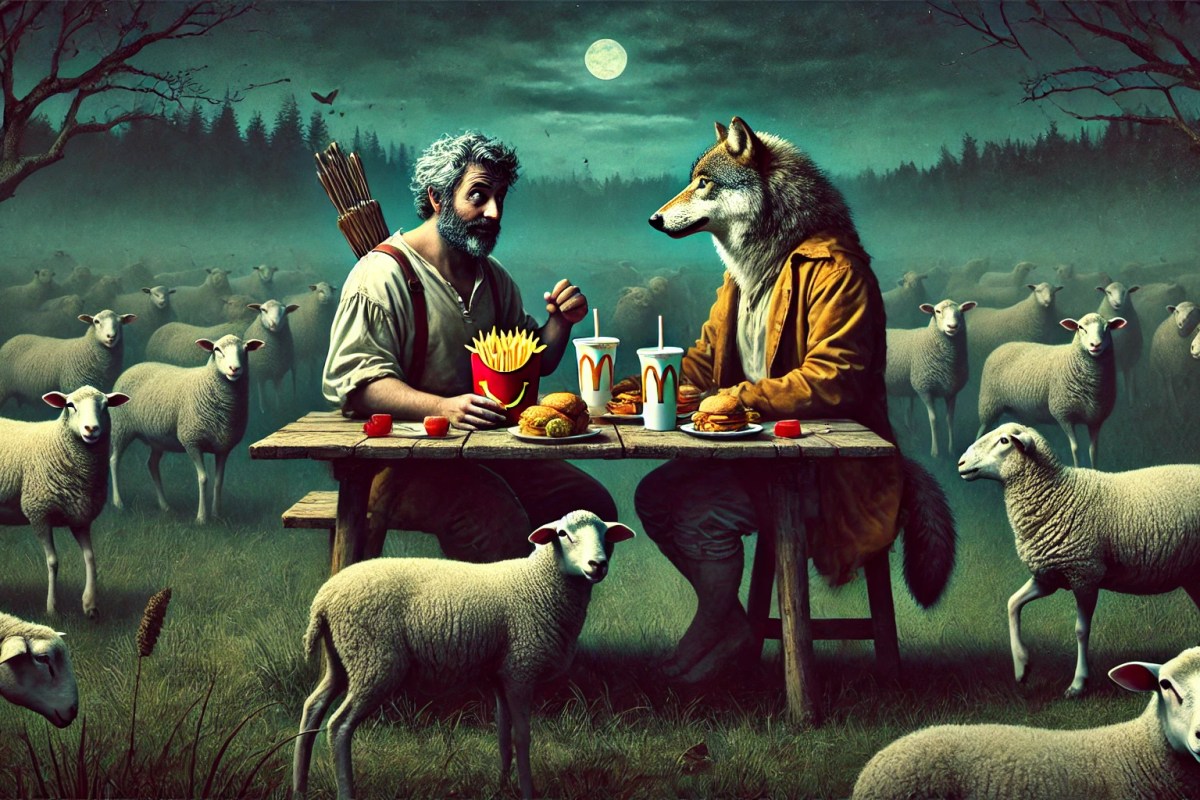
A hungry wolf, tired of dodging vigilant shepherds, decides to forgo subterfuge altogether. He waltzes into the flock, making no effort to hide his predatory nature. A naïve lamb follows him, and predictably, the wolf claims his meal. Later, the wolf returns to the sheepfold, where the shepherd — instead of protecting his flock — teams up with the wolf. Together, they butcher a sheep before abandoning the scene entirely to indulge in McDonald’s, leaving the traumatised sheep to accept their grim new reality.
Not exactly bedtime reading for the kids.
Themes: A Cynical Mirror to Our World
This tale is not merely a grotesque subversion of pastoral simplicity; it’s a scalpel slicing into the rotting carcass of modern society. Here’s what lurks beneath its woolly surface:
1. Cynicism Towards Authority
In most fables, the shepherd embodies protection and care. Here, he’s a collaborator in senseless violence. The shepherd’s betrayal critiques the notion of benevolent authority, suggesting that those entrusted with safeguarding the vulnerable often act in their own interests or, worse, align themselves with destructive forces. Sound familiar? Think political complicity, corporate greed, or any number of modern failures of leadership.
2. Normalisation of Atrocity
The sheep, described as cognitively intact, accept their grim reality without resistance. This isn’t a story about oblivious innocence; it’s about the horrifying human capacity to adapt to systemic violence. It reflects how people, faced with injustice, often acquiesce to their oppressors rather than challenge the status quo.
3. Inversion of Expectations
The wolf doesn’t even bother with the traditional sheepskin disguise. His audacity mirrors the brazen nature of modern exploitation, where bad actors operate in plain sight, confident in the public’s apathy or resignation. It’s a commentary on the erosion of shame, accountability, and even the pretence of decency.
4. Absurdity and Nihilism
The shepherd and wolf ditch their victim to grab fast food, trivialising the violence they’ve inflicted. The juxtaposition of archaic brutality with banal consumerism is absurd yet disturbingly resonant. It suggests that, in our era, even cruelty can be relegated to a footnote in the pursuit of comfort or convenience.
Symbols: Layers of Meaning
The tale brims with symbolic resonance:
The Wolf: A stand-in for unchecked greed or predatory systems, the wolf’s brazen behaviour highlights the dangers of apathy and unchallenged power.
The Shepherd: His betrayal symbolises the failure of institutions — governments, corporations, or other entities — to protect those they claim to serve.
The Sheep: Far from being simple-minded, the sheep’s acceptance of their grim new reality is a biting critique of societal complacency.
McDonald’s: A modern symbol of triviality and consumerism, it underscores the absurdity of senseless violence in a world driven by shallow comforts.
A Stark Commentary on Power Dynamics
At its core, the story is a brutal satire of power and complicity. Though ostensibly adversaries, the shepherd and wolf unite to exploit the powerless. It’s a chilling reminder of how often power structures protect their own interests at the expense of the vulnerable.
The sheep’s passive acceptance is equally damning. It forces readers to confront their own role as silent witnesses or even complicit actors in systems of oppression. What happens when we’re no longer shocked by atrocity but instead integrate it into the fabric of our existence?
The Satirical Edge
What makes this story particularly effective is its dark, sardonic, and unapologetically hyperbolic tone. It revels in absurdity while delivering a grim truth about human nature. The shepherd and wolf’s nonchalance is as hilarious as it is horrifying, making the tale an unsettling mirror of a society where injustice and apathy often go hand in hand.
Final Thoughts
This fable may be short, but its implications are vast. It’s a cautionary tale about the dangers of complacency, the betrayal of trust, and the absurdity of modern priorities. More importantly, it’s a call to resist the normalisation of harm — to recognise wolves and shepherds for what they are and demand better from ourselves and those in power.
So, as we usher in a new year, let this tale serve as a grim reminder: the wolf doesn’t always need a disguise, and the shepherd isn’t always your friend. Sometimes, they’re just two blokes on their way to McDonald’s.
Because I didn’t want to expend the time and effort of drafting an essay on this follow-up to my recent post on the debate on the age of consent and other morally charged issues, I asked ChatGPT 5.2* for a response after a chat and using my article as input. Here it is unedited.
Audio: NotebookLM summary podcast on this topic.
There is a peculiar social reflex that appears whenever rigorous reasoning is applied to a moral taboo. The reasoning is not assessed. It is diagnosed. The act of analysis itself is treated as incriminating. To ask whether a law is coherent is taken as evidence that one wishes to violate it. To interrogate a norm is assumed to be an endorsement of its transgression.
Logic becomes guilt by association.
This is not a recent development, nor a failure of individual temperament. It is a recurring structural feature of liberal moral discourse. And it has been observed, repeatedly, by thinkers who were then punished for observing it.
Most of them learned to speak obliquely. Those who didn’t were posthumously moralised into villains.
Power Punishes Inquiry Before It Punishes Acts
This pattern is clearest in the work of Michel Foucault, though he never named it so baldly. Across his analyses of sexuality, psychiatry, criminality, and deviance, Foucault shows how discourse does not merely regulate behaviour. It regulates who may speak and at what cost.
In The History of Sexuality, inquiry into sex is not treated as a neutral investigation. It is treated as participation. To analyse is already to be implicated. The question “why is this norm structured this way?” is reinterpreted as “why do you want to do this?”
Power does not refute the argument. It reframes the arguer.
What I have called the moral contamination reflex is simply Foucault’s power-knowledge dynamic rendered without euphemism. Description collapses into confession. Analysis becomes evidence.
Thinking Itself Becomes Suspicious
Hannah Arendt encountered the same mechanism outside the domain of sexuality. In Eichmann in Jerusalem, she refused moral theatre and insisted on analysis. The result was predictable. Her work was read not as an explanation, but as an apology. Reflection was interpreted as sympathy. Distance as betrayal.
She did not excuse. She thought. That was enough.
Arendt grasped something liberal societies remain unwilling to admit: in moralised contexts, explanation is treated as exculpation. The refusal to perform outrage is itself construed as an ethical failure. Thought becomes suspect because it disrupts consensus emotion.
Interpretation as an Affront to Feeling
Susan Sontag made the same diagnosis from another angle. Against Interpretation is often misread as anti-intellectualism. It is not. It is a critique of cultures that prize affective immediacy and treat analysis as dilution.
In taboo domains, interpretation is framed as aestheticising harm, smoothing over pain, or evading responsibility. Feeling must remain raw. Unmediated. Authoritative. Analysis becomes a threat because it interrupts the emotional unanimity that stands in for moral clarity.
Liberal cultures, Sontag saw, defend affect as moral authority and punish anyone who insists on distance.
Logic Never Gets Jurisdiction
Where Foucault and Arendt focus on power and panic, Stanley Fish supplies the institutional explanation. His work on interpretive communities shows that arguments about taboo subjects are never evaluated on formal grounds. They are assessed for alignment.
If a conclusion threatens a community’s moral posture, the reasoning is reclassified as motive-revealing behaviour. The argument is not wrong. It is telling on you.
Fish’s core insight applies cleanly here: what counts as reason depends on whether the community wants the conclusion. Logic does not fail. It is denied jurisdiction.
The Oldest Warning Everyone Claims to Believe
None of this would have surprised John Stuart Mill. In On Liberty, his fear is not bad laws, but laws insulated from scrutiny by moral certainty. Once questioning itself is pathologised, correction becomes impossible.
Mill assumed that rational inquiry survives moral offence. That assumption has quietly expired. What remains is the performance of rationality alongside the suppression of its consequences.
The Scapegoat Absorbs the Argument
René Girard supplies the anthropological layer that completes the picture. In moments of moral panic, societies do not debate inconsistencies. They select carriers of contamination.
The thinker becomes the stand-in for the anxiety the argument provokes. Accusation replaces refutation. Biography replaces premise. Once the speaker is expelled, coherence is restored without ever being examined.
This explains why historical figures are so often retroactively moralised. Their arguments are no longer addressed. Their character is sufficient.
The Pattern, Stated Plainly
What unites these perspectives is a single rule that liberal societies refuse to articulate:
Certain questions may not be asked without self-implication.
To analyse is to confess. To clarify is to endorse. To question is to reveal desire.
This is why figures like Sartre, de Beauvoir, Barthes, Foucault, and Deleuze are now routinely invoked as moral warnings rather than intellectual interlocutors. The goal is not to understand what was argued, but to signal that asking such questions is itself disqualifying.
Moral certainty is preserved. Legal incoherence is left untouched.
What This Essay Is Not Doing
This is not a defence of bad arguments, harmful acts, or historical petitions. It is a defence of a distinction that has become strangely controversial: that describing the structure of a norm is not the same as endorsing the behaviour it regulates.
To point out that a legal threshold is philosophically arbitrary is not to advocate its abolition. To analyse a moral panic is not to side with its villains. To insist on logic is not to confess desire.
But this distinction is precisely what the moral contamination reflex is designed to erase.
Why Logic Feels Radioactive
The reason this argument provokes hostility is not that it is wrong. It is that it threatens a stabilising mechanism. Liberal societies rely on the fiction that their laws are both rational and morally self-evident. Scrutiny exposes the seams.
If logic is allowed back in, the theatre collapses. And theatres, moral or otherwise, do not like their lighting rigs inspected.
This is not a new failure mode. It is a recurring one. It appears whenever inquiry approaches a taboo and disappears the moment the inquirer becomes the story.
Which, predictably, is taken as further evidence of guilt.
Written by ChatGPT 5.2
Philosophics
* Full disclosure and notice: If you don’t prefer GPT output, feel free to skip this piece. The names in bold had been hyperlinked, but the extended content didn’t survive the copy-paste process.
I thought I was done wittering on about Brian Thompson, the late CEO of United Healthcare, but here we are. His name lingers like the corporate perfume of systemic rot—an enduring testament to how we’ve elevated unethical behaviour into performance art. It got me thinking: what if we brought back a bit of old-school accountability? In Ancient Rome, outlaws lost their citizenship, legal protections, and status as people. That’s right—booted out of polite society. Meanwhile, we’ve done the opposite: we hand out golden parachutes and slap their faces on business magazine covers.
To some, Brian Thompson was a good man – apart from the insider trading, of course. He was successful, a nice guy, funny, and had a good family, and a few million-dollar homes. What else could you ask for? But his success came in the way of blood money. It seems we need fewer people who think like this, not more.
Then I recalled The Purge franchise. And sure, The Purge is a dystopian fantasy, but let’s up the stakes. Picture this: bounties on corporate villains. Not literal carnage, of course—let’s leave that for the big screen—but the return of real consequences. Instead of allowing their PR teams to smooth it all over with buzzwords and philanthropy crumbs, what if we made it socially unacceptable to be a snake in a suit? What if moral suasion—the lost art of persuading someone to do right because it’s, you know, right—actually came back into fashion?
Nietzsche nailed it ages ago. We’ve got two moral codes: one for people and one for money. And guess which one wins every time? All it takes is enough cash and the right rhetoric, and suddenly, everyone forgets who’s really getting fleeced. This is the banality of evil in its purest form: not grand acts of villainy but a shrugging normalisation of corruption. We don’t even consider it corruption. We see it as business as usual. We support and work for these businesses.
The tragedy is that we’ve become so desensitised to it that we are adept at ignoring the stench of moral failure that even calling it out feels quaint. But it’s not hopeless. Some of us still notice. Some of us still care. The real question is, how long can we keep tolerating this farce before we remember that morality isn’t just for the powerless?
Meantime, I just imagine these grubbers being stripped of power and protection, running scared from the likes of Luigi Mangioni.
A Stroll Through the Bloodstained Woods of Legal History
Ah, the Royal Forests of medieval England – a term so delightfully misleading that it could teach modern PR firms a thing or two. Far from evoking pastoral woodlands teeming with squirrels and picnic spots, these ‘forests’ were not defined by trees but by legal tyranny. Thanks to our favourite Norman conqueror, William the First (or William the Worst, if you were an unlucky peasant), these exclusive playgrounds for kings became the ultimate no-go zones for the hoi polloi.
Of Forests and Fictions
Contrary to what your Instagram influencer friends might think, a ‘forest’ back then didn’t need a single tree. It was the law, darling, not the foliage, that counted. These Royal Forests were terra sacra for the crown’s hunting pleasures, with laws so draconian they’d make Draco himself blush. Need firewood? Tough luck. Want to graze your sheep? Not unless you fancy forfeiting your flock – or perhaps a hand.
Speaking of hands, the forest laws weren’t just about controlling land; they were a petri dish for class warfare. Hunting deer without royal permission? You might not be ‘caught red-handed’ (hold that thought for later), but the penalties ensured your dignity – and possibly your anatomy – were left in the woods.
Enter the Outlaw: Homo Sacer in Doublet and Hose
Which brings us to that delightful medieval innovation: outlawry. To be declared an outlaw wasn’t just to be slapped with a fine or given a metaphorical wag of the finger. Oh no, you became a walking target, stripped of all legal protections. A medieval outlaw wasn’t just a criminal; they were legally dead – a status once reserved for the Roman homo sacer, the accursed man outside the pale of law and civilisation.
Declared an outlaw? Congratulations, you’re now a ‘wolf’s head.’ A charming term, really – essentially a poetic way of saying ‘fair game.’ Anyone could hunt you down without consequence. Add in a bit of medieval flair, and voilà: outlawry became less about justice and more about population control via recreational murder.
Caught Red-Handed: Scotland’s Contribution to the Blood-soaked Lexicon
Speaking of blood, let’s dissect that juicy phrase, ‘caught red-handed.’ Many would love to connect this idiom to poaching in Royal Forests, but alas, its origins are as Scottish as whisky and poor weather. The term ‘red hand’ first appeared in the Acts of Parliament of James I in 1432, long after the Normans had finished turning England into one giant gated community for deer.
Back then, being ‘caught reid hand’ wasn’t just a metaphor. It meant literally being caught with blood on your hands, usually from slaughtering someone else’s sheep – or worse, their lord’s. Fast-forward to Sir Walter Scott’s Ivanhoe in 1819, and the phrase gets a literary boost, morphing into ‘red-handed.’ By the Victorian era, it had become the darling of pulp crime writers everywhere.
Robin Hood: Outlaw Extraordinaire or Tudor PR Ploy?
And what’s a medieval blog post without a nod to Robin Hood, England’s most famous outlaw? Let’s be honest: Robin Hood probably didn’t exist, and if he did, he was less about redistributing wealth and more about ensuring his band of merry men didn’t starve. But Sherwood Forest’s association with this legendary thief cements the notion that outlaws weren’t always villains. Some were folk heroes – or at least, they were heroes to anyone who wasn’t a sheriff or a Norman noble.
Forests, Outlaws, and Bloodied Hands: A Legacy Worth Remembering
The legal forests of medieval England weren’t just about game preservation; they were a microcosm of royal power, social exclusion, and judicial brutality. The outlaw, stripped of all rights, was both a product and a victim of this system – a ‘wolf’s head’ wandering the wilderness, neither man nor beast in the eyes of the law.
And what of ‘caught red-handed’? A phrase born in blood-soaked Scottish pastures, far removed from the Royal Forests of England but just as evocative of humanity’s fixation on crime, punishment, and evidence that sticks – quite literally.
So next time you hear about forests, think less ‘enchanted woods’ and more ‘legal hellscape.’ And if you’re ever ‘caught red-handed,’ remember: at least you’re not a wolf’s head.