Find your self. What is this self you are searching for, and who is you in the first place?
You and self are taxonomical references—conveniences—, yet they don’t actually exist.
πάντα ῥεῖ : The only constant is change
Heraclitus of Ephesus
The Second Law of Thermodynamics states that entropy rules. Things decay. We can see this in the great structures of our ancient past. Try as we may, without energy, everything falls apart.
There is no you. The you that was born is not the same you that attended kindergarten, that graduated high school, dated, worked, or died. Even in a short span of time, you switch personae. Can you be multiple yous simultaneously? Are you only expressing some instance or another? I’m not buying it.
No one ever steps in the same river twice, for it’s not the same river and he’s not the same person
Plato, attributed to Heraclitus
When Heraclitus said that no man ever steps into the same river twice, it’s not only the river that has changed; the person has changed, too. It’s not the same person.
Woman in River
For the sake of convenience, we create this sense of identity, whether for ourselves or for others we want to categorise in some form or fashion. But they aren’t the same either.
It’s like the physical object that appears to be solid and yet is more space than material. It’s a matter of convenience, but it’s a trompe l’oeil. Yet again, your senses have deceived you.
Does this impact survival or some evolutionary progression? Apparently not. Not if you are here to read this. But that doesn’t make it real. Perception is reality.
But what about identity politics? Can’t a person choose their own identity? Sure. Choose away. It doesn’t it real.
I’ve written about the difference between sex and gender. Both are taxonomical creations. Whether a society accepts the distinction between sexes, genders, or even of the distinction of sex and gender is up to that society.
One is not born, but rather becomes, a woman.
Simone de Beauvoir, Second Sex
As with sex and gender, identity is a social construct. As such, its acceptance into a society is yet again a rhetorical effort.
Indeed, it has been said that democracy is the worst form of Government except for all those other forms that have been tried from time to time.
Sir Winston Chirchill
I am not a defender of or apologist for Democracy. Any system is only as strong as its weakest link, but save for the rhetorical promises Democracy is nothing but weak links. Turtles all the way down. It’s another failed Enlightenment experiment. Sure, you can argue that the Ancient Greeks invented democracy—or at least implemented it at any scale—, but specious Enlightenment ideals pushed it forward into the mainstream.
The Achilles’ heel of Democracy is the principle-agent problem, the same one that separates management (CEOs) from owners (shareholders). Incentives are different.
Achilles’ Heel
Plato published his solution is Republic, but this proposal was naive at best. The notion that meritocracy is something real or that we can appropriately understand dimensions and measures in order to create the right incentives is another weak link.
Plato’s Republic
We see the same problem controlling elected officials. Time and again, we elect them, and time and again, they disappoint. We, the People, are the principles, and the elected are our agents. People in the US (and in so-called ‘democratic’ societies) have the vote, and yet—per the oft-cited definition of insanity—, they perform the same action and continue to expect different results; in fact; they are always surprised). At its core, it’s an incentive and accountability problem.
Kenneth Arrow wrote about the Impossibility Theorem, where he proved mathematically that no voting system would yield optimal results. Democracy is cursed with mediocrity. We like to soft-pedal the notion of mediocrity with the euphemism of compromise, another Ancient Greek legacy of moderation. If this makes you feel better, who am I to break the delusion? Cognitive dissonance is a powerful palliative.
μηδέν άγαν
Do Nothing in Excess, Delphic Oracle Inscription
Interestingly enough, many people clamour for term limits (a subversion of democracy) because they can’t help themselves from voting for the same shit politicians over and again. They rationalise it and say it is to defend against the other guy’s vote because they’d have never voted for shit representation.
This is often couched as ‘save me from myself’, but it is just as aptly cast as ‘save me from democracy’. I suppose a heroin addict might have the same thoughts.
I’ve been engaging in a bit of friendly dialogue countering a claim citing the demise of atheism with a mate (Neal Mack) at a blog named The scientific case against evolution, but I’ve decided to pose some points here so I can leverage some of my expended energy on my own content.
Although I don’t believe in the supernatural or metaphysical, I’ve got no dog in the race as to how others believe. Where I draw the line, though, is where religious doctrine seeps into the realm of political philosophy, jurisprudence, and governance because then it’s not about a ‘personal relationship’ with God. It’s about imposing that God upon me.
Parent scolding child
As the sayings go, if you feel abortion is wrong, then don’t have one; if you don’t approve of gay marriage, then don’t marry a same-sex partner; if you don’t believe that two (or more) adults should be able to engage in safe, sane, and consentual sexual acts, then don’t participate; if you don’t believe that a woman should be able to earn money from sex, then don’t pay her any; and on and on and on and on…
if you don’t approve of gay marriage, then don’t marry a same-sex partner
But don’t impose your sense of morality on me. Keep it to yourself. If it were up to me, I would prefer that there be no religion and no superstition outside of the domain of fiction. But a key reason that these things even work in fiction is the sense that they could be or might be true. It fits into the evolutionary psychology the got humans to where we are instead of withering and dying on the evolutionary vine. But give us time. Homo sapiens sapiens is a relatively young species, and they appear on course to extinguish themselves relatively soon anyway, making all of this moot. Perhaps a more fitting name would have been Homo hubris.
I’ll keep this post short, as I’ve got nothing new to add, and it’s getting late. If you’ve read my other posts, you’ll know that I am a non-cognitivist, and I don’t believe in any objective truth. I also understand—and as Nietzsche pointed out—the difficulty in forming a cohesive society without this orientation and supporting meta-narrative. Yet, this is not my problem.
Love is an archetype. It’s a word we’ve created to express the notion of caring off the charts, on steroids. We throw it around and over-use it for many purposes. Generally, love is amorphic and expansive. In the typical scenario, a mother with a loved-child who bears another loves them both equally, but it’s not part of some arithmetic function where each child gets half an equal dose each. Love defies any notion of conservation of energy. Both children receive equal shares of the same quantity of love that the first received.
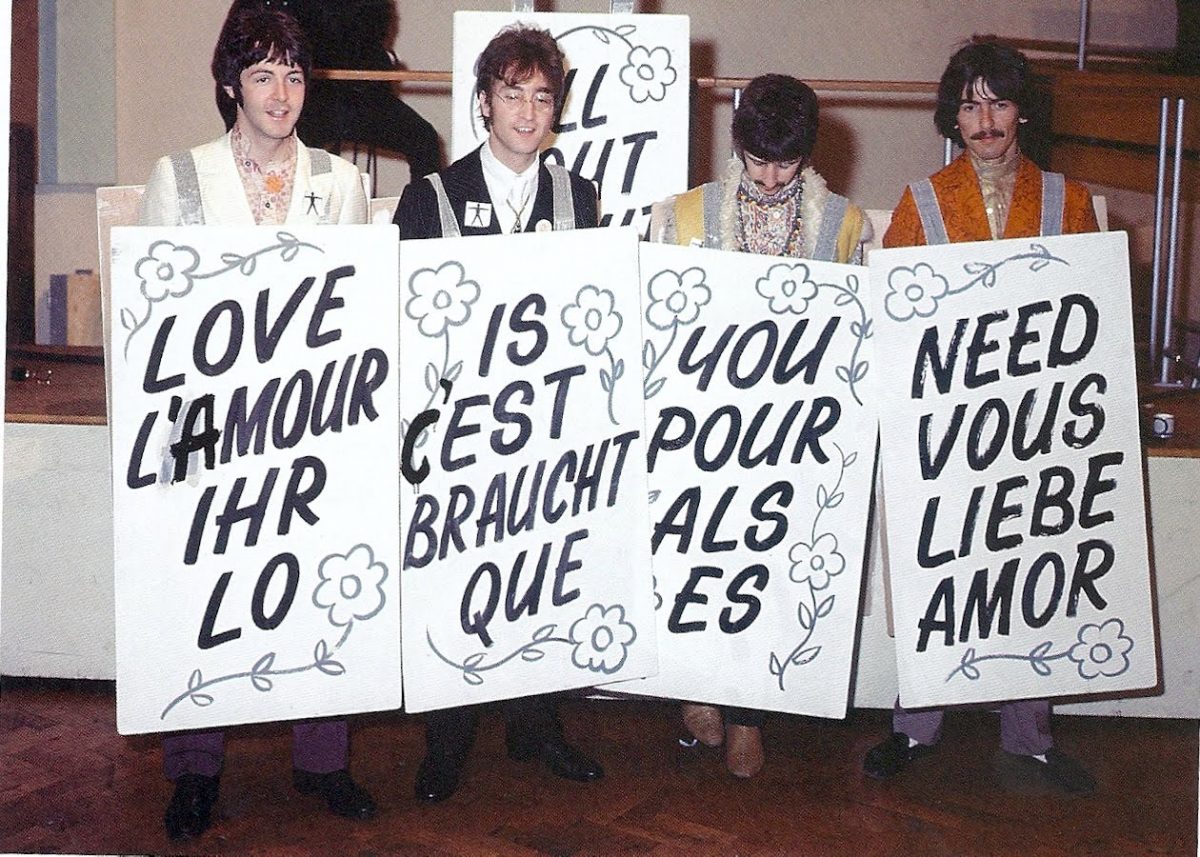
The Beatles – All You Need Is Love
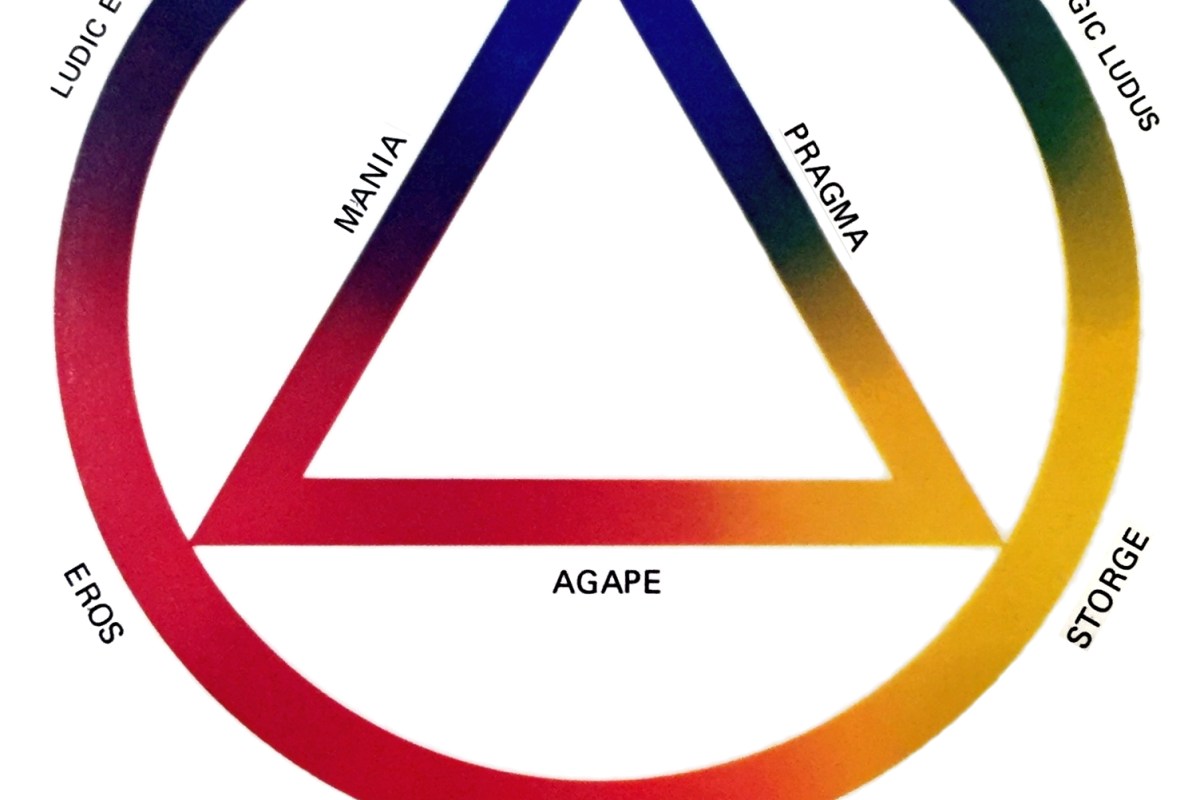
The ancient Greeks had several words to express love.
Storge (στοργή)
Storge is the love we have for community, for family, for our children and spouses. Storge is not romantic love. It is more a love of affection and tenderness. It may be the basis for the urge toward tribalism and nationalism, and it may have a sort of analogue to gravity, wherein the proximity of the source, the greater the attraction. This is where ‘blood is thicker than water’ and why I like my sports team better than yours.
Storge – love of family
Agape (ἀγάπη)
Agape is a sort of universal love, the selfless love of biblical reference of God and all of his children. Neither is agape a romantic notion. It is akin to charity, and the connection of transcending storge to include all of the world and ignoring the silos of tribalism. There appears to be a tension between agape and storge because one cannot have an equal love for all whilst retaining a greater love for one’s own tribe. Perhaps the notion is more aspirational than practicable.
Agape – Universal love
Philia (φιλία)
Philia is fraternal (to be more inclusive, perhaps also sororal) love, the brotherly love hoped to be inspired by the city of Philadelphia in Pennsylvania. This is an affectionate love, typically between equals. Again, philia has no romantic basis.
Philia – Sororal love
Eros (ἔρως)
Eros is notably erotic love; sexual love; intimate, passionate love; lust. Eros is ephemeral. Returning to physics, eros requires a lot of energy to maintain. In a typical setting, eros moderates to storge or pragma.
Plato believed that this love was transcendent of the body—and so could exist independently of body—, but I’ll not give heed to this metaphysical notion. Perhaps, this is where the notion of soulmates derives. This is a romantic love.
Ludus
Ludus is a lightweight version or precursor to erotic love. It is the playful, flirtatious nature expressed by young proto-lovers. Viewed teleologically, ludus may be seen as a stepping stone to eros, but not everyone makes it successfully to the final level.
Full disclosure: Ludus is Latin and not of Greek original.
Pragma (πράγμα)
Obviously, pragma is a pragmatic love. This is the love that remains to bond a pair who have remained together for years, say, an old married couple. This form either requires a lot of energy and compromise or a lot of apathy or indifference.
Older couple demonstrate pragma
Philautia
Philautia is a love of one’s self. It’s a portmanteau of philia + auto. As the saying goes, if you can’t love yourself, you can’t love anyone. As with most adages, they is as often true as not and require additional context to assess. Philautia should not be confused with narcissism, which may more properly be classified as a mania. It should also not be confused by onanism.
Philautia – Love of one’s self
Love will tear us apart… again.
Joy Division
Mania (μανία)
Some people include mania in their love collection. Mania is simply an unbalanced sort of love; obsessive love; eros gone wild.
Love has many meanings, but they are all about connecting. Perhaps, I am being hasty to dismiss the term, but it is overused and perhaps more phatic than genuine. In the parlance of Foucault, it’s a power phrase—especially in the erotic arena—, a means to manipulate.
2: Do not think it worthwhile to produce belief by concealing evidence, for the evidence is sure to come to light.
3: Never try to discourage thinking, for you are sure to succeed.
4: When you meet with opposition, even if it should be from your husband or your children, endeavor to overcome it by argument and not by authority, for a victory dependent upon authority is unreal and illusory.
5: Have no respect for the authority of others, for there are always contrary authorities to be found.
6: Do not use power to suppress opinions you think pernicious, for if you do the opinions will suppress you.
7: Do not fear to be eccentric in opinion, for every opinion now accepted was once eccentric.
8: Find more pleasure in intelligent dissent than in passive agreement, for, if you value intelligence as you should, the former implies a deeper agreement than the latter.
9: Be scrupulously truthful, even when truth is inconvenient, for it is more inconvenient when you try to conceal it.
10. Do not feel envious of the happiness of those who live in a fool’s paradise, for only a fool will think that it is happiness.
Although I don’t agree with all of these, I won’t challenge them here. On balance, they are words to live by.
I’ve been having a side debate with a Christian mate of mine who made these claims:
Whom do you serve?
Chrétien de Troyes — Perceval
‘[Non-religious people may] not define themselves as particularly “religious”, but…everyone is’, as he references lyrics from a Rush song, ‘even if you choose NOT to decide, you still have made a choice’.
‘One can choose to believe in nothing but themselves, but if they’re honest, “self” IS their religion. Everyone is religious.
We all yearn for some meaning and we end up pursuing something or someone to fill that inward desire. Whether we organise that something and call it “religion” is beside the point, as he references Bob Dylan’s lyric, “Ya gotta serve somebody; it may be the devil, or it may be the Lord, but ya gotta serve somebody.”
This had been the fluid exchange of ideas, but I’ll reply in turn.
even if you choose not to decide, you still have made a choice
Rush — Freewill
I’ve won’t repeat my position on free will, but one can choose to be religious or not. To choose not to be religious is not also a choice to be religious. I can agree that some people substitute superstitious, metaphysical believe for, say, scientism, and this is just as ridiculous, but some people remain unconvinced in these metanarratives.
“Self” is their religion
Some Guy
Again, not everyone even ascribes to the notion of self, and there is little reason to believe that there is some element of religious worship involved.
We all yearn for some meaning
Some Guy
Again, this is fundamental attribution error, the assumption that because he believes there is some underlying meaning and yearns to find it that everyone else does. I understand that he surrounds himself with people who share this belief system, and they convince themselves that someone who says otherwise is mistaken.
Ya gotta serve somebody; it may be the devil, or it may be the Lord, but ya gotta serve somebody
Bob Dylan — GottA Serve Somebody
This is clearly dualistic thinking incarnate; a false ‘you’re either with me or against me’ dichotomy.
I remember self-assessing myself when I was in high school. Nietzsche notwithstanding, I could never agree with the frame or the assertion that there are leaders and there are followers. I did not identify with either. I do feel that within the society I was born, that I need to comply just enough to not be subjected to the violence inherent in the system for non-conformance, but that’s not exactly following. I also don’t care to lead.
It turns out that this (perhaps not coincidentally) manifested in my career, as I am a consultant—an adviser.
Just a brief post today. I had forgotten about this Steven Pinker quote I shared elsewhere a few years back.
“Judges are not very good linguists. For better or worse, they try to find a way around the most natural interpretation of a sentence if it would stand in the way of the outcome they feel is just.”
The fact is that they do not care about the lack of specificity of language. Politicos revel in the fact that they can torture language into submission to meet their own objectives. This is the power of rhetoric.
As I have reviewed my posts over the past couple of years, it seems I repeat myself, repeat myself, repeat myself, repeat… I get a sudden urge to capture a notion, and it turns out that I had already written about it before. I’d just forgotten.
What I need to do is to formulate a cogent distilled version, but I can’t quite seem to get there. For now, I’ll just share this.
I’ve been accused of being hyper-logical and aloof, and I self-identify as a logical intellectual. This noted, for humans—myself included—emotion precedes logic. Every time. Logic is applied to rationalise our emotional response. This ‘logic’ is based somewhat on classical logic and otherwise on environmental factors. This is one reason that rhetorical persuasion is so effective. It doesn’t loose sight of the emotional element—pathos—whilst retaining logical and ethical notions—logos and ethos.
Stoic dude, Marcus Aurelius
I’ve been accused of being a stoic and Star Trek’s Mr Spock—devoid of emotion—, and on one level I don’t feel that I am run by emotions’ but on the other hand, I likely am. It’s just I can rhetorically convince myself to the contrary.
I find that highly illogical
Epistemologically, how can I know this? I can’t. But I think that this fits into Daniel Kahneman’s 2-system approach, and system 1, the heuristic element, is the first responder to all incidences. System 2, the analytical element often isn’t even alerted. For people of my persuasion, we intentionally invoke system 2, but this is always after system 1 has evaluated the situation. I highly recommend Kahneman’s Thinking Fast & Slow as an introduction to these systems and how they deal (and don’t deal) with cognitive biases.
If I had a dollar
This may be why Emotivism makes sense categorically, as Truth is just another notion wrought from emotion. It is also how humans convince themselves that things like justice and fairness can exist.
And, so, does this post have another point to make? Am I going to elaborate? It seems a bit short. By my own admission, nope.
Experience is more important than material wealth because you can’t take it with you.
This is silly on so many levels.
Firstly, you can’t take experiences with you any more than you can take material, so the entire logic is faulty.
Secondly, although unsaid, this is typically uttered by those who equate experience with travel to other places, and so one needs some notion of material wealth to do so.
Thirdly, just being alive and somewhat aware is an experience, but I understand the notion implies a diversity of experience.
Fourthly, you still can’t take it with you.
Personally, I love aphorisms, those near-phatic quips that no one really thinks about, yet they feel that these are somehow guiding principles.
Opposites attract.
versus
Like attracts like.
Which of these is correct?
In fact, each of these statements may be correct; it simply depends on context. The issue is that people spout these off to make a point.
Opposites attract is how we justify when two unexpected people, for example, are together. It is also the basis behind the Jungian anima-animus concept.
Like attracts like may be either to justify why person A is with person B, but it sometimes further is meant to imply a sort of guilt by association.
The other issue is one of dimension. When applied to people, they are multidimensional. So which dimension is opposite and which is like. Of course, we’ll choose the dimension that fits our purposes.
Perhaps a 172 cm brunette woman is a police officer has a life partner who is a 172 cm blonde man, who is a criminal, and who both enjoy art museums.
Without specifying what percentage the likeness needs to be to qualify, if like truly attracted like, wouldn’t the 172 cm brunette policewoman be attracted to another 172 cm brunette policewoman? Or would just another taller policewoman be good enough?
Anyway, nothing earth-shattering here. This is simply another example of the imprecision of language. That, and I couldn’t sleep.
TRIGGER WARNING: This post is about sex and prostitution and includes words and images not necessarily appropriate for the self-righteous.
If this describes you, avert your eyes.
The Holy Water, It Burns
I stumbled across another blog site advocating the Nordic (anti-prostitution) Model, which in a nutshell makes it illegal to buy but not ‘sell’ sex.
On the positive side, the advocates of this model pretty much all adhere to the same talking points. On the negative side, there are only weak strawman arguments , moralising, and anecdotes. Any studies referenced are limited in scope and with dubious rigour.
In this case, I (again) pointed out that the core of the argument was one against Capitalism, and (again) the response was that it is (somehow) more than this—because, well, things…moral things.
Interestingly, the site is named Your Social Construct Is Showing, but it seems her complaint is not about social constructs in general; rather, she doesn’t appear to like any social construct she doesn’t agree with—and without recognising the irony in claiming to understand the constructed nature of society whilst also claiming that her construction is somehow better—because, well, things…just things. She’s got some subcultural metanarrative running through her head, and, by God, it’s got to be the only valid one.
I’ve written on this before, but the primary argument is that sex work is not work—otherwise, they wouldn’t have to label it as work. It sort of employs the same logic that oral sex is not sex for the same reason—because reasons.
The next angle is to conflate prostitution with sex trafficking, just hoping no one will notice the redirection. Then they try to muddy the waters with other issues such as exploited, underage subjects as if there is some parallel between these cohorts and women who choose this line of work.
Example of an advertisement by a sex worker
So, to be fair and not fight strawmen like Cammy, I’ll comment on a Logos blog she posted in a response to me. She seemed to be impressed with it. After a rambling preamble, the post gets to its points:
Worker safety: Sex Work does not comply with OSHA rules.
Sexual Harassment: ‘unwelcome sexual conduct that is a term or condition of employment’
Civil Rights: Slavery used to be illegal, and now it isn’t. Prostitution is like slavery.
Without devoting more than a passing moment to remind the reader that workplace safety and sexual harassment rules are social constructs that vary by place and time. OSHA is relevant in the United States of America and nowhere else. Let’s address these in turn:
The Logos post cites various OSHA rules and attempts to rationalise how sex work would be non-compliant.
1
Worker Safety
Mouth pipetting/suctioning of blood or other potentially infectious materials is prohibited
The author (attributed as Lori Watson) points out that ‘this doesn’t say is permitted with protective gear. It says prohibited.’ The line of argumentation here is seemingly that semen is a potentially infectious material and so is prohibited. What she fails to note is that suctioning is not the purpose of oral sex, and with a condom, no suctioning could happen anyway.
Gloves shall be worn when it can be reasonably anticipated that the employee may have hand contact with blood, other potentially infectious materials…
If the punter is wearing a condom, it cannot be reasonably anticipated that the employee would be in contact with [semen].
Masks, Eye Protection, and Face Shields. Masks in combination with eye protection devices, such as goggles or glasses with solid side shields, or chin-length face shields, shall be worn whenever splashes, spray, spatter, or droplets of blood or other potentially infectious materials may be generated…
Again: Condoms obviate this need.
Gowns, Aprons, and Other Protective Body Clothing. Appropriate protective clothing such as, but not limited to, gowns, aprons, lab coats, clinic jackets, or similar outer garments shall be worn in occupational exposure situations. The type and characteristics will depend upon the task and degree of exposure anticipated.
Ditto: Condoms
In the event of exposure, OHSA requires: “The source individual’s blood shall be tested as soon as feasible…
OK
This part of the post closes with a comment that many [note: weasel word] punters do not prefer condoms.
2
Sexual HARASSMENT
Since the definition and expressed purpose of prostitution is ultimately an exchange of sexual services for remuneration, it seems that a person waives this protection. There is much precedence of this occurrence.
Case in point. In the United States, citizens are protected by the Constitution and its Amendments. These documents contain inalienable rights (as established by the Declaration of Independence), yet these rights are abridged (waived) in many instances—military service being the most notable, where members do not have the right to free speech, peaceable assembly, to carry a weapon (except as specifically allowed), due process, and on and on.
3
Civil Rights
The response here is a deluxe word salad, so I’ll break it down slowly.
If sexual autonomy is to mean anything, it has to mean the right to refuse sex with anyone, at any time, for any reason.
Indeed. And the woman can refuse service and refund the fee. If I am a fast food worker, I can forego my wages and my job if I no longer wish to do it. Try to do that in the military. Indentured servitude, you ask? Why, yes. I do believe you’d be correct.
[As] a regulated commercial exchange, the “providers” are cannot be legally free to refuse clients in protected classes on grounds of their membership in the protected class.
Indeed. If I were a lawyer and refused to service a member of a protected class, I would likely be disbarred. This said, the sex worker could choose another profession. In my experience, many sex workers exclude various classes of people they do not prefer to service.
Below are some images I found whilst performing a Google search. Notice that the provider advertises her boundaries and limitations.
This one makes it clear that she does not provide unprotected services or anal sex and does not accept African-American (AA) customers under 35 years of age.
No BB – No Greek – No AA
This ad makes it clear that she only practices safe sex (No BB (bareback), including no BB oral sex) and will not provide Girl Friend Experience (GFE).
No BBBJ
Again, this provider does not service African American men of any age and does not require protection for oral sex, but she only services from her own location.
BBBJ Friendly – No AA
So at the end of all this, I stand by my original position that there is no argument to have beyond ‘boo hoo. I don’t like prostitution and neither should you. I can’t come up with a cogent argument, so I’ll shout into an echo chamber where my friends and allies will cheer me on, but critical thinking need not apply because reasons and things…lots of them.


















 Philosophics