Violence and Rules

I haven’t yet shared my thoughts that equate bureaucracy with violence, but this is somewhat tangential or perhaps orthogonal.

Humanity does not gradually progress from combat to combat until it arrives at universal reciprocity, where the rule of law finally replaces warfare; humanity installs each of its violences in a system of rules and thus proceeds from domination to domination. The nature of these rules allows violence to be inflicted on violence and the resurgence of new forces that are sufficiently strong to dominate those in power. Rules are empty in themselves, violent and unfinalised; they are impersonal and can be bent to any purpose. The successes of history belong to those who are capable of seizing these rules, to replace those who had used them, to disguise themselves so as to pervert them, invert their meaning, and redirect them against those who had initially imposed them; controlling this complex mechanism, they will make it function so as to overcome the rulers through their own rules.

Michel Foucault, Nietzsche, Genealogy, History 1977

Taking holiday, so taking shortcuts in posting. Here, Foucault discusses Nietzsche.

Institutionalised

Jordan Peterson is decidedly not my cup of tea. I can tolerate Pinker and Haidt. I agree with much of what they have to say, but in this video, the dissonance finally dawns on me. Interestingly, I can tolerate Peterson within the scope of this discussion.

I don’t agree with much of what these three are saying, but it is refreshing to hear Peterson outside of a philosophical domain, a place where he has no place. And although I don’t agree with him here, it is on the basis of his argumentation rather than his abject ineptitude.

I disagree with this trio. This video reveals these three people as Institutionalists. Peterson may be a political Conservative versus Pinker’s and Haidt’s enlightened Liberalism, but this is a common core value they defend with escalating commitment. Typically, we find these to be polar opposites, but here they have a common enemy that is not necessarily anti-institutionalists or anarchists but people who don’t understand venerable institutions and thereby risk tipping the apple cart or toppling the Jenga tower because they just don’t understand. Not like them. Besides constitutionalism, the common thread is Paternalism. They may disagree on the specifics, but one thing is true: We know more than you, and this knowledge is embedded in the sacred institutions. If only the others understood.

In this video, we hear these three commiserate about the diversity and inclusion forces in University today, and where this movement is off base.

Death and Dying

Not explicitly about Kübler-Ross. In the 1990s, I enjoyed listening to the stories of a cantadora—keeper of the stories—, Clarissa Pinkola Estes and her Theatre of the Imagination. Many inspirational stories. That I deem psychology as a pseudoscience does not mean that it serves no purpose. It runs aground where they interpret metaphor for the actual—the symbol for the object. There is a lot to glean from symbols as representations, and one can even apply them to their lives, but never conflate the map for the terrain.

I loved Baba Yaga, but the one I am reminded of today regards candles as measures of life remaining. In this story, a person on a deathbed pleads with Death.

Death explains that the candles represent peoples’ lives and their life force.

Some are tall and burning brightly whilst others are on the verge of being snuffed out

The Dying assumes that all the tall and bright candles must represent young children and that the ones with almost no wax and wick to burn are the elderly.

Death explains:

Some children have very short candles.

And some of the very tall and very bright ones are very old people.

‘Look, here is yours’, Death tells him.

The Dying is directed to one of the dimmest, most pathetic, struggling-for-its-last-few-moments-of-burning-candle in all the land.

He understands.

Blame

Even the moral sceptic is not immune from his own form of the wish to over-intellectualize such notions as those of moral responsibility, guilt, and blame. He sees that the optimist’s account is inadequate and the pessimist’s libertarian alternative inane; and finds no resource except to declare that the notions in question are inherently confused, that ‘blame is metaphysical’.

PF Strawson, Freedom and Resentment
Quote from Freedom and Resentment and Other Essays by PF Strawson

Part of my central thesis of non-agency is centred on the notion of blame, and it seems PF Strawson has a lot to contribute in this arena. In short, given my lack of belief of material human agency, I wish to investigate the connection between seemingly innate impulses to project blame and the absence of a blameworthy object.

In order to devote more time to researching and writing my thesis and less time editorialising elsewhere, I may post some shorter content such as these gems that I stumble upon along the way. This facilitates my desire to create and share content without the burden of devoting hours to render it. It also gives me places to come back to.

I only hope that you don’t blame me for doing so.


Meantime, indulge my recording my thoughts here in the public space.

What is blame?

We don’t have very precise definitions of blame, we have an intuitive sense of what it means. There is a subject (or object, as the case might be) that creates (or has been attributed to have created) an action that results in an interaction on an object (or process) with a subsequent effect and a notion of intentionality. But we have to parse casual effect, responsibility, and blame as they are not strictly equivalent. Let’s begin with a causal event.

I believe that on balance the causal event process and object interaction is uncontroversial. A billiard ball (Object A), through directed (or undirected) motion, collides (action) with a second billiard ball (Object B) with the subsequent effect of displacing the second ball.

What we can claim in this scenario is that A → B, A causes B to move. Except in the loosest of idiomatic speech, we can’t really extend this causal relationship to claim that A is responsible for B’s movement. Even further removed, one can’t claim that A is to blame for B’s movement.

Responsibility and blame are different moral claims attributed to an agent. I feel I am safe to claim that a billiard ball has no agency. Whilst human agency is defined as an individual’s capacity to determine and make meaning from their environment through purposive consciousness and reflective and creative action (Houston, 2010), an agent in a more general sense is a being with the capacity to act, and ‘agency’ denotes the exercise or manifestation of this capacity.

The word blame is infused with negative connotations. Praise is a loose antonym with positive connotations, but I won’t focus on it because it is not nearly as heavy and operates semantically differently. In any case, I feel justified to cross blame from the list of possible qualifiers for the billiard ball scenario.

Is A responsible for B? Again, I believe that most people do not assign responsibility to inanimate objects—notwithstanding animism, pantheism, and possibly panpsychism.

Here are some diagrammes.

Above, there is only cause and effect. We can intuit that the movement of Object A is not uncaused. Even so, it careens into Object B, causing it to move. And while one could say A is responsible for moving B, this would be non-standard English language use.

If one pulls back to catch a wider glimpse, one can see that the cause of Object A striking Object B, was a person striking Object A (possibly with a cue stick). Here, the casual event chain is the person causing A to strike B. Two cause-effect relationships at a macro level. However, in this case, we can also say that the person is responsible for the event to set A into motion. We can also say that the person caused B to move (by the way of Object A). Even here, blame would be inappropriate to assert.

We may be able to reframe the scenario slightly differently to get blame into the picture, but let’s take a short detour and create a praise situation. If Object B is hit into a pocket, we can praise the person. Perhaps this shot wins the game. The person is responsible for making the shot.

In scenario B, the person misses the shot. Moreover, Object A does collide with Object B, but perhaps Object B is the 8 ball, and it was not supposed to be pocketed yet. Or perhaps the cue ball deflects off of Object B causing A to scratch because it falls into a pocket. Either of these situations might cause the person to lose the match. A mate may blame this person for being responsible for the loss.

Before moving on, I’ll point out that one distinction that affords blame more weight than praise is the ongoing psychology. Whilst with praise, a person may reflect fondly on a positive event, there is not really a counter to a grudge in the case of blame. And while praise can be misattributed with benefits to social capital, misdirected blame can result in a loss of social capital with longer-term implications.

Perhaps someone unseen pushes you into another person causing them to be injured. You may have been the cause of this person being injured, but like the billiard ball, Object B, you are not morally responsible. Moreover, you may be the target of blame.

These are rather low-stakes scenarios. Imaging these as legal negligence or in a criminal setting. Innocent people are routinely convicted for crimes they never committed. Perhaps, they had been previously unaware of any of the actors or events, yet they are blamed and fined or incarcerated.

This isn’t my interest to discuss at the moment. This is a different scope, so let’s return to the main theme.

In the low-stakes billiards example we can say that the person seems to have agency. For trivial events, we can ignore whether this is more than seeming. In essence, we can ignore the antecedent event arrow that caused the person to be in a situation to have the opportunity to strike the ball in the first place. We’ll return to this later.

Will What You Want

Whilst researching a chapter on the notion of blame among hominids, I was chasing down a rabbit hole and I ended up finding Schopenhauer’s oft-quoted,

Man can do what he wants, but he cannot will what he wants

And that’s where the trouble started. Memory is fallible. Although I feel deceived, I don’t feel bad because many people have misattributed this quote to Schopenhauer, but if the Wikipedia footnote is steering me right, this was actually Einstein’s misquote—the Einstein; Albert Einstein of E = MC2 fame.

According to the citation, Albert said this:

„Der Mensch kann wohl tun, was er will,
aber er kann nicht wollen, was er will.”

— Albert Einstein, Mein Glaubensbekenntnis (August 1932)

It translates into the offending sentence.

‘Man can do what he wants, but he cannot will what he wants.’

The full translated quote reads,

‘I do not believe in free will. Schopenhauer’s words: ‘Man can do what he wants, but he cannot will what he wants’ accompany me in all situations throughout my life and reconcile me with the actions of others, even if they are rather painful to me. This awareness of the lack of free will keeps me from taking myself and my fellow men too seriously as acting and deciding individuals, and from losing my temper.’

Albert Einstein

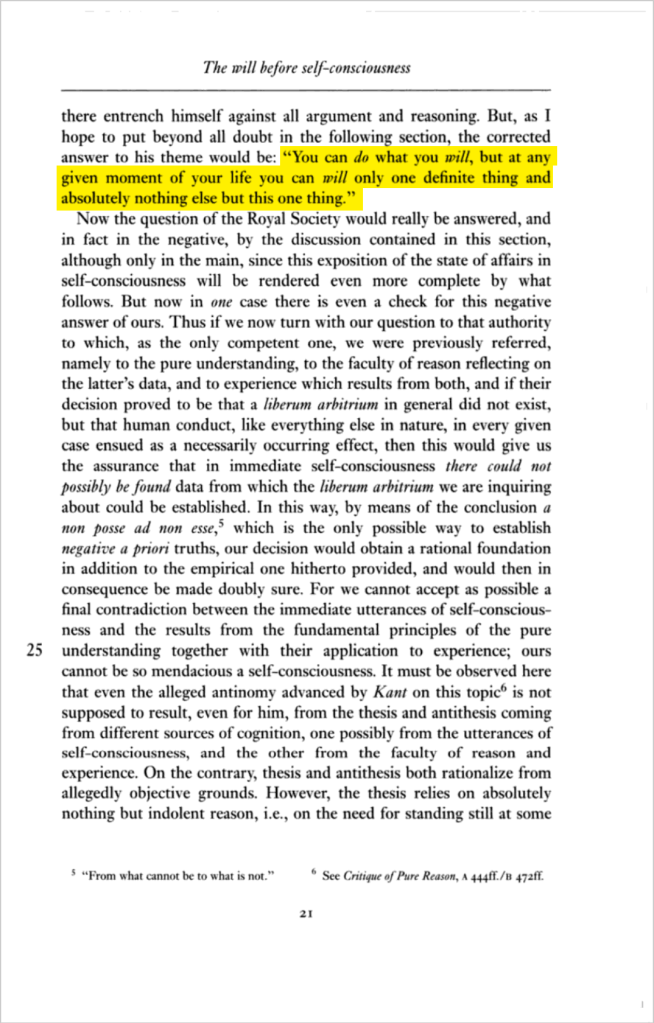
What Schopenhauer actually said not only doesn’t resonate quite so well, it doesn’t even convey the same notion. His actual words were:

‘You can do what you will, but in any given moment of your life you can will only one definite thing and absolutely nothing other than that one thing.’

— Arthur Shopenhauer, On the Freedom of the Will, Ch. II.

In the original German read,

Du kannst tun was du willst: aber du kannst in jedem gegebenen Augenblick deines Lebens nur ein Bestimmtes wollen und schlechterdings nichts anderes als dieses eine.

— Arthur Shopenhauer, Ueber die Freiheit des menschlichen Willens
Arnold Schopenhauer, On the Freedom of the Will

In the spirit of misattributed quotes, here are a few things Einstein never said but are attributed to I’m anyway.

“The definition of insanity is doing the same thing over and over again and expecting different results.”

“Everyone is a genius. But if you judge a fish by its ability to climb a tree, it will live its whole life believing that it is stupid.”

Not Albert Einstein

“I refuse to believe that God plays dice with the universe.”

Not Albert Einstein

Though to be fair, the last one at least directionally reflects something he did say,

“It seems hard to sneak a look at God’s cards. But that He plays dice and uses ‘telepathic’ methods… is something that I cannot believe for a single moment.”

Albert Einstein

Yet again, I am confused. I feel I’ve been living a lie.

Can We Just Stop Talking About Free Will

The problem with free will is that we keep dwelling on it. Really, this has to stop.

Owen D. Jones, The End of (Discussing) Free Will, 18 March 2012

This quote was made by Owen Jones in an article published in 2012. I share it because I feel the author is not only being cavalier but wrongly so. According to the bio at the end of the article, Owen D. Jones is a professor of law and biological sciences at Vanderbilt University. As I see it, the problem is not some theoretical—What is the sound of one hand clapping?—pseudo-problem. Human agency is the basis of our legal and jurisprudence systems.

Like good magicians, people like Owen want to redirect your focus to neuroscience and consciousness rather than have to explain how the causal engine that is the brain manifests itself ex nihilo.

Doubling down on my causa sui position, humans may be able to make constrained solutions, and yet they never have control over the constrained system they inherit. I discuss this at length elsewhere, but I wanted to address this comment forthright.

I’ll leave with a quote I tend to trot out a lot.

It is difficult to get a man to understand something when his salary depends on his not understanding it.

— Upton Sinclair, prepared speech, I, Candidate for Governor (1935)

Free will is a necessary illusion for power structures to propagate or they will lose a cornerstone of their control mechanisms. And since humans want to feel they are in control, they are willing to accept the downside for the illusion of an upside.

Motility, Automotion, and Agency

I just wrapped up chapter eleven of The Righteous Mind by Jonathan Haidt. I’ve got only 35 pages to go to get through chapter twelve. I’ve been tempted to stop reading. Chapter eleven—and I am tempted to inject a bankruptcy pun here—has been more frustrating than the rest thus far. And yet I am glad to have persisted.

My intellectual focus these past months has been on agency. Et voilà, paydirt. Chapter eleven’s title reveals the context: Religion is a Team Sport. Let’s walk through this garden together.

A goal of Haidt is to educate the reader on his third principle of moral psychology: Morality binds and blinds. He establishes parallels between sports and religion. And here’s the thing—I don’t disagree. But here’s the other thing—I feel that are equally vapid—, with no apologies to sports fans or the religious. Let’s keep moving.

“A college football game is a superb analogy for religion.”

Jonathan Haidt, The Righteous Mind, Chapter 12: Religion is a Team Sport

He talks about the organising and unifying functions of both. But here’s the thing. It unifies the like-minded. Haidt claims to be irreligious and not be into sports, and yet he cites these as somehow desirable. I find him to be an apologist for religion.

I am not a psychologist, but if I were, I’d be tempted to claim that Haidt’s conclusions follow from his personal beliefs. He believes in morals, society, order, intuition, and institutions. He is a textbook Modern and an extrovert to boot. I think he also falls into teleological fallacy traps. Was that a play on words?

His goal is to fuse the positions of Darwin and Durheim. Along the way, he reminds us of the New Atheists, their publications, and their positions: Sam Harris’ The End of Faith: Religion, Terror, and the Future of Reason; Richard Dawkins’s The God Delusion; Daniel Dennett’s Breaking the Spell: Religion as a Natural Phenomenon; and Christopher Hitchens’s God Is Not Great: How Religion Poisons Everything.

Although he views religion through rose-coloured glasses, he comes to the conclusion that religions have done a great deal of harm over the millennia, but the good outweighs the bad, especially if you consider it through a social-moral lens. But if religion creates in-groups versus out-groups, which they do, and religious in-groups outlive even non-religious ingroups, then this is a winning option. But what if you don’t like that option?

Personally, I am a collectivist, but this is not willy-nilly any collective.

Haidt contrasts the New Atheist vantage that religious belief is an evolutionary byproduct versus a position that what started as a byproduct evolved into group selection and then, perhaps, an epigenetic phenomenon.

Here’s my contention:

Borrowing from New Atheism, Haidt adopts the notion of a “hypersensitive agency detection device [that] is finely tuned to maximize survival, not accuracy”.

The first step in the New Atheist story—one that I won’t challenge—is the hypersensitive agency detection device. The idea makes a lot of sense: we see faces in the clouds, but never clouds in faces, because we have special cognitive modules for face detection. The face detector is on a hair trigger, and it makes almost all of its mistakes in one direction—false positives (seeing a face when no real face is present, e.g., ), rather than false negatives (failing to see a face that is really present). Similarly, most animals confront the challenge of distinguishing events that are caused by the presence of another animal (an agent that can move under its own power) from those that are caused by the wind, or a pinecone falling, or anything else that lacks agency.

The solution to this challenge is an agency detection module, and like the face detector, it’s on a hair trigger. It makes almost all of its mistakes in one direction—false positives (detecting an agent when none is present), rather than false negatives (failing to detect the presence of a real agent). If you want to see the hypersensitive agency detector in action, just slide your fist around under a blanket, within sight of a puppy or a kitten. If you want to know why it’s on a hair trigger, just think about which kind of error would be more costly the next time you are walking alone at night in the deep forest or a dark alley. The hypersensitive agency detection device is finely tuned to maximize survival, not accuracy.

Op Cit, p. 292

I fully agree with the assertion that the brain values fitness over truth, and I’ve commented in several posts that pareidolia and apophenia create false-positive interpretations of reality.

But now suppose that early humans, equipped with a hypersensitive agency detector, a new ability to engage in shared intentionality, and a love of stories, begin to talk about their many misperceptions. Suppose they begin attributing agency to the weather. (Thunder and lightning sure make it seem as though somebody up in the sky is angry at us.) Suppose a group of humans begins jointly creating a pantheon of invisible agents who cause the weather, and other assorted cases of good or bad fortune. Voilà—the birth of supernatural agents, not as an adaptation for anything but as a by-product of a cognitive module that is otherwise highly adaptive.

Op Cit, p. 293

For me, this supports my contention that agency is a wholly constructed fiction. The same agency we ascribe to unknown natural events, we ascribe to ourselves. And perhaps this ability served an egoistic function, which was then generalised to the larger world we inhabit.

I have an issue with his teleological bias. He feels that because we have evolved a certain way to date; this will serve as a platform for the next level as it were. I’ll counter with a statement I often repeat: It is possible to have adapted in a way that we have been forced into an evolutionary dead end. Historically, it’s been said that 99 per cent of species that ever occupied this earth are no longer extant. That’s a lot of evolutionary dead ends. I am aware that few species could have survived an asteroid strike or extended Ice Ages, but these large-scale extinction events are not the only terminal points for no longer extant species.

So finally, Haidt essentially says that it doesn’t matter that these religious and cultural narratives are wholly fictitious, if they promote group survival, we should adopt them. This seems to elevate the society over the individual, which is fine, but perhaps the larger world would be better off still without the cancer? Just because it can survive—like some virulent strain—doesn’t mean we should keep it.

Finally, given these fictions, what’s a logical reasonable person to do? I don’t buy into ‘this country is superior to that country’ or ‘this religion is better than that religion’ or even ‘this sports team is better than that’ or ‘this company is better than that’.

Haidt does idolise Jeremy Bentham, but this is more Pollyannaism. It sounds good on paper, but as an economist, I’ll reveal that it doesn’t work in the real world. No one can effectively dimensionalise and define ‘good’, and it’s a moving target at that.

No thank you, Jonathan. I don’t want to buy what you are selling.

News Flash: From the time I started this content, I’ve since read the final chapter. Where I categorically reject a lot of what Haidt proposes in this chapter, I tend to find chapter twelve to fit more amicably with my worldview. Perhaps I’ll share my thoughts on that next.

If you’ve reached this far, apologies for the disjointed presentment. I completed this over the course of a day through workaday interruptions and distractions. I wish I had an editor who could assert some continuity, but I am on to the next thing, so…

Bonus: I happened upon this journal article, and it somehow ended up here. I haven’t even read it yet, so I’ve got no commentary. Perhaps someday.

Rai, T. S., and A. P. Fiske. 2011. “Moral Psychology Is Relationship Regulation: Moral Motives
for Unity, Hierarchy, Equality, and Proportionality.” Psychological Review 118:57–75

Cover art source

Individual and Collective Agency and Freedom

As a person dismissive of individual human agency, of course, I am not going to rate the probability of collective agency highly. However, I am very drawn to this topic because I am sure there will be attempts to make parallels and connexions between the individual and the collectives. My guess is that attacks by those who support individual agency yet deny collective agency will pose arguments that will in the end undermine their own position that they will nonetheless cling to.

Colloquium Poster

This event is being broadcast on Zoom on 21 through 23 July 2022 from 17:00 – 21:00 Tawain Time (GMT +8).

Conversational topics will be (i) The Reality of Free Will and (ii) The Loci of Responsibility, two topics near and dear to my interest.

Details can be read here: https://www.lmpsttw.org/ch/events/5thtmc-schedule-721-723

A colleague had this to add.

A question that exercises the minds of philosophers is the existential status and role of groups and collectives. Do ‘forests’ exist, or are there just trees in proximity? Do “herds” exist, or are there just elephants? Perhaps the answers to these questions are of little consequence, but there are other, more interesting questions like, for example:

Do collectives act as single units, and if so, how? Do properties of individuals ‘scale’? For example, we readily attribute consciousness and intelligence to individual humans, can we also attribute consciousness and intelligence to a committee, or community? How is a collective conscious or intelligent? Also, individuals have ‘agency’ – they can/do exercise their individual “will” – but does a collective have a “will”, or “agency”? Does a large population of agents (a ‘country’, say) have a ‘will’ of its own? Does a country have ‘free will’,, and ‘know’ what it is ‘doing’? Do such questions even make sense?

On July 21-23, the National Taiwan University is holding a mini-conference about such “social ontology” conundrums, via ZOOM: https://ucl.zoom.us/j/98941995734, Zoom room ID:989 4199 5734

System Failure

The system is broken. It’s not just broken in the United States. It’s the entirety of Western Civilisation. It’s not time for a reboot. The virus is still inherent in the system. It’s time for a new system.

The reaction to this line of reasoning does something along the lines of, ‘It’s easy to criticise. What’s your solution?’ So let’s begin by parsing this enquiry.

Firstly, not all problems have solutions.

Humans, it seems, need resolution and closure. And they seem to gravitate towards easy answers, specious or otherwise. But humans have an abysmal track record of solving complex problems—political issues, social issues, economic issues, and so on. It’s not as much as there is no solution, per se, but that the interactions within the complexities are too many to consider. The system has a temporal dimension, which means even if I solve the problem at time-nought, the solution may not hold at time-prime.

Secondly, that one can recognise a problem does not mean one can fix it.

This was the denouement of Occupy Wall Street a few years back. They shed light on the problems, but those in charge—hawking ‘solutions’—established a frame wherein a problem without a solution is worse than a problem ‘remedied’ with the wrong solution. You don’t have to be a mechanic or body shop guy to recognise a smashed car even if you can’t fix it.

Auto smash

What then?

Harry Potter’s Hermione’s Magic Wand

If I had a magic wand, for a start, I’d abolish Capitalism, private property, and religion and go from there.

What’s wrong with private property?

‘Do you live on the street?’ is a typical response I hear when I suggest abolishing private property. ‘Give me your address. I suppose you wouldn’t mind if I moved in’ is another. I’ve discussed eliminating private property elsewhere, but the underlying problems remain:

  1. Why accept the usurpation of the commons to private property?
  2. Why accept the premise that one can own what one doesn’t possess?
  3. Why accept the premise of a first-come, first-served principle?
  4. Why accept, given the notion of property rights, that distribution must occur within the domain of economics?
  5. If one accepts that property should fall into the domain of economics, why not apply a ‘best use’ litmus instead of a ‘first come’ or ‘ability to purchase’ litmus?

Usurpation of the Commons

I don’t accept this usurpation. In nature, where conflict exists, violence or the threat of violence is the arbiter. As humans in nature, it’s no different. Like the meat one purchases behind the veil of a grocery mart, we are shielded from the inherent violence,

In many jurisdictions, property owners are justified in homicide if another person encroaches on their property. Many homeless or indigent people have tried to squat on unoccupied property only to be forcibly removed.

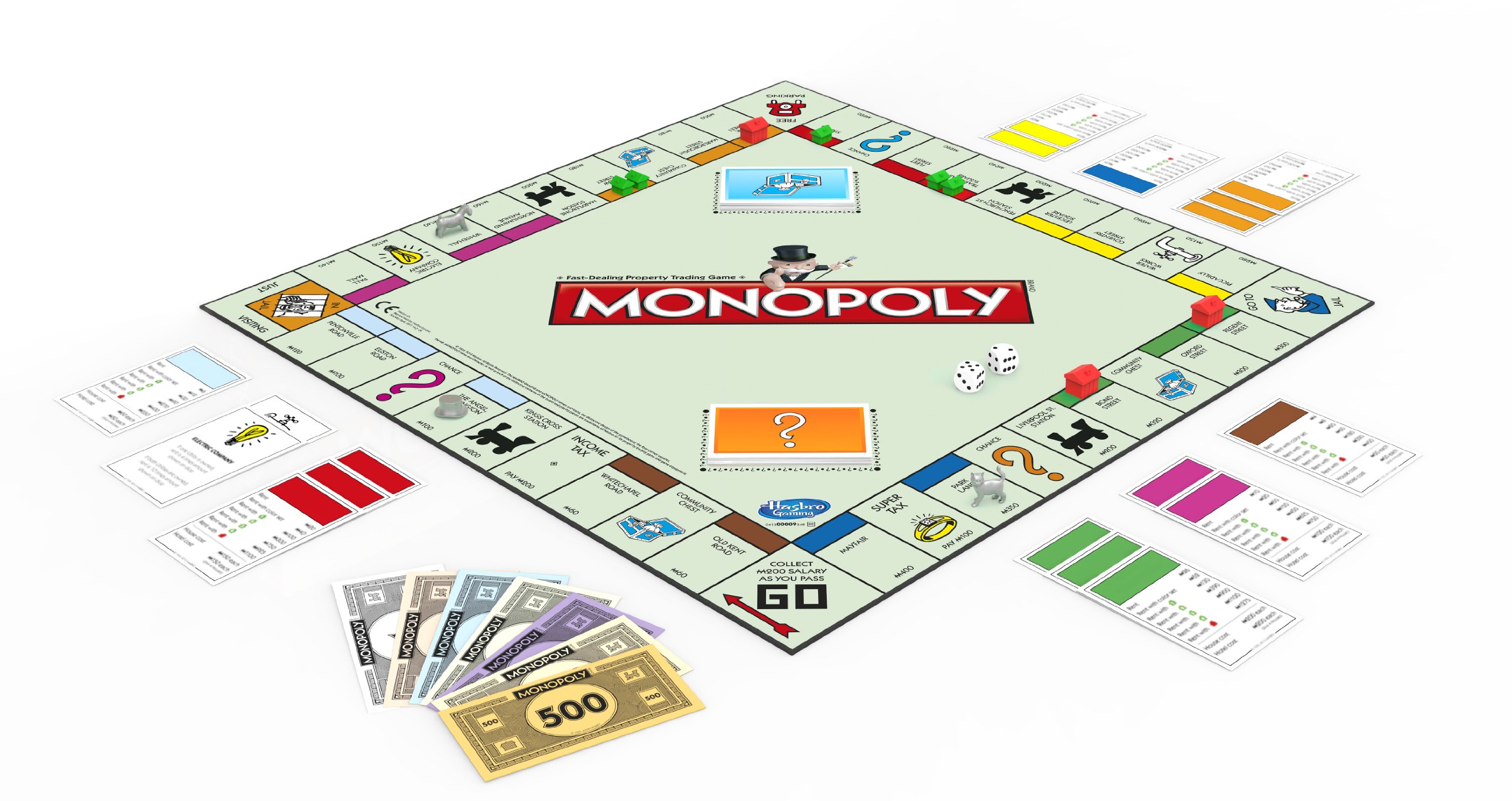
Monopoly Game Board

Property is like the game of musical chairs. And if you are late to the game, the chairs may already be taken. Imagine joining a game of monopoly late in the game and ownership of all the property has already been distributed. How do you think you might fare?

Possession is 9/10 of the Law

Possession is different to property. That I possess a place offers a different justification for my occupancy of it than a place that I own in absentia. Sure a philosophical argument could be made against any right to possess, but I’m not going there—at least not today.

This becomes a situation where usage is a determining factor. Can this ownership be justified if you’ve got a dozen places scattered around the globe?

First Come, First Served

It’s easy to see why this is in place: It’s simple. And at the start, there were few people and a seemingly infinite amount of land, but this was not sustainable. Land is ostensibly a fixed resource whilst humans multiply somewhat geometrically. So, given enough time, this allocation problem was predictable and inevitable.

But, given that property is something we insist on, what are the alternatives? Do we have a lottery periodically to redistribute property? Do we reset ownership whenever a new potentially qualifying owner emerges? Do we establish duration of ownership with some expiry? Do we not allow property to pass to forward generations? Or do we simply disallow ownership because this solution is too cumbersome to implement?

Disclaimer: In an attempt to economise my time yet still contribute content, this is a post dredged from Drafts (from May 2020) and posted with touchups in the manner of applying lipstick on a pig. Sadly, it’s still relevant.