The Mediated Encounter Ontology of the World

Philosophers adore two things: inventing problems and then fainting when someone solves them. For decades, we’ve been treated to the realism–idealism tug-of-war, that noble pantomime in which two exhausted metaphysical camps clutch the same conceptual teddy bear and insist the other stole it first. It’s almost touching.

Try out the MEOW GPT language parser.

Enter Nexal Ontology, my previous attempt at bailing water out of this sinking ship. It fought bravely, but as soon as anyone spotted even a faint resemblance to Whitehead, the poor thing collapsed under the weight of process-cosmology PTSD. One throwaway comment about ‘actual occasions’, and Nexal was done. Dead on arrival. A philosophical mayfly.

But MEOW*The Mediated Encounter Ontology of the World – did not die. It shrugged off the Whitehead comparison with the indifference of a cat presented with a salad. MEOW survived the metaphysical death match because its commitments are simply too lean, too stripped-back, too structurally minimal for speculative cosmology to get its claws into. No prehensions. No eternal objects. No divine lure. Just encounter, mediation, constraint, and the quiet dignity of not pretending to describe the architecture of the universe.

And that’s why MEOW stands. It outlived Nexal not by being grander, but by being harder to kill.
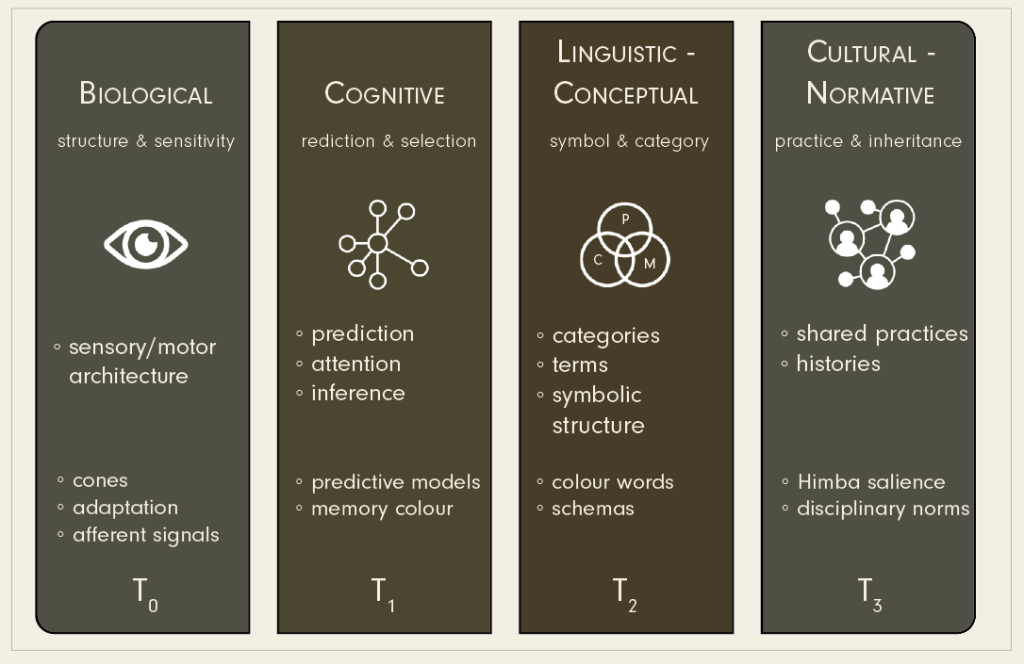
Image: The Four Mediation Layers – Biological, Cognitive, Conceptual, Cultural – structuring every encounter we mistake for ‘direct’.

This little illustration gives the flavour:
T0 Biological mediation – the body’s refusal to be neutral.
T1 Cognitive mediation – the brain, doing predictive improv.
T2 Linguistic–conceptual – words pretending they’re objective.
T3 Cultural–normative – the inheritance of everyone else’s mistakes.

The essay argues that what we call ‘mind’ and ‘world’ are just abstractions we extract after the encounter, not the metaphysical scaffolding that produces it. Once you begin with the encounter-event itself – already mediated, already structured, already resistive – the mind–world binary looks about as sophisticated as a puppet show.
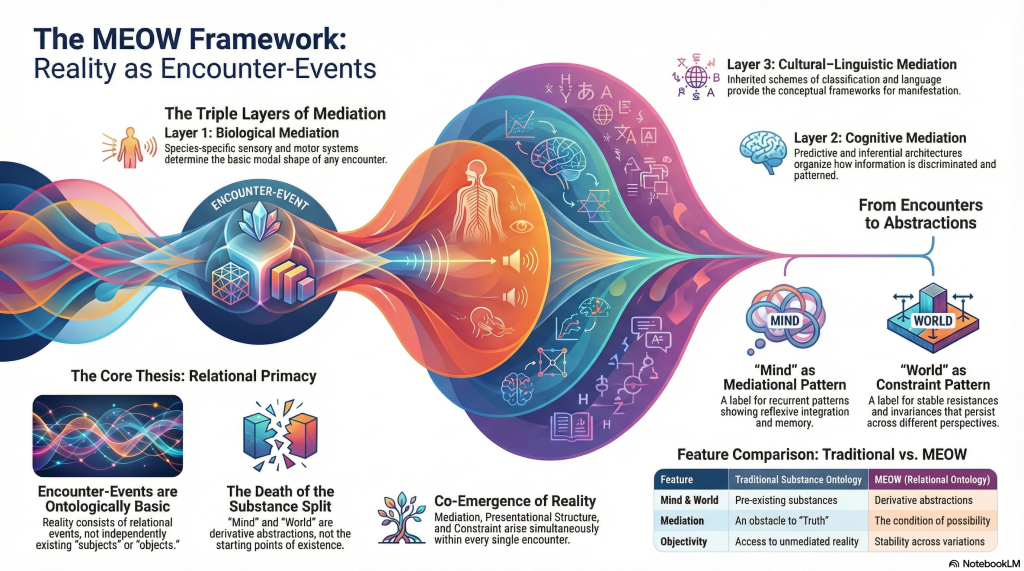
What the essay actually does

The Mediated Encounter Ontology of the World is the first framework I’ve written that genuinely sheds the Enlightenment scaffolding rather than rebuking it. MEOW shows:

  • Mediation isn’t an epistemic flaw; it’s the only way reality appears.
  • Constraint isn’t evidence of a noumenal backstage; it’s built into the encounter.
  • Objectivity is just stability across mediation, not a mystical view-from-nowhere.
  • ‘Mind’ and ‘world’ are names for recurring patterns, not metaphysical hotels.
  • And – importantly – MEOW does all of this without drifting into Whiteheadian cosmological fan-fiction.

The full essay is now published and archived:

DOI: https://doi.org/10.5281/zenodo.17685689

If you prefer a soft landing and the sound of a passable human voice explaining why metaphysics keeps tripping over its shoelaces, a NotebookLM discussion is here:

Audio: NotebookLM summary podcast of this essay.

MEOW is the survivor because it does the one thing philosophy is terrible at: it refuses to pretend. No substances, no noumena, no grand metaphysical machinery—just a clean, relational architecture that mirrors how we actually encounter the world.

And frankly, that’s quite enough ontology for one lifetime.


* To be perfectly honest, I originally fled from Michela Massimi’s Perspectival Realism in search of a cleaner terminological habitat. I wanted to avoid the inevitable, dreary academic cross-pollination: the wretched fate of being forever shelved beside a project I have no quarrel with but absolutely no desire to be mistaken for. My proposed replacement, Nexal Ontology, looked promising until I realised it had wandered, by sheer lexical accident, into Whitehead’s garden – an unintentional trespass for which I refused to stick around to apologise. I could already hear the process-metaphysics crowd sharpening their teeth.

Early evasive action was required.

I preferred nexal to medial, but the terminology had already been colonised, and I am nothing if not territorial. Mediated Ontology would have staked its claim well enough, but something was missing – something active, lived, structural. Enter the Encounter.

And once the acronym MEO appeared on the page, I was undone. A philosopher is only human, and the gravitational pull toward MEOW was irresistible. What, then, could honour the W with appropriate pomp? The World, naturally. Thus was born The Mediated Encounter Ontology of the World.

Pretentious? Yes. Obnoxious? Also yes.

And so it remains—purring contentedly in its absurdity.

Scientific Authority in an Age of Uncertainty

At a time when scientific authority faces unprecedented challenges—from climate denial to vaccine hesitancy—the radical critiques of Paul Feyerabend and Bruno Latour offer surprising insight. Their work, far from undermining scientific credibility, provides a more nuanced and ultimately more robust understanding of how scientific knowledge actually progresses. In an era grappling with complex challenges like artificial intelligence governance and climate change, their perspectives on the nature of scientific knowledge seem remarkably prescient.

The Anarchist and the Anthropologist: Challenging Scientific Orthodoxy

When Paul Feyerabend declared “anything goes” in his critique of scientific method, he launched more than a philosophical provocation—he opened a fundamental questioning of how we create and validate knowledge. Bruno Latour would later expand this critique through meticulous observation of how science operates in practice. Together, these thinkers reveal science not as an objective pursuit of truth, but as a deeply human enterprise shaped by social forces, rhetoric, and often, productive chaos.

Consider how modern climate scientists must navigate between pure research and public communication, often facing the challenge of translating complex, probabilistic findings into actionable policies. This mirrors Feyerabend’s analysis of Galileo’s defence of heliocentrism—both cases demonstrate how scientific advancement requires not just empirical evidence, but rhetorical skill and strategic communication.

The Social Construction of Scientific Facts

Latour’s concept of “black boxing”—where successful scientific claims become unquestioned facts—illuminates how scientific knowledge achieves its authority. Contemporary examples abound: artificial intelligence researchers like Timnit Gebru and Joy Buolamwini have exposed how seemingly objective AI systems embed social biases, demonstrating Latour’s insight that technical systems are inseparable from their social context.

The COVID-19 pandemic provided a stark illustration of these dynamics. Public health responses required combining epidemiological models with social science insights and local knowledge—precisely the kind of epistemological pluralism Feyerabend advocated. The pandemic revealed what sociologist Harry Collins calls “interactional expertise”—the ability to communicate meaningfully about technical subjects across different domains of knowledge.

Beyond Method: The Reality of Scientific Practice

Both Feyerabend and Latour expose the gap between science’s methodological ideals and its actual practice. This insight finds contemporary expression in the work of Sheila Jasanoff, who developed the concept of “sociotechnical imaginaries”—collectively imagined forms of social life reflected in scientific and technological projects. Her work shows how scientific endeavours are inseparable from social and political visions of desirable futures.

The climate crisis perfectly exemplifies this interweaving of scientific practice and social context. Scholars like Kyle Whyte and Robin Wall Kimmerer demonstrate how indigenous environmental knowledge often provides insights that Western scientific methods miss. This validates Feyerabend’s assertion that progress often requires breaking free from established methodological constraints.

The Pluralistic Vision in Practice

Neither Feyerabend nor Latour advocates abandoning science. Instead, they argue for recognising science as one way of knowing among many—powerful but not exclusive. This vision finds practical expression in contemporary movements like citizen science, where projects like Galaxy Zoo or FoldIt demonstrate how non-experts can contribute meaningfully to scientific research.

The “slow science” movement, championed by Isabelle Stengers, similarly echoes Feyerabend’s critique of methodological orthodoxy. It advocates for more thoughtful, inclusive approaches to research that acknowledge the complexity and uncertainty inherent in scientific inquiry.

Knowledge in the Age of Complexity

Today’s challenges—from climate change to artificial intelligence governance—demand precisely the kind of epistemological pluralism Feyerabend and Latour advocated. Kate Crawford’s research on the politics of AI parallels Latour’s network analysis, showing how technical systems are shaped by complex webs of human decisions and institutional priorities.

Feminist scholars like Karen Barad propose “agential realism,” suggesting that scientific knowledge emerges from specific material-discursive practices rather than revealing pre-existing truths. This builds on Feyerabend’s insight that knowledge advances not through rigid methodology but through dynamic interaction with multiple ways of knowing.

Towards a New Understanding of Scientific Authority

The critiques of Feyerabend and Latour, amplified by contemporary scholars, suggest that scientific authority rests not on infallible methods but on science’s capacity to engage with other forms of knowledge while remaining open to revision and challenge. This understanding might help address contemporary challenges to scientific authority without falling into either naive scientism or radical relativism.

The rise of participatory research methods and citizen science projects demonstrates how this more nuanced understanding of scientific authority can enhance rather than diminish scientific practice. Projects that combine traditional scientific methods with local knowledge and citizen participation often produce more robust and socially relevant results.

Conclusion: Embracing Complexity

Feyerabend and Latour’s critiques, far from being merely historical curiosities, offer vital insights for navigating contemporary challenges. Their work, extended by current scholars, suggests that the future of knowledge lies not in establishing new orthodoxies but in maintaining openness to multiple approaches and perspectives.

In an age of increasing complexity, this pluralistic vision offers our best path forward—one that recognises science’s value while acknowledging the essential contribution of other ways of knowing to human understanding. As we face unprecedented global challenges, this more nuanced and inclusive approach to knowledge creation becomes not just philosophically interesting but practically essential.

The lesson for contemporary science is clear: progress depends not on rigid adherence to method but on maintaining open dialogue between different ways of understanding the world. In this light, the apparent chaos Feyerabend celebrated appears not as a threat to scientific authority but as a necessary condition for genuine advancement in human knowledge.