That perception and memory work hand in hand is mostly taken for granted, but this case reminds us that this sometimes breaks down. This is not the case of the neurotypical limitations to fallible sense organs and standard cognitive boundaries and biases. This subject can’t discern the arabic numerals from 2 through 9.
To recap the study, the man can perceive 0 and 1 as per usual, but numerals 2 through 9 are not recognisable. Not even in combination, so A4 or 442 are discernible.
In a neurotypical model, a person sees an object, a 3 or a tree, and perhaps learns its common symbolic identifier—’3′, ‘three’, or ‘tree’. The next time this person encounters the object—or in this case the symbol—, say, 3, it will be recognised as such, and the person may recite the name-label of the identifier: three.
It might look like this, focusing on the numerals:
For each observation, the impression of 3 is different.
Phenomenologically, this is different to the question of whether two subjects share the same perception of, say, the colour red. Even if you perceive red as red, and another perceives red as red, as long as this relative reference persists to the subject, you can still communicate within this space. When you see a red apple, you can remark that the apple is red—the name marker—, and the same is true for the other, who can also communicate to you that the apple is indeed red because the word ‘red’ become a common index marker.
But in the anomalous case, the name marker would have little utility because ‘red’ would be generated by some conceivably unbounded stochastic function:
Colourₓ = ƒ(x), where x is some random value at each observation
It would be impossible to communicate given this constraint.
This, as I’ve referenced, is anomalous, so most of us have a stronger coupling between perception and memory recall. Interesting to me in this instance is not how memory can be (and quite often is) corrupted, but that fundamental perception itself can be corrupted as well—and not simply through hallucination or optical illusion.
I was engaged in a conversation in a Facebook Philosophy group for Pragmatists. I feel that these groups take me as adversarial because I question their system of belief. To the extent that I accept any categorical distinction, I consider myself to be a Postmodernist first and foremost and a Pragmatist second. In a similar fashion, I am at once an atheist first, but I operate as a Buddhist. I am a nihilist first, but I operate as an Existentialist. In any case, in explaining this, I hit upon an analogy that I hadn’t considered before.
everything just ‘is’
Pragmatism is Samsara. In Buddhism, there is the concept of Samsara, which contains the realms we reside in before we reach Enlightenment, the state of realising that everything just ‘is’, is , and is undifferentiated, at which case we either exit the system or remain as aware (woke anyone?) Bodhisattvas.
everything is a constructed illusion
The ‘just is’ is the postmodern condition. Nothing is as it seems and everything is a constructed illusion. There is no good, no bad, no right or wrong—not even black or white. This is all perception of difference, but there is no difference.
I am a Buddhist in the same way I am a Pragmatist. I know that this is all a cognitive construct—or constructs—, but I am still stuck in the middle of it, ‘thrown in’ (Geworfenheit) to echo Heidegger, and I attempt to make the best of it. None of it is real, but, as with people of the Matrix, I can’t perceive my way out of it.
The risk for Pragmatists is that they are empiricists. They trust that the past will ostensibly operate the same as the future. It’s been generally that way thus far, and we’ve misinterpreted how things operate in the past, but we’ve corrected this interpretation, and we’ll correct and refine these interpretations in future. That’s the employed logic. I’ve not got a better plan, so as shoddy or rickety as it might be, it’s my life raft replete with holes, but I’ll patch them as swiftly as I can and hope my history of having not encountered any sharks or tidal disruptions or undertows persists.
none of this exists
All the while, my core beliefs are that none of this exists—not in a solipsistic way, just not as we imagine it does. It’s the wall constructed of atoms and molecules that is more space than not, and yet we can’t pass through it. If only we could all be Neo and overcome this misperception.
Please note that this content has been subsumed into the originating article: The Truth about Truth.
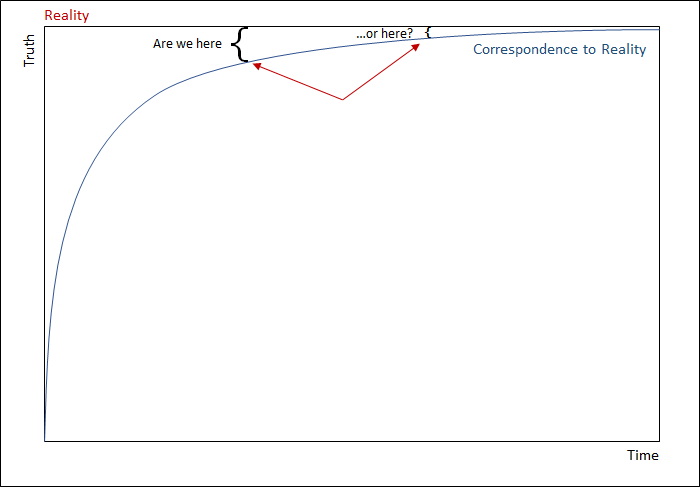
We have no idea how close or far we are from Reality on the Y (Truth) axis.
Graph: Correspondence of Truth to Reality (Asymptotic Curve)
Assuming for the time being that there is an approachable truth, we have no reference to understand how close to reality we might be. In practice, we seem to operate on a basis of always being within some level of statistical significance of where Truth = Reality, and when new information is introduced, we say, “Hooray for Science!” Aren’t we glad that science is self-correcting. And Empiricism has its own issues.
Historically, we’ve had ‘wrong’ correspondence between Truth and Reality, but then we got it ‘right’—until we didn’t.
We may all know how Einstein progressed and refined Newtonian physics. What Einstein did is to create a new narrative—a synchronous shift of paradigm and rhetoric—, which has been accepted into a new orthodoxy. In our mind, this feels like progress. How close are we to the real truth?
Taking our understanding of gravity or of the fabric of space-time, we still have no idea what’s going on or how it operates, but this doesn’t prevent us from accepting it as a black box and making pragmatic predictions from there. So, for all intents and purposes, the ‘truth’ mechanism is less important than the functional relationship, just as I can tell time on a watch I have no idea how it operates.
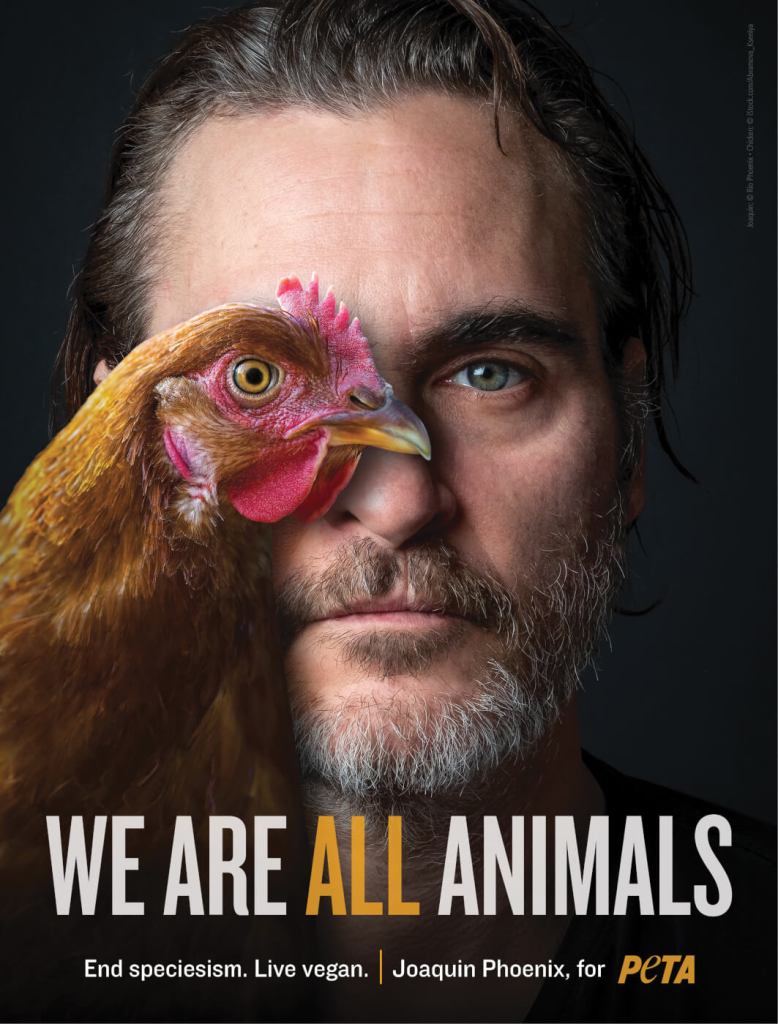
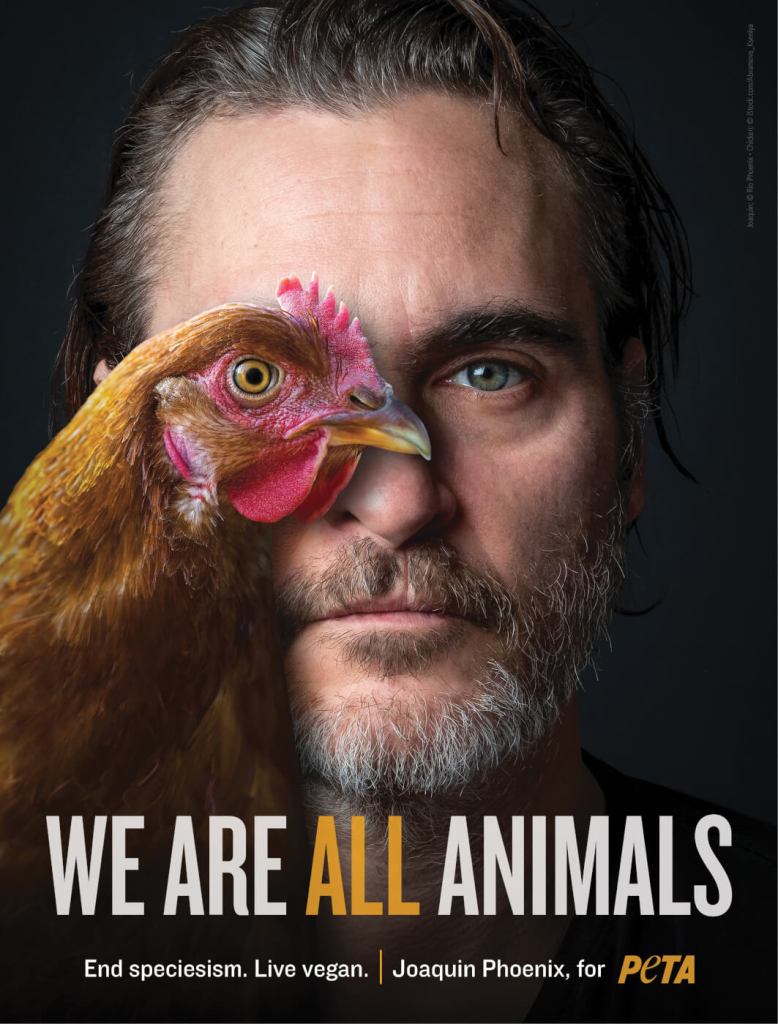
Why is racism wrong but speciesism OK? Primarily, other species have no voice, and to have no voice is to have no say. This advert got my attention.
Joaquin Phoenix Advert
Humanism is part and parcel specious Enlightenment tripe, where ‘coincidentally‘ humans put themselves at the forefront. Copernicus removed Earth from the centre — though to be fair, even Christians had elevated gender-non-specific-Man above other animals — , but Humanism makes it more poignant that it’s Man at centre not God. Gods be damned. In fact, it’s often an afterthought that humans are animals at all, despite only the slightest veneer of consciousness and, more to the point, language to separate us from them.
Otherness has proven itself to be an evolutionary survival aspect, one that has brought me to a point where I can write this, so one can call it natural, another term fraught with connotational baggage. To be able to differentiate and discriminate appear to be valuable attributes, but how much is enough, and how much is too much.
Buddhism teaches that we are all one with the cosmos and that any distinction is an illusion. Buddhist Enlightenment — not to be confused with Western Enlightenment — is to understand this, to not be bound to the illusion.
But, if racism is wrong, why is speciesism OK? Humans do give some animals some rights, and some places give different animals different rights, whilst others give animals categorically more and fewer rights. Some places ascribe divinity upon animals, elevating them above humans.
Racism seems to be more wrong because humans are more genetically homogeneous — at least phenotypically. Other mammals and herptiles don’t look so much like us. In observation, when they do, we have an additional layer of empathy, so chimps and canines with expressive eyes gain sympathy not afforded crustaceans and pinnipeds.
I don’t have an answer save to say that it’s just convenient and someday we may see a world as portrayed by science fiction where some — mostly bipedal species — live quasi-harmoniously with humans. But even there, humans are always the start, front and centre to provide to moral POV.
Identity is a human construct, but, more specifically, it’s a social construct. If you were abandoned in a place without human contact and with no prospects for contact, your current perception of yourself would wither away. If you are born in this place (and managed to survive and somehow have language to self-articulate), you would have little of what one might term identity. Whether the ability to discriminate yourself from other species and objects may not qualify for identity.
Identity is not a solo sport. One needs at least two to play.
For every identity, i, the relationship must always be
i ≥ i + 1
Where by ≥ , I mean at least equal to. In fact, for each i, one may be able to argue that one should multiply the number of identities by the number of nodes, which is to say the number of participants in forming the identities. This accounts for developed personae.
i ≥ n(i + 1)
Today, this was on my mind (as it were) as I was grocery shopping. I identify as an urbanite. I’ve lived in cities and in near suburbs, but I’ve recently moved from a rural setting to a more rural setting.
Sidenote in the middle:
It’s easy to see why the US are so politically fractured. Fundamentally, I do not see the world as do my rural neighbours. I am already predisposed to be an introvert, but this gives my more reason to segregate. These neighbours just view different things as fundamentally important. And the people create a veritable monoculture. I could pretend to fit it. Instead, I remain at the margin and watch.
Thankfully, my profession allows me to work remotely, but I have the opportunity to visit cities when working closely with my clientele. To be even more honest, in my reckoning the US have only 2 cities, New York and Los Angeles. I’ve lived in Chicago, have worked in Houston, and live south of Philadelphia at the moment–the 3rd, 4th, and 5th largest cities in the US, all of which pale in comparison to numbers 1 and 2. And my heart, as it were, resides in LA.
And we’re back…
Where other people are concerned, they have a vision of our identity, and we have our own. And this doesn’t exist in a vacuum, as we somewhat adjust our identity if we wish to be accepted into the group, but we don’t typically lose our self-identity, even if we can’t fully express it.
Some identities are easier to hide than others. If I am a gay female, I can just not discuss the matter or deny it if the situation would otherwise be hostile, but it doesn’t make me less gay. And to the other party, the may see me as a nubile woman.
Fairly obviously, my mum sees me differently to my coworkers or even my spouse, and most people I’ve seen interact with their parents differently than other people. This is about the identity of the persona. This is how a 30- or 40-something can still feel like a child when interacting with a parent but would never demur to, say, a peer.
In isolation, there is no need for identity in this way. If I am a trans-male who in society identifies with wearing clothes traditionally reserved for women of the same culture, there are no other women to model myself after. If I have these clothes available, I’ll wear them. Perhaps I have left my favourite dress behind, and I remember it fondly. This was a part of my former identity.
But would I spend time dressing well and applying cosmetics if the chance of meeting another human was nil to none? Unlikely.
And what if two heterosexual males were to find themselves abandoned with little hope for rescue? Would this be Brokeback Mountain revisited? This is stereotypical prison behaviour. Of course, in this case, this is a temporary identity override, and perhaps not something to ever admit once reinserted into polite company.
So What?
Whilst shopping, I was hypercritical (though quiet) about how I did not feel I fit into the environment. I questioned whether I might be considered to be a misanthrope. Not that I hated these people, but I just did not identify with them. And though I could be civil in short doses, it was not my preference to interact.
Truth be told, there may have been plenty of other people thinking the same thing, but how would one tell? At times, I’ll wear identifying clothing, like a tee-shirt that reads ‘Jesus Saves Sinners… and redeems them for valuable cash and prizes‘. These tend to attract the like-minded people with senses of humour, and the people baited into the headline but offended by the punchline.
Although I have changed my opinion and perspective over the years, I feel that most people settle into their ways, fixing their positions with an unhealthy dose of confirmation bias. I’d like to think that I could change my position materially from where I am now given the introduction of new evidence, but I don’t think it’s likely. First off: because I am coming from a vantage where I feel I am ‘right’.
Don’t believe everything you think.
— Various
Of course, there is no absolute right, but from the perspective of the times and place and some triangulation, I’ll say ‘relatively right’.
Rewinding…
When I left high school in 1979, I considered myself to be generally Conservative — at least as I understood the word to mean and without dimension or nuance. I’m not sure I had a great grasp of the definition.
Upon graduation, I entered the military. I remember in conversation with a mate that I was a Conservative. He laughed, and said I was the least Conservative person he’d ever come across. I was perplexed, but I had to reorient my self-perspective.
New Definition
I decided that I was a Conservative — a Fiscal Conservative —, but I was a Social Liberal. I’d pretty much been a Social Justice Warrior (SJW), concerned with the underdogs, but it wouldn’t be on my dime — or the prospect I had for future nickels and dimes.
I held this position for years — until I realised that the two positions were untenable. You can’t simultaneously offer full social equality for free, and these were rights we were discussing. Fundamental rights. If money was the friction between a right and its realisation, then it needed to be spent. Fiscal Conservatism be damned!
Politicus Interruptus
Somewhere in the fray, I had dabbled with Libertarianism. Again, I dismissed this as an untenable fantasy. There had never been even close to an instance of this working, and it goes against the grain of all social concepts. It’s built on a dream — somehow anarchy without the anarchy, so anarchy + magic.
Progress
At some point, I didn’t like the PR of the Liberal tag, so I opted for Progressive. In the real world, I tend to side pragmatically with Progressives — the Bernie Sanders crowd in the US — , though I understand the illusion of progress and of politics in general.
Searching further to find a political identity, I settle on anarcho-syndicalism, the system I most identify with today, though there are only slightly more examples of this as there are Libertarian instances, a problem being that when some people see a leaderless group, they see it as a vacuum, and history repeats itself, so I’m not sure how sustainable this system could be.
This is now…
I am under no delusion that there is a right way for society to exist. I do believe there are plenty of wrong ways, but there are too many dimensions and complexities to have a single way. After all, how are you optimising the system? Trade-offs exist, and making a choice to maximise X might (and does) mean that Y is no longer maximised. Do you make X = 10 and Y = 8, or do you settle for X = 9 and Y = 9? And there are decidedly more than just X and Y.
There is no real reason to believe that society or even humans should exists, but given consciousness and self-preservation urges, I’ll take that as a given. That’s an inviolable metanarrative element.
Sort of interesting topic, but I’ve been too busy to post much or respond lately.
Think about the concepts of “red” and “justice” and you’ll notice a key difference. If you’re sighted, you’ll associate “red” most strongly with the sensory experience, which relates to signals from cone cells in your eyes. “Justice”, in contrast, doesn’t have any associated sensory qualities – as an abstract concept, you’ll think about its meaning, which you learnt via language, understanding it to be related to other abstract concepts like “fairness” or “accountability”, perhaps. But what about blind people – how do they think about “red”?
A brain-imaging study of 12 people who had been blind from birth, and 14 sighted people, published recently in Nature Communications, shows that while for sighted people, sensory and abstract concepts like “red” and “justice” are represented in different brain regions, for blind people, they’re represented in the same “abstract concept” region.
Find your self. What is this self you are searching for, and who is you in the first place?
You and self are taxonomical references—conveniences—, yet they don’t actually exist.
πάντα ῥεῖ : The only constant is change
Heraclitus of Ephesus
The Second Law of Thermodynamics states that entropy rules. Things decay. We can see this in the great structures of our ancient past. Try as we may, without energy, everything falls apart.
There is no you. The you that was born is not the same you that attended kindergarten, that graduated high school, dated, worked, or died. Even in a short span of time, you switch personae. Can you be multiple yous simultaneously? Are you only expressing some instance or another? I’m not buying it.
No one ever steps in the same river twice, for it’s not the same river and he’s not the same person
Plato, attributed to Heraclitus
When Heraclitus said that no man ever steps into the same river twice, it’s not only the river that has changed; the person has changed, too. It’s not the same person.
Woman in River
For the sake of convenience, we create this sense of identity, whether for ourselves or for others we want to categorise in some form or fashion. But they aren’t the same either.
It’s like the physical object that appears to be solid and yet is more space than material. It’s a matter of convenience, but it’s a trompe l’oeil. Yet again, your senses have deceived you.
Does this impact survival or some evolutionary progression? Apparently not. Not if you are here to read this. But that doesn’t make it real. Perception is reality.
But what about identity politics? Can’t a person choose their own identity? Sure. Choose away. It doesn’t it real.
I’ve written about the difference between sex and gender. Both are taxonomical creations. Whether a society accepts the distinction between sexes, genders, or even of the distinction of sex and gender is up to that society.
One is not born, but rather becomes, a woman.
Simone de Beauvoir, Second Sex
As with sex and gender, identity is a social construct. As such, its acceptance into a society is yet again a rhetorical effort.
OK, so this isn’t at all about Foucault’s rhetoric. My main riff this year is the assertion that there is no Truth, only rhetoric—or should I rather say Rhetoric. I created a Reddit post asking for references to other philosophers (or whomever) who had made a similar claim, to which I was offered Vico and Rorty. Unfortunately, there were only two responders, and their assistance was superficial.
What I did encounter by one of the responders was a criticism similar to that levelled at Foucault, hence the inspired title of this post. This critique at its essence is that having proposed no positive solutions to the issues I point to, I cannot defend my position. In fact, as with Habermas‘ fault with Foucault, evidently, I have disarmed myself.
I find this line of argumentation weak tea at best. To argue that one has no claim to declare something incorrect if they don’t have a correct replacement for it is absurd. For example, I don’t know what 13,297 ÷ 1,492 equals arithmetically; but I can assert with confidence that it does not equal 2. Moreover, to criticise, one doesn’t need the ‘ability to generate positive alternatives’.
“There is no truth but rhetoric.”
So when I say there is no Truth but rhetoric (for non-ontic concepts), I am making a Truth statement. As such, this assertion—by my own admission—is only as strong as the rhetoric I can muster to its defence. Alas, my defences are weak, and so the argument fails. Were I to make a stronger argument—a more convincing argument—, it might be accepted as Truth.
Evidently, my first mistake was to separate ontic and non-ontic, which is to say things existing apart from their given names and those whose existence is entirely fabricated. An ontic thing might be a stone, a tree, a planet, a star, or the sensation of pain. These things exist even without language, a label, or an observer. As Saussure and other structuralists have noted, in semiotics, there is the signified (or referent) and the signifier—the object and the identifier. In the context of language, these are tautological.
There is no spoon.Non-ontic things are conceptual, freedom, truth, justice, rights, gods, and so on. I may opt to replace non-ontic with language-contextual or some such to sidestep the taxonomical quagmire. Or perhaps I’ll adopt the dichotomy of concrete versus abstract. These concepts do not exist outside of language. They are wholly constructed in a complex system created by humans—and humans whilst humans have done OK with complicated systems, they have an abysmal track record when it comes to complex systems. By analogue to the physics of solids, there is more space than atoms, and the atoms and their constituent particles are in constant motion—zero-degrees Kelvin, be damned. Our senses perceive something to be there, but as in that scene in The Matrix, ‘there is no spoon‘.
In my mind, leveraging Saussure’s ideas are useful to depict the differences in the concrete versus the abstract.
The famous painting depicted above illustrates explains the difference between a signifier and a referent. In this image, there is only the signifier. Magritte makes clear the distinction with the text, Ceci, n’est pas une pipe: This is not a pipe. It is merely a depiction of one. To be even more arcane, the image is a signifier to another signifier that in turn refers to the referent.
A sign is the device that encapsulates the concept. It may be visual—an icon (an illustration of photograph) or a written word or even Braille—or it can be spoken or signed, as with American Sign Language. These are all signs.
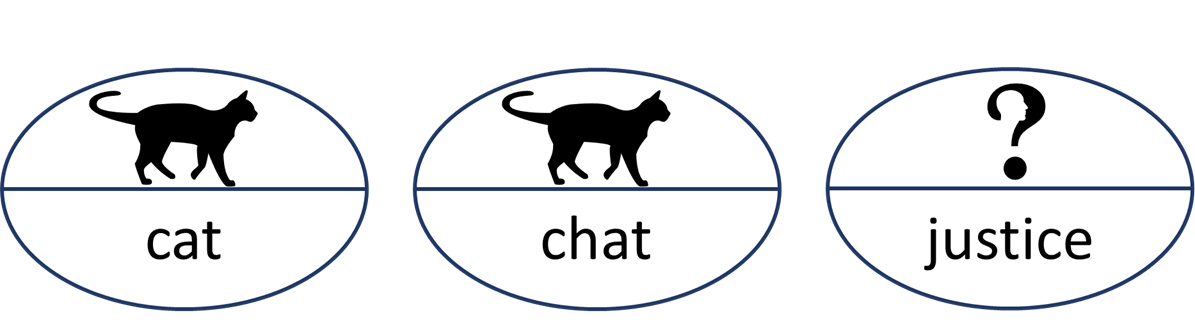
Notice when one considers a sign that a concrete cat (or in French, chat), it is pretty clear to what one is referring. Above the line, we see the signified, the idea conveyed by the sign. This doesn’t mean that everyone sees the silhouette depicted above, but it is a catlike thing, a feline animal, a mammal, normally with four legs and a tail. Perhaps you are thinking of a particular cat. But to someone with a grasp of the language in which you are communicating, when you say cat, there is little room for ambiguity. In fact, if you are trying to teach someone a different language, say, French, you could show them the cat with the chat signifier, and they would grasp your meaning almost instantaneously.
All language is arbitrary and socially constructed, so there is no connection between the words—say, the spelling or shape of a word—and its referent. The words cat and chat do not look like cats.
There are concrete things that cannot be so readily translated into an icon; for example, the wind. However, one could fairly quickly be able to articulate or gesticulate, as the case might be, the notion of wind. The same cannot be said for the abstract concept of justice.
As I’ve mentioned before, justice, especially one of the restorative or retributive varieties, is a euphemism for vengeance. The distinction is supposed to be found in the intent, but intent cannot be known; it can only be inferred. And, speaking of Foucault, justice can only be delivered from a power position.
But the notion of justice relies heavily on social construct; it has geo-spacial dependencies. What is considered to be just in ancient times may not be considered just now. What is considered just in one country might not be considered to be just in another. And this is more than a difference in instantiation. It is due to the arbitrary if not capricious articulation of a nebulous concept.
Returning to Foucault, (Christian apologist) Nancy Pearcey declares his stance paradoxical: “[when someone] states that it is impossible to attain objectivity, is that an objective statement? The theory undercuts its own claims.”
First, Pearcey merely asks a question about objectivity, but it doesn’t matter. The answer is: this may as well be an objective statement, but it’s just another language game. Wittgenstein (and Russell and Heidegger and Rorty…) was on the right path when he pointed out that the ambiguity inherent in language provide cover for all sorts of mischief. I’m only pretty sure that Derrida might yield paydirt as well. Besides, let’s pretend for a moment that there exists some objective truth, there is no reason (language game; except in accepting the broadest definition, reason is a capability elusive to many if not most humans) to expect that this truth is either accessible or verifiable anyway. The best one can do is to pose a more convincing rhetorical argument.
Reason /ˈrēzən/ (noun) the power of the mind to think, understand, and form judgments by a process of logic
A similar critique has been advanced by (another Christian apologist) Diana Taylor, and by Nancy Fraser who argues that “Foucault’s critique encompasses traditional moral systems, he denies himself recourse to concepts such as ‘freedom’ and ‘justice’, and therefore lacks the ability to generate positive alternatives.”
So whilst I’ve just managed to stream-of-consciousness my contention, I am not in a position to resolve anything. For now, I’ll settle for documenting my position as I continue to search for other supporters and formulate a more cogent response, a more robust rhetorical presentment.
If anyone can direct me to resources relevant to my position, let me know in the comments. I’ll appreciate it. If you don’t agree—which would be expected, as this is the accepted orthodoxy—feel free to comment as well.








![There_is_no_Spoon[1]](https://philosophics.blog/wp-content/uploads/2018/07/there_is_no_spoon1.jpg)
![1bb[1]](https://philosophics.blog/wp-content/uploads/2018/07/1bb1.jpg)
 Philosophics