The Matter with Things: Chapter Three Summary: Perception

Index and table of contents

In this segment, I continue the journey through Iain McGilchrist’s masterwork, The Matter with Things by summarising chapter three, Perception, a followup to the previous chapters, respectively titled Some Preliminaries and Attention. I strongly recommend that you listen to these in turn, but feel free to play the rebel and cut queue. No one will even notice but you, and if you don’t tell, neither shall I. Come join me.

Podcast: Audio rendition of this page content

Intro

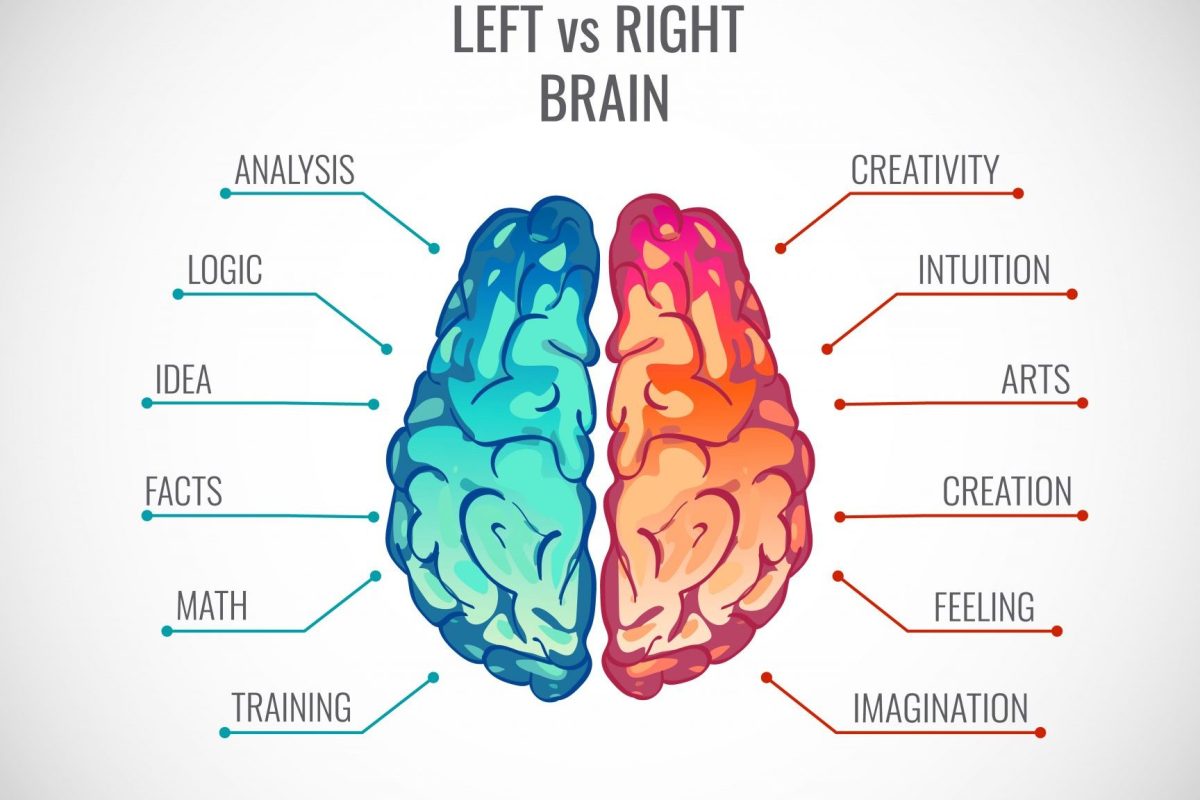
Chapter two of The Matter with Things is titled Perception. Following the previous chapter, Attention, itโ€™s about how we perceive what we attend to. Without attention, there is no perception, but perception is not always correspondent with the so-called reality โ€œout thereโ€.  

Content

From the start, McGilchrist wants to assess which hemisphere is more veridical. Spoiler Alert: Itโ€™s the right half. But you already knew that because youโ€™ve been keeping pace. And you also know that I feel he is leaving an option on the table, that neither is veridical to the actual terrain; rather, one just better maps the map. But the question essentially resolves to the same place, not as much verity as trust.

Sensory perception occurs in both hemispheres, but it is better in the right hemisphere than the left, as the left has been somewhat relegated to re-presentation over timeโ€”the same hemisphere that is better suited for codifying and mapping using symbolic languageโ€”something reserved for the brains of primatesโ€”which gives us a virtually inexhaustible way of mapping the world.

Perception is holistic, something better handled by the right hemisphere, being as the left hemisphere is more about focus and specificity. On balance, the right hemisphere is the arbiter of performance delegation, whether to perform a task or delegate it to the left hemisphere. About three-quarters of perception functions are right hemisphere processes.

McGilchrist is partial to the position advanced by Merleau-Ponty, that is โ€œperception as a reciprocal encounter.โ€ Perception is not a passive act. It is an interactive intercourse with the environment. What and how we perceive is affected by our experience and the situation.

Visual Perception

Perception involves all the available sensesโ€”and by definition none of those otherwise unavailable. He starts with vision. The right hemisphere does a lot of heavy lifting here. It handles size, shape and pattern recognition, contour, shadows, distance and depth, for example, three-dimensional space, and motion and time as well as the ability to recognise objects from unusual angles or from incomplete information, which I tend to think of as playing some Gestalt role. The right also handles colour perception, though the left maintains the colour name mapping.

The left hemisphere is slightly faster at detection, but if what is detected has any signal degradation, the right hemisphere tends to be more accurate. And since the left hemisphere is, what Iโ€™ll call lazy, it may tire quickly and space out, so the right hemisphere may have to intervene, if even a bit more slowly. Paradoxically, if the left hemisphere is given more time, its recognition error rate increases. Incidentally, one reason the right hemisphere may respond more slowly is that it is deliberating to attempt to deliver the correct response whilst the left tosses out its first best guess and declares victory. Nailed it!

Nailed It!

Recall from the last chapter that the left hemisphere is also a master of denial, so it is unapologetic when it guesses wrong. I imagine it signalling โ€˜thatโ€™s not a busโ€™ just as it hits you and then insists that it never was a bus; that injury must have been caused by something else. Perhaps it was an untoward wrecking ball. 

Without delving into details here, McGilchrist points out that much early research might be invalid because it employed cathode ray tubesโ€”CRTsโ€”whose mechanisms present biased information to the visual field, thereby invalidating conclusions.

the left hemisphere is better at recognising toolsโ€”hammers and spannersโ€”, but not musical instruments, which it perceives more as living entities

An interesting area for me is that the left hemisphere is better at recognising toolsโ€”hammers and spannersโ€”, but not musical instruments, which it perceives more as living entities. And this is an apt segue to auditory perception.   

Auditory Perception.

Whereas the left hemisphere is better at symbolic language processing and โ€œthe processing of meaningless noises, such as clicksโ€, the right hemisphere pretty much handles the rest, from pitch, inflexion, tone, phrasing, metre and complex rhythm, and melody. The left keeps tabs on basic rhythmic patterns. It is assumed that rhyming relies on both hemispheres working in concert.

For most people, music processing is a right hemisphere event, but this is not true for professional musicians, who utilise both hemispheres, likely owing to the musical language translation processing unnecessary for the casual listener.

Olfactory Perception

Interestingly, the acuity of the nose is orders of magnitude superior to that of the eyes and ears. Olfactory recognition and discrimination have a right hemisphere preference, but emotional reactions to scent may be stronger in the left hemisphere.

Gustatory Perception

โ€œApart from five very basic tastes โ€“ salt, sweet, sour, bitter and umami โ€“ which come from the tongue, all flavours come from the olfactory sense.โ€ In general, gustatory perception is a right hemisphere function. However, there is an exception for professional wine tasters, who like professional musicians need to map experiences to words associated to rating and naming.

Tactile Perception

Remembering that the right hemisphere controls the left half of the body, whilst the left hemisphere controls the right, the sense of touch is superior in the left hand. Feelings of warmth, and temperature discriminations in general, are associated with right hemisphere activation. Interoception, the ability to perceive the internal workings of the body, is another right hemisphere process.

Local versus Global Perception

Recall that the right hemisphere captures the world holistically whilst the left hemisphere has a laser focus. This equates respectively to global and local perception. As it happens, the right can do both, but the left is limited to local. This means that if the left hemisphere is damaged, the right can pick up the slack, but if the right hemisphere is damaged, the left cannot compensate for the lost holistic perspective. In practice, the right runs the show and delegates to the left when it deems it to be appropriate for the circumstance. For some reason, normal adolescents have a bias toward local perception over global.

Pathologies of Perception

This leads us to abnormalities, such as Alzheimerโ€™s disease. Deterioration of right hemisphere function leads to a sense of disorganisation and loss of sensation. This hemisphere is also responsible for constructing a sense of self and self-awareness. McGilchrist calls out that the term self has multiple meanings. Much of the notion of self is associated with the medial prefrontal cortex in both hemispheres, but the objectified self and the self as an expression of will (in the respect Schopenhauer spoke of) are left brain aspects.

Perception of a contiguous self over time is a right hemisphere function, the loss of which is not uncommon in cases of schizophrenia.

In discussing visual hallucinations and distortions, almost ninety per cent of these have been attributable to right hemisphere anomalies. McGilchrist shares examples over several pages, but Iโ€™ll summarise by description alone of what can be categorised under the umbrella term of metamorphopsia. These might lead to object impermanence, or viewing things as too large or too small, too close or too distant, skewed, or the wrong shape altogether. In some cases, only half of an object, including self-perception, was outsized. This might occur on a macro level or a micro level, which is to say that it may be entire objects or bodies or just faces, or just familiar faces or just eyes or just one eye.  This might occur on a macro level or a micro level, which is to say that it may be entire objects or bodies or just faces, or just familiar faces or just eyes or just one eye.

Some of these cases involved motion, for example, the sense that some object is receding away from the observer as the observer draws nearer to it.

After a journey through Charles Dodgson, AKA Lewis Carroll, and Alice in Wonderland, provides a plethora of examples in prose of some of these visual effects.

From visual hallucinations, we wonder through hallucinations of the other senses, though the data points on these are much sparser, but the left hemisphere does seem to be the culprit of most auditory hallucinations.

Perspective

To summarise, I am again left to feel that the left hemisphere is a deadbeat hanger-on. Itโ€™s there in a pinch, but itโ€™s an unreliable narrator and worker that falls asleep at the wheel. Psychology does have a position on what a normal person should see and hear and taste and touch, but normal doesnโ€™t mean real. 

I was hoping to see some information and perspective on synaesthesia, a condition where people perceive experiences through sense-perception organs different to normal. These people see music and hear smells or taste colours and so on. We consider this to be anomalous, but does it provide a fitness benefit, and are these people ahead of “normal” people or are they carrying excess baggage that creates a burden, even if the condition is otherwise benign.

Now that weโ€™ve covered attention and perception, weโ€™ll be covering judgment in the next chapter.  I hope youโ€™ll join me.

What are your thoughts? What did you think of this chapter? Have you experienced or know of anyone who has experienced any of these so-called anomalies. Are you familiar with any of the effects mentioned in Alice in Wonderland? Leave comments below.
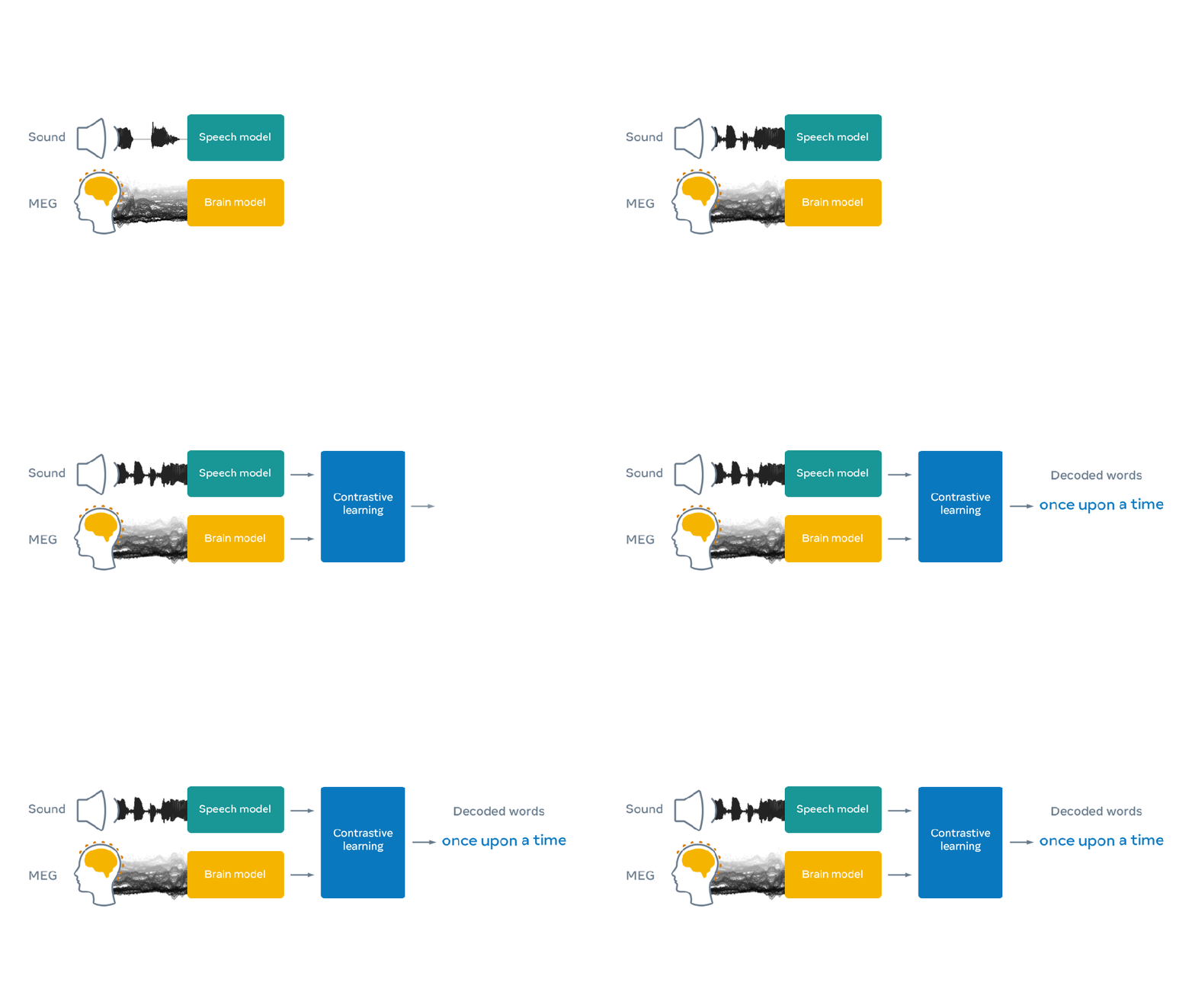
Using AI to Decode Speech from Brain Activity

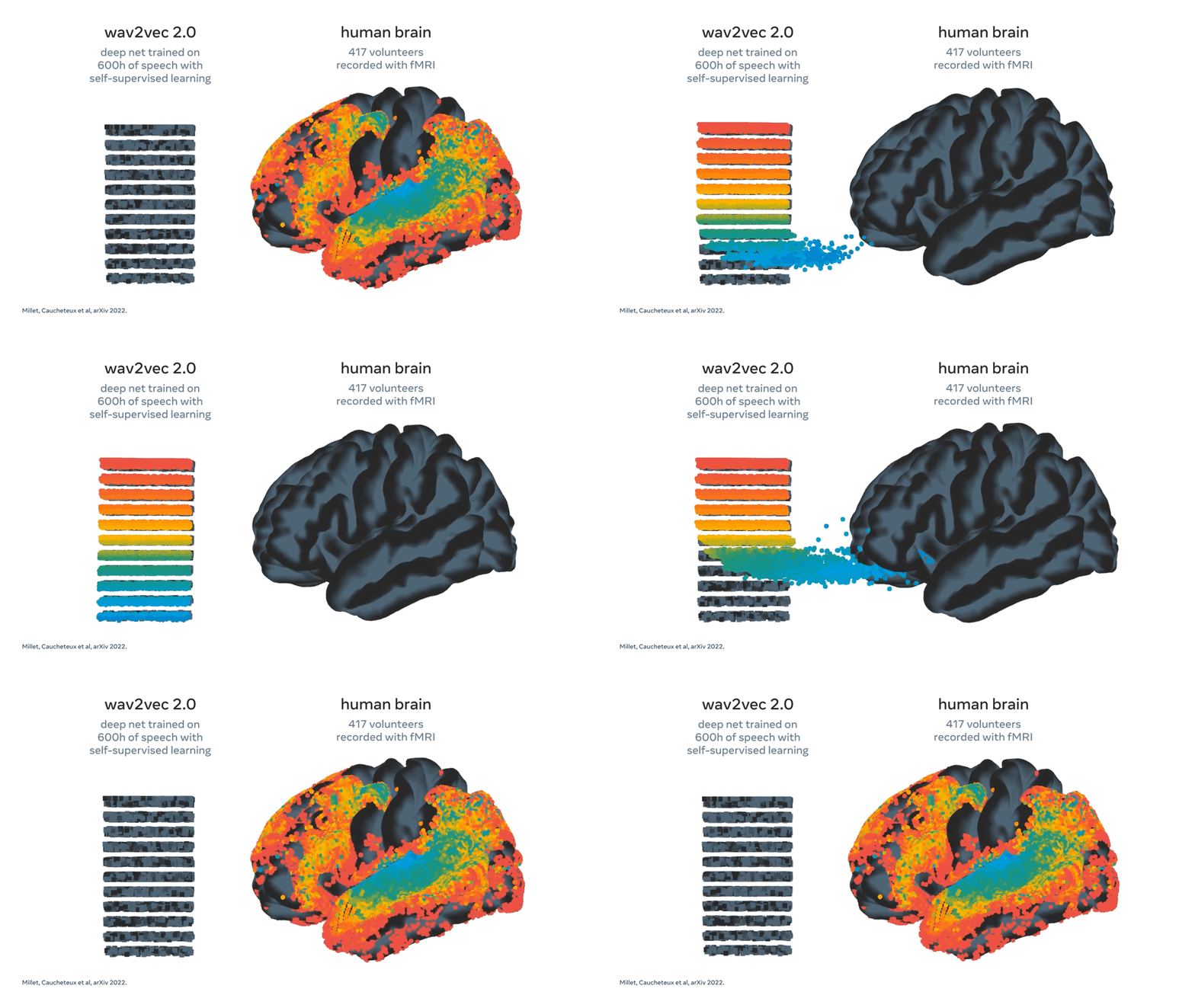
Apologies in advance for sharing PR hype from Meta (formerly known as Facebook),but I want to comment on the essence of the idea, which is using AI to decode speech from brain activity. It seems to imply that one would apply supervised machine learning to train a system to map speech to brain activity as illustrated by the image below.

Podcast: Audio rendition of this page content
To decode speech from noninvasive brain signals, we train a model with contrastive learning to align speech and its corresponding brain activity

The dataset would require the captured patterns of a large enough sample size. In this case, it appears to have been some 417 volunteers.

Activations of wav2vec 2.0 (left) map onto the brain (right) in response to the same speech sounds. The representations of the first layers of this algorithm (cool colours) map onto the early auditory cortex, whereas the deepest layers map onto high-level brain regions (e.g. prefrontal and parietal cortex).

This feels like it could have many commercial, consumer, and industrial uses including removing other human-computer interface devices, notably keyboards, but perhaps even mouses. Yes, I said mouses. Sue me.

Given hypotheses related to language and cognition, I am wondering what can be gleaned by mapping different multiple native language speakers to cognitive processes in order to remap them to speech output if it would be able to arrive at some common grammar that could then output a given thought stream into any known (and mapped) language, allowing for instantaneous “translation”.

Of course, a longer-term goal would be to skip the external devices and interface brain to brain. This sounds rogue science fiction scary, as one might imagine an external device trained on a brain to read its contents. One of the last things this world needs is to have to worry about neuro-rights and about being monitored for thought crimes. Come to think of it, isn’t there already a book on this? Nevermind. Probably not.

Technology is generally not inherently harmful or helpful, as that is determined by use. Humans do seem to tend toward the nefarious. Where do you think this will go? Leave a comment.

The Matter with Things: Chapter One Summary: Some Preliminaries and How We Got Here

Index and table of contents

I’ve decided after all to share my thoughts as I journey through Iain McGilchrist’s The Matter with Things. Come join me.

Podcast: Audio rendition of this page content (6:41)

Intro and Biographical

Iโ€™ve decided, perhaps against my better judgement, to have a run at Iain McGilchristโ€™s The Matter with Things. At almost 3,000 pages this seems a bit daunting at the start. I debate whether I wish to pursue this course because it slows my pace significantlyโ€”perhaps allowing me to progress at a rate 15 to 20 per cent of what I might have otherwise been able to maintain. However, creating content affords me at least two offsetting benefits. Firstly, I get to share my experience with a wider audience and do so in the moment. Secondly, it allows me to better absorb and comprehend the material. As a former professor of economics myself, I internalised the aphorism โ€œto teach is to learn twice.โ€ Of course, this is not teaching so much as regurgitating and providing my own reactions and perspectives in places. It may be akin to learning some one-point-some-odd times. Letโ€™s round up to two.

Biographically, McGilchrist was a lecturer of Literature at Oxford before refocusing on Medicine and then Psychiatry with an interest in Neuroscience. Interestingly, he was particularly interested in hemisphere differences in the brain and was advised strongly not to pursue this academically, as it was a certain career-killer. Besides the domain was already over-studied and summarily disproven. Iain persisted.

As it happens, the older notions of hemispheric differences were facile nonsense, but there was evidence of brain asymmetryโ€”which will become readily apparent in the opening chaptersโ€”, and this has been his passion project ever since.

Structure

The Matter with Things is a two-volume set presented in three parts, the first two contained in the first volume. Neuropsychologyโ€”both neurological and neuropsychologicalโ€”is the theme of the first part, which is comprised of nine chapters.  The second part consists of 10 chapters with a focus on epistemology.  The second volume, being the third part, is about metaphysics.

Content

The first chapter is aptly named, Some Preliminaries and How We Got Here.  Per the author, this is the most technical chapter with the added encouragement: โ€œIf you survive this, youโ€™re good to go.โ€

This chapter provides some basic history of the evolution of the brain. He establishes that the โ€œraison dโ€™รชtre [of the right hemisphere] is to enable us to be on the lookout for potential predators, to form bonds with mates, and to understand, and interpret the living world around usโ€ whilst the left hemisphereโ€™s purpose โ€œis to enable us to be effective predators.โ€

This is a gross oversimplification, but details will follow. Essentially, the right hemisphere experiences the external world rather holistically as presented whilst the left hemisphere interprets, codifies, and maps this world for later access. He doesnโ€™t mention it in this chapter, but since Iโ€™ve read a bit ahead alreadyโ€”so weโ€™ll return to it presentlyโ€”the left hemisphere does not, loosely speaking, interact with the external world. It creates map based on what the right hemisphere conveys of the terrain, as I like to call it, and refers only to the map from then on. This sets us up for some peculiar behaviours, but weโ€™ll get to that in upcoming chapters.

Perspective

I donโ€™t have much to say about this first chapter as it is pretty much scientific facts, and I donโ€™t have any unique perspective to offer. As I expect to reserve the tail of these segments for perspective, Iโ€™ll use this allotted space for some general thoughts going in.

I am not sure where McGilchrist falls on the Realism versus Idealism front. As I understand from other sources, he believes there is an out there out there, and without our brains, perception couldnโ€™t happen. I also understand that heโ€™s a Panpsychist, which is to say that he believes that everything has consciousness, so it will be interesting how that all comes together. Unfortunately, I feel this is second-volume fare.

As I am an Analytic Idealist, I believe that there is an out there out there as well. But I donโ€™t believe we have any access to its veridical nature. What we experience is a Bayesian approximation, the best guess necessary for us to survive and evolve. I mention this as I believe it is a difference of opinion I have up front, so I am offering full disclosure of a potential bias. Also, I get the feeling that he conflates this paradigm with those espousing views that we live in a Matrix-style simulation, or everything is a hologram or holograph, and one day Iโ€™ll understand the difference between the two.

If you know the difference between a hologram and a holograph, let me know in the comments or on the blog.

Have you read this book already? Are you interested in reading it? If so, stick around and perhaps youโ€™ll gather enough information here to catch your attention.

Chapter 2, Perspective, is also available.

Hemispheres

Iโ€™ve only read the first four chapters of Iain McGilchristโ€™s The Matter with Things. My intent is to build up to how his ideas intersect with my workaday life in a future segment, but for now, I’ll summarise some main themes.

Podcast: Audio rendition of this page content (< 5 minutes)

The chapters Iโ€™ve read are

  1. Some preliminaries: How we got here
  2. Attention
  3. Perception
  4. Judgment

The next chapter is Apprehension.

Philosophically, or rather I have an interest in McGilchristโ€™s ontological model, but that appears not to arrive until the second volume, perhaps in chapters 24 or 25, respectively Space and Matter and Matter and Consciousness. Being that this underlaid my reluctance to engage with this book, I did take liberties and skimmed these chapters quickly in an attempt to discern whether he is a Realist or an Idealist.

Until recently, Iโ€™ve been a Realist with reservations, but now I consider myself instead to be an Idealist with reservationsโ€”though I may have fewer reservations, so perhaps I am moving in the right direction.

As a Realist with reservations, I felt that there was some underlying reality, but sense-perception and cognitive limitations limited access to it, so correspondence to it was necessarily limited.

As an Idealist with reservations, I feel that there is some underlying reality, and sense-perception and cognitive limitations limit access to it, so correspondence to it is still necessarily limited, so we generate an approximation.

I agree with Donald Hoffmanโ€™s assertion of Fitness Before Truth, in summary, that it is faster and more efficient to assess environmental fitness and take penalties where the assessment may have been a false positive. If one recoils in error from a coiled garden hose initially perceiving it to be a snake, the penalty is low. If a delay is incurred to assess some โ€˜snakenessโ€™ truth value, we may have already been bitten. If we see something charging at us, better to avert and assess than to take time to discern. Itโ€™s of little consolation to consider, โ€œAh. Iโ€™m being mauled by a cheetah.โ€ Better to have ducked and covered.

My chapter skimming was not enough to ascertain McGilchristโ€™s position. Iโ€™ll wait until I arrive there in due time. No need to spoil the ending. Given the bookโ€™s title, I am leaning toward Idealist, but I may be mistaken.

Moving on, these chapters build on each other. Not so much with narrative content as to represent the necessary chain of perceptual events: attention, perception, and judgmentโ€”in this order.

We cannot judge what we can’t perceive, and we can’t perceive what doesnโ€™t come into the sense-perception space. McGilchrist reminds the reader that just because something is in a space where it can be perceived does not mean it can or will be perceived. He cites the example of the invisible gorilla in a basketball game study, which Iโ€™ll link to separately.

What we attend to is a matter of the situation and experience. Once we bring our attention to it, we can attempt to perceive it. Is it a snake or just a garden hose?  Finally, we can make a judgmentโ€”it was just a garden hose. Silly old bear. Or, I sure am thankful my reflexes are lightning quick.

Winnie the Pooh: Silly Old Bear

McGilchrist provides a plethora of examples, though most are tied to split-brain scenarios, which brings me to my last point. One of his theses is that left-right brain hemisphere differences are real and significant. Some had argued that the left-right representation is false, and he wants to take it back and regain that space by asserting arguments to the contrary.

I expect to discuss this more in an upcoming segment and apply my preliminary thoughts to my comprehension.

Book Review: Conspiracy Against the Human Race

The Conspiracy against the Human Race is a work of non-fiction by horror author Thomas Ligotti. There is an audio podcast version and a YouTube video version. Feel free to leave comments in the space below or on YouTube.

Transcript

In this segment, Iโ€™ll be reviewing a book by Thomas Ligotti, The Conspiracy Against the Human Race, A Contrivance of Horror.

I havenโ€™t done any book reviews, but since I tend to read a lot of books, I figure why not share my take and see how itโ€™s received? If you like these reviews, click the like button and Iโ€™ll consider creating more.

Letโ€™s get started.

First, Iโ€™ll be providing a little background, and then Iโ€™ll summarise some of the content and main themes. Iโ€™ll close with my review and perspective.

The author is Thomas Ligotti. He is a published writer in the horror genre in the vein of Lovecraftโ€™s atmospheric horror. Iโ€™ve not read any of his work and havenโ€™t read much fiction in ages.

The Conspiracy Against the Human Race is Ligottiโ€™s first work of non-fiction. The book was originally published in 2010. I read the 2018 paperback version published by Penguin Books.

Conspiracy Against the Human Race falls into the category of Ethics and Moral Philosophy in a subcategory of pessimism. The main thesis of this book is that humans ought never to have been born. Following in the footsteps of anti-natalist David Benatar, who published Better Never to Have Been Born in 2007, Ligotti doubles down on Benatarโ€™s position on the harm of coming into existence and argues that humans should just become extinct. Moreover, we should take out life in general.

In the book, Ligotti posits that consciousness was a blunder of nature and is the root of all suffering. He argues the derived Buddhist position of dukkha, which translates as Life is suffering. He establishes that most people are aware of this fact, but that we are nonetheless wired to be biased toward optimism through delusion and what a psychoanalyst might call repressed memories. Moreover, pessimists are a cohort not tolerated by society, who donโ€™t want their delusions shattered.

Philosophically, Ligotti is a determinist. Iโ€™ve created content on this topic, but in a nutshell, determinism is the belief that all events are caused by antecedent events, leading to a chain of causes and effects stretching back to the beginning of time and bringing us to where we are now. If we were able to rewind time and restart the process, we would necessarily end up in the same place, and all future processes will unfold in a like manner.

Ligotti likes the metaphor of puppets. He employs puppets in two manners. Firstly, being the determinist he is, he reminds us that we are meat puppets with no free will. Our strings are controlled by something that is not us. This something ends up being Schopenhauerโ€™s Will, reminding us that one can want what we will, but we canโ€™t will what we will. This Will is the puppeteer. Secondly, puppets are soulless, lifeless homunculi that are employed in the horror genre to create unease by means of an uncanny association.
He cites the work and philosophy of Norwegian author Peter Zapffe, who also elucidates human existence as a tragedy. Humans are born with one and only one rightโ€”the right to die. And death is the only certainty. The knowledge of this causes unnecessary suffering.

Quoting Ligotti,

โ€œStringently considered, then, our only natural birthright is a right to die. No other right has ever been allocated to anyone except as a fabrication, whether in modern times or days past. The divine right of kings may now be acknowledged as a fabrication, a falsified permit for prideful dementia and impulsive mayhem. The inalienable rights of certain people, on the other hand, seemingly remain current: somehow we believe they are not fabrications because hallowed documents declare they are real.โ€

Ligotti reminds us that consciousness is a mystery. We donโ€™t really know what it is or what causes it other than it exists and we seem to have it, to be cursed with it. He adopts Zapffeโ€™s position that consciousness is also responsible for the false notion of the self.

As all life is, humans are the result of an evolutionary process. Consciousness was just the result of an evolutionary blunder. He cites Zapffe and conveys that โ€œmutations must be considered blind. They work, are thrown forth, without any contact of interest with their environment.โ€

Whilst pessimists view consciousness as a curse, optimists such as Nicholas Humphry think of it as a marvellous endowment.

He summarises the reason humans have it worse than the rest of nature:

โ€œFor the rest of the earthโ€™s organisms, existence is relatively uncomplicated. Their lives are about three things: survival, reproduction, deathโ€”and nothing else. But we know too much to content ourselves with surviving, reproducing, dyingโ€”and nothing else. We know we are alive and know we will die. We also know we will suffer during our lives before sufferingโ€”slowly or quicklyโ€”as we draw near to death. This is the knowledge we โ€œenjoyโ€ as the most intelligent organisms to gush from the womb of nature. And being so, we feel shortchanged if there is nothing else for us than to survive, reproduce, and die. We want there to be more to it than that, or to think there is. This is the tragedy: Consciousness has forced us into the paradoxical position of striving to be unself-conscious of what we areโ€”hunks of spoiling flesh on disintegrating bones.โ€

Iโ€™ll repeat that: Consciousness has forced us into the paradoxical position of striving to be unself-conscious.

He cites Zapffeโ€™s four principal strategies to minimise our consciousness, isolation, anchoring, distraction, and sublimation

  1. Isolation is compartmentalising the dire facts of being alive. So, he argues, that a coping mechanism is to push our suffering out of sight, out of mind, shoved back into the unconscious so we donโ€™t have to deal with it.
  2. Anchoring is a stabilisation strategy by adopting fictions as truth. We conspire to anchor our lives in metaphysical and institutional โ€œveritiesโ€โ€”God, Morality, Natural Law, Country, Familyโ€”that inebriate us with a sense of being official, authentic, and safe in our beds.
  3. Distraction falls into the realm of manufactured consent. People lose themselves in their television sets, their governmentโ€™s foreign policy, their science projects, their careers, their place in society or the universe, et cetera. Anything not to think about the human condition.
  4. Sublimation. This reminds me of Camusโ€™ take on the Absurd. Just accept it. Embrace it and incorporate it into your routine. Pour it into your art or music. Ligotti invokes Camusโ€™ directive that we must imagine Sisyphus happy, but he dismisses the quip as folly.

Ligotti underscores his thesis by referencing the works of other authors from David Benatar to William James.

Interestingly, he suggests that people who experience depression are actually in touch with reality and that psychology intervenes to mask it again with the preferred veil of delusion and delf-deception. Society canโ€™t operate if people arenโ€™t in tune with the masquerade. Citing David Livingstone Smith in his 2007 publication, Why We Lie: The Evolution of Deception and the Unconscious Mind, Ligotti writes:
โ€œPsychiatry even works on the assumption that the โ€œhealthyโ€ and viable is at one with the highest in personal terms. Depression, โ€œfear of life,โ€ refusal of nourishment and so on are invariably taken as signs of a pathological state and treated thereafter.โ€

Ligotti returns to the constructed notion of the self and presents examples of how a lack of self is an effective horror trope, citing John Carpenterโ€™s The Thing and Invasion of the Body Snatchers.

He spends a good amount of time on ego-death and the illusion of self, a topic Iโ€™ve covered previously. He mentions Thomas Metzinger and his writings in several places including his Being No One, published in 2004, ostensibly reinforcing a position described as naรฏve realism, that things not being knowable as they really are in themselves, something every scientist and philosopher knows.

He delves into Buddhism as a gateway to near-death experiences, where people have dissociated their sense of self, illustrating the enlightenment by accident of U. G. Krishnamurti, who after some calamity โ€œwas no longer the person he once was, for now he was someone whose ego had been erased. In this state, he had all the self-awareness of a tree frog. To his good fortune, he had no problem with his new way of functioning. He did not need to accept it, since by his report he had lost all sense of having an ego that needed to accept or reject anything.โ€ Krishnamurti had become a veritable zombie. He also cited the examples of Tem Horwitz, John Wren-Lewis, and Suzanne Segal, but I wonโ€™t elaborate here.

Russian Romantic author, Leo Tolstoy, famous for War and Peace and Anna Karenina, was another pessimist. He noticed a coping approach his associates had employed to deal with their morality.

  1. Ignorance is the first. As the saying goes, ignorance is bliss. For whatever reason, these people are simply blind to the inevitability of their mortal lives. As Tolstoy said these people just did not know or understand that โ€œlife is an evil and an absurdityโ€.
  2. Epicureanism comes next. The tactic here is to understand that we are all in here and no one gets out alive, so we might as well make the best of it and adopt a hedonistic lifestyle.
  3. Following Camusโ€™ cue, or rather Camus following Tolstoy and Schopenhauer, he suggests the approach of strength and energy, by which he means the strength and energy to suicide.
  4. Finally, one can adopt the path of weakness. This is the category Tolstoy finds himself in, writing โ€œPeople of this kind know that death is better than life, but not having the strength to act rationallyโ€”to end the deception quickly and kill themselvesโ€”they seem to wait for something.โ€

The last section of the book feels a bit orthogonal to the rest. I wonโ€™t bother with details, but essentially he provides the reader with examples of how horror works by exploring some passages, notably Radcliffeโ€™s, The Mysteries of Udolpho; Conradโ€™s Heart of Darkness; Poeโ€™s Fall of the House of Usher; Lovecraftโ€™s Call of Cthulhu; and contrasting Shakespeareโ€™s Macbeth and Hamlet.

This has been a summary of Thomas Logottiโ€™s Conspiracy against the human race. Hereโ€™s my take. But first some background, as it might be important to understand where I am coming from.

I am a Nihilist. I feel that life has no inherent meaning, but people employ existentialist strategies to create a semblance of meaning, much akin to Zapffeโ€™s distraction theme or perhaps anchoring.
This said I feel that, similar to anarchism, people donโ€™t understand nihilism. Technically, itโ€™s considered to be a pessimistic philosophy because they are acculturated to expect meaning, but I find it liberating. People feel that without some constraints of meaning, that chaos will ensue as everyone will adopt Tolstoyโ€™s Epicureanism or to fall into despair and suicide. What they donโ€™t know is theyโ€™ve already fabricated some narrative and have adopted one of Zappfeโ€™s first three offerings: isolation, which is to say repression); anchoring on God or country; or distracting themselves with work, sports, politics, social media, or reading horror stories.

Because of my background, I identify with Ligottiโ€™s position. I do feel the suffering and anguish that he mentions, and perhaps I am weak and rationalising, but I donโ€™t feel that things are so bad. I may be more sympathetic to Benatarโ€™s anti-natalism than to advocate for a mass extinction event, though I feel that humans are already heading down that path. Perhaps this could be psychoanalysed as collective guilt, but I wonโ€™t go there.

I recommend reading this. I knocked it out in a few hours, and you could shorten this by skipping the last section altogether. If you are on the fence, Iโ€™d suggest reading David Benatarโ€™s Better Never to Have Been. Perhaps Iโ€™ll review that if there seems to be interest. If youโ€™ve got the time, read both.

So there you have it. Thatโ€™s my summary and review of Thomas Ligottiโ€™s The Conspiracy against the Human Race.

Before I end this, Iโ€™ll share a personal story about an ex-girlfriend of mine. Although she experienced some moments of happiness and joy, she saw life as a burden. Because she had been raised Catholic and embodied the teachings, she was afraid that committing suicide would relegate her to hell. In fact, on one occasion, she and her mum had been robbed at gunpoint, and her mum stepped between my girlfriend and the gun. They gave the gunmen what they wanted, so the situation came to an end.

My girlfriend laid into her mother that if she ever did something like that again and took a bullet that was her ticket out, she would never forgive her. As it turned out, my girlfriend died as collateral damage during the Covid debacle. She became ill, but because she was living with her elderly mum, she didnโ€™t want to go to hospital and bring something back. One early morning, she was writhing in pain and her mum called the ambulance. She died later that morning in hospital, having waited too long.

For me, I saw the mercy in it all. She got her ticket out and didnโ€™t have to face the hell eventuality. Not that I believe in any of that, but she was able to exit in peace. Were it not for the poison of religion, she could have exited sooner. She was not, in Tolstoyโ€™s words, weak, so much as she had been a victim of indoctrination. I feel this indoctrination borders on child abuse, but Iโ€™ll spare you the elaboration.
So, what are your thoughts on this book? Is there a conspiracy against humanity? Are optimists ruining it for the pessimists? What do you think about anti-natalism or even extinction of all conscious beings or the extreme case of all life on earth? Is Ligotti on to something or just on something?

Share your thoughts in the comments below.

Analytic Idealism

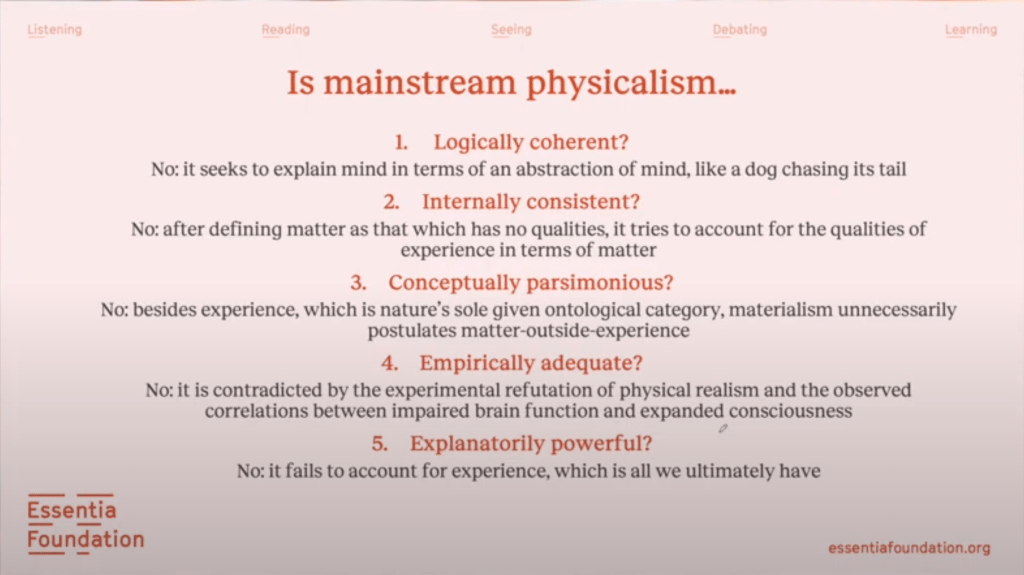
Until now, I’ve considered myself to be a physicalist or materialist, but in adopting this position, I’ve had open questions. I’d tell people, “I’m a Physicalist, but I don’t understand how X, Y, or Z works.” As it happens, Analytic Idealism fills in most of these gaps. I’ve also been leery of Constitutive Panpsychism, and this theory addressed those shortcomings.

According to standard materialistic doctrine, consciousness, like space-time before the invention of general relativity, plays a secondary, subservient role, being considered just a function of matter and a tool for the description of the truly existing material world. But let us remember that our knowledge of the world begins not with matter but with perceptions. I know for sure that my pain exists, my โ€œgreenโ€ exists, and my โ€œsweetโ€ exists. I do not need any proof of their existence, because these events are a part of me; everything else is a theory. Later we find out that our perceptions obey some laws, which can be most conveniently formulated if we assume that there is some underlying reality beyond our perceptions. This model of material world obeying laws of physics is so successful that soon we forget about our starting point and say that matter is the only reality, and perceptions are only helpful for its description.


Universe, Life, Consciousness by Andrei Linde
What about mainstream Physicalism?

Firstly, it centres everything on experience. It divides the world into ‘out there’ and ‘perception’, what Bernard Kastrup calls ‘intrinsic view’ and ‘extrinsic experience’, what Schopenhauer termed ‘noumena’ and ‘phenomena’.

So how could I abandon material so quickly? The short answer is that I didn’t. It’s just that it’s not fundamental. One of the challenges I always had with the notion of materialism is the distance between perception and material. Analytic Idealism allows there to be a concealed nature out there and a revealed nature that our senses could perceive.

physics is ultimately a science of perception

I abandoned Donald Hoffman’s’ book, The Case Against Reality: Why Evolution Hid the Truth from Our Eyes, a few months back because although it seemed to make sense, it wasn’t quite resonating with me. It seems that he shares this perspective.

Before I get ahead of myself, I’ll lay a foundation. Our brains, among other things, are experience-perceiving machinesโ€”not experience-generating. Unlike some solipsistic theories, we don’t generate our reality. There is an objective reality, as it were. out there, but our perception of it is limited by our sense organs and cognitive faculties. Anything not accessible to these is imperceptible, pretty much by definition. It could be that there is nothing out there beyond perception, but I wouldn’t count on it.

I know that this invites paranormal and spiritual injections. I don’t have a propensity to make this jump, and absence of at least circumstantial evidence, I don’t expect to expend energy pondering this space. If this is your proclivity, feel free, and I’d love to see what you come up with. As it happens, Bernard Kastrup does believe in paranormal phenomena, so you’d be in good company. I’m just not ready to make that leap.

Humans do not view reality as it is. This conforms to correspondence theories of truth. In this theory, we interface reality through a virtual dashboard. Like an aeroplane with dials and gauges, our sense organs merely give USA representations of this reality in a manner suitable to our survivalโ€”fitness over truth. Just as the altimeter and speedometer are fit for navigating a plane, they are just symbols or icons representing the ‘out there’. Similar to the Matrix, the out there is unintelligibleโ€”save for Neo who is able to transcend and decode on the fly. But this is science fiction. We cannot see beyond the dashboard, and it wouldn’t benefit us if we could.

instrument dashboard from EssentiaFoundation.org

This instrument panel or dashboard, as Kastrup calls it, is all we have. And like a computer monitor that represents files and folders as beige, blue, and white rectangles, looking behind the screen isn’t going to yield you more information. At their core, these represent binary code, millions or zeros and ones that would not be useful to see in their native state. It is more useful to see the iconic representation.

It turns out that matter is simply a representation of reality through dashboard instruments. This means that physics is ultimately a science of perception, though it only has access to the map rather than the terrain.

It’s not my intent to articulate the entire theory. Besides, I’m new to it. There is much more for me to suss out. For now, it’s the best explanation for the way I perceive perception. And although I still have questions, I have fewer than before, so here’s looking to a long and fruitful relationship.

The Meaning of Life for Sisyphus

In pursuit of my travail intellectuel, I stumbled on a thought experiment proposed by Richard Taylor regarding an old crowd favourite, Sisyphus.

Of course, Albert Camus had famously published his Myth of Sisyphus essay (PDF), portraying his life as analogous to the workaday human, absurdly plodding through existence like rinse and repeat clockworkโ€”same gig on a different day.

Given my perspective on human agency and the causa sui argument, I felt commenting on Taylor’s essay, The Meaning of Life (PDF) would be apt.

The story of Sisyphus finds the namesake character, fated by the gods to each day push a stone up a hill only for it to roll back down for him to push it back up every day ad infinitum. Camus leaves us with the prompt, โ€˜One must imagine Sisyphus happyโ€™. But must we.?

As Taylor puts it,

Sisyphus, it will be remembered, betrayed divine secrets to mortals, and for this he was condemned by the gods to roll a stone to the top of a hill, the stone then immediately to roll back down, again to be pushed to the top by Sisyphus, to roll down once more, and so on again and again, forever. Now in this we have the picture of meaningless, pointless toil, of a meaningless existence that is absolutely never redeemed.

Taylor wants us to consider an amended Sisyphus. He writes,

Let us suppose that the gods, while condemning Sisyphus to the fate just described, at the same time, as an afterthought, waxed perversely merciful by implanting in him a strange and irrational impulse; namely, a compulsive impulse to roll stones.

This significantly alters the dynamic. In the scenario, Sisyphus is not toiling; rather, he is pursuing his passionโ€”following his heart. This is the athlete, artist, politician, or mass murderer following their passion. In fact, one might say that he is being his authentic self. He has no control over his self or his desire to roll stones, but he is in his element.

Taylor’s ultimate point is that in either case, the life of Sisyphus is just as devoid of meaning. Ostensibly, nothing can provide meaning. The best one can do is to have the perception of meaning. He writes,

Sisyphus’ existence would have meaning if there were some point to his labors, if his efforts ever culminated in something that was not just an occasion for fresh labors of the same kind. But that is precisely the meaning it lacks.

Although we cannot control what is within, contentment and happiness derive from perception. As we might be reminded by the quip attributed to Schopenhauer,

We can want what we will,
but we can’t will what we will.

In the end, Taylor wants us to know that nothing out there can make us happy.

The meaning of life is from within us, it is not bestowed from without, and it far exceeds in both its beauty and permanence any heaven of which men have ever dreamed or yearned for.


I’ve subsequently read some critiques of Taylor’s position, but I don’t want to take the time to rejoin them. Suffice it to say that I find them to be weak and wanting.

Man versus Machine

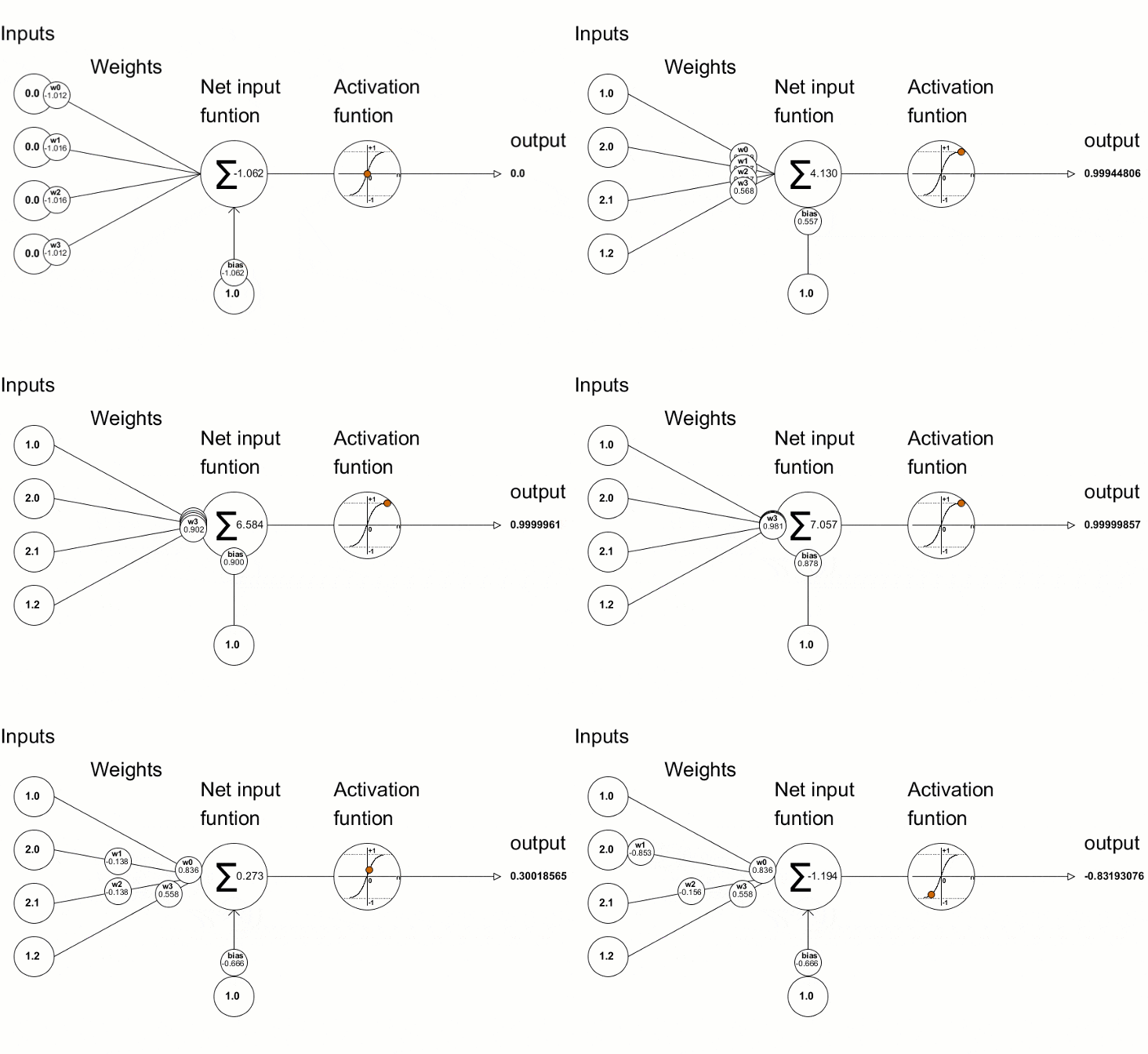
Human-designed systems seem to need a central orchestration mechanismโ€”similar to the cognitive homunculus-observer construct substance dualists can’t seem to escapeโ€”, where consciousness (for want of a better name) is more likely the result of an asynchronous web with the brain operating as a predictive difference and categorisation engine rather than the perceived cognitive coalescence we attempt to model. Until we unblock our binary fixedness, we’ll continue to fall short. Not even quantum computing will get us there if we can’t escape our own cognitive limitations in this regard. Until then, this error-correcting mechanism will be as close to an approximation of an approximation that we can hope for.

The net-input function of this machine learning algorithm operates as a heuristic for human cognition. Human-created processes can’t seem to create this decoupled, asynchronous heuristic process, instead ending up with something that looks more like a railway switching terminal.

Cover photo: Railroad tracks stretch toward Chicago’s skyline at Metra’s A2 switching station on March 29, 2019.ย (Antonio Perez/Chicago Tribune); story

Materialism and Measurement

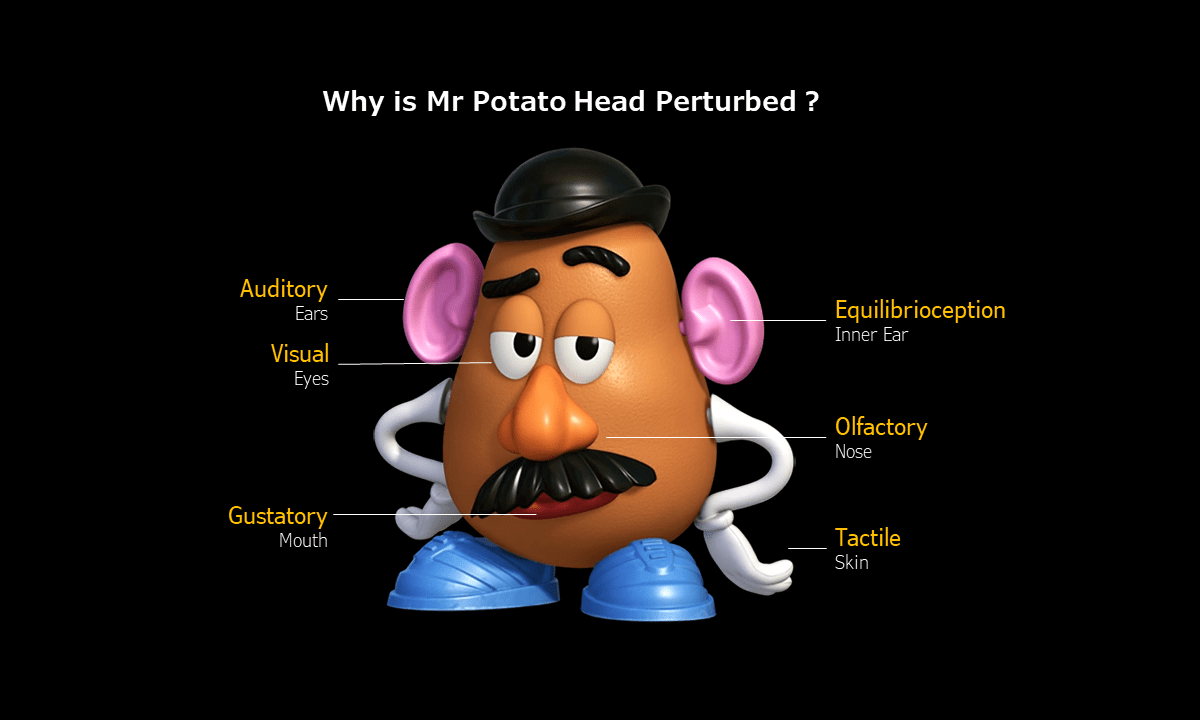
Why is Mr Potato Head perturbed?

Following up on recent posts about Unknown Dimensions and Material Idealism, I was pondering the implication of the spaces between. Fundamentally, I consider myself to be a materialist or physicalist depending on which nomenclature you prefer. I don’t believe in metaphysics, but I am perturbed like Mr Potato Head, because if there exists phenomena not accessible to our sensesโ€”and the other senses noted in a prior postโ€”we simply have no way to experience them let alone measure them.

There could exist many other physical phenomena that we not only cannot register, but we can’t even imagine what they might be. These don’t need to be metaphysical or spiritual, but they can exist in theory. Perhaps we can reference them as paraphysical.

As humans, we can extend our senses with instruments such as lenses on telescopes, microscopes, and cameras, with which we can register ultraviolet and infrared light, and so on. But I am not talking about this.

I’m not going to lose any sleep over this notion, but as ridiculous as this might seem, it is fully within the realm of possibilities. It’s neither testable nor falsifiable.

So what’s the deal?

We can’t touch this because it has no mass, but neither do sights or sounds or smells or tastes. In fact, we wouldn’t even know what we are missing. But imagine one day, a person through some genetic quirk could suddenly sense this new aspect of reality.

I imagine it would be like Plato’s Allegory of the Cave, trying to convey the unconveyable to the masses. Synesthesia is odd enough for some people to wrap their brains around, but at least we can understand the concept as crossed wires or some such.

Now imagine a second and third person each aware of the others with this heightened ability. Could they exploit this to their advantage?

How might this work? What might it be? Although magnetoception, electroception, hygroreception, or echolocation might be interesting, we can already conceptualise and in some cases measure these phenomena. And we’ve already got infrared and ultraviolet covered.

The closest idea I can equate this to is that of Flatland, where higher-dimension objects interact with a lower-dimension world, but this doesn’t quite capture the essence.

Physics tells us there is no space for gods in current models, but do we need space? How much space do the molecules for ‘scent’ occupy? Could these same molecules carry the cargo for other missing sense perceptions? They may be already hiding among us.

Does anyone have any ideasโ€”especially you storytellers and poets?

Material Idealism

Synchronicity is in full force and effect. I’ve been on holiday for the past week and a half during which time I’ve read twice over Being You by neuroscientist Anil Seth, who also competently narrates an audio version. I enjoyed it, though it was on one hand too general and on the other hand oddly specific. I expect to summarise it presently.

Meantime, I just watched this interview with Bernardo Kastrup, of whom I’ve only recently become aware, and he makes some of the points Anil makes, but I feel his logical leap to the spiritual realm is a bit premature and wishful thinking on his partโ€”sort of a God of the gaps approach.

Bernardo is the author of Why Materialism Is Boloney.

Russell Brand interviews philosopher and author Bernardo Kastrup

I find his analogy equating human perception and an aeroplane cockpit on instrument control is apt, and I fully agree that humans are limited by their sense organs and limited cognitive faculties. so there exists more than we can measure or even perceive.

I recently read an article about a recent discovery where artificial intelligence identified a new dynamic variable in physics.

It stands to reason that there are a great many things about nature that are flat out not only NOT PERCEIVABLE by us but INCONCEIVABLE by us

Bernardo Kastrup

Aristotle is responsible for the notion that humans are limited to 5 senses, a myth still propagated by education systems. We are all familiar with the five basic senses:

SensePerceptionSensory Organ
VisionVisionEye
HearingAuditoryEar
TouchTactileSkin
TasteGustatoryMouth
SmellOlfactoryNose

Touch limits the scope of the somatosensory system that extends tactile mechanoreception perception with thermoception, which not only perceives the temperature of external objects and environments but includes receptors necessary to regulate internal body temperatures.

SensePerceptionSensory Organ
VestibularEquilibrioceptionInner Ear

Equilibrium or balance is yet another sense.

Perhaps it’s that vestibular sensation feels different to the rest, and so it gets marginalised.

Apart from the senses in and of themselves, we know that different life forms with analogous sense receptors perceive the world with different levels of acuity and resolution as well as range.

Dogs hear sounds at higher frequencies. Whales hear lower frequencies.

Birds see at a faster ‘frame rate’ than humans. In fact, a bird watching a film would not see the contiguous frames as fluid motion but would likely perceive the frames like a flip book progressing too slowly. Their visual acuity is also sharper, effectively giving them a higher DPI resolution. Thankfully, our visual system doesn’t provide a dithered or pixelated representation.

Some animals also ‘see’ images on infrared or ultraviolet frequencies.

Human eyes are front-mounted and provide binocular vision and depth perception. Internal mechanisms give the appearance of a continuous view. In fact, our eyes have a very small focal width, but they flit and flitter to capture snippets that are stitched together to give the impression of a scene. This is a Gestalt consideration.

Side-mounted eyes operate at a different level. For example, a pigeon needs to continually bob its head to render a stereoscopic view. Similarly, internal mechanisms stitch these images into a cogent environment.

And then there are compound eyes. Despite the manner these are depicted in movies, it’s likely that the visual system composites the facets into a single view.

Where humans can sense depth, distance, and direction with their eyes and ears, sharks can sense direction with their ‘nose’s.

Whilst humans have some ‘awareness’ of pheromones, this awareness is heightened in other animals via vomeronasal organ perception.

The notion of time is another perception, but we don’t even have a decent definition or understanding of time, so we’ve got a while before we figure this one out.

In addition to these human faculties, we understand that animals have others we had discovered.

SensePerceptionExample Species
MagnetoceptionMagnetic fieldsbirds, cattle, bacteria
EcholocationSpatialbats, cetaceans
ElectroceptionElectric fieldsfish
HygroreceptionMoisture levelsinsects

The addition of these other senses is borderline trivial insomuch as they each sense known phenomena. The question is whether some animals sense phenomena yet unknown.

I had more I wanted to say, but my time was occupied gathering these lists. Perhaps when I return to comment on Being You, I’ll share more.