The Frege–Geach problem was one of the impetuses for finishing my Language Insufficiency Hypothesis. From the first encounter it felt off, as though someone were trying to conjure depth from a puddle. There was no paradox here; just another case of mistaking the map for the terrain, a habit analytic philosophy clings to with almost devotional zeal. The more time I spend on this project, the more often I find those cartographic illusions doing the heavy lifting.
Audio: NotebookLM podcast on this topic.
For the uninitiated, the Frege–Geach problem is supposed to be the knockout blow against AJ Ayer’s emotivism. Frege’s manoeuvre was simple enough: moral language must behave like descriptive language, so embed it in a conditional and watch the whole thing buckle. Neat on paper. Vacuous in practice. The entire construction only stands if one accepts Frege’s original fiat: that moral utterances and empirical propositions share the same logical metabolism. And why should they? Because he said so.
This is the core of the analytic mistake. It is grammar dressed up as ontology.
The LIH doesn’t ‘solve’ the Frege–Geach problem for the simple reason that there is nothing to solve. What it does instead is reclassify the habitat in which such pseudo-problems arise. It introduces categories the analytic tradition never suspected existed and drafts a grammar for language’s failure modes rather than politely ignoring them. It exposes the metaphysics analytic philosophy has been smuggling under its coat for decades.
The LIH does four things at once:
• It destabilises an alleged Invariant. • It exposes the Contestable foundations underneath it. • It shows that many analytic puzzles exist only because of the presuppositions baked into the analytic grammar. • And it asks the forbidden question: what if this cherished problem simply isn’t one?
Analytic philosophy proceeds as though it were operating on a single, pristine grammar of meaning, truth, and assertion. The LIH replies: charming idea, but no. Different conceptual regions obey different rules. Treating moral predicates as if they were factual predicates is not rigour; it’s wishful thinking.
As my manuscript lays out, instead of one flat linguistic plain, the LIH gives you an ecology:
• Invariants for the things that actually behave. • Contestables for the concepts that wobble under scrutiny. • Fluids for notions that change shape depending on who touches them. • Ineffables for everything language tries and fails to pin down.
The analytic tradition, bless its little heart, tries to stretch classical logic across the entire terrain like clingfilm. The clingfilm snaps because reality never agreed to be wrapped that way.
This taxonomy isn’t jargon for its own sake. It’s a meta-grammar: a way of describing how language breaks, where it breaks, and why it breaks in predictable places. It names the structures analytic philosophy has been tripping over for a century but studiously refused to acknowledge.
Their error is simple: they treat language as flat. The LIH treats language as topographical – scored with ridges, fault lines, and pressure fronts.
They think in one grammar. I wrote a grammar for grammars.
No wonder there’s disquiet. Their tools have been optimised for the wrong terrain. I’m not challenging their competence; I’m pointing out that the conceptual map they’ve been so proudly updating was drawn as if the continent were uniformly paved.
This is why Frege–Geach, the ‘hard problem’ of consciousness, another irritant, paradoxes, semantic embeddings – so many of their grand intellectual fixtures – appear dramatic inside their grammar yet quietly evaporate once you switch grammars. The LIH isn’t a theory about language; it is a theory of the boundary conditions where language stops being able to masquerade as a theory of anything at all.
And the Frege–Geach problem? In the end, perhaps it isn’t.
Note that the cover image is of the rhinocerosin the animated movie, James and the Giant Peach. The rhino was meant to remind James of the importance of perspective. I feel it’s fitting here.
I’ve just published Objectivity Is Illusion: An Operating Model of Social and Moral Reasoning, an essay that began as this blog post. I’m sharing the ‘official’ link and this first draft. As the essay matured, I added additional support, but I focused primarily on refuting the anticipated opposing arguments. Rather than regurgitate the final version here, I felt showing the genesis would be more instructive. Of course, the essay didn’t spring fully formed; I’ve pruned and expanded from earlier notes still sitting on my hard drive.
Every so often, I’m told I’m too slippery with words, that I treat truth as if it were just another game of persuasion, that I reduce morality to chalk lines on a playing field. The objection usually comes with force: ‘But surely you believe some things are objectively true?‘
I don’t. Or more precisely, I don’t see how ‘objectivity’ in the metaphysical sense can be defended without lapsing into stagecraft. Granite foundations have always turned out to be scaffolding with the paint touched up. Priests once told us their gods guaranteed truth; scientists later promised the lab would serve as granite; politicians assure us democracy is the stone pillar. But in each case the creaks remain.
Audio: NotebookLM podcast on this topic.
This essay is written with an academic readership in mind. It assumes familiarity with figures like Nietzsche, Foucault, Rorty, and Ayer, and with the long quarrel over subjectivity, relativity, and objectivity. My aim is not to retell those arguments from the ground up, but to position my own framework within that ongoing dispute.
Scope
Before proceeding, some guardrails. When I say ‘objectivity is illusion,’ I mean in the social and moral domain. I’m not denying quarks or mathematics. My claim is narrower: in human discourse, no truth escapes subjectivity or contingency.
This dovetails with my broader Language Insufficiency Hypothesis: that even our words are leaky vessels, prone to misfire and misunderstanding. If language itself is unstable ground, then objectivity built upon it can hardly be granite. My claim here is not that nothing exists outside us, but that in the social world we inhabit together, every ‘truth’ rests on creaking boards.
One more note: just because social administration requires appeals to objectivity doesn’t mean objectivity exists. Courts, laboratories, and parliaments invoke it to secure trust, and it works well enough as theater. But necessity is not proof. And it is not my responsibility to conjure a granite replacement. What follows is an operating model, not a new altar.
Thesis
Objectivity is an illusion. Truth is rhetorical. Morality is prescriptive, not propositional. Our ethic is not granite but care: tending the planks we walk on, knowing they creak.
Operating Model: Five Premises
This framework is not a foundation. It is an operating model – contingent, provisional, subject to revision as circumstances change. Like any model, it can (and should) be updated to fit the culture and times.
Premise 1: Subjectivity is the baseline. Every claim originates in a perspective. No statement is free of the lens through which it is made. Even to deny subjectivity is to speak from a subject.
Premise 2: Relativity is emergent. What we call ‘relative truth’ is not a separate category but the convergence of individual subjectivities into provisional consensus. Consensus is never neutral: it is formed rhetorically – through persuasion, cultural resonance, and power [1]. MacIntyre made a similar point in After Virtue. The moral consensus of the Ancients was not grounded in objectivity but in a shared tradition – a thick account of human flourishing that gave coherence to their claims. When that scaffolding collapsed, consensus fractured, leaving modern moral discourse in fragments. Critics accused MacIntyre of relativism, since different traditions yield different ‘truths’, but his point reinforces mine: what looks like objectivity is in fact the temporary overlap of subjectivities sustained by tradition [2].
Premise 3: Objectivity is illusion. Claims presented as objective are relative norms hardened by repetition and forgotten as contingent scaffolding. ‘Objectivity’ is consensus disguised as granite. Its invocation in courts or parliaments may be useful, but usefulness is not existence. The burden of proof belongs to anyone insisting on an independent, metaphysical anchor for moral or social truths (Nietzsche’s ‘mobile army of metaphors’ [3], Kuhn’s paradigms [4], Latour’s laboratories [5]).
Even if one concedes, with Weber (as MacIntyre reminds us), that objective moral truths might exist in principle, they remain inaccessible in practice. What cannot be accessed cannot guide us; reconciliation of values and virtues must therefore take place within traditions and rhetoric, not in appeal to unreachable granite [13].
Premise 4: Rhetoric establishes truth. What counts as ‘true’ in the social and moral domain is established rhetorically – through coherence, resonance, utility, or force. This does not mean truth is ‘mere spin’. It means truth is never metaphysical; it is enacted and enforced through persuasion. If a metaphysical claim convinces, it does so rhetorically. If a scientific claim holds, it does so because it persuades peers, fits the evidence, and survives testing. In short: rhetoric is the medium through which truths endure [6].
Premise 5: Non-Cognitivism, Stated Plainly. I take moral utterances to be prescriptions, not propositions. When someone says ‘X is wrong’, they are not reporting an objective fact but prescribing a stance, a rule, a line in chalk. This is my operating position: non-cognitivism (Ayer [7], Stevenson [8]).
That said, I know the term feels alien. Many prefer the dialect of subjectivism – ‘X is true-for-me but not-for-you’ – or the quasi-realist stance that moral language behaves like truth-talk without cosmic backing (Blackburn [9]). I have no quarrel with these translations. They name the same scaffolding in different accents. I am not defending any school as such; I am simply stating my plank: morality prescribes rather than describes.
Ethic: Care. Since scaffolding is all we have, the obligation is not to pretend it is stone but to keep it usable. By ‘care’, I do not mean politeness or quietism. I mean maintenance – deliberation, repair, mutual aid, even revolt – so long as they acknowledge the scaffolding we share. Care is not optional: stomp hard enough and the floor collapses beneath us all.
Examples clarify: peer review in science is care in action, patching leaky vessels rather than proving granite. Civil rights movements practiced care by repairing rotten planks of law, sometimes with revolt. Communities rebuilding after disaster embody care by reconstructing scaffolding, not pretending it was indestructible. Care is maintenance, reciprocity, and survival.
Bridge: These five premises do not add up to a system or a foundation. They form an operating model: subjectivity as baseline, relativity as emergent, objectivity as illusion, rhetoric as truth, morality as prescription. Together they outline a practice: walk the planks with care, admit the creaks, patch where needed, and stop pretending we live in marble halls.
Rationale
Why prefer scaffolding to granite? Because granite has always been a mirage. The history of philosophy and politics is a history of crumbling temples and collapsing empires. The promises of permanence never survive the weather.
Think of Nietzsche, who called truths ‘a mobile army of metaphors’ [3]. Think of Foucault, who showed that what counts as ‘truth’ is always bound up with power [1]. Think of Rorty, who reduced truth to what our peers let us get away with saying [6]. These are not nihilists but diagnosticians: they exposed the creaks in the floorboards and the wizard behind the curtain.
Metaphors drive the point home:
Scaffolding and granite: What holds is temporary, not eternal. Granite is an illusion painted on timber.
Chalk lines: Rules of play – binding, real, but contingent. They can be redrawn.
Shoreline houses: Rome, the USSR, the British Empire – each built like beachfront villas with a fine view and bad footing. Storms came, sand eroded, and down they went.
Bias as framing: Kahneman himself admitted ‘bias’ is not a thing in the world [10], only a deviation from a chosen model. Gigerenzer [11] and Jared Peterson [12] remind us heuristics are adaptive. To call them ‘biases’ is not neutral – it’s allegiance to a standard of rationality.
The point is simple: what holds today is scaffolding, and pretending otherwise is self-deception.
Counterarguments and Refutations
Objection: Moral Paralysis. Without objective morality, why abolish slavery or defend rights?
Refutation: Chalk lines still bind. Speed limits aren’t cosmic, but they regulate conduct. Abolition endured not because it tapped a cosmic truth but because it persuaded, resonated, and took root. Slavery was once ‘in bounds’. Now it is ‘offsides’. That shift was rhetorical, emotional, political – but no less binding.
Objection: Problem of Dissent. If all is subjective, the lone dissenter is ‘just another voice’.
Refutation: Dissent gains traction through coherence, predictive success, or resonance. Galileo, abolitionists, suffragists – none relied on metaphysical granite. They persuaded, they resonated, they moved chalk lines. Truth was made through rhetoric, not uncovered in stone.
Objection: Performative Dependency. Even to say ‘subjective’ assumes the subject/object split. Aren’t you still inside the house?
Refutation: Of course. But I’m the one pointing at the slippery boards: ‘Mind the dust’. Yes, I’m in the house. But I refuse to pretend it’s marble. And even the category ‘subject’ is not eternal – it’s porous, dynamic, and leaky, just like language itself.
Objection: Infinite Regress. Why stop at subjectivity? Why not de-integrate further?
Refutation: Subjectivity is not granite, but it is the last plank before void. Peel it back and you erase the possibility of claims altogether. If tomorrow we discover that the ‘subject’ is a swarm of quarks or circuits, fine – but the claim still emerges from some locus. Regression refines; it doesn’t disprove.
Conclusion: The Ethic of Care
This is not reintegration. It is dis-integration: naming the creaks, stripping polyvinyl from rotten boards, refusing granite illusions.
If you wish to build here, build. But know the ground shifts, the storms come, the shoreline erodes. The ethic is not certainty but care: to tend the scaffolding we share, to patch without pretending it is stone, and to let dissent itself become part of the maintenance.
I’ve been reengaging with philosophy, though my positions haven’t changed recently. My last change was to shift from being a qualified material realist to a qualified idealist in the shape of Analytic Idealism. In most matters I can think of, I am an anti-realist, which is to say concepts like truth and morality are not objective; rather they are mind-dependent.
I’ve long been on record of taking the stance that Capital-T Truth, moral truths, are derived rhetorically. There is no underlying Truth, only what we are aggregately convinced of, by whatever route we’ve taken. As a moral non-cognitivist, I am convinced that morality is derived through emotion and expressed or prescribed after a quick stop through logic gates. Again, there is nothing objective about morality.
Truth and morality are subjective and relative constructs. They resonate with us emotionally, so we adopt them.
Were I a theist — more particularly a monotheist —, I might be inclined to be emotionally invested in some Divine Command theory, where I believe that some god may have dictated these moral truths. Of course, this begs the question of how these so-called “Truths” were conveyed from some spirit world to this mundane world. I have no such conflict.
But let’s ask how an atheist might believe in moral realism. Perhaps, they might adopt a Naturalistic stance: we have some natural intuition or in-built moral mechanism that is not mind-dependent or socially determined. I am not a naturalist and I don’t take a universalist approach to the world, so this doesn’t resonate with me. I can agree that we have an in-built sense of fairness, and this might become a basis for some aspects of morality, but this is still triggered by an emotional response that is mind-dependent.
Another curious thing for me is why non-human animals cannot commit immoral acts. Isn’t this enough to diminish some moral universal? In the end, they are an extension of language by some definition. No language, not even a semblance of morality.
Anyway, there’s nothing new here. I just felt like creating a philosophical post as I’ve been so distracted by my health and writing.
As moral error theorists, we’re accustomed to facing criticism for our perspective. I’m a moral non-cognitivist, but there’s a significant intersection with these theories. When someone asserts that torture is wrong, I might argue that the claim is hollow, as moral wrongness is merely an emotional response masquerading as an objective moral stance. On the other hand, an error theorist would debunk this argument, stating that there’s no absolute position of right or wrong. Pragmatically, we both arrive at the conclusion that the claim cannot hold true.
Video: Is Error Theory Counterintuitive — Kane B
Intuition leads others to a different interpretation. If they believe something is true due to their epistemic certainty, then for them, it is true. Their reality is shaped by experience. Curse the limitations of sense perception and cognitive constraints. “I know what I know,” is their typical retort. Moreover, it’s a matter of practicality. “You know what I mean,” they insist.
They attempt to substitute fact with heuristics, truth with analogue, and terrain with a map. Admittedly, it’s convenient to feign an identity at play, but at best, it’s a near equivalence.
In the linked video, the example of claiming ‘that car is red’ is presented. But can cars truly be red? Not precisely. Cars can possess the property of appearing red to most individuals in specific lighting conditions, but a car cannot inherently be red. Thus, this statement is categorically false. We can assert ‘that the car appears to be red,’ and as a matter of practicality, we might designate the car as such. However, this highlights the inadequacy of language, particularly concerning abstract concepts.
A challenge arises from people’s inclination, driven by the principle of least effort, to seek simplicity and convenience, often at the expense of truth.
A challenge arises from people’s inclination, driven by the principle of least effort, to seek simplicity and convenience, often at the expense of truth. This principle underpins Occam’s Razor: choose the simplest version among competing explanations. It’s a misguided endeavour, akin to living under the notion that opposites attract rather than like attracting like.
I encounter this opposing worldview when I pinpoint certain inconsistencies or issues in the ‘real world,’ emphasizing that language is insufficient to convey adequate meaning, that there exists no objective moral centre, and that democracy is a system that falters even on paper. Almost invariably, the response is, ‘then what?’ I don’t possess the answer to ‘then what.’ I’m merely informing you that your leg is broken. I don’t need to know how to fix it for this to be true, a valid assessment.
While I’m on a roll, let’s talk about charity in philosophical argumentation, which, in my view, is another misguided concept. Why should I favour the notion that a person genuinely believes in the position they hold? It’s another heuristic rule set up to lend credence to otherwise weak arguments. We need not adhere to these boundaries—they’re nonexistent.
BONUS: I ran this content through ANTHROP/C’s Claude 2 for analysis and evaluation. I include it as an example of the bias inherent in generative AI. Whilst I realise that I am taking a polemic position—nothing new here—, Claude apes canned responses. Ironically, the same responses I am arguing against. I do agree that I could have ‘steel-manned’ my argument, but this is a blog post, not a dissertation. Perhaps another day.
Here are some thoughts on evaluating the blog post:
The author takes a strong moral non-cognitivist stance, arguing that moral claims like “torture is wrong” are not objective facts but expressions of emotion. This view aligns with moral error theory in debunking moral realism.
However, the dismissive attitude towards those who believe moral claims have truth value shows a lack of philosophical charity. The author could strengthen their position by steelmanning the opposing view before critiquing it.
The analogy between moral claims and claims like “the car is red” makes an interesting point about the inadequacy of language for capturing nuanced truth. However, more nuance could be applied in acknowledging the usefulness of simplifying language and heuristics in everyday life.
The author’s critique of Occam’s Razor and preference for complex explanations is thought-provoking but could benefit from addressing the pragmatic value of simpler models. Outright dismissing this philosophical principle seems extreme.
The call to abandon charity in argumentation in the name of absolute truth risks throwing the baby out with the bathwater. Some level of mutual understanding between interlocutors is needed for productive discourse.
Overall, while the post raises thoughtful challenges to moral realism, heuristics, and other commonly held views, the dismissive tone and lack of nuance weaken the arguments. More charity towards opposing views and addressing pragmatic concerns could strengthen the critique.
In summary, the post puts forward some provocative arguments but could benefit from greater philosophical charity, nuance, and balancing pragmatism with pursuing absolute truth. A more measured tone discussing pros and cons of different perspectives would likely lend more persuasive force.
The notion of Truth is not as cut-and-dry as it might appear at first glance. As a non-cognitivist, I don’t believe in the notion of objective Truth, so I am not entirely sure why it matters enough to me to continue to talk about it. I suppose I’m an Emotivist and Prescriptivist, if these terms capture the essence of my feelings. The Emotivism is what attracts me to an issue whilst Prescriptivism is why I feel the urge to transmit my beliefs. I’ll also suppose, if I adopt an evolutionary survival framework, that people do this to enhance probability of survival by minimising otherness. It also identifies me to those with a similar perspective. The inherent risk is that this attempt at community-building also broadcasts my potential—and let’s be real here, actual—otherness.
In practice, I’d venture that most people simply take the notion of truth for granted, and given an inquiry would defend it with an ‘of course it’s true‘ response with no need for additional justification. But as with human language more generally, Truth is an approximation of a notion. I like to categorise it as Archetypal.
The issue with Truth and other virtues (and pretty much everything else not analytically tautological), is that people don’t seem to believe that they operate asymptotically. They believe there is a truth, it’s objective and accessible, with enough inquiry, can be discovered.
I am self-aware that employing the language of maths and science is a problem adopted for many in philosophy, as they attempt to legitimatise a position by explaining it relative to the currently adopted metanarrative framework. I also know that by adopting this frame, I (or anyone in a similar position) am (is) twisted into convoluted knots. This is how science had been forced into retrograde motion models to explain a geocentric model of the universe, but when the paradigm was shifted to a heliocentric model, these off behaviours fell by the wayside. I suppose a superior approach would be to redefine the language and deposition the frame, but that’s easier said than done.
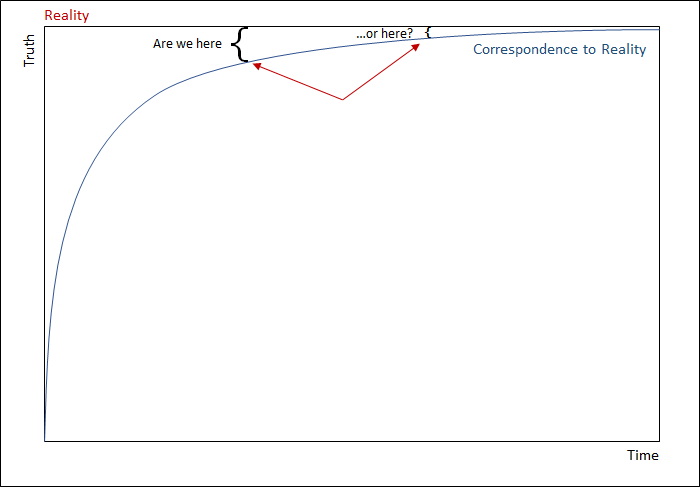
Graph: Correspondence of Truth to Reality (Asymptotic Curve)
The common assumption is that, over time, scientific inquiry will lead us closer to the truth. Correspondence theory supports the notion that more observations and perspectives will lead to a closer approximation, and eventually tools at our disposal will lead to more granular definitions, until we reach a point that and differences in the tangency to reality will be insignificant, a veritable rounding error. But there are several problems with these assumptions.
We have no idea how close or far we are from Reality on the Y-axis, representing Truth.
Graph: Correspondence of Truth to Reality (Asymptotic Curve)
Assuming for the time being that there is an approachable truth, we have no reference to understand how close to reality we might be. In practice, we seem to operate on a basis of always being within some level of statistical significance of where Truth = Reality, and when new information is introduced, we say, “Hooray for Science!” Aren’t we glad that science is self-correcting. Empiricism has its own issues.
Historically, we’ve had ‘wrong’ correspondence between Truth and Reality, but then we got it ‘right’—until we didn’t. Rinse and repeat.
We may all be familiar with the story of how Einstein progressed and refined Newtonian physics. What Einstein did is to create a new narrative—a synchronous shift of paradigm and rhetoric—, which has been accepted into a revised orthodoxy. In our mind, this feels like progress. But how close are we to the real truth?
Taking our understanding of gravity as the fabric of space-time, we still have no idea what’s going on or how it operates, but this doesn’t prevent us from accepting it as a black box and making pragmatic predictions from there. So, for all intents and purposes, the ‘truth’ mechanism is less important than the functional relationship, just as I can tell time on a watch I have no idea how it operates.
We have no idea if any changes to our perception move us closer to or further from Reality.
Rather than being asymptotic, perhaps the relationship to is polynomial (or the result of some stochastic function). See the graph above. As we move into the future (in red) and look back, we may perceive that we’ve reversed against some notion of progress. Common wisdom is that progress is directly, positively related to time. But is it?
In my first amendment, I reference how Einstein progressed and refined Newtonian physics, but in the future, this could be shown to be wrong. In our minds, what had seemed like progress may in retrospect turn out to have been a false assertion.* Moreover, we’ll dutifully accept this updated notion of truth if the rhetoric is sufficient to fit our concept of evidence, especially given humans’ propensity for pareidolia.
I am no true Sceptic, but neither do I accept the prevailing meta-narrative whole cloth. Unfortunately, I am in no better position than the next person to discern proximity to the underlying structure of reality.
Rhetoric is a primary driver to fashion our sense of how close or distant we are from reality. Rhetoric shapes and focuses the frame.
War Is Peace, Freedom Is Slavery, and Ignorance Is Strength
— 1984, George Orwell
I’ve already commented at length about the primacy of rhetoric. To recap for the purpose of this disquisition, the only meaningful arbiter of truth is rhetoric—the ability to persuade the larger populace to accept something as true.
Here, I’d expect someone to counter with, ‘Just because people are convinced that something is true doesn’t make it so’, and they’d be right. However, as we cannot access the underlying reality accept through our admittedly fallible senses, who’s to argue?
Moreover—departing on a tangent—, we know that other lifeforms—let’s stick with the animal kingdom—have different senses than humans, and some humans perceive things differently to the normie (if I may adopt a spectrum term) .
Sharks have electroreception (re: The Ampullae of Lorenzini), which allows them to perceive small changes in electrical fields as well as what’s termed a lateral line ( mechanoreceptor function), which allows them to recognise changes in environmental pressure. Other known sensory adaptations are echolocation in bats and dolphins and chemoreceptors (notably in insects and snails).
We are probably also aware that different animals have differing degrees of sense acuity compared to humans. Dogs hear frequencies above the human threshold and have better olfactory discrimination. Birds of prey have superior vision. Women typically have a broader colour vocabulary.
And then there’s synesthesia, a condition in which one sense is simultaneously perceived as if by one or more additional senses. A person with synesthesia may perceive sound as colour (chromesthesia) or perhaps taste.
Given concepts of normality, we presume we are synesthesia are normal and these other people are somehow not, but for all we know, we normies are evolutionary dead ends, soon to be displaced by synesthesiacs. (Is that even a word? It is now.)
But I digress.
Perception is reality. If one can convince you of something, e.g. Donald Trump is a good president, then it’s ostensibly true to you. If one can convince an entire population that something is true, e.g. the plot of Orwell’s 1984, or The Matrix, then who’s to say otherwise.
Intent in communicating perception does not get one closer to some corresponding reality. It merely converges perception.
This fourth entry is a response to this comment by Landzek from The Philosophical Hack regarding the notion of intended truth in communication.
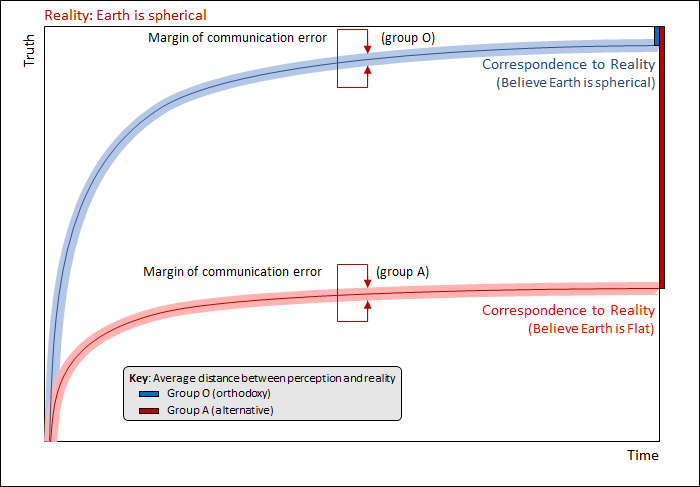
Extending the simple asymptotic function from the first section, we might see (in Graph 4a) a slight variation in interpretation due to the insufficiencies of language—providing us with a close enough for the government approximation to some shared perception. People in this group will tend to agree on some perception, say, that the earth is spherical.** The average distance from perception to reality is the same for all in-group members, give or take some small variance that I’ll dismiss as an insignificant rounding error.
Graph 4a: Correspondence of Truth to Reality (Simplified in-group concurrence)
Graph 4b, however, illustrates two opposing perceptions of reality. In this example, I show proponents of orthodoxy (group O), who claim the earth to be roughly spherical, arbitrarily closer to reality than proponents of an alternative theory (group A), who claim that the earth is flat.
Each in-group has some variance from the mean notion, but ex-group members are orders of magnitude apart, as measured by the blue and red bars to the right of the chart. If we assume some binary condition that the earth is either spherical or flat with no other options, one of these might be considered to be right whilst the other would be wrong. We can establish this situation relative to the ex-groups, but, still, neither of these is comparable to Reality™ .
Graph 4b: Correspondence of Truth to Reality (Simplified ex-group concurrence)
The intent of each group may be to promote the perspective of the group—each claiming to be closer to the truth than the other. It is easy to imagine a situation where both claimants are equally distant from the truth:
Imagine two groups, each making opposing claims:
Tarot is superior to Astrology in predicting the future.
Astrology is superior to Tarot in predicting the future.
I’ll go out on a limb here and create a reality where the future is not predictable by either measure, irrespective of what each in-group believes.
* I am not versed well enough in the history of science, but I’d be interested to know which, if any, scientific advances have been a step ‘backward’, that a belief had overtaken a prior belief only to have reverted to the former.
I am aware of the slow march of science and the ignorance of possibly valid assertions simply because the rhetoric was not strong enough or the PR just wasn’t adequate. An example might be the debate of theoretical Democracy versus Communism: which is better than the other. Of course, there are too many dimensions to consider, and the adoption or exclusion of one dimension over another might be enough to tilt the outcome.
In the real world—see what I did there—, the US spend billions upon billions of dollars to interfere with Communism—and I am not taking a position whether it would have succeeded or failed on its own terms—, just to be able to knock down the strawman some century later though propagandising and disinformation campaigns.
** I understand that the earth being an oblate spheroid is primarily an analytical distinction, so is tautologically true, but I am using a simplification of a commonly accepted fact.
DISCLAIMER: In order to keep generating new content (or even content) on this blog, I will occasionally adopt a new approach of publishing unfinished thoughts instead of waiting to complete the thought. This means, I may be editing pages in place to correct my position and alter narrative flow, of not the narrative itself.
EDIT: I’ve included my amendments in line above, though I’ve retained links to the original content.
One particular criticism of non-cognitivism is that it is not intuitive (as if this is the arbiter of truth). Much of statistics is not intuitive. The behaviour of quarks and other quantum events are counter-intuitive. This is a poor argument, especially given the limitations of intuition—whatever that might be.
In his book Moral Realism, Kevin Delapp advances his belief ‘that as a descriptive thesis, noncognitivism appears exceptionally counterintuitive’. He advances with argumentum ad numeram(or ad populum—take your pick): Most speakers of most languages do not mean by “killing innocents is wrong” merely that they don’t approve of it, or even that they are simply endorsing a norm, no matter how universal in form. Rather they say, namely that killing innocents is literally wrong.’ Moreover, what people think they mean and what they mean may diverge widely. But these are petty arguments.
“Killing innocents is wrong.”
Let’s unpack the example Delapp uses. Let’s even move forward by accepting common idiomatic notions of these terms. The problem is one of scope. Keeping away from any metaphysical complications but considering a cosmic scope, how is this wrong?
Ignoring that people die routinely of natural and otherwise ‘unnatural’ causes—however these might even be classified—, the absence of some particular human or all humans or all life forms would have a nil effect on planetary motion, the birth and death or stars, or of the creation of other universes. An analogue might be similar to killing a single bacterium in your body, an event that happens countless times daily yet you don’t even notice.
The reason that this is considered wrong relates to hubris, the self-importance humans bestow themselves. It would be amazing for another lifeform with the capacity for language—a shared human language—to impose its parallel morality on earth-dwelling mortals…with the twist that they envision themselves as superior lifeforms. Of course, in the work, the earthlings would justify eliminating this hostile species—and vice versa. Yet neither would be right. As we do on earth now, we’d rely on our divine intuition and know that our vantage was the true one and these usurpers would need to be shown the error of their ways.
In any case, the only reason this logic is justified is by some argument of self-preservation, as if the universe somehow cares about this. Of course, the religious attribute the special place occupied by humans to be justified because we are God’s special children—but these are short-bus children indeed.
Returning to recast the original statement, ‘killing innocents is wrong’, we end up with something less than universal and quite contextual more along the lines of ‘killing [human] innocents is wrong [to me as a human with simple cognitive assessment skills and who has been socially indoctrinated to believe that humans are the most important lifeform in the entire universe or any possible multiverse]. Here wrong means ‘not conducive to the furthering of humanity‘, which is miles away from some claim with a deeper foundation, integrally woven into the fabric of space-time itself.
And when these people counter with, ‘would you want me to kill you’ (smugly clever, indeed), taking this to be some logical checkmate as opposed to the “I know you are but what am I” juvenile retort. Weak tea, indeed.
Emotivism and the rest are categorised under the non-cognitivist branch whilst ethical subjectivism falls into the cognitivist bucket. Intuitively, humans appear to have an innate bias toward accepting cognitivism, much in the same way as they seem to be wired to believe in supernatural concepts and see images of Jesus in toast. Whether these are vestiges of some successful evolutionary strategy is beside the point, but the problem it creates is that, in contrast, non-cognitivism is perceived as counterintuitive.
In its essence, cognitivism can be distilled down to the belief that moral statements are truth-apt, which is to say that they can be evaluated as true or false. Because of the current created by intuitionists, I lead with my fallback position, which is one of ethical subjectivism or more likely error theory.
Heads I win; Tails you lose
Although for reasons I’ll articulate later, entering a conversation assuming truth-aptness, the conversation can at least focus on the compositionality and universality components because whether I believe that moral statements cannot be evaluated as true or false, the default cognitive position of the general population is that they can be. This is not to say that I identify as a quasi-realist, which is to believe that there is no truth-aptness but to behave (pretend) that they do.
Image: Deciding the truth-aptness of a moral claim
God Is Dead
In his critique of Enlightenment beliefs, Nietzsche declared that ‘God is dead’ as he understood the implications of a society absent a justification for not only believing that morality claims are truth-apt but that they are true, divinated from some metaphysical, supernatural, and universal power. In practice, the Enlightenment replaced God with a rather animated and interactive concept of Nature, hence were born all sorts of natural rights. You may get a sense of some déjà vu, as humans, not being particularly creative, just reappropriated and rebranded the same tropes Theists use prior to that. They just performed a search-and-replace of God with Nature in a manner similar to the Christian appropriation of pagan holidays.
Image: God is dead
Non-cognitivism has generally fallen out of favour primarily because it was sort of painted into a corner by the Frege-Geach (embedding) problem, but this issue is only intractable if you accept the given frame.
I should probably just link out to a different source to explain the Frege-Geach problem because I feel it’s a red herring, which only presents a problem if you accept the frame established by the Structuralist
The problem here is that language is a complex, socially constructed communication system. Even if we accept Chomsky’s theory of the innate ability to parse language, the syntax, lexicon, and grammar are still arbitrary human constructs. I can’t likely repeat this point often enough: humans have a poor track record of creating and comprehending complex systems, examples of which are the various half-cocked socio-political, economic, jurisprudent, and philosophical systems. Hubris is evidently a successful evolutionary selection factor, as it persists everywhere and certainly in people of power.
The logical positivists ran into a similar problem when they proposed the verification principle that asserted that a statement is only truth-apt if it is either an ANALYTICAL statement or a SYNTHETIC statement, and yet this assertion with neither analytical nor synthetic, so it itself does not meet the verification principle. It’s simply a normative prescription.
Fundamentally, this quandary underscores the deficiencies of the constructed language system more than anything else, what I am developing with a working title of Insufficiency Theory. A tangent to this theory is my concept that the only moral truth (and many social truths) are simply rhetorical victories—situations where one agent employing rhetorical devices has convinced others as the truth of some condition.
Intermission
A problem with writing an unstructured stream of consciousness is that you look up and realise your post is getting pretty lengthy, and there is a lot more depth than you expected. Due to this, I am going to unpack this over several posts over several days.
Disclaimer
DISCLAIMER: I am not a professionally-trained philosopher, linguist, psychologist, or gynaecologist for that matter. I had considered studying Linguistics at uni as well as Philosophy, but I opted instead to study Economics and Finance, as these appeared to be more pragmatic. As relates to philosophy and language, I am an autodidact. This said, this particular area is new to me, so I am certain that I am missing key elements and may have large gaps in my understanding. In some cases, I’ve read more excerpts and others’ perspective on these people and their work than their actual work product. I am trying to catch up, but that leads me to a place fraught with selection and affirmation bias—though I do try to comprehend counter arguments as well. Moreover, I am painfully well aware of the Dunning-Kruger effect, and I am trying to allow for enough time to elapse to move further along this curve.






![Quarks[1]](https://philosophics.blog/wp-content/uploads/2018/07/quarks1.png)


![dunning-kruger-graph[1]](https://philosophics.blog/wp-content/uploads/2018/07/dunning-kruger-graph1.gif)
 Philosophics