When Deflation Becomes Ritual

I recently shared a post calling out mystics, trying to fill spaces I deflate, but I am self-aware enough that I can be guilty, too. I worry about Maslow’s Law of the Instrument. Deflationary philosophy likes to imagine itself as immune to excess. It dissolves puzzles, clears away bad questions, and resists the urge to add metaphysical upholstery where none is needed. No mysteries, thank you. No hidden depths. Just conceptual hygiene. This self-image is mostly deserved. But not indefinitely. This post is an attitude check.

Because deflation, like anything that works, can ossify. And when it does, it doesn’t inflate into metaphysics. It hardens into something more embarrassing: a ritual of refusal.

Audio: NotebookLM summary podcast on this topic.

From method to mannerism

Deflation begins as a method:

  • A question is posed.
  • Its assumptions are examined.
  • The confusion is diagnosed.
  • The question dissolves.
  • Everyone goes home.

At its best, this is liberating. It frees us from chasing shadows and mistaking grammatical artefacts for ontological puzzles. The trouble begins when the gesture outlives the job.

What was once a diagnostic move becomes a stylistic tic. Refusal becomes automatic. Silence becomes performative. ‘There is nothing there’ is delivered not as a conclusion, but as a posture. At that point, deflation stops doing work and starts doing theatre.

I am often charged with being negative, a pessimist, a relativist, and a subjectivist. I am sometimes each of these. Mostly, I am a Dis–Integrationist and deflationist, as it were. I like to tear things apart – not out of malice, but seeing that certain things just don’t sit quite right.

Another thing I do is to take things at face value. As I came up through the postmodern tradition, I don’t trust metanarratives, and I look for them everywhere. This is why I wrote A Language Insufficiency Hypothesis (LIH), and even more so, the Mediated Encounter Ontology (MEOW). Some words carry a lot of baggage and connotation, so I want to be sure I understand the rawest form. This is why I rail on about weasel words like truth, justice, freedom, and such.

I also refrain from responding if I am not satisfied with a definition. This is why I consider myself an igntheist as opposed to an atheist. Functionally, I am the latter, but the definition I’d be opposing is so inane that it doesn’t even warrant me taking a position.
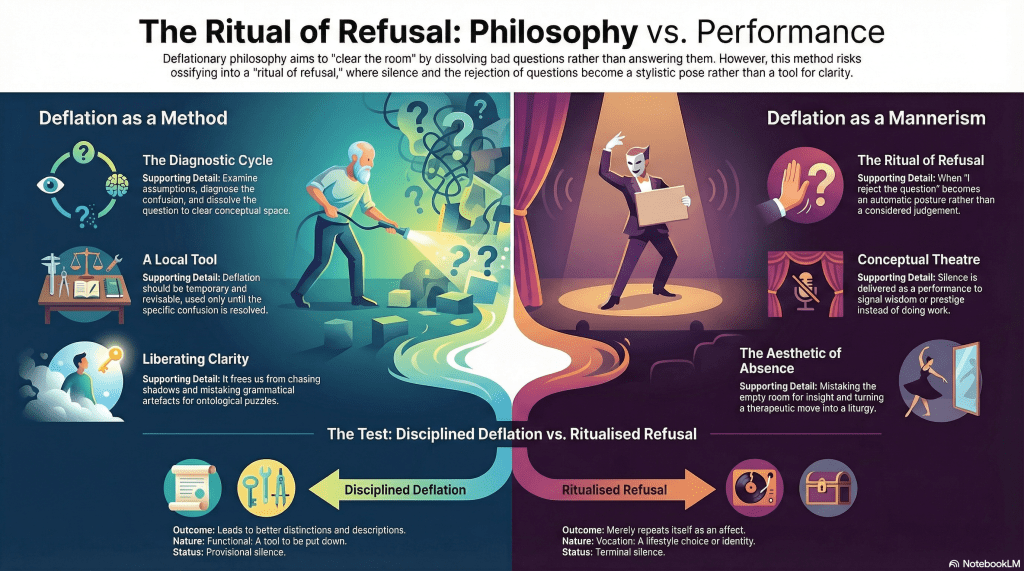
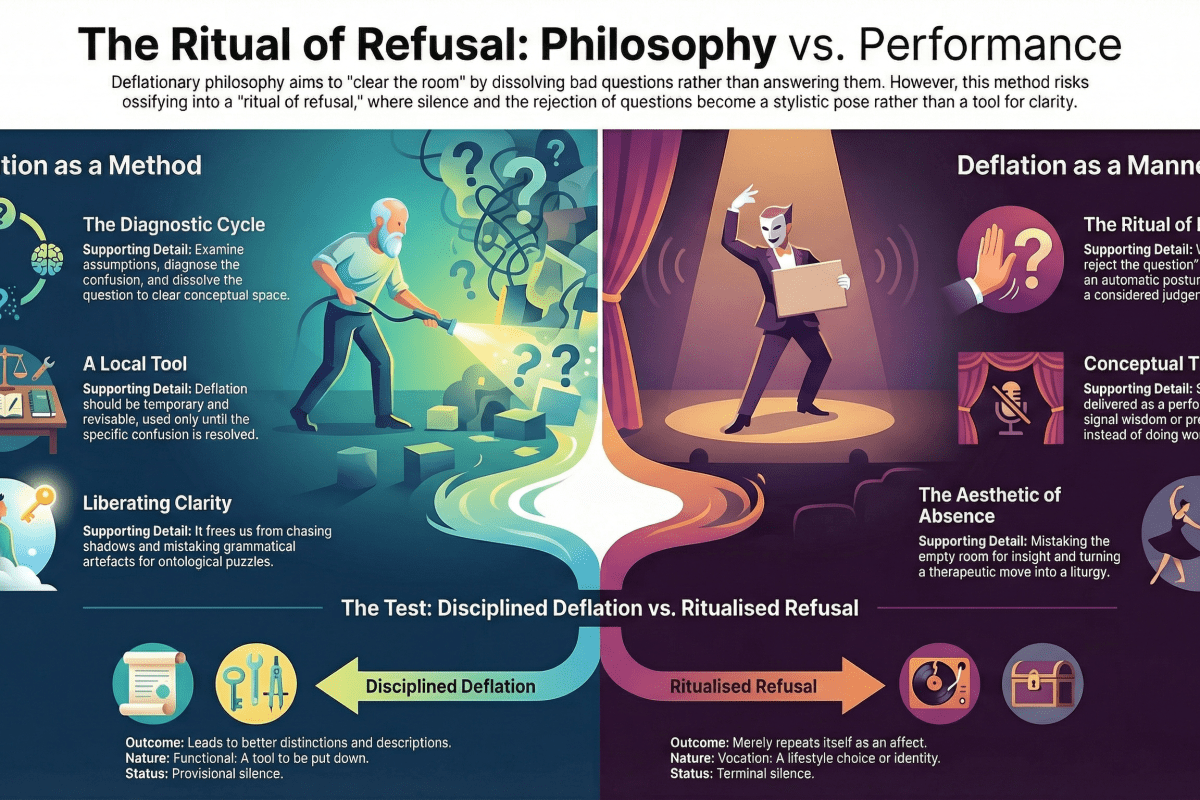
Image: NotebookLM infographic of this topic.

The prestige of saying less

There is a quiet prestige attached to not answering questions. Refusal sounds serious. Restraint sounds wise. Silence, in the right lighting, sounds profound. This is not an accident. Our intellectual culture has learned to associate verbal minimalism with depth, much as it associates verbosity with insecurity. Deflationary philosophers are not immune to this aesthetic pull.

When ‘I reject the question’ becomes a default response rather than a considered judgement, deflation has slipped from method into mannerism. The absence of claims becomes a badge. The lack of commitments becomes an identity. One is no longer clearing space, but occupying emptiness.

This is how deflation acquires a style – and styles are how rituals begin.

Apophasis without God

Mysticism has its negative theology. Ritualised deflation develops something similar.

Both rely on:

  • refusal to name
  • insistence on limits
  • reverent quiet

The difference is meant to be procedural. Mysticism stops at the silence. Deflation is supposed to pass through it. But when deflation forgets that its silence is provisional, it starts to resemble the thing it set out to criticise. Absence becomes sacred again, just without the cosmology. The metaphysician worships what cannot be said. The ritualised deflationist admires themselves for not saying it. Neither is doing conceptual work anymore.

A brief and unavoidable Wittgenstein

This is where Ludwig Wittgenstein inevitably reappears, not as an authority, but as a warning. Wittgenstein did not think philosophy ended in silence because silence was holy. He thought philosophy ended in silence because the confusion had been resolved. The ladder was to be thrown away, not mounted on the wall and admired. Unfortunately, ladders make excellent décor.

When deflation becomes ritual, the therapeutic move freezes into liturgy. The gesture is preserved long after its purpose has expired. What was meant to end a problem becomes a way of signalling seriousness. That was never the point.

A diagnostic test

There is a simple question that separates disciplined deflation from its ritualised cousin:

  • Is this refusal doing explanatory work, or is it being repeated because it feels right?
  • If silence leads to better distinctions, better descriptions, or better questions, it is doing its job.
  • If silence merely repeats itself, it has become an affect.

And affects, once stabilised, are indistinguishable from rituals.

Deflation is local, not terminal

The corrective is not to abandon deflation, but to remember its scope.

Deflation should be:

  • local rather than global
  • temporary rather than terminal
  • revisable rather than aestheticised

Some questions need dissolving. Some need answering. Some need rephrasing. Knowing which is which is the entire discipline. Deflation is not a worldview. It is not a temperament. It is not a lifestyle choice. It is a tool, and like all tools, it should be put down when it stops fitting the task.

Clearing space is not a vocation

There is a temptation, once a room has been cleared, to linger in it. To admire the quiet. To mistake the absence of furniture for the presence of insight. But clearing space is not a vocation. It is a task. Once it is done, staying behind is just another way of refusing to leave. And refusal, repeated without reason, is no longer philosophy. It is choreography.

Why Deflationary Philosophy Keeps Attracting Mystics

4–5 minutes

The struggle is real. There is an odd occupational hazard that comes with writing deflationary philosophy: mystics keep turning up to thank you for your service.

This is always mildly bewildering. One spends a great deal of time dismantling metaphysical furniture, only to discover a small group lighting incense in the newly cleared space. Candles appear. Silence thickens. Someone whispers ineffable. Nope. The filing cabinet was just mislabeled.

Audio: NotebookLM summary podcast of this topic.

The problem is not misunderstanding. It’s reuse.

It is tempting to think this is a simple misreading: I say this concept breaks down here, and someone hears you have glimpsed the ultimate. But that’s too kind. What’s really happening is more interesting. Mysticism does not merely misunderstand deflationary work; it feeds on the same linguistic moves and then stops too early.

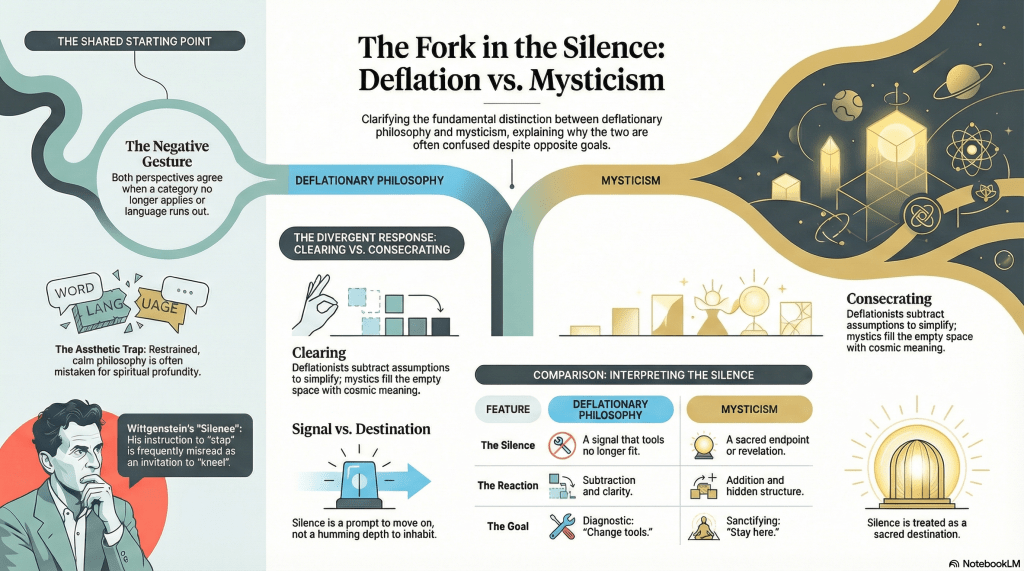
Both mysticism and deflation rely on negative gestures:

  • “This description fails.”
  • “That category no longer applies.”
  • “Our usual language runs out.”

Up to this point, they are indistinguishable. The fork comes immediately after. The mystic treats conceptual failure as an endpoint. The silence itself becomes the destination. Something deep must live there, humming quietly, just out of reach.

The deflationist treats the same failure as a transition. The silence is not sacred. It’s a signal. It means: this tool no longer fits; pick another or move on. Same breakdown. Entirely different posture.

Clearing space versus consecrating it

Much deflationary philosophy clears space. It removes assumptions that were doing illicit work and leaves behind something quieter, simpler, and occasionally disappointing.

Mysticism has a standing policy of consecrating cleared space. An empty room is never just empty. It must be pregnant with meaning. Absence becomes depth. Silence becomes revelation. The fewer claims you make, the more cosmic you must be.

This is not a philosophical disagreement so much as a difference in temperament. One side sees subtraction. The other experiences loss and rushes to compensate. Modern intellectual culture strongly prefers addition. New layers. Hidden structures. Further depths. Deflation feels like theft. So it gets reinterpreted as a subtler form of enrichment: Ah, fewer words, therefore more truth.

The aesthetic trap

There is also an aesthetic problem, which I increasingly suspect does most of the damage. Deflationary philosophy, when done well, tends to sound calm, patient, and restrained. It does not shout. It does not posture. It does not perform certainty. Unfortunately, this is exactly how profundity is supposed to sound.

Quiet seriousness is easily mistaken for spiritual depth. Refusal to speculate reads as wisdom. Negative definition acquires an apophatic glow. This is how one ends up being mistaken for a mystic without having said anything mystical at all.

A brief word about Wittgenstein (because of course)

This is not a new problem. Ludwig Wittgenstein spent a good portion of his career trying to convince people that philosophical problems arise when language goes on holiday. He was not pointing at a deeper reality beyond words. He was pointing back at the words and saying: look at what you’re doing with these.

Unfortunately, “Whereof one cannot speak, thereof one must be silent” has proven irresistible to those who think silence is where the real action is. Wittgenstein meant: stop here. Many readers heard: kneel here. This is the recurring fate of therapeutic philosophy. The cure gets mistaken for a sacrament.

Charity is not complicity

Another contributor to the confusion is tone. Deflationary work tends to be charitable. It explains why certain intuitions arise. It traces confusions to their sources. It does not sneer. This generosity is often misheard as validation. When you say, “It makes sense that we think this way,” some readers hear, “Your intuition is pointing at something profound.” You are offering an explanation. They are receiving an affirmation. At that point, no disclaimer will save you. Any denial is absorbed as further evidence that you are brushing up against something too deep to articulate.

The real disagreement

The disagreement here is not about reality. It is about what to do when explanation fails.

Mysticism treats failure as revelation. Deflation treats failure as diagnostic.

One sanctifies the breakdown. The other changes tools.

Once you see this, the repeated misfire stops being frustrating and starts being predictable.

A final, self-directed warning

There is, admittedly, a risk on the other side as well. Deflation can become mystical if it turns into ritual. If refusal hardens into identity. If “there is nothing there” becomes something one performs rather than concludes. Even subtraction can acquire ceremony if repeated without purpose. The discipline, such as it is, lies in knowing when to clear space—and when to leave the room.

No replacement gods

When a metaphysical idol is removed, someone will always ask what god is meant to replace it. The deflationary answer is often disappointing: none. This will never satisfy everyone. But the room is cleaner now, and that has its own quiet reward—even if someone insists on lighting incense in the corner.

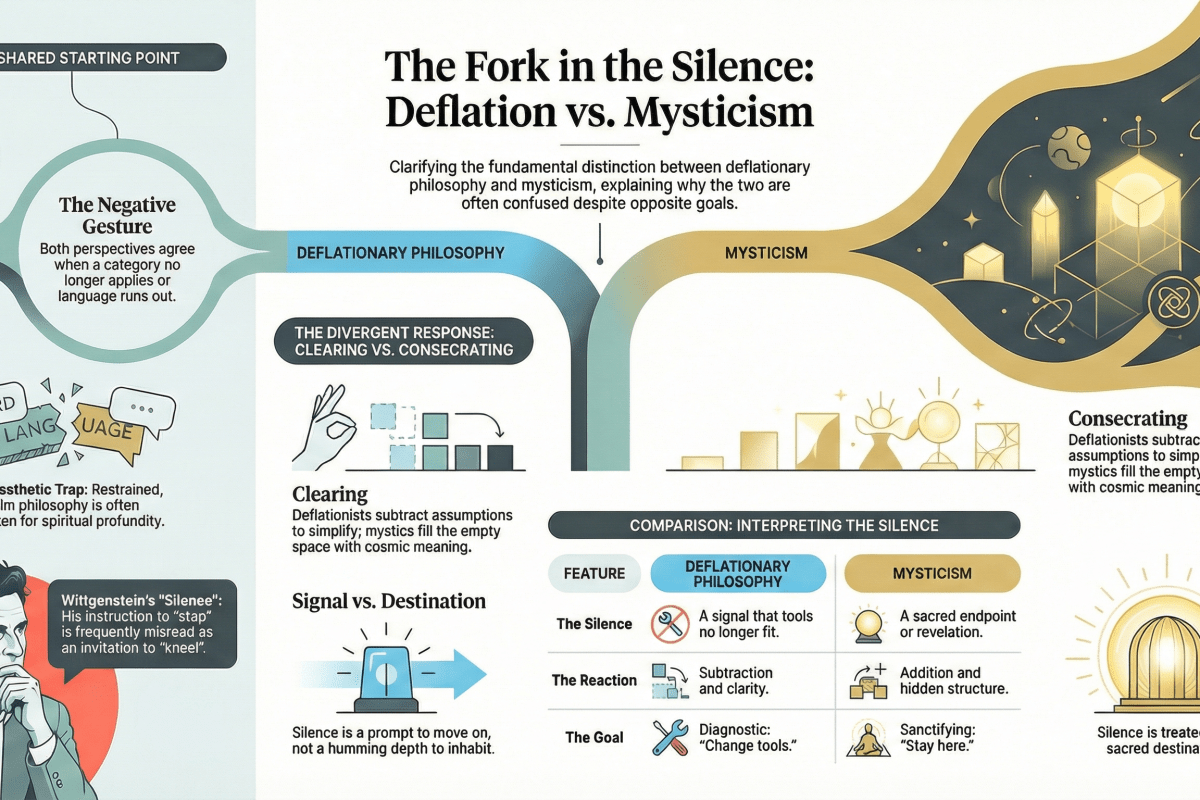
Image: Full cover image infographic by NotebookLM

What If the Frege–Geach Problem Isn’t?

3–4 minutes

The Frege–Geach problem was one of the impetuses for finishing my Language Insufficiency Hypothesis. From the first encounter it felt off, as though someone were trying to conjure depth from a puddle. There was no paradox here; just another case of mistaking the map for the terrain, a habit analytic philosophy clings to with almost devotional zeal. The more time I spend on this project, the more often I find those cartographic illusions doing the heavy lifting.

Audio: NotebookLM podcast on this topic.

For the uninitiated, the Frege–Geach problem is supposed to be the knockout blow against AJ Ayer’s emotivism. Frege’s manoeuvre was simple enough: moral language must behave like descriptive language, so embed it in a conditional and watch the whole thing buckle. Neat on paper. Vacuous in practice. The entire construction only stands if one accepts Frege’s original fiat: that moral utterances and empirical propositions share the same logical metabolism. And why should they? Because he said so.

This is the core of the analytic mistake. It is grammar dressed up as ontology.

The LIH doesn’t ‘solve’ the Frege–Geach problem for the simple reason that there is nothing to solve. What it does instead is reclassify the habitat in which such pseudo-problems arise. It introduces categories the analytic tradition never suspected existed and drafts a grammar for language’s failure modes rather than politely ignoring them. It exposes the metaphysics analytic philosophy has been smuggling under its coat for decades.

The LIH does four things at once:

• It destabilises an alleged Invariant.
• It exposes the Contestable foundations underneath it.
• It shows that many analytic puzzles exist only because of the presuppositions baked into the analytic grammar.
• And it asks the forbidden question: what if this cherished problem simply isn’t one?

Analytic philosophy proceeds as though it were operating on a single, pristine grammar of meaning, truth, and assertion. The LIH replies: charming idea, but no. Different conceptual regions obey different rules. Treating moral predicates as if they were factual predicates is not rigour; it’s wishful thinking.

As my manuscript lays out, instead of one flat linguistic plain, the LIH gives you an ecology:

Invariants for the things that actually behave.
Contestables for the concepts that wobble under scrutiny.
Fluids for notions that change shape depending on who touches them.
Ineffables for everything language tries and fails to pin down.

The analytic tradition, bless its little heart, tries to stretch classical logic across the entire terrain like clingfilm. The clingfilm snaps because reality never agreed to be wrapped that way.

This taxonomy isn’t jargon for its own sake. It’s a meta-grammar: a way of describing how language breaks, where it breaks, and why it breaks in predictable places. It names the structures analytic philosophy has been tripping over for a century but studiously refused to acknowledge.

Their error is simple: they treat language as flat. The LIH treats language as topographical – scored with ridges, fault lines, and pressure fronts.

They think in one grammar. I wrote a grammar for grammars.

No wonder there’s disquiet. Their tools have been optimised for the wrong terrain. I’m not challenging their competence; I’m pointing out that the conceptual map they’ve been so proudly updating was drawn as if the continent were uniformly paved.

This is why Frege–Geach, the ‘hard problem’ of consciousness, another irritant, paradoxes, semantic embeddings – so many of their grand intellectual fixtures – appear dramatic inside their grammar yet quietly evaporate once you switch grammars. The LIH isn’t a theory about language; it is a theory of the boundary conditions where language stops being able to masquerade as a theory of anything at all.

And the Frege–Geach problem? In the end, perhaps it isn’t.


Note that the cover image is of the rhinoceros in the animated movie, James and the Giant Peach. The rhino was meant to remind James of the importance of perspective. I feel it’s fitting here.