A Sequel to “The Disorder of Saying No” and a Companion to “When ‘Advanced’ Means Genocide”
In my previous post, The Disorder of Saying No, I explored the way resistance to authority is pathologised, particularly when that authority is cloaked in benevolence and armed with diagnostic manuals. When one refuses — gently, thoughtfully, or with a sharp polemic — one is no longer principled. One is “difficult.” Or in my case, oppositional.
So when I had the gall to call out Bill Maher for his recent linguistic stunt — declaring that a woman is simply “a person who menstruates” — I thought I was doing the rational thing: pointing out a classic bit of reductionist nonsense masquerading as clarity. Maher, after all, was not doing biology. He was playing lexicographer-in-chief, defining a term with centuries of philosophical, sociological, and political baggage as though it were a checkbox on a medical form.
I said as much: that he was abusing his platform, presenting himself as the sole arbiter of the English language, and that his little performance was less about clarity and more about controlling the terms of discourse.
My friend, a post-menopausal woman herself, responded not by engaging the argument, but by insinuating — as others have — that I was simply being contrary. Oppositional. Difficult. Again. (She was clearly moved by When “Advanced” Means Genocide, but may have missed the point.)
So let’s unpack this — not to win the debate, but to show what the debate actually is.
This Isn’t About Biology — It’s About Boundary Maintenance
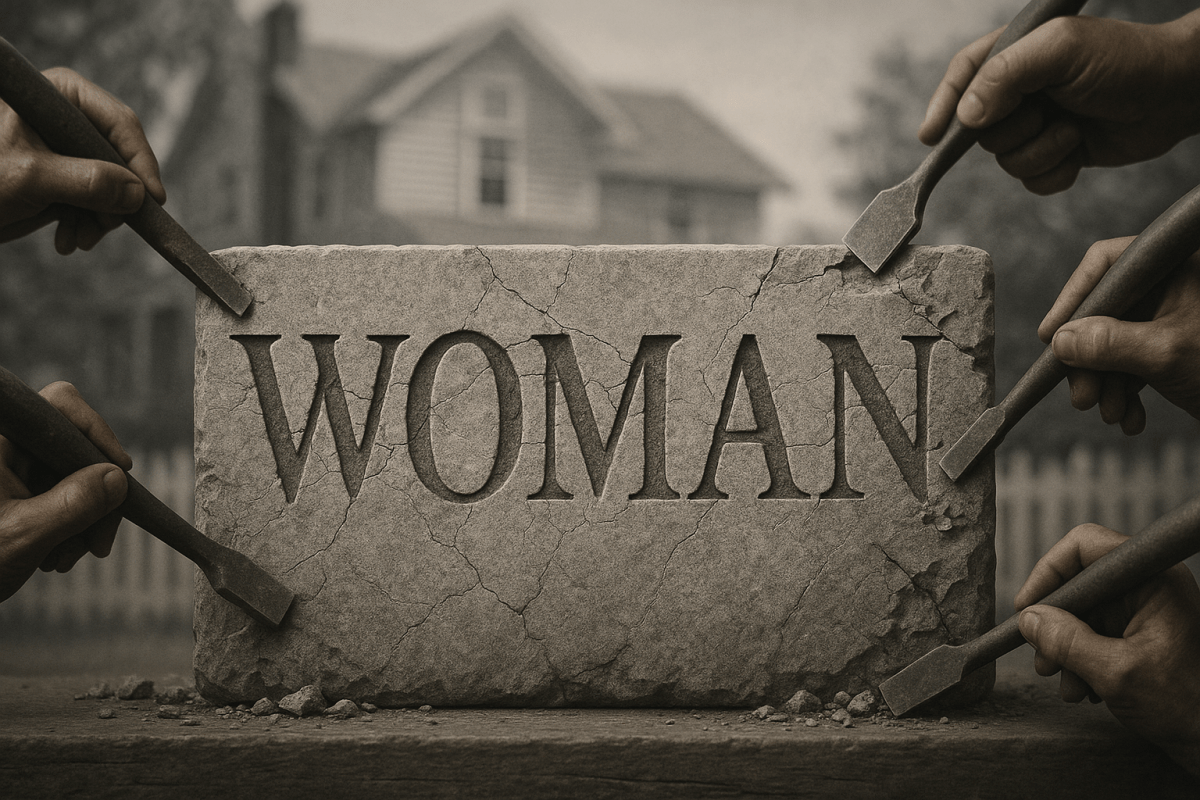
Maher’s statement wasn’t intended to clarify. It was intended to exclude. It wasn’t some linguistic slip; it was a rhetorical scalpel — one used not to analyse, but to amputate.
And the applause from some cisgender women — particularly those who’ve “graduated” from menstruation — reveals the heart of the matter: it’s not about reproductive biology. It’s about controlling who gets to claim the term woman.
it only works if you pretend the world is simpler than it is.
Let’s steelman the argument, just for the sport of it:
Menstruation is a symbolic threshold. Even if one no longer menstruates, having done so places you irrevocably within the category of woman. It’s not about exclusion; it’s about grounding identity in material experience.
Fine. But now let’s ask:
- What about women who’ve never menstruated?
- What about intersex people?
- What about trans women?
- What about cultures with radically different markers of womanhood?
You see, it only works if you pretend the world is simpler than it is.
The Language Insufficiency Hypothesis: Applied
This is precisely where the Language Insufficiency Hypothesis earns its keep.
The word woman is not a locked vault. It is a floating signifier, to borrow from Barthes — a term whose meaning is perpetually re-negotiated in use. There is no singular essence to the word. It is not rooted in biology, nor in social role, nor in performance. It is a hybrid, historically contingent construct — and the moment you try to fix its meaning, it slips sideways like a greased Wittgensteinian beetle.
“Meaning is use,” says Wittgenstein, and this is what frightens people.
If woman is defined by use and not by rule, then anyone might claim it. And suddenly, the club is no longer exclusive.
That’s the threat Maher and his defenders are really reacting to. Not trans women. Not intersex people. Not language activists or queer theorists.
The threat is ambiguity.
What They Want: A World That Can Be Named
The push for rigid definitions — for menstruation as membership — is a plea for a world that can be named and known. A world where words are secure, stable, and final. Where meaning doesn’t leak.
But language doesn’t offer that comfort.
It never did.
And when that linguistic instability gets too close to something personal, like gender identity, or the foundation of one’s own sense of self, the defensive response is to fortify the language, as though building walls around a collapsing church.
Maher’s defenders aren’t making scientific arguments. They’re waging semantic warfare. If they can hold the definition, they can win the cultural narrative. They can hold the gates to Womanhood and keep the undesirables out.
That’s the fantasy.
But language doesn’t play along.
Conclusion: Words Will Not Save You — but They Might Soothe the Dead
In the end, Maher’s definition is not merely incorrect. It is insufficient. It cannot accommodate the complexity of lived experience and cannot sustain the illusion of clarity for long.
They are defending nostalgia.
And those who cling to it — friend or stranger, progressive, or conservative — are not defending biology. They are defending nostalgia. Specifically, a pathological nostalgia for a world that no longer exists, and arguably never did: a world where gender roles were static, language was absolute, and womanhood was neatly circumscribed by bodily functions and suburban etiquette.
Ozzy and Harriet loom large here — not as individuals but as archetypes. Icons of a mid-century dream in which everyone knew their place, and deviation was something to be corrected, not celebrated. My friend, of that generation, clings to this fantasy not out of malice but out of a desperate yearning for order. The idea that woman could mean many things, and mean them differently across contexts, is not liberating to her — it’s destabilising.
But that world is gone. And no amount of menstruation-based gatekeeping will restore it.
The Real Scourge Is Ambiguity
Maher’s tantrum wasn’t about truth. It was about fear — fear of linguistic drift, of gender flux, of a world in which meaning no longer obeys. The desire to fix the definition of “woman” is not a biological impulse. It’s a theological one.
And theology, like nostalgia, often makes terrible policy.
And theology, like nostalgia, often makes terrible policy.
This is why your Language Insufficiency Hypothesis matters. Because it reminds us that language does not stabilise reality — it masks its instability. The attempt to define “woman” once and for all is not just futile — it’s an act of violence against difference, a linguistic colonisation of lived experience.
So Let Them Rest
Ozzy and Harriet are dead. Let them rest.
Let their picket fence moulder. Let their signage decay.
The world has moved on. The language is shifting beneath your feet. And no amount of retroactive gatekeeping can halt that tremor.
The club is burning. And the only thing left to save is honesty.

 Philosophics