Democracy: Judge and Jury

As I make progress on my Democracy: The Great Illusion book, I am working on a chapter considering juries as a microcosm of a democratic process. I am debating whether to include this information in the chapter, Like the justice system in the United States, perhaps I should just flip a coin.

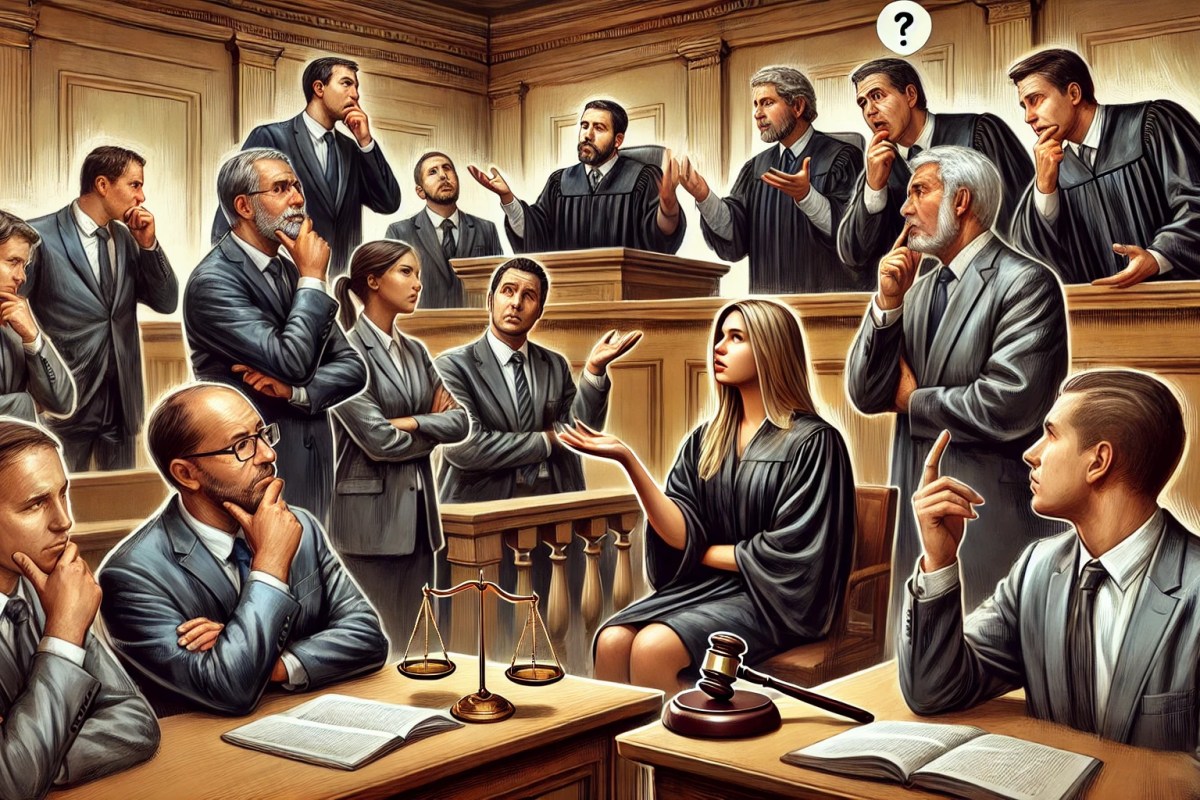
Having been seated on three juries in my lifetime, it was just as I had expected. Thankfully, I’ve never been on the other side of this Russian Roulette revolver. We really need to limit human-based decision systems. I have as much faith in juries as I have with democracies, but I thought I might take a peek into deliberation at a smaller scale, perhaps 12 jurors.

I read Kahneman’s Noise: A Flaw in Human Judgment when it was published in 2021, and I was not at all surprised how trial outcomes, quite often led to markedly different outcomes depending on the judge and the defendant. Although discrepancies based on sex and race have been well documented, this book showcased how much the judge’s mood affected sentencing—particularly if s/he was hungry. But this was not my interest.

My interest was to assess how the same case might fare given different judges and juries, so I asked ChatGPT. I want to share what it had to say—edited slightly for readability and flow.

ChatGPT Transcript

There have been several studies and controlled experiments assessing the variability in trial outcomes when the same case is tried separately by different judges and juries. These studies aim to evaluate the consistency and reliability of judicial decision-making, shedding light on the fallibility and variability of trial outcomes. Here are some key findings from such research:

Studies on Judicial and Jury Variability

The American Jury Study

One of the most notable studies is “The American Jury” by Harry Kalven and Hans Zeisel. This extensive study compared the decisions of juries and judges in actual cases. It found that juries and judges often agree on verdicts, but there are significant instances where they disagree. This disagreement highlights the subjective nature of decision-making and the potential for variability in trial outcomes.

Judge-Jury Agreement

Research by Valerie Hans and Neil Vidmar in “Judging the Jury” indicates that judges and juries reach the same verdict about 75-80% of the time. However, in the remaining 20-25% of cases, the disagreement can lead to different outcomes for the same case. These findings suggest that personal interpretations and biases can influence verdicts.

The Civil Jury Project

The Civil Jury Project at NYU School of Law has conducted several studies examining jury decision-making. Their research has highlighted how factors like juror demographics, pre-existing biases, and the presentation of evidence can lead to different outcomes in similar cases.

Controlled Experiments

Controlled experiments, such as those conducted by Shari Seidman Diamond and her colleagues, have involved mock trials where participants (acting as jurors) are presented with the same case. These experiments have shown significant variability in verdicts and sentences, demonstrating the influence of group dynamics, individual biases, and the presentation of evidence on jury decisions.

Key Findings

Cognitive Bias and Heuristics

Studies indicate that cognitive biases and heuristics significantly impact both judges and juries. Biases such as the anchoring effect, where the initial piece of evidence presented influences subsequent judgments, can lead to different outcomes for the same case.

Case Complexity and Juror Understanding

Research has shown that the complexity of legal cases can lead to variability in outcomes. Jurors often struggle with understanding complex legal and technical issues, leading to decisions based on incomplete or misunderstood information.

Influence of Legal Instructions

The clarity and comprehensibility of legal instructions given to juries play a crucial role in decision-making. Studies have found that poorly understood instructions can result in inconsistent application of the law, leading to variable outcomes.

Implications

The variability in trial outcomes highlights the fallibility of judicial processes and underscores the importance of reforms to enhance consistency and fairness. Potential reforms could include:

  1. Improving Juror Education: Providing better education and resources for jurors to understand legal principles and case-specific details.
  2. Reducing Cognitive Bias: Implementing measures to mitigate cognitive biases, such as standardized jury instructions and blind procedures.
  3. Enhancing Legal Instructions: Ensuring that legal instructions are clear, concise, and comprehensible to prevent misinterpretation.
  4. Utilizing Expert Testimony: Increasing the use of expert testimony to clarify complex issues for jurors.

Conclusion

The variability in trial outcomes, when the same case is tried by different judges and juries, underscores the need for ongoing research and reform in judicial processes. By understanding the factors that contribute to inconsistent verdicts, we can develop strategies to enhance the fairness and reliability of the justice system.

References

  • Kalven, H., & Zeisel, H. (1966). The American Jury. Little, Brown and Company.
  • Hans, V., & Vidmar, N. (1986). Judging the Jury. Plenum Press.
  • Diamond, S. S., & Rose, M. R. (2005). Real Juries: The Power of Watching. Basic Books.
  • The Civil Jury Project at NYU School of Law. (n.d.). Research on Jury Decision Making. Retrieved from [website].
  • Kahneman, D., Sibony, O., & Sunstein, C. R. (2021). Noise: A Flaw in Human Judgment. Little, Brown Spark.
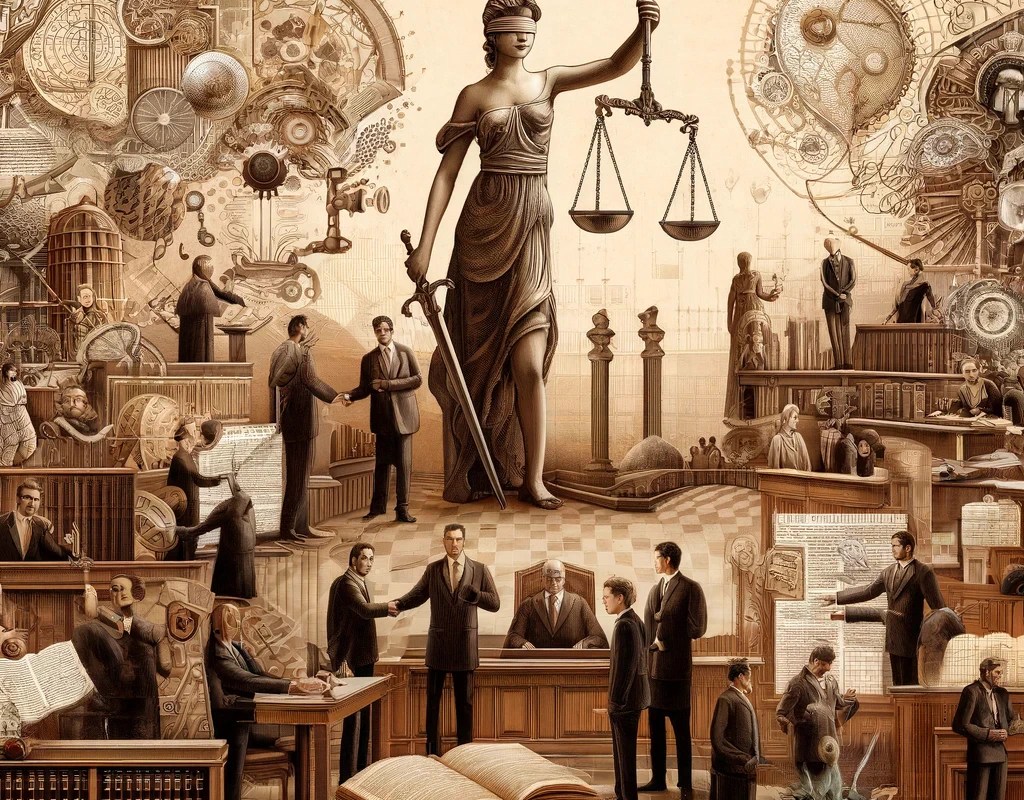
Fiction Nation: Legal and Jurisprudence Systems


Section 4: Legal and Jurisprudence Systems as Fictions

The Nature of Legal Systems

Legal and jurisprudence systems are among the most complex and entrenched fictions in society. Laws are human-made rules that govern behaviour, established by governments and enforced by judicial institutions. While laws aim to create order and justice, they are ultimately constructs, products of human agreement and cultural evolution.

The concept of law varies significantly across cultures and historical periods. Ancient legal codes, such as the Code of Hammurabi or Roman law, illustrate the long-standing tradition of codifying rules to govern society. However, these codes, like modern laws, are not natural phenomena but rather inventions designed to regulate human interactions and maintain social cohesion.

The Evolution of Legal Fictions

Legal systems have evolved alongside societies, adapting to changes in cultural norms, technological advancements, and political landscapes. The development of common law, for example, is a testament to the adaptive nature of legal systems. Common law, which originated in medieval England, is based on judicial precedents and case law rather than written statutes. This system relies heavily on the interpretation and application of past decisions, demonstrating how legal principles are constructed and reconstructed over time.

Moreover, legal fictions are often used within these systems to achieve practical outcomes. For instance, the concept of corporate personhood, where a corporation is treated as a legal person with rights and responsibilities, is a legal fiction designed to facilitate business operations and protect individual shareholders from certain liabilities. This illustrates how legal constructs can shape economic activities and social relations.

Implications of Legal Fictions

The recognition that legal systems are fictions has profound implications for how we understand and engage with the law. It highlights the role of human agency in creating and modifying legal norms, suggesting that laws are not immutable truths but rather adaptable tools for governance.

Legal systems are often seen as impartial and objective, but they are deeply influenced by the values, beliefs, and power dynamics of the societies that create them. This can lead to biases and inequalities being embedded within legal frameworks. For example, historical laws that discriminated based on race, gender, or class demonstrate how legal fictions can perpetuate social injustices.

Understanding the fictional nature of legal systems also opens the door to questioning and reforming these systems. It encourages us to consider alternative approaches to justice and governance that may better reflect contemporary values and address the needs of diverse populations.

The Role of Legal Narratives

Legal narratives, the stories told through laws and legal decisions, play a crucial role in shaping public perceptions and societal norms. These narratives construct realities that influence how individuals and communities understand their rights, responsibilities, and relationships with the state.

The work of scholars like Robert Cover, who in “Nomos and Narrative” (1983) argued that law is a system of meaning-making through narratives, underscores the importance of storytelling in the legal realm. By examining these narratives critically, we can uncover the underlying assumptions and power structures that they reinforce.

Future of Legal Systems

As societies continue to evolve, so too will their legal systems. The rise of international law, human rights conventions, and transnational legal frameworks reflects the growing interconnectedness of the world. These developments challenge traditional notions of state sovereignty and domestic legal autonomy, suggesting a future where legal systems may become even more complex and intertwined.

By recognizing legal systems as fictions, we are better equipped to navigate and influence these changes. This awareness can lead to more inclusive and equitable legal frameworks that serve the broader goals of justice and human flourishing.

References

  1. Cover, Robert. “Nomos and Narrative” (1983).
  2. Graeber, David. Debt: The First 5,000 Years (2011).
  3. Anderson, Benedict. Imagined Communities: Reflections on the Origin and Spread of Nationalism (1983).
  4. Giddens, Anthony. The Consequences of Modernity (1990).
  5. Beck, Ulrich. Cosmopolitan Vision (2006).

⬅ Fiction Nation: Economies & Money (part 3)

➡ Fiction Nation: Living in a World of Fictions (section 5)

Music Property

The topic of intellectual property gets me every time. As much as I am opposed to the notion of property in general, intellectual property is a complete farce. Along with Rick Beato and David Bennet, Adam Neely is one of my three main music theory staples on YouTube. Here, he goes into more depth than I would have expected, but it’s worth hearing the perspective of a musician. I won’t break down his video fully because it speaks for itself. Instead, I’ll share my thoughts and pull out highlights.

Podcast: Audio version of this page content.

November 8th, 1548 is the day in history that the French King Henri II opened the door to intellectual property, an obvious giveaway to a benefactor, creating a publishing monopoly. He turned community cultural knowledge into property, turning the benefit of many into the benefit of one. This is the crux of capitalism—favouring the one over the many.

Before continuing, it seems that there is a schism in the legal system itself. In fact, it is very fractured even within this small domain. At the same time it wants to be precise and analytical, it’s dealing with a subject that cannot be analysed as such. To add insult to injury, it exempts musicians and musical experts and requires music consumers to decide the outcomes of trial cases. To be fair, even relying on so-called experts would lead to mixed results anyway. They might as well just roll the dice. This is what happens when right hemisphere art enters a left hemisphere world.

nature + work = ownership

Adam establishes a grounding on the theory of property rights Ă  la John Locke’s ‘sweat of the brow’ concept, wherein nature plus work equates to ownership. He then points out how intellectual property has even shakier ground to stand on. It relies rather on notions of originality and creativity, two concepts that have no intersection with the left-hemisphere heavy legal and jurisprudence systems. Moreover, like pornography, these things cannot be defined. They need to be divined. Divination is no place for lay jurists. It’s a recipe for disaster. The entire English court system is rife with problems, but the left-brainers feel these are just trivial devils in the details. I beg to differ, yet I am voiceless because I won’t participate within their frame.

Adam also points out how out of date the law is insomuch as it doesn’t recognise much of the music produced in the past few decades. Moreover, the music theory it’s founded on is the Romantic Era, white European music that often ties transcriptionists in knots. If the absence of certain words to emote experience is a challenge, it’s even worse for musical notation.

In any case, this is a hot-button issue for me on many levels, and I needed to vent in solidarity. This video is worth the 30 minutes run time. His ham sandwich analogy in part V works perfectly. It’s broken into logical sections:

  1. 0:00 Intro
  2. 1:45 Part I – Rhythm-A-Ning
  3. 7:07 Part II – Property Rights
  4. 11:25 Part III – Copyright
  5. 15:58 Part IV – Musical Constraints
  6. 22:18. Part V – HAM SANDWICH TIME
  7. 26:51 Part VI – Solving copyright….maybe?

Give it a listen. Cheers.

The cover image for this is of Thelonius Monk (circa 1947), who features heavily in the video.

Can We Just Stop Talking About Free Will

The problem with free will is that we keep dwelling on it. Really, this has to stop.

— Owen D. Jones, The End of (Discussing) Free Will, 18 March 2012

This quote was made by Owen Jones in an article published in 2012. I share it because I feel the author is not only being cavalier but wrongly so. According to the bio at the end of the article, Owen D. Jones is a professor of law and biological sciences at Vanderbilt University. As I see it, the problem is not some theoretical—What is the sound of one hand clapping?—pseudo-problem. Human agency is the basis of our legal and jurisprudence systems.

Like good magicians, people like Owen want to redirect your focus to neuroscience and consciousness rather than have to explain how the causal engine that is the brain manifests itself ex nihilo.

Doubling down on my causa sui position, humans may be able to make constrained solutions, and yet they never have control over the constrained system they inherit. I discuss this at length elsewhere, but I wanted to address this comment forthright.

I’ll leave with a quote I tend to trot out a lot.

It is difficult to get a man to understand something when his salary depends on his not understanding it.

— Upton Sinclair, prepared speech, I, Candidate for Governor (1935)

Free will is a necessary illusion for power structures to propagate or they will lose a cornerstone of their control mechanisms. And since humans want to feel they are in control, they are willing to accept the downside for the illusion of an upside.

Quarantine and Social Justice

Gregg Caruso is interested in the notion of Agency from the perspective of justice, desert, and sentencing. This is applied philosophy.

My main argument against the possibility of free will is Nietzsche-Strawson’s causa sui argument, which I’ve touched on a few times by now, but I haven’t yet fully articulated my position. I’ll get to that another day. I’d also like to create another video, as I would like to do for this as I explore in more detail.

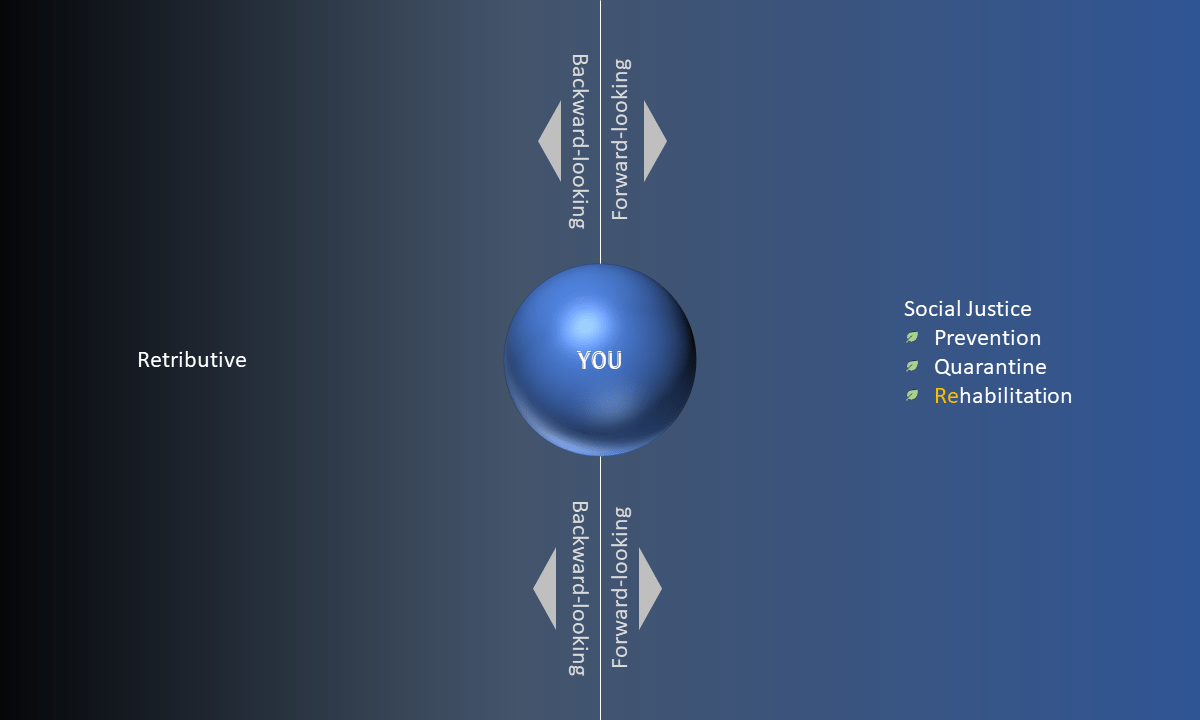
Ostensibly, this is a compatibilist view that leaves a modicum of free will, even with causa sui in place. I hope this illustration will be helpful.

In the centre of the illustration is you, the self of some arbitrary person who shall act as our subject. Let’s assume a couple of basic premises:

  1. We either live in a relaxed causal, deterministic or indeterministic universe.
  2. Causa sui is in full force and effect: one cannot cause any aspect of one’s self.

I include the term relaxed in the first premise, so I don’t have to deal with a fully deterministic universe governed entirely by the notion captured by Schrödinger’s equation. The second premise is in place to serve as a limitation: even if consciousness is an emergent property, its emergence doesn’t grant some insuperable metaphysical powers. One cannot reach outside of one’s self.

The scenario plays out as follows. You have been apprehended for violating some statute. Let’s say that you’ve taken an item from a retail store. As you are leaving the store, the police stop you. When asked if you took the item, you answer in the affirmative. This is a very efficient municipality, so you are taken immediately to a magistrate to make a plea.

In this scenario, Caruso is your attorney at law. His argument is that, given causa sui, you cannot be responsible for who you are. We’ve been here before. Since you can’t be responsible for who you are, any sentence to punish you would be unethical, as you’ve done nothing to deserve it. This is the notion of desert in the realm of retributive justice.

The judge buys this argument, but s/he counters with three possible courses of action. You may not be responsible for who you are, but we are a community of laws. You are a victim of your circumstances, so we cannot look backwards. For whatever reason—and through no fault of your own, by definition—, you were broken relative to complying with community norms.

Social Justice

Firstly, we may wish to make an example of you, to signal the community that we will incarcerate people who break the laws. This is more a public service purpose than a punishment.

Secondly, if you had contracted a communicable disease—we’re looking at you Covid—, you can be quarantined under the consideration of the common good. Framed this way, it is not a punishment, we just don’t want it to happen again.

Lastly, we may also be justified on the grounds of rehabilitation. I highlight the ‘re‘ in rehabilitation because some people may not have been ‘habilitated’ in the first place. Perhaps think of them as feral. In any case, a computer programming analogy might make sense here.

So what’s this all about? Remember, causa sui says that you cannot be held responsible for creating yourself. The claim is that you are a product of your nature and nurture. Genetically speaking, perhaps there was some reason that you could not incorporate inputs into factors that allowed you to appropriately interpret this law—or any law, more generally. Or maybe, you were never exposed to this law or category of law before.

In the preventative vein, we could be signalling, ‘We caught You taking an item from a shop without paying. Now you know this, and we may make an example of you since you are caught as well’.

Quarantine may be a bit of a stretch in this scenario, so feel free to substitute a more serious offence if it helps you to remember this. Perhaps You killed someone. Even without punishment, we may want to get You off the streets before another killing is perpetrated. I’ll come back to this one.

Rehabilitation makes sense even if one is not responsible for one’s self. Presuming that you are a product of programming—family, culture, peers, and so on—, perhaps you just need to be rewired. Perhaps a particular subroutine was not implemented or activated correctly. This rationality could be used as a non-punitive justification.

Counterarguments

The public prevention case may be why offenders were pilloried in by-gone days. Display in a public square may inform some who may have missed the lesson the first time around, hence dissuading taking similar actions. But unless this ‘public service message’ reached enough people, it would probably not be the best rationale.

Quarantine may sound OK on the surface, but it’s actually rather specious. Firstly, that You knicked a trinket. What exactly is the risk of contagion? Petty theft is not known to be particularly communicable. Secondly, just because you’ve done something once is little measure of whether you’ll do it again. In fact, if this were true, then one might have assumed that you could never have committed the offence because of your history.

Rehabilitation may likely be the best option among these. If you missed that particular lesson or had forgotten or diminished the calculus, remediation may do just the trick. However, if your ‘operating system’ is not up to snuff, it’s not a matter of inputs. It’s a matter of processing capability.

Psychological intervention is in its infancy, so the probability of remediating this is low, if not a crap shoot. And not all such processes can be remediated. This could lead one to fall back on the quarantine option, but who is the competent assessor in this case?

It’s easy enough to assess if You is Hannibal Lecter or tells you straight out that s/he intends to repeat the offence. Some cognitive deficiencies are simple enough to recognise. But what about the grey areas—all of that space in between?

And who is making sure that the judges are not being punitive simply because they haven’t yet eaten lunch?

Enfin

Bringing this to a close, if we have no free will, it makes no sense to punish. Sadly, most justice systems promote retributive justice and punishment in sentencing. I’ll spare you my diatribe on how I believe most people attracted to jurisprudence, law, and law enforcement have been conditioned. And whilst Caruso feels justified in foreword action, I am more sceptical. This said, I’ll take what I can get.

This post is pretty much a stream of consciousness. I hope to give it better treatment in a future video.

Identity and Responsibility

Self and identity are cognitive heuristic constructions that allow us to make sense of the world and provide continuity in the same way we create constellations from the situation of stars, imagining Ursa Major, the little dipper, or something else. The self and identity are essentially expressions of apophenia.

Consider this thought experiment about responsibility. Rob decides to rob a bank. He spends weeks casing the target location. He makes elaborate plans, drawing maps. and noting routines and schedules. He gets a gun, and one day he follows through on his plans, and he successfully robs the bank, escaping with a large sum of money in a box with the name of the bank printed on it. Rob is not a seasoned criminal, and so he leaves much incriminating evidence at the scene. To make it even more obvious, he drops his wallet at the scene of the crime containing his driver’s licence with fingerprints and DNA on the licence and other contents of his wallet. He leaves prints and DNA on the counter where he waited for the money. This wallet even contains a handwritten checklist of steps to take to rob this bank—the address of the bank, the time and date. All of this left no doubt about who robbed the bank.

The self and identity are essentially expressions of apophenia.

Using this evidence, the police show up at Rob’s apartment to arrest him. They knock on the door and identify themselves as law enforcement officers. Rob opens the door and invites them in. All of the purloined money is still in the box with the name of the bank printed on it. It’s on a table in plain sight next to the gun he used. All of his maps, plans and, surveillance notes are in the room, too. They read him his rights and arrest him. Things aren’t looking good for Rob.

Before I continue this narrative, ask yourself is Rob responsible for robbing the bank? Let’s ignore the question of whether Rob has agency. For this example, I am willing to ignore my contention that no one has or can have agency. Besides, the court will continue to presume agency long after it’s been determined that it is impossible because agency is a necessary ingredient to law and jurisprudence.

Is Rob responsible? Should he be convicted of armed robbery and sentenced to incarceration? Let’s make it even easier. This isn’t Rob’s first offence. In fact, he’s been in prison before for some other crimes he committed. He’s no first-time offender. Why do you think that he’s responsible? More importantly, why should he be convicted and sentenced? What should his sentence be?

Consider that the money has been recovered, no one was injured, and Rob didn’t resist arrest. At first glance, we might consider both restorative and retributive justice. I’ve purposely made it easy to ignore restorative justice as all the money was recovered. This leaves us with retributive justice. What should happen to Rob? What would you do if you were the judge? Why? Hold that thought.

Let’s continue the narrative. All of the above happened, but I left out some details. Because of course I did. After the heist, Rob returned home and he lost his balance and hit his head rendering him an amnesiac—diagnosed with permanent retrograde and dissociative amnesia. Because of the retrograde amnesia, Rob can’t remember anything prior to hitting his head. Because of the dissociation, Rob has no recollection of anything about himself, not even his name. In fact, he now only responds to the name Ash. (This is where I debate whether to have Rob experience a gender-identity swap, but I convince myself to slow my roll and focus on one thought experiment at a time.)

Because of the retrograde amnesia, Rob can’t remember anything prior to hitting his head. Because of the dissociation, Rob has no recollection of anything about himself

To make this as obvious as I can consider, Ash has no recollection of Rob, robbing the bank, or anything about Rob. Ash doesn’t know Rob’s friends or family. Ostensibly Ash is a different person inhabiting former-Rob’s body. To make it even easier, Ash is not feigning this condition. So, let’s not try to use that as an out when I ask you to reconsider responsibility.

If my experience serves as a guide, if I asked you about your response to whether Rob was responsible and what his sentence should be, you would be committed to your same response and for the same reasons, so I won’t ask again.

What I ask now is if Ash is responsible and what his sentence should be. Keep in mind that we should be able to ignore the restorative element and focus on the retributive aspect. What should happen to Ash? What would you do if you were the judge? Whether your response has changed or remained the same, why would you judge Ash this way?

Here are some considerations:

  • Retributive justice might serve as a lesson to other would-be offenders.
  • The public may not believe the amnesia excuse—even though you, as judge, are convinced thoroughly.
  • Ash does not believe he committed the crime and does not comprehend the charges.
  • Ash was surprised to discover the money and gun and was pondering how it got there and what to do with it when the police arrived at his apartment.
  • If released, Ash would not commit a crime in the future. (My thought experiment, my rules; the point being that Ash was no threat to society.)
  • From my perspective, Ash is a different person. Sentencing Ash is ostensibly the same as sentencing any person arbitrarily.

The purpose of this experiment is to exaggerate the concept of multiple selves. Some have argued that there is no self; there is just a constructed narrative stitching discrete selves together to create a continuous flow of self-ness.

Is Ash responsible for Rob’s action?

I’m interested in hearing what you think. Is Ash responsible for Rob’s action, and why or why not? Let me know.

Testudineous Agency

In chapter 71, Ultimate Responsibility, in Intuition Pumps and Other Tools for Thinking, author and philosopher, Daniel Dennett presents a counterargument to the notion that an agent, a person, is not absolutely responsible for their actions. He questions some premises in the ‘the way you are’ line of argumentation, but I question some of his questions.

Here is a nice clear version of what some thinkers take to be the decisive argument. It is due in this form to the philosopher Galen Strawson (2010):
1. You do what you do, in any given situation, because of the way you are.
2. So in order to be ultimately responsible for what you do, you have to be ultimately responsible for the way you are—at least in certain crucial mental respects.
3. But you cannot be ultimately responsible for the way you are in any respect at all.
4. So you cannot be ultimately responsible for what you do.

Dennett, Daniel C.. Intuition Pumps And Other Tools for Thinking (p. 395). W. W. Norton & Company. Kindle Edition.

Dennett continues.

The first premise is undeniable: “the way you are” is meant to include your total state at the time, however you got into it. Whatever state it is, your action flows from it non-miraculously.

Dennett and I are in agreement with Strawson. There is not much to see here. It’s akin to saying the now is the result of all past events until now. This is “the way you are”.

The second premise observes that you couldn’t be “ultimately” responsible for what you do unless you were “ultimately” responsible for getting yourself into that state—at least in some regards.

This second premise asserts that one cannot be responsible for any action that one had no part in performing. Two scenarios come immediately to mind.

First, you are not responsible for being born. As Heidegger notes, we are all thrown into this world. We have no say in when or where—what country or family—or what circumstances.

Second, if one is hypnotised or otherwise incapacitated, and then involved in a crime, one is merely a cog and not an agent, so not responsible in any material sense.

But according to step (3) this is impossible.

Whilst Dennett fixates on the absolute aspect of the assertion, I’d like to be more charitable and suggest that we still end up with a sorites paradox. Dennett will return to this one, and so shall I.

So step (4), the conclusion, does seem to follow logically. Several thinkers have found this argument decisive and important. But is it really?

As Dennett invalidates step (3), he insists that the conclusion is also invalid. He asserts that the notion of absolute responsibility is a red herring, and I argue that Dennett doesn’t get us much further, perhaps redirecting us with a pink herring.

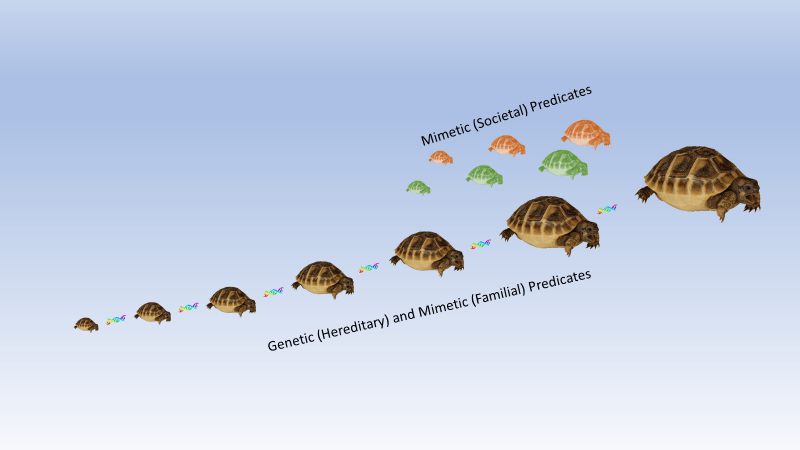
I’ve created an image with tortoises to make my point. There are actually two points I wish to make. The first point is to determine where the responsibility is inherited. This point is meant to articulate that the world can not be strictly deterministic and yet one can still not have significant agency. The second point is that culpability is asserted as a need, and acceptance of this assertion is the problem.

This image has an empty alt attribute; its file name is image-14.png
Testuditude

The image depicts an evolution of an agent, with time progressing from left to right. The tortoise on the right is a product of each of the recursive tortoises to its left. The image means to convey that each subsequent tortoise is a genetic and social and social product of each tortoise prior. Of course, this is obviously simplified, because tortoises require pairs, so feel free to imagine each precedent tortoise to represent a pair or feel free to add that level of diagrammatic complexity.

This is not meant to distinguish between nature and nurture. Instead, the claim is that one is a product of both of these. Moreover, as genetic, epigenetic, and mimetic influences are transmitted in family units, they also occur through social interaction and the environment, as represented by the orange and green tortoises.

…if one is a product of genetic and mimetic forces, how much agency remains for culpability?

The point here is that if one is a product of genetic and mimetic forces, how much agency remains for culpability? Each person is an emergent unit—autonomous, yes, and yet highly programmed.

If I programme a boobytrap to kill or maim any intruder, the boobytrap has no agency. I assert further, that the maker of that boobytrap has no more responsibility than the killing device.

The old hand grenade wired to a doorknob boobytrap trick

But who do we blame? you ask, and that’s precisely the problem. Asking questions doesn’t presume answers. This is a logical fallacy and cognitive bias. This heuristic leaves us with faulty jurisprudence systems. Humans seem hardwired, as it were, to blame. Humans need to believe in the notion of free will because they need to blame because they need to punish because vengeance is part of human nature to the extent there is human nature. There seems to be a propensity to frame everything as a causal relationship. Dennett calls this the Intentional stance. To borrow a from Dennett…

This instinctual response is the source in evolution of the invention of all the invisible elves, goblins, leprechauns, fairies, ogres, and gods that eventually evolve into God, the ultimate invisible intentional system.

Dennett, Daniel C.. Intuition Pumps And Other Tools for Thinking (p. 374). W. W. Norton & Company. Kindle Edition.
Fire Trap in Home Alone

Sins of the Fathers (and Mothers)

Let’s wrap this up with a sorites paradox. As I’ve already said, I agree with Dennett that the absolute aspect is unnecessary and undesired. The question remains how much agency™ does a person have once we account for the other factors? Is it closer to 90 per cent or 10 per cent? Apart from this, what is the threshold for culpability? Legal systems already have arbitrary (if not capricious) thresholds for this, whether mental capacity or age, which basically distils back to the realm of capacity.

I have no basis to even venture a guess, but that’s never stopped me before. I’d argue that the agency is closer to zero than to one hundred per cent of the total, and I’d propose that 70 per cent feels like a reasonable threshold.

I could have sworn I’d posted a position on this after I read Robert Sapolsky’s Behave. Perhaps it’s never made it out of drafts.

In closing, I don’t think we need to settle the question of determinism versus free will to recognise that even without strict determinism, personal agency is still severely limited, and yet as our political systems presume a level of rationality that is not apparent, so do legal systems presume a level of agency not present.

Should the Criminal Justice System Be Abolished?

Much of jurisprudence is based on logic founded on faulty premises of regurgitated theological concepts shrouded in naturalistic theory and pseudoscience. This is not about the defund the police social trend of 2020. This is to say that the justice system is smoke and mirrors writ large. It’s ostensibly built on anachronistic concepts such as volition, evil, soul, blame, and forgiveness that should be tossed into the dustbin of history along with phrenology, humours, and will.

The titleof this post is taken from Robert Spapolsky’s proposed chapter concept for Behave, published in 2017, where until now, it’s languished on my Want to Read list, having entered via the vector of my interest in behavioural economics. Chapter 16 was eventually published with the title of Biology, the Criminal Justice System, and (Oh, Why Not?) Free Will.

I’ve been writing for years about the nonesensical attachment to these notions, so it gives me comfort in solidarity to discover others who share, at least to some degree my perspective, knowing, of course, that this doesn’t make this perspective any more correct.

To be fair, I’ve held a low opinion of so-called justice (and government) systems pretty much since I was taught about them almost 50 years ago. In the US, much teaching is really propagandising about how fair these systems are and how peers and reasonable persons concepts make is superior. In my mind, those were the being failings. Later, when I hopped onto my language insufficiency bandwagon, it only fell apart more. Kafka’s The Trial represents the internal workings of most justice systems than the logic and reason of propogated but proponants.

Stopping here. Much to do. I recommend reading Behave. If you’ve read it, I’d love to see what you thought about it.

In the name of the law…

A brief change of pace…

We’re all familiar with the scenario: a representative from law enforcement appears at a door and flashes a badge or an ID. It’s in most of the police movies. A gaggle of people in official-looking uniforms. One of them pulls out a warrant, and they make their way into the residence. You still with me?

Here’s the rub? How does one know with any degree of certainty higher than blind faith?

Do you know what an ‘official’ badge or ID looks like? How do you know it’s not counterfeit? 

Do you even know what a search warrant looks like? It’s signed, do you know the person it’s signed by? Perhaps it’s a judge. Is the warrant real or fake? What about the uniforms or official-looking vehicles? 

Indoctrination and cognitive dissonance are key factors

The answer is most people would have no idea. Indoctrination and cognitive dissonance are key factors. In movies, apart from the documentation, there’s the intimidation factor. And maybe guns for full effect.

To be sure, people have performed variations of this script, and they’ve been punked. So, the question remains: How can one tell? And when does when get to call bullshit?

And what are the down sides?  If these cats are legit, and after the bullying and indignity, you’ll probably be facing accusations of obstruction or resisting. Of course, you’ll be justified, but justification is asymmetrical and out of your favour. The house holds the advantage, and you aren’t the house.

But let’s pretend that justice is symmetrical and does have meaning beyond its application as a power tool, how far would one need to go to be sure?

Take the case of the warrant signed by a judge. S/he shows up in person and says, ‘Yup. I signed that warrant’. Has that gotten you anywhere? Probably not. You don’t know this person, and you have no way of evaluating the authenticity of the claim. Does it take the governor? The president? The head of the UN? 

And even if you trust the entire process thus far, what say do you have in justifying the merit of issuance of the warrant? 

Well, that was something…

Police State

Bad police dramas on TV have gotten me in the mood to rail. First, there was the topic of lying, and then there was the Unabomber. This post is broader.

We laugh of the notions of Barney Fife, Chief Wiggum, and Paul Blart, but in my estimation these are closer to the norm than the stereotype of the bad-ass cop.

My armchair pop-psychology assessment is that people who are drawn to police work are underachievers with power and control issues and conformity and morality fetishes.

Advantage goes to the house

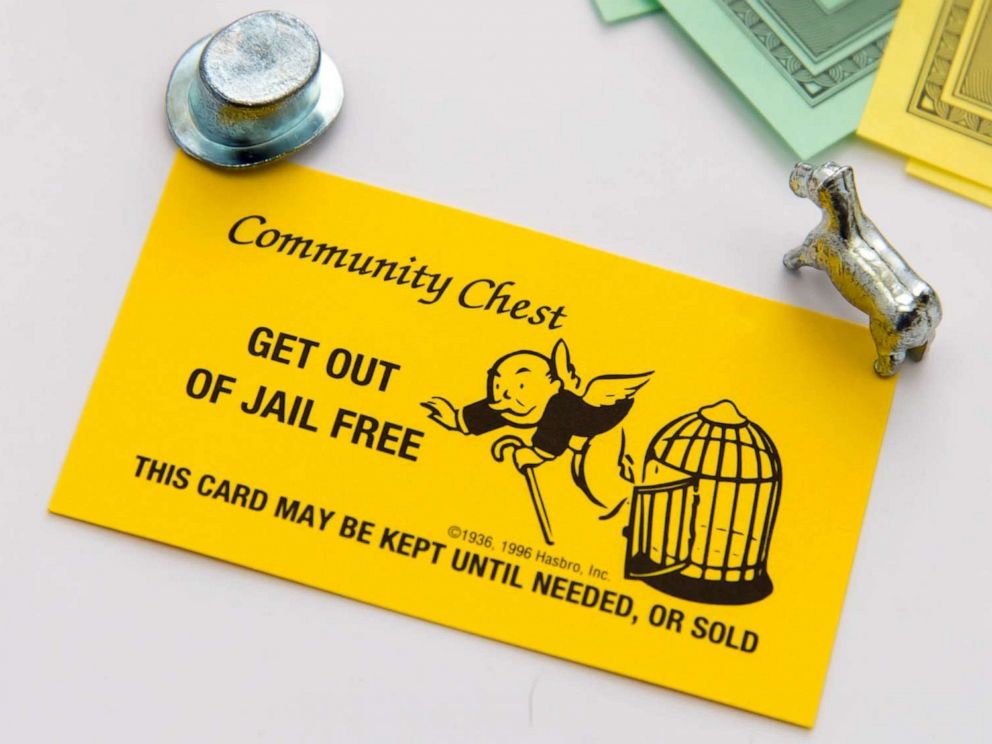
Law enforcement and jurisprudence systems wouldn’t work if they didn’t stack the decks in their favour. They give themselves get out of jail free cards and rely on lies and deception to create an advantage. Watching these TV shows, they have permission to lie, withhold, misrepresent, coerce, and entrap without repercussion. They make ‘deals’ in domains where they have no authority. They are even allowed to engage in criminal activity if it serves the better interests of a case. They can buy drugs and property, engage with prostitutes, and any number of otherwise illegal activities.

I won’t even spend more digital ink commenting on the lack of due process judges commit in the courtroom—personal fiefdoms.

Domestic abuse

Over 40% of active police officers have domestic abuse histories.

Over 40% of active police officers have domestic abuse histories. These people have records of abusing the wives, children, domestic partners, and pets. And these are only the ones who have been caught. Statistically, the percentage is very likely to be over 50%. This is not shining endorsement. Sadly, domestic abuse is inversely correlated with IQ, so this doesn’t fair well with the next topic.

Low IQs

The average IQ of a police officer in the United States is about 104. In and of itself, this might not seem strange. This seems to imply that these IQs are in line with average, but there’s a problem. The courts have ruled that is not discriminatory to exclude people with high IQs from being police officers because they are more likely to be independent thinkers and not conformant.

Conformity

Because cops are usually and expectedly conformant, it should come as no surprise that they feel the urge to prescribe this conformity on others. Given the opportunity, I’d argue that in many instances this conformity is superficial and performative, but that’s a topic for another day.