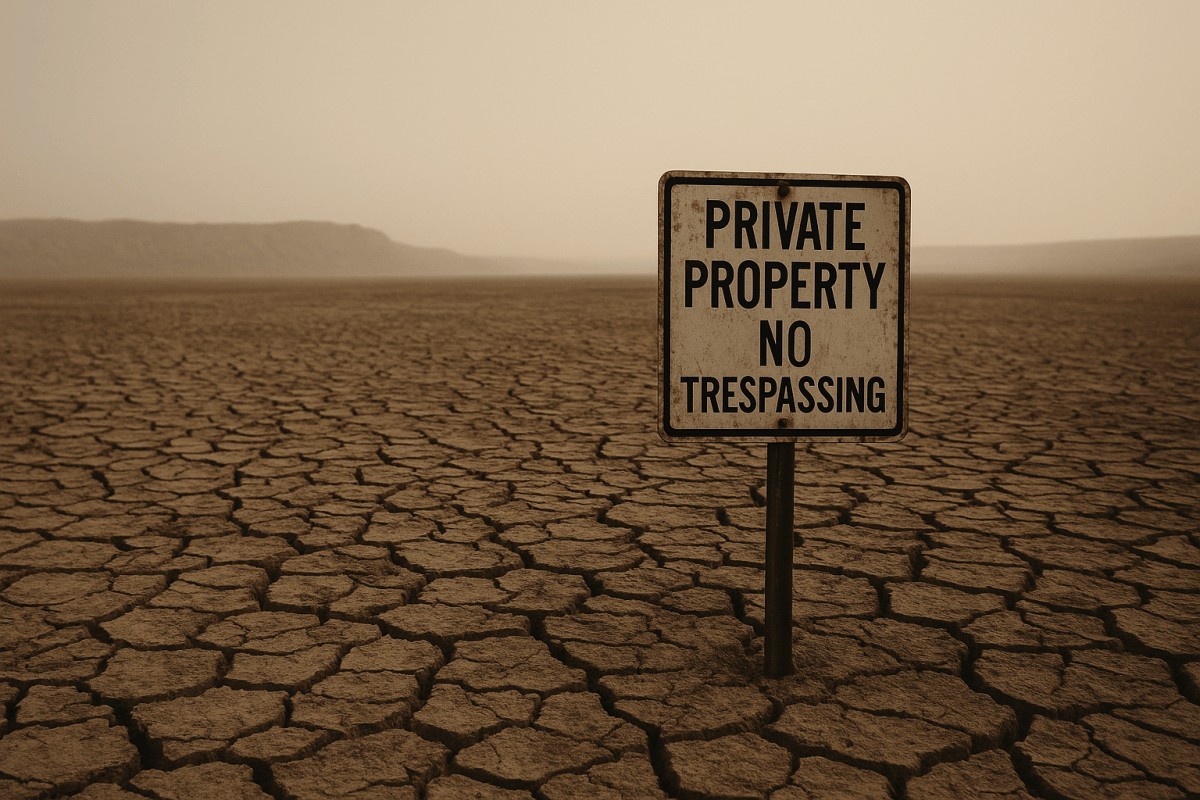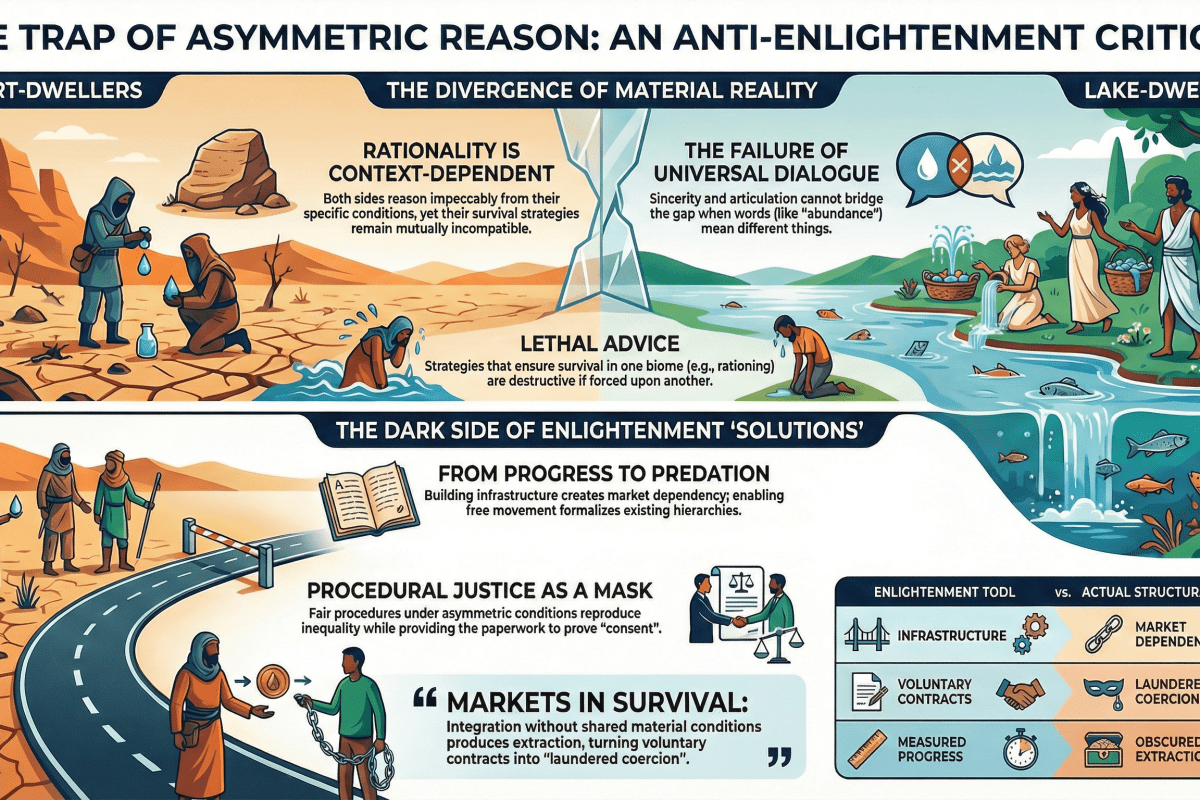
The Tunnel (Or: How Modernity Solves Precisely Nothing)

4–5 minutes

But wait—surely someone will object—what if we just built a tunnel?

Remove the barrier! Enable free movement! Let people see both sides! Markets will equilibrate! Efficiency will reign! Progress!

So fine. The desert-dwellers say, “Let’s build a tunnel”.

Engineers arrive. Explosives are deployed. A passage is carved through the mountain. The fog clears inside the tunnel itself. You can now walk from lake to desert, desert to lake, without risking death by altitude.

Congratulations. Now what?

Audio: NotebookLM summary podcast of this topic.

The lake doesn’t flow through the tunnel. The desert doesn’t migrate. The material conditions remain exactly as they were, except now they’re adjacent rather than separated.

And here’s where Modernity performs its favourite trick: it converts geographical accident into property rights.

The lake-dwellers look at their neighbours walking from the tunnel and think: “Ah. We have water. They need water. We should probably charge for that.”

Not out of malice. Out of perfectly rational economic calculation. After all, we maintain these shores (do we, though?). We cultivate these reeds (they grow on their own). We steward this resource (it replenishes whether we steward it or not).

John Locke would be beaming. Property through labour! Mixing effort with natural resources! The foundation of legitimate ownership!

Except nobody laboured to make the lake.

It was just there. On one side. Not the other.

The only “labour” involved was being born facing the right direction.

Primacy of position masquerading as primacy of effort.

What Actually Happens

The desert-dwellers can now visit. They can walk through the tunnel, emerge on the shore, and confirm with their own eyes: yes, there really is abundance here. Yes, the water is drinkable. Yes, there is genuinely enough.

And they can’t touch a drop without payment.

The tunnel hasn’t created shared resources. It’s created a market in geographical accident.

The desert-dwellers don’t become lake-dwellers. They become customers.

The lake-dwellers don’t become more generous. They become vendors.

And the separation—formerly enforced by mountains and fog and the physical impossibility of crossing—is now enforced by price.

Which is, if anything, more brutal. Because now the desert-dwellers can see what they cannot have. They can stand at the shore, watch the water lap at the sand, understand perfectly well that scarcity is not a universal condition but a local one—

And still return home thirsty unless they can pay.
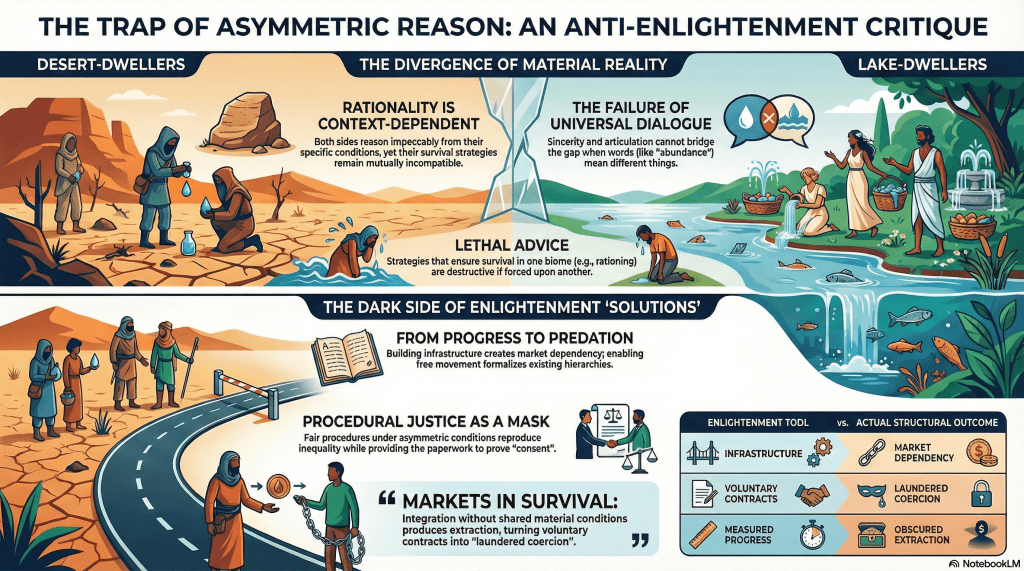
Image: NotebookLM infographics of this topic

The Lockean Slight-of-Hand

Here’s what Locke tried to tell us: property is legitimate when you mix your labour with natural resources.

Here’s what he failed to mention: if you happen to be standing where the resources already are, you can claim ownership without mixing much labour at all.

The lake people didn’t create abundance. They just didn’t leave.

But once the tunnel exists, that positional advantage converts into property rights, and property rights convert into markets, and markets convert into the permanent enforcement of inequality that geography used to provide temporarily.

Before the tunnel: “We cannot share because of the mountains.”

After the tunnel: “We will not share because of ownership.”

Same outcome. Different justification. Significantly less honest.

The Desert-Dwellers’ Dilemma

Now the desert people face a choice.

They can purchase water. Which means accepting that their survival depends on the economic goodwill of people who did nothing to earn abundance except be born near it.

Or they can refuse. Maintain their careful, disciplined, rationed existence. Remain adapted to scarcity even though abundance is now—tantalisingly, insultingly—visible through a tunnel.

Either way, the tunnel hasn’t solved the moral problem.

It’s just made the power differential explicit rather than geographical.

And if you think that’s an improvement, ask yourself: which is crueller?

Being separated by mountains you cannot cross, or being separated by prices you cannot pay, whilst standing at the shore watching others drink freely?

TheBit Where This Connects to Actual Politics

So when Modernity tells you that the solution to structural inequality is infrastructure, markets, and free movement—

Ask this:

Does building a tunnel make the desert wet?

Does creating a market make abundance appear where it didn’t exist?

Does free movement help if you still can’t afford what’s on the other side?

The tunnel is a technical solution to a material problem.

But the material problem persists.

And what the tunnel actually creates is a moral problem: the formalisation of advantage that was previously just an environmental accident.

The lake-dwellers now have something to sell.

The desert-dwellers now have something to buy.

And we call this progress.


Moral: If your political metaphor doesn’t account for actual rivers, actual deserts, and actual fog, it’s not a metaphor. It’s a fairy tale. And unlike fairy tales, this one doesn’t end with a reunion.

It ends with two people walking home, each convinced the other is perfectly reasonable and completely unsurvivable.

Unless, of course, we build a tunnel.

In which case, it ends with one person selling water to the other, both convinced this is somehow more civilised than being separated by mountains.

Which, if you think about it, is far more terrifying than simple disagreement.

Molyneux, Locke, and the Cube That Shook Empiricism

Few philosophical thought experiments have managed to torment empiricists quite like Molyneux’s problem. First posed by William Molyneux to John Locke in 1688 (published in Locke’s An Essay Concerning Human Understanding), the question is deceptively simple:

If a person born blind, who has learned to distinguish a cube from a sphere by touch, were suddenly granted sight, could they, without touching the objects, correctly identify which is the cube and which is the sphere by sight alone?

I was inspired to write this article in reaction to Jonny Thmpson’s post on Philosophy Minis, shared below for context.

Video: Molyneux’s Problem

Locke, ever the champion of sensory experience as the foundation of knowledge, gave a confident empiricist’s answer: no. For Locke, ideas are the products of sensory impressions, and each sense provides its own stream of ideas, which must be combined and associated through experience. The newly sighted person, he argued, would have no prior visual idea of what a cube or sphere looks like, only tactile ones; they would need to learn anew how vision maps onto the world.

Audio: NotebookLM podcast on this topic.

This puzzle has persisted through centuries precisely because it forces us to confront the assumptions at the heart of empiricism: that all knowledge derives from sensory experience and that our senses, while distinct, can somehow cohere into a unified understanding of the world.

Empiricism, Epistemology, and A Priori Knowledge: The Context

Before we dismantle the cube further, let’s sweep some conceptual debris out of the way. Empiricism is the view that knowledge comes primarily (or exclusively) through sensory experience. It stands opposed to rationalism, which argues for the role of innate ideas or reason independent of sense experience.

Epistemology, the grandiloquent term for the study of knowledge, concerns itself with questions like: What is knowledge? How is it acquired? Can we know anything with certainty?

And then there is the spectre of a priori knowledge – that which is known independent of experience. A mathematical truth (e.g., 2 + 2 = 4) is often cited as a classic a priori case. Molyneux’s problem challenges empiricists because it demands an account of how ideas from one sensory modality (touch) might map onto another (vision) without prior experience of the mapping—an a priori leap, if you will.

The Language Correspondence Trap

While Molyneux and Locke framed this as an epistemological riddle, we can unmask it as something more insidious: a failure of language correspondence. The question presumes that the labels “cube” and “sphere” – tied in the blind person’s mind to tactile experiences – would, or should, carry over intact to the new visual experiences. But this presumption smuggles in a linguistic sleight of hand.

The word “cube” for the blind person means a specific configuration of tactile sensations: edges, vertices, flat planes. The word “sphere” means smoothness, unbroken curvature, no edges. These are concepts anchored entirely in touch. When vision enters the fray, we expect these words to transcend modalities – to leap from the tactile to the visual, as if their meanings were universal tokens rather than context-bound markers. The question is not merely: can the person see the cube? but rather: can the person’s tactile language map onto the visual world without translation or recalibration?

What Molyneux’s problem thus exposes is the assumption that linguistic labels transparently correspond to external reality, regardless of sensory apparatus. This is the mirage at the heart of Locke’s empiricism, the idea that once a word tags an object through experience, that tag is universally valid across sensory experiences. The cube and sphere aren’t just objects of knowledge; they are signs, semiotic constructs whose meaning depends on the sensory, social, and linguistic contexts in which they arise.

The Semiotic Shambles

Molyneux’s cube reveals the cracks in the correspondence theory of language: the naïve belief that words have stable meanings that latch onto stable objects or properties in the world. In fact, the meaning of “cube” or “sphere” is as much a product of sensory context as it is of external form. The newly sighted person isn’t merely lacking visual knowledge; they are confronted with a translation problem – a semantic chasm between tactile signification and visual signification.

If, as my Language Insufficiency Hypothesis asserts, language is inadequate to fully capture and transmit experience across contexts, then Molyneux’s problem is not an oddity but an inevitability. It exposes that our conceptual frameworks are not universal keys to reality but rickety bridges between islands of sense and meaning. The cube problem is less about empiricism’s limits in epistemology and more about its blind faith in linguistic coherence.

In short, Molyneux’s cube is not simply an empirical puzzle; it is a monument to language’s failure to correspond cleanly with the world, a reminder that what we call knowledge is often just well-worn habit dressed up in linguistic finery.

A Final Reflection

Molyneux’s problem, reframed through the lens of language insufficiency, reveals that our greatest epistemic challenges are also our greatest linguistic ones. Before we can speak of knowing a cube or sphere by sight, we must reckon with the unspoken question: do our words mean what we think they mean across the changing stage of experience?

That, dear reader, is the cube that haunts empiricism still.

Parfit’s Long-Termism and Property Rights

Cause and effect: This clip by Jonny Thompson influenced this post.

I’ve written extensively (and, some might say, relentlessly) on the immorality of private property, particularly the theological nonsense that undergirds its supposed legitimacy. Locke’s first-come, first-served logic might have sounded dashing in the 17th century, but it now reads like a boarding queue at Ryanair: desperate, arbitrary, and hostile to basic decency.

Audio: NotebookLM podcast on this content.

The core problem? Locke’s formulation assumes land was once freely available, as if Earth were a kind of colonial vending machine: insert labour, receive title. But that vending machine was already jammed by the time most of humanity got a look-in. Worse, it bakes in two kinds of chauvinism: temporal (screw the future) and speciesist (screw anything non-human).

Parfit’s long-termism lays bare the absurdity: why should a bit of land or atmospheric stability belong to those who happened to get here first, especially when their stewardship amounts to strip-mining the pantry and then boarding up the exit?

And no, “mixing your labour” with the land does not miraculously confer ownership—any more than a damp bint lobbing a sword at you from a pond makes you sovereign. That’s not philosophy; that’s Arthurian cosplay.