Reality Happens Once. Facts Happen Many Times.

I want to clarify my recent The Trouble with Facts post. I realise that I was speaking to one non-trivial form of facts, but there is more than one class of facts. We argue about facts as if the word named a single, stable thing. It doesn’t. It names a family of very different things, quietly grouped together by habit, convenience, and institutional need. Most disputes about facts go nowhere, not because one side is irrational, but because the word itself is doing covert work. We slide between meanings without noticing, then act surprised when disagreement follows. This piece is an attempt to slow that slide.

Audio: NotebookLM summary podcast of this topic.

Polysemy We Notice, Polysemy We Don’t

We are comfortable with ambiguity when it is obvious. A bank can be a financial institution or the edge of a river. A bat can be an animal or a piece of sports equipment. Context resolves these instantly. No one feels existentially threatened by the ambiguity.

Fact is different. The word is polysemous in a way that is both subtle and consequential. Its meanings sit close enough to bleed into one another, allowing certainty from one sense to be smuggled into another without detection. Calling something a fact does not merely describe it. It confers authority. It signals that questioning should stop. That is why this ambiguity matters.
Different Kinds of Facts

Before critiquing facts, we need to sort them.

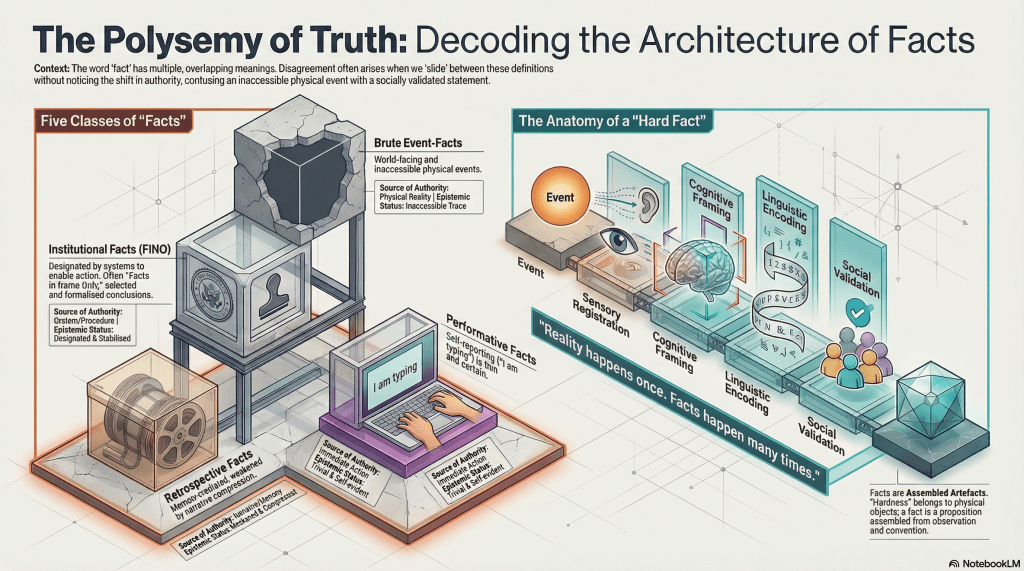
1. Event-facts (brute, world-facing)
As mentioned previously, these concern what happens in the world, independent of observation.

  • A car collides with a tree.
  • Momentum changes.
  • Metal deforms.

These events occur whether or not anyone notices them. They are ontologically robust and epistemically inaccessible. No one ever encounters them directly. We only ever encounter traces.

2. Indexical or performative facts (trivial, self-reporting)
“I am typing.”

I am doing this now – those now may not be relevant when you read this. This is a fact, but a very thin one. Its authority comes from the coincidence of saying and doing. It requires no reconstruction, no inference, no institutional validation. These facts are easy because they do almost no work.

3. Retrospective personal facts (memory-mediated)
“I was typing.”

This may be relevant now, at least relative to the typing of this particular post. Still a fact, but weaker. Memory enters. Narrative compression enters. Selectivity enters. The same activity now carries a different epistemic status purely because time has passed.

4. Prospective statements (modal, not yet facts)
“I will be typing.”

This is not yet a fact. It may never come to be one. It is an intention or prediction that may or may not be realised. Future-tense claims are often treated as incipient facts, but this is a category error with real consequences.

5. Institutional facts (designated, procedural)
“The court finds…”
“The report concludes…”

These are facts by designation. They are not discovered so much as selected, formalised, and stabilised so that systems can act. They are unlikely to rise to the level of facts, so the legal system tends to generate facts in name only – FINO, if I am being cute.

All of these are called ‘facts’. They are not interchangeable. The trouble begins when certainty migrates illicitly from trivial or institutional facts into brute event-facts, and we pretend nothing happened in the transfer.

One Motor Vehicle

Reconsider the deliberately simple case: A motor vehicle collides with a tree. Trees are immobile, so we can rule out the tree colliding with the car.

Ontologically, something happened. Reality did not hesitate. But even here, no one has direct access to the event itself.

The driver does not enjoy privileged access. They experience shock, adrenaline, attentional narrowing, selective memory, post hoc rationalisation, perhaps a concussion. Already several layers intervene before language even arrives.

A rough schema looks like this:

event → sensory registration → cognitive framing → linguistic encoding → social validation

Ontology concerns what happens.
Epistemology concerns how anything becomes assertable.

Modern thinking collapses the second into the first and calls the result the facts.

People speak of “hard facts” as if hardness transfers from objects to propositions by proximity. It doesn’t. The tree is solid. The fact is an artefact assembled from observation, inference, convention, and agreement.

And so it goes…

Why the Confusion Persists

When someone responds, “But isn’t it a fact that I read this?”, the answer is yes. A different kind of fact.

The error lies not in affirming facts, but in failing to distinguish them. The word fact allows certainty to migrate across categories unnoticed, from trivial self-reports to brute world-events, and from institutional verdicts to metaphysical claims. That migration is doing the work.

Conclusion

Clarifying types of facts does not weaken truth. It prevents us from laundering certainty where it does not belong.

Facts exist. Events occur. But they do not arrive unmediated, innocent, or singular.

Reality happens once. Facts happen many times.

The mistake was never that facts are unreal. It was believing they were all the same kind of thing.

The Enlightenment Sleight of Hand

How Reason Inherited God’s Metaphysics.

The Enlightenment, we are told, was the age of Reason. A radiant exorcism of superstition. Out went God. Out went angels, miracles, saints, indulgences. All that frothy medieval sentiment was swept aside by a brave new world of logic, science, and progress. Or so the story goes.

Audio: NotebookLM podcast on this topic.

But look closer, and you’ll find that Reason didn’t kill God—it absorbed Him. The Enlightenment didn’t abandon metaphysics. It merely privatised it.

From Confessional to Courtroom

We like to imagine that the Enlightenment was a clean break from theology. But really, it was a semantic shell game. The soul was rebranded as the self. Sin became crime. Divine judgement was outsourced to the state.

We stopped praying for salvation and started pleading not guilty.

The entire judicial apparatus—mens rea, culpability, desert, retribution—is built on theological scaffolding. The only thing missing is a sermon and a psalm.

Where theology had the guilty soul, Enlightenment law invented the guilty mind—mens rea—a notion so nebulous it requires clairvoyant jurors to divine intention from action. And where the Church offered Hell, the state offers prison. It’s the same moral ritual, just better lit.

Galen Strawson and the Death of Moral Responsibility

Enter Galen Strawson, that glowering spectre at the feast of moral philosophy. His Basic Argument is elegantly devastating:

  1. You do what you do because of the way you are.
  2. You can’t be ultimately responsible for the way you are.
  3. Therefore, you can’t be ultimately responsible for what you do.

Unless you are causa sui—the cause of yourself, an unmoved mover in Calvin Klein—you cannot be held truly responsible. Free will collapses, moral responsibility evaporates, and retributive justice is exposed as epistemological theatre.

In this light, our whole legal structure is little more than rebranded divine vengeance. A vestigial organ from our theocratic past, now enforced by cops instead of clerics.

The Modern State: A Haunted House

What we have, then, is a society that has denied the gods but kept their moral logic. We tossed out theology, but we held onto metaphysical concepts like intent, desert, and blame—concepts that do not survive contact with determinism.

We are living in the afterglow of divine judgement, pretending it’s sunlight.

Nietzsche saw it coming, of course. He warned that killing God would plunge us into existential darkness unless we had the courage to also kill the values propped up by His corpse. We did the first bit. We’re still bottling it on the second.

If Not Retribution, Then What?

Let’s be clear: no one’s suggesting we stop responding to harm. But responses should be grounded in outcomes, not outrage.

Containment, not condemnation.

Prevention, not penance.

Recalibration, not revenge.

We don’t need “justice” in the retributive sense. We need functional ethics, rooted in compassion and consequence, not in Bronze Age morality clumsily duct-taped to Enlightenment reason.

The Risk of Letting Go

Of course, this is terrifying. The current system gives us moral closure. A verdict. A villain. A vanishing point for our collective discomfort.

Abandoning retribution means giving that up. It means accepting that there are no true villains—only configurations of causes. That punishment is often revenge in drag. That morality itself might be a control mechanism, not a universal truth.

But if we’re serious about living in a post-theological age, we must stop playing dress-up with divine concepts. The Enlightenment didn’t finish the job. It changed the costumes, kept the plot, and called it civilisation.

It’s time we staged a rewrite.

Justice and Intent

When discussing the topic of justice, besides the element of the event of offence, another element is typically intent. In this case, a father inadvertently left an infant in his car. He was supposed to drop the child off at daycare but forget and instead drove directly to work. The temperatures were hot, and this contributed to the death of the child. Upon discovering this, the father suicided.

I have copied the story below in full, as these things have been known to go missing every now and again.

A Virginia father died by an apparent suicide after finding his child dead inside his hot car, authorities said.

It appears the father accidentally left the 18-month-old in the car for at least three hours on Tuesday, leading to the child’s death, Lt. Col. Christopher Hensley of the Chesterfield Police Department said at a news conference.

When the child didn’t arrive at daycare, the father apparently realized the toddler was in his car, Hensley said.

Around noon, family members called police to report that the father was talking about dying by suicide in the woods behind his house. The father was the only person home at the time, Hensley said.

Responding officers found the car in the driveway with an open door and an empty child seat, Hensley said.

Officers went into the home where they found the dead 18-month-old, he said.

As officers continued to check the perimeter, they found the father dead in the woods from an apparent gunshot wound, he said.

Hensley called it a “horrible tragedy on so many levels.”

This marks the eighth child to die from a hot car this year, according to national nonprofit KidsAndCars.org. More than 1,000 kids have died from hot cars since 1990, the organization said.

Click here for tips on how to keep children safe from hot cars this summer.

ABC News

An interest of mine is justice, hence this post. I’ll get to that, but there is also a narrative of social priorities to extract from here, too.

The first is that we live in a society where 18-month-olds almost need to be separated from their family. Of course, the privileged can defend that they have sitters or au pairs or nannies. In the past, there were extended families and Clinton’s Village. Each has its plusses and minuses. I am not a fan of the idea of women serving as baby factories, pumping out babies and serving their plight as wage slaves, but that’s not my call. I also understand that raising children is not the most mentally stimulating activity, but that’s beside the point.

In this case, the father was more focused on getting to work than the welfare of his child. And given the outcome, it’s obvious that he had feelings for the child—although perhaps it was more the fear of the repercussions of being blamed. One can’t know for sure, but I’ll opt for the charitable rendition.

Let’s return to justice. Justice is the sense that one gets one’s just desert, but what is just and what is desert? In the artificial form of justice purportedly practised by lawyers and jurists, this man would not likely be held responsible for legal reasons without even having to plumb the depths of philosophical reasons.

It’s been said that karma operates with three levers:
intent, action, and reflection.

In this case, intent appears to be absent and reflection seems to be apparent in the outcome. The action was the lost life of an infant, a human life. Equally weighted, he’d be one step back and two steps forward, so his register would not be in the black. But this is not how he judged himself.

Even given the karmic model, it’s easy to imagine the reactions. As easy as it is for me to sit back behind my keyboard and be dispassionate, I can imagine the mother not being so reserved. Humans are blame-machines. I’ve been spending the past three or four months researching this topic peripherally with a focus on human agency, but in a reductionist model, humans seem to need to blame. And if there is no object, they have no qualms about making one up. Humans are good storytellers—more so, story-receivers—, but let’s not get distracted. He knew he would be blamed. Not least of all, he blamed himself.

Although I don’t subscribe to the notion of self—or even of intent—, it seems obvious that this father did. I can’t imagine how I’d feel if this were me—and I don’t want to try. But let’s not lose sight of the complicity of society that forces humans to make a choice between family and survival.

The Truth about Truth (Fourth Amend)

Please note that this content has been subsumed into the originating article: The Truth about Truth.

This is a response to this comment by Landzek from The Philosophical Hack regarding the notion of intended truth in communication, the fourth amendment in a series of posts extending the concept commenced in The Truth about Truth.

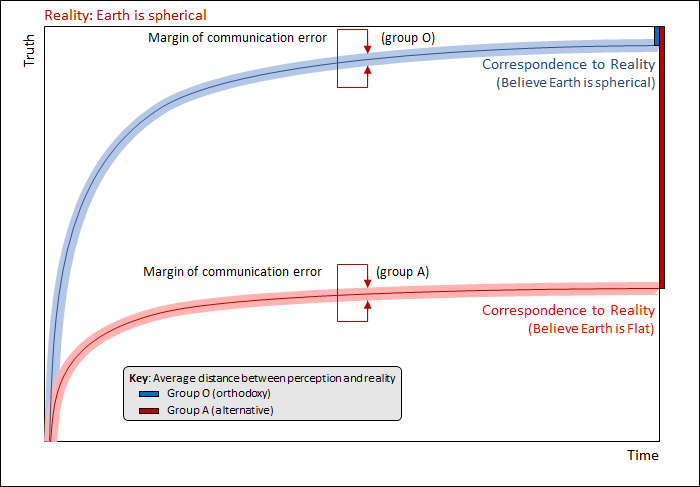
Extending the simple asymptotic function from the first amend, we might see (in Graph 4a) a slight variation in interpretation due to the insufficiencies of language—providing us with a close enough for the government approximation to some shared perception. People in this group will tend to agree on some perception, say, that the earth is spherical.* The average distance from perception to reality is the same for all in-group members, give or take some small variance that I’ll dismiss as an insignificant rounding error.

Graph 4a: Correspondence of Truth to Reality (Simplified in-group concurrence)

Graph 4b, however, illustrates two opposing perceptions of reality. In this example, I show proponents of orthodoxy (group O), who claim the earth to be roughly spherical, arbitrarily closer to reality than proponents of an alternative theory (group A), who claim that the earth is flat.

Each in-group has some variance from the mean notion, but ex-group members are orders of magnitude apart, as measured by the blue and red bars to the right of the chart. If we assume some binary condition that the earth is either spherical or flat with no other options, one of these might be considered to be right whilst the other would be wrong. We can establish this situation relative to the ex-groups, but, still, neither of these is comparable to Reality™ .


Graph 4b: Correspondence of Truth to Reality (Simplified ex-group concurrence)

The intent of each group may be to promote the perspective of the group—each claiming to be closer to the truth than the other. It is easy to imagine a situation where both claimants are equally distant from the truth:

Imagine two groups, each making opposing claims:

  • Tarot is superior to Astrology in predicting the future.
  • Astrology is superior to Tarot in predicting the future.

I’ll go out on a limb here and create a reality where the future is not predictable by either measure, irrespective of what each in-group believes.


* I understand that the earth being an oblate spheroid is primarily an analytical distinction, so is tautologically true, but I am using a simplification of a commonly accepted fact.

Why Sexual Morality Doesn’t Exist

His words, not mine.

Whilst I agree that all morality is contrived, Alan H. Goldman, Kenan Professor Emeritus of Philosophy at the College of William and Mary, presents his position that sexual morality is not divorced from any morality. It’s not particularly a special case. I agree in principle, but his argument is lacking.


Sexual desire aims directly at the pleasure derived from physical contact

Alan H. Goldman

He states that ‘As other philosophers point out, pleasure is normally a byproduct of successfully doing things not aimed at pleasure directly, but this is not the case with sex. Sexual desire aims directly at the pleasure derived from physical contact. [The] desire for physical contact in other contexts, for example, contact sports, is not sexual because it has other motives (winning, exhibiting dominance, etc.), but sexual desire in itself has no other motive. It is not a desire to reproduce or to express love or other emotions, although sexual activity, like other activities, can express various emotions including love.’

Pleasure is normally a byproduct. 

Sure.

This is not the case with sex.

OK. Elaborate.

Sexual desire aims directly at … pleasure.

I'm still following.

Sexual desire in itself has no other motive, which is pleasure.

Damn. You lost me.

I might agree that pleasure (let’s ignore the fact that this is another weasel word) may be the motivation behind sexual desire, but we don’t really have means to determine motivation or intent, and we certainly can’t assess one attribute over another.

Power is everywhere because it comes from everywhere — Michel Foucault

Foucault may have argued that the motivation is power—perhaps each side is making their own power calculus. Given the state of current knowledge, this is not ascertainable. Prof Goldman may feel that pleasure is the motive; one may even argue that power yields pleasure. I’ll not traverse that rabbit hole.

Later, he asserts that ‘More controversial is whether any consensual sex between willing partners is wrong’. I won’t debate this position, but there is no good way to full assess consent.

I’ll outline a fairly stereotypical scenario—excuse me for opting for a heterosexual situation, but the pronouns are easier to track. Say a man and a woman have met in a social setting—perhaps they’ve been dating for some period—, and they ‘mutually’ decide to engage in sex. We’d call this exercising agency, two consenting adults.

But what of ulterior motives? Following the stereotype, perhaps he feels that he is conquering her, and she feels she is securing a stable mate; or perhaps they don’t feel this at all. What is the actual intent? Not to go full-on Freud, but are they playing out some latent urge? Is this just some deterministic eventuality. There’s really no way to tell. Any story I tell is as speculative as the next.

So, to end on a tangent, a significant problem underlying philosophy, psychology, and jurisprudence is the issue of intent. The term is bandied about on most cop shows and legal dramas, but it is another just another vapid notion that we accept as valid. Of course, if we dispense of the notion, our legal systems would just unravel.

Yet again we’ve reached a point where the only truth is rhetoric.