Perspectival Realism – Enchantment

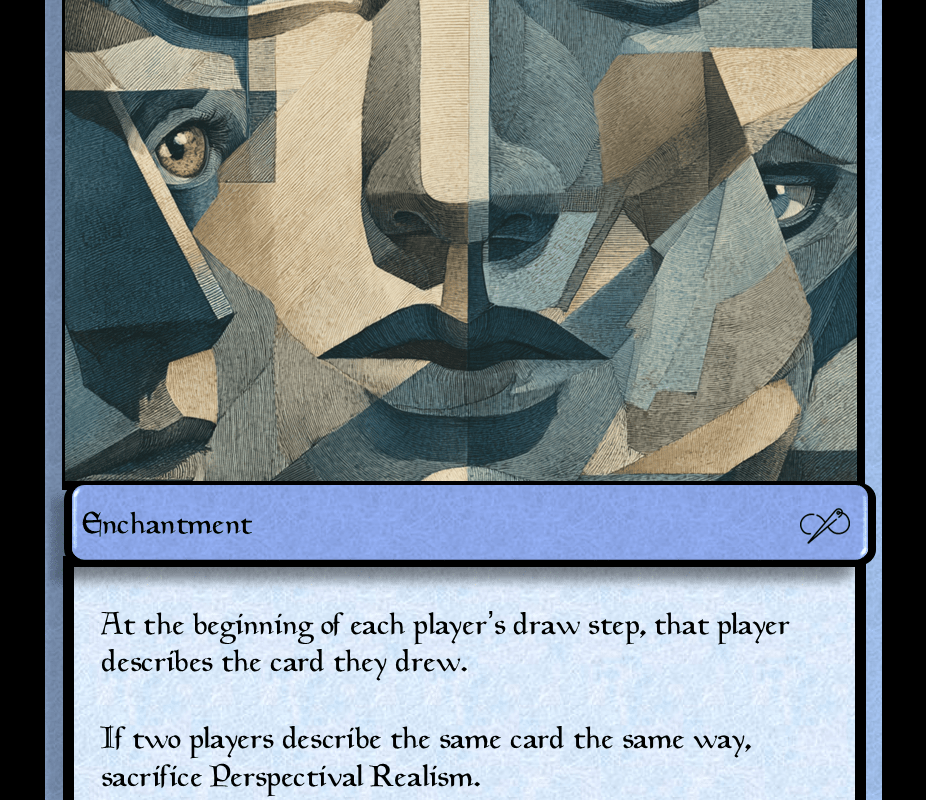
This Magic: The Gathering parody trading card was the first in my Critical Theory series.

It’s an important card for me. As with sex and gender, creating a taxonomic or ontological dichotomy poses categorical challenges. Despite the insufficiency of language, it’s still all I have to attempt to classify the world. In the case of articulating the perception of reality, we can choose between idealism and realism. The problem is that it’s not either; it’s both. Reality cannot be realised without both.

Reality, we’re told, exists. That confident noun has carried a great deal of human arrogance. It has underwritten empires, sciences, and sermons. Yet somewhere between Plato’s cave and the latest TED Talk, we forgot to ask a simpler question: for whom does reality exist, and from where is it seen?

Audio: NotebookLM podcast of this topic.

The parody trading card Perspectival Realism was born from that unease. Its mechanic is simple but cruel: at the beginning of each player’s draw step, they must describe the card they drew. The enchantment persists until two players describe a card in the same way—at which point the spell collapses. In other words, consensus kills magic.

That rule is the metaphysics of the thing.

When a player ‘describes’ a card, they are not transmitting information; they are constructing the object in linguistic space. The moment the description leaves their mouth, the card ceases to be a piece of paper and becomes a conceptual artefact.

This mirrors the insight of Kant, Nietzsche, and every post-structuralist who ever smoked too much Gauloises: perception isn’t passive. We don’t see reality; we compose it. Language isn’t a mirror but a paintbrush. The thing we call truth is not correspondence but coherence – a temporary truce among competing metaphors.

So the card’s enchantment dramatises this process. So long as multiple descriptions circulate, reality remains vibrant, contested, alive. Once everyone agrees, it dies the death of certainty.

Philosophers have spent centuries arguing whether the world is fundamentally real (existing independent of mind) or ideal (a projection of mind). Both sides are equally tiresome.

Realism, the old bulldog of metaphysics, insists that perception is transparent: language merely reports what’s already there. Idealism, its mirror adversary, claims the opposite – that what’s “there” is mind-stuff all along. Both mistakes are symmetrical. Realism forgets the perceiver; Idealism forgets the world.

Perspectival realism refuses the divorce. It begins from the premise that world and mind are inseparable aspects of a single event: knowing. Reality is not a photograph waiting to be developed, nor a hallucination spun from neurons – it’s a relation, a constant negotiation between perceiver and perceived.

For years, I called myself a Realist™ with an asterisk. That asterisk meant I understood the observer problem: that every ‘fact’ is perspective-laden. Then I became an Idealist™ with an asterisk, meaning I recognised that mind requires matter to dream upon.

The asterisk is everything. It’s the epistemic scar left by perspectival humility – the tacit admission that every claim about the world carries a hidden coordinate: said from here. It is not relativism, but situatedness. It is the philosophical equivalent of depth perception: without the offset, there’s no vision at all.

The card’s rule – sacrifice Perspectival Realism when two players describe a card identically – captures the tragedy of modernity. The Enlightenment taught us to chase consensus, to flatten multiplicity into “objective truth.” We became addicted to sameness, mistaking agreement for understanding.

But agreement is anaesthetic. When all perspectives converge, the world ceases to shimmer; it becomes measurable, predictable, dead. The card’s enchantment disappears the moment reality is stabilised, precisely as our cultural enchantment did under the fluorescent light of ‘reason’.

To live under perspectival realism is to acknowledge that reality is not what is drawn but what is described. And the description is never neutral. It is always written from somewhere – by someone, with a vocabulary inherited from history and stained by desire.

As long as multiple descriptions coexist, the game remains alive. The moment they fuse into one, the spell is broken, and the world returns to grey.

Bernardo Kastrup’s analytic idealism reminded me that consciousness might be primary, but perspectival realism refuses to pledge allegiance. It keeps both flags tattered but flying. The world exists, yes, but only ever for someone.

The enchantment, then, is not belief but perspective itself. So long as difference endures, the game continues.

A Case for Intersectionalism

The Space Between

In the great philosophical tug-of-war between materialism and idealism, where reality is argued to be either wholly independent of perception or entirely a construct of the mind, there lies an underexplored middle ground—a conceptual liminal space that we might call “Intersectionalism.” This framework posits that reality is neither purely objective nor subjective but emerges at the intersection of the two. It is the terrain shaped by the interplay between what exists and how it is perceived, mediated by the limits of human cognition and sensory faculties.

Audio: Podcast conversation on this topic.

Intersectionalism offers a compelling alternative to the extremes of materialism and idealism. By acknowledging the constraints of perception and interpretation, it embraces the provisionality of knowledge, the inevitability of blind spots, and the productive potential of uncertainty. This essay explores the foundations of Intersectionalism, its implications for knowledge and understanding, and the ethical and practical insights it provides.

Reality as an Intersection

At its core, Intersectionalism asserts that reality exists in the overlapping space between the objective and the subjective. The objective refers to the world as it exists independently of any observer—the “terrain.” The subjective encompasses perception, cognition, and interpretation—the “map.” Reality, then, is not fully contained within either but is co-constituted by their interaction.

Consider the act of seeing a tree. The tree, as an object, exists independently of the observer. Yet, the experience of the tree is entirely mediated by the observer’s sensory and cognitive faculties. Light reflects off the tree, enters the eye, and is translated into electrical signals processed by the brain. This process creates a perception of the tree, but the perception is not the tree itself.

This gap between perception and object highlights the imperfect alignment of subject and object. No observer perceives reality “as it is” but only as it appears through the interpretive lens of their faculties. Reality, then, is a shared but imperfectly understood phenomenon, subject to distortion and variation across individuals and species.

The Limits of Perception and Cognition

Humans, like all organisms, perceive the world through the constraints of their sensory and cognitive systems. These limitations shape not only what we can perceive but also what we can imagine. For example:

  • Sensory Blind Spots: Humans are limited to the visible spectrum of light (~380–750 nm), unable to see ultraviolet or infrared radiation without technological augmentation. Other animals, such as bees or snakes, perceive these spectra as part of their natural sensory worlds. Similarly, humans lack the electroreception of sharks or the magnetoreception of birds.
  • Dimensional Constraints: Our spatial intuition is bounded by three spatial dimensions plus time, making it nearly impossible to conceptualise higher-dimensional spaces without resorting to crude analogies (e.g., imagining a tesseract as a 3D shadow of a 4D object).
  • Cognitive Frameworks: Our brains interpret sensory input through patterns and predictive models. These frameworks are adaptive but often introduce distortions, such as cognitive biases or anthropocentric assumptions.

This constellation of limitations suggests that what we perceive and conceive as reality is only a fragment of a larger, potentially unknowable whole. Even when we extend our senses with instruments, such as infrared cameras or particle detectors, the data must still be interpreted through the lens of human cognition, introducing new layers of abstraction and potential distortion.

The Role of Negative Space

One of the most intriguing aspects of Intersectionalism is its embrace of “negative space” in knowledge—the gaps and absences that shape what we can perceive and understand. A compelling metaphor for this is the concept of dark matter in physics. Dark matter is inferred not through direct observation but through its gravitational effects on visible matter. It exists as a kind of epistemic placeholder, highlighting the limits of our current sensory and conceptual tools.

Similarly, there may be aspects of reality that elude detection altogether because they do not interact with our sensory or instrumental frameworks. These “unknown unknowns” serve as reminders of the provisional nature of our maps and the hubris of assuming completeness. Just as dark matter challenges our understanding of the cosmos, the gaps in our perception challenge our understanding of reality itself.

Practical and Ethical Implications

Intersectionalism’s recognition of perceptual and cognitive limits has profound implications for science, ethics, and philosophy.

Science and Knowledge

In science, Intersectionalism demands humility. Theories and models, however elegant, are maps rather than terrains. They approximate reality within specific domains but are always subject to revision or replacement. String theory, for instance, with its intricate mathematics and reliance on extra dimensions, risks confusing the elegance of the map for the completeness of the terrain. By embracing the provisionality of knowledge, Intersectionalism encourages openness to new paradigms and methods that might better navigate the negative spaces of understanding.

Ethics and Empathy

Ethically, Intersectionalism fosters a sense of humility and openness toward other perspectives. If reality is always interpreted subjectively, then every perspective—human, animal, or artificial—offers a unique and potentially valuable insight into the intersection of subject and object. Recognising this pluralism can promote empathy and cooperation across cultures, species, and disciplines.

Technology and Augmentation

Technological tools extend our sensory reach, revealing previously unseen aspects of reality. However, they also introduce new abstractions and biases. Intersectionalism advocates for cautious optimism: technology can help illuminate the terrain but will never eliminate the gap between map and terrain. Instead, it shifts the boundaries of our blind spots, often revealing new ones in the process.

Conclusion: Navigating the Space Between

Intersectionalism provides a framework for understanding reality as a shared but imperfect intersection of subject and object. It rejects the extremes of materialism and idealism, offering instead a middle path that embraces the limitations of perception and cognition while remaining open to the possibilities of negative space and unknown dimensions. In doing so, it fosters humility, curiosity, and a commitment to provisionality—qualities essential for navigating the ever-expanding terrain of understanding.

By acknowledging the limits of our maps and the complexity of the terrain, Intersectionalism invites us to approach reality not as a fixed and knowable entity but as an unfolding interplay of perception and existence. It is a philosophy not of certainty but of exploration, always probing the space between.

Analytic Idealism

Until now, I’ve considered myself to be a physicalist or materialist, but in adopting this position, I’ve had open questions. I’d tell people, “I’m a Physicalist, but I don’t understand how X, Y, or Z works.” As it happens, Analytic Idealism fills in most of these gaps. I’ve also been leery of Constitutive Panpsychism, and this theory addressed those shortcomings.

According to standard materialistic doctrine, consciousness, like space-time before the invention of general relativity, plays a secondary, subservient role, being considered just a function of matter and a tool for the description of the truly existing material world. But let us remember that our knowledge of the world begins not with matter but with perceptions. I know for sure that my pain exists, my “green” exists, and my “sweet” exists. I do not need any proof of their existence, because these events are a part of me; everything else is a theory. Later we find out that our perceptions obey some laws, which can be most conveniently formulated if we assume that there is some underlying reality beyond our perceptions. This model of material world obeying laws of physics is so successful that soon we forget about our starting point and say that matter is the only reality, and perceptions are only helpful for its description.


Universe, Life, Consciousness by Andrei Linde
What about mainstream Physicalism?

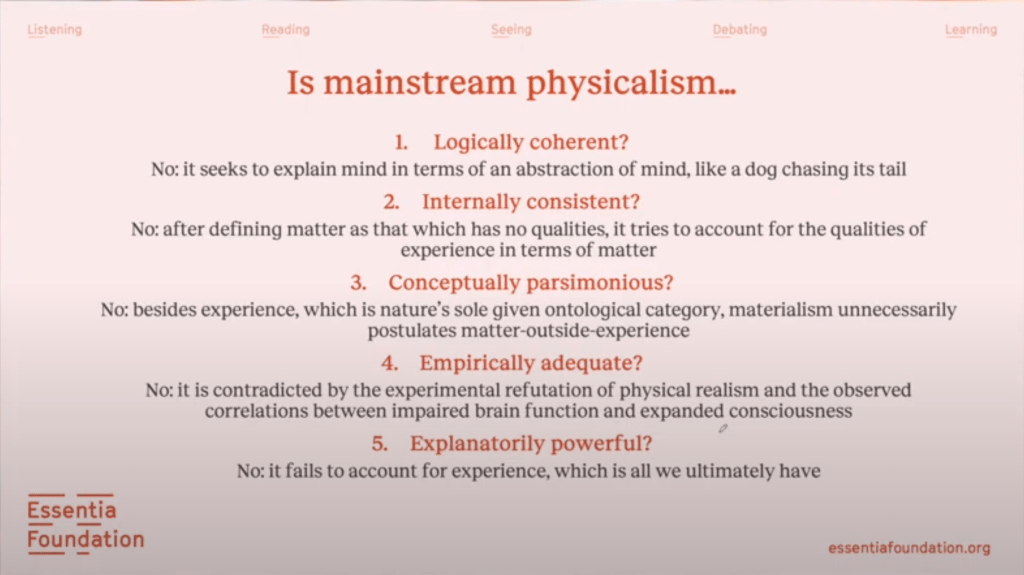
Firstly, it centres everything on experience. It divides the world into ‘out there’ and ‘perception’, what Bernard Kastrup calls ‘intrinsic view’ and ‘extrinsic experience’, what Schopenhauer termed ‘noumena’ and ‘phenomena’.

So how could I abandon material so quickly? The short answer is that I didn’t. It’s just that it’s not fundamental. One of the challenges I always had with the notion of materialism is the distance between perception and material. Analytic Idealism allows there to be a concealed nature out there and a revealed nature that our senses could perceive.

physics is ultimately a science of perception

I abandoned Donald Hoffman’s’ book, The Case Against Reality: Why Evolution Hid the Truth from Our Eyes, a few months back because although it seemed to make sense, it wasn’t quite resonating with me. It seems that he shares this perspective.

Before I get ahead of myself, I’ll lay a foundation. Our brains, among other things, are experience-perceiving machines—not experience-generating. Unlike some solipsistic theories, we don’t generate our reality. There is an objective reality, as it were. out there, but our perception of it is limited by our sense organs and cognitive faculties. Anything not accessible to these is imperceptible, pretty much by definition. It could be that there is nothing out there beyond perception, but I wouldn’t count on it.

I know that this invites paranormal and spiritual injections. I don’t have a propensity to make this jump, and absence of at least circumstantial evidence, I don’t expect to expend energy pondering this space. If this is your proclivity, feel free, and I’d love to see what you come up with. As it happens, Bernard Kastrup does believe in paranormal phenomena, so you’d be in good company. I’m just not ready to make that leap.

Humans do not view reality as it is. This conforms to correspondence theories of truth. In this theory, we interface reality through a virtual dashboard. Like an aeroplane with dials and gauges, our sense organs merely give USA representations of this reality in a manner suitable to our survival—fitness over truth. Just as the altimeter and speedometer are fit for navigating a plane, they are just symbols or icons representing the ‘out there’. Similar to the Matrix, the out there is unintelligible—save for Neo who is able to transcend and decode on the fly. But this is science fiction. We cannot see beyond the dashboard, and it wouldn’t benefit us if we could.

instrument dashboard from EssentiaFoundation.org

This instrument panel or dashboard, as Kastrup calls it, is all we have. And like a computer monitor that represents files and folders as beige, blue, and white rectangles, looking behind the screen isn’t going to yield you more information. At their core, these represent binary code, millions or zeros and ones that would not be useful to see in their native state. It is more useful to see the iconic representation.

It turns out that matter is simply a representation of reality through dashboard instruments. This means that physics is ultimately a science of perception, though it only has access to the map rather than the terrain.

It’s not my intent to articulate the entire theory. Besides, I’m new to it. There is much more for me to suss out. For now, it’s the best explanation for the way I perceive perception. And although I still have questions, I have fewer than before, so here’s looking to a long and fruitful relationship.