Yaron Brook, ever Ayn Rand’s ventriloquist, insists students are customers. Education, in his frame, is no different from a gym membership; you pay to be made “uncomfortable.” Professors as personal trainers, universities as masochism boutiques. It’s an absurd metaphor that fits all too well in our consumerist age: education rebranded as a service industry, discomfort sold at premium prices.
Video: What is killing universities?
Catherine Liu cuts in sharply: I am not a service worker. And she’s right. Education is not concierge service; it is meant to disturb, dislodge, and disorient. Liu distinguishes “Leftist” universal reason from “Liberal” mushy inclusivity, nostalgic for Enlightenment rationality, perhaps, but her refusal to collapse education into hospitality is a rare moment of clarity.
Eric Kaufman diagnoses the “new left” as a cult of the sacred, where identity is fetishised and offence policed. Liu nods; Brook flirts with Marxism for a minute; suddenly everyone seems to agree the university has lost its bearings.
Brook is not wrong that conservatives self-select out of higher ed. But let’s be clear: not because academia is too “left,” but because they crave catechism, not critique. They want ideological madrassas, not laboratories of doubt. In this sense, Brook’s consumer model is apt: conservatives want a product that validates their priors. That is indoctrination, not education.
Meanwhile, the universities collude in their own corruption. They market “education™” as networking, branding, and employability. At the top tier, the Ivies, Oxbridge, Grandes Écoles, you might still buy proximity to power. But below that? Snake oil. At best, you get nosebleed seats in the auditorium of influence. At worst, an obstructed view behind a pillar. For most, the ticket is counterfeit: a credential that promises access and delivers only debt.
And yet, the true thing still exists. Real education, the kind Liu gestured toward, doesn’t need oak-panelled halls or hedge-fund endowments. It can happen online, in a book, in a seminar, even here with ChatGPT. It’s the deliberate encounter with discomfort, with error, with reason itself. But snake oil sells better than hard truths, and so universities keep hawking tickets they don’t own.
In an idealised vision of science, the laboratory is a hallowed space of discovery and intellectual rigour, where scientists chase insights that reshape the world. Yet, in a reflection as candid as it is disconcerting, Sabine Hossenfelder pulls back the curtain on a reality few outside academia ever glimpse. She reveals an industry often more concerned with securing grants and maintaining institutional structures than with the philosophical ideals of knowledge and truth. In her journey from academic scientist to science communicator, Hossenfelder confronts the limitations imposed on those who dare to challenge the mainstream — a dilemma that raises fundamental questions about the relationship between truth, knowledge, and institutional power.
I’ve also created a podcast to discuss Sabine’s topic. Part 2 is also available.
Institutionalised Knowledge: A Double-Edged Sword
The history of science is often framed as a relentless quest for truth, independent of cultural or economic pressures. But as science became more institutionalised, a paradox emerged. On the one hand, large academic structures offer resources, collaboration, and legitimacy, enabling ambitious research to flourish. On the other, they impose constraints, creating an ecosystem where institutional priorities — often financial — can easily overshadow intellectual integrity. The grant-based funding system, which prioritises projects likely to yield quick results or conform to popular trends, inherently discourages research that is too risky or “edgy.” Thus, scientific inquiry can become a compromise, a performance in which scientists must balance their pursuit of truth with the practicalities of securing their positions within the system.
Hossenfelder’s account reveals the philosophical implications of this arrangement: by steering researchers toward commercially viable or “safe” topics, institutions reshape not just what knowledge is pursued but also how knowledge itself is conceptualised. A system prioritising funding over foundational curiosity risks constraining science to shallow waters, where safe, incremental advances take precedence over paradigm-shifting discoveries.
Gender, Equity, and the Paradoxes of Representation
Hossenfelder’s experience with gender-based bias in her early career unveils a further paradox of institutional science. Being advised to apply for scholarships specifically for women, rather than being offered a job outright, reinforced a stereotype that women in science might be less capable or less deserving of direct support. Though well-intentioned, such programs can perpetuate inequality by distinguishing between “real” hires and “funded outsiders.” For Hossenfelder, this distinction created a unique strain on her identity as a scientist, leaving her caught between competing narratives: one of hard-earned expertise and one of institutionalised otherness.
The implications of this dilemma are profound. Philosophically, they touch on questions of identity and value: How does an individual scientist maintain a sense of purpose when confronted with systems that, however subtly, diminish their role or undercut their value? And how might institutional structures evolve to genuinely support underrepresented groups without reinforcing the very prejudices they seek to dismantle?
The Paper Mill and the Pursuit of Legacy
Another powerful critique in Hossenfelder’s reflection is her insight into academia as a “paper production machine.” In this system, academics are pushed to publish continuously, often at the expense of quality or depth, to secure their standing and secure further funding. This structure, which rewards volume over insight, distorts the very foundation of scientific inquiry. A paper may become less a beacon of truth and more a token in an endless cycle of academic currency.
This pursuit of constant output reveals the philosopher’s age-old tension between legacy and ephemerality. In a system driven by constant publication, scientific “advancements” are at risk of being rendered meaningless, subsumed by an industry that prizes short-term gains over enduring impact. For scientists like Hossenfelder, this treadmill of productivity diminishes the romantic notion of a career in science. It highlights a contemporary existential question: Can a career built on constant output yield a genuine legacy, or does it risk becoming mere noise in an endless stream of data?
Leaving the Ivory Tower: Science Communication and the Ethics of Accessibility
Hossenfelder’s decision to leave academia for science communication raises a question central to contemporary philosophy: What is the ethical responsibility of a scientist to the public? When institutional science falters in its pursuit of truth, perhaps scientists have a duty to step beyond its walls and speak directly to the public. In her pivot to YouTube, Hossenfelder finds a new audience, one driven not by academic pressures but by genuine curiosity.
This shift embodies a broader rethinking of what it means to be a scientist today. Rather than publishing in academic journals read by a narrow circle of peers, Hossenfelder now shares her insights with a public eager to understand the cosmos. It’s a move that redefines knowledge dissemination, making science a dialogue rather than an insular monologue. Philosophically, her journey suggests that in an age where institutions may constrain truth, the public sphere might become a more authentic arena for its pursuit.
Conclusion: A New Paradigm for Scientific Integrity
Hossenfelder’s reflections are not merely the story of a disillusioned scientist; they are a call to re-evaluate the structures that define modern science. Her journey underscores the need for institutional reform — not only to allow for freer intellectual exploration but also to foster a science that serves humanity rather than merely serving itself.
Ultimately, the scientist’s dilemma that Hossenfelder presents is a philosophical one: How does one remain true to the quest for knowledge in an age of institutional compromise? As she shares her story, she opens the door to a conversation that transcends science itself, calling us all to consider what it means to seek truth in a world that may have forgotten its value. Her insights remind us that the pursuit of knowledge, while often fraught, is ultimately a deeply personal, ethical journey, one that extends beyond the walls of academia into the broader, often messier realm of human understanding.
This article concludes our five-part series examining the contemporary state of higher education. Having analysed the divergence of purpose and function, market paradoxes, grade inflation, and credentialism, we now explore potential paths forward.
Reimagining Higher Education: Beyond the Current Paradigm
Our examination has revealed fundamental tensions in contemporary higher education: the divergence between purpose and function, market dynamics that undermine accessibility, weakened academic standards, and credential inflation1. These challenges suggest the need not merely for reform, but for reimagining the entire enterprise. The task before us requires both vision and pragmatism—the ability to envision transformative change while acknowledging the practical constraints of implementation.
The future of higher education lies not in preserving outdated models, but in creating new ones that honour traditional values whilst embracing contemporary realities.
Learning from Global Experience
The dominant Anglo-American model of higher education, despite its global influence, has reached a critical juncture. Its combination of unsustainable costs, credential inflation, and declining standards has created what scholars describe as a “perfect storm”2. Students emerge with significant debt but diminishing returns on their educational investment, whilst employers increasingly question the value of traditional degrees.
However, alternative approaches from around the world offer valuable insights for reformation. The German dual education system demonstrates how academic and vocational pathways can achieve parity of esteem whilst serving different student needs and economic requirements. This system’s success in maintaining high employment rates and industrial competitiveness suggests that differentiated educational pathways need not result in social stratification3.
Similarly, Scandinavian models of public funding have largely avoided the access crisis plaguing American and British universities. Their approach suggests that maintaining broad accessibility need not compromise educational quality when supported by appropriate funding structures and societal commitment. Meanwhile, Asian systems, particularly in Singapore and South Korea, have successfully emphasised technical expertise whilst maintaining strong liberal arts traditions, demonstrating that these educational approaches can be complementary rather than contradictory4.
Institutional Differentiation: A Path Forward
The future of higher education likely lies in embracing institutional diversity rather than forcing all universities to conform to a single model. This approach recognises that different types of institutions can excel in different ways, serving distinct but equally valuable purposes in the educational ecosystem5.
Research-intensive universities might focus on advancing knowledge frontiers and training future scholars, whilst teaching-focused institutions could prioritise pedagogical excellence and student development. Professional schools might emphasise practical skills and industry connections, while liberal arts colleges maintain their focus on broad intellectual development. This diversification need not create a hierarchy; rather, it acknowledges that excellence takes different forms in different contexts.
Excellence in higher education should be measured not by universal standards, but by how well institutions fulfil their chosen missions.
Technology’s Transformative Role
The role of technology in higher education extends far beyond the simple digitisation of existing practices. True technological transformation requires reimagining the very nature of teaching, learning, and assessment6. Adaptive learning systems can personalise education at scale, whilst artificial intelligence might help identify student struggles before they become critical. However, technology should enhance rather than replace human interaction in education.
The pandemic-era shift to online learning revealed both the potential and limitations of digital education. Whilst remote learning can increase accessibility and flexibility, it also highlighted the irreplaceable value of in-person interaction and community building. The future likely lies in thoughtfully blended approaches that combine digital efficiency with human connection.
Reimagining Funding and Accessibility
The current funding model of higher education, particularly in Anglo-American contexts, has become unsustainable. Innovation in financial structures must balance institutional sustainability with genuine accessibility7. Income-contingent loan schemes, whilst helpful, represent only a partial solution to a more fundamental problem.
More radical approaches might include lifetime learning accounts, where individuals can draw upon educational credits throughout their careers, or hybrid funding models that combine public support with private investment. Some institutions have begun experimenting with risk-sharing agreements, where universities retain a stake in their graduates’ future earnings, aligning institutional incentives with student success.
Quality Assurance in a Diverse Landscape
As higher education becomes more diverse in its forms and delivery methods, traditional quality assurance frameworks require fundamental revision8. New approaches must balance rigour with flexibility, maintaining standards whilst encouraging innovation. This might involve moving away from input-based measures (such as contact hours or library resources) toward outcome-based assessments that focus on student learning and capability development.
Quality in higher education must be redefined to encompass both traditional academic excellence and real-world effectiveness.
The New Social Contract
Higher education’s relationship with society requires fundamental reconsideration. The traditional implicit contract—where universities served as custodians of knowledge and certifiers of capability—no longer fully serves societal needs9. A new social contract must encompass universities’ roles in lifelong learning, social mobility, economic development, and cultural preservation.
This reimagined relationship requires universities to become more embedded in their communities, more responsive to societal needs, and more accountable for their outcomes. Yet they must also maintain their essential role as centres of independent thought and critical inquiry.
Implementation Challenges
The path to transformation faces significant obstacles10. Institutional inertia, regulatory constraints, and vested interests all resist change. Moreover, the complexity of higher education systems means that reforms in one area often have unintended consequences in others.
Success requires careful sequencing of changes, sustained commitment from leadership, and broad stakeholder engagement. Perhaps most importantly, it demands a willingness to experiment and learn from failure—characteristics that many educational institutions, ironically, struggle to embrace.
Vision for the Future
The future of higher education must balance preservation with transformation11. Traditional academic values—rigorous inquiry, intellectual freedom, the pursuit of truth—remain vital. Yet these must be pursued through new structures and methods appropriate to contemporary challenges.
Success will require unprecedented collaboration between institutions, governments, employers, and communities. It will demand new thinking about what constitutes education, who provides it, and how it is validated. Most fundamentally, it will require us to reimagine what universities can and should be in the 21st century and beyond.
The future belongs not to those who defend the status quo, but to those who reimagine what education can become.
Conclusion: Beyond Reform
The transformation of higher education represents one of the great challenges—and opportunities—of our time12. The task before us is not merely to reform existing institutions but to reimagine the very nature of higher education for a new era. This requires preserving what is valuable from traditional models whilst creating new approaches that better serve contemporary needs.
Success in this endeavour will require vision, courage, and persistence. Yet the stakes could hardly be higher. The future of higher education will shape not only individual opportunities but our collective capacity to address the complex challenges facing human society.
This concludes our five-part series on the state of higher education. We hope these analyses contribute to the ongoing dialogue about the future of learning and knowledge creation in our society.
Footnotes
1 Christensen, C. M., & Eyring, H. J. (2011). “The Innovative University.” Jossey-Bass. ↩
2 Barber, M., Donnelly, K., & Rizvi, S. (2023). “An Avalanche Is Coming: Higher Education and the Revolution Ahead.” Institute for Public Policy Research. ↩
3 Graf, L. (2022). “The German Dual Education System: Analysis of Its Evolution and Present Challenges.” Oxford Review of Education. ↩
4 OECD. (2023). “Education at a Glance 2023: OECD Indicators.” ↩
5 Clark, B. R. (2021). “Creating Entrepreneurial Universities: Organizational Pathways of Transformation.” Emerald Publishing. ↩
6 Selwyn, N. (2023). “Digital Technology and the Future of Education.” Routledge. ↩
7 Johnstone, D. B. (2022). “Financing Higher Education: Cost-Sharing in International Perspective.” SUNY Press. ↩
8 European Association for Quality Assurance. (2023). “Standards and Guidelines for Quality Assurance.” ↩
9 Collini, S. (2017). “Speaking of Universities.” Verso. ↩
10 Crow, M. M., & Dabars, W. B. (2020). “The Fifth Wave: The Evolution of American Higher Education.” Johns Hopkins University Press. ↩
11 Davidson, C. N. (2017). “The New Education: How to Revolutionize the University to Prepare Students for a World in Flux.” Basic Books. ↩
12 Collini, S. (2022). “What Are Universities For?” Penguin. ↩
This article is the second in a five-part series examining the contemporary state of higher education. Building on our analysis of purpose versus function, we now explore how attempts to democratise higher education have led to unexpected economic consequences.
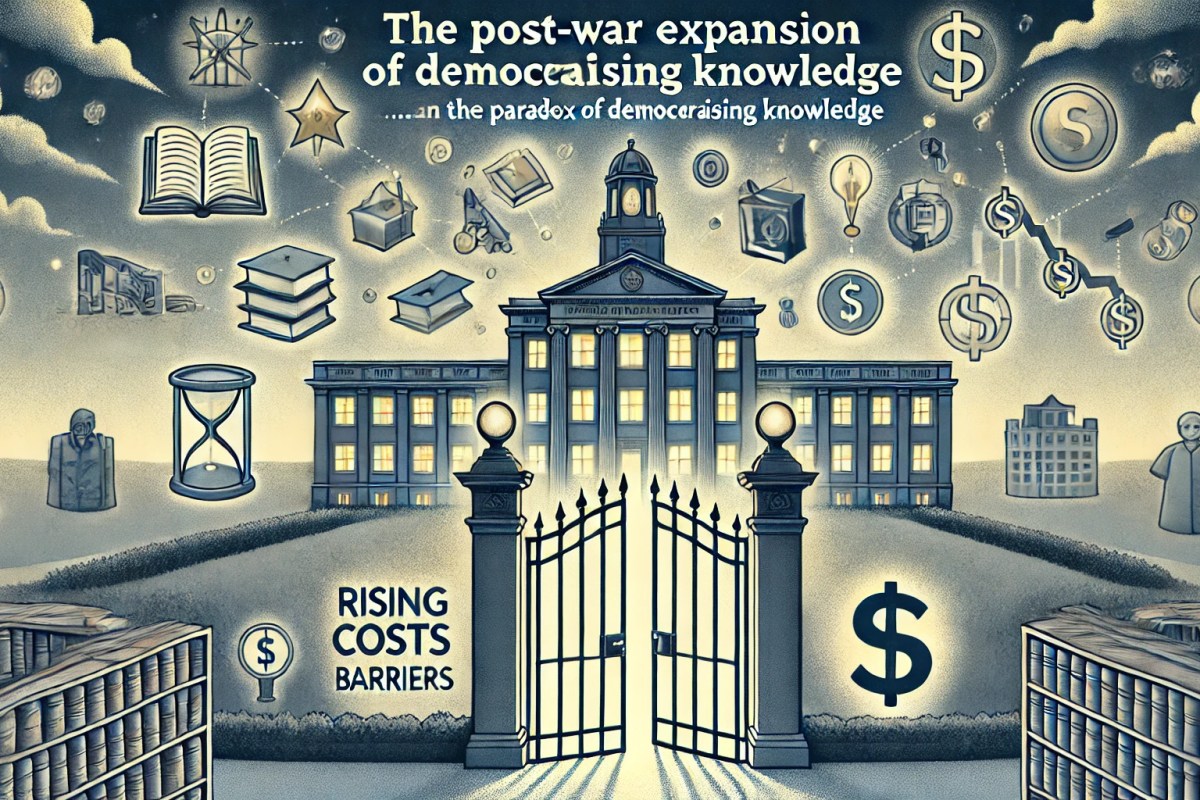
The post-war expansion of higher education emerged from noble aspirations: democratising knowledge, fostering social mobility, and building a more equitable society. State funding and policy initiatives aimed to transform university education from an elite privilege into a broadly accessible opportunity1. Yet this worthy goal has yielded paradoxical outcomes that merit careful examination.
The democratisation of higher education has created an unexpected paradox: as access widens, the individual value of a degree diminishes, while its cost increases.
The democratisation of higher education has created an unexpected paradox: as access widens, the individual value of a degree diminishes, while its cost increases. This counterintuitive outcome challenges our fundamental assumptions about educational accessibility and its relationship to social progress.
The Market Response
Supply and Demand Distortions
As state funding increased access, universities responded not by expanding supply to meet demand, but by leveraging increased demand to enhance their market position2. This response reflects the peculiar economics of higher education, where traditional market forces fail to regulate prices effectively. Unlike typical markets, increased competition in higher education often drives prices up rather than down, as institutions compete on prestige rather than affordability.
increased competition in higher education often drives prices up rather than down
The economic dynamics create several distinct but interrelated effects. Institutions invest heavily in amenities and facilities, transforming campuses into sophisticated learning environments that often resemble luxury resorts more than traditional academic settings. Administrative costs expand exponentially as universities create new departments and positions to manage increasingly complex operations and regulatory requirements. Marketing budgets have grown dramatically, with some institutions spending millions annually on recruitment and brand positioning. Research infrastructure continues to expand as universities seek to enhance their global rankings and attract prestigious faculty members.
The Prestige Premium
The persistence of institutional hierarchy means that despite wider access, competition for elite institutions intensifies3. This creates a two-tier effect where elite institutions maintain exclusivity while raising prices, and other institutions emulate this model, driving up costs across the sector. Prestige in higher education operates as a positional good: its value depends on its scarcity. This fundamental characteristic creates an inherent tension with democratisation efforts.
The pursuit of prestige manifests in various forms across the educational landscape. Elite institutions leverage their historical advantages to maintain selective admission rates while steadily increasing tuition fees. Mid-tier universities, attempting to climb the prestige ladder, invest heavily in research facilities and faculty recruitment, often at the expense of teaching resources. Less prestigious institutions find themselves caught in a difficult position, struggling to maintain academic standards while competing for a diminishing pool of students who can afford their fees.
The Student Debt Paradox
What began as an initiative to democratise opportunity has evolved into a system where students require more debt to access opportunity4. This creates a troubling cycle where rising tuition requires increased borrowing, which in turn influences career choices and often constrains social mobility. The burden falls disproportionately on those from disadvantaged backgrounds, who often take on higher debt levels relative to family income5.
What began as an initiative to democratise opportunity has evolved into a system where students require more debt to access opportunity
The implications of this debt burden extend far beyond graduation. Recent graduates increasingly postpone major life decisions such as home ownership, marriage, or starting a family. Career choices become heavily influenced by loan repayment considerations rather than personal interest or societal need. Perhaps most troublingly, those who fail to complete their degrees often find themselves in the worst position: bearing the burden of educational debt without the corresponding benefit of a credential.
The Institutional Arms Race
The inflow of state funding and student debt has fuelled an institutional arms race6. Universities compete through an ever-expanding array of facilities, services, and programmes. Modern campuses now routinely feature state-of-the-art fitness centres, dining facilities that rival upscale restaurants, and residential accommodation that would have been considered luxurious by previous generations’ standards.
Universities now maintain extensive bureaucracies to manage everything from compliance and risk management to student life and career service
Administrative growth has been particularly striking. Universities now maintain extensive bureaucracies to manage everything from compliance and risk management to student life and career services. Marketing departments have expanded dramatically, employing sophisticated digital strategies and international recruitment campaigns. Research facilities continue to grow more elaborate and expensive, with institutions investing heavily in specialised equipment and facilities to attract top researchers and secure grant funding.
International Perspectives
Different funding models across nations reveal varying approaches to this challenge7. The European model of state-funded universities has historically maintained broader access while controlling costs, though recent pressures have begun to erode this advantage. The American model of high-fee, high-aid institutions creates a complex system of cross-subsidisation but often results in significant student debt. Emerging Asian hybrid models attempt to balance state control with market forces, though they too face increasing pressure from global competition.
The American model of high-fee, high-aid institutions creates a complex system of cross-subsidisation but often results in significant student debt.
These international variations provide valuable insights into alternative approaches to higher education funding and delivery. The Nordic countries, for instance, maintain high-quality public universities with minimal student fees, funded through progressive taxation. German-speaking countries have preserved a dual system of universities and technical institutions, helping to maintain distinct educational pathways. East Asian systems often combine strong state oversight with significant private sector involvement, creating unique hybrid models.
Implications for Social Mobility
The democratisation of access, paradoxically, may reinforce rather than reduce social stratification8. This occurs through multiple mechanisms that often work in concert to preserve and sometimes exacerbate existing inequalities. Debt burdens disproportionately affect students from lower-income backgrounds, potentially limiting their post-graduation choices and economic mobility. Credential inflation requires increasingly lengthy periods of study, favouring those with the financial resources to remain in education longer. Elite institutions, despite widened access overall, often remain bastions of privilege, with admission rates for disadvantaged students showing minimal improvement over time.
The democratisation of access, paradoxically, may reinforce rather than reduce social stratification
The role of social capital in educational success has, if anything, grown more significant. Students from privileged backgrounds often benefit from better information about university choices, stronger support networks, and greater access to unpaid internships and other career-building opportunities. These advantages compound over time, potentially leading to greater rather than lesser social stratification.
Looking Forward
Resolving these tensions requires rethinking not just funding mechanisms but the underlying structure of higher education9. The challenge lies in preserving genuine accessibility while avoiding the inflationary spiral that threatens to undermine the very democratisation we seek. True democratisation of higher education may require reimagining not just how we fund universities, but how we conceive of their role in society.
True democratisation of higher education may require reimagining not just how we fund universities, but how we conceive of their role in society.
This reimagining might involve developing new models of educational delivery, creating alternative credentialing systems, or fundamentally restructuring the relationship between education and employment. Whatever path forward we choose, it must address both the financial sustainability of institutions and the genuine accessibility of education for all qualified students.
In the next article in this series, we shall examine how grade inflation compounds these challenges, further eroding the value proposition of higher education.
Footnotes
1 Trow, M. (2007). “Reflections on the Transition from Elite to Mass to Universal Access.” Springer. ↩
2 Winston, G. C. (1999). “Subsidies, Hierarchy and Peers: The Awkward Economics of Higher Education.” Journal of Economic Perspectives. ↩
3 Marginson, S. (2016). “The Dream Is Over: The Crisis of Clark Kerr’s California Idea of Higher Education.” University of California Press. ↩
4 Goldrick-Rab, S. (2016). “Paying the Price: College Costs, Financial Aid, and the Betrayal of the American Dream.” University of Chicago Press. ↩
5 Scott-Clayton, J. (2018). “The Looming Student Loan Default Crisis Is Worse Than We Thought.” Brookings Institution. ↩
6 Zemsky, R., Wegner, G., & Massy, W. (2005). “Remaking the American University: Market-Smart and Mission-Centered.” Rutgers University Press. ↩
7 OECD (2023). “Education at a Glance 2023: OECD Indicators.” OECD Publishing. ↩
8 Chetty, R., et al. (2017). “Mobility Report Cards: The Role of Colleges in Intergenerational Mobility.” NBER. ↩
9 Christensen, C. M., & Eyring, H. J. (2011). “The Innovative University.” Jossey-Bass. ↩
This article is the second in a five-part series examining the contemporary state of higher education. Building on our analysis of purpose versus function, we now explore how attempts to democratise higher education have led to unexpected economic consequences.
The post-war expansion of higher education emerged from noble aspirations: democratising knowledge, fostering social mobility, and building a more equitable society. State funding and policy initiatives aimed to transform university education from an elite privilege into a broadly accessible opportunity1. Yet this worthy goal has yielded paradoxical outcomes that merit careful examination.
The democratisation of higher education has created an unexpected paradox
The democratisation of higher education has created an unexpected paradox: as access widens, the individual value of a degree diminishes, while its cost increases. This counterintuitive outcome challenges our fundamental assumptions about educational accessibility and its relationship to social progress.
The Market Response
Supply and Demand Distortions
As state funding increased access, universities responded not by expanding supply to meet demand, but by leveraging increased demand to enhance their market position2. This response reflects the peculiar economics of higher education, where traditional market forces fail to regulate prices effectively. Unlike typical markets, increased competition in higher education often drives prices up rather than down, as institutions compete on prestige rather than affordability.
increased competition in higher education often drives prices up rather than down
The economic dynamics create several distinct but interrelated effects. Institutions invest heavily in amenities and facilities, transforming campuses into sophisticated learning environments that often resemble luxury resorts more than traditional academic settings. Administrative costs expand exponentially as universities create new departments and positions to manage increasingly complex operations and regulatory requirements. Marketing budgets have grown dramatically, with some institutions spending millions annually on recruitment and brand positioning. Research infrastructure continues to expand as universities seek to enhance their global rankings and attract prestigious faculty members.
The Prestige Premium
The persistence of institutional hierarchy means that despite wider access, competition for elite institutions intensifies3. This creates a two-tier effect where elite institutions maintain exclusivity while raising prices, and other institutions emulate this model, driving up costs across the sector. Prestige in higher education operates as a positional good: its value depends on its scarcity. This fundamental characteristic creates an inherent tension with democratisation efforts.
The pursuit of prestige manifests in various forms across the educational landscape. Elite institutions leverage their historical advantages to maintain selective admission rates while steadily increasing tuition fees. Mid-tier universities, attempting to climb the prestige ladder, invest heavily in research facilities and faculty recruitment, often at the expense of teaching resources. Less prestigious institutions find themselves caught in a difficult position, struggling to maintain academic standards while competing for a diminishing pool of students who can afford their fees.
The Student Debt Paradox
What began as an initiative to democratise opportunity has evolved into a system where students require more debt to access opportunity4. This creates a troubling cycle where rising tuition requires increased borrowing, which in turn influences career choices and often constrains social mobility. The burden falls disproportionately on those from disadvantaged backgrounds, who often take on higher debt levels relative to family income5.
What began as an initiative to democratise opportunity has evolved into a system where students require more debt to access opportunity
The implications of this debt burden extend far beyond graduation. Recent graduates increasingly postpone major life decisions such as home ownership, marriage, or starting a family. Career choices become heavily influenced by loan repayment considerations rather than personal interest or societal need. Perhaps most troublingly, those who fail to complete their degrees often find themselves in the worst position: bearing the burden of educational debt without the corresponding benefit of a credential.
The Institutional Arms Race
The inflow of state funding and student debt has fuelled an institutional arms race6. Universities compete through an ever-expanding array of facilities, services, and programmes. Modern campuses now routinely feature state-of-the-art fitness centres, dining facilities that rival upscale restaurants, and residential accommodation that would have been considered luxurious by previous generations’ standards.
Universities now maintain extensive bureaucracies to manage everything from compliance and risk management to student life and career services.
Administrative growth has been particularly striking. Universities now maintain extensive bureaucracies to manage everything from compliance and risk management to student life and career services. Marketing departments have expanded dramatically, employing sophisticated digital strategies and international recruitment campaigns. Research facilities continue to grow more elaborate and expensive, with institutions investing heavily in specialised equipment and facilities to attract top researchers and secure grant funding.
International Perspectives
Different funding models across nations reveal varying approaches to this challenge7. The European model of state-funded universities has historically maintained broader access while controlling costs, though recent pressures have begun to erode this advantage. The American model of high-fee, high-aid institutions creates a complex system of cross-subsidisation but often results in significant student debt. Emerging Asian hybrid models attempt to balance state control with market forces, though they too face increasing pressure from global competition.
The American model of high-fee, high-aid institutions creates a complex system of cross-subsidisation but often results in significant student debt.
These international variations provide valuable insights into alternative approaches to higher education funding and delivery. The Nordic countries, for instance, maintain high-quality public universities with minimal student fees, funded through progressive taxation. German-speaking countries have preserved a dual system of universities and technical institutions, helping to maintain distinct educational pathways. East Asian systems often combine strong state oversight with significant private sector involvement, creating unique hybrid models.
Implications for Social Mobility
The democratisation of access, paradoxically, may reinforce rather than reduce social stratification8. This occurs through multiple mechanisms that often work in concert to preserve and sometimes exacerbate existing inequalities. Debt burdens disproportionately affect students from lower-income backgrounds, potentially limiting their post-graduation choices and economic mobility. Credential inflation requires increasingly lengthy periods of study, favouring those with the financial resources to remain in education longer. Elite institutions, despite widened access overall, often remain bastions of privilege, with admission rates for disadvantaged students showing minimal improvement over time.
The democratisation of access, paradoxically, may reinforce rather than reduce social stratification.
The role of social capital in educational success has, if anything, grown more significant. Students from privileged backgrounds often benefit from better information about university choices, stronger support networks, and greater access to unpaid internships and other career-building opportunities. These advantages compound over time, potentially leading to greater rather than lesser social stratification.
Looking Forward
Resolving these tensions requires rethinking not just funding mechanisms but the underlying structure of higher education9. The challenge lies in preserving genuine accessibility while avoiding the inflationary spiral that threatens to undermine the very democratisation we seek. True democratisation of higher education may require reimagining not just how we fund universities, but how we conceive of their role in society.
This reimagining might involve developing new models of educational delivery, creating alternative credentialing systems, or fundamentally restructuring the relationship between education and employment. Whatever path forward we choose, it must address both the financial sustainability of institutions and the genuine accessibility of education for all qualified students.
In the next article in this series, we shall examine how grade inflation compounds these challenges, further eroding the value proposition of higher education.
Footnotes
1 Trow, M. (2007). “Reflections on the Transition from Elite to Mass to Universal Access.” Springer. ↩
2 Winston, G. C. (1999). “Subsidies, Hierarchy and Peers: The Awkward Economics of Higher Education.” Journal of Economic Perspectives. ↩
3 Marginson, S. (2016). “The Dream Is Over: The Crisis of Clark Kerr’s California Idea of Higher Education.” University of California Press. ↩
4 Goldrick-Rab, S. (2016). “Paying the Price: College Costs, Financial Aid, and the Betrayal of the American Dream.” University of Chicago Press. ↩
5 Scott-Clayton, J. (2018). “The Looming Student Loan Default Crisis Is Worse Than We Thought.” Brookings Institution. ↩
6 Zemsky, R., Wegner, G., & Massy, W. (2005). “Remaking the American University: Market-Smart and Mission-Centered.” Rutgers University Press. ↩
7 OECD (2023). “Education at a Glance 2023: OECD Indicators.” OECD Publishing. ↩
8 Chetty, R., et al. (2017). “Mobility Report Cards: The Role of Colleges in Intergenerational Mobility.” NBER. ↩
9 Christensen, C. M., & Eyring, H. J. (2011). “The Innovative University.” Jossey-Bass. ↩
This article is the first in a five-part series examining the contemporary state of higher education. The series explores the growing tensions between traditional academic ideals and modern institutional practices, from the changing role of universities to the challenges of credential inflation.
The Purpose versus Function of Higher Education: An Analysis of Divergent Trajectories
The medieval university emerged as a sanctuary of scholarly pursuit, where knowledge was cultivated for its own sake and learning was viewed as a transformative journey rather than a transactional exchange. This original purpose—the advancement of knowledge and cultivation of intellectual growth—stood largely unchallenged until the modern era. Yet today’s universities operate in a markedly different landscape, where their function has evolved far beyond these foundational aims.
The modern university finds itself caught between its historical mission of knowledge creation and its contemporary function as a credentialing institution.
Historical Foundations and Modern Tensions
The university as we know it took shape in medieval Europe, with institutions like the University of Bologna, Oxford, and the Sorbonne establishing models of scholarly community that would endure for centuries. These early universities served a dual purpose: preserving classical knowledge while fostering new intellectual discoveries. Their function aligned closely with their purpose—the pursuit of truth through rational inquiry and scholarly debate1.
This alignment between purpose and function persisted well into the modern era, even as universities expanded their scope to encompass scientific research and professional training. The Humboldtian model of the 19th century explicitly united teaching and research, viewing them as complementary aspects of the scholarly enterprise2. This unity of purpose and function began to fragment only with the mass expansion of higher education in the 20th century.
Competing Perspectives in Modern Higher Education
The Institutional Perspective
Today’s universities balance multiple, often competing imperatives: research excellence, financial sustainability, market positioning, and societal impact. This multiplication of purposes has led to a functional transformation where universities increasingly operate as commercial entities rather than purely academic institutions3. The pressure to maintain enrolment numbers, secure research funding, and compete in global rankings has fundamentally altered how institutions approach their educational mission.
The pressure to maintain enrolment numbers, secure research funding, and compete in global rankings has fundamentally altered how institutions approach their educational mission.
When institutions prioritise market demands over academic rigour, the very essence of higher education comes into question.
The Student Perspective
Contemporary students approach higher education primarily as an investment in future earnings potential. Recent studies indicate that even at elite institutions, students struggle with fundamental academic practices like sustained reading4. This shift reflects broader societal changes, raising questions about whether pure academic pursuit remains viable for most students in today’s economic climate.
Where once university attendance signified a commitment to intellectual development, it now often represents a necessary credential for professional advancement.
The transformation in student attitudes mirrors wider cultural shifts. Where once university attendance signified a commitment to intellectual development, it now often represents a necessary credential for professional advancement. This pragmatic approach, while understandable, fundamentally alters the student-institution relationship5.
The Employer Perspective
Employers, historically peripheral to academic pursuits, now significantly influence university function through their hiring preferences and skill demands. This relationship has transformed universities into de facto credential providers, potentially at odds with their historical purpose of fostering intellectual development6.
The gulf between academic achievement and workplace requirements continues to widen, challenging the traditional value proposition of university education.
The Case for Multiple Modalities
The tension between historical purpose and contemporary function suggests that a single model of higher education may no longer suffice. A more nuanced and differentiated approach to higher education could better serve our diverse societal needs. Traditional academic institutions could maintain their focus on pure scholarly pursuit, preserving the medieval ideal of knowledge for its own sake while fostering deep intellectual development. Alongside these, professional schools could explicitly focus on career preparation, with curricula and pedagogy designed specifically for workplace demands7.
[A] differentiated approach would allow each type of institution to excel in its chosen domain rather than trying to fulfil every possible educational function.
Research institutes could dedicate themselves primarily to knowledge creation, operating with different metrics and expectations than teaching-focused institutions. Meanwhile, vocational centres could prioritise practical skill development, offering focused, efficient pathways to specific career outcomes. This differentiated approach would allow each type of institution to excel in its chosen domain rather than trying to fulfil every possible educational function.
The Anachronism Question
Is the traditional university model anachronistic in today’s world? The evidence suggests a more nuanced conclusion. While the medieval model may not suit all modern needs, its emphasis on deep learning and intellectual development remains valuable—perhaps increasingly so in an age of rapid technological change and complex global challenges8.
Synthesis and Future Implications
The divergence between historical purpose and contemporary function need not signal the death of traditional academic values. Rather, it might herald the birth of a more diverse educational ecosystem, where different institutional types serve different purposes explicitly rather than trying to be all things to all stakeholders.
The future of higher education may lie not in choosing between tradition and innovation, but in creating space for both to thrive.
As we navigate this transition, the challenge lies in preserving the essential benefits of traditional academic pursuits whilst adapting to contemporary needs. This may require reimagining not just how universities function, but how society values different forms of higher education.
The future of higher education may lie not in choosing between tradition and innovation, but in creating space for both to thrive.
In the next article in this series, we shall examine how the widening of access to higher education, whilst democratising knowledge, has precipitated unexpected economic consequences that challenge the very accessibility it seeks to promote.
Footnotes
1 Newman, J. H. (1852). “The Idea of a University.” Notre Dame Press. ↩
2 Humboldt, W. von. (1810). “On the Internal and External Organization of the Higher Scientific Institutions in Berlin.” ↩
3 Clark, B. R. (1998). “Creating Entrepreneurial Universities.” Pergamon. ↩
4 Horowitch, R. (2024). “The Elite College Students Who Can’t Read Books.” The Atlantic. ↩
5 Arum, R., & Roksa, J. (2011). “Academically Adrift: Limited Learning on College Campuses.” University of Chicago Press. ↩
6 Brown, P., & Lauder, H. (2010). “The Global Auction: The Broken Promises of Education, Jobs, and Incomes.” Oxford University Press. ↩
7 Trow, M. (2007). “Reflections on the Transition from Elite to Mass to Universal Access.” Springer. ↩
8 Collini, S. (2012). “What Are Universities For?” Penguin. ↩
9 Christensen, C. M., & Eyring, H. J. (2011). “The Innovative University.” Jossey-Bass. ↩





 Philosophics