
If you can’t tell, does it matter?

3–5 minutes

Westworld was a disappointment. It became unwatchable after the first season. But one exchange from 2016 has aged better than anything else in that show, and it landed differently when I recalled it recently in the context of AI authorship.

A greeter robot exchanges words with William, a guest.

You want to ask, so ask.’

Are you real?’

Well, if you can’t tell, does it matter?

I thought of this after encountering a post that’s representative of a genre now doing brisk trade on LinkedIn and its satellites. The argument runs roughly thus: AI can write fast, but it can’t write you. Your why is sacred. Your scars make the prose real. The messy middle is where the magic lives. Keep the soul in your stories.

Audio: NotebookLM summary podcast of this topic.

A bloke shared this opinion:

The one thing AI can’t replicate is your “Why.” đź§ 

There’s a lot of noise lately about how AI can “write a book in an hour.” But after publishing 8 books, I’ve realized something crucial: speed is not the same as substance.

The “hidden danger” of letting tools do the heavy lifting isn’t just about the quality of the prose—it’s about the erosion of the creative spirit. When we skip the struggle of the “messy middle,” we skip the insights that actually make a story resonate with a reader.

Tools are great for grammar and brainstorming, but they don’t have:
The scars that make a character’s pain feel real.

The weird, specific memories that make a setting feel alive.
The intuition to know when to break the rules for emotional impact.

By all means, use the tech. But don’t let it sit in the driver’s seat. Your readers are looking for a connection with you, not a refined algorithm.

Keep the soul in your stories. It’s the only thing that actually sticks.
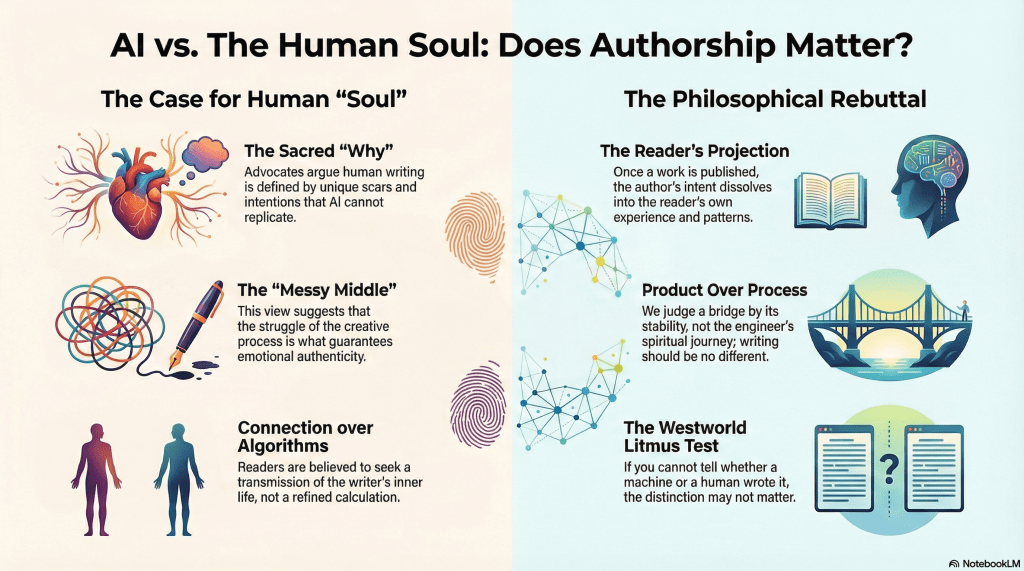
NotebookLM Infographic on this topic.

So much to unpack.

This sounds lovely enough. It is also almost entirely wrong, methinks.

Why is doing suspiciously grand work in these arguments. It’s treated as an ineffable essence – a soul-particle immune to replication. But why is not a substance. It’s an interpretive gloss. A post-hoc narrative we attach to action to stabilise it. Call it intention, call it telos, call it ‘creative spirit’ if one must. It remains a story we tell about stories.

And if we’re invoking the canon, let’s not do so selectively. Roland Barthes already detonated the neat alignment between authorial intention and readerly reception. Once a work leaves the desk, its why dissolves into a field of readings. The reader does not commune with your struggle. They encounter marks on a page. The rest is projection.

The romanticisation of the ‘messy middle’ borders on Calvinism – suffering as guarantor of authenticity, as though the scar itself writes the sentence. Plenty of humans have scars and produce dull prose. Plenty of writers construct convincing pain from observation, empathy, craft, and yes, occasionally from tools. Emotional resonance is not a moral reward for having bled.

Then there is the means-fetish: the idea that process sanctifies product. We do not evaluate a bridge by how spiritually formative the drafting was for the engineer. We ask whether it stands. If a text moves a reader, unsettles them, clarifies something, disturbs them – the instrument used to draft it is historically interesting, not aesthetically decisive.

There is also a quiet assumption buried in all of this: that connexion between writer and reader is a transmission of interiority. It isn’t. It is a negotiated effect. Readers connect with patterns that mirror, disrupt, or reframe their own experience. They are not sniffing for artisanal anguish.

None of this means craft evaporates. It means we should be wary of smuggling metaphysics into workflow preferences.

If someone prefers to wrestle with the blank page unaided – splendid, have at it. But the fetish for purity says more about our anxieties over authorship than it does about art. And if you can’t tell whether the thing that moved you was written by hand or by machine, then I’d suggest, with the greeter robot, that perhaps it doesn’t matter.

In the end, I am not even advocating using AI for writing, but I am saying not to be a dick about it. Enough of the virtue signalling

The Relativity of Morality: A Penguin’s Tale

I recently watched The Penguin on HBO Max, a series set in DC’s Batman universe. Ordinarily, I avoid television – especially the superhero genre – but this one intrigued me. Less spandex, more mob drama. An origin story with a dash of noir. I’ll spare you spoilers, but suffice it to say that it was an enjoyable detour, even for someone like me who prefers philosophy over fistfights.

This post isn’t a review, though. It’s a springboard into a larger idea: morality’s subjectivity – or, more precisely, its relativity.

Audio: Spotify podcast related to this topic.

Morality in a Vacuum

Morality, as I see it, is a social construct. You might carry a private moral compass, but without society, it’s about as useful as a clock on a desert island. A personal code of ethics might guide you in solitary moments, but breaking your own rules – eating that forbidden biscuit after vowing to abstain, for instance – doesn’t carry the weight of a true moral transgression. It’s more akin to reneging on a New Year’s resolution. Who’s harmed? Who’s holding you accountable? The answer is: no one but yourself, and even then, only if you care.

The Social Contract

Introduce a second person, and suddenly, morality gains traction. Agreements form – explicit or tacit – about how to behave. Multiply that to the level of a community or society, and morality becomes a kind of currency, exchanged and enforced by the group. Sometimes, these codes are elevated to laws. And, ironically, the act of adhering to a law – even one devoid of moral content – can itself become the moral thing to do. Not because the act is inherently right, but because it reinforces the structure society depends upon.

But morality is neither universal nor monolithic. It is as fractured and kaleidoscopic as the societies and subcultures that create it. Which brings us back to The Penguin.

Crime’s Moral Code

The Penguin thrives in a criminal underworld where the moral compass points in a different direction. In the dominant society’s eyes, crime is immoral. Robbery, murder, racketeering – all “bad,” all forbidden. But within the subculture of organised crime, a parallel morality exists. Honour among thieves, loyalty to the family, the unspoken rules of the game – these are their ethics, and they matter deeply to those who live by them.

When one criminal praises another – “You done good” – after a successful heist or a precise hit, it’s a moral judgement within their own framework. Outside that framework, society condemns the same actions as abhorrent. Yet even dominant societies carve out their own moral exceptions. Killing, for instance, is broadly considered immoral. Murder is outlawed. But capital punishment? That’s legal, and often deemed not only acceptable but righteous. Kant argued it was a moral imperative. Nietzsche, ever the cynic, saw this duality for what it was: a power dynamic cloaked in self-righteousness.

In The Penguin, we see this dichotomy laid bare. The underworld isn’t without morals; it simply operates on a different axis. And while the larger society might disdain it, the hypocrisy of their own shifting moral codes remains unexamined.

Final Thoughts on the Series

I’ll save other philosophical musings about The Penguin for another time – spoilers would be unavoidable, after all. But here’s a quick review: the series leans into drama, eschewing flashy gimmicks for a grittier, more grounded tone. The writing is generally strong, though there are moments of inconsistency – plot holes and contrivances that mar an otherwise immersive experience. Whether these flaws stem from the writers, director, or editor is anyone’s guess, but the effect is the same: they momentarily yank the viewer out of the world they’ve built.

Still, it’s a worthwhile watch, especially if you’re a fan of mob-style crime dramas. The final episode was, in my estimation, the best of the lot – a satisfying culmination that leaves the door ajar for philosophical ruminations like these.

Have you seen it? What are your thoughts – philosophical or otherwise? Drop a comment below. Let’s discuss.