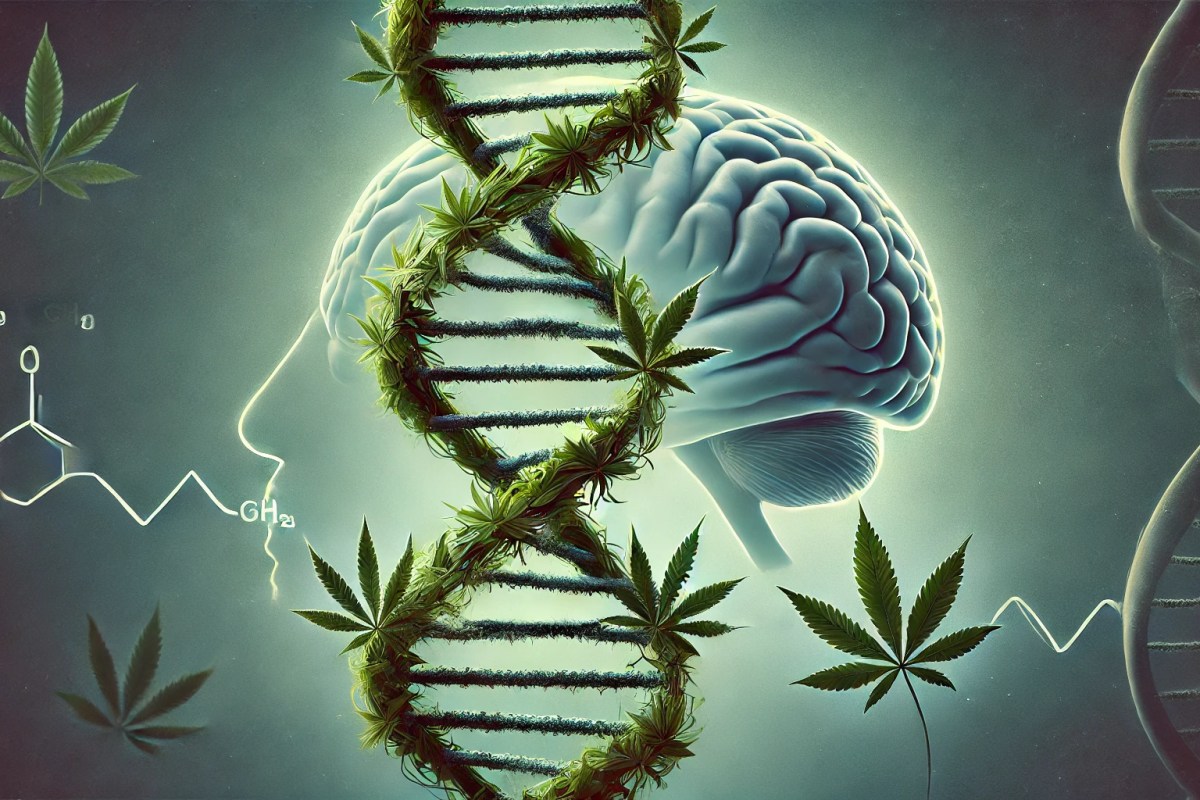
A study on genetics and cannabis found a connexion between marijuana use and genetic states. The study claimed to be looking for epigenetic effects and although there were some correlations, the directions of causality haven’t been determined.
Recent research has delved into the complex interplay between genetics and cannabis use, revealing intriguing correlations but leaving some critical questions unanswered. A recent study aimed to uncover the epigenetic effects of marijuana use, suggesting a link between genetic states and cannabis consumption. Whilst the findings offer some fascinating insights, they also highlight the ambiguity surrounding causality.
The Genetic Link
The study in question sought to explore whether cannabis use might influence genetic expression or, conversely, whether genetic predispositions could affect an individual’s likelihood of using marijuana. The results indicated some noteworthy correlations between cannabis use and certain genetic states, yet they fell short of clarifying the direction of causality. In other words, the research raises important questions but doesn’t definitively answer whether cannabis use leads to changes in genetic expression or if genetic predispositions increase the likelihood of cannabis use.
Cannabis and Schizophrenia: A Complicated Relationship
One of the most contentious aspects of the study is its implications for understanding the relationship between cannabis use and schizophrenia. The association between the two has been a subject of ongoing debate, with some evidence suggesting a connection. However, the study’s findings underscore the complexity of this relationship. It remains unclear whether cannabis use contributes to the development of schizophrenia or if individuals with a predisposition to schizophrenia are more likely to use cannabis.
The ambiguity stems from the fact that whilst correlations exist, they do not establish a clear cause-and-effect relationship. Schizophrenia is a multifactorial disorder, influenced by a combination of genetic, environmental, and neurobiological factors. Cannabis use might interact with these factors, but pinning down the exact nature of this interaction remains elusive.
What’s Next?
This study serves as a reminder of the challenges inherent in unraveling the connections between genetics and behaviour. It highlights the need for further research to elucidate the causal pathways and better understand how genetic predispositions and environmental factors like cannabis use interact. Until then, while correlations provide valuable insights, they are insufficient to draw definitive conclusions about causality.
As research progresses, it’s crucial to approach these findings with a nuanced perspective, recognising that the relationship between cannabis, genetics, and mental health is complex and multifaceted. Continued exploration in this area will hopefully shed more light on these intricate connections and help guide future investigations.
Denis Noble’s critique of Richard Dawkins’ approach to genetics isn’t just a scientific debate; it’s a microcosm of a much larger issue: our inadequate grasp of systems thinking. This inadequacy resonates through every layer of our social, political, and economic frameworks, revealing why these systems often fail us—they are simply too fragile.
VIDEO: Denis Noble explains his revolutionary theory of genetics | Genes are not the blueprint for life
Why do we struggle with systems thinking? The concept itself demands an understanding of boundaries, dimensions, and interactions that are often far beyond our regular scope. More often than not, we define system boundaries too narrowly. We overlook crucial dimensions and, crucially, miss the interactions. This isn’t just an academic observation; it’s a practical one. In my experience, even when we do acknowledge broader boundaries, management frequently undermines their importance, limiting the scope of what’s considered relevant.
Humans Are Abysmal Systems Thinkers
Since the 1980s, my interest in genetics has been piqued by Dawkins’ seminal works like The Selfish Gene and The Blind Watchmaker. Dawkins has long championed a gene-centric view of evolution, one that has shaped our understanding of biology for decades. However, Denis Noble challenges this perspective, advocating for a systems-level view that considers not just the genes but the interactions between a myriad of biological processes. This isn’t just genetics; it’s a profound illustration of systems thinking—or our lack thereof.
I’m not suggesting we discard Dawkins’ contributions to science, but Noble’s arguments are compelling and warrant serious consideration. They underscore a broader philosophical dilemma: our rhetorical constructs often overshadow deeper truths. In discussing the nuances between Dawkins’ and Noble’s theories, I argue that rhetoric, for better or worse, becomes our only accessible truth. While there may be more fundamental truths out there, they are often beyond our grasp, obscured not just by our cognitive limitations but also by the very language we use to discuss them.
So, which is true? The answer might be less about choosing sides and more about acknowledging our limitations in understanding and managing complex systems. Perhaps it’s time to consider that in the quest for truth, acknowledging our blind spots is just as important as the truths we defend.
Apologies in advance for linking a teaser video that leads to a paywall, but the relevant content is self-contained.
In chapter 71, Ultimate Responsibility, in Intuition Pumps and Other Tools for Thinking, author and philosopher, Daniel Dennett presents a counterargument to the notion that an agent, a person, is not absolutely responsible for their actions. He questions some premises in the ‘the way you are’ line of argumentation, but I question some of his questions.
Here is a nice clear version of what some thinkers take to be the decisive argument. It is due in this form to the philosopher Galen Strawson (2010): 1. You do what you do, in any given situation, because of the way you are. 2. So in order to be ultimately responsible for what you do, you have to be ultimately responsible for the way you are—at least in certain crucial mental respects. 3. But you cannot be ultimately responsible for the way you are in any respect at all. 4. So you cannot be ultimately responsible for what you do.
Dennett, Daniel C.. Intuition Pumps And Other Tools for Thinking (p. 395). W. W. Norton & Company. Kindle Edition.
Dennett continues.
The first premise is undeniable: “the way you are” is meant to include your total state at the time, however you got into it. Whatever state it is, your action flows from it non-miraculously.
Dennett and I are in agreement with Strawson. There is not much to see here. It’s akin to saying the now is the result of all past events until now. This is “the way you are”.
The second premise observes that you couldn’t be “ultimately” responsible for what you do unless you were “ultimately” responsible for getting yourself into that state—at least in some regards.
This second premise asserts that one cannot be responsible for any action that one had no part in performing. Two scenarios come immediately to mind.
First, you are not responsible for being born. As Heidegger notes, we are all thrown into this world. We have no say in when or where—what country or family—or what circumstances.
Second, if one is hypnotised or otherwise incapacitated, and then involved in a crime, one is merely a cog and not an agent, so not responsible in any material sense.
But according to step (3) this is impossible.
Whilst Dennett fixates on the absolute aspect of the assertion, I’d like to be more charitable and suggest that we still end up with a sorites paradox. Dennett will return to this one, and so shall I.
So step (4), the conclusion, does seem to follow logically. Several thinkers have found this argument decisive and important. But is it really?
As Dennett invalidates step (3), he insists that the conclusion is also invalid. He asserts that the notion of absolute responsibility is a red herring, and I argue that Dennett doesn’t get us much further, perhaps redirecting us with a pink herring.
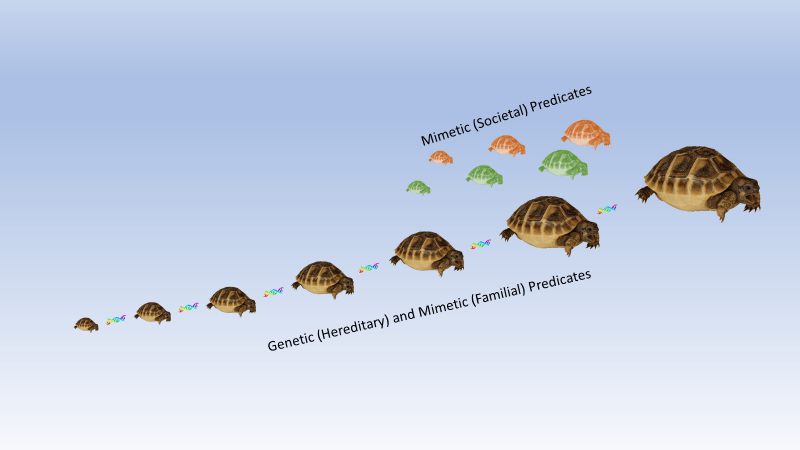
I’ve created an image with tortoises to make my point. There are actually two points I wish to make. The first point is to determine where the responsibility is inherited. This point is meant to articulate that the world can not be strictly deterministic and yet one can still not have significant agency. The second point is that culpability is asserted as a need, and acceptance of this assertion is the problem.
Testuditude
The image depicts an evolution of an agent, with time progressing from left to right. The tortoise on the right is a product of each of the recursive tortoises to its left. The image means to convey that each subsequent tortoise is a genetic and social and social product of each tortoise prior. Of course, this is obviously simplified, because tortoises require pairs, so feel free to imagine each precedent tortoise to represent a pair or feel free to add that level of diagrammatic complexity.
This is not meant to distinguish between nature and nurture. Instead, the claim is that one is a product of both of these. Moreover, as genetic, epigenetic, and mimetic influences are transmitted in family units, they also occur through social interaction and the environment, as represented by the orange and green tortoises.
…if one is a product of genetic and mimetic forces, how much agency remains for culpability?
The point here is that if one is a product of genetic and mimetic forces, how much agency remains for culpability? Each person is an emergent unit—autonomous, yes, and yet highly programmed.
If I programme a boobytrap to kill or maim any intruder, the boobytrap has no agency. I assert further, that the maker of that boobytrap has no more responsibility than the killing device.
The old hand grenade wired to a doorknob boobytrap trick
But who do we blame? you ask, and that’s precisely the problem. Asking questions doesn’t presume answers. This is a logical fallacy and cognitive bias. This heuristic leaves us with faulty jurisprudence systems. Humans seem hardwired, as it were, to blame. Humans need to believe in the notion of free will because they need to blame because they need to punish because vengeance is part of human nature to the extent there is human nature. There seems to be a propensity to frame everything as a causal relationship. Dennett calls this the Intentional stance. To borrow a from Dennett…
This instinctual response is the source in evolution of the invention of all the invisible elves, goblins, leprechauns, fairies, ogres, and gods that eventually evolve into God, the ultimate invisible intentional system.
Dennett, Daniel C.. Intuition Pumps And Other Tools for Thinking (p. 374). W. W. Norton & Company. Kindle Edition.
Fire Trap in Home Alone
Sins of the Fathers (and Mothers)
Let’s wrap this up with a sorites paradox. As I’ve already said, I agree with Dennett that the absolute aspect is unnecessary and undesired. The question remains how much agency™ does a person have once we account for the other factors? Is it closer to 90 per cent or 10 per cent? Apart from this, what is the threshold for culpability? Legal systems already have arbitrary (if not capricious) thresholds for this, whether mental capacity or age, which basically distils back to the realm of capacity.
I have no basis to even venture a guess, but that’s never stopped me before. I’d argue that the agency is closer to zero than to one hundred per cent of the total, and I’d propose that 70 per cent feels like a reasonable threshold.
I could have sworn I’d posted a position on this after I read Robert Sapolsky’s Behave. Perhaps it’s never made it out of drafts.
In closing, I don’t think we need to settle the question of determinism versus free will to recognise that even without strict determinism, personal agency is still severely limited, and yet as our political systems presume a level of rationality that is not apparent, so do legal systems presume a level of agency not present.
As the article states, there is no one gene, and we can’t even predict ‘gayness’ based on some configuration of genes. That humans’ knowledge of genetics is so nascent is one reason, and over-imagining the impact of genes on behaviours may be a problem. Just because you want to find a relationship doesn’t mean one exists.
My take is that genetics establish a predisposition. Genes may limit your height to 180 cm, but environmental factors may not allow you to reach this limit, and anything short of genetic modification will not allow you to surpass this limit.
I don’t see a reason for sexual orientation to be different. One may have a propensity to same sex attraction, let’s say 70%, but if environmental factors fail to catalyse this predilection, it may never manifest. Even this is too simplistic.
Being ‘gay’ is an identity marker. Just because a person has same-sex relationships does not mean the person identifies as gay. Moreover, one can be ‘virginal’ or celibate and otherwise have had unexpressed same-sex tendencies. More-moreover, ‘gay’ is not about activity; it’s an emotional attraction. A ‘gay’ person might have sex outside of their identity orientation for myriad reasons, for example, access to a partner of the preferred orientation (say, prisoners) or for survival (say, prostitutes).
On balance, I’d argue that this is a quixotic venture into finding the underpinning of a human social construct. Once again, humans obsessed with categorisation, as if finding a category provides special meaning to the thing in it.
[EDIT: Researching immediately after I wrote this article, I skimmed—I’ll have to find time to read it later—Turkheimer’s paper Still Missing (PDF, 2011), where he walks back his original assertion.]
The question, “why are children in the same family so different?” is answered, “Because measurable differences in their environment make them that way.”
I finished Pinker’s The Blank Slate the other day, but I didn’t have much time to capture my reflections. I’m already onto my next book, Mill’s Utilitarianism, so I figured I record some thoughts before they become too distant.
The First Law: All human behavioural traits are heritable.
The Second Law: The effect of being raised in the same family is smaller than the effect of the genes.
The Third Law: A substantial portion of the variation in complex human behavioural traits is not accounted for by the effects of genes or families.
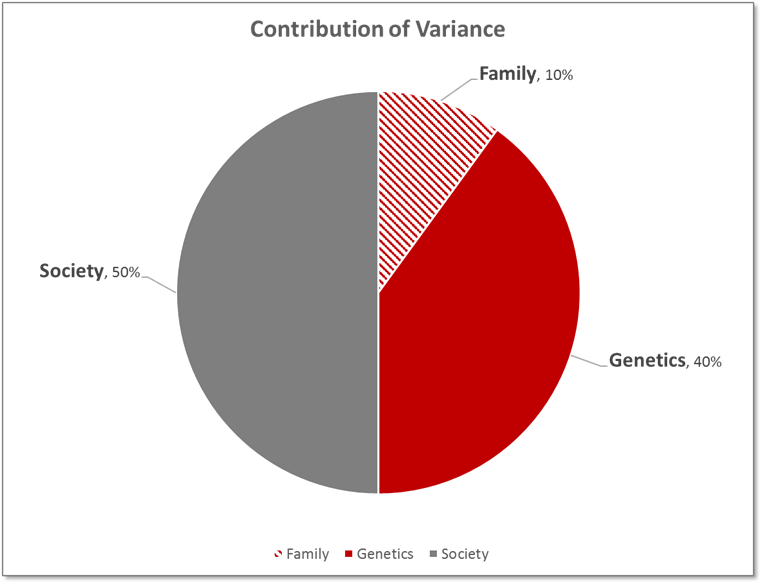
Elaborating on this, he summarises Turkheimer’s assessment on the variance in personality contributable to three factors: genetics, society, and family. According to this theory, variations in personality due accounted for by environment, are composed as
50 percent accounted for by society (non-shared environment); 40 – 50 percent accounted for by genetics (biology) and 0 to 10 percent attributable to family (shared environment). In his assessment, he was able to eliminate usual-suspect factors like birth order and siblings.
“Genotype is in fact a more systematic
source of variability than environment.”
According to Pinker, the 0 to 10 percent is generous, and it could just as well be 50% society and the rest is genetics. That doesn’t leave a lot of room for psychoanalysis, a discipline who strongly pushes back on this concept—just with emotional appeal in lieu of science.
I’ve just finished reading Steven Pinker‘s The Blank Slate. Originally published in 2002 (and re-published with an afterword in 2016), it still feels fresh. Pinker offers compelling rationale for accepting that humans are not blank slates entering the world.
Though I am somewhat of a social justice warrior in principle, I am still a moral subjectivist, a post-modern thinker. Pinker shares his strong feelings against subjectivism, but he provides no evidence of the moral objectivism he advances, relying instead on an emotional appeal; in fact, he employs the same defensive tactic his detractors employ, which is to try to make an empathic connection to the reader.
All he does is to claim that there is an objective morality because everybody feels and knows that X is better than Y, taking a strawman approach. It’s not that I disagree with his Xs and Ys; it’s just that they are subjective not objective measures. He tries to slip in an appeal to popularity by claiming that everybody would (or should) feel this way when push comes to shove.
Nietzsche, I think, had it right in Beyond Good and Evil when he pointed out the dual moral systems of masters and slaves. Although a moral (just) system might be best constructed from scratch in the manner of Rawls‘ veil of ignorance, we are not starting from a blank slate. The power structures are already in place. There is a possibility for upward and downward mobility, but large jumps are not likely except in the manner of a lottery. Other than this, it’s unlikely that one will move from one quintile to another and even less likely to skip a quintile, especially on the upward trend.
In any case, the issue is not whether some might feel subjectively better; it’s whether—across all possible dimensions—a relative, stable equilibrium can be found. Even here, this is not objective, even if it’s not otherwise arbitrary or capricious. The larger problem is one of epistemological empiricism—apart from the ontological question—, whether we can know that we’ve found the objective truth or if we’ve just settled on something that works for our current station.
As much as I really do like Steven Pinker, and I await his next book, Enlightenment Now, I do so only to read how he couches his argument in support of Enlightenment and Humanism, two concepts I feel are tainted by hubris



 Philosophics