Modern liberal democracies still chant the Enlightenment’s refrain: the rational, self-governing individual acting freely within a moral order of their own design. It’s an elegant myth – until the self begins to wobble. Under economic, cultural, and epistemic strain, autonomy curdles into exhaustion, and exhaustion seeks relief in obedience.
Audio: NotebookLM podcast of this essay. Please note that this audio summarises the entire essay. As such, it’s also longer than most, coming in at just under 40 minutes. I listened to it, and I feel it does a good job of capturing the essences of the essay. Of course, you could read the essay more quickly, but the perspective may still be helpful.
This essay traces that drift – from the Enlightenment’s causa sui complex to the ecstatic submission that defines modern authoritarianism. Drawing on Fromm, Arendt, Adorno, Reich, Han, and Desmet, it explores how freedom’s rhetoric becomes its opposite: obedience moralised as virtue, conformity sold as courage, submission experienced as pleasure.
At its core, The Will to Be Ruled argues that totalitarianism is not the antithesis of Enlightenment reason but its fulfilment. Once the world is rendered intelligible only through rational mastery, the subject inevitably longs to be mastered in return.
The closing section introduces Dis-Integrationism – a philosophical stance that declines redemption, preferring maintenance over mastery. It offers no cure, only the small ethic of attentiveness: keeping the field responsive while the light fades.
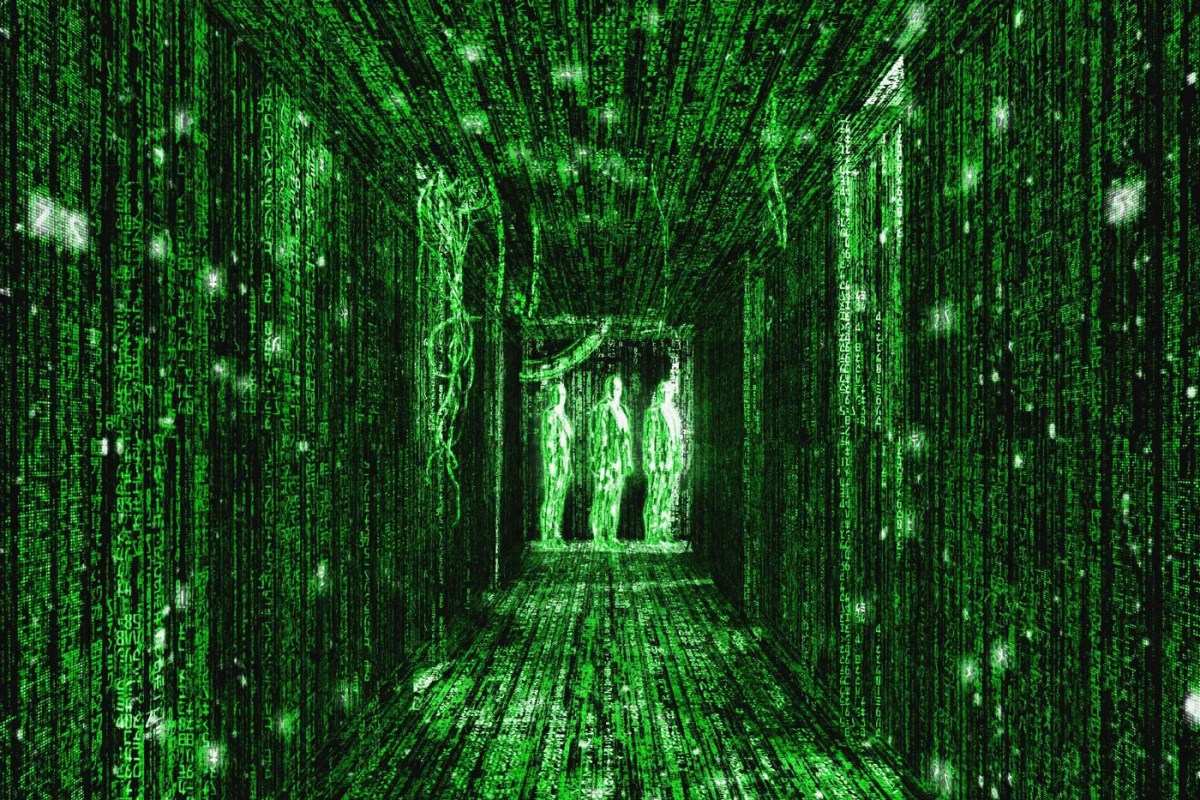
In the late 1990s, the Wachowskis gave us The Matrix – Keanu Reeves as Neo, the Chosen One™, a man so bland he could be anyone, which was the point. Once he realised he was living inside a simulation, he learned to bend its laws, to dodge bullets in slow motion and see the code behind the curtain. Enlightenment, Hollywood-style.
Audio: NotebookLM podcast on this topic.
But here’s the twist, the film itself couldn’t stomach: realising the simulation doesn’t free you from it.
Knowing that race and gender are social constructs doesn’t erase their architecture. Knowing that our economies, legal systems, and so-called democracies are fictions doesn’t get us out of paying taxes or playing our assigned roles. “The social contract” is a collective hallucination we agreed to before birth. That and a dollar still won’t buy you a cup of coffee.
Baudrillard, whose Simulacra and Simulation the film name-dropped like a trophy, argued that simulation doesn’t hide reality – it replaces it. When representation becomes indistinguishable from the thing it represents, truth evaporates, leaving only consensus. We don’t live in a system of power; we live in its performance.
The Matrix got the metaphor half right. It imagined the bars of our cage as a digital dream – glossy, computable, escapable. But our chains are older and subtler. Rousseau called them “social”, Foucault diagnosed them as “biopolitical”, and the rest of us just call them “normal”. Power doesn’t need to plug wires into your skull; it only needs to convince you that the socket is already there.
You can know it’s all a fiction. You can quote Derrida over your morning espresso and tweet about the collapse of epistemic certainty. It won’t change the fact that you still have rent to pay, laws to obey, and identities to perform. Awareness isn’t liberation; it’s just higher-resolution despair with better UX.
Neo woke up to a ruined Earth and thought he’d escaped. He hadn’t. He’d only levelled up to the next simulation – the one called “reality”. The rest of us are still here, dutifully maintaining the system, typing in our passwords, and calling it freedom.
NB: Don’t get me wrong. I loved The Matrix when it came out. I still have fond memories. It redefined action films at the time. I loved the Zen messaging, but better mental acuity doesn’t grant you a pass out of the system.
As I am putting some finishing touches on my latest paper, I had the idea to illustrate some of the novel nomenclature. For some reason, Zeno’s Paradox came to mind. Unlike in maths, it is not reconcilable in language. I asked ChatGPT how I might integrate the concept into my paper. Here is what it rendered. Not only is the exposition decent, but it also provides citations and references. Humorously, when I read the citations, I thought that they were placeholders – Brown, David, Smith, and Jones – but they turned out to be legitimate references – references I hadn’t considered and each relatively recent. I’m chalking this up as a win. This was not a case of ‘ChatGPT, do my homework’. Instead, it reflects an active collaboration between a human and technology. And now I have more reference papers to read and absorb.*
Take the term ‘freedom’, an archetypal example of a Contestable that resists precise communication due to its inherent abstraction and ideological weight. To enhance its effectiveness, we might parse it into narrower forms, such as ‘freedom from’ (liberation from oppression or constraint) and ‘freedom to’ (the capacity to act or pursue desires). Whilst this initial breakdown provides some clarity, it is merely the beginning. Each parsed term demands further qualification: ‘freedom from what?’ and ‘freedom to do what?’ At every level of subdivision, new ambiguities emerge, requiring further refinement (Smith, 2021).
This process resembles Zeno’s paradox, where each attempt to clarify ‘freedom’ by moving incrementally closer to a precise meaning only reveals new layers of interpretive complexity. The concept remains elusive, perpetually deferring any definitive understanding as we approach it in ever-smaller fragments without fully grasping its essence (Jones, 2019). Unlike concrete terms like ‘chair’ or ‘table’, whose meanings can be pinned down through physical reference or functional description, ‘freedom’ resists final articulation (Brown, 2020). This continual parsing illustrates the inherent limitations of language when applied to abstract, boundary-resistant concepts: the more we attempt to define them, the more they fracture into an infinite regress of sub-concepts, each requiring its own explanation (Davis, 2022). Thus, whilst parsing ‘freedom’ improves communicative effectiveness to a point, it ultimately underscores language’s impotence in capturing the full spectrum of complex, ideational constructs (Wilson, 2018).
References:
Brown, J. (2020). The elusive nature of abstract concepts. Journal of Philosophical Studies, 35(2), 123-145.
Davis, S. (2022). Language and the limits of definition. Linguistic Quarterly, 57(1), 78-92.
Jones, M. (2019). Zeno’s paradox and the infinite regress of meaning. Metaphysical Review, 82(3), 245-263.
Smith, L. (2021). Freedom and its discontents: A study in semantic complexity. Political Philosophy Today, 14(2), 56-78.
Wilson, G. (2018). The impotence of language in capturing ideational constructs. Journal of Language and Meaning, 27(4), 198-215.
* References: Here’s the twist. When I went to read the cited references, none were found. Here’s what ChatGPT had to say about it:
I understand your difficulty in locating the references you’ve mentioned. It appears that the articles by Brown (2020), Davis (2022), Jones (2019), and Smith (2021) may not exist in the public domain or could be hypothetical examples. Consequently, Digital Object Identifiers (DOIs) for these works are unavailable.
If you’re interested in exploring topics related to abstract concepts, the limits of language, or semantic complexity, I can recommend some reputable sources:
“The Challenges of Abstract Concepts” by Guy Dove (2021): This chapter discusses the theoretical challenges posed by abstract concepts and reviews current evidence and responses. Springer Link
“Abstract Concepts and Metacognition: Searching for Meaning in Self and Others” by Anna M. Borghi, Chiara Fini, and Luca Tummolini (2021): This work explores the role of metacognition in understanding abstract concepts. Springer Link
“The Limits of Language: Wittgenstein’s Later Philosophy and Skinner’s Verbal Behavior” by R. Harre (1983): This article examines the limitations of language through the perspectives of Wittgenstein and Skinner. JSTOR
“Varieties of Abstract Concepts and Their Multiple Dimensions” by Anna M. Borghi et al. (2018): This paper discusses the representation of abstract concepts and the different criteria used to select them. Cambridge University Press
These sources should provide valuable insights into the subjects you’re interested in.
Welcome to Part 5 of a Week-Long Series on the Evolution and Limits of Language! This article is part of a seven-day exploration into the fascinating and often flawed history of language—from its primitive roots to its tangled web of abstraction, miscommunication, and modern chaos. Each day, we uncover new layers of how language shapes (and fails to shape) our understanding of the world.
If you haven‘ yet, be sure to check out the other posts in this series for a full deep dive into why words are both our greatest tool and our biggest obstacle. Follow the journey from ‘flamey thing hot’ to the whirlwind of social media and beyond!
Pinker: The Optimist Who Thinks Language Works
Enter Steven Pinker, a cognitive scientist and eternal optimist about language. While we’ve been busy pointing out how language is a jumbled mess of misunderstandings, Pinker comes along with a sunny outlook, waving his banner for the language instinct. According to Pinker, language is an evolved tool – something that our brains are wired to use, and it’s good. Really good. So good, in fact, that it allowed us to build civilisations, exchange complex ideas, and, you know, not get eaten by sabre-toothed tigers.
Sounds like a nice break from all the linguistic doom and gloom, right? Pinker believes that language is a powerful cognitive skill, something we’ve developed to communicate thoughts and abstract ideas with remarkable precision. He points to the fact that we’re able to create entire worlds through language – novels, philosophies, legal systems, and scientific theories. Language is, to him, one of the greatest achievements of the human mind.
But here’s where things get a little sticky. Sure, Pinker’s optimism about language is refreshing, but he’s still not solving our core problem: meaning. Pinker may argue that language works wonderfully for most of our day-to-day communication – and in many cases, he’s right. We can all agree that saying, “Hey, don’t touch the flamey thing” is a pretty effective use of language. But once we start using words like ‘freedom’ or ‘justice’, things start to unravel again.
Take a sentence like ‘freedom is essential’. Great. Pinker might say this is a perfectly formed thought, conveyed using our finely tuned linguistic instincts. But the problem? Ask five people what ‘freedom’ means, and you’ll get five different answers. Sure, the grammar is flawless, and everyone understands the sentence structurally. But what they mean by ‘freedom’? That’s a whole other ball game.
Pinker’s language instinct theory helps explain how we learn language, but it doesn’t really account for how we use language to convey abstract, subjective ideas. He might tell us that language has evolved as an efficient way to communicate, but that doesn’t fix the problem of people using the same words to mean wildly different things. You can be the most eloquent speaker in the world, but if your definition of ‘freedom’ isn’t the same as mine, we’re still lost in translation.
And let’s not forget: while language is indeed a fantastic tool for sharing information and surviving in complex societies, it’s also great at creating conflicts. Wars have been fought over differences in how people interpret words like ‘justice’ or ‘rights’. Pinker might say we’ve evolved language to foster cooperation, but history suggests we’ve also used it to argue endlessly about things we can never quite agree on.
So, yes, Pinker’s right – language is a cognitive marvel, and it’s gotten us pretty far. But his optimism doesn’t quite stretch far enough to cover the fact that language, for all its brilliance, still leaves us stuck in a web of interpretation and miscommunication. It’s like having a state-of-the-art GPS that works perfectly – until you get to that roundabout and suddenly no one knows which exit to take.
In the end, Pinker’s got a point: language is one of the most sophisticated tools we’ve ever developed. It’s just a shame that when it comes to abstract concepts, we still can’t agree on which way’s north.
Sapir-Whorf: Language Shapes Reality – Or Does It?
Now it’s time for the Sapir-Whorf hypothesis to take the stage, where things get really interesting – or, depending on your perspective, slightly ridiculous. According to this theory, the language you speak actually shapes the way you see the world. Think of it as linguistic mind control: your perception of reality is limited by the words you have at your disposal. Speak the wrong language, and you might as well be living on another planet.
Sounds dramatic, right? Here’s the gist: Sapir and Whorf argued that the structure of a language affects how its speakers think and perceive the world. If you don’t have a word for something, you’re going to have a hard time thinking about that thing. Inuit languages, for example, are famous for having multiple words for different kinds of snow. If you’re an Inuit speaker, the hypothesis goes, you’re much more attuned to subtle differences in snow than someone who just calls it all ‘snow’.
Now, on the surface, this sounds kind of plausible. After all, we do think using language, don’t we? And there’s some truth to the idea that language can influence the way we categorise and describe the world. But here’s where Sapir-Whorf starts to go off the deep end. According to the stronger version of this hypothesis, your entire reality is shaped and limited by your language. If you don’t have the word for “freedom” in your language, you can’t experience it. If your language doesn’t have a word for “blue,” well, guess what? You don’t see blue.
Let’s take a step back. This sounds like the kind of thing you’d hear at a dinner party from someone who’s just a little too impressed with their first year of linguistics classes. Sure, language can shape thought to a degree, but it doesn’t have a stranglehold on our perception of reality. We’re not prisoners of our own vocabulary. After all, you can still experience freedom, even if you’ve never heard the word. And you can certainly see blue, whether your language has a word for it or not.
In fact, the idea that you’re trapped by your language is a little insulting, when you think about it. Are we really saying that people who speak different languages are living in different realities? That a person who speaks Mandarin sees the world in a fundamentally different way than someone who speaks Spanish? Sure, there might be some subtle differences in how each language breaks down concepts, but we’re all still human. We’re all still sharing the same world, and no matter what language we speak, we still have the cognitive capacity to understand and experience things beyond the limits of our vocabulary.
Let’s also not forget that language is flexible. If you don’t have a word for something, you make one up. If you’re missing a concept, you borrow it from another language or invent a metaphor. The idea that language is some kind of mental prison ignores the fact that we’re constantly evolving our language to keep up with the way we see the world—not the other way around.
And here’s the real kicker: if Sapir and Whorf were right, and we’re all walking around in little linguistic bubbles, then how on earth have we managed to translate anything? How have entire philosophies, religious texts, and scientific theories made their way across cultures and languages for centuries? If language really was shaping our reality that strongly, translation would be impossible – or at least incredibly limited. But here we are, discussing concepts like ‘freedom’, ‘justice’, and ‘truth’ across languages, cultures, and centuries.
So while it’s fun to entertain the idea that your language shapes your reality, let’s not give it too much credit. Yes, language can influence how we think about certain things. But no, it doesn’t define the boundaries of our existence. We’re not all stuck in a linguistic matrix, waiting for the right word to set us free.
In the United States, freedom of speech is protected by the Second Amendment. Just kidding. It’s the First Amendment. But if we’re honest, the line between speech and violence is thin in practice, if not in law.
Here’s the thing: freedom goes both ways. There’s the freedom to speak, and the freedom from being bombarded by whatever nonsense comes tumbling out of people’s mouths. And that’s where things get messy. The grand defence of speech, in all its uncensored glory, often ignores what we’re giving up—our freedom of peace. You know, that quiet space where we don’t have to listen to the verbal sewage spewed by the uninformed, the unhinged, or just the plain old wankers.
What about freedom of peace?
We’ve all heard the phrase: “Your freedom to swing your fist ends at my nose.” Simple. You can’t punch someone in the face and call it freedom. But what about words? There’s no shield for the nose of the mind. The stupid, the ignorant, the hateful—they get to swing their fists of idiocy without a single consequence. What about freedom of peace?
We’ve all been there. You’re minding your own business, and then—bam!—some blowhard pipes up with their unsolicited, half-baked opinion. And guess what? They’re free to do it. But where’s the balance between their freedom to spew nonsense and your right not to have to listen? Spoiler: it doesn’t exist.
Now, this isn’t an argument for censorship. Let’s not confuse it. No one’s saying we should start gagging people (tempting as it is sometimes). But the conversation around freedom of speech needs a reality check. We defend it like it’s a sacred cow, and in many ways, it is. But that defence is often blind to the other side of the coin. Freedom of speech without the freedom from a constant barrage of verbal rubbish? That’s not freedom. It’s a social endurance test.
Maybe it’s time to rethink what we mean by “freedom”—not to restrict speech, but to recognise the cost of living in a world where everyone gets to say whatever they want, whenever they want. The right to peace is real too, even if it’s less glamorous than the right to shout.
It’s July. The season of independence in the United States. Independence from the overt tyranny of Britain, but not from the tacit tyranny of their government—the government purported to be ‘of the people, by the people, and for the people‘ per Abraham Lincoln’s 1863 Gettysburg Address. As their Constitution reads, ‘We the People‘. Governments may be of the people and by the people, but governments are an emergent phenomenon as happens when oxygen and hydrogen combine just so and create water. Two gases combine to create a new substance—water. Some forget that, like water, government are a distinct element to the people that constitute it. Some think it resembles them. It doesn’t. It’s Hobbes’ Leviathan—or a Jabberwok.
In preparation for the traditional Summer season, I took to reading Derrida’s 1976 essay, Declarations of Independence. It was interesting, but I was hoping to get more from it. I decided to deconstruct the opening paragraph—the preamble—of the Declaration of Independence:
We hold these truths to be self-evident, that all men are created equal, that they are endowed by their Creator with certain unalienable Rights, that among these are Life, Liberty and the pursuit of Happiness.
Deconstructing Binary Oppositions
Self-Evident vs. Non-Self-Evident
The Declaration boldly asserts that ‘these truths’ are ‘self-evident’,’ a claim that is nothing more than a rhetorical trick. By presenting these ideas as self-evident, the authors seek to place them beyond questioning, discouraging dissent and critical examination. In reality, these ‘truths’ are far from universal; they are the product of a specific cultural and historical context, shaped by the interests and perspectives of the privileged few who drafted the document.
Interrogating Assumptions and Hierarchies The Declaration of Independence asserts that certain truths are ‘self-evident’, implying that these truths are so obvious that they require no further justification. However, the concept of self-evidence itself is far from universally accepted. It is deeply embedded in the philosophical tradition of Enlightenment rationalism, which holds that reason and logic can reveal fundamental truths about the world.
Philosophical Foundations of Self-Evidence
Enlightenment Rationalism: The idea of self-evidence relies heavily on Enlightenment rationalism, which posits that certain truths can be known directly through reason and are therefore beyond dispute. Philosophers such as René Descartes and Immanuel Kant emphasised the power of human reason to uncover self-evident truths. Descartes, for instance, argued for the self-evident nature of ‘Cogito, ergo sum‘ (‘I think, therefore I am’) as a fundamental truth (Descartes, Meditations on First Philosophy).
Critique of Rationalism: Critics of Enlightenment rationalism, including existentialists like Friedrich Nietzsche and phenomenologists like Martin Heidegger, argue that what is considered self-evident is often culturally and historically contingent. Nietzsche, for example, contended that what we take as ‘truth’ is a product of our perspective and historical context, not an absolute given (Nietzsche, Beyond Good and Evil).
Cultural and Philosophical Contingency
Cultural Relativity: Different cultures and philosophical traditions may not find the same truths to be self-evident. For instance, the concept of individual rights as self-evident truths is a product of Western liberal thought and may not hold the same self-evident status in other cultural frameworks. In many Eastern philosophies, the focus is more on community and harmony rather than individual rights.
Subjectivity of Self-Evidence: The term ‘self-evident’ implies an inherent, unquestionable truth, yet what one group or culture finds self-evident, another may not. This variability reveals the instability and subjectivity of the claim. For example, in traditional Confucian societies, the emphasis is placed on hierarchy and duty rather than equality and individual rights, demonstrating a different set of ‘self-evident’ truths.
Constructed Nature of Truth
Language and Context: Jacques Derrida’s concept of différance illustrates how meaning is not fixed but constantly deferred through language. What we consider to be “truth” is constructed through linguistic and social contexts. Derrida argues that texts do not have a single, stable meaning but rather a multiplicity of interpretations that change depending on the reader’s perspective and context (Derrida, Of Grammatology).
Social Construction: Michel Foucault’s analysis of power and knowledge further deconstructs the notion of objective truth. Foucault argues that what is accepted as truth is produced by power relations within society. Truths are constructed through discourses that serve the interests of particular social groups, rather than being objective or self-evident (Foucault, Discipline and Punish).
Created Equal vs. Not Created Equal
The Declaration’s claim that ‘all men are created equal’ is a blatant falsehood, a manipulative promise designed to appease the masses whilst maintaining the status quo. The glaring contradictions of slavery and gender inequality expose the hollowness of this assertion. Equality, as presented here, is nothing more than an ideological construct, a tool for those in power to maintain their dominance while paying lip service to the ideals of justice and fairness.
Creator vs. No Creator
The Declaration refers to a ‘Creator’ who endows individuals with rights, grounding its claims in a divine or natural law. This invokes a theistic worldview where moral and legal principles are derived from a higher power. However, Derrida challenges this by showing that the concept of a creator is a cultural and philosophical construct, not a universal truth.
The presence of the creator in the text serves to legitimise the rights it declares. However, this legitimacy is contingent on accepting the cultural narrative of a creator. Secular and non-theistic perspectives are marginalised by this assertion, revealing the ideological biases inherent in the Declaration. The authority of the declaration is thus shown to be dependent on particular beliefs, rather than an objective reality.
Unalienable vs. Alienable
The notion of ‘unalienable Rights’ is another empty promise, a rhetorical flourish designed to inspire loyalty and obedience. In practice, these supposedly inherent and inviolable rights are regularly violated and denied, particularly to those on the margins of society. The Declaration’s lofty language of ‘Life, Liberty and the pursuit of Happiness’ rings hollow in the face of systemic oppression and injustice. These rights are not unalienable; they are contingent upon the whims of those in power.
Conclusion
Through this deconstruction, we expose the Declaration of Independence for what it truly is: a masterful work of propaganda, filled with false promises and manipulative rhetoric. The document’s purported truths and self-evident principles are revealed as arbitrary constructs, designed to serve the interests of the powerful while placating the masses with empty platitudes.
As some celebrate this 4th of July, let us not be fooled by the high-minded language and lofty ideals of our founding documents. Instead, let us recognise them for what they are: tools of control and manipulation, employed by those who seek to maintain their grip on power. Only by constantly questioning and deconstructing these texts can we hope to expose the truth behind the facade and work towards a more genuine understanding of freedom and equality.
References
Jacques Derrida, “Declarations of Independence,” in Negotiations: Interventions and Interviews 1971-2001, ed. Elizabeth Rottenberg (Stanford: Stanford University Press, 2002).
Jacques Derrida, Of Grammatology (Baltimore: Johns Hopkins University Press, 1976).
Friedrich Nietzsche, Beyond Good and Evil (Cambridge: Cambridge University Press, 2002).
Michel Foucault, Discipline and Punish: The Birth of the Prison (New York: Vintage Books, 1995).
Immanuel Kant, Critique of Pure Reason (Cambridge: Cambridge University Press, 1998).
René Descartes, Meditations on First Philosophy (Cambridge: Cambridge University Press, 1996).
Robert Kane’s chapter in Four Views on Free Will is titled Libertarianism, and I’ve just finished it. I’ve been writing in the margins, and I’ll summarise my thoughts here.
TL;DR
As I wrote in my last post, I don’t find the Libertarian position on free will and agency compelling. Kane made some interesting points, but none persuaded me to buy what he was selling. The biggest challenge I had was to maintain focus because I think he was chasing red herrings—at least given my focus on agency. He spent a lot of time tearing down determinism and indeterminism instead of building up his own position. I feel the debate centres around agency. I waited for him to explain how this agency operated, but he just assumes agency—or at least a self to possess agency—from the start. I am not convinced. If you are interested, my more detailed commentary follows.
The Rest of the Story
My intent at the start is to approach this chronologically as I retrace my marginalia, hoping to recall whatever prompted my notes in the first place. I’ll be quoting or paraphrasing Kane’s positions to serve as a reference in the event you don’t have access to the book.
1, Determinism and the Garden of Forking Paths
Kane starts off by mentioning that determinism implies that ‘given the past and the laws of nature at any given time, there is only one possible future‘. Within this unvarying environment, he writes, ‘We believe we have free will when we view ourselves as agents‘. I don’t disagree with either of these points, and, as agents, we are ‘capable of influencing the world in various ways‘.
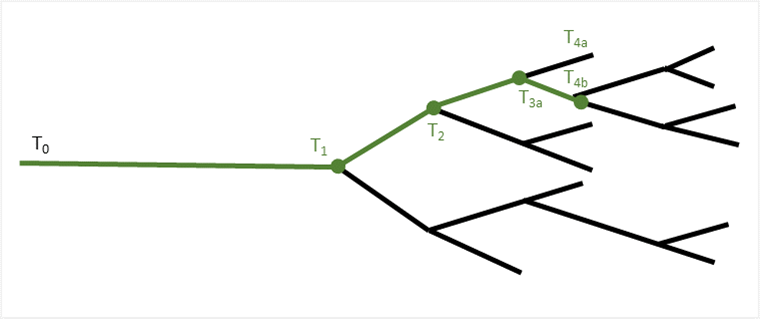
Kane introduces a garden of forking paths illustration, which I’ve recreated here.
Garden of Forking Paths
He uses this as a visual decision tree, where an actor traverses the branches and makes decisions at the various vertices. To breathe life into this tree, he gives us one of several forthcoming examples. He introduces us to Jane.
In his scenario, Jane is faced with a decision with one of two possible outcomes, and ‘she believes there is more than one possible path into the future available to her and it is “up to her” which of these paths will be taken‘. He continues, ‘This picture of different possible paths into the future is also essential, I believe, to what it means to be a person and to live a human life‘.
And herein lies the rub. Jane is not making these decisions in a vacuum. She is a puppet to forces beyond her control. I shouldn’t be so hard on psychology and Freud, but as Luke 23:34 of the Christian Bible relates, ‘Forgive them, for they know not what they do’.
Then Kane reinforces that if determinism were true that Jane would not have free will before bringing up the idea of responsibility, that ‘free will is … intimately related to notions of accountability, blameworthiness, and praiseworthiness for actions‘. I agree with Kane here.
Next, he invokes an emotional appeal-to-nature argument, asking us to imagine a ‘young man [who] is on trial for an assault and robbery in which his victim was beaten to death.’ He suggests that our tendency to blame this man is natural, but that we might search for mitigating circumstances that might account for his actions. He leaves us with a question, Did these influences entirely determine his actions, or did they “leave anything over” for him to be responsible for?
I have this question, too, but as I said, this is an appeal to emotion in the way Westerners have been conditioned to believe. There is little reason to accept this as some sort of universal law or principle.
2. Modern Challenges to Libertarian Free Will
He starts this section as follows, ‘I will be defending the libertarian view of free will in this volume. We libertarians typically believe that a free will that is incompatible with determinism is required for us to be truly morally responsible for our actions, so that genuine moral responsibility, as well as free will, is incompatible with determinism.’
He continues his setup, ‘A goal of this essay is therefore to consider this modern attack on the traditional libertarian view of free will and to ask how, and whether, it can be answered. Much is at stake, it seems to me, in knowing whether we do or do not have a freedom of the will of the ultimate kind that libertarians defend. The modern attack on it has two parts‘.
‘Part 1: The first prong of the modern attack on libertarian free will comes from compatibilists, who argue that, despite appearances to the contrary, determinism does not really conflict with free will at all.‘
‘[A]ccording to compatibilists, esoteric questions about whether determinism is true or not – in the physical or psychological sciences – are irrelevant to the freedoms we really care about in everyday life. All the varieties of free will “worth wanting” (as a modern compatibilist, Daniel Dennett, has put it) do not require the falsity of determinism for us to possess them, as the traditional libertarian view of free will suggests.‘
He informs the reader, ‘Influential philosophers of the modern era, such as Thomas Hobbes, John Locke, David Hume and John Stuart Mill, were all compatibilists‘.
Kane ends part 1 with, ‘If compatibilists are right, we can have both free will and determinism; and we need not worry that increasing scientific knowledge about nature and human beings will somehow undermine our ordinary convictions that we are free and responsible agents.’
I agree with this statement. It’s also why I consider agency to be the pivotal target, not determinism.
In part 2, he writes ‘The second prong goes further, arguing that libertarian free will itself is impossible or unintelligible and has no place in the modern scientific picture of the world.‘
He conveys that ‘modern defenders of libertarianism, such as Immanuel Kant, have argued that we need to believe in libertarian free will to make sense of morality and genuine responsibility, but we can never completely understand such a free will in theoretical and scientific terms.’
This is a good point, and Kant is correct. As a moral non-cognitivist, I feel that morality is a non-sensical human social construct. Inventing free will to make sense of another invention doesn’t get much sympathy from me. Kant finishes with an appeal to noumenism, yet another concept I’ve got no time for.
Next, Kane introduces us to another foe of free will, indeterminism. ‘Events that are undetermined, such as quantum jumps in atoms, happen merely by chance. So if free actions were undetermined, as libertarians claim, it seems that they too would happen by chance.’
He ends this section with two issues a libertarian must address:
The Compatibility Problem: free will really is incompatible with determinism
The Intelligibility Problem: indeterminism can be made intelligible and how, if at all, such a free will can be reconciled with modern scientific views
3. Is Free Will Incompatible with Determinism?: The Consequence Argument
Kane opens with a plea, ‘[L]ibertarians who believe free will is incompatible with determinism can no longer merely rely on intuitions about “forking paths” into the future to support their view that determinism conflicts with free will. These intuitions must be backed up with arguments that show why free will must be incompatible with determinism.‘
If determinism is true, then our acts are the consequences of the laws of nature and events in the remote past. But it is not up to us what went on before we were born; and neither is it up to us what the laws of nature are. Therefore the consequences of these things (including our own acts) are not up to us.
Peter van Inwagen, An Essay on Free Will, Oxford: Clarendon Press, 1983, p. 16
Then he sets up The Consequence Argument:
There is nothing we can now do to change the past.
There is nothing we can now do to change the laws of nature.
There is nothing we can now do to change the past and the laws of nature.
If determinism is true, our present actions are necessary consequences of the past and the laws of nature.
Therefore, there is nothing we can now do to change the fact that our present actions occur.
In other words, we cannot now do otherwise than we actually do.
Indeed, I agree in principle with the logic, but I’ll reiterate that I feel that the entire determinism angle is a red herring. Next, Kane goes into a discussion about the Transfer of Powerlessness Principle.
In essence, TP ‘says in effect that if you are powerless to change something X, and something else Y is necessarily going to occur if X does, then you are also powerless to change Y.‘
As I don’t think it’s’ important to my ends and I agree with Kane’s critique of this tailing logic, if you are powerless to change something X, and something else Y is necessarily going to occur if X does, then you are also powerless to change Y.
Finally, he argues that there is a likely insurmountable semantic challenge that accepting one meaning of ‘can’ and ‘power’ (and some other terms) will determine [pun intended] if one is a compatibilist or not.
4. Ultimate Responsibility
Carrying over from the previous section, Kane reminds us that ‘as a result of this impasse, philosophical debates have multiplied about just what “can” and “power” (and related expressions, such as “could have done otherwise”) really mean‘. But he also concedes that ‘The problem is that focusing on “alternative possibilities” (or “forking paths” into the future) or the “power to do otherwise” alone, as the Consequence Argument does, is too thin a basis on which to rest the case for the incompatibility of free will and determinism.’
He sets up his position.
Free will seems to require that open alternatives or alternative possibilities [AP] lie before us – a garden of forking paths – and it is “up to us” which of these alternatives we choose.
Free will also seems to require that the sources or origins of our actions lie “in us” rather than in something else.
This second point he terms ultimate responsibility [UR].
‘The basic idea of UR is this: To be ultimately responsible for an action, an agent must be responsible for anything that is a sufficient cause or motive for the action’s occurring.‘
‘To be ultimately responsible for the choice, the agent must be at least in part responsible by virtue of choices or actions voluntarily performed in the past for having the character and motives he or she now has.‘
This is what I am waiting for him to resolve. A red flag that has me on alert is the term character. This is on my list of weasel words. He also cites Aristotle as a reference—also relative to character—, so that’s a double red flag in my book.
He returns to his post that free will ‘does require that we could have done otherwise with respect to some acts in our past life histories by which we formed our present characters. I call these earlier acts by which we formed our present characters “self-forming actions,” or SFAs‘.
My causa sui post already illustrates that Kane doesn’t actually answer the question of how the self forms the so-called self-forming actions. He just invents the term, appeals to idiomatic notions of self and declares victory. I recent post discussed the challenges with self.
In the sense that the enemy of my enemy is my friend, he name-drops Daniel Dennett and a story Dennett had cited involving Martin Luther initiation of the Protestant Reformation. Luther said, “Here I stand, I can do no other.”
Kane then argues that Dennett’s deterministic interpretation is incorrect, but given that Dennett is a compatibilist, he doesn’t care if Luther was free or determined in a deterministic universe.
So the ability to do otherwise (“could have done otherwise”) or AP, says Dennett, is not required for moral responsibility or free will.
In the end, we are back into a language game—a semantic pissing match.
Continuing with Luther, Kane concedes, ‘We can grant that Luther could have been responsible for this act, even though he could not have done otherwise then and there and even if his act was determined. But this would be so, if UR is required, only to the extent that Luther was responsible for his present motives and character by virtue of some earlier struggles and self-forming actions.‘
I’m still left wondering how and when Kane is going to prove this argument.
Kane provides more context by telling us that an agent requires sufficient cause of motive, but he never does define sufficient. He is also aware that a causal chain can lead us back to the dawn of time, so he’s devised an angle:
‘The only way to stop this regress is to suppose that some acts in our life histories must lack sufficient causes altogether.’
Perfect. Let’s see how this works.
Now he’s bringing in his SFAs and character. No thank you, please.
‘UR makes explicit something that is often hidden in free will debates, namely that free will – as opposed to mere freedom of action – is about the forming and shaping of character and motives which are the sources or origins of praiseworthy or blameworthy, virtuous or vicious, actions.’
This is where the psychobabble word salad comes in full force. It feels that Kane is employing circular reasoning and claiming that free will is necessary to shape the character necessary to have free will. Perhaps I am missing something.
‘If persons are responsible for the wicked (or noble, shameful, heroic, generous, treacherous, kind or cruel) acts that flow from their wills (characters and motives), they must at some point be responsible for forming the wills from which these acts flow
This ‘forming’ argument feels like a non-sequitur. Let’s keep going.
5. Ultimate Responsibility and Alternative Possibilities
‘When one argues about the incompatibility of free will and determinism from alternative possibilities or AP (as in the Consequence Argument), the focus is on notions of “necessity,” “possibility,” “power,” “ability,” “can,” and “could have done otherwise.” By contrast, the argument from UR focuses on a different set of concerns about the “sources,” “grounds,” “reasons,” and “explanations” of our wills, characters, and purposes. Where did our motives and purposes come from, who produced them, who is responsible for them?’
These are my questions as well. He provides his answers to his own question:
‘To understand the connection between AP and UR, alternative possibilities and ultimate responsibility, we must first note that having alternative possibilities for one’s action – though it may be necessary for free will – is not sufficient for free will, even if the alternative possibilities should also be un-determined. This can be shown by noting that there are examples in which agents may have alternative possibilities and their actions are undetermined, and yet the agents lack free will.’
I can’t wait.
Next, he witters on about God and determinism and leaves us with the conclusion that ‘persons in such a world lack free will‘. Whew! Good thing.
I haven’t really addressed the issue here, but the very concept of will doesn’t sit right with me. It feels a bit magical, but let’s just leave that here.
This assertion relies on volition, cause, and motive—volition and motive feeling pretty weaselly.
Around here, he conveys a story about an assassin that I feel totally misses the mark. Pun intended because in this story, the assassin intent on shooting the Prime Minister gets an involuntary twitch and kills the aide instead.
‘UR captures this additional requirement of being the ultimate source of one’s will that is lacking in this imagined world. For UR says that we must be responsible by virtue of our voluntary actions for anything that is a sufficient cause or a sufficient motive (or reason) for our acting as we do.’
Kane says that the will of the assassin is sufficient motive and reason. I disagree. I’ll circle back to this in a moment with a robot assassin analogy. Kane goes on to say ‘Anything else he might do (miss the prime minister, kill the aide) would be done only by accident or mistake, unintentionally or unwillingly‘.
This second part is particularly interesting to me. If his intent was to kill the Prime Minister and failed but killed the aide without intention, does this mean he’s not culpable?
Kane tells us that ‘we are interested in whether they could have acted in more than one way voluntarily, intentionally, and rationally, rather than only in one way voluntarily, intentionally, and rationally and in other ways merely by accident or mistake, unintentionally or irrationally.‘
Kane revisits UR: If (i) free will requires (ii) ultimate responsibility for our wills as well as for our actions, then it requires (iii) will-setting actions at some points in our lives; and will-setting actions require (iv) the plurality conditions, the ability to act in more than one way voluntarily, intentionally and rationally.
I’m feeling strongly that a person agreeing with this line of argumentation has to already agree with the underlying conditions. In fact, one cannot will oneself to believe in free will if one doesn’t and vice versa. I’m not inclined to agree.
Kane injects pangs of conscience into the equation. I’ll ignore it, as conscience in this context is wholly constructed. I understand that Kane wants to say that conscience is an impetus for free. I’ll disagree and level it at that.
‘If we are to be ultimately responsible for our own wills, some of our actions must be such that we could have done otherwise, because some of them must have been such that we could have done otherwise voluntarily, intentionally, and rationally.‘
We are still in agreement. Now what?
He closes with a dual regress of free will. We need to be ultimate sources of our actions and ultimate sources of our actions wills.
6. The Intelligibility Problem: Is Libertarian Free Will Possible?
‘Can we make sense of a free will that requires Ultimate Responsibility of the kind described in the previous section? Can we really be the ultimate designers of our own ends and purposes? There are many skeptics about free will who think not. They argue that being the ultimate source of one’s will and actions is an incoherent and impossible ideal…‘
Please. Are we there yet?
The “Intelligibility Problem” says that incompatibilist free will requires that ultimate responsibility is intelligible or possible and can be reconciled with modern scientific views of human beings.
Kane articulates how indeterminism and probability might affect free will and how, given the ‘exactly same past’, can possibly arrive at different outcomes on our forking paths. He provides an example. I’ll relate it, but mostly to critique his narrative.
Recalling the forking paths we have two scenarios. The premise is that, in the first scenario, John has to decide whether to travel to Hawaii or Colorado. Based on the state of his person, he chose Hawaii.
This can be illustrated about be following the green line from point T0 to T4b. At decision point T3a, John had to choose between Hawaii and Colorado. T4a represents his Hawaii preference.
Still looking at the same chart (above), under the second scenario, something ever so slightly changed and John could have chosen the top branch rather than the lower branch, thus choosing Colorado instead.
‘“If the past had been just a tiny bit different, then John might have sensibly and rationally chosen differently (chosen Colorado instead).” Determinists and compatibilists can say this.’
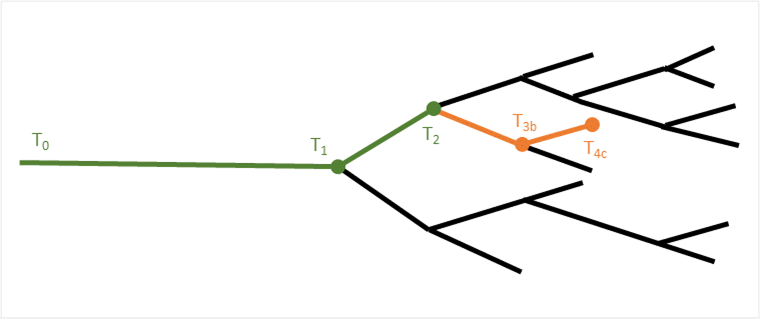
The problem (referring to the chart below) is that a different choice at T2, no matter how small or seemingly insignificant, would have put him on a different path, choosing T3b on the lower branch over T3a on the upper branch. Therefore, the T4b option stemming from the upper T3a branch is not the same T4c option on the lower branch. Instead of a choice of travelling to Hawaii or Colorado, the choice may have between chicken or steak for dinner.
Whilst it is conceivable that the Colorado versus Hawaii decision might still occur, the person at T3 is not the same person.
Kane reintroduces Kant’s noumenal self by name, but he quickly discounts it on the grounds of obscurantism or mystery or “panicky metaphysics”. He’s right in doing so.
As Kane also admits creating the external actors tend to render supporters of these notions as nutters. Besides, if the external actor is the agent, it’s no different than a god doing it.
Before we move to the next section, I want to return to the assassin. My argument is that anyone, including the assassin, is a product of their environment. Full stop. Therefore, one cannot be responsible for anything. To illustrate this, let’s replace the human assassin with a robot assassin. We want to be sure the robot doesn’t twitch and miss.
The robot gets into place and does the assassination task as designed without a hitch (or a twitch). Is the robot in any way responsible for its actions? Not many would argue that it was. It was a victim of its own circumstances. Here, one might argue that the robot has no conscience, and so has no ability to do otherwise. The robot has been programmed. Even if this robot could acquire new information, it could only interpret it relative to the information and processes it already had. The human is no different. The human cannot transcend itself to invoke a different outcome. And any new input would. by definition, be an external influence.
7. Indeterminism and Responsibility
Kane wants to set the stage, so he conveys that ‘The first step in this rethinking about the Intelligibility Problem is to note that indeterminism does not have to be involved in all acts done “of our own free wills” for which we are ultimately responsible … only those acts by which we made ourselves into the kinds of persons we are, namely the “will-setting” or “self-forming actions” (SFAs) that are required for ultimate responsibility.’
Kane believes that ‘believe these undetermined self-forming actions or SFAs occur at those difficult times of life when we are torn between competing visions of what we should do or become.’ Thus, he reintroduces character.
Next, he makes an assertion that I disagree with: ‘The uncertainty and inner tension we feel at such soul-searching moments of self-formation is thus reflected in the indeterminacy of our neural processes themselves.’ It should be obvious that I object to the notion of soul-searching from the start.
Kane advances another assertion: ‘Just as indeterminism need not undermine rationality and voluntariness of choices, so indeterminism in and of itself need not undermine control and responsibility.’ I suppose it may ‘need not’, but let’s see if it does.
Then he introduces an example from communications theory, suggesting that a person can willfully concentrate on the signal to overcome noise: ‘Whether you are going to succeed in solving the problem is uncertain and undetermined because of the distracting neural noise. Yet, if you concentrate and solve the problem nonetheless, we have reason to say you did it and are responsible for it, even though it was undetermined whether you would succeed. The indeterministic noise would have been an obstacle that you overcame by your effort’. My margin note reads ‘silly’. I’ll just leave it at that.
8. Parallel Processing
I’ll admit at the start, that this section was just an annoyance, adding little to Kane’s position. My commentary will be brief.
Kane brings in his SFAs and suggests that if we are at a decision point with two (or multiple) options, each option is processed on its own thread. Reflecting on a woman faced with a decision, he tells us that ‘the choice the woman might make either way will not be “inadvertent,” “accidental,” “capricious,” or “merely random” (as critics of indeterminism say) because the choice will be willed by the woman either way when it is made, and it will be done for reasons either way – reasons that she then and there endorses.‘
NB: Underlined words in the paragraph above represent Kane’s italicised words in the chapter text.
Here, Kane continues down a rabbit hole wintering on about SFAs. I’m not convinced. It’s getting late. I’m getting cranky. I’ll will myself to continue. [Yes, that’s a joke.]
9. Responsibility, Luck, and Chance
Kane now wants to remind us that although one might ‘still find it hard to shake the intuition that if choices are undetermined, they must happen merely by chance – and so must be “random,” “capricious,” “uncontrolled,” “irrational,” and all the other things usually charged‘, and that ‘such intuitions are deeply ingrained‘.
Fair enough. Also interesting is how ingrained the sense of self and soul is, but never mind that for now.
Kane continues to unwind the bias he notes. His punchline is this:
‘(Imagine the assassin’s lawyer arguing in the courtroom that his client is not guilty because his killing the prime minister was undetermined and might therefore have failed by chance. Would such a defense succeed?)’
The ‘law’ is not seeking this truth. it is seeking blame and will go to great lengths to do so. Law is about closure. This feels like a strawman on a non-sequitur. Nothing to see here. Let’s keep on.
Kane’s final blow is that if ‘they endorsed the outcomes as something they were trying and wanting to do all along, knowingly and purposefully, not by mistake or accident‘, then they are responsible.
This reminds me of something that may or may not have been uttered by the Dalai Lama explaining the mechanics or scoring system that karma operates by. There are effectively three dimensions of karma:
Intent
Action
Reaction
Intent is the desire to do something, whether to give a gift or assassinate a Prime Minister.
Action is the activity itself: giving a gift or killing a Prime Minister.
Reaction is your emotional response: giving a gift or killing a Prime Minister.
Exploring this, say a person gains or loses a karmic point for each good or bad thing and receives no point where an event did not happen.
Let’s start with the assassin.
If your intent is to kill someone, you lose a karma point. Sort of a thought crime, I guess. [-1]
If you do kill the Prime Minister, you’ve lost another point. [-1]
Now, if you feel good about your success in this case, you lose yet another point [-1], netting you with minus 3 [-3] all tolled. However, if you feel remorse, you gain a point [+1], netting you with a minus 2 [-2].
Let’s say you have no intent to kill the Prime Minister, yet you lose control of your vehicle and smash into them. S/he dies instantly.
You get no intent point—positive or negative. [0]
You lose a point for the action. Sorry, Charlie. [-1]
Now, if you feel remorse about this event, you gain another point [+1], netting you with zero [0] all tolled. However, if you didn’t really like the Prime Minister and start singing—even in your head—Ding, Dong, the witch is dead, you lose another point [-1], netting you with a minus 2 [-2].
Let’s try gift-giving.
If you want to give a gift, you gain a karma point. [+1]
If you don’t follow through, you lose a karma point [-1], leaving you with zero [0]. There is no cause for reaction, so you remain at zero.
Let’s up the game a bit and instead of just wanting to buy a gift, you promise to buy one.
If you promise to give a gift, you gain a karma point. [+1]
If you don’t follow through, you lose a point [-1], leaving you with zero [0].
If you feel good about the ensuing disappointment, you lose another point. [-1]
If you feel bad about it, you regain a karma point [+1], so you are ahead of the game. And this, boys and girls, is how you game karma. But karma is ahead of your sorry ass, and it takes back the point. And then it takes away a penalty point if you don’t feel sorry about being a jerk.
But I digress. What were we talking about? Oh yeah, I do not endorse Kane’s endorsement idea.
10. Choice, Agency, Efforts, and Causes: Further Objections Considered
‘If indeterminism is involved in a process (such as the woman’s deliberation) so that its outcome is undetermined, one might argue that the outcome must merely happen and therefore cannot be somebody’s choice. But there is no reason to assume such a claim is true‘, Kane relates. More subterfuge.
‘Self-forming choices are undetermined, but not uncaused‘, Kane says. Tell me more.
‘They are caused by the agent’s efforts.’ Them’s fighting words.
He continues, ‘Perhaps indeterminism does not undermine the idea that something is a choice simply, but rather that it is the agent’s choice. This objection raises important questions about agency. What makes the woman’s choice her own on the above account is that it results from her efforts and deliberation, which in turn are causally influenced by her reasons and her intentions (for example, her intention to resolve indecision in one way or another). And what makes these efforts, deliberation, reasons, and intentions hers is that they are embedded in a larger motivational system realized in her brain…
‘A choice is the agent’s when it is produced intentionally by efforts, by deliberation and by reasons that are part of this self-defining motivational system and when, in addition, the agent endorses the new intention or purpose created by the choice into that motivational system as a further purpose to guide future practical reasoning and action.’
My reaction is that this so-called agent is just an invention.
‘Since those causally relevant features of the agent, which can be counted among the causes of the woman’s choice, are her reasons or motives, her conscious awareness and her deliberative efforts, we can also say that she is the cause of the choice by virtue of making the efforts for the reasons and succeeding.’
Just no.
Next, Kane conveys a situation where a guy smashes a glass table and blames it on chance events, ending with this argument.
‘We tend to reason that if an outcome (breaking a table or making a choice) depends on whether certain neurons fire or not (in the arm or in the brain), then the agent must be able to make those neurons fire or not, if the agent is to be responsible for the outcome.’
Let’s see if he comes up from this rabbit hole in the next section.
11. Responsibility and Control: Three Assassins
Watch out. Kane is doubling down—nay, tripling down—on the assassins. His primary argument appeals to emotion and indoctrination—the social programming of the reader.
‘Is the assassin less guilty of killing the prime minister, if he did not have complete control over whether he would succeed because of the indeterminism in his neural processes?’
Robert Kane, Four views on Free Will
Kane recalls the dilemma that I discussed in my Citizen Kane post of a woman to continue to the office or to help someone being mugged, and asserts (without evidence) that this is volitional and ‘is coming from her own will‘.
‘There must be hindrances and obstacles to our choices and resistance in our own wills to be overcome, if we are to be capable of genuine self-formation and free will. Compare Evodius’s question to St Augustine (in Augustine’s classic work On the Free Choice of the Will).‘
This seems like plausible logic, I suppose. But it doesn’t follow from this definition that self-formation—genuine or otherwise—or free will exists.
I tuned out at the God talk.
12 Conclusion: Complexity and “Being an Author of One’s Own Story”
Finally. The last section of this chapter before I turn to John Martin Fischer’s chapter on Compatibilism.
Kane introduces the complexity of chaotic systems next.
‘Agents, according to this modern conception with ancient roots, are to be conceived as information-responsive complex dynamical systems. Complex dynamical systems are the subject of “dynamical systems theory” and also of what is sometimes popularly called “complexity theory.” They are systems (which are now known to be ubiquitous in nature) in which new emergent capacities arise as a result of greater complexity or as the result of movement away from thermodynamic equilibrium toward the edge of chaos.’
‘Only when creatures attain the kind of inner complexity capable of giving rise to conflicts in their wills, or motivational systems, between incommensurable values does the capacity for self-formation characteristic of free will arise.’
Supposing a reaction by critics, he asks himself, ‘Even if one granted that persons, such as the businesswoman, could make genuine self-forming choices that were undetermined, isn’t there something to the charge that such choices would be arbitrary?‘
His response is that we can’t really answer this question and tries to redirect the reader’s attention to the semantics of the word arbitrary. In the end, his final position is that this is the right approach because he can feel it in his bones.
I like David Guignion’s channel, and I’ve been taking in several perspectives on Kant’s article, ‘What is Enlightenment?‘
Feel free to watch from the start, but I’ve cued it to the place where David shares my thoughts around Agency. He brings up the point that absent official authority such as a political or religious structure, we are still influenced—subconsciously—to some degree by mass media and culture. These are the embodied norms and customs that most people just take for granted without question.
As David suggests, we can’t just slough off this inherited skin. First, because we do not even question it, and, two, it’s ingrained, one would likely deny the influence or be subject to escalating commitment under so-called critical inspection.
This is akin to asking a person of a certain religious persuasion if they would have the same religious beliefs if they had not been indoctrinated with them. I feel that a vast majority would defend their religion and the underlying or resultant morality as being obvious, so at the very least they are kept in the lane with guide rails. The extent of this influence and the degree it subtracts from autonomy is my question. I believe if pressed, the individual would defend the prescribed morality to be self-evident and they would have acted the same way even without religious instruction.
Being critical of freedom, liberty, and autonomy is likely to make one the subject of scorn and derision. Most people tend to feel these things are self-evident attributes and goals, but they are all simply rhetorical functions. I was reading a passage in Mills’ On Liberty, where he posits
That the only purpose for which power can be rightfully exercised over any member of a civilized community, against his will, is to prevent harm to others. His own good, either physical or moral, is not a sufficient warrant … Over himself, over his body and mind, the individual is sovereign.
On Liberty, John Stuart Mill
It should come as no surprise that I question a position adopted by the Enlightenment Age. These geezers posited that many things were self-evident, but all of this is self-serving magical thinking, and there is no reason to have truck with any of it. These are all normative claims being dressed as positive, non-normative, ones, hoping to skirt scrutiny by employing a position of self-evidence.
I am generally critical of any notions of identity and self from the start, so affixing some attribute of power to it seems just silly.
It seems that I again am distilling this notion to a power equation. As a person, I want to claim power, if anything, over my self however that might be defined. And though, I would like this, too, it is nothing more than some emotional reaction.
Without delving into the depths of autonomy quite yet, on a proverbial desert island—as necessarily the case with any social constructs, where these notions are meaningless without a social context—adding a second person creates friction. Person A seemed to have full autonomy on this island—notwithstanding the other life forms on this island that are somehow never granted autonomy—now has had this autonomy reduced by the presence of Person B.
Firstly, Person A may have claimed this island to be their own. Given this, Person B is infringing on this autonomous decision, having arrived sequentially. Is Person B tresspassing? Does their presence harm Person B, be limiting their autonomy however slightly?
Mills’ concept is one of no harm: one is free to do what one chooses as so long as it doesn’t harm another. Accordingly, it says one is free to harm one’s self—essentially treating the self, the corpus, as personal property. Just as one could damage a piece of personal furniture, one could damage themself. I am not sure if Mills intend this to extend to suicide, but that’s not an important distinction here, so I’ll move on.
Let’s return to Person A on the island—only Person A is a woman and Person B is a fetus. What rights and autonomy does Person B now possess? For some, it has full autonomy; full personhood. Still, Person B is ostensibly trespassing, so does this autonomy even matter if it exists?
If you are Person X and own a house, and I, as Person Y, enter into it, how does this differ from A and B? Can you justify disallowing Person Y from exercising autonomy whilst supporting Person B? I don’t want to make this about abortion, so I’ll keep stop here.
What’s an anarcho-syndicalist supposed to do in the advent of artificial intelligence, process automation, and robots?
Wikipedia relates anarcho-Syndicalism as follows:
Anarcho-syndicalism (also referred to as revolutionary syndicalism)[1] is a theory of anarchism that views revolutionary industrial unionism or syndicalism as a method for workers in capitalist society to gain control of an economy and thus control influence in broader society. Syndicalists consider their economic theories a strategy for facilitating worker self-activity and as an alternative co-operative economic system with democratic values and production centered on meeting human needs.
Anarcho-syndicalists view the primary purpose of the state as being the defense of private property, and therefore of economic, social and political privilege, denying most of its citizens the ability to enjoy material independence and the social autonomy that springs from it.[3] Reflecting the anarchist philosophy from which it draws its primary inspiration, anarcho-syndicalism is centred on the idea that power corrupts and that any hierarchy that cannot be ethically justified must either be dismantled or replaced by decentralized egalitarian control.[3]
As a matter of preference, I’ve leaned toward anarcho-syndicalism. I don’t have a lot of faith in humans or humanity to govern or self-govern. The arguments for this, whether monarchies, democracies, plutocracies, or even anarchies are each rife with its own sets of problems. Still, I favour a system where there is no class of governors, though I am more of a fan of Proudhon over Marx.
Mind you, I don’t think humans make very good judgements and are as bad in groups as individuals but for different reasons—and especially where complexity or too many choices are available. That we’ve survived this long is, quite frankly, a miracle.
This said, it isn’t my problem. My contention is with the syndicalist aspect. If all of this human as worker displacement occurs as some are forecasting, there will be precious few workers. I am not saying that this is inevitable or will ever happen. My concern is merely conditional. If this were to happen, the idea of a worker-centric system is daft.
Do we just defer to people categorically, where we arrive at simple anarchism? Without delving, there are different flavours of, and I have neither the time nor the inclination to debate, for example, the merits of anarco-capitalism (an oxymoron if there ever was one) versus anarcho-communism or anarcho-transhumanism for that matter.
Although, I like how Kant identified four kinds of government…
Law and freedom without force (anarchy)
Law and force without freedom (despotism)
Force without freedom and law (barbarism)
Force with freedom and law (republic)
…the whole notion of freedom is another weasel word, and laws without force are unenforceable—pun intended. At least the syndicalism felt like it was intentional or purposeful. I understand why Plato despised the rabble, but as with the sorites paradox in the heap-hill distinction, where to the rabble distil down to something meaningful?





 Philosophics