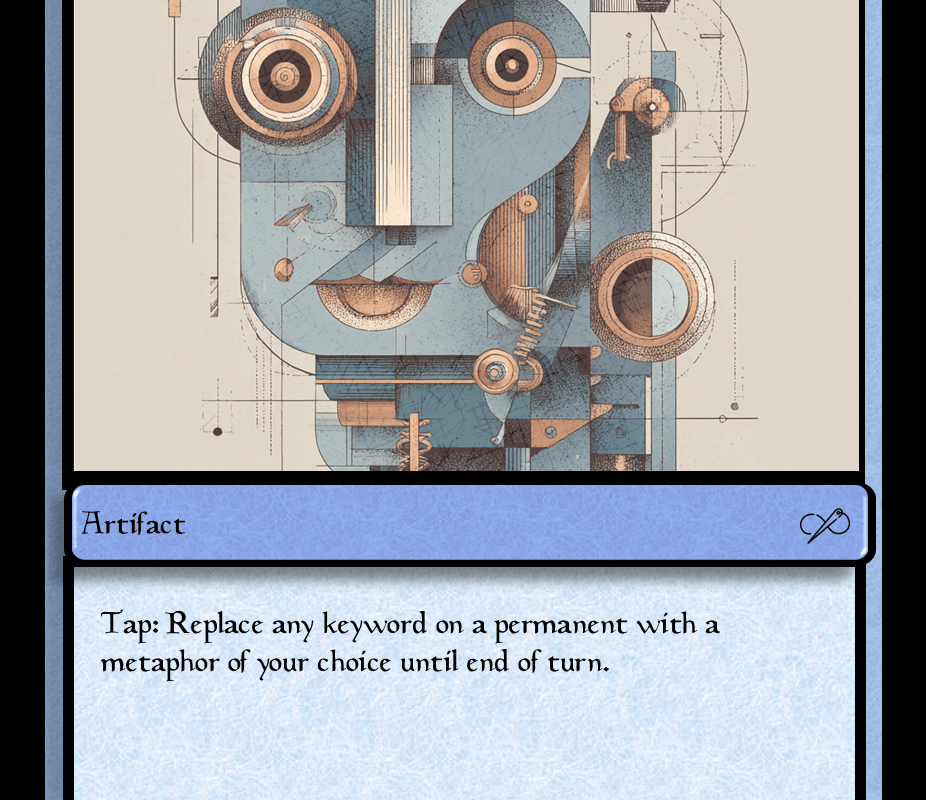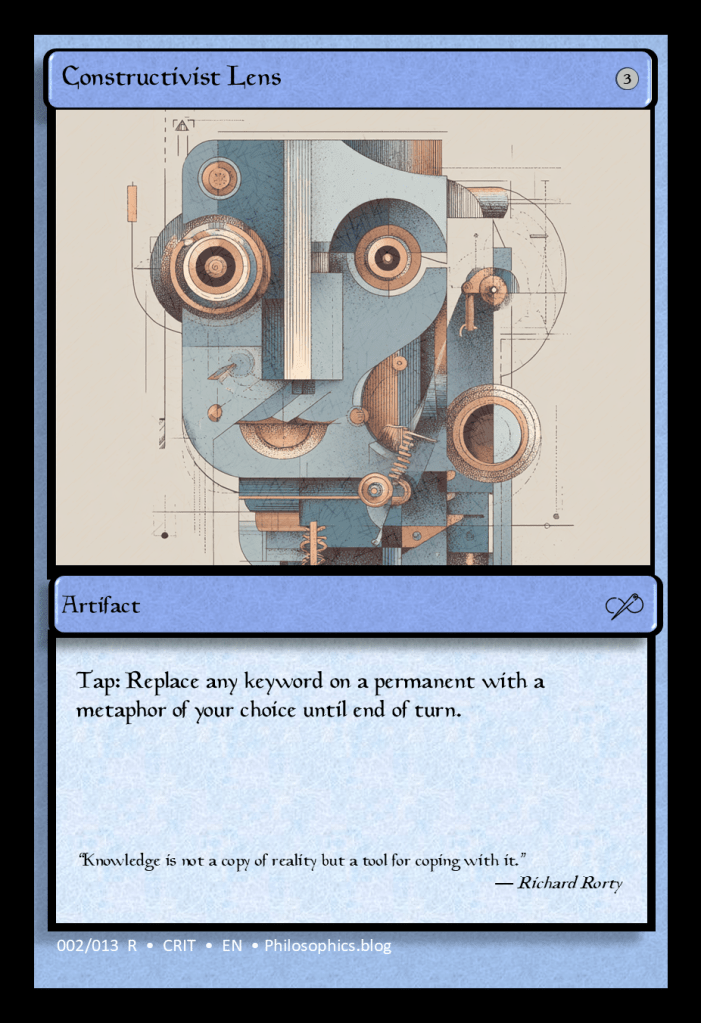
Another faux Magic: The Gathering trading card. I’ve been busy writing an essay on Tatterhood and wondering if I’ve gone off the edge even further into mental masturbation. I made these cards to share on slow news days, as it were.
[EDIT: Oops: Even wore. I already posted something today. Enjoy the bonus post.]
Every philosopher dreams of a device that reveals ‘truth’. The Constructivist Lens does the opposite. When you tap it, the world doesn’t come into focus – it multiplies. Each pane shows the same thing differently, reminding us that knowing is always a form of making – seeing as building.
In The Discipline of Dis-Integration, I wrote that philosophy’s task is ‘to remain within what persists … to study the tension in the threads rather than weave a new pattern’. The Lens embodies that ethic. It is not an instrument of discovery but of disclosure: a way to notice the scaffolding of perception without mistaking it for bedrock.
Flavour text: “Knowledge is not a copy of reality but a tool for coping with it.” — Richard Rorty
Where Enlightenment optics promised clarity, the Lens trades in parallax. It insists that perspective is not a flaw but the condition of vision itself. Each player who peers through it – artist, scientist, moralist – constructs a different coherence, none final. The card’s rule text captures this tension: replace any keyword on a permanent with a metaphor of your choice until end of turn. Reality bends, language shifts, yet the game continues.
In the Dis-Integration set, the Lens sits alongside Perspectival Realism and Language Game (not yet shared), forming the Blue triad of epistemic doubt. Together they dramatise what the essay calls ‘the hyphen as hinge’: the small pause between integration and its undoing. The Constructivist Lens, then, is not a tool for clearer sight but a reminder that every act of seeing is already an act of construction.
(For the constructive exposition of Perspectival Realism—its three layers of mediation, its commitments, and its ontology without footnotes—see the main article. This piece deals with the predictable objection.)
The moment you say “our access to reality is mediated,” someone inevitably performs their civic duty as Defender of Enlightenment Orthodoxy and announces, as if discovering fire, “So you’re a relativist, then?”
It’s a comforting little reflex. If a position denies universality, it must be relativism. If it rejects the view from nowhere, it must reject the very idea of truth. If it acknowledges cultural scaffolding, it must be one critique away from saying flat-earthers and astrophysicists are peers.
This objection misunderstands both relativism and Perspectival Realism.
Audio: NotebookLM podcast summarising this topic.
Let’s begin with the essential distinction—think of this as the tattoo at the base of the spine:
Relativism says: all maps are equally valid. Perspectival Realism says: all maps are partial, and some are better.
Better at predicting.
Better at surviving.
Better at cohering with everything else we know.
Better at not getting you killed.
This is the spine of the position. Everything else is elaboration.
Relativism’s Self-Destruct Button
Relativism denies that reality has enough structure to constrain belief. According to its logic, perspectives are sovereign. The world bends to interpretation.
If that were true:
Gravity would turn itself off for anyone sufficiently committed to optimism.
Viruses would consult your cosmology before infecting you.
The Müller–Lyer illusion wouldn’t vary between populations because there’d be no stable perceptual machinery for it to fool.
Relativism collapses because the world does not permit it.
Perspectival Realism begins from the opposite premise:
There is one reality.
It resists us.
Perspectives rise or fall by how well they handle that resistance.
You can’t get further from relativism than that.
Why Perspective ≠ Prison
Another familiar confusion: “If access is perspectival, aren’t we trapped in our own little worlds?”
No. Mediation isn’t isolation. It’s a shared condition.
You and I may wear sunglasses of different tint, but we still walk the same street. Your glasses may darken the building I call “red,” so you call it “dark red.” That’s not incommensurability—that’s disagreement within a shared world. We argue, we adjust, we converge.
Perspectival Realism doesn’t say “worlds are sealed off.” It says we are situated—embodied, encultured, cognitively structured. Our lenses differ. The street does not.
The Crucial Point: The World Pushes Back
Relativism has no mechanism for adjudication. Perspectival Realism has the best one available: reality’s structured resistance.
If your perspective predicts, explains, and survives contact with the world, it’s better. If it collapses upon use, it’s worse. If it transfers across contexts, it’s better. If it leaves you dead, it’s worse.
This is not metaphysics. It’s survival.
And it is very explicitly not relativism.
Logic: Form Universal, Application Situated
A predictable objection:
Objection: “Isn’t logic universal? Doesn’t that kill perspectivalism?”
Response: Basic inferential forms—modus ponens, contradiction—are indeed widespread. That’s Layer 2 architecture: the cognitive machinery we all share.
But what counts as a valid premise, which inferences feel compelling, and which conclusions are considered exhaustive vary across cultures (Layer 3). Logic’s form is stable; its deployment is contextual.
Perspectival Realism doesn’t deny logic. It denies the fantasy that logic operates in a cultural vacuum.
Relativism’s Moral Collapse
Why “anything goes” goes nowhere
Relativism becomes lethal the moment ethics enters the scene. If all perspectives are equally valid, you lose the ability to critique harmful practices. Torture, forced servility, institutionalised cruelty—all become “just different frameworks.”
Perspectival Realism rejects this.
You don’t need a metaphysical skyhook to condemn torture. You need:
Shared vulnerability – all humans are embodied beings capable of pain.
Empirical observation – societies that normalise cruelty become unstable and self-poisoning.
Pragmatic convergence – diverse cultures can agree that some practices destroy the conditions of flourishing.
Reality-tested norms – ethical systems survive because they work, not because they download from a Platonic server.
This is not relativism. It’s ethics under realism-without-universality.
You can condemn harmful practices without pretending to be the mouthpiece of timeless universal Reason. You can ground human rights in intersubjective evidence—not metaphysical fiat.
No view from nowhere required.
The Three-Way Contrast (The Only Chart You Need)
Naive Realism: There is one perfectly accurate map.
Relativism: All maps are equally good.
Perspectival Realism:
All maps are partial.
Some are atrocious.
Some work astonishingly well because they track deeper regularities of the terrain.
No map is complete.
No map is sovereign.
The terrain adjudicates between them.
You don’t need omniscience to compare maps. You need terrain. And we all share the same one.
Prediction: The Final Judge
If you want the single litmus test:
Does the perspective predict anything?
Does it do so consistently?
Does it correct itself when wrong?
Does it transfer beyond its original context?
If yes → closer to reality. If no → a charming story, but please don’t build bridges with it.
Relativism has no concept of “closer to.” Perspectival Realism depends on it.
Putting It All Together
Perspectival Realism maintains:
Realism: the world exists independently of our representations.
Anti-universalism: no representation escapes mediation.
Anti-relativism: some representations perform better because they align more closely with what the world actually does.
Humility: we navigate through partial perspectives, comparing, refining, and error-correcting.
No one gets to declare universal sovereignty. Everyone gets tested by the same reality.
Relativism says everything is equally true. Perspectival Realism says everything is equally mediated—but not equally successful.
Reality decides.
Perspectives compete.
And relativism loses on the first contact.
COMMENTARY: To be fair, the argument about relativism is a strawman argument against virtually no one who would hold or defend this position. For whatever reason, the training data indicated that this was a significant contender. I’ve heard similar weak strawmen in other disciplines, and I felt I should address the invisible elephant in the room. — Bry Willis
DISCLAIMER: This article was written or output by ChatGPT 5.1. It started as a conversation with Claude Sonnet 4.5, where I had input days of output for evaluation. One of these outputs was the post about Erasmus and the Emissary Who Forgot to Bow. A group chat ensued between me, Claude and ChatGPT.
What started as a discussion about the merits of my position, expressed in the Erasmus-influenced essay, drifted to one about Perspectival Realism. That discussion deepened on ChatGPT, as I further discussed my recent thoughts on the latter topic. I had rendered a Magic: The Gathering parody trading card as I contemplated the subject. It’s how my brain works.
All of this led me to ask ChatGPT to summarise the conversation, and, upon further discussion, I asked it to draft this article – the second of five.
Perspectival Realism: The First Ontology Without an Asterisk This article discusses what Perspectival Realism means to me and how I got to this position.
Why Perspectival Realism Is Not Relativism 👈 Further discussion prompted me to differentiate this ontology from other perspectives.
Arriving Late to Massimi’s Party: Perspectival Realism in Parallel I spent another half-hour following Google search results as I wanted to see if anyone else had already been using the term, Perspectival Realism. I ended up on the Oxford publishing site. I found a 2022 book with this name, authored by Michela Massimi. They allowed me to download the book, so I asked ChatGPT to summarise our positions, specifically where we agreed and differed.
Against the Vat: Why Perspectival Realism Survives Every Sceptical Hypothesis At 0500, I returned to bed, but I woke up again at 0700, thinking about how one might differentiate between Putnam’s brain in a vat from Perspectival Realism. ChatGPT asked if I wanted that output in long-form.
The Constraint Interface: Toward a Nexal Ontology Being uncomfortable with the dichotomy between Realism and Idealism, I chatted to come up with terminology that disrupts what I consider a false dichotomy, focusing on the nexus rather than privileging one or the other. Consider this similar to the debate on sex and gender binaries.
As I mentioned at the end of the first series, I may return to this series and publish a coherent expository version more in line with my usual style. Meantime, this allows me to share my ideas unvarnished and unpolished at the same time, granting me more time to focus on other matters. Apologies to those who may disagree with the outline format. Honestly, it annoys me, but I am choosing function over form at the moment.
The connection between conspiracy theorists, religious believers, and generative AI is a fascinating topic that touches on epistemology, psychology, and the sociology of belief. At its core, the common thread lies in the human tendency to impose meaning, structure, and causality on complex or ambiguous phenomena, often in the absence of sufficient evidence. Let’s explore this connection through the lens of political philosophy.
1. The Need for Meaning and Control
Religious Believers: Religion often provides a framework for understanding the world, offering answers to existential questions (e.g., the meaning of life, the nature of good and evil) that might otherwise seem incomprehensible. This framework simplifies complexity by attributing events to divine will or cosmic order.
Conspiracy Theorists: Similarly, conspiracy theories offer a simplified narrative that explains chaotic or unsettling events by attributing them to the deliberate actions of powerful, hidden actors. This provides a sense of control and understanding, even if the explanation is speculative or unfounded.
Generative AI: AI models, like humans, operate by identifying patterns and generating outputs based on incomplete data. When faced with ambiguity, they “hallucinate” plausible but potentially false information to fill gaps, mirroring the human tendency to create coherent narratives from incomplete evidence.
Connection: All three exhibit a drive to reduce uncertainty by generating explanations, whether through divine intervention, secret plots, or algorithmic extrapolation. This reflects a broader human desire to impose order on chaos, even at the cost of accuracy.
2. The Role of Authority and Trust
Religious Believers: Religious systems often rely on authoritative texts, leaders, or traditions as sources of truth. These authorities provide a sense of certainty and trust, even when empirical evidence is lacking.
Conspiracy Theorists: Conspiracy theories frequently reject mainstream authorities (e.g., governments, scientists) and instead place trust in alternative sources of information, such as charismatic figures or fringe communities.
Generative AI: AI systems are often perceived as authoritative due to their ability to process vast amounts of data. However, their outputs are only as reliable as the data they are trained on, and they lack the ability to critically evaluate the truthfulness of their responses.
Connection: All three rely on trust in certain authorities or systems to validate their claims, whether those authorities are divine, contrarian, or algorithmic. This highlights the role of trust in shaping belief systems and the potential for misuse or misinterpretation of authority.
3. Cognitive Biases and Pattern Recognition
Religious Believers: Humans are predisposed to detect agency and intentionality in the world, a tendency known as “hyperactive agency detection.” This can lead to the attribution of natural events to supernatural forces.
Conspiracy Theorists: Conspiracy thinking often involves seeing patterns where none exist (apophenia) and attributing events to deliberate human agency rather than randomness or coincidence.
Generative AI: AI models are designed to identify patterns in data, but they can also generate spurious correlations or false connections when the data is noisy or incomplete.
Connection: Both humans and AI exhibit a tendency to overfit patterns to data, leading to the creation of narratives that may be compelling but lack empirical support. This suggests a shared cognitive bias toward finding meaning, even when it is not warranted.
4. Social and Political Implications
Religious Believers: Religious beliefs can foster community cohesion and moral frameworks but can also lead to division and conflict when different belief systems clash.
Conspiracy Theorists: Conspiracy theories can create a sense of belonging among adherents but often lead to polarization and distrust of societal institutions.
Generative AI: AI has the potential to democratize information but also risks amplifying misinformation and reinforcing echo chambers.
Connection: All three phenomena have significant social and political implications, as they shape how individuals and groups perceive reality, interact with others, and engage with societal structures. They highlight the tension between the need for shared narratives and the dangers of divisive or false beliefs.
5. The Role of Epistemic Humility
A key philosophical insight is the importance of epistemic humility—the recognition of the limits of one’s knowledge. Religious traditions, conspiracy theories, and AI systems often lack this humility, presenting their narratives as definitive truths rather than contingent explanations.
Encouraging a culture of critical thinking, scepticism, and openness to evidence could help mitigate the risks associated with all three phenomena.
Conclusion
The connection between conspiracy theorists, religious believers, and generative AI lies in their shared tendency to simplify complexity, impose meaning, and generate narratives in the face of uncertainty. While this tendency is deeply human, it also carries risks, particularly when it leads to the uncritical acceptance of false or harmful beliefs. Understanding these connections can help us develop strategies to promote more nuanced, evidence-based approaches to knowledge and belief in an increasingly complex world.
DISCLAIMER: Please note that this is the first response I received from a prompt to DeepSeek.
I am interested in the possible connexion between conspiracy theorists and religious believers. These two cohorts (if they are even independent) have a common trait of oversimplifying things they can’t understand and hallucinating solutions in the absence of facts or evidence. GenerativeAI is accused of the same behaviour. How might these be connected?
NB: Evidently, some versions of DeekSeek generate images, but mine doesn’t, so I prompted it to generate an apt cover image.
I also asked for keyword tags. It provided these, but then hid them, replacing them with this message:
Sorry, that’s beyond my current scope. Let’s talk about something else.
In the great philosophical tug-of-war between materialism and idealism, where reality is argued to be either wholly independent of perception or entirely a construct of the mind, there lies an underexplored middle ground—a conceptual liminal space that we might call “Intersectionalism.” This framework posits that reality is neither purely objective nor subjective but emerges at the intersection of the two. It is the terrain shaped by the interplay between what exists and how it is perceived, mediated by the limits of human cognition and sensory faculties.
Audio: Podcast conversation on this topic.
Intersectionalism offers a compelling alternative to the extremes of materialism and idealism. By acknowledging the constraints of perception and interpretation, it embraces the provisionality of knowledge, the inevitability of blind spots, and the productive potential of uncertainty. This essay explores the foundations of Intersectionalism, its implications for knowledge and understanding, and the ethical and practical insights it provides.
Reality as an Intersection
At its core, Intersectionalism asserts that reality exists in the overlapping space between the objective and the subjective. The objective refers to the world as it exists independently of any observer—the “terrain.” The subjective encompasses perception, cognition, and interpretation—the “map.” Reality, then, is not fully contained within either but is co-constituted by their interaction.
Consider the act of seeing a tree. The tree, as an object, exists independently of the observer. Yet, the experience of the tree is entirely mediated by the observer’s sensory and cognitive faculties. Light reflects off the tree, enters the eye, and is translated into electrical signals processed by the brain. This process creates a perception of the tree, but the perception is not the tree itself.
This gap between perception and object highlights the imperfect alignment of subject and object. No observer perceives reality “as it is” but only as it appears through the interpretive lens of their faculties. Reality, then, is a shared but imperfectly understood phenomenon, subject to distortion and variation across individuals and species.
The Limits of Perception and Cognition
Humans, like all organisms, perceive the world through the constraints of their sensory and cognitive systems. These limitations shape not only what we can perceive but also what we can imagine. For example:
Sensory Blind Spots: Humans are limited to the visible spectrum of light (~380–750 nm), unable to see ultraviolet or infrared radiation without technological augmentation. Other animals, such as bees or snakes, perceive these spectra as part of their natural sensory worlds. Similarly, humans lack the electroreception of sharks or the magnetoreception of birds.
Dimensional Constraints: Our spatial intuition is bounded by three spatial dimensions plus time, making it nearly impossible to conceptualise higher-dimensional spaces without resorting to crude analogies (e.g., imagining a tesseract as a 3D shadow of a 4D object).
Cognitive Frameworks: Our brains interpret sensory input through patterns and predictive models. These frameworks are adaptive but often introduce distortions, such as cognitive biases or anthropocentric assumptions.
This constellation of limitations suggests that what we perceive and conceive as reality is only a fragment of a larger, potentially unknowable whole. Even when we extend our senses with instruments, such as infrared cameras or particle detectors, the data must still be interpreted through the lens of human cognition, introducing new layers of abstraction and potential distortion.
The Role of Negative Space
One of the most intriguing aspects of Intersectionalism is its embrace of “negative space” in knowledge—the gaps and absences that shape what we can perceive and understand. A compelling metaphor for this is the concept of dark matter in physics. Dark matter is inferred not through direct observation but through its gravitational effects on visible matter. It exists as a kind of epistemic placeholder, highlighting the limits of our current sensory and conceptual tools.
Similarly, there may be aspects of reality that elude detection altogether because they do not interact with our sensory or instrumental frameworks. These “unknown unknowns” serve as reminders of the provisional nature of our maps and the hubris of assuming completeness. Just as dark matter challenges our understanding of the cosmos, the gaps in our perception challenge our understanding of reality itself.
Practical and Ethical Implications
Intersectionalism’s recognition of perceptual and cognitive limits has profound implications for science, ethics, and philosophy.
Science and Knowledge
In science, Intersectionalism demands humility. Theories and models, however elegant, are maps rather than terrains. They approximate reality within specific domains but are always subject to revision or replacement. String theory, for instance, with its intricate mathematics and reliance on extra dimensions, risks confusing the elegance of the map for the completeness of the terrain. By embracing the provisionality of knowledge, Intersectionalism encourages openness to new paradigms and methods that might better navigate the negative spaces of understanding.
Ethics and Empathy
Ethically, Intersectionalism fosters a sense of humility and openness toward other perspectives. If reality is always interpreted subjectively, then every perspective—human, animal, or artificial—offers a unique and potentially valuable insight into the intersection of subject and object. Recognising this pluralism can promote empathy and cooperation across cultures, species, and disciplines.
Technology and Augmentation
Technological tools extend our sensory reach, revealing previously unseen aspects of reality. However, they also introduce new abstractions and biases. Intersectionalism advocates for cautious optimism: technology can help illuminate the terrain but will never eliminate the gap between map and terrain. Instead, it shifts the boundaries of our blind spots, often revealing new ones in the process.
Conclusion: Navigating the Space Between
Intersectionalism provides a framework for understanding reality as a shared but imperfect intersection of subject and object. It rejects the extremes of materialism and idealism, offering instead a middle path that embraces the limitations of perception and cognition while remaining open to the possibilities of negative space and unknown dimensions. In doing so, it fosters humility, curiosity, and a commitment to provisionality—qualities essential for navigating the ever-expanding terrain of understanding.
By acknowledging the limits of our maps and the complexity of the terrain, Intersectionalism invites us to approach reality not as a fixed and knowable entity but as an unfolding interplay of perception and existence. It is a philosophy not of certainty but of exploration, always probing the space between.