Molyneux, Locke, and the Cube That Shook Empiricism

Few philosophical thought experiments have managed to torment empiricists quite like Molyneux’s problem. First posed by William Molyneux to John Locke in 1688 (published in Locke’s An Essay Concerning Human Understanding), the question is deceptively simple:

If a person born blind, who has learned to distinguish a cube from a sphere by touch, were suddenly granted sight, could they, without touching the objects, correctly identify which is the cube and which is the sphere by sight alone?

I was inspired to write this article in reaction to Jonny Thmpson’s post on Philosophy Minis, shared below for context.

Video: Molyneux’s Problem

Locke, ever the champion of sensory experience as the foundation of knowledge, gave a confident empiricist’s answer: no. For Locke, ideas are the products of sensory impressions, and each sense provides its own stream of ideas, which must be combined and associated through experience. The newly sighted person, he argued, would have no prior visual idea of what a cube or sphere looks like, only tactile ones; they would need to learn anew how vision maps onto the world.

Audio: NotebookLM podcast on this topic.

This puzzle has persisted through centuries precisely because it forces us to confront the assumptions at the heart of empiricism: that all knowledge derives from sensory experience and that our senses, while distinct, can somehow cohere into a unified understanding of the world.

Empiricism, Epistemology, and A Priori Knowledge: The Context

Before we dismantle the cube further, let’s sweep some conceptual debris out of the way. Empiricism is the view that knowledge comes primarily (or exclusively) through sensory experience. It stands opposed to rationalism, which argues for the role of innate ideas or reason independent of sense experience.

Epistemology, the grandiloquent term for the study of knowledge, concerns itself with questions like: What is knowledge? How is it acquired? Can we know anything with certainty?

And then there is the spectre of a priori knowledge – that which is known independent of experience. A mathematical truth (e.g., 2 + 2 = 4) is often cited as a classic a priori case. Molyneux’s problem challenges empiricists because it demands an account of how ideas from one sensory modality (touch) might map onto another (vision) without prior experience of the mapping—an a priori leap, if you will.

The Language Correspondence Trap

While Molyneux and Locke framed this as an epistemological riddle, we can unmask it as something more insidious: a failure of language correspondence. The question presumes that the labels “cube” and “sphere” – tied in the blind person’s mind to tactile experiences – would, or should, carry over intact to the new visual experiences. But this presumption smuggles in a linguistic sleight of hand.

The word “cube” for the blind person means a specific configuration of tactile sensations: edges, vertices, flat planes. The word “sphere” means smoothness, unbroken curvature, no edges. These are concepts anchored entirely in touch. When vision enters the fray, we expect these words to transcend modalities – to leap from the tactile to the visual, as if their meanings were universal tokens rather than context-bound markers. The question is not merely: can the person see the cube? but rather: can the person’s tactile language map onto the visual world without translation or recalibration?

What Molyneux’s problem thus exposes is the assumption that linguistic labels transparently correspond to external reality, regardless of sensory apparatus. This is the mirage at the heart of Locke’s empiricism, the idea that once a word tags an object through experience, that tag is universally valid across sensory experiences. The cube and sphere aren’t just objects of knowledge; they are signs, semiotic constructs whose meaning depends on the sensory, social, and linguistic contexts in which they arise.

The Semiotic Shambles

Molyneux’s cube reveals the cracks in the correspondence theory of language: the naïve belief that words have stable meanings that latch onto stable objects or properties in the world. In fact, the meaning of “cube” or “sphere” is as much a product of sensory context as it is of external form. The newly sighted person isn’t merely lacking visual knowledge; they are confronted with a translation problem – a semantic chasm between tactile signification and visual signification.

If, as my Language Insufficiency Hypothesis asserts, language is inadequate to fully capture and transmit experience across contexts, then Molyneux’s problem is not an oddity but an inevitability. It exposes that our conceptual frameworks are not universal keys to reality but rickety bridges between islands of sense and meaning. The cube problem is less about empiricism’s limits in epistemology and more about its blind faith in linguistic coherence.

In short, Molyneux’s cube is not simply an empirical puzzle; it is a monument to language’s failure to correspond cleanly with the world, a reminder that what we call knowledge is often just well-worn habit dressed up in linguistic finery.

A Final Reflection

Molyneux’s problem, reframed through the lens of language insufficiency, reveals that our greatest epistemic challenges are also our greatest linguistic ones. Before we can speak of knowing a cube or sphere by sight, we must reckon with the unspoken question: do our words mean what we think they mean across the changing stage of experience?

That, dear reader, is the cube that haunts empiricism still.
Fiction Nation: Can This Be True?

Section 6: Can This Be True?

The Nature of Truth in Fictions

In exploring the concept that nations, economies, money, legal systems, and even sports are fictions, we confront a fundamental question: can this be true? The answer hinges on our understanding of truth and reality. If we define truth as correspondence to an objective, external reality, then fictions, by their nature, are not “true” in a literal sense. However, if we recognize that truth can also be a construct shaped by human perception and social agreements, then fictions hold a different kind of truth.

Fictions are true in the sense that they have real effects on our lives. They shape our behaviours, influence our decisions, and structure our societies. The value of money, the authority of laws, and the significance of national identities are all real because we collectively believe and act as if they are. This shared belief and action give fictions their power and their truth.

Philosophical Perspectives

Philosophers have long grappled with the nature of truth and reality. The concept of social constructs aligns with the ideas of thinkers like Michel Foucault, who argued that knowledge and power are intertwined, and that what we accept as truth is often a product of social and historical processes. Similarly, Jean Baudrillard’s concept of hyperreality suggests that in the postmodern world, the line between reality and simulation becomes blurred, and fictions can become more real than reality itself.

These perspectives challenge the notion of an objective, immutable truth, suggesting instead that truth is often contingent, context-dependent, and constructed through human interactions. In this light, the fictions that structure our world are as true as any other aspect of our lived experience.

Empirical Evidence

Empirical evidence supports the idea that fictions have real effects. For instance, studies in economics and sociology demonstrate how beliefs and narratives shape market behaviours and social norms. The placebo effect in medicine, where patients experience real improvements in health due to their belief in a treatment, exemplifies the power of belief in creating tangible outcomes.

Historical examples further illustrate this point. The Treaty of Westphalia in 1648, which established the modern system of nation-states, was a legal and diplomatic construct that reshaped political boundaries and identities. The creation of fiat currencies, which derive their value from collective trust rather than intrinsic worth, has revolutionized global economies.

Practical Implications

Recognizing the constructed nature of our social realities has practical implications. It empowers us to critically examine and potentially reshape the fictions we live by. This critical awareness fosters adaptability and innovation, allowing us to address contemporary challenges more effectively.

For example, understanding that economic systems are human-made constructs can inspire alternative models that prioritize sustainability and equity. Similarly, recognizing the fictional nature of national identities can promote more inclusive and cosmopolitan forms of belonging.

Ethical Considerations

While fictions can be powerful tools for organizing society, they also carry ethical considerations. The manipulation of fictions for political or economic gain can lead to exploitation and injustice. It is crucial to approach the construction and perpetuation of fictions with a sense of responsibility and a commitment to the common good.

Transparency, inclusivity, and critical engagement are key to ensuring that the fictions we create serve the interests of all members of society. This requires ongoing dialogue and reflection to align our social constructs with our evolving values and aspirations.

Conclusion

The notion that we live in a world of fictions is both profound and practical. It challenges us to rethink our assumptions about truth and reality, and to recognize the power of collective belief and social constructs in shaping our lives. By embracing this perspective, we gain the ability to question, reform, and innovate the fictions that structure our world, fostering a more just and dynamic society.

In acknowledging the constructed nature of our social realities, we affirm the human capacity for imagination and creativity. This recognition opens up possibilities for envisioning and creating new fictions that better reflect our values and aspirations, guiding us toward a more equitable and sustainable future.

PS: Apologies for the AI typo in the thumbnail image. I fixed it once, and it went missing. Perhaps. I’ll mend it later.

References

  1. Graeber, David. Debt: The First 5,000 Years (2011).
  2. Foucault, Michel. Discipline and Punish: The Birth of the Prison (1975).
  3. Baudrillard, Jean. Simulacra and Simulation (1981).
  4. Anderson, Benedict. Imagined Communities: Reflections on the Origin and Spread of Nationalism (1983).
  5. Giddens, Anthony. The Consequences of Modernity (1990).
  6. Beck, Ulrich. Cosmopolitan Vision (2006).

Future Forward

How Soon Is Now? Is there anything beyond now—is there a future? Was there a past? What better occasion to reflect on this than the turn of a new year, of a new decade?

Now is easy. It right here, and here, and here, and here… and interminable series of heres. The past is easy, too, we were there—the accumulation of former heres—, so at least we can claim it was real at the time—or as real as we could perceive and can imagine. Memory frailties notwithstanding, the past is indelible. Whether we are or can be aware is another story.

Past is different to history. Past is an event or events. We may not even become aware of these events until they have passed—perhaps centuries or millennia later. These may be historicised. History is a story. In French, the terms aren’t even separated. L’histoire is simultaneously a story and history, a reminder of how inextricable they are.

But what about the future? A conceptual future is a fairly new human construct. Some events occuring after now have happened since the beginning of time. In fact without time or the invention of a notion of time, there can be no future or past. It’s been said that time is what keeps everything from happening at once.

“Time is what keeps everything from happening at once.”

Ray Cummings

We talk about the future, but when we reference it now, it’s only some speculative future—some admixture of uncertainty and probabilities. There are no guarantees any given event will actually manifest, whether we will be there to experience it, or whether any future will even arrive. This is a known limitation of empiricism. That the sun has risen for some 4 billion years doesn’t guarantee it will rise tomorrow. There is nothing necessarily preventing the universe from ceasing to exist tomorrow or in an instant, pardoning the nomenclature of time.

Where our perception of now is already quite limited in scope and experience, any notion of future is decidedly worse. And of all of the possible threads and imagined threads, only one will manifest—unless you subscribe to parallel universe models, in which case you can still only experience one and only one, at least for the time being.

From the perspective of now, the future, like history, is just a story. In these times of COVID, we should realise that some stories hadn’t been written. Similar storylines had been imagined and authored, but the one that manifest was different still. Truth is stranger than fiction—and worse.

But does the future exist? Can we discuss the future other than conceptually? Is the notion of future reserved for a privileged few? One so-called cognitive bias is that humans favour now and near-term events over further future events? From an evolutionary perspective, this makes perfect sense. First, I am here now, and whether I am here to experience the future remains to be seen. This bias is the basis for why most people don’t save enough for a comfortable retirement—a retirement with a comparable standard of living and quality of life as one’s ‘productive’ years.

One consideration is expected lifespan. Actuarially, a person might be expected to live on average, say, 76 years. If people my family historically live to 65 and I expect to retire thereabouts, saving past that is inefficient—transferring wealth across generations notwithstanding. If I die at 65, there is no mismatch. If I die at 76, then oopsie. Retirement income and savings is predominantly a First-world problem—a challenge for people who live in an income-based, consumerist society, so worrying about the future takes on a more relevance.

Even if I expect my village, tribe, or family care for me in my twilight years, there is still a notion of future to consider. Will they be there for me. But from an evolutionary perspective, this doesn’t necessitate a future beyond a generation, so the probability of an uncertain event is lower than, say, a thousand years from now.

NB: What had been a concept riffing on Hoffman’s evolutionary argument against reality was intercepted by the related notion of the future. I hope to return to Hoffman presently—if the future allows.

Pragmatism and Samsara

I was engaged in a conversation in a Facebook Philosophy group for Pragmatists. I feel that these groups take me as adversarial because I question their system of belief. To the extent that I accept any categorical distinction, I consider myself to be a Postmodernist first and foremost and a Pragmatist second. In a similar fashion, I am at once an atheist first, but I operate as a Buddhist. I am a nihilist first, but I operate as an Existentialist. In any case, in explaining this, I hit upon an analogy that I hadn’t considered before.

everything just ‘is’

Pragmatism is Samsara. In Buddhism, there is the concept of Samsara, which contains the realms we reside in before we reach Enlightenment, the state of realising that everything just ‘is’, is , and is undifferentiated, at which case we either exit the system or remain as aware (woke anyone?) Bodhisattvas.

everything is a constructed illusion

The ‘just is’ is the postmodern condition. Nothing is as it seems and everything is a constructed illusion. There is no good, no bad, no right or wrong—not even black or white. This is all perception of difference, but there is no difference.

I am a Buddhist in the same way I am a Pragmatist. I know that this is all a cognitive construct—or constructs—, but I am still stuck in the middle of it, ‘thrown in’ (Geworfenheit) to echo Heidegger, and I attempt to make the best of it. None of it is real, but, as with people of the Matrix, I can’t perceive my way out of it.

The risk for Pragmatists is that they are empiricists. They trust that the past will ostensibly operate the same as the future. It’s been generally that way thus far, and we’ve misinterpreted how things operate in the past, but we’ve corrected this interpretation, and we’ll correct and refine these interpretations in future. That’s the employed logic. I’ve not got a better plan, so as shoddy or rickety as it might be, it’s my life raft replete with holes, but I’ll patch them as swiftly as I can and hope my history of having not encountered any sharks or tidal disruptions or undertows persists.

none of this exists

All the while, my core beliefs are that none of this exists—not in a solipsistic way, just not as we imagine it does. It’s the wall constructed of atoms and molecules that is more space than not, and yet we can’t pass through it. If only we could all be Neo and overcome this misperception.

The Truth about Truth (First Amend)

Please note that this content has been subsumed into the originating article: The Truth about Truth.

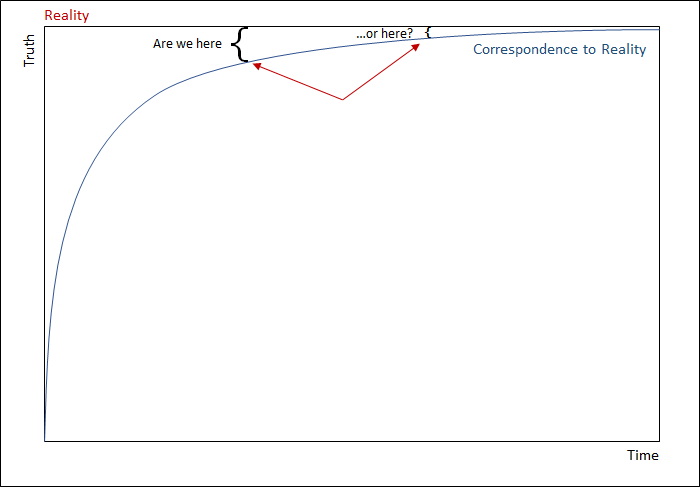
We have no idea how close or far we are from Reality on the Y (Truth) axis.

Graph: Correspondence of Truth to Reality (Asymptotic Curve)

Assuming for the time being that there is an approachable truth, we have no reference to understand how close to reality we might be. In practice, we seem to operate on a basis of always being within some level of statistical significance of where Truth = Reality, and when new information is introduced, we say, “Hooray for Science!” Aren’t we glad that science is self-correcting. And Empiricism has its own issues.

Historically, we’ve had ‘wrong’ correspondence between Truth and Reality, but then we got it ‘right’—until we didn’t.

We may all know how Einstein progressed and refined Newtonian physics. What Einstein did is to create a new narrative—a synchronous shift of paradigm and rhetoric—, which has been accepted into a new orthodoxy. In our mind, this feels like progress. How close are we to the real truth?

Taking our understanding of gravity or of the fabric of space-time, we still have no idea what’s going on or how it operates, but this doesn’t prevent us from accepting it as a black box and making pragmatic predictions from there. So, for all intents and purposes, the ‘truth’ mechanism is less important than the functional relationship, just as I can tell time on a watch I have no idea how it operates.

Rorty on Truth

2–4 minutes

To a comment on Death of the Metanarrative, I responded about the notion of truth relative to the map and the terrain. Although my rambling response was lengthy, I thought I’d share Richard Rorty’s view on this from his Contingency, Irony and Solidarity. According to Rorty, rationalists and empiricists turn claims about the world into the world—convincing others that a map of the world is the world.


We need to make a distinction between the claim that the world is out there and the claim that truth is out there.

—Richard Rorty

“We need to make a distinction between the claim that the world is out there and the claim that truth is out there. To say that the world is out there, that is not our creation, is to say, with common sense, that most things in space and time are the effects of causes which do not include human mental states. To say that truth is not out there is simply to say that where there are no sentences there is no truth, that sentences are elements of human languages, and that human languages are human creations.


Truth cannot be out there—cannot exist independently of the human mind—because sentences cannot so exist, or be out there.

Richard Rorty

“Truth cannot be out there—cannot exist independently of the human mind—because sentences cannot so exist, or be out there. The world is out there, but descriptions of the world are not. Only descriptions of the world can be true or false. The world in its own—unaided by the describing activities of human beings—cannot…

“The world does not speak. Only we do. The world can, once we have programmed ourselves with a language, cause us to hold beliefs. But it cannot propose a language for us to speak…

“It was Nietzsche who first explicitly suggested that we drop the whole idea of ‘knowing the truth’. But in abandoning the traditional notion of truth, Nietzsche did not abandon the idea of discovering the causes of our being what we are … In his view, in achieving this sort of self-knowledge we are not coming to know a truth which was out there (or in here) all the time. Rather, he saw self-knowledge as self-creation. The process of coming to know oneself, confronting one’s contingency, tracking one’s causes home, is identical with the process of inventing a new language … So the only way to trace home the causes of one’s being as one is would be to tell a story about one’s causes in a new language…

“[O]ne can—fruitlessly, in my view—come at [the question of knowledge] by way of anthropology and the question of whether there are ‘cultural universals’, or by way of psychology and the question of whether there are psychological universals. [There is an] indefinite plurality of standpoints, [a] vast number of ways of coming at the issue sideways … It is central to the idea of a liberal society that, in respect to words as opposed to deeds, persuasion as opposed to force, anything goes. This openmindedness should not be fostered because, as Scripture teaches, Truth is great and will prevail, nor because, as Milton suggests, Truth will always win in a free and open counter. It should be fostered for its own sake. A liberal society is one which is content to call ‘true’ whatever the upshot of such encounters turns out to be.”

Husky Meme – According to this book, I can’t read.